This post was authored by Cisco CSIRT’s Robert Semans, Brandon Enright, James Sheppard, and Matt Healy.
In late 2013–early 2014, a compromised FTP client dubbed “StealZilla,” based off the open source FileZilla FTP client was discovered. The attackers modified a few lines of code, recompiled the program, and disbursed the trojanized version on compromised web servers. This new attack appears to involve the same actors who reused the same techniques to alter the source code of the widely used open source Telnet/SSH client, PuTTY, and used their network of compromised web servers to serve up similar fake Putty download pages. This new campaign is like the StealZilla campaign in almost every way. Continue reading “Trojanized PuTTY Software”
We launched Cisco ONE Software to give our customers a more valuable and flexible way to purchase and consume Cisco infrastructure software.
Since the launch, more than 300 customers have switched to this more valuable and flexible model. If you’re not one of these customers – and you are still asking, “What is Cisco ONE Software?” or “What does it mean for me?” – don’t worry. On Tuesday, May 19 we’ll be holding a web event to get you up to speed. We’ll explain what Cisco ONE Software is and how you can use it to deploy solutions for the Local Access, WAN and Data Center domains.
You can register for the event here. Or, if you’d like to be entertained first, here’s a video you can watch – click on it to access the event registration page.
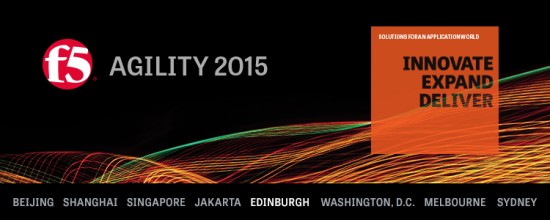
It is a back-back, double-header for me this weekend, as I head from an action-packed week in Orlando to exotic Edinburgh, Scotland for F5 Agility. F5 is Cisco’s premier partner and I can’t wait to be in the thick of action at the Edinburgh International Convention Centre next week. From “you are lucky to be there” to “WoWs”, I am fast becoming the envy of my friends at Cisco. For me personally, it is the second EMEA F5 Agility event, and last year I had a blast at the Bella Center, Copenhagen. These things aside, there is a lot for me to report about Cisco’s participation in this event.
You probably know F5 recently announced a new CEO. F5’s incoming CEO Manny Rivelo in his keynote themed around “Innovate, Expand and Deliver”, will take you on a tour of current market trends, how F5 has grown in market momentum under John McAdam’s tenure, the evolution of the F5 Platform from simple load balancer to ADC to support Cloud based business models, the growing importance of enterprise security, recent F5 acquisitions, and last but not the least the growing eco-system of Partners. I recommend getting started with Manny’s keynote. Manny is also hosting invitation only roundtables to key verticals Retail and financial earlier in the morning, same day. Following Manny, Dean Darwin, Marketing SVP of F5 will deliver F5’s forward looking vision. Dean’s session aligns well with Manny’s keynote in that he will address how to Innovate and continue to be a thought leader, Expand business models (like As A Service) and Deliver customer satisfaction and financial excellence.
There is plenty of excitement Cisco is bringing to this event centred around Cisco’s award winning SDN strategy, Application Centric Infrastructure (ACI) .
Cisco Exec Shashi Kiran is joining F5 Exec Calvin Rowland and fellow Cisco Exec Patrick Schmidt in a panel session May 20. For those of you not familiar with ACI, this panel session is a great opportunity to learn how Cisco and F5 are expanding their partnership, how their combined thought leadership is advancing the SDN landscape, and customer successes and momentum experienced by Cisco ACI, F5’s BIG IP & BIG IQ in the marketplace. The panellists are seasoned industry experts and I promise it will be a treat to the attendees.
If you somehow missed the panel session, there is room to cheer. Shashi is hosting a breakout session the next day, May 21, 11.30 local time. What’s unique about this Breakout Session? Well, you will get to not only hear Shashi eloquently walk you through the role of Cisco ACI in today’s Application-Oriented Economy, but also see customers and partners join him on stage and share their success stories with ACI. Shashi will discuss how emerging applications are placing huge demands on Data Center Infrastructure and how grossly unprepared they are to meet the same. Shashi will then introduce Cisco ACI, an open, scalable, programmable SDN solution that helps address these infrastructure challenges. Shashi will illustrate how Cisco’s open architecture enables seamless integration of F5 into ACI’s policy framework and how the joint solution brings unprecedented agility and end-end L2-L7 accelerated application delivery. Shashi’s breakout as I said earlier, also features a unique Customer and Partner segment towards the end. Martin Lipka from Pulsant corporation and Stefaan Hinderyckx from Dimension Data will join Shashi on stage to share their ACI experiences. How often do you get this comprehensive experience in a breakout session, one that is devoid of a sales pitch. Sounds great, doesn’t it?
That is not all. Cisco ACI brings you additional customer engagement opportunity in the solutions expo hall. We are featuring cool demos showcasing our joint solutions namely, ACI-BIG IP and ACI-BIG IQ on both May 20 and 21, during the entire duration of the expo hours. Stop by the Cisco demo booth to get a personal walk-through of our solution working. Our product experts are available to engage you in white-board type sessions and to compliment the demos, we also run short duration presentations in the Cisco theatre at periodic intervals. Should you desire, we are happy to meet you in 1-1 meetings, so let us know how we can enrich your experience at the event.
For all the hard work we all do at the event, there is plenty F5 offers to let us relax and enjoy. The evening event on May 20 allows attendees to step back to a time of knights and ladies, including one of Scotland’s most famous royals – Mary Queen of Scots.
Agility attendees will have the ability to see all that the castle has to offer, from Mons Meg, one of the largest cannons in the world, to the huge collection of weapons and armoury in The Great Hall, the Stone of Destiny and the Royal Palace Crown Jewels. Network with your fellow attendees while enjoying tasty food and drink, entertaining music, knowledgeable guides, and more are awaiting you on Wednesday 20th May.
I am eager to see you all in Edinburgh next week. There are some useful links for you to check out before your visit on how Cisco ACI and F5 work together on the innovation front.
OpenStack summit Vancouver has arrived and I for one can’t wait to see how much OpenStack has progressed from Juno to Kilo. I expect to see even more momentum with new companies being added to the OpenStack community, continuing to drive the industry acceptance momentum of OpenStack. While a lot of good stuff is happening from a functionality (features) and new projects standpoint, being able to systematically measure performance across the major components still remains largely a work in progress. While Nova (Compute) and Swift (Object Storage) continue to mature rapidly with good work being done by many in the OpenStack community around performance measurement, Neutron (Networking) continues to lag.
Prior to the Juno summit in Paris last November, there was intent in the OpenStack community to move away from Nova networking onto Neutron where there is significantly more functionality and scale to be had. But there are many challenges that are preventing this migration from happening. Primary among those challenges is the inability to easily measure performance on Neutron to ensure that there isn’t significant performance degradation as a result of the move from Nova networking to Neutron. Cisco is proactively addressing the gap of performance measurement on Neutron by releasing in Stackforge an open source data plane performance measurement tool called VMTP (VMThroughput Performance). It is heartening to see that others in the community are also providing tools for data plane measurement such as the recently released “shaker”. Continue reading “Addressing data plane performance measurement on OpenStack clouds using VMTP”
#CiscoChampion Radio is a podcast series by Cisco Champions as technologists. Today we’ll be talking about securing ACI with Cisco Technical Marketing Engineer Carly Stoughton.
Learn about the Cisco Champions Program HERE.
See a list of all #CiscoChampion Radio podcasts HERE. Ask about the next round of Cisco Champions nominations. EMAIL US.
Cisco SME Carly Stoughton, @_vCarly, Cisco Technical Marketing Engineer
Ensuring application experience at the branch is a daunting task. IT must look beyond traditional WAN challenges (like bandwidth, transport type, and speed) to applications experience. As time-to-market becomes a pillar of enterprise’s competitive advantages, application experience is key to ensuring fast service and high customer satisfaction.
In today’s connected world, users demand instant connectivity and seamless experience. As the business innovates, the burden on the WAN intensifies, yet three-fourth (75%) of today enterprises say their bandwidth budget will remain flat[1]. IT knows this, and they plan ahead. They evolve their network into a hybrid WAN (see Figure 1), utilize the latest technologies, but application performance still suffers. Why?
Cisco Systems is announcing a new set of features that enhance its HDX (High Density Experience) suite. This blog is the second in a series that explains the new features that comprise the enhancements to HDX.
5 GHz is a great place to operate a WLAN. There is ample spectrum, and it’s far less crowded and noisy than 2.4 GHz.
However, the majority of 5 GHz spectrum is shared with radar (for both weather and military systems). Therefore, Wi-Fi Access Points not only need to detect radar in order to avoid interference but also need to avoid being an interferer to these systems.
For DFS operation, if radar is detected on a channel then the AP must abandon that channel from further operation for some minimum amount of time. Furthermore, the AP must ensure that any new channel it selects for operation is free from radar (and that detection also requires a minimum amount of time).
Finally, accurate detection of radar (i.e., avoiding false positives) also requires a lot of skill. Compounding the issue are many devices that emit “radar like” transmissions (including Wi-Fi clients and APs doing proprietary over the air detection and calibration).
As a result, many equipment vendors simply take the easy way out and avoid use of the channels requiring DFS.
Last month, I had the opportunity to attend and present at the 2015 North American IPv6 Summit. Several hundred IPv6 experts and networking professionals attended from across the country to discuss the IPv6 adoption, hear about the latest IPv6 research and learn what others are doing to prepare for the transition to IPv6.
To refresh, IPv6 is the next-generation Internet Protocol (IP), the communications protocol that provides identification for computers on networks and allows computers to talk to each other. The existing Internet Protocol, IPv4, has a finite number of IP addresses, limiting the number of devices that can be given a new address. In fact, the free pool held by the Internet Assigned Numbers Authority (IANA) was depleted in 2011 and the American Registry of Internet Numbers (ARIN) has less than 3.5 million IP addresses left, a supply so small it could be completely exhausted by June of this year. IPv6’s large number of new IP addresses make it a foundational building block for the future of the Internet, especially as increasingly more devices become connected as part of the Internet of Things (IoT).
U.S. Government Should Lead
It’s not just that government agencies should be migrating to IPv6 themselves, it’s that they should be leading that charge given our history. Public Internet was born through the U.S. government, and as Internet leaders, we need to continue to be at the forefront of the Internet’s evolution. Currently, Belgium is leading the world in IPv6 capability with 49 percent adoption. By comparison, the United States is at 35 percent.
The U.S. government has issued several mandates and deadlines to facilitate the IPv6 migration among agencies. The most recent one in 2014 called for all government agencies provide IPv6 connectivity to their user community. However, despite the mandate deadlines, many government agencies are struggling to make the switch. Out of over 1,200 federal agency websites, less than 500 are IPv6 enabled. It’s time for the U.S. government to start leading this necessary transition.
Why Migrate Today?
Beyond simply providing more IP addresses, there are business benefits to transitioning for both private and public sector organizations. IPv6 will enable organizations to take advantage of numerous opportunities presented by IoT and the Internet of Everything (IoE) – the networked connection of people, devices, data and processes. For instance, future Bring Your Own Device (BYOD) policies need to be IPv6 enabled as new devices will automatically be IPv6 connected. Further, IPv6 will allow agencies to achieve value from future connections to help optimize business functions, support mobile workforces, improve security and enhance citizen services.
There will be an estimated 50 billion connected devices by 2020, which means migration is not an option – it’s a necessity given how few IPv4 addresses remain. If your organization is not IPv6 enabled, you won’t be able to connect natively with these new devices. In order improve network operations and processes in the future, private and public sector organizations will need to transition to IPv6.
So, why are some organizations and agencies putting off migrating? Simple – because change is scary. Organizations have been managing the legacy protocol for over 30 years, and there is uncertainty that comes with transitioning to something different. Also, many don’t fully understand the big picture benefits. By getting hung up on potential deployment challenges, IT managers and network engineers overlook the fact that their organizations won’t be able to leverage the power of IoE tomorrow unless they start transitioning to IPv6 today.
Create Your IPv6 Transition Plan
So what can government do to start leading the switch to IPv6? Below are five key steps to migrating to IPv6:
Identify the business value and impact.
Create a project team of IT professionals, technical business owners and an assigned project manager to manage progress and address any outstanding issues.
Engage in assessment of equipment and assets for infrastructure readiness.
Develop architectural solutions.
Test, monitor and deploy IPv6.
As an industry leader in IP technology and pioneer of IPv6 technology since its beginning in 1996, Cisco is well positioned to assist government in this process from beginning to end. We have experts that can help your organization walk through each step above; from evaluating IPv6 readiness to offering deployment services, our IPv6 can expertise has helped organizations save time, money and resources. In addition, we have the widest range of platforms and features for IPv6 compared to any other vendor, which enables us to provide customized solutions sets to meet the needs of customers.
Ultimately, IPv6 is the global plan of record for a sustainable, scalable Internet, and public sector organizations need to migrate to continue improving operations and meet citizens’ needs. Click here to learn more about the IPv6 transition and how Cisco can help.
Over the last couple of years, Data Centers have become a key focus on networking innovations, particularly around the broad area of Software Defined Networking (SDN). At Cisco, for nearly one year, we have been shipping our new way to build a Data Center with our Application Centric Infrastructure (ACI) solution. ACI relies on the vision of using a policy based methodology to enable network switches, services, and hypervisors to establish network connectivity among each other.
At the Open Networking User Group (ONUG), a survey reports that 3% of the networks run by ONUG members are built on open networking whereas 71% are not open at all. The assessment of any system being declared “open” is a subjective term. At Cisco we have built a foundational infrastructure in ACI, that relies on open protocols and programming constructs such as APIs, in order to provide a solution where the network becomes ‘invisible’ to the end user, and the network devices and services modules, such as firewalls, load balancers, physical and, virtual switches are automatically configured based on the end user intent. Continue reading “Open Networking with Cisco ACI and Open NX-OS”











 #CiscoChampion Radio is a podcast series by