So, you’ve decided to introduce a collaboration solution to your organization. You’ve thought about the benefits you want it deliver: flexibility, expandability, and interoperability. And you want the user experience to be easy enough for everyone to use — not just the engineers or executives.
Great. You are on the right path. But what next? Now it’s time to become familiar with the components that make it all work.
Cisco has created a collaboration core infrastructure that provides the intelligence behind the experience. It powers the industry’s leading collaboration portfolio, which includes flexible cloud services and endpoints to fit any need or budget.
The Cisco Collaboration core infrastructure has four key components:
Remember your first compact disc? Maybe yours was a music album like Billy Joel’s “52nd Street” or Bruce Springsteen’s “Born in the USA.” Or maybe your first compact disc was the CD-ROM, used to download the first application to your brand new computer. The jewel case made your CD look far more valuable than the price you paid. CDs were the future. Audio cassettes were a thing of the past.
Today, if you say the words “compact disc” to anyone under age 20, you get a strange look, and usually hear “What is a Compact Disc?” The introduction of MP3 players in the early 2000s gave consumers easy access to music, allowing them to share and download files to multiple devices with a few simple clicks.
Today, consumers also have easy access to downloadable software, images, and product licenses. They don’t need one more CD to collect dust in their office. CDs are a thing of the past.
https://youtu.be/n1yuFRFRR7s
Cisco understands our customers desire for fast, electronic fulfillment of software, licenses, and documentation. Our Supply Chain’s eDelivery program is not only delighting our customers by reducing physical software, licenses, and product documentation that ship with our product hardware, we are reducing Cisco’s environmental impact as well.
eDelivery is reducing software order lead times from weeks to less than 6 hours. eDelivery provides fast, reliable, and secure delivery, reducing logistics for our partners and customers. In Fiscal Year 2014, the eDelivery program saved over US$8 million, a 75% increase over the previous year. Additionally, eDelivery saved 904 metric tonnes of CO2 emissions, or the equivalent of 2.15 million miles driven by a passenger vehicle. That’s impact multiplied!
[Note: This is part 1 in a three part series of blogs discussing how Cisco ACI stands alone in the market. Part 2 | Part 3]
Customers are bombarded by network virtualization and SDN technologies. In many cases, they are conflicted by vendor claims and marketing hype. Rob Lloyd, president of Cisco Systems highlighted some of that in his blog ACI or NSX.
In this blog and subsequent blogs, we’ll expand on Rob’s blog and provide more color on ACI differentiators compared to competing network virtualization solutions.
1) ACI Simplifies Diagnosis of Slow email AccessIn this episode, Joe Onisick highlights a scenario where IT received complaints from users experiencing slow email access and timeouts sending email with large attachments. As a network admin, going about debugging this type of complaint to determine the root cause can be time consuming and cumbersome especially in a mixed environment of physical and virtual applications.
With ACI, the debugging process can be simple and quick with real-time visibility into the fabric. By examining the healthscore dashboard and email app profile from a central managed location, APIC, a corrective action can be taken quickly.
In this case, they can easily see that a new tenant is introducing data into a Hadoop cluster running on the same infrastructure neighboring racks, which has created a hotspot on the fabric that is impacting the email platform. The vAdmin can modify the fabric policy to enforce a QoS setting that quickly fixes the problem.
Correlating the problem would have been difficult with competing network virtualization solutions because the physical network admin would have not found an easy way to identify the email traffic vs. other types of traffic, nor to spot the place of hotspot or reason.
Joe Onisick shows us this all in detail in this whiteboarding video
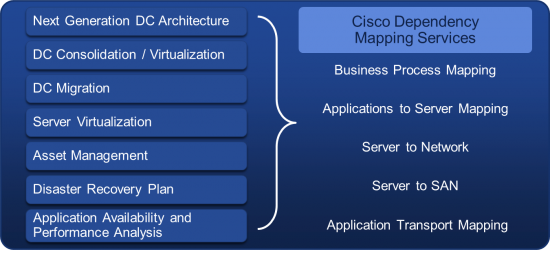
Earlier this month, I blogged about the challenges of Cloud Sprawl. Let’s now turn to the challenges of “Application Sprawl”!If you are planning migration of applications inside or between data centers, or if you are planning a migration to Cisco Application Centric Infrastructure (ACI), the understanding of your applications and how they tie to the underlying infrastructure will be top of mind.
If you are not sure precisely what infrastructure you have in your data center, if you are not sure exactly how many application instances are running in your data center, and what the component workloads are, if you are concerned about whether your network design best serves your application estate: you are not alone!
Let’s be honest, many organizations are in this position – so read on to find out more on how the Cisco Application Dependency Mapping Service will help you! And we’ll tell you more about some exciting technology we’re incorporating to help understand the application landscape, and your associated software costs, via automated analysis coupled with the expertise of Cisco Services consultants.
Cisco Application Dependency Mapping Service – Key Use Cases
At the recent Gartner BI Summit in Las Vegas, there was a lot of discussion about the paradigm shift underway in business intelligence (BI) and analytics. Business’s need for agile data access and self-service, combined with IT’s inability to satisfy this need, is causing disruption to traditional models and shifting the balance of power from IT to the business.
While that is certainly true, it is not a new phenomenon. In fact, it has been building for more than a decade.
We’ve introduced several of the key figures within Bit Stew and shared with you the ways they are working to bring the IIoT to fruition, particularly within the energy sector.
I had a chat with Kevin Collins, CEO of Bit Stew to discuss the next opportunities for the company:
“It’s an exciting day at Bit Stew, with the announcement of additional funding from Cisco Investments and GE Ventures. With this support, we will continue to bring our experience in managing massive data sets and optimizing edge and fog computing to automate industrial operations in utilities and other industries as well.”
Kevin told me that the new funding will help fuel Bit Stew’s ongoing technology innovation and customer adoption: “This investment will open doors to new market opportunities for Bit Stew, and positions the company as a global leader in Software Defined Operations for IIoT. Bit Stew has quickly become the hot company to watch”.
Bit Stew was recently recognized to Greentech Media’s prestigious Grid Edge 20 list, as one of the top 20 innovators architecting the future of the electric power industry, along with Tesla, Duke Energy and SolarCity. “Making the Grid Edge 20 provides validation of our strong market traction, and is a tribute to what we’ve achieved since Bit Stew was incorporated in 2009. It also serves as a reminder of the responsibility we have to our utility customers, partners, and the industry as we work towards transforming the power sector to one that is more efficient, reliable and agile.”
Purpose-built for the Industrial Internet
The MIx Core platform is the culmination of years of industry-hardened machine learning derived from trillions of data points analyzed throughout the utility and oil and gas industries. Purpose-built for the Industrial Internet, MIx Core processes and analyzes greater volumes of data than most of the largest social networks in the world every day.
Bit Stew’s MIx Core takes full advantage of Cisco’s IOx technology, by embedding its core technology inside Cisco fog devices, providing data analysis at the edge of the network and in cloud-based systems – all in real-time. Running MIx Core in the “fog” brings a significant new advantage for organizations that are dealing with massive amounts of data running on complex networks in the IIoT
“Bit Stew’s collaboration with Cisco and the synergy between our Mix products and Cisco’s IOx platform has allowed us to utilize fog computing to completely revolutionize the way the energy sector operates,” Kevin said. “By using the edge of the network in the computing and analysis process, together we can create instant intelligence that is shared simultaneously in the operations center and in the field. This contextual analysis of industrial operations enables decision-making with a confidence that wasn’t necessarily available before. This expanded awareness results in increased up-time, faster issue resolution and optimized dispatch of resources,” adds Kevin.
Containers just might be the hottest technology in the business and quickly becoming a focal point within the OpenStack community and several members of the OpenStack team here at Cisco have been very involved. Daneyon Hansen and Steven Dake have helped me give a quick look at how Containers and OpenStack are coming together.
Two container-focused OpenStack projects, Magnum and Kolla, have evolved significantly through the Kilo development cycle. Kolla formed shortly before the Kilo Design Summit, while Magnum was created shortly afterward. Both projects use Docker for containers, but leverage the technology for different purposes. Magnum is a Container-as-a-Service (CaaS) system, allowing users to build and run container-based applications in OpenStack clouds, while Kolla’s mission is to simplify the OpenStack operational experience.
Kolla improves OpenStack operations by containerizing OpenStack into micro services and providing additional tooling to simplify management. Containerizing OpenStack services improves operations such as providing deployment consistency, simplified upgrades, portability, scaling, etc.. These capabilities are achieved by encompassing the entire application runtime for each OpenStack service into a lightweight, portable unit. Each micro service becomes an atomic unit of management such as deployment, upgrading, scaling, etc. Kolla was developed as an integration project, allowing other tools such as TripleO, Heat, Ansible, etc.. to manage OpenStack at scale using Docker containers.
Magnum is an API service developed for OpenStack to make container management tools such as Docker, Kubernetes, etc. available as first class resources in OpenStack. Magnum uses Heat to orchestrate an operating system image that includes the container management tools and runs the image in a Nova instance cluster. Magnum is meant to launch a minimalistic host operating system such as Fedora Atomic, CoreOS, or Ubuntu Snappy. The operating system includes enough tools to launch Docker, Kubernetes, etc.. Once the operating system is launched, Magnum configures the clusters to run a Container Orchestration Environment for multi-tenancy.
Today, Microsoft has released their monthly set of security bulletins designed to address security vulnerabilities within their products. This month’s release sees a total of 13 bulletins being released which address 48 CVEs. Three of the bulletins are listed as Critical and address vulnerabilities in Internet Explorer, GDI+ Font Parsing, and Windows Journal. The remaining ten bulletins are marked as Important and address vulnerabilities in Microsoft Office, Sharepoint, .NET, Silverlight, Service Control Manager, Windows Kernel, VBScript/JScript, Microsoft Management Console, and Secure Channel.
South Island School in Hong Kong is made up of students from around the world with 1,400 students from over 35 countries. One value that sets the school apart is its commitment to using technology in the classroom. For instance, all students have a laptop that they use to access e-books, watch educational videos, and complete homework assignments. Some exams are even taken digitally.
With wireless devices used daily by every student and faculty member, a stable network connection is almost as important as pencil and paper in classrooms. South Island School’s existing Cisco network had reached end of life, and the school needed to refresh the infrastructure with a network that could meet bandwidth needs for years to come.
“We looked at other vendors, but we were extremely impressed with how the existing Cisco equipment performed over the years,” says Victor Alamo, ICT manager at South Island Schools.
“By upgrading to the latest Cisco access points and switches, we’d have an infrastructure that would keep up with our needs.”
South Island Schools updated their network around the Cisco Aironet Access Points which supported the latest Wi-Fi standard, 802.11ac. This along with Centralized management with support for converged wired and wireless networks allowed South Island Schools to keep their students and teachers connected with reliable and fast service.
These changes resulted in stable wireless connections for thousands of wireless devices which enhanced classroom work with video, applications, and sharing providing a better user experience for both students, teachers and administrators.