Avatar

Today, I am pleased to announce that we will be showcasing the  Cisco Intelligent WAN (IWAN) Application for the APIC-EM controller with early adopter customers at Cisco Live San Diego next week. For those of you familiar with Cisco’s SDN solutions, the APIC-EM builds on Cisco’s ACI architecture to extend Software Defined Networking from the Data Center to the WAN and Access areas of your network.

Before diving into the IWAN App, you might be wondering what is “Software Defined Networking for the WAN” or “SD-WAN” is. The simple answer is that the same benefits that SDN brings to the Data Center can be applied to the Wide Area Network. SDN for the WAN is all about moving from feature by feature configuration to policy and intent driven management. Benefits achieved include reduced costs to operate the WAN and optimize bandwidth. It’s about improving your application experience, enabling digital experiences in your remote branches, and enabling you to move to cloud based applications without giving up on application performance. Finally, it’s about WAN resiliency. Crucially, you must achieve all of this while maintaining end-to-end security and this requires enhancing security capabilities.

Sounds like a lot? It is, and that’s why we (and most of the industry) are so excited about the changes happening in the WAN. To boil it down, as I talk to customers about evolving their WAN architecture to meet the growing bandwidth and performance demands generated by mobile devices, digital stores, cloud based applications, and IoT sensors – to name a few – customers are focused on a short list of business outcomes:

  • Greater business agility with faster application delivery
  • Reducing costs with simplified operations and management
  • Improving business continuity with high availability and resiliency

If these business outcomes sound familiar it is because we are addressing them today with our Intelligent WAN Solution (IWAN) and have been talking about them for the past few years. What’s unique about Cisco is that we have built IWAN to be integrated with our industry leading ISR and ASR 1000 routers while many others have chosen to go with a pure overlay. By combining the strengths of IOS XE software with rock solid hardware to provide detailed visibility across all layers of the network, the Cisco IWAN solution has a much more intimate understanding of network conditions and can make better and faster decisions about how to direct traffic over the WAN. IWAN also retains all of the inherent resiliency, security, and self-healing aspects that routing protocols were developed to provide. Combine this with Cisco’s industry-leading security portfolio as well as our end-to-end vision for policy based infrastructure (ACI) and we have a solution is pretty hard to beat. Continue reading “Bringing Software-Defined Networking to the WAN”

Authors

Jason Rolleston

Sr. Director of Product Management

Cisco's Connected Mobile Experience (CMX)

Avatar

We’ve come a long way since the first mobile devices hit the network. Our use of these devices has evolved beyond basic tasks such as checking email. They help us collaborate in real-time, stay healthy, directly connect with our favorite things, and even find true love.

Today, mobility is driving the future of digitization.

As mobility continues to permeate many facets of life, there will be a landslide of new connected devices beyond the smartphone and tablet — think wearables, sensors, and other “things” that we have yet to imagine. And with them, there will be an increased demand for speed and bandwidth from the network.

 https://www.youtube.com/watch?v=cWByHu9CpUU

So how does IT prepare for the next wave in mobility? At Continue reading “Building the Foundation for the Next Wave in Mobility”

Authors

Rad Sethuraman

Senior Director of Product Management

Mobility Services

Avatar

Have you ever suffered phone envy in the office? You stroll by someone’s desk and notice that they have a better, newer, cooler desktop phone than you do? Maybe it’s one with a smooth sleek design, embedded video capabilities, and a higher-resolution display. If so, now might be a good time to raise your hand and ask for a new phone. We are introducing two new video phones to the IP Phone 8800 Series, which we’ve built to scale across your organization.

Next week at Cisco Live in San Diego, we will showcase the 8845 and 8865 IP Phone models. The new phones deliver the great experience you expect from the 8800 Series with addition of 720p HD video capabilities — at a great price. The new models also have advanced features that go beyond video, such as Cisco’s Intelligent Proximity for Mobile Voice, which provides telephony feature integration with your personal mobile devices. It’s all about enabling you to work your way.

8800 blog image
Cisco IP Phone 8845 and 8865*
8800 blog image 2
Cisco IP Phone 8845 and 8865*


These new phones round out an exciting phase of innovation on the desktop for Cisco. This time a year ago,

Continue reading “Say Hello to Our New Advanced Video IP Phones”

Authors

Angie Mistretta

Chief Marketing Officer, AppDynamics

AppDynamics

Avatar

I’ll be the first to admit that I am not a cloud expert by any means: not as a private pilot or marketing professional working in high tech..

But I do know this

Cloud computing can be intimidating – just as real clouds are intimidating to any general aviation pilot looking to fly from point A to point B under visual flight rules (VFR). In aviation it’s simple: avoid them.

Screen Shot 2015-06-01 at 1.01.39 PM

Atlantic Ocean out my window flying over RI – March 2015

Continue reading “Dinner as a Service (DaaS) – or a just better path to the cloud?”

Authors

Adrian den Hartog

Senior Marketing Manager

Field Marketing US Commercial

Avatar

Recent economic analysis by Cisco (http://internetofeverything.cisco.com/) reveals that the Internet of Everything is a $4.6 trillion opportunity for global Public Sector organisations (e.g. Government, Healthcare, Education) over the next decade. This is the result of cost savings, increased productivity, new revenues and the enhanced citizen experiences it will bring.

A sound Big Data strategy will allow Public Sector organisations to capture this value by:

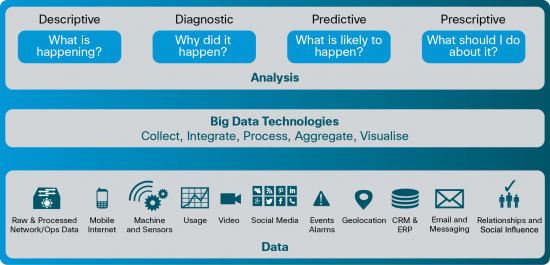
  1. Prioritising the key use cases – gaining insight through descriptive, diagnostic, predictive or prescriptive analysis.
  2. Deploying the right technology – to collect, integrate, process, aggregate and visualise information.
  3. Connecting the previously unconnected – from sensors and databases to usage patterns and social media.

Big Data - elements

Many Public Sector organisations have announced their “Big Data strategies” but then failed to deliver the results… why?

Typically, there are three reasons:

  1. The focus is put on the technology to deploy, which is often the wrong one, rather than key use cases.
  2. The right technologies are deployed for each use case, but there is no common platform architecture. As each solution is in its own silo, it’s not scalable and is costly.
  3. Data sources are not standardised or interoperable so it’s not possible to correlate data sets and generate new perspectives.

A team at Cisco of Big Data specialists and experts on government have put together a white paper to analyse how Public Sector organisations can best use Big Data to create Value for Society. In this white paper, you will discover:

  • Some of the most relevant use cases for the Public Sector
  • How to build a future-proof platform that will evolve with your needs
  • Why you should consider Cisco for your Big Data projects

Please download the white paper:
Big Data in the Public Sector: Turning Bytes into Valuable Information for Society

Looking forward to your comments.

Authors

Patrick Bikar

Global Systems Engineer Transformation Programs Lead

Global Systems Engineering

Avatar

On May 25 2015, I had the honor to participate on a panel on Digital Inclusion of Women for Gender Equality at WSIS 2015, held in Geneva, Switzerland:

Women with varying backgrounds from all parts of the world, passionately discussed the opportunities to advocate for change both in the industry and in government.

IMG_0477

Questions for all of us to posit may be the following: Continue reading “Advocating for The Internet of Change”

Authors

Monique Morrow

CTO-Evangelist

New Frontiers Development and Engineering

Avatar

Today, enterprises need greater business agility and faster time-to-market for applications. That’s why, in many instances, they are building their own private clouds or adopting on-demand private cloud. Companies that are most suited to building their own private clouds are those that have deep engineering and IT leadership and need strong security and governance around applications and services.

Depending on the needs of the business and core competencies, other types of companies can benefit from a managed private cloud. For these companies, it’s not core to the business to be great at infrastructure, but it is crucial to be able to focus on the services offered on top of the infrastructure. These types of organizations may not have strict regulatory or data sovereignty requirements. Typically, they gain the most advantage from using managed private clouds.

Continue reading “On-Demand Private Cloud: How to Cut CapEx, Free Up Resources, and Boost Business Agility”

Authors

Kenneth Owens

Chief Technical Officer, Cloud Infrastructure Services

Avatar

TDM transport remains the backbone of service provider networks throughout the world, but technology has matured to the point that we’re finally able to see a path toward truly converged, packet optimized transport networks. This shift puts service providers on a plan to eventually retire their SONET/SDH infrastructure, saving significant space, power, and other operational costs. For end users, it promises bandwidth flexibility and an even easier ability to tap into cloud-based applications.

Of course, such a change won’t happen overnight but will take time to ensure existing customer services aren’t affected in terms of the performance, latency, and availability.

While there has been a lot of talk about the technologies to enable IP and optical convergence — such as timing-over-packet standards and cost-effective circuit emulation — that’s just part of the solution. Just as important are the operational aspects as we converge (or “packetize”) networks, but how are we going to manage them? That’s the reason behind Cisco’s new Evolved Programmable Network Manager software, or EPN Manager for short.

https://www.youtube.com/watch?v=9H8al8MZa9A

EPN Manager, along with Continue reading “Cisco EPN Manager Helps Carriers Drive Packet Optimized Transport”

Authors

Greg Smith

Sr. Manager, Marketing

Cisco Solutions Marketing

Avatar

Over the last three years at Cisco, we’ve accomplished incredible things amidst an unbelievably dynamic time in our industry. During this period, we’ve delivered industry-leading innovation and increased our relevance with customers, and transformed Cisco. Our Presidents, Rob Lloyd and Gary Moore, have played a significant role in driving these results. Thanks to their vision, we have the strong foundation that will allow Cisco to lead in the digital age.

As I transition to the role of CEO, my focus areas are acceleration, simplification, operational rigor and culture. These will be the foundation for Cisco’s continued evolution that will position us for the future. The moves we’ve already made as a company in the last three years in Engineering, Sales and Services were designed to deliver innovation with speed and meet the needs and expectations of our customers.

To drive our continued success and leadership, our organization structure must always evolve as the market changes. Today I am announcing that at the end of this fiscal year, Rob and Gary will be leaving Cisco. They will remain in their President roles until July 25th. Going forward, we will move to a flatter leadership team designed for the speed, innovation and execution that is required of us over the next decade.

Rob and Gary have provided tremendous leadership for Cisco. I believe that one of their greatest achievements is the breadth and depth of the leadership team they’ve helped build. They are both deeply passionate about developing great talent. I am confident that many of those world-class leaders they’ve recruited and mentored will no doubt lead Cisco into the future, and for this I’m incredibly grateful.

Continue reading “Leadership Transitions for the Digital Age”

Authors

Chuck Robbins

Chair and Chief Executive Officer

Cisco Systems, Inc.