Avatar

As you may have heard by now, I have decided to leave Cisco at the end of July to begin the next chapter in my career.

After nearly 21 years of riding this rocket ship called Cisco, my mind is filled with the amazing experiences I have had around the world with colleagues, business partners and customers. Together, we have harnessed the incredible power of the Internet to change the world.

I have had so many memorable and proud moments during these past two decades thanks to the opportunities that Cisco presented to me and to my family. So humor me here, and join me, while I reflect back on just a few of them. To all of you who were part of these, I hope you realize how much I appreciate your friendship.

The fun all started when I joined Cisco Canada in the fall of 1994 as President and General Manager. I inherited a small team of 40, with lots of open headcount requisitions, and was quickly amazed at how this powerful small team effectively served customers as the convergence to IP accelerated. I remember the closed-door meetings talking about “Project Symphony”, the program that led to the introduction of the Catalyst 5000. Following several acquisitions of Ethernet switching companies, Cisco established the switching juggernaut that it has maintained for almost two decades. We also acquired Stratacom, which provided us with some much needed “carrier chops” and helped us become the market leader in the IP-centric service provider market we all recognize today.

Continue reading “Keep Skating to Where the Puck is Going, Not Where it is”

Authors

Rob Lloyd

President, Development and Sales

Avatar

The decision to move on and embark on my new chapter has not been an easy one. I joined Cisco in 2001 because I saw the opportunity to change the world for the better with our technology. My 14 years here have been immensely rewarding because of the friendships I’ve made with so many of you. The last four and a half years, first as COO and then President, have been the most challenging and exciting professional experience any one could hope for in their career.

Looking back at my career here, I am extremely proud of many things. When I joined, John asked me to build a world class services organization that would be best in class in terms of margins, value add to our customers and supportive of our important and vast partner ecosystem. The Services organization I joined to build has grown from $3 billion to nearly $10 billion in annual revenue in 12 years, with among the strongest margins in the industry, and is a key contributor to Cisco’s growth and profitability. Importantly, our partner delivered services represents many billions of dollars beyond that. Culturally, Services has always led with a mindset of customer first and has led the company as we have moved to focus on our customers’ business outcomes.

Continue reading “Next Chapter for All of Us”

Authors

Gary Moore

President and Chief Operating Officer

Avatar

The term “operating system bypass” (or “OS bypass”) is typically tossed around in MPI and HPC conversations; it’s generally something that is considered a “must have” in order to get good performance with many MPI applications.

But what is it?  And if it’s good for performance, why don’t all applications use OS bypass?

Continue reading “MPI newbie: What is “operating system bypass”?”

Authors

Jeff Squyres

The MPI Guy

UCS Platform Software

Avatar

Cisco Systems is announcing a new set of features that enhance its HDX (High Density Experience) suite. This blog is the fourth in a series that explains the new features that comprise the enhancements to HDX.

The first three blogs in the Enhancing HDX series are here and here and here.

The rapid and massive adoption of Wi-Fi into handheld devices has created new challenges for managing a wireless network.

As a consequence, the traditional view of a rogue Access Point has to change. The advent of mobile APs and Wi-Fi Direct (client to client networking without requiring infrastructure) means that rogue devices don’t need to be “connected” to the infrastructure in order to create a potential for nuisance.

Effectively these capabilities mean that “Bring Your Own Device” (BYOD) may also mean “Bring Your Own AP” or “Bring Your Own Network” and therefore “Bring Your Own Interferer”. Thus the threat from a rogue becomes less about security and more about consuming excessive air time (a so-called “spectrum hog”) thus degrading performance in the WLAN. This can be especially troublesome in high density pubic venues but can also be problematic in enterprises.

So in addition to Cisco CleanAir (which mitigates and reports on non Wi-Fi interference) and RRM (which primarily prevents self induced neighboring AP interference via DCA and TPC for the entire WLAN) Cisco is effectively merging aspects of both of these solutions in order to provide improved mitigation of Wi-Fi that is not affiliated with the production WLAN.

Enhancing HDX 1

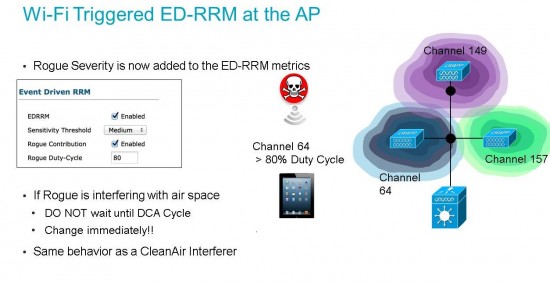
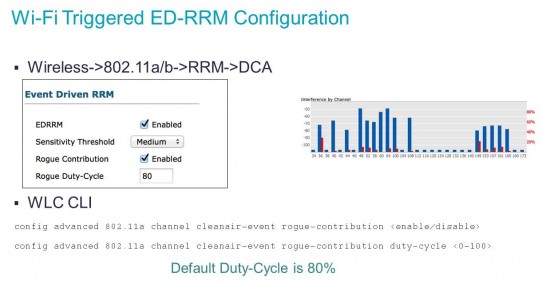
Accounting for rogue Wi-Fi interference is accomplished by configuring a trigger threshold for ED-RRM. This is effectively a severity indicator so that the affected access point that has ED-RRM is additionally triggered by Wi-Fi interference.

Enhancing HDX2

Since rogue severity is now added to the ED-RRM metrics, this provides the capability of a faster channel change than the typical DCA cycle. In other words, if a rogue is interfering with airspace, then instead of waiting until the next DCA cycle to elapse, change the channel as quickly as possible. This is the same behavior as for mitigating non-Wi-Fi interferers with Cisco CleanAir technology.

Since Wi-Fi interference is becoming more prevalent, rogue APs that are serving traffic to clients (e.g., mobile APs) or client devices creating networks in real time means that air quality will be affected. Wi-Fi needs to be prevented from becoming a problem by reacting to the presence of client devices that are legitimately acting as independent, unaffiliated networks.


Please feel free to comment, share and connect with us on Facebook, Google+ and @Cisco_Mobility!

Authors

Allen Huotari

Product Management

RF Excellence and Wireless Innovation

Avatar

Why do I love Big Data so much? It’s because there are endless possibilities to deliver on the Internet of Everything (IoE) opportunity that will create new capabilities, richer experiences, and unprecedented economic opportunities for businesses, countries, and individuals. Analytics is an enormous part of that value creation and is estimated to drive $7.3T of the $19T IoE opportunity over the next 10 years.

Big Data and Analytics take the data created by people, processes, and things – that’s held within the Data Center and at the Edge – and convert it to insights that deliver the truly transformational business outcomes for which we all strive. I’m not talking about ‘iterative’ changes here. I’m talking about game-changing breakthroughs that change the way businesses compete, healthcare teams treat their patients, and cities and governments meet the needs of their constituents.

Cisco has incredible Connected Analytics offerings that address the needs of data streaming at the edge. These offerings are complemented by solutions based on Cisco UCS Integrated Infrastructure and broad ecosystem of Big Data & Analytics Partners.

Big Data and Analytics_McHugh529[1]

Continue reading “Cisco and Big Data and Analytics Partners unveil vertical solutions at Cisco Live”

Authors

Jim McHugh

Vice President, Product and Solutions Marketing

Unified Computing Systems

Avatar

“Mom, is there anything you don’t do well?” That came from Jaden, my twelve-year-old daughter, after a particularly arduous week tackling algebra and a To Kill a Mockingbird essay with a little help from me.

Clearly, I don’t do everything well, but the validation felt really good coming from a kid who I think is pretty extraordinary, herself. I might be slightly biased, but there’s enough evidence for extraordinary that some of my colleagues call me “Tiger Mom.” What they don’t know is that by Amy Chua standards, I would be a deadbeat mom since I only make my kids practice piano 30-45 minutes a day, and sometimes not everyday (gasp!).

Kim N and daughters 2All joking aside, I did ponder why I was the object of such adoration during a time when kids often retreat from their parents. And I believe it’s because I’m able to be around a lot and be present for my kids at their point of need. That’s because the collaboration tools that are essential to my productivity as an employee also give me the flexibility to work from home and still only be a video call away for my kids when I’m not.

The ability to be present at the point of struggle, at the point of discovery, at the point of accomplishment has been key to my close relationship with my children and in their development. But isn’t that true with just about any relationship? Don’t relationships with customers, partners and colleagues also flourish if you can be immediately present at their point of need?

The video collaboration technologies that are designed for faster decision-making, faster time to market and beating the competition are, in my world, really just about connecting people at their core. Continue reading “Video Collaboration and the Present Mom”

Authors

Kim Nguyen

Senior Marketing Manager

Avatar

Cisco Prime WorkFlows for Converged Access are designed to help simplify the deployment of Converged Access architecture quickly and error free. There are 3 WorkFlows  – Small network, Large network and Centralized network deployment.

The focus of this document is deployment of small branch offices using the Single-Switch Small Branch Deployment Model.

Single Switch Branch Overview

The small-size remote branch office or retail store may consist of a single or a stack of Ethernet switches to provide network connectivity to the wired and wireless users. Such small networks can converge the Ethernet switching with next-generation wireless capability on the same Catalyst switch.

For such network designs, the switch can integrate WLC Mobility Controller (MC) and Mobility Agent (MA) functions without requiring any additional Converged Access elements, such as Switch-Peer-Group (SPG) in the network. These networks may need Guest wireless services, as well as common security and network access policy enforcement across all branch offices.

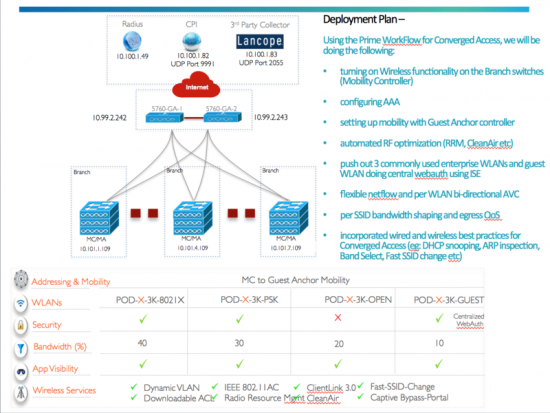
The network administrator can use Cisco Prime Infrastructure IOS-XE Controller Small Network Template to deploy Converged Access. Below figure illustrates reference network design and deployment plan for single switch small branch office network.

image213

The WorkFlow helps deploy the below features. With just a few clicks you can deploy multiple branch networks with all the wired / wireless best practices for Converged Access. Continue reading “Cisco Prime Infrastructure WorkFlows for Converged Access – Single Switch Branch Network WorkFlow”

Avatar

[Note: This is part 2 in a three part series of blogs discussing how Cisco ACI stands alone in the market. Part 1 | Part 3]

In part 1 we talked about how Cisco ACI simplifies diagnosis and enables DevOps Model compared to competing network virtualization solutions.

In this blog we’ll explore two additional critical scenarios that affect network IT teams. We’ll look at it from ACI perspective and compare that to other network virtualization solutions.

1) ACI Provides Proactive SLA Assurance

IT organizations are pressed to track and provide SLA especially for productivity and critical business applications. The challenge is typically around how to actively monitor SLA for specific app and how fast to go about improving SLA in case it drops below certain level?

In this scenario, IT wants the ability to monitor health score for a customer facing app and to be able to correlate performance degradation across the network to locate the problem. With ACI, you get real-time healthscore dashboard as well as built-in intelligence in the fabric to load balance application traffic as congestion occurs to meet SLA requirements. Also, the integration of L4-7 devices with APIC allows fault correlation across loadbalancers and firewalls to locate the problem.

In comparison to competing network virtualization solutions, they are unable to natively demonstrate real-time view of traffic/ application pattern, or automatically load balance traffic in case of congestion or link failure as well as limited integration with underlay to locate cause of problem.

See Joe Onisick explaining this here

https://www.youtube.com/watch?v=Krq-YnC8sVE&index=2

2) ACI Designed For High Application Performance

In the new era of applications that require the highest performance from networks, we’ve seen leaf spine architectures becoming more common to optimize traffic patterns and minimize number of hops that packets traverse the network. So it is important the architecture is able to support both physical and virtual applications without complicated configurations or additional Layer 3 gateways that may impact performance.

In this scenario, users are experiencing application performance problem related to data residing on bare-metal DB server. Let’s look at how ACI architecture will handle this? First, the ACI fabric is automatically discovered and configured thus minimizing amount of time required to bring up switches and configure them. Second, every leaf switch which can be top-of-rack is a Layer 3 gateway for both physical and virtual workloads. Third, all are managed from a central location, APIC. Lastly, every packet is two hops away maximum from its destination within the data center and delivery of small packets won’t suffer in the presence of large packets.

This is unlike what customers may find in competing network virtualization solutions that require additional Layer 3 gateways. The result is likely to have impact on application performance, increased latency, and additional cost.

See Joe Onisick detailing this here

https://www.youtube.com/watch?v=M1qK4qdhX2w&index=1

Tags: ACIapplication networking servicesdata centerproductsSDNtechnologyvirtualization

Authors

Rami Rammaha

Sr. Marketing Manager

IDS

Avatar

The Internet of Everything (IoE)—bringing together previously unconnected people, processes, data and things—opens a world of possibilities in terms of creating new capabilities, richer experiences and unparalleled economic opportunity for organizations, individuals, and nations. Cisco predicts that 50+ billion devices will be connected by 2020. The ramifications are enormous and varied, including how manufacturing plants operate.

The exchange between information technology (IT) and operations technology (OT) is increasing as the industrial plant floor and corporate enterprise become more connected. The convergence of IT and OT is expanding IP Networking and Ethernet connectivity on the industrial plant floor. Understandably, World Bank Studies estimate that 220,000 new engineers are required every year from 2014 to 2022 to connect the unconnected. In addition, there are 300,000 Control Engineers that need to be re-skilled in the industry.

As part of Cisco’s ongoing commitment to equip IT and networking professionals with the knowledge and skills essential to fulfill evolving industry job roles, we have launched the new CCNA Industrial certification. It’s an expansion, due to high demand, of the IT/OT track we began last year with the release of our Industrial Networking Specialist Certification.

Cisco collaborated closely with Rockwell Automation, a company with significant expertise in the industrial automation space, to develop a program to help control-system and traditional network engineers better understand the technologies needed to manage a hyperconnected industrial enterprise. This complements and extends our existing collaboration on products, services, validated architectures, and educational resources to jointly address IT and OT network convergence.

Continue reading “Certifying for the Hyperconnected Plant Floor”

Authors

Sudarshan Krishnamurthi

Head of Business Strategy, Cisco's education services

Cisco Services