
Avatar

Thirty years. What were you doing 30 years ago? Were you graduating from college? From high school? Were you starting your first career? Were you born yet? Thirty years is obviously going to mean different things to different people.

Here at Cisco, we’re celebrating 30 years. Thirty years of technology. Thirty years of innovation. Thirty years of growth. And while it may not have been a part of our original vision to change the way the world works, lives, plays, and learns, we’ve certainly evolved—making that mantra a part of our DNA. We’re also saying goodbye to our CEO John Chambers, who has led us through the last 20 years, and welcoming new CEO Chuck Robbins to carry the torch and lead us into our next chapter.

Our 30 years have not been without struggles or challenges. We’ve seen the rise and fall of other companies. We’ve walked among the giants and startups of the Silicon Valley, a region that has grown into an economic powerhouse for change. And, today—at this moment—we’re not only surviving, we’re thriving.

Our success means more than good things for Cisco. Ultimately, it amplifies our ability to change the world.

Cisco Networking Academy, our longest-running and largest Corporate Social Responsibility (CSR) program, has helped more than 5.5 million people develop IT skills and launch careers since 1997.

Continue reading “What 30 Years of History Means for the Future”

Authors

Tae Yoo

No Longer with Cisco

Avatar

WPC

Next week, Cisco will be “Igniting Opportunities Through Innovation”  at the Microsoft Windows Partner Conference (WPC).  One of the key innovations the team from Cisco’s Insieme Networks and I would like to share at WPC is Cisco ACI for the Microsoft Cloud Platform.  It provides opportunities for  Microsoft partners and system integrators by bringing a new level of flexibility, consistency in control and operations, openness, and security to the enterprise and service provider cloud environment.

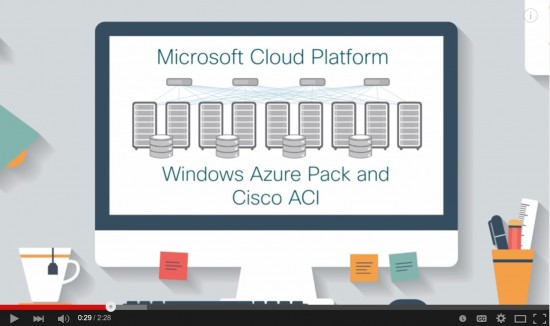
ACI enables new shared tenant services for users of the Microsoft Cloud Platform.  To get a sense, take a look at the 5th video in our little animation series: Winning Together with Cisco ACI and Microsoft Azure Pack.

Cisco ACI Meets Microsoft Cloud

If you are heading to WPC in Orlando, FL next week and would like to learn more, visit Cisco at Booth 1000.  You can request a meeting to learn more about partnership opportunities with ACI by making your request here.

More Information on ACI

http://www.cisco.com/go/aci

Video #1 – An Impossible Deadline

Video #2 – The Needle in the Haystack

Video #3 – Operation Clean Up

Video #4 – Cisco ACI and IT Security Automation Saves the Day

Infographic – Why Choose ACI

Infographic – ACI Ecosystem

Infographic – Cisco ACI for the Microsoft Cloud 2015

Magazine – Unleashing IT ACI Special Edition

Authors

Harry Petty

Director

Data Center and Cloud Marketing

Avatar

As more of the business models in IT shift to a recurring revenue model for products, software, solutions and services, the ability to easily implement, track, manage and renew contracts is critical to maximizing revenue potential. These transitions create opportunities and change for our customers, our partners, and for Cisco.

That is why I am pleased to announce Cisco’s intent to acquire MaintenanceNet, a privately held company providing a cloud-based software platform that uses data analytics and automation to manage and scale attach and renewals of recurring customer contracts.

Since 2009, Cisco and MaintenanceNet have worked together to offer Cisco distribution and reseller partners a simple and automated way to improve service renewals and identify uncovered product opportunities. How does this work? MaintenanceNet’s software identifies customers with service contracts that are coming up for renewal, overdue, or with products that are not yet covered. Their low-touch solution enables automated quoting, notifications, and, in some cases, ordering online. This helps Cisco partners capture high-volume and low-dollar sales opportunities that may risk being overlooked. This streamlined process enables services contract opportunities to be pursued quickly and efficiently.

MaintenanceNet will be joining Cisco’s Global Customer Success (GCS) organization, a group dedicated to improving customer engagement and delivering a coordinated, end to end experience to our partners and customers. This acquisition is a critical component of our strategy for GCS to simplify and digitize our business processes.

Just as MaintenanceNet’s business was built with and through partners, this acquisition demonstrates Cisco’s focus on serving the partner go-to-market strategy and its significant role in our customers’ success. While we have worked together for some time, I look forward to welcoming the MaintenanceNet team into the Cisco family as we continue to innovate and grow our business.

Cisco will pay $139 million in cash and retention based incentives to acquire MaintenanceNet. The acquisition is expected to be complete in the first quarter of Cisco’s fiscal year 2016.

Authors

Debbie Dunnam

Senior Vice President, Global Customer Success

Avatar

Have you heard Weston Jossey explain his company’s hybrid cloud strategy before? If you haven’t, get comfortable and enjoy the recording of our most recent OpenStack Podcast. In it, Wes explains why his company chose to deploy a private cloud, what they use it for, and how they use it in conjunction with AWS to achieve maximum efficiency.  Seriously–if you’re looking for tips about how to do hybrid well, this is the podcast for you. Wes makes it easy to understand both the upside and downside of private clouds in general and OpenStack-based private clouds in particular. Plus, he’s extraordinarily honest about what OpenStack is good for and what it’s not so good for. Among other things, in this interview, Wes discusses:

  • Tapjoy’s big data architecture
  • How they handle 5-10 billion transactions per day
  • The TCO of their OpenStack-based cloud
  • How he finds great hires in a competitive market
  • How Tapjoy automates deployment

https://www.youtube.com/watch?v=KKuGaUSPjuo

Have a show idea? Tweet Jeff and Niki at @openstackpod

See past episodes, subscribe, or view the upcoming schedule on the OSPod website.

To see the full transcript of this interview, click “Read more” below.

Continue reading “OSpod #33: Weston Jossey”

Authors

Niki Acosta

OpenStack Evangelist

Avatar

Almost daily, I work with customers and partners as they develop strategies to gain competitive differentiation through innovative technology. One area bursting with change is the Internet of Things (IoT), which has grown more than threefold in number of deployments since 2012. This is the first in a series of blogs on technology and business factors to keep in mind while considering IoT, beginning with the explosion of IoT access technologies.

The first wave of the Internet focused on enabling human communication. Since the early 1990s, the number of connected devices has skyrocketed from around 1 million personal computers to 15 billion networked devices today. As more and more devices enter the picture, we are developing the key building blocks for the next big wave of the Internet, called the Internet of Everything (IoE)—the networked connection of people, process, data, and things. IoT is a major enabler of IoE, connecting sensors, machines, and other devices.

By 2020, there will be as many as 50 billion connected devices—including cars, buses, trains, office buildings, factories, oil rigs, homes, and entire cities. Some are stationary, some mobile, some have IP addresses, some don’t, some are always on, some intermittent, some are clustered together, some geographically dispersed. This diversity is driving a proliferation of access technologies to connect them. No longer limited to Ethernet, Wi-Fi, and 3G/4G, IoT deployments today also include satellite, Bluetooth LE, Low Power Wide Area Network (LPWAN) technologies such as LoRa, Power Line Communication (PLC), and various Wireless Personal Area Networks (WPAN) such as Wi-SUN. Which technology is best for each situation depends on several criteria: Continue reading “Number of Access Technologies and IoT Deployments Is Skyrocketing”

Authors

Maciej Kranz

Vice President and General Manager

Corporate Strategic Innovation Group

Avatar

Once upon a time, sales and marketing were in love

True, Marketing wanted a long-term relationship and Sales only wanted a one-night stand, but it was clear where everyone stood.

Then, the relationship began to change

With the advent of digital and social tools, buyers – not sellers – stepped into the driver’s seat.  They began using online means to conduct ROI analyses before making final purchasing decisions.  Today, according to Sirius Decisions, buyers are more informed than ever because they’ve got access to online content as well as an extensive online peer network.  And, according to a recent DemandGen Buyer Behaviour report, almost half of buyers create a short-list of potential vendors and one- third conduct initial research on solution options before the first communication with a sales rep.

Marketing started to use tactics that buyers, not Sales, preferred

Marketing started to change too.  As Cisco’s CMO Karen Walker has said, “Marketing was the last function to be industrialised and the first function to be digitised.” With the buyer in control, Marketers started moving away from outbound tactics like tradeshows, live events, and email campaigns that Sales was used to.  We started using digital tactics that matched the buyers’ desire to look for information online using search engines, vendor websites, and social media sites. But neither Sales nor Marketing was happy.  Things got so bad that Hubspot reported:  “87% of the terms sales and marketing teams use to describe each other are negative.”

Enter Revenue Marketing

Like a good marriage counsellor, Revenue Marketing helped Sales and Marketing rekindle their relationship.  In a nutshell, Revenue Marketing ensures that Marketing strategies and campaigns align with Sales and business objectives to generate a measurable ROI to the bottom line.  Using Revenue Marketing principles, Marketing started to transform from a cost centre to a revenue centre. Marketing and Sales began to work in partnership again. And they began speaking the same language – using terms of endearment like planning, forecasts, pipeline, bookings, and revenue.

Back on track:  Smarketing

Today, the romance between Sales and Marketing is back on.  And, like all happy couples, they’re using a pet name:  Smarketing.  Hubspot defines the term Smarketing as “the alignment between your sales and marketing teams created through frequent and direct communication.” We’ve embraced the term and the concept here at Cisco, and here are four lessons learned to strengthen the relationship between sales and marketing.

4 Tips For Smarketing bliss

 1. Speak a common language

It’s important to be on the same page. For example, here at Cisco, Sales and Marketing both know exactly what we mean by terms such as Marketing Qualified Leads (MQL), Sales Accepted Leads (SAL), and Sales Qualified Leads (SQL).

2. Gaze in the same direction

Marketing and Sales must also share revenue goals and strategies.  We have defined how much Marketing will contribute to Sales  – both to the pipeline and to bookings.  We have also articulated what each team will do to support the others’ efforts.

3. Communicate, communicate, communicate

Once you’re on the same page, tune your operational systems to give visibility into results – and refine your processes continually.  At Cisco, Sales and Marketing use common reporting dashboards and hold each other accountable.  Both teams listen and respond to feedback.

 4. Celebrate success hand-in-hand

Now that Marketing can concretely prove its value, both teams can celebrate together. This builds strong team morale.

Smarketing may be a cute term but it has very real ramifications.  In fact, according to a study done by the Aberdeen Group, companies with strong sales and marketing alignment can get 20% annual revenue growth.  Now that’s worth celebrating.

So please raise a glass and join me in congratulating the happy couple.  To….Smarketing!

Authors

Dr. Christine Bailey

Marketing Director

EMEAR

Avatar

What if car ownership was like being a Cisco OpenStack Private Cloud customer?

You’d do your research and buy the car that was right for you. You’d drive it and love it because it was reliable and functional and had all the safety features you were looking for. But then one day you’d walk out to the garage, and BAM–you’d find that you’ve got heated leather seats!

Continue reading “Cisco OpenStack Private Cloud – June Update!”

Authors

Ali Amagasu

Marketing Communications Manager

Avatar

Cisco Chat Banner logoNow we know why one participant tweeted that they couldn’t wait for a “kick-a**” #CiscoChat with Cisco Live keynote speaker and award-winning CNN analyst Mel Robbins. The chat was one of the most inspirational and honest discussions of our #CiscoChat series with nearly 70 participants engaging on the theme: How Do We Continue to ReDefine Ourselves?
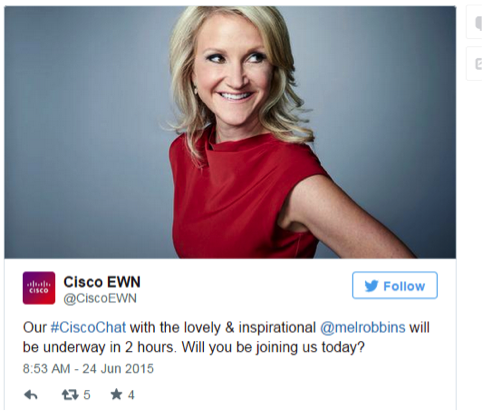
During the chat, Cisco Empowered Women’s Network (Cisco EWN) founders Anuja Singh, Rima Alameddine & Priscila David, along with Mel Robbins, explored the “ReDEFINE Tomorrow, Today” theme that began at Cisco Live. Analyzing the definitions of leadership, networking, innovation and success, Cisco EWN’s forum empowered every attendee and provided ample insight into how they can redefine what these words personally mean to them.

The passionate commentary and authentic advice shared was so impactful that we wanted to keep the conversation going. If you missed the live forum or just want to recapture key discussion points (like the meaning of the “5 Second Rule” or how to be a contender vs. a competitor) take a look at some of our #CiscoChat highlights.

Reflecting on her “ReDEFINE Tomorrow, Today” closing keynote, CEWN founders Anuja Singh, Rima AlameddinePriscila David and a host of our #CiscoChat followers were more than excited for Mel Robbins to re-join the conversation.

Cisco Chat  1 Continue reading “CiscoChat Recap: How Do We Continue to ReDefine Ourselves?”

Authors

Rehana Rehman

No Longer with Cisco

Avatar

We’ve promised to provide regular updates about important events related to our litigation to stop Arista’s wrongful copying of Cisco’s copyrighted and patented intellectual property. An action by the Supreme Court of the United States this week has the potential to change the landscape for our US District Court action related to our CLI technology.

In December 2014, we took action against Arista’s verbatim copying of portions of our user manuals and over 500 of our multi-word commands in our command line interface (CLI). At the time, some speculated that the CLI copying might be justified under principles that Google had asserted regarding its copying of the Sun/Oracle code for Java Application Programming Interfaces (APIs), and Arista’s lawyers were relying on that argument in court. At that time, Google was appealing the Federal Circuit’s decision (holding that API software code is copyrightable) with the Supreme Court of the United States.

Some felt that if the Supreme Court took up the Oracle/Google case and reversed Oracle’s Federal Circuit win, it might somehow apply to justify Arista’s brazen copying. It’s worth noting that Arista also offers a CLI that they created themselves (though it’s not used by many of their customers), and the only justification in their public statements prior to the litigation was that their users preferred Cisco’s CLI. With that in mind, we’ve always felt that Arista’s copying of large portions of the Cisco CLI could be distinguished from Google’s argument in that there was no alternative to the API code to create Java-compatible applications.

However, the Supreme Court decision this week, to decline to review Oracle’s win in the Federal Circuit, effectively removed another argument that Arista could make to the Court.

Once again, we call on Arista to stop their blatant copying, respect others’ intellectual property rights, and immediately disable use of the copied Cisco CLI. We are using all available processes to resolve this matter, and will undertake all necessary steps to expedite the District Court’s review of our claims and ask the court to instruct Arista to end use of their products that include the copied CLI.

Note that this decision affects only the copyright claims in the District Court.  Our patent claims in the District Court and our International Trade Commission action about Arista’s infringement of twelve Cisco patents continues apace. We are confident in our case and expect positive rulings to be issued by next May.


Authors

Mark Chandler

Retired | Executive Vice President

Chief Legal and Compliance Officer