Avatar

It’s dawn and I’m catching the fast train from Amsterdam to Paris. Three days of meetings and a view of one of the most fantastic cities in the world. While stepping onto the train, I had a déjà vu moment that took me back to being a student when I traveled around Europe with a train ticket in my back pocket.

nic villa blogTrains have not changed much. Same rails, similar seats, just a different color fabric. Even the people are the same—as diverse as always, each with a slightly different reason for stepping onto the train. What has changed is the whole experience around the journey. Waking up in the morning, I consulted my smartphone for the weather forecast in Paris, which by the way, the alarm function also woke me from a deep sleep. Using an app I chose a taxi by the number of people who “liked” that particular driver with the Eastern European look. Then my phone paid the taxi fare and alerted me that the train was going to depart within five minutes, well before the announcer at the station did. Just enough time for a good coffee. I plan to get the same taxi service in Paris – just Michelle instead of Piotr.

Connectivity has become part of our everyday life. A life in which information follows – and sometimes proceeds us. Our smart devices proactively give useful information; in my case, the cheapest and quickest way to get to the office as well as a mechanism to build a personal connection with my taxi driver; all before stepping into the vehicle. Continue reading “Data Analytics: Transforming Journeys”

Authors

Nicola Villa

Managing Director, Global Analytics Practice

Cisco Consulting Services

Avatar

Last week I was in Orlando attending NCR’s Synergy Conference, which, this year focused on “Inspired Commerce.”  At the show I heard a lot of dialog with retailers and technology partners about how the Internet of Things and the integrated use of mobility in our day-to-day lives is changing how retailers engage with consumers. I addressed this topic in my session at the show, but wanted to mention a few highlights in hindsight.

First, the use of mobile devices during the shopping journey is no longer for millenials and early adopters only. They are certainly the heaviest users, but across the board in the US, 55% of shoppers are making use of retailer-specific applications, and 34% are using independent shopping apps such as Groupon, Zulily, etc. More than 40% of consumers want to receive their loyalty points/perks and discounts in real time, while shopping in the store, vs. receiving the same information in snail mail or in email.

Second, mobile is becoming integral to the shopping process. Retailers are facing demands for greater convenience, transparency, and interactivity with their consumer base that would have been unimaginable even a decade ago. (As a side note, this is extending into other industries as well, such as healthcare and financial services.)  Consumer expectations are evolving, and with this, retailers need to be able to offer new and effective engagement opportunities with their brand.

Other disruptors include fast-changing technologies such as social media use (not just Facebook and Twitter, but now Pinterest and Instagram) and the need to aggregate social sentiment data; unstructured data such as photos, posts, Tweets; and structured data coming from legacy systems such as CRM, SCM, and POS to make real-time decisions at the edge of the network – in the store or online where the rubber meets the road.

So – high volumes of structured and unstructured data, exponentially growing sophisticated consumer demands, and the growing use of mobile devices in the shopping journey. How does the retailer leverage all of these opportunities to make the most of this evolution?

With billions of connections, sensors and devices lighting up the Internet of Things, the aggregation of structured and unstructured data to deliver real-time analytics on mobile devices for store associates and mobile engagement via apps aimed at consumers, the opportunities are endless.  Retailers that can deliver hyper-relevance – which, according to Cisco’s research, is increasingly what consumers prefer during the shopping process – will be the ones who stand out.  Hyper-relevance delivers to me, the consumer, what I want, when and how I want it, in the context where I am at that particular moment.

To succeed in this new paradigm, retailers must earn consumers’ trust and deliver consistently as a brand to get access to the data that lets them provide a truly relevant real-time experience. Once consumers are willing to share a certain amount of personal data – at Cisco, we call this the “trust cliff” – retailers can use real-time analytics to turn that data into actionable insights.

We have identified three key attributes that retailers must possess to deliver hyper-relevance and build a dynamic infrastructure and processes:

  1. Hyper-aware: By implementing and automating edge technologies such as sensors, cameras, beacons, and RFID tags, retailers can capture value from the intelligence and automation that is now available to them. This is the way to begin to gain true visibility into what the customer is experiencing in the store, how they are dwelling in the store, where they need help with the shopping process.
  2. Predictive: By overlaying intelligence and analytics on top of these edge technologies, retailers can gain real-time anticipatory insight into what is happening, what to expect, and how to meet customers’ real-time needs. If retailers can more systematically determine peak timeframes and loyal customers’ shopping patterns, they can anticipate the staffing needs to speed up the shopping process and assist customers through the checkout process faster.
  3. Agile: Agile, solid infrastructures, adaptive business processes, and associate training capabilities are critical to being able to deliver the kinds of dynamic experiences discussed here. When business processes can change dynamically and associates trained to respond and do what’s best for the customer, all while leveraging technology and insights gained from integrated systems, the customers’ shopping experience can delivered in an excellent manner.

This is obviously not as easy as it sounds.  Implementing a hyper-aware, predictive, and agile network to respond to your customer demands is very difficult.  We in the Cisco Business Transformation Team work with customers to help them explore where they are today and where they want to take their business in the future, and work arm-in-arm with them to look at what it would take to get from where they are today to this desired future state.

We recommend the following steps:

  1. Forget everything you thought you knew about the digital consumer – all the old paradigms are melting away and “segmentation” no longer applies
  2. Go to the edge for visibility into what customers are experiencing at that moment
  3. Build a dynamic infrastructure and create agile processes that to support the customer experience
  4. Develop new business models that drive innovation and enable hyper-relevance

If you would like to download the white paper from Cisco Consulting Services that I’ve referenced, please click here.

Authors

Anne M. McClelland

Director, Retail & Hospitality Practice

Avatar

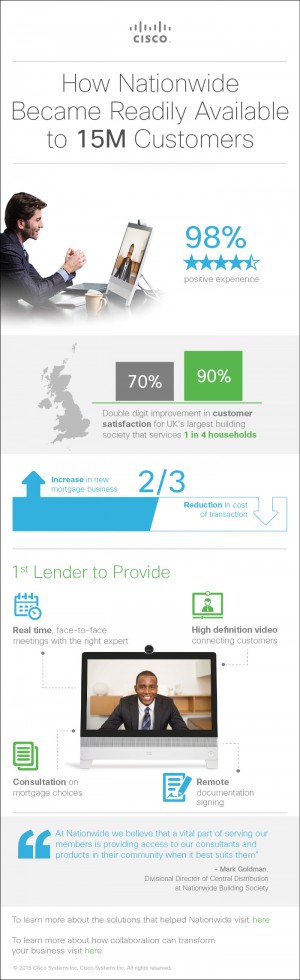
107718_NW Infographic_04-27-15As consumers, we have many options in how we browse, research, and purchase products today.  We expect more freedom and flexibility in how we work with retail companies. Forward-looking companies strive to improve their customers’ experiences and provide flexibility without compromising quality.

However, some industries are considered conservative and rigid. Financial institutions are often seen this way. It’s ironic. Financial institutions brought us ATMs, online banking, bill payer, and generally made us more self-sufficient with our funds.

Unfortunately, areas such as mortgage lending remain high-touch and require a face-to-face meetings with customers. For banks, the challenge is that it doesn’t make sense to have an expert in every branch, which means mortgage experts typically travel among branches.  Customers may have access to a lending expert only once a week, or even every two weeks.  It’s difficult to do business that way.

Now, look at what Nationwide has accomplished in the area of mortgage lending.  Nationwide prides itself on customer service: It’s the world’s largest building society and services 1 of every 4 U.K. homes.  In order to grow and provide exceptional service to more households, Nationwide realized it would be better to
bring its mortgage experts to the customer.  They did this with video conferencing and the results have been spectacular.

Most impressive is the increase in customer satisfaction from meeting with consultants over video.  The experience and expertise remain the same, but providing experts at the customer’s convenience led to a significant improvement in ratings. And, additional business for Nationwide at lower cost.

I applaud Nationwide for not over-rotating on video.  They have successfully taken advantage of video to serve more members and bring home ownership to reality for those members on their terms.  They did this by continuing to provide “white glove” treatment to their members.

Upon arrival, customers are greeted by an employee who escorts them to the meeting room. The employee begins the video session, makes introductions, provides refreshments, and supports the process by managing documents, copies, signatures, and other branch-based tasks.

Video doesn’t replace the experience, it augments it.

There’s a saying that Continue reading “Provide Service at Your Customer’s Convenience”

Authors

John Gaudin

No Longer with Cisco

Avatar

Hello world!

Welcome to the Life at Cisco blog. This is our “hello world” post, our inaugural post to tell you what you might come to expect from us.

Managed by the Talent Acquisition team at Cisco, the goal of the Life at Cisco blog is to show why working at Cisco is awesome.

Listen to outgoing CEO John Chambers, or incoming CEO Chuck Robbins speak about Cisco employees, and you’ll always hear one word. Family. That’s what we are, one big family. We work together. We play together. We build amazing things together. We change the world together.

We can be serious, we can be goofy and we can find a reason to celebrate just about anything, because we like cake. And cookies. And balloons. And lunches. And team events.

Most of all, we like changing the world. Connecting the unconnected. Those are big statements, but on this blog, we’ll drill down to the details on how we do that.

As we travel the world of Cisco employees, we’ll also try to give some tips and tricks for your career – at Cisco or elsewhere. We want everyone to find success and happiness in their job.

For current employees, we would love to engage with you and hear your stories in the comments. For the rest of the world, you’ll still enjoy the stories we post here. If it motivates you in any way to want to join the best darned team in the whole world, apply now.

Authors

Carmen Shirkey Collins

Social Media Manager

Talent Brand and Enablement Team, HR

Avatar

At Cisco Intercloud CTO Innovation Center, innovative vendors are selected to integrate and build cloud services for customer and market trials. We combine the world’s best ISVs with Cisco’s best to bring unique innovations to our customers.   At Cisco Live 2015 in San Diego, we launched one such solution – Intercloud Microservices with Docker, Nirmata, and the Cisco ONE Enterprise Suite.  The Intercloud Microservices solution enables a new breed of DevOps – where business get unprecedented agility at scale using cloud-native architectures, and unprecedented flexibility in choosing best-of-breed Cisco Intercloud providers across the globe.

Continue reading “Intercloud Microservices with Docker and Nirmata”

Authors

Kenneth Owens

Chief Technical Officer, Cloud Infrastructure Services

Avatar

CiscoChampion200PXbadge#CiscoChampion Radio is a podcast series by Cisco Champions as technologists. Today we’ll be talking about Cisco ONE Software with Cisco Product Manager Anurag Aggarwal and Cisco Product Management Director Vikram Rao.

Listen to the Podcast.

Learn about the Cisco Champions Program HERE.
See a list of all #CiscoChampion Radio podcasts HERE.
Ask about the next round of Cisco Champions nominations. EMAIL US.

Cisco SMEs
Anurag Aggarwal, Cisco Product Manager
Vikram Rao, Cisco Product Management Director

Cisco Champion Guest Hosts
Michael Aossey, @aossey, Solutions Architect
Ed Walsh, @vEddieW, Senior Consultant, Technologist Continue reading “#CiscoChampion Radio S2|Ep 25. Cisco ONE Software”

Authors

Rachel Bakker

Social Media Advocacy Manager

Digital and Social

Avatar

This post was authored by Rich Johnson, William Largent, and Ryan Pentney. Earl Carter contributed to this post.

Cisco Talos, in conjunction with Apple’s security advisory issued on June 30th,  is disclosing the discovery of a remote code execution vulnerability within Apple Quicktime. This vulnerability was initially discovered by the Talos Vulnerability Research & Development Team and reported in accordance with responsible disclosure policies to Apple.

There is a remote code execution vulnerability in Apple Quicktime (TALOS-2015-0018/CVE-2015-3667). An attacker who can control the data inside an stbl atom in a .MOV file can cause an undersized allocation which can lead to an out-of-bounds read. An attacker can use this to create a use-after-free scenario that could lead to remote code execution.

There is a function within QuickTime (QuickTimeMPEG4!0x147f0) which is responsible for processing the data in an hdlr atom. There is a 16-byte memory region, allocated near the beginning of the function, if the hdlr subtype field in an mdia atom is set to ‘vide’, this reference is passed to a set of two functions.

Continue reading “Vulnerability Spotlight: Apple Quicktime Corrupt stbl Atom Remote Code Execution”

Authors

Talos Group

Talos Security Intelligence & Research Group

Avatar

ONS1When one of the oil and gas industry’s largest events needed a solution to save resources, time and money, they called Cisco. At the Offshore Northern Seas (ONS) conference, organizers wanted to find a way to eliminate the paper maps, guides and updates that needed to be printed for the over 90,000 attendees and 1,300 exhibitors participating at the event. Forgoing the printed material, ONS came up with the idea of a digital app to guide conference goers around their show.

With the help of Cisco Connected Mobile Experiences (CMX) ecosystem partner, MazeMap, ONS had the searchable and linkable maps it needed. With Cisco CMX Location Analytics, ONS identified and addressed congestion at the venue.

“Cisco CMX is a key component of our wayfinding solutions,” says Thomas Jelle, CEO at MazeMap. “Attendees can search for exhibitors on the ONS app and maps guide them to the booth they’re looking for.”

The next part of their solution was installing the hardware needed to make sure those maps made it to their attendees’ wireless devices. Using Cisco switches and wireless access points (APs) with integrated 802.11ac, ONS was able to provide their members with the ability to navigate the 40,000 square meters of conference space spread out over multiple buildings. Continue reading “Putting Cisco on the Map at ONS”

Authors

Byron Magrane

Product Manager, Marketing