
We recently concluded another NCTA Cable Show. Despite Boston’s cloudy weather, after hundreds of meetings with our cable service provider customers, the common pain points across the industry are clear. Cutting across geography, subscriber footprint, and budget, were the common challenges of responding to the threat of OTT content delivery, evolving existing infrastructure, and supporting multi-screen experiences.
When we launched Videoscape at CES 2011, we introduced a platform to leverage the inter-networking of cloud + network + client architectures. Videoscape enables our service provider customers to rapidly launch compelling new revenue generating services while transforming the cost structure of their network operations.
It is gratifying to see how our key principles are being appreciated by our MSO customers. We are helping our MSO customers evolve the home environment for their subscribers. This means supporting next generation services across proliferating devices, and bridging both managed and unmanaged device experiences. As our recently updated VNI data shows, the trend towards IP-enabled experiences is Read More »
By Steve Harris, Senior Director, Advanced Network Technologies
How prepared are you for the future of cable telecommunications? You’ll have a chance to find out with the return of the SCTE IP Challenge over the next few weeks.
With the support of our friends at Cisco Systems, the Society of Cable Telecommunications Engineers has brought back the challenge in a bigger and better way to help test knowledge and heighten understanding of the Internet Protocol (IP) technologies that will shape our industry in the years to come.
To get involved – see below for the cool prizes you can win – there are three things Read More »
This year’s Cable Show kicked off with a … well, with a flash mob! First one ever for this event. All very exciting, if you ask me, or the hundreds of other cable onlookers on hand at the Boston Convention Center this morning.
Here’s how it went down: When the Show floor opened yesterday, at 11:00am, attendees mixed it up with 100 or so professional troupe dancers, some dressed in green stretchy suits, head to toe, with signage: “Don’t miss the event of the Show! Imagine Park, today at 11:30am! Be there!” Mysterious.
When Cisco Fellow John Chapman took the Imagine Park stage at about 11:40am, it wasn’t to talk about CCAP, or the future of DOCSIS, or anything else, for that matter – because the green people and flash mobbers took over, in a big way. See for yourself:
But flashmobbing isn’t all we’re doing in Boston to shine the spotlight on the many good things happening in cable technology. We’re also glad to announce our work with Bright House Networks, to help businesses and school districts manage the security risks that come with the “BYOD” (bring your own device) realities of today.
Specifically, we’re working with Bright House to help the nation’s 10th-largest school district, serving 179,000 students, with a cloud-based managed services mix (IP VPNs, security; unified communications to come) to more than 250 sites. More here.
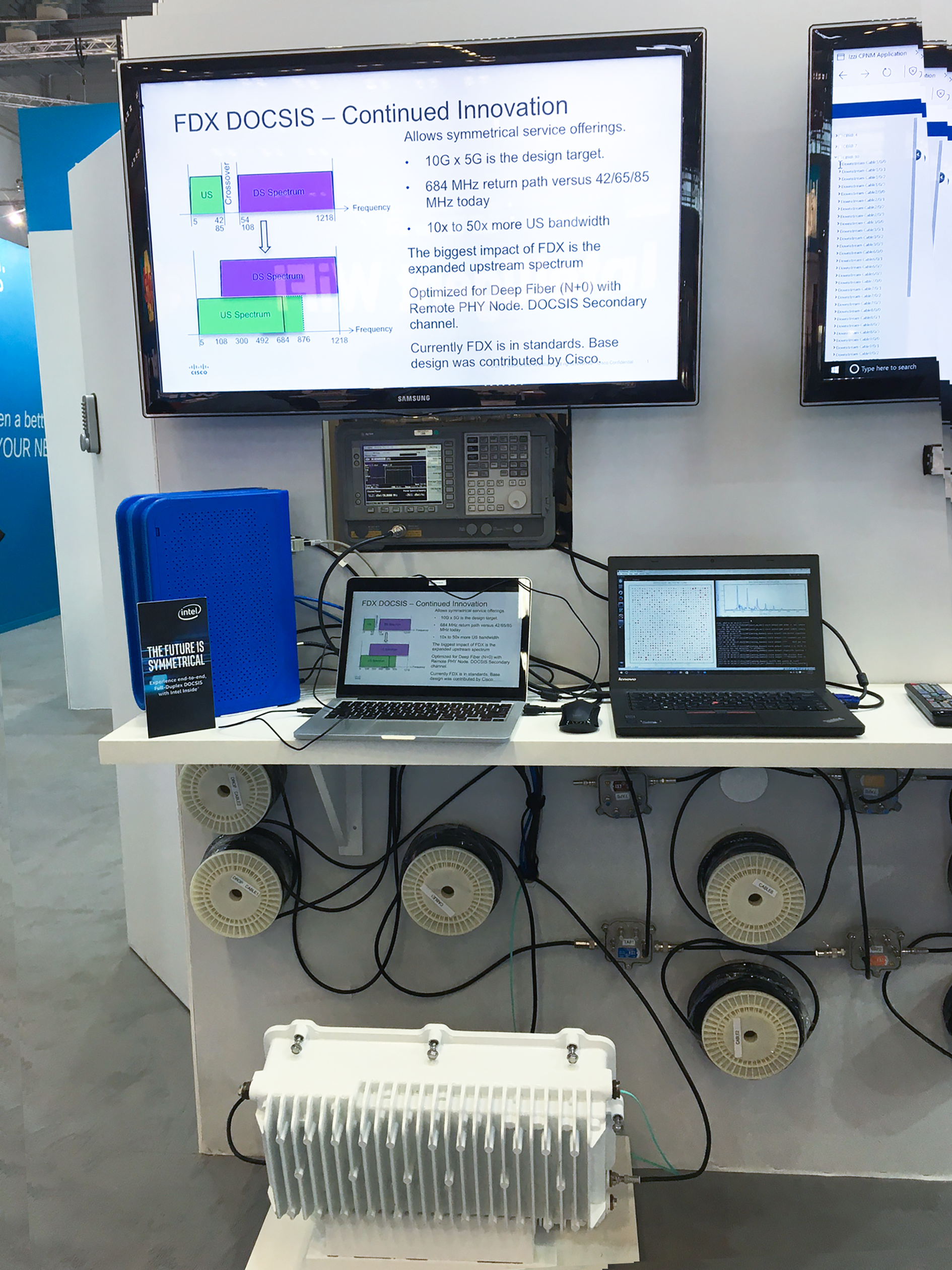
On the floor, do please come by Booth #1453, to check out our brand spankin’ new DS384 line cards, for our RF Gateway 10 chassis. Why you care: 10 cards, each capable of 10 Gbps. Apply one for redundancy, still get 160 Gbps of potential downstream throughput. Hello, full spectrum!
All in, it’s a great cable week in Boston! We’re here ‘til Wednesday afternoon, come on by.
Meanwhile, check out what John Chapman has to say about DOCSIS:
Think back to the year 1997. Back then, Bill Clinton had just begun his second Presidential term. Princess Diana’s funeral was watched by 1.5 billion people. Internet Explorer version 4 was new. The Hale-Bopp comet made its closest approach to Earth – and the Data Over Cable Service Interface Specification (DOCSIS) was released publicly for the first time (March 1997), marking the beginning of the broadband revolution.
The highlights: By year-end 1997, some 10,000 DOCSIS-based cable modems were installed in Canada. At the time, services ran on a single carrier, for 40 Mbps downstream – spread across 20+ fiber nodes.
By Roland Klemann, Director of Service Provider Practice, Western Europe, Internet Business Solutions Group
Although the coaxial cable may have been born in 1929, predictions of its death have been greatly exaggerated.
While traditional models for consuming television are indeed under siege—from time-shift TV, over-the-top video, and an ever-expanding array of new devices—cable remains highly relevant, even in an age of exploding data traffic. In fact, with savvy deployment of Wi-Fi services, cable providers can seize an opportunity—not in spite of the mobile data deluge, but because of it.
After all, that sleek new iPad—introduced last week while I was attending the Cable Congress in Brussels—boasts dazzling video resolution. But for network operators, it only adds to a growing problem. They are already reeling under the burden of a massive upsurge in traffic, from tablets and IP-enabled devices of all kinds. What’s worse, they are still at the low end of an ongoing mobile data explosion. Cisco’s Virtual Networking Index predicts an eighteen-fold increase in mobile traffic from 2011 to 2016.
As a result, two things are breaking down: 1) the physical capacity of the networks, and 2) their economics. Theoretically, mobile carriers can build enough macro cells to carry all the traffic in the world, but in reality, that gets prohibitively expensive—fast. No wonder some are feeling an encroaching sense of doom.