
The world is in the midst of an unprecedented technological transformation, and at its heart lies artificial intelligence (AI). AI isn’t just changing how we work and live; it’s fundamentally reshaping the global economy, redefining value creation, and evolving entire industries. For communications service providers (CSPs) and telecommunications companies, this isn’t just a trend to watch—it’s a once-in-a-generation opportunity to become pivotal players in the AI economy, unlocking significant new revenue streams.
As the industry’s focus shifts from capital-intensive large language model (LLM) buildouts to widespread enterprise adoption of AI, CSPs are well-positioned to act as the “central nervous system” connecting and activating AI-driven business. Leveraging their vast existing assets—including far-reaching networks, regional data centers and points of presence, domain expertise, strategic partnerships, and deep customer relationships—CSPs can move beyond traditional connectivity to offer high-value AI services.
Catching the AI wave: Why CSPs are well-positioned
Several rapidly unfolding AI trends are creating this fertile ground for CSPs:
- The emergence of agentic AI: Agentic AI marks the most significant shift, transforming infrastructure needs from capital-intensive centralized data centers for training to highly dynamic, distributed inferencing and interconnected environments. With inference workloads expected to account for roughly two-thirds of all compute in 20261, CSPs are well-positioned to deliver AI-optimized connectivity services to help ensure consistent low latency, robust security, and hyper-resiliency from the edge to the cloud for these distributed workflows that are core to business today.
- The rise of inferencing: This creates a prime opportunity for CSPs to host and deploy distributed compute infrastructure more efficiently and cost effectively for inferencing at their existing edge presence or network aggregation points, bringing AI closer to the data source.
- Surging real-time sensor data: The explosion of IoT devices, projected to reach 39 billion by 20302, is generating an unprecedented volume of real-time sensor data. CSPs, with their ubiquitous reach, are optimally positioned to manage and monetize the secure, scalable, and low-latency transmission of this data to support new AI-enabled IoT and Industry 4.0 use cases.
- Demand for sovereign AI services: Global concerns about digital sovereignty are pushing for localized AI solutions, with governments tightening regulations on data residency and cross-border transfers. CSPs can leverage their regional data centers and trusted networks to provide sovereign AI offerings, both within data centers and for data in transit, helping ensure each customer’s control over their own data and systems.
Unlocking new revenue streams with Cisco: Five pillars for CSPs
By working with Cisco, CSPs can secure their place in the AI value chain by delivering critical AI infrastructure services across five key avenues:
- AI connectivity services: Building on their core networking competencies, CSPs can create the ultra-resilient “central nervous system” from edge to cloud for agentic AI. This includes intelligent, AI-optimized connectivity based on the Cisco Agile Services Networking architecture for unpredictable, latency-sensitive AI traffic between endpoints, agents, and LLMs. CSPs can also offer data center interconnect (DCI) based on Cisco advanced routing solutions, including Cisco Routed Optical Networking and Cisco high-speed coherent optics, as well as “scale-across” connectivity for massive GPU training clusters, using Cisco deep buffer routers.
- AI data center infrastructure services: Many CSPs own underutilized data center facilities. With AI data center capacity already in tight supply and projected to account for 70% of total data center demand by 20303, CSPs can generate new revenue by offering colocation or by deploying Cisco full-stack AI data center infrastructure solutions, like Cisco Secure AI Factory with NVIDIA to build and manage dedicated or shared regional AI infrastructure for their customers, including GPU as a service (GPUaaS).
- Sovereign AI services: CSPs are ideally suited to provide comprehensive sovereign AI solutions. By leveraging their existing regional and national data centers, together with the Cisco Sovereign AI Cloud Reference Architecture, they can build and manage trusted AI infrastructure that meets stringent privacy and regulatory needs. They can also use Cisco advanced secure routing and Crosswork Network Automation to help ensure that data traversing the network is routed intelligently and exclusively across compliant, trusted network routes. This assists in making sure that data stays within sovereign boundaries. Bringing both sovereign cloud and data-in-transit services together, CSPs can offer much-needed end-to-end compliance.
- Edge AI services: The shift towards localized data processing is significant, with global spending on edge AI computing projected to reach $143.06 billion by 2034.4 CSPs can capitalize on this by offering edge AI managed services which leverage Cisco Unified Edge, Cisco AI PODs, Cisco AI-native wireless networks, and Cisco SD-WAN to deliver low-latency, high-bandwidth, and secure AI processing at the edge for various industries.
- Security and observability managed services: As AI solutions become more sophisticated and distributed, comprehensive security and performance insights are paramount. With Cisco Security Cloud Control and Cisco Hybrid Mesh Firewall, CSPs have an opportunity to deliver managed services that provide secure AI workflows end to end. Furthermore, by leveraging the billions of data points they collect daily, together with Cisco Observability for AI based on Cisco Splunk and Cisco Provider Connectivity Assurance, CSPs can offer high-value observability services, monitoring the health of complex AI systems and proactively detecting issues.
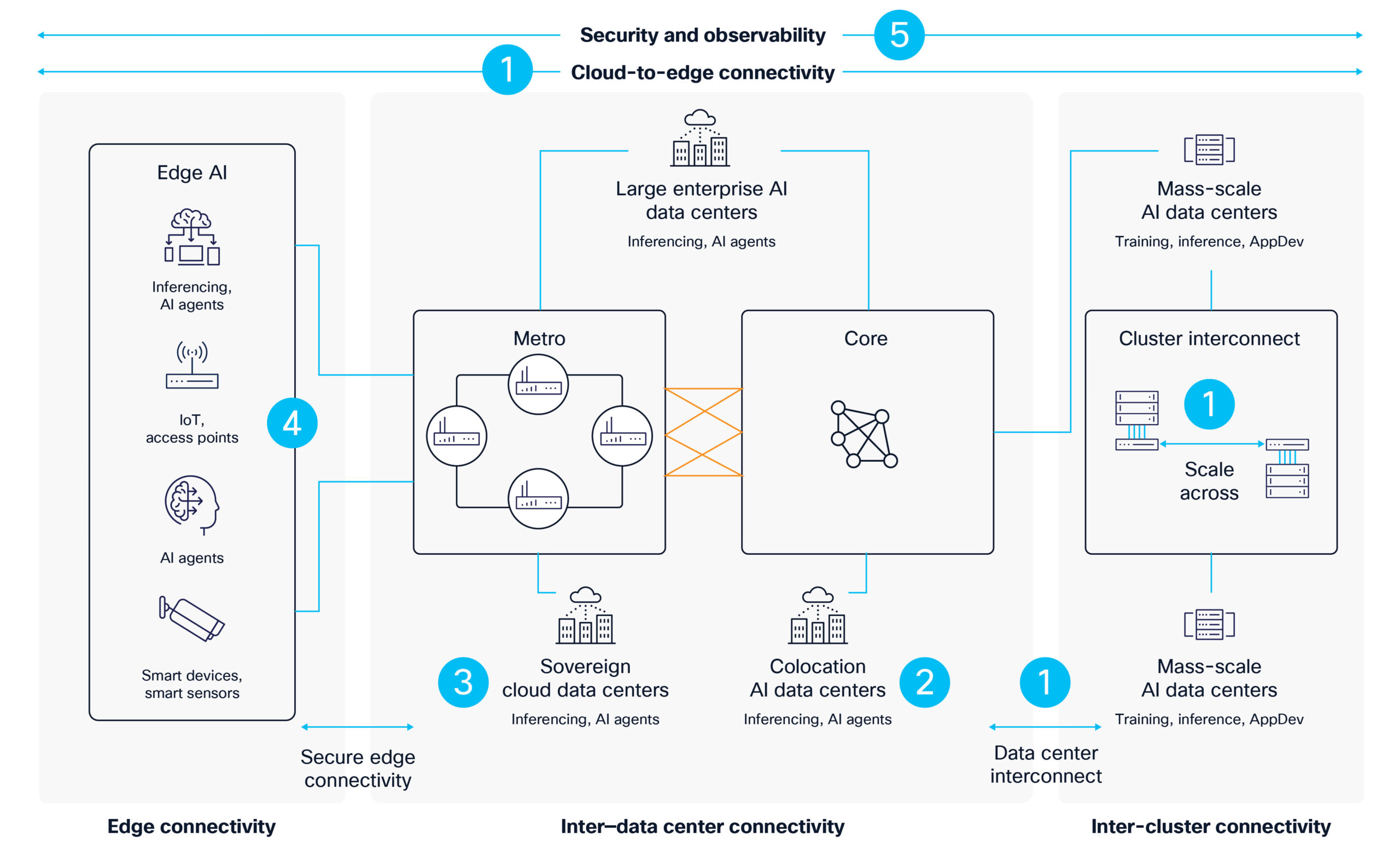
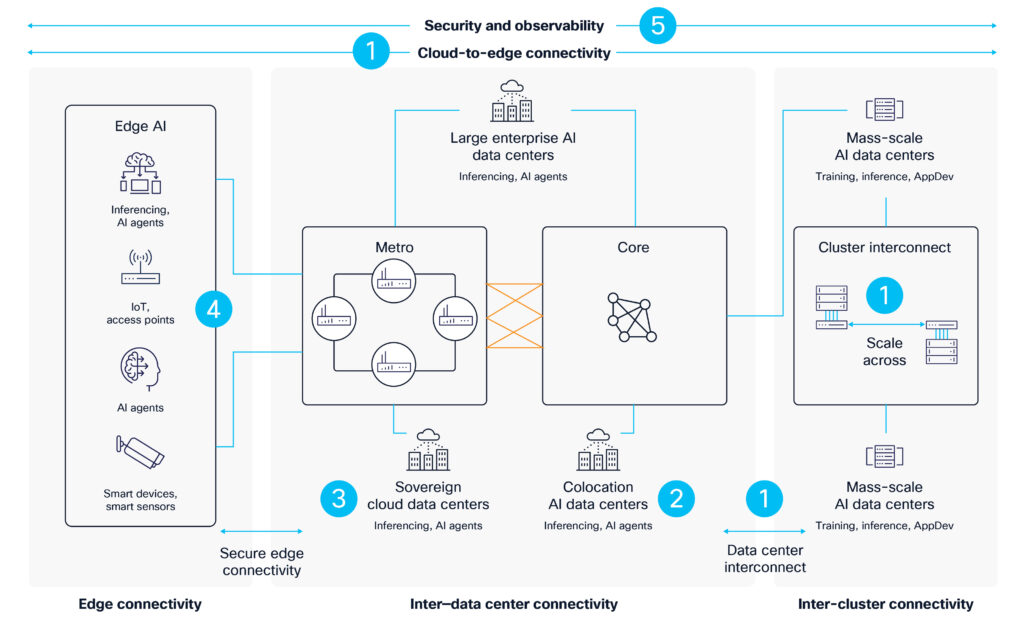
Figure 1: Cisco empowers CSPs to serve as the “central nervous system,” aligning connectivity, security, and observability
Cisco, with its 25+ years of experience in secure, scalable networking and infrastructure, provides the ideal platforms for CSPs to capitalize on these opportunities and succeed in the AI economy. Cisco offers a comprehensive AI infrastructure portfolio spanning silicon, networking, compute, optics, routing, security, and observability—enabling CSPs to deliver differentiated, high-value services.
Empowering the next generation of intelligent connectivity
The AI era is here and CSPs stand at a pivotal juncture. By collaborating with Cisco, they can transform their networks into platforms for innovation, growth, and lasting value. The convergence of agentic AI, changing traffic patterns, enterprise AI adoption, and data sovereignty regulations presents an unprecedented opportunity. With Cisco’s proven track record and comprehensive portfolio, CSPs can build the agility, resiliency, and AI expertise required to lead this transformation, empowering the next generation of intelligent connectivity and the broader AI economy.
1. Why AI’s next phase will likely demand more computational power, not less, Deloitte, November 18, 2025.
2. State of IoT 2025: Number of connected IoT devices growing 14% to 21.1 billion globally, IoT Analytics, October 28, 2025.
3. The cost of compute: A $7 trillion race to scale data centers, McKinsey & Company, April 2025.
4. Edge AI Market Size, Share and Trends 2025 to 2034, Precedence Research, November 12, 2025.
Learn more about Cisco solutions for AI or read this white paper to further explore CSP revenue opportunities in the AI economy.