


Every conversation I have with customers, partners, and colleagues in my short time with Cisco lands in the same place: the AI conversation is about more than models. It is about whether the infrastructure underneath the models can operate safely, securely, and at scale.
For more than 40 years, Cisco has been built around a foundational idea: the network is more powerful than the node. The nodes today — models, applications, agents, silicon — are all critical. But the true magic lies in the connections between them.
That idea matters more than ever. AI agents are sitting in production environments right now. And so, in the agentic era, the network has to do what no single node can: help organizations operate, defend, and future-proof the systems the world depends on — all at a speed and scale humans can no longer manage alone.
That is the shift Cisco is building. We have evolved far beyond connectivity to become the critical infrastructure for the AI era, reimagining how infrastructure is built, secured, and operated as humans and AI agents begin working side by side.
At Cisco Live this week, three movements show what that future looks like:
Operate together.
The era of managing critical infrastructure purely at human scale is ending. AI agents have entered the enterprise — accessing systems, moving data, triggering workflows, and accelerating decisions. That activity is only going to grow. The question is not whether agents belong in operations. The question is whether operations are built for them.
Cisco Cloud Control is our answer: a unified platform built for humans and AI agents to run critical IT infrastructure together — networking, compute, security, observability, and collaboration in one environment, one login, one shared view. For IT teams, the morning stops being a dozen browser tabs and a half-built picture of what’s actually happening. Room & Board is one of the early customers using Cloud Control to bring its environment into that single view, so its teams can focus on the infrastructure they support instead of piecing evidence together by hand.
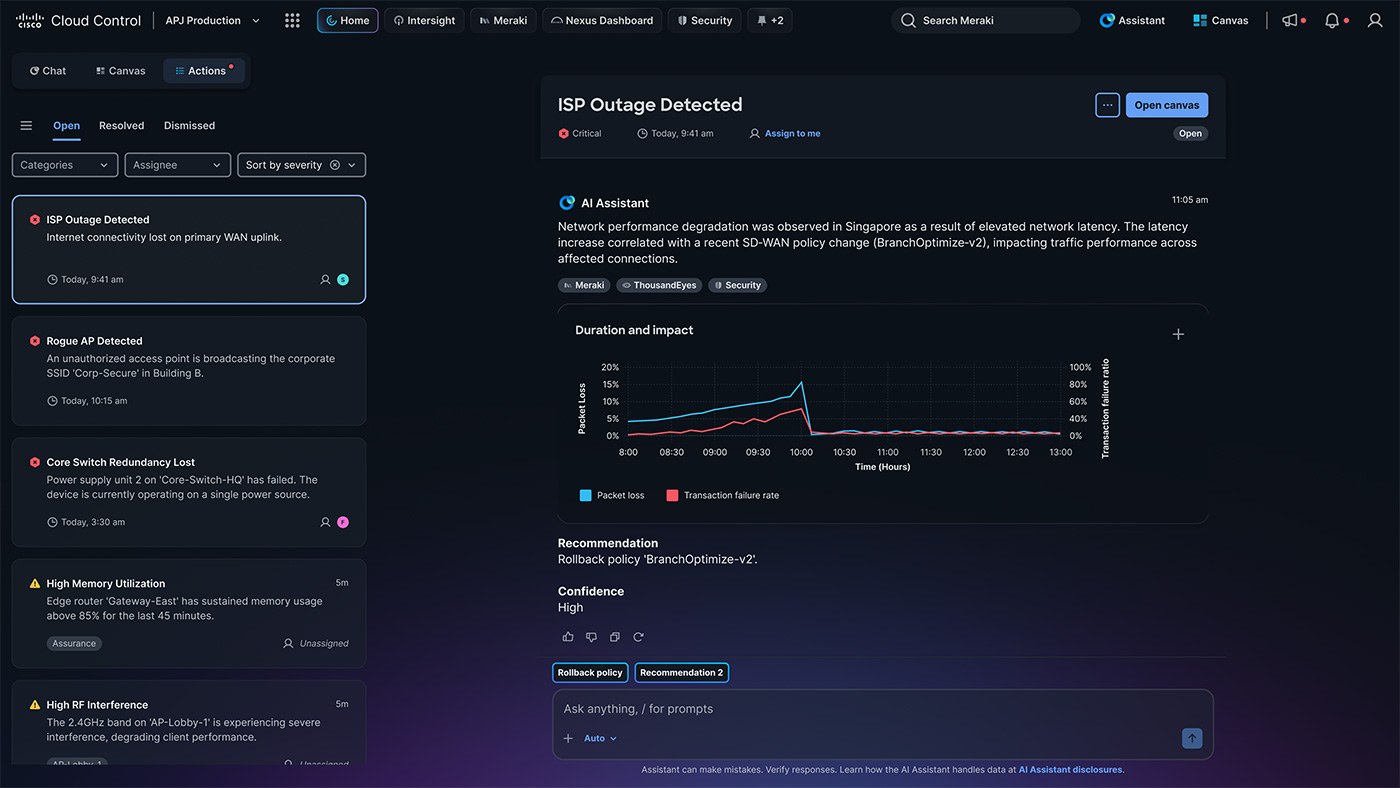
A single view is the surface. There is more power in what sits inside and underneath.
Cisco AI Canvas is the workspace where operators and agents work side by side on the same live evidence, drawn from across the entire Cisco estate. The agentic loop, is where agents powered by Cisco telemetry and purpose-built models — such as Cisco’s Deep Network Model, grounded in 40 years of our operational networking data — notice, diagnose, and handle issues, often before anyone has to look. This is intelligence built directly into the network — visible, governed, and informed by how the network actually behaves.
And because no two enterprises run the same way, Cloud Control Studio is the design space which lets customers and partners extend the platform with their own agents and apps in natural language, with Open AI Codex’s agentic coding assistant built in, connected to an entire ecosystem of third-party tools and platforms including AWS, ServiceNow, Slack, and many more. Agentic operations shouldn’t arrive as someone else’s blueprint. The platform should be one customers can shape themselves.
Jeetu Patel goes deeper on the platform architecture in his post — worth reading alongside this one.
Defend together.
And then came Mythos — a reminder of how quickly the security landscape is changing. The window between a vulnerability being discovered and being exploited has collapsed from weeks to minutes. “Patch on Tuesday and hope for the best” does not survive that timeline. Security has to live where the work happens, not in a layer wrapped around it.
That’s why we’re working on two fronts at once across several security announcements at Cisco Live: protecting products in the moment and putting our own infrastructure under the same scrutiny our adversaries will.
Live Protect is a striking example — a ‘digital immune system’ for supported Cisco products that helps shield against newly discovered vulnerabilities at runtime, with no reboots and no maintenance windows. In some cases, the difference between a quiet Tuesday and a very bad week may come down to that kind of capability. It’s now live in N9000 series switches, expanding across the portfolio in the coming months. And as a charter member of Anthropic’s Project Glasswing and OpenAI’s Daybreak, Cisco is stress-testing its own products against frontier-model attacks before adversaries get the chance – sharing what we learn through the open-sourced Foundry Security Spec, so every defender can apply the same rigor.
Prepare together.
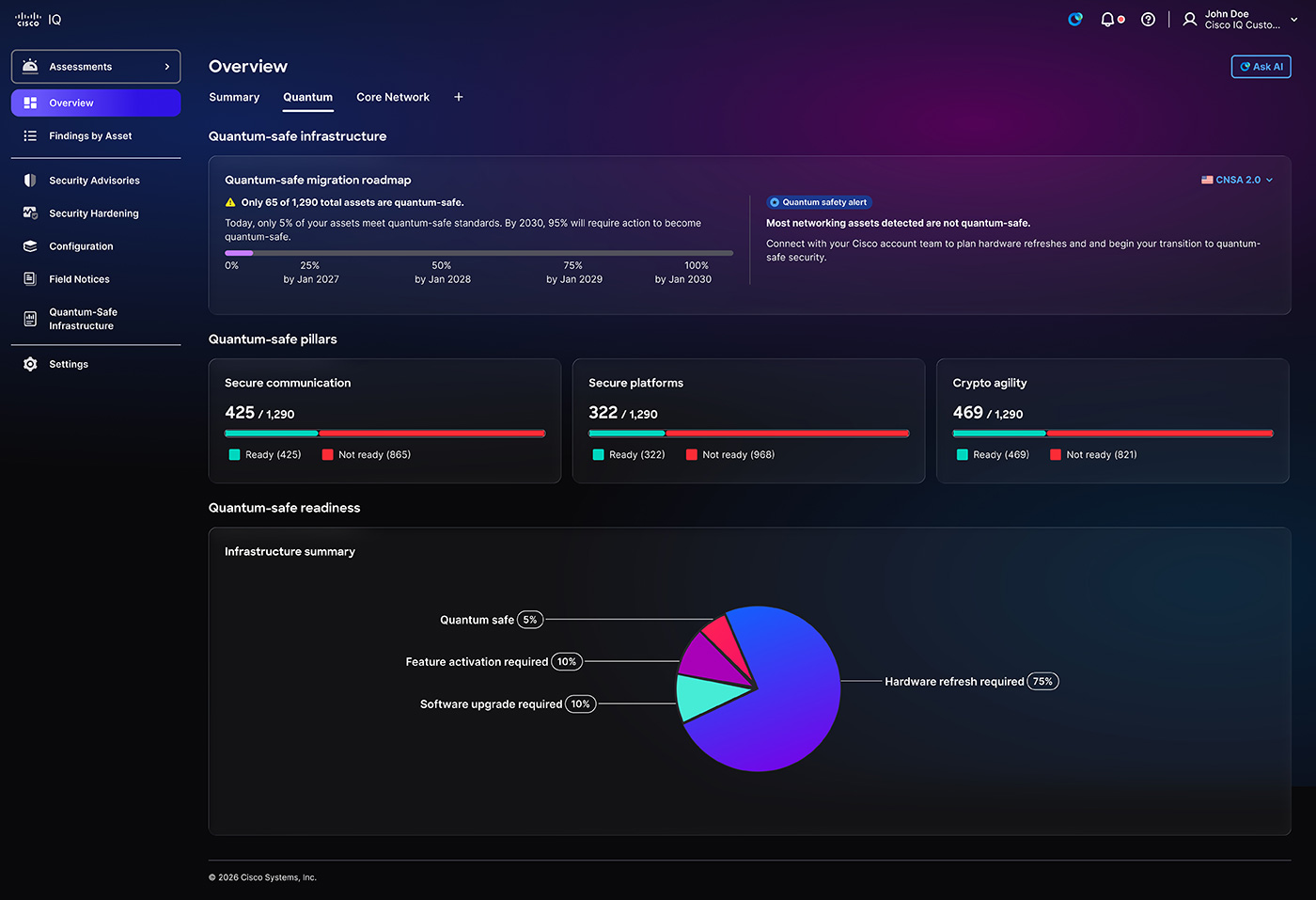
Real-time defense holds today’s line, but some threats are already in motion years before they land. Cisco IQ — our AI-powered delivery vehicle for Support and Professional Services — is where customers go to see where they’re exposed and decide what to fortify before risk becomes urgent. And it’s fully integrated into Cisco Cloud Control.
New Resilient Infrastructure Services help customers assess exposure, modernize, and mitigate frontier model risk. We also announced new options in Cisco IQ for customers with data sovereignty requirements to run ‘on-premises,’ and a new capability for them to see how their security posture compares with peers, among other data-driven insights. Customers including AdventHealth, GlobalFoundries, and Nestlé are already using Cisco IQ insights to make more informed infrastructure decisions.
Quantum is where we sharpen that work. Quantum computing will eventually challenge today’s encryption, and attackers know it. “Harvest now, decrypt later” activity is already happening. If encrypted data will still matter in five or ten years, leaders need to start treating it as a risk now. The new Quantum Ready Assessments, with global availability in Cisco IQ planned for July 2026, help customers see which assets are exposed and where to start. We’ve committed to quantum-safe communications capabilities across the majority of our core portfolio by the end of this year — with every newly launched campus, branch and data center routers, switches, and firewall series now leaving the factory with quantum-safe secure boot.
The network is where the agentic era happens
One principle runs through all of these announcements: the network is the layer where humans and AI agents meet to run the critical infrastructure the world depends on.
AI’s capability sets the pace. Trust sets the limit. Infrastructure proves both.
That’s why the network is more powerful than the node.
It was true when two computers in different buildings needed to talk to each other in 1984. It is true now, when thousands of agents across hundreds of organizations need to coordinate without breaking anything important.
History has shown us that every computing revolution becomes a networking revolution.
Building the critical infrastructure for the AI era — that’s the work. And that’s why we’re here at Cisco Live this week.


