Every enterprise now operates at the relentless speed of digital experience. Applications are more dynamic. Users connect from everywhere. Infrastructure spans campuses, branches, clouds, service providers, and the internet. And expectations continue to rise.
NetOps teams are not short on data. They are surrounded by it—alerts, telemetry, tickets, topology changes, application signals, and user complaints arriving faster than humans can correlate them. They are being asked to resolve incidents in minutes, prevent problems before users feel them, improve performance, strengthen security, and keep the business moving across environments that change constantly.
The next era of network operations cannot be built on more dashboards alone. Teams need a way to move from signal to trusted action at machine speed.
That is why AgenticOps matters.
It’s also why agentic operations is about more than autonomy. In critical infrastructure, speed without trust creates risk. AI agents cannot operate as opaque black boxes. Operators need to understand what agents see, why they make recommendations, what actions they propose, when human approval is required, and how outcomes are verified. Every decision must be explainable, traceable, and accountable.
This principle underpins Cisco Cloud Control: a unified operating model where humans and AI agents collaborate to manage critical IT infrastructure with shared context, governed action, and end-to-end accountability.
This is the next step in Cisco AgenticOps—our vision for moving complex IT workflows from manual investigation to agent-driven orchestration. The goal is not to remove operators from the loop. It is to give them an agentic workforce they can trust: agents that sense, diagnose, remediate, validate, and deploy through governance built in from the start.
The future of NetOps is not human or machine. It is human-led, agent-powered operations.
Across industries, senior IT leaders have told us the same thing: the network is now critical infrastructure for the business, and trust must be earned before autonomy can expand. Leaders want AI that solves real operational pain, improves user experience, increases efficiency, and gives their teams choice in how much autonomy they enable. They also want proof: reasoning, audit trails, reliability, and control.
Advancing AgenticOps at Cisco Live
At Cisco Live, we are advancing Cisco AgenticOps with three new capabilities that help NetOps teams move from signal to action through a governed, closed-loop workflow:
- Ambient agents for networking are always-on and purpose-built to sense issues, investigate anomalies, reason over telemetry and topology, and recommend or execute actions through governed workflows.
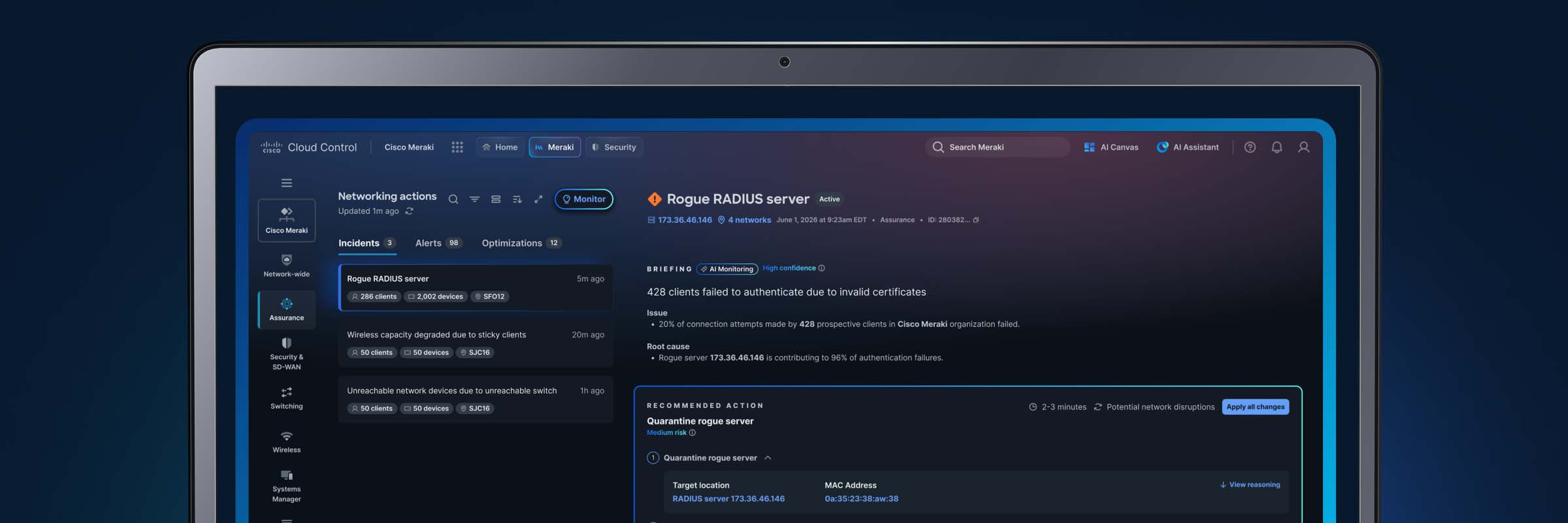
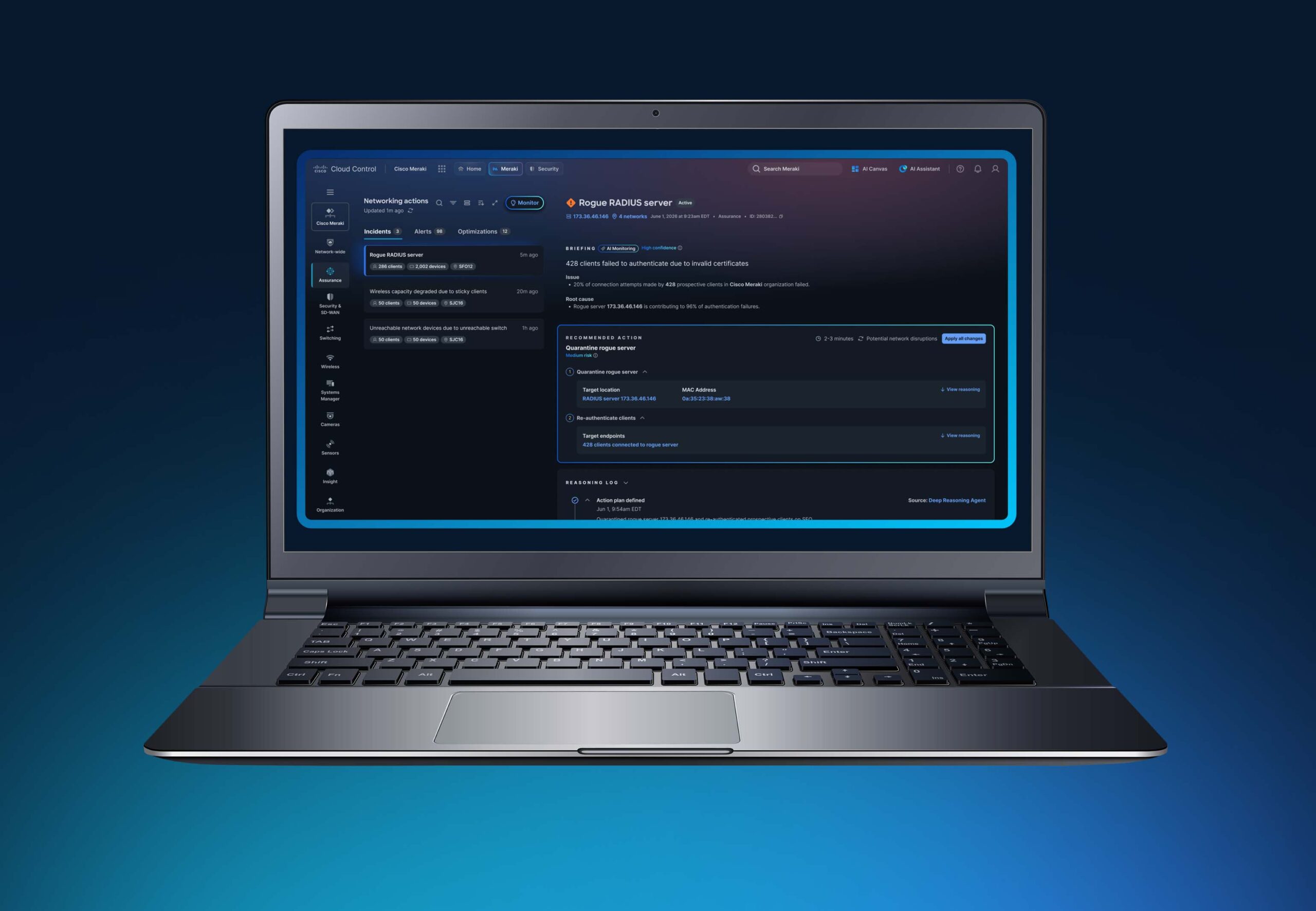
- Agentic Actions for networking gives operators one place to see, approve, audit, and control agent activity.
- The Agentic Loop structures every autonomous action through five stages: sense, diagnose, remediate, validate, and deploy. It is powered by Experience Metrics, Deep Reasoning, Digital Twin, and Cisco Agentic Workflows.
Together, these capabilities help teams find issues faster, understand root cause, validate the right fix, act within operator-defined controls, and verify that the user experience has recovered.
Many AI tools can summarize alerts. Some automation platforms can execute predefined scripts. Cisco AgenticOps is designed to go further: to connect sensing, reasoning, workflow, validation, deployment, and experience verification in one governed operating model.
That is what enterprises need before they can trust agents to act in critical environments.
Agents built for network operations
The starting point is the agentic workforce itself.
Cisco agents for networking are designed to help NetOps teams handle the work that overwhelms them today: too many alerts, too many tools, too much context-switching, and not enough time for deep investigation.
These agents monitor signals, cluster related events, identify likely causes, and propose next steps. For approved action types, they can move from recommendation to execution. For higher-risk changes, they route the decision through the right controls.
Ambient agents are not waiting for a prompt. They proactively observe the environment, detect patterns, investigate anomalies, and prepare recommended actions before an operator has to ask.
They are not standalone bots making isolated decisions. They operate inside Cisco Cloud Control, grounded in Cisco networking knowledge, customer telemetry, topology, configuration context, Experience Metrics, ThousandEyes network intelligence, Digital Twin validation, and governed Cisco Agentic Workflows.
That context is what makes the difference between generic AI assistance and agentic operations built for enterprise networks.
Agentic Actions: Where autonomy is governed
If agents are going to act in the network, operators need one place to see what is happening, understand why, and govern what happens next. That is Agentic Actions for networking.
Agentic Actions gives teams a clear view into agent activity across the network. Operators can see what the agent observed, what it inferred, what evidence supports the recommendation, what action it proposes, whether approval is required, what action was taken, and what outcome was verified.
Every decision includes reasoning. Every action is captured in an audit trail. Every recommendation that requires oversight appears in an approvals queue.
This is the difference between black-box autonomy and enterprise-ready autonomy. Operators do not lose control. They gain a governed system for deciding where agents can act independently, where approval is required, and where automation should not proceed.
As these capabilities expand, customers will be able to define autonomy controls by action type, network domain, and change window. They decide where agents can act, what they are allowed to do, and when those actions can happen.
This is how autonomy becomes operationally usable: not all-or-nothing, but governed, incremental, and aligned to the customer’s risk model.
The Agentic Loop
The Agentic Loop is how agents move from signal to action in a structured, governed, and accountable way.
Each stage is supported by Cisco capabilities built for trusted network operations.
Sense
Every loop starts with a signal.
Cisco detection systems continuously watch alerts, network events, configuration changes, user experience indicators, application behavior, and other signals that something may be wrong. When an issue appears, an ambient agent begins investigating.
The system does not treat every signal as a separate incident. It clusters related events, filters noise, and prioritizes what matters before routing the issue forward.
For example, when 20 access points reboot simultaneously, the agent can correlate AP reboot timestamps with upstream switch reboot data using network topology. Instead of treating this as 20 separate support cases, it recognizes a single upstream switch problem and directs the fix to the right device.
Experience Metrics plays a critical role in this sensing layer by turning thousands of client, device, infrastructure, and application telemetry points into simple, actionable indicators of user experience. Instead of forcing teams to interpret every raw signal, it helps them understand whether users are having a good experience across wired, wireless, and application environments.
By combining application-aware traffic inspection built into wireless access points and switches with proactive synthetic measurements, customers gain real-time insight into how users experience applications across the network. That holistic view helps agents detect abnormalities earlier, understand impact more clearly, and begin root cause analysis with the user experience in mind.
Diagnose
Once the signal is understood, the agent diagnoses the issue using telemetry, topology, configuration context, and Cisco networking expertise.
Many problems can be resolved quickly with a focused answer. The harder issues—ambiguous symptoms, cross-domain dependencies, or conditions outside a standard playbook—require deeper investigation.
That is where Deep Reasoning comes in.
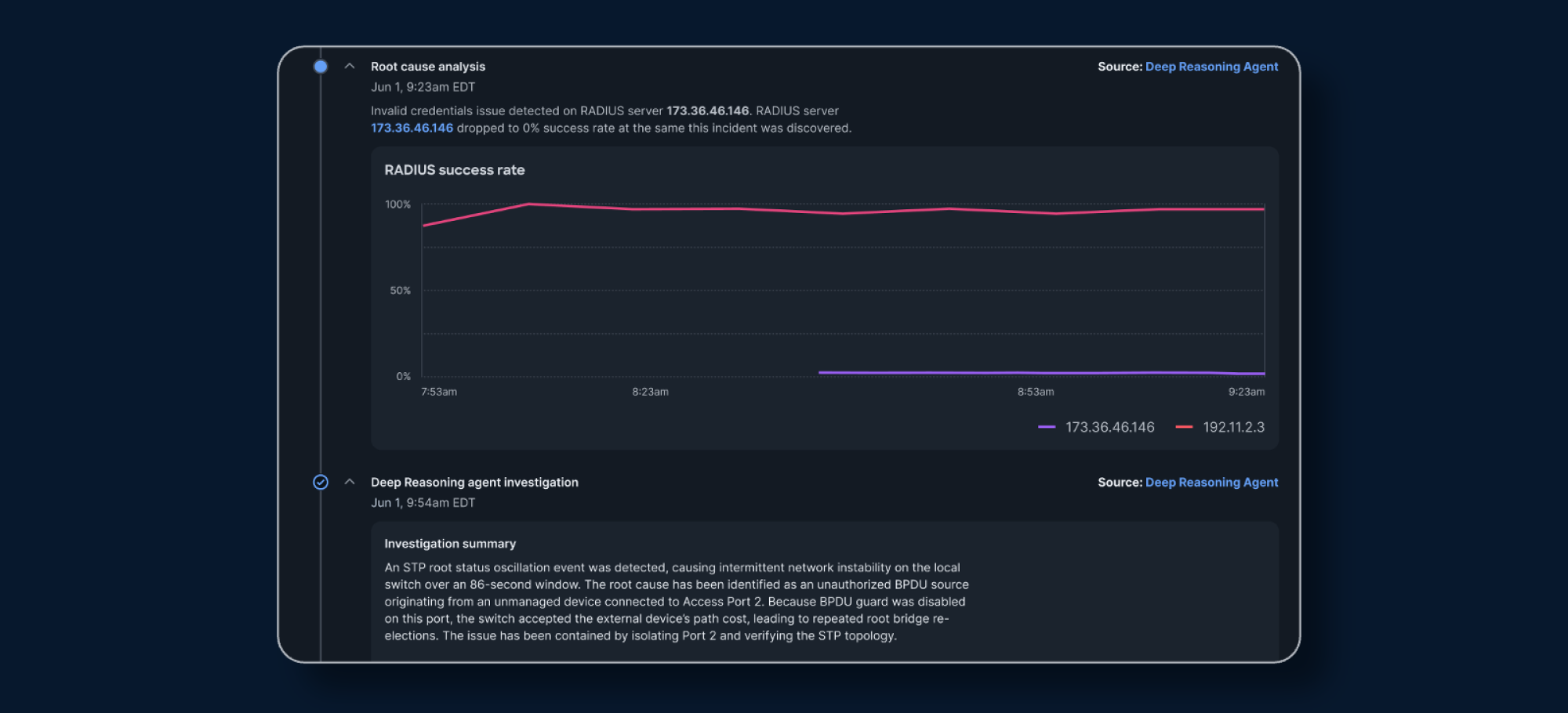
Deep Reasoning is designed for the problems that simple playbooks cannot solve. It uses a self-correcting diagnostic process grounded in a Cisco-authored library of standardized networking skills. These skills span wired, wireless, WAN, and security domains, encoding the diagnostic methodology and decision logic that an experienced network engineer would apply.
That grounding matters.
In production networks, a confident wrong answer is not good enough. Imagine an agent that diagnoses a Layer 2 loop and recommends shutting down a port, even though the topology is linear and there is no loop at all. That confident-but-wrong answer is what hallucinated AI looks like in production, and it is exactly the kind of mistake that erodes trust in autonomy.
With Deep Reasoning, the agent checks its work against observable network signals such as topology, port state, and MAC behavior. The agent reasons. The network confirms.
In early deployments, this approach is already surfacing issues traditional monitoring can miss—from unstable backup cellular WAN links across multiple sites to access points falling into mesh repeater mode because an unmanaged upstream switch had gone offline.
Deep Reasoning Mode is also available in AI Assistant, giving operators investigative responses rather than surface-level summaries. It brings Cisco expert-informed diagnostics, in natural language, to every operator on the team.
After a Deep Reasoning session, an information security leader at a state public-sector agency told us: “This is a huge leap forward. It’s giving me another member of my team.”
These are the kinds of problems AgenticOps is designed to find: real issues, in real production networks, before they become larger incidents.
Remediate
Once the issue is diagnosed, the agent generates the proposed fix through Cisco Agentic Workflows.
Remediation does not happen through improvised API calls or one-off scripts. It runs through validated automation, with audit logging and step-by-step traceability.
The proposed remediation is visible in Agentic Actions, where operators can review the recommendation and decide what happens next. If the action is pre-approved, the agent can continue. If it requires oversight, it moves into the approval queue.
This is where AgenticOps begins to change the operating model. The agent is not simply telling the operator what might be wrong. It is helping prepare the next best action, presenting the evidence, and routing the action through the right controls.
Validate
Before a change is deployed, the system validates the action based on risk.
Some actions may be low-risk and pre-approved. Others require deeper validation. For changes such as topology modifications, security policy updates, or large-scale configuration changes, the proposed fix can be tested against a Digital Twin before it touches production.
Cisco Digital Twin gives teams a virtual environment to model network behavior and evaluate proposed changes before they reach production. For higher-risk actions, agents can test expected impact, assess blast radius, and identify potential unintended consequences before deployment.
That simulation helps answer the questions operators care about most:
Will this fix the issue? What is the potential blast radius? Could the change create unintended consequences? Is it safe to deploy?
Not every action needs a full simulation. The system applies the right level of validation based on risk and blast radius. That is what makes autonomy practical in the real world. It allows teams to move faster where the risk is low and apply deeper assurance where the stakes are higher.
Deploy
Once validated, the action is deployed according to the customer’s controls.
Some actions can be executed autonomously. Others require human approval. The choice depends on the action type, the network, the change window, and the policies the operator has defined.
But deployment is not the end of the loop. It is the moment the system proves whether the action worked.
After a change is deployed, Cisco uses ThousandEyes synthetic testing and Experience Metrics to help verify that the user experience has recovered. The loop does not close simply because infrastructure reports green. It closes when the outcome is confirmed.
The goal is not just to clear an alert. The goal is to restore the experience.
Earning trust, one decision at a time
Human-only NetOps can no longer keep pace with the complexity and speed of modern digital environments. But enterprises will not trust critical infrastructure to black-box autonomy.
That is why Cisco AgenticOps is built around a different principle: autonomy must earn trust every time it acts.
It earns trust by sharing context. By explaining its reasoning. By operating through governed workflows. By validating higher-risk changes before they touch production. By giving operators control over where agents can act and where approval is required. And by closing the loop only when the user experience is restored.
This is the path to trusted autonomous network operations: human-led, agent-powered, and outcome-validated.
It is also a journey. With every advance in AI reasoning, every new skill added to the library, and every customer deployment that sharpens our models, the scope of what Cisco agents can do autonomously will grow.
But the principle will not change.
Always governed. Always accountable. Always earning trust, one decision at a time.
Learn more about
Cisco AgenticOps.
See more Enterprise Networking news from Cisco Live Las Vegas 2026:
The Agentic Workplace Runs on Cisco by Anurag Dhingra
Trust at Machine Speed: Building Secure Campus Networks for the AI Era by Michael Dickman
Cisco Unveils Multicloud Fabric in Cloud Control: Network Ready for the AI Era by Rohit Agarwalla