Mark Grayson is a Distinguished Consulting Engineer in Cisco’s ETI Group, where he currently has broad responsibility for leading Cisco's 5G strategy, including defining the role of Wi-Fi based access, leading Cisco’s multi-vendor RAN virtualization program as well as supporting Cisco’s enterprise team defining systems for supporting 5G enterprise use cases. He has over 25 years of experience in the wireless industry, ranging from the development of military HF systems, cellular handset RF/DSP design, the definition of mobile satellite communication architectures, architecting service provider Wi-Fi solutions, the evolution of traditional cellular systems through to the creation of the latest virtualized RAN solutions.
He holds a first class Honors degree in Electronics and Communications Engineering from the University of Birmingham (England) together with a PhD in Radio Communications. Mark has been granted over 120 patents in the area of mobile communications and is the co-author of IP Design for Mobile Networks (2009) and Building the Mobile Internet (2011), both published by Cisco Press.
Simplification and scaling of private 5G solutions is going to be critical to ensure the full potential of 5G can be harnessed. In this post we will highlight an approach that can facilitate the adoption of roaming interconnect between private and public 5G networks.
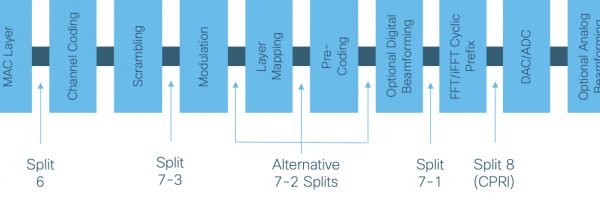
The transition to open RAN (Radio Access Network) based on interoperable lower layer splits is gaining significant momentum across the mobile industry. However, where best to split the open RAN is a complex compromise between radio unit (RU) simplification, support of advanced coordinated multipoint RF capabilities, consequential limitations on transport delay budgets as well as bandwidth expansion. This post compares the two leading alternative splits for realizing an interoperable open RAN.
OpenRoaming is set to revolutionize roaming, enabling access and identify partners with very different business models to co-operate in order to deliver seamless wireless service to users.
One of the key principles of the Open vRAN ecosystem that Cisco and its ecosystem partners announced earlier this year, is to establish open, standard interfaces and management for vRAN. Recently the xRAN Forum has defined the use of IETF’s NETCONF/YANG standard for programmatically configuring and managing its lower layer split RAN architecture.
Showcasing the results of the co-operation between Cisco, Open Air Interface and the open-nFAPI project: demonstrating how open-source can accelerate RAN modularization and ease the adoption of multi-vendor vRAN splits
Cisco is pleased to announce we have joined the Open Air Interface (OAI) open source ecosystem and welcomes other members and researchers to contribute to this effort.
Over 80% of mobile data is being consumed indoors. This white paper examines at the essentials for multi-operator 5G to succeed in indoor environments.
If 5G is going to deliver on its promise, it must be accompanied by an organizational transformation, where traditional boundaries are increasingly blurred.