
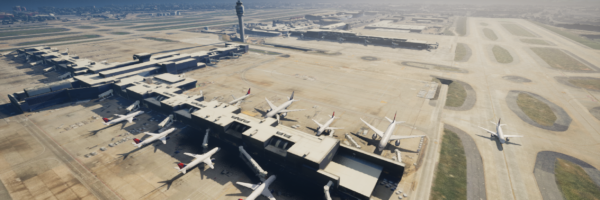
Every traveler knows the feeling: the rolling delay that creeps from 15 minutes to three hours, the missing bag, the anxious dash between terminals. Air travel is one of the most universal experiences on the planet and one of the most complex systems humans have ever built. A single storm can ripple across an entire network, affecting thousands of passengers, millions of dollars, and, in the worst cases, safety itself.
What if airports could see those disruptions coming and rehearse their response before a single passenger felt the impact?
That’s the promise behind Autonoma’s AutoVerse platform, a high-fidelity “digital twin” for airports built on Cisco technology and made possible by Cisco’s Country Digital Acceleration (CDA) program. For airport and airline operators, the challenge is not simply responding faster. It is understanding how a decision will play out across the entire operation.
It’s a story that stretches from autonomous race cars to the busiest airport in the world, and it’s a vivid example of how technology can advance Cisco’s Purpose to Power an Inclusive Future for All.
From Racetrack to Runway
Autonoma’s story doesn’t begin in an airport. It begins with autonomous vehicles: robo-taxis, semi-trucks, and eventually autonomous race cars, the last of which first connected founder and CEO Will Bryan to Cisco through a sponsored racing league.
Across all of that work, one problem kept resurfacing: technology that performed flawlessly in simulation would fall apart the moment it hit the real world. So, Will’s team built better simulation tools. Four and a half years ago, that work became Autonoma. And while it started in autonomous vehicles, the team soon realized the same challenges also existed across airports, cities, and beyond. Cisco’s CDA team helps countries accelerate their national digital agendas by working alongside government, industry, and academia to unlock the value of digitization and drive digital transformation at scale. So, airports were a natural fit. As Wayne Cuervo, CDA’s Director of Business Development puts it, “An airport is the front door to a country and its economy.” Autonoma first caught the team’s attention through Cisco’s Fast Future Innovation Awards, and what followed was a partnership that would prove itself at the extremes: Hartsfield-Jackson Atlanta International airport, the busiest in the world, and Augusta Regional Airport, a small regional airport home to the Masters Tournament annual surge.
The Conversation
Below, Will and Wayne share how their partnership came together, how simulation is helping airport teams make more confident operational decisions, and what those improvements ultimately mean for travelers.
How did the partnership with Autonoma begin and why was it a good fit for CDA?
Wayne: We first connected with Autonoma through the Fast Future Innovation Awards, our open call for companies using technology to solve real-world problems. They stood out for addressing a critical infrastructure challenge with a differentiated solution.
That made it a strong fit for CDA. It’s built to support bold solutions to large, nationally important problems, and airports are vital gateways to a country’s economy. Autonoma’s advanced, physics-based simulations improve airport operations, which requires the kind of secure, high-performance compute, resilient networking, and IoT integration where Cisco brings real value.
Beyond technology, CDA could bring expertise, rigor, and validation to help prove the solution and help it scale. Autonoma was a strong investment fit because it combined a high-impact use case, a novel approach, and clear alignment with Cisco’s strengths.
Tell me about the work with Delta at Hartsfield-Jackson Atlanta Airport. How did this partnership come about, and what early results can you share?
Will: For Hartsfield-Jackson, it’s obviously the busiest airport in the world. We’d won the Cisco Innovation Award to bring our technology into new airports, and Atlanta is our backyard, and also where Delta is based. We had ongoing conversations with Delta, but Cisco coming in to help get the pilot off the ground really accelerated things.
The initial focus was optimizing schedules and gate assignments. Delta is developing great technologies to make schedules more efficient, easing passenger and crew connections, and reducing taxi times so they burn less fuel. But, before overhauling their whole system, they wanted to make sure it would work. So, we built a high-fidelity digital twin to test and validate gate assignments before rolling them out. It then extended into day-to-day forecasting: what does the next four to six hours look like as weather comes in?
Autonoma has cited a 99% reduction in deployment risk. What does that look like in practice?
Will: There are a lot of metrics we look at, but one is how many simulations you’ve tested virtually before rolling something out. For Augusta, we tested around 40 different parking strategies, each across different traffic levels.
Working with Cisco, we can run these simulations hundreds of times faster than real time, 50 in parallel on a single machine, because the Cisco hardware is resilient enough to handle it. Instead of taking a day to simulate a day, you can simulate months in a single day. That decreases deployment risk and improves your scenario coverage for what you’re prepared for.
What would you say to airports hesitant to move from traditional, reactive operations toward one that leverages AI and simulation?
Wayne: I’d say running an airport on traditional methods, even spreadsheets, are no longer effective, and frankly no longer a responsible way to run critical services. An airport is so complex that it’s no longer feasible to manage it all manually. Every airport is challenged with reducing its environmental footprint, and you can’t do that without technology to help uncover and resolve inefficiencies. Any airport continuing with purely manual services is doing itself and its passengers a disservice.
Responsibly-deployed AI and simulation can help improve the outcomes airports care most about: digital resilience, security, efficiency, and sustainability. Technology helps uncover inefficiencies, test alternatives, and support better decisions in real time.
We see AI in the AutoVerse evolving from a tool that helps engineers test thousands of scenarios to one that can anticipate issues and support action before problems escalate.
As CEO of Autonoma, how do you balance being on the leading edge of innovation while maintaining the reliability partners and public-sector customers depend on?
Will: It’s a difficult line to walk. Going from a prototype to delivering for an enterprise or public-sector customer requires more than innovation — it requires something robust, reliable, and validated. At Autonoma, we develop quickly, but we are diligent about building the testing, validation, and deployment infrastructure around every new capability. That rigor is calibrated to operational risk: lower-impact features can move quickly, while anything affecting critical operations undergoes deeper testing and validation.
That’s also one reason our partnership with Cisco is so valuable. Autonoma brings deep simulation expertise, operational fidelity, and the ability to iterate quickly. Cisco brings proven infrastructure, extensive experience, and the ability to support integrations across networking, compute, and hardware. Together, we can move innovation forward without compromising the reliability these environments demand.
Cisco’s Purpose is to Power an Inclusive Future for All. How does a project like this advance our Purpose, and who benefits in ways people might not expect?
Will: What we’re proving at Autonoma is that simulations can predict outcomes beyond the foresight of any individual. It looks at follow-on effects, causality, and ripple effects across a complex ecosystem like an airport. And because airports are so complex, if we can solve it there, we can solve it in a lot of other industries. This proof of concept is transferable to smart cities and even healthcare. There’s a whole host of applications. Once we’ve proven the capability in an environment this complex and security-critical, the implications are very open to other industries that touch every aspect of human life.
What do these innovations mean for the everyday traveler, including those too often overlooked?
Wayne: If it’s rolled out across an airport, passengers get more efficient transit times, they can predict delays and weather effects, and the journey becomes more pleasant, more predictable, safer, and more efficient. Less idle time on a plane, fewer missing bags, faster routing from plane to gate. It means a better experience for us all.
Will: Right now, a mom traveling with three kids gets a notification, flight delayed 15 minutes. Then 30. Then it just rolls and rolls, and four hours later she’s exhausted and the kids are miserable. If we could give the airline a little foresight, knowing hours ahead that it’s actually going to be a three-hour delay, it doesn’t make her day better, but it’s a lot better to know it’s three hours than to face constant rolling delays. Now she has time to feed the kids, change the baby, and go to the lounge. Turning someone’s big inconvenience into a slightly smaller one, that’s already progress, and it already makes people’s lives better.

Power an Inclusive Future for All
Driven by our Purpose, we combine our technology, people, and broader networks to address society’s greatest challenges.
Learn more about our Purpose