Avatar

Search on Google for technology in healthcare. The results will include the latest medical devices, biosensors, robotics, and such. These innovations are doing amazing things to improve medical procedures and outcomes. But the patient experience extends beyond robots and devices.

At the very core, healthcare is about collaboration between caregivers and patients. The most elemental part of health care is people interacting with people. Where does technology come into the equation? Collaboration technology, especially incorporating video conferencing, can:

  • Allow people in remote areas access to care that would otherwise require hours of travel
  • Leverage specialists across facilities to provide specialized expertise to more patients
  • Help caregivers confer across geographies to address complex cases

All the while, performance and growth are top of mind for healthcare CIOs. Healthcare organizations have to allocate spending like any other business. Where do you put the dollars to deliver the most benefit? Here again, collaboration technology provides benefits – both for providers and patients.
Video appointments can provide an efficient option in many scenarios. Remote appointments are often more cost-effective, minimizing the impact on medical staff and services. For example, a video consult can help a caregiver route a patient to a specialist without an in-person appointment for a referral. In Houston, Texas, 911 call-center medics triage patients to assess their immediate needs, often avoiding expensive ambulance rides (see video below).

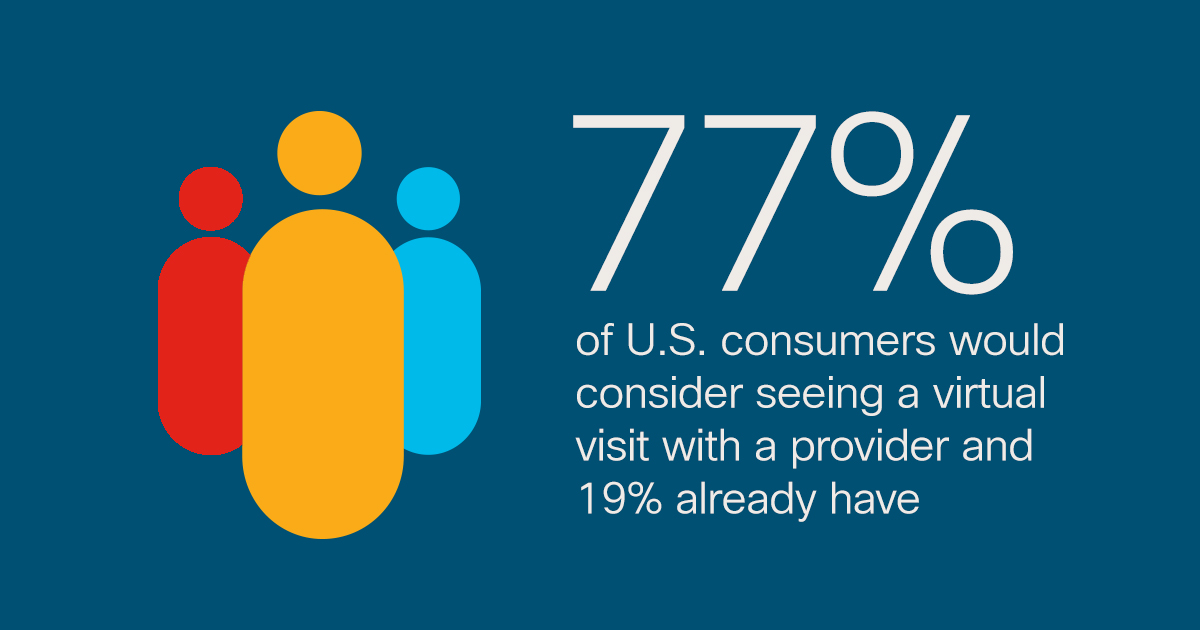
Up to 77% of U.S. consumers would consider a virtual visit with a healthcare provider—and 19% already have—according to a survey from The Advisory Board Company.

In a 2017 Reach Health study, 93% of healthcare professionals identified “integrated audio and video for live patient engagement” as the most valuable feature of telemedicine systems. The study also identified top objectives for telemedicine programs as follows:

  • Improve patient outcomes
  • Increase patient engagement and satisfaction
  • Improve patient convenience
  • Provide remote/rural patients with access to care
  • Improve leverage of limited physician resources

Read on for examples of how organizations worldwide are improving patient care and business processes:

  • North and East London Commissioning Support Unit
  • NYC Health + Hospitals
  • Ontario’s London Health Sciences Centre
  • The Steadman Clinic
  • Lee Memorial Health System
  • City of Houston Emergency Services


.

UK’s North and East London Commissioning Support Unit (NEL CSU)

Simplifying access to care

NEL CSU worked with Stellar Healthcare to create HealthConnect, a cloud-based service for booking secure video consultations with doctors. When patients call to make appointments, receptionists do initial triage to identify appropriate cases for video calls.

The service has proved very popular with patients. Wait times are shorter and patients can meet with their general practitioners from home, or even work. This is especially helpful for patients with full-time jobs, young children, chronic conditions, or restricted mobility. Everything runs on the UK’s National Health Service N3 network, ensuring information remains private.

“Using video has improved the quality of remote consultations and makes our support more appropriate to each individual. It also appeals to younger and tech-savvy patients.”
Debbie Bodhanya, CEO, Stellar Healthcare

Stellar Healthcare estimates that video consults could reduce missed appointments by 40% while improving the productivity of consulting time up to 70%.

Learn more about how NEL CSU and Stellar Healthcare are working together in the full case study.


New York City’s Correctional Health Services

Reaching an oft-forgotten population

NYC Health + Hospitals is the largest municipal health care system in the United States. Within it, the division of Correctional Health Services maintains a clinic presence at each of the City’s 12 jails. In the past, the jails had to transport inmates to public hospitals for specialist care. Not only was this expensive and time-consuming, but had obvious security risks.

“Many specialist care interactions do not require a live visit with the patient. In those situations, telehealth is an ideal solution.”
Dr. Erick Eiting, Correctional Health Services Director of Specialty and Emergency Services

Omitting transport also helps patients. “Patients are also in a better frame of mind to interact with us because they haven’t just been through a grueling transportation experience,” says Dr. Vingh Pham who sees patients from Bellevue Hospital. “Every telehealth session has ended on a positive note, with no security incidents.”

“Telehealth is also more flexible—we can jump from facility to facility and schedule back-to-back sessions without moving anyone,” says Dr. Eiting. “We’re getting a lot more done in a lot less time.”

Learn more about how NYC Health + Hospitals is improving healthcare for the correctional services population.


Ontario, Canada’s London Health Sciences Centre

Boosting productivity and improving training

With 15,000 employees, London Health Sciences Centre and St. Joseph’s Health Care London is using collaboration technology to reduce travel, streamline workflows, and improve communications between specialists.

“Having a solid platform for digital healthcare is vital. We’re able to work more efficiently, flexibly, and securely, and deliver better outcomes and quality of care to our patients.”
Glen Kearns, CIO

Like many hospitals, pagers were still prevalent at London Health Sciences, with 6,000 staff members using them. Moving 2,000 users to Cisco Jabber has both reduced costs and boosted productivity. For example, clinicians can view the availability of colleagues and use chat to resolve issues in real time.

The video element of Cisco WebEx has also had a huge impact. Beyond time efficiency, WebEx allows the hospital to train users in diverse locations over a single session. With Canada’s annual minimum requirement for 50 hours of training per physician, video solutions help save time. It adds up: Saving about 100 hours of a doctor’s time each year translates to up to 600 additional patient consultations.

Learn more about how London Health Sciences Centre is using collaboration solutions to improve business processes.


The Steadman Clinic

Advancing sports medicine and orthopedics

The Steadman Clinic is a world renowned orthopedic institute that specializes in performing complex surgeries. Patients come from all over the world to be treated by the clinic’s surgeons.

“[Cisco] Spark is a unique technology that allows for collaboration across all aspects of a business, an organization, and, for us, the health care delivery.” Dan Drawbaugh, CEO, The Steadman Clinic

Implementing Cisco Spark and devices like Cisco Spark Board has allowed The Steadman Clinic to improve communication within the organization as well as with other medical facilities worldwide.

https://www.youtube.com/watch?v=6vF97IeLtms&list=PL9DD5D64E0603C96C&index=4


Lee Memorial Health System

Saving critical minutes with mobile video

Lee Memorial Health System implemented has “mobile telestroke carts” to expand stroke care services across its hospitals. When patients arrive in the emergency room with stroke symptoms, the staff uses the carts to connect remote doctors to patients using Cisco video conferencing and Jabber.

These quick connections with on-call physicians can help save crucial minutes in treatment. Neurologists can evaluate a patient within minutes of the ER physician’s call from any remote location. After an assessment, the neurologist is immediately accessible to consult with the care team over video.

“There are obvious benefits to our community in the level and speed of care we’re able to provide.” Dr. William Carracino, neurologist, Lee Memorial Health System

The solution also gives patients more face-to-face time with doctors because doctors spend less time moving between patient rooms.

Read more about the telestroke carts at Lee Memorial Health System in the full case study.


City of Houston Emergency Services


Use our case study index to search by industry, technology, location, or products to find more case studies about organizations using Cisco collaboration technology.


Authors

Kim Austin

No Longer with Cisco

Avatar

Today, Talos is disclosing several vulnerabilities that have been identified in CorelDRAW X8. CorelDRAW X8 is graphics suite used for manipulating raster and vector images and is a common alternative to Adobe Creative Cloud. Several of the vulnerabilities being disclosed today specifically affect PHOTO-PAINT X8, a raster graphics editor. Talos has responsibly disclosed this vulnerability to Corel. Corel has made a software update that addresses this vulnerability available for download.

Read More >>

Authors

Talos Group

Talos Security Intelligence & Research Group

Avatar

Partner feedback is at the core of everything we do at Cisco.

Talking with partners is one of the best parts of my job. Over the last few months, I’ve been traveling across the Americas attending a number of partner events – Commercial Channel Advisory Board (CCAB), Partner Operations Advisory Board (POAB), Cisco Live, our own Cisco Partner Executive Exchanges (CPEE) in Latin America and US, and much more. So far this year, I have had the pleasure of spending one on one time with more than 400 partner executives.

I get the greatest ideas on how partners and Cisco can truly innovate and deliver powerful digital business outcomes for our customers when I spend time with our partners. This is so powerful! I share this invaluable feedback with the Americas, Global Partner, Business Unit, Operations and Sales leadership teams at Cisco.  Net/net – our partners deliver more than  90% of our solutions and their voices need to be heard and factored into everything thing we do.


So, what’s the “word on the street”?


Partners want to build adoption practices

Partners are very interested in learning about how to build a Software Adoption Practice. This is great news. We recently redesigned Cisco’s Americas Partner Organization (APO) with a new Recurring Revenue Center of Excellence – led by Connie Dimitroff. Connie and her team are maniacally focused on fully enabling our team and our partners to sell software – and even more important – driving adoption and expansion.

Let’s face it, over the years, Cisco and partner sellers have been excellent at “Landing” deals. Now, we all need to build new muscle memory that helps us “land” differently as we incorporate services to drive Adoption, Expansion and, of course, Renewals (LAER).  Yes – I’m sorry – but we have a new acronym. However, I couldn’t be more excited about the work we’re doing to drive enablement here, and we’re also building exciting incentives for Cisco FY18 designed to reward those partners who are most successful at driving adoption.

Stay tuned!

Impact Workshops are a huge hit!

At Partner Summit last November, I announced Impact Workshops based on feedback from partners during in my travels in FY16 .  Many partners pointed out to me that their sellers needed to improve their “Customer-In” selling capabilities – specifically, how to leverage the Cisco partner ecosystem, how to sell to theline of business buyer, and how to develop real business outcomes. We worked with a handful of learning partners to develop this Cisco training, and the feedback it overwhelmingly positive. The sellers are raving that it’s the best training they’ve had in years, and that it has opened their eyes to new ways to approach a sale.

I love hearing this feedback! By the way, the numbers are equally supportive of the qualitative feedback – the average scores are 4.8 on a 5.0 scale. We’re also projected to train more than 1,500 partner sellers in twelve months – beyond our goal of 1,000!  Wow!

Continue to work with your Partner Account Manager to learn more about how you can participate. We are also starting to think about Impact 2.0 open to your ideas here!

High interest levels in security

Partners are now embracing our position as having the most robust and complete security portfolio in the market. Partners are investing heavily in training their sellers and sales engineers in security, and it’s paying dividends for these partners. Security products and services are driving the greatest profit margins for the partners we talk to ‘on the street.’

It’s also further validated in our annual Partner Profitability Survey conducted by Global Touch. The survey results clearly illustrates that our most profitable partners lead with security, and that their gross margins are, on average, an astounding 45% higher.

In Chuck Robbin’s opening keynote at CiscoLive 2017, he discussed the strategic importance of security in our business, and assured the 20,000 plus customers in attendance about our ongoing commitment to be the leading security player in the market – because our customers expect this from Cisco. I’m excited the Cisco partner community is embracing our portfolio, and FY18 will be chock full of enablement around security and incentives to drive partner profitability.   

Learn more about our Security portfolio.

Apple and Cisco

Partners have been asking me, “How’s the relationship with Apple going?“ My answer: It’s going great and it’s very real, as evidenced by Tim Cook and Chuck talking it up on stage.

They gave some great examples of how enterprises see such huge value in IOS with a fast lane for Wi-Fi. In addition, the C-suite will find great comfort with the enhanced security features that are a part of the Apple and Cisco roadmap. They even talked about Apple and Cisco teaming up to push for cyber security insurance discounts. Pretty cool!

Looking ahead

These are highlights I’ve captured after talking with our partners. We can’t emphasize enough how important our partners’ feedback is for our mutual success and for driving customer outcomes going forward.

If you missed me on the road, please leave your feedback or commentary in the comment section below so we can capture your insights.

Finally, if you want to learn more about how we can help you in these areas, reach out to your PAM or SE, or check out our partner tools.

Thanks and great partnering!

If you are not a Cisco partner, here’s how you can get started today.

Authors

Rick Snyder

Senior Vice President

Americas Partner Organization

Avatar

The nature of technology is innovation. Innovation challenges the norm, creating new ways to do things; and disrupting and displacing established ways with better methods and even whole paradigm shifts that completely change how the world operates. It is not that unusual for a new company to create a new market with an innovative idea, product or service and transform itself from a small startup into a multi-billion-dollar company. Recent examples include: Facebook, Netflix, etc.

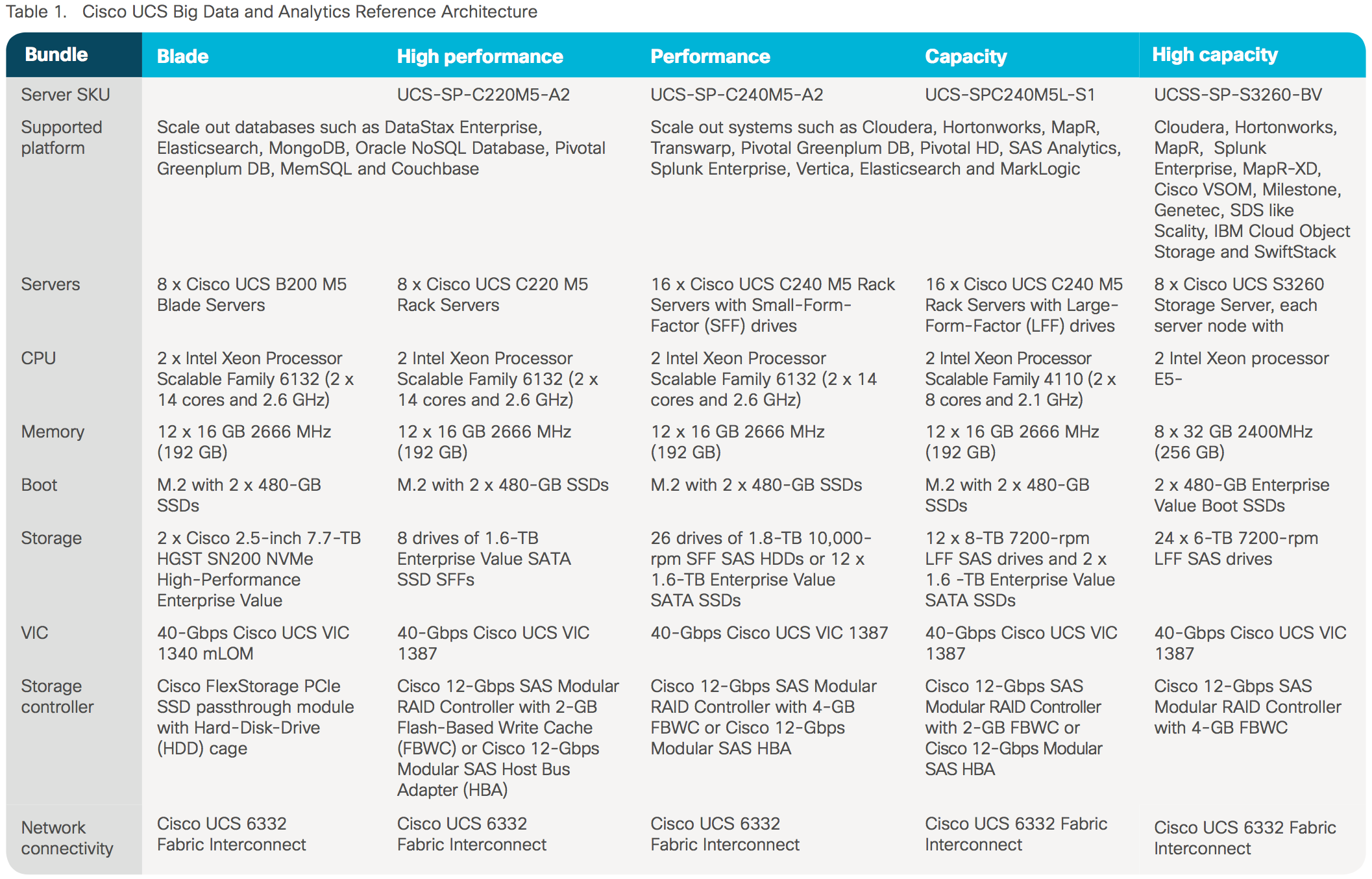
It is rare to find instances where a large enterprise enters an established market and disrupts it with an innovative product. A recent example is Apple’s iPhone disrupting the mobile phone market. Another such example is Cisco UCS disrupting the server market, growing from zero to 60,000 customers and #1 market share in the x86 blade server market in just a few years. Cisco UCS disrupted the market by changing the way enterprises think about how to deploy and manage infrastructure across their environment by creating a fully programable infrastructure that encompasses compute, storage and network.

Since the early days of Cisco UCS, rather than build individual components, we focused on creating a ‘system’ providing a single management entity freeing enterprises to focus on business needs rather than infrastructure management. Along the way, we built partnerships with major ISVs, such as IBM, Microsoft, Oracle and SAP. Several notable achievements: ranked #1 in converged systems server revenue in 2016; ranked #1 platform of choice for SAP HANA; plus several Number 1 performance and price-performance records. Another notable achievement is the growth of our analytics business – fifteen times growth in the last four years. Our analytics portfolio includes Apache Hadoop, ITOA and Internet of Things analytics. According to IDC Cisco customers reported substantial value through Big Data operations with the Cisco UCS solutions – on an average 366% ROI in three-year return on investment. We’ve been successful in the analytics space because our strategy has been 100% aligned with industry trends. Stay tuned for solutions for machine learning and deep learning.

In my earlier blogs, I’ve talked about the pillars of digital transformation: the power derived from connecting people, processes and things, and the creation of value through data analytics. Cisco is uniquely positioned to deliver intelligent infrastructure allowing enterprises to turn data into insight either through real-time stream processing or historical analysis.

Today, I’m excited to announce our 5th Generation of Cisco UCS Integrated Infrastructure for Analytics. It builds on the architectural superiority of the previous generation, which has been widely adopted across major industry verticals including: agriculture, education, entertainment, finance, healthcare, industrial, insurance, manufacturing, public-sector and utilities.

Our fifth generation offering continues to build upon our proven track record of performance leadership and features complete solutions with industry-leading partnerships, incorporating: new Cisco UCS M5 servers powered by Intel Skylake family of processors; broad support for hard disk drives, SSDs and NVMe; and 40-Gbps connectivity delivering significant performance and efficiency gains.Our reference architectures are carefully designed, optimized and tested with the leading big data and analytics software to achieve a balance of performance and capacity to address specific application requirements. These reference architectures, offered as solutions, are supported with leading software partners including Cloudera, Couchbase, DataStax, Elastic, Hortonworks, IBM, MapR, MemSQL, Pivotal, SAP, SAS and Splunk.

You can deploy these configurations as is or use them as templates for building custom configurations. You can scale your solution as your workloads demand, including expansion to thousands of servers through the use of Cisco Nexus® 9000 Series Switches.  The configurations vary in disk capacity, bandwidth, price, and performance characteristics. Base configurations for each solution are listed in Table 1.


Additional Information

Authors

Raghunath Nambiar

No Longer with Cisco

Avatar

Hello all,

We are excited to have another guest blog by JT Ripton and Peter Scott. This time they cover some goals to set for next year as a Small Business Owner. We hope you enjoy the article.

Seven Goals to Set as a Small Business Owner in 2018

You might think you have eons until 2018 arrives, but next year will be here faster than you think. Now is the perfect time to start planning your goals for the coming year so you can make your business stronger and more effective than ever before. Check out these seven goals that can help you reach more clients, increase your brand’s reach, improve brand recognition and stimulate revenue.

Devote More Time to Social Media

Some business owners love social media while others avoid it. Whether you love or hate social media, it’s undeniably an effective way to market your business. If you’re ready to launch a social media marketing campaign in 2018, follow these steps to make sure you reach your goals:

  • Select the right social media platforms. If you run a restaurant, Facebook will help you share promotions, photos and customer reviews. If you are a clothing retailer, you’ll want to focus on creating eye-catching content for Instagram.
  • Involve your audience. If you already have an existing list of email subscribers or contacts, let them know about your social media account so they can follow, friend, or otherwise engage with you there.
  • Set specific social media goals. Do you want to get more likes on your content? Are you interested in growing your subscriber base? Do you want to increase conversion rates? Decide what, exactly, you want to accomplish this year.
  • Post regularly. Set a specific schedule and avoid deviating from it. Your audience will begin to expect consistent activity on social media from your brand.
  • Partner with influencers. If you can find industry influencers, you will expand your social media reach considerably.

Once you get started with social media — or revamp your existing social media marketing efforts — you could experience a significant return on investment. Just remember that you might have to spend several months building your presence and acquiring followers before you see results.

Improve Customer Loyalty

Consider starting a loyalty program in 2018. Assign members a unique number they can use to accrue points toward discounts, free merchandise, and other goodies. Many stores and companies have successfully used loyalty programs to improve customer retention and increase repeat purchases. As long as you offer enticing incentives, your loyalty program will bring in new business.

Evaluate and Increase Employee Engagement

Did you know that employee engagement can have a direct impact on customer satisfaction? Active, knowledgeable, and eager employees pass on their enthusiasm to the customer. They create a rich, consistent customer experience that sticks with the customer long after he or she ends a transaction with your company. You might start an employee-of-the-month program, invest in more employee development, or find better ways to communicate with your staff.

Invest in New Technology or Equipment

Outdated technology and equipment can give your competitors an edge, and that’s the last thing you want. A convenient small business loan or line of credit can make upgrading easier to fit into your budget. Instead of interrupting cash flow with a big one-time expenditure, spread out your investment over several months.

Your company might need several new things for your office, storefront, or work site, including:

  • Software upgrades.
  • New heavy machinery.
  • Better office equipment.
  • Improved workspace decor or furniture.
  • Enhanced curb appeal.
  • Fresh signage.

Take an inventory of your business to determine what looks or feels outdated. A face lift can help bring in more customers, while upgraded technology and equipment on the back end can make your staff more efficient.

Expand Into New Markets

Maybe it’s time to let go of the status quo and find new customers or markets. Maybe you want to open a new location in 2018, which could give you access to a fresh demographic in a new geographic location. Alternatively, you could identify new potential customers for your products or services, or even create fresh products to appeal to a different audience.

Repeat customers can keep a business alive, but you always want to push the envelope. You can bet that your competitors are expanding into new markets as you read this, so why let them take over market share?

Set Short- and Long-Term Goals

In 2018, don’t just focus on those 12 months. Set long-term goals that take you through 2020, 2030, or even 2040. What do you want to accomplish several years from now that you could put into motion today? In some cases, small tweaks can set you up for big advancements in business as long as you time them correctly.

Make a list of short-term goals, such as the ones you see on this list, as well as long-term objectives that you might not put into motion for several years. Share them with your colleagues and partners, get feedback, and start creating action steps that will lead you to your goal.

Increase Employee Benefits

Your staff has worked hard to help you realize your dream. If you want to keep your top talent on the payroll, consider offering better benefits. You don’t have to increase salaries or even spend lots of money on benefits. Many employees want perks that cost little to nothing, such as:

  • Opportunities to work remotely
  • Access to company resources that they can use to further their career development
  • Opportunities to cross-train in other departments
  • Shorter summer work hours
  • A lounge area in the office where employees can take breaks
  • An on-site library with useful resources

Let your imagination take over for a few minutes as you brainstorm ideas. Alternatively, ask your employees which benefits appeal to them most. That way, they know you’re taking their needs into account. You can also use these features as benefits when looking for new hires, snagging the top talent away from the competition.

Building your business requires some forethought, so don’t wait until New Year’s Eve to plan your small business goals for 2018. If you start now, you’ll hit the ground running on January 1 and start implementing the changes that will get you the best results.

About the authors: Peter Scott is a journalist and editor who has been covering business, technology and lifestyle trends for more than 20 years. You can contact him at PeterEditorial@gmail.com. And JT Ripton is a freelance business and technology writer out of Tampa. He loves to write to inform, educate and provoke minds. Follow him on twitter @JTRipton.

From our team to your, have a great week.

Marc and the rest of the Cisco Small Business Team.


Authors

Marc Nagao

Product Manager

Small Business RV Series Routers

Avatar

Human trafficking is the third largest crime industry in the world. In India, one girl is sold into sex slavery every ten minutes.

Most organizations that work to eliminate human trafficking focus on fighting the crime after it occurs. They rescue girls and prosecute criminals. Operation Red Alert is taking a different approach, focusing instead on prevention and prediction.

This strategy isn’t easy. There are over 660,000 villages in the country and more than 1.25 billion people.

To reach more people, Operation Red Alert reached out to our Australian data analytics partner Quantium. They chose MapR’s Converged Data Platform to develop a big data solution on Cisco UCS infrastructure. MapR technology lets Quantium create an application that integrates real-time analytics with operational processes.

MapR adds performance security and the ability to segregate multiple data sets from multiple data partners for Operation Red Alert

– Simon Reid, Quantium Group Executive for Technology

Quantium analyzes crime and government data to spot human trafficking patterns, identify villages most at risk, and predict traffickers’ plans.

Operation Red Alert uses this data to educate parents, teachers, and children on how to protect vulnerable girls.

With the analytics for Operation Red Alert we’re fine-tuning the algorithm, adding more hypotheses and granular data to improve our predictive capabilities.

– Simon Reid

So far, Quantium has helped Operation Red Alert educate 600 villages, reaching over 600,000 people since 2014 and equipping them with the knowledge to protect young girls in India.

For Cisco Partners

To add data analytics to your offers, visit our Big Data campaign on PMC

Or partner with MapR to add their converged data platform to your solutions

Watch how Operation Red Alert is preventing human trafficking:

https://www.youtube.com/watch?v=wUUl_sqP31E


Authors

Rebecca Benen

Marketing Manager

WW Sales - Partner Programs

Avatar

What will work look like in 10 years? We’ve heard a lot about the ways new technologies—artificial intelligence, virtual reality, robotics and the like—will disrupt work as we know it.

Will we have a shiny new future, where machines take over menial or repetitive tasks so people can be free to pursue more creative work? Or will AI and robotics take all the jobs, leaving humanity with no meaningful work and a broken economy?

We know from pop culture that we are notoriously bad at predicting the future. Unlike the Jetsons, we don’t zip around with jet packs. No hoverboards from Back to the Future. And 2001 came and went without a computer trying to take over a spacecraft, or the world. And yet we keep trying. And worrying.

Socrates worried 2,500 years ago that by releasing language from the constraints of time and space, the written word would destroy human memory and the art of argument. Today, parents and educators worry that social media is destroying the face-to-face social skills and relationships. In the 1800s, critics of steam locomotives worried that traveling at speeds approaching 50 miles an hour could cause women’s uteruses to fly right out of their bodies! Today, we have growing anxiety about driverless cars—can they be hacked? Will they cause accidents? What will happen to taxi drivers and long-haul truckers?

While we all see the promise of technology, many people see a dystopian future where automation replaces workers and nothing replaces their jobs. Or where drones, facial recognition technology, big data, and analytics are so pervasive that privacy becomes a distant memory.

So what vision of the future do you see?As creators of massive transformation, we need to be thoughtful about how new technologies will challenge and change the ways we work, learn, and interact with others. And we need to be careful about how to lead people along the adoption curve, considering broad social and ethical issues as we develop and shape our society.

That is one reason we on the CHILL team are excited to be ramping up our focus on the Future of Work. Technology is changing how, where, and when we work, and we want to be able to anticipate these changes.

Cisco Hyper-Innovation Living Labs (CHILL) represents a unique approach to shaping the future. At our Future of Work lab this coming November, we will compress two years of innovation into two days – winding up at the end of the process with several viable work-related solutions that teams will pitch to senior executives for on-the-spot development funding. To help us prepare, we’re inviting a select group of people from some of the giants of industry to go on a “learning journey” with us next week. We’ll be visiting some of the most innovative companies in Silicon Valley to see how the future of work is shaping up. And we’ll be asking questions focused in three areas:

  • How will the worker of the future evolve? What are the changing expectations of future workers? How do the gig economy and talent sharing match supply to demand on an ad hoc basis? What tools do freelancers need for insurance, accounting, and tax preparation?
  • How can technology augment the worker? How will artificial intelligence, augmented and virtual reality, robotics, chatbots, and other technologies help humans create orders-of-magnitude improvements in productivity?
  • What is the workspace of the future? How does technology change how and where work gets done? Has geographical distribution become irrelevant? Should we be designing and using physical offices differently?

By exploring these and other questions, we’ll be looking for ways not just to predict, but to shape the future of work. If you’re interested in being part of it, we still have a few spots available for our Learning Journey on July 26. Contact Alice Pollard (alpollar@cisco.com) to request an invitation.

Authors

Kate O'Keeffe

Senior Director

Customer and Partner Innovation

Avatar

Leading into 2020, picture a world where Millennials are the shoppers in store with THEIR kids, and Gen Z, your teenagers, the “partial attention generation”, is the new growth demographic for retailers. So the definition of consumers is changing: technology-driven shifts empower customers, guests and fans to assume a greater, if not complete, role in designing and directing their own products and experiences.

In order to build a successful relationship with the consumer of 2020, brands must acknowledge the growing role of the individual and incorporate technological innovations that match consumer capabilities and deliver on their increasing expectations.

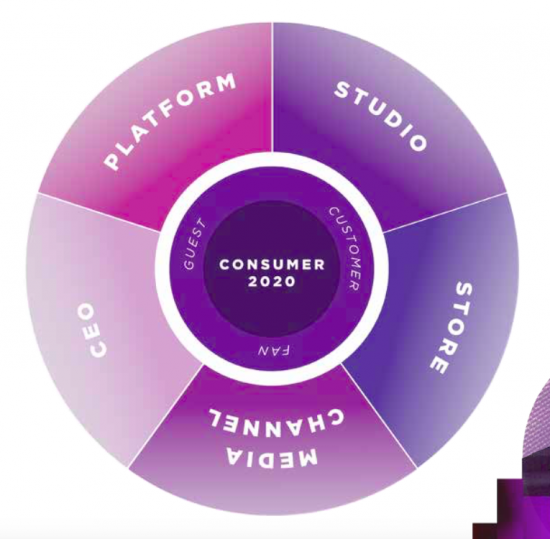
Consumer 2020

The consumer no longer simply interacts with a store, hotel, stadium or media channel; he or she possesses the tools and skill set to embody those roles independently.

They are the STORE – they have the store in the palm of their hands, they are the STUDIO – creating shoes and beauty products with the ingredients that they want, they are the PLATFORM – they drive the experiences that they want; they are the MEDIA – they create their own media and choose to watch content created by friends over TV and other media outlets. They are even driving the CEO’s agenda – companies are experiencing a mandate to go digital or run the risk of disruption.

Research shows that 4 out of 10 companies will fail over the next decade if they cannot transform their business to meet today’s digital demands (Digital Vortex, Global Center for Digital Business Transformation). This research supports what we see in today’s marketplace: a repositioning of malls and hotel chains, mergers and acquisitions and closures, disruptive and surprising technical capabilities – major shakeups across the board.

In the midst of all this change, businesses are pushed to continue driving revenues and lowering operating expenses. The essential strategy to survive in such an environment is to invest in a technology foundation that is supple enough to adapt to each change as it comes along, from reorganizations to new business practices. In other words, companies require a digital network architecture (DNA) to adapt and succeed.

Cisco DNA revolutionizes how companies design, build and manage the network. It means faster deployment and simpler, centralized management of an intelligent network, getting multiple stores up and running in days rather than months. It also offers deep, network-wide insights to support personalized and more relevant customer engagement and smarter business operations. Cisco DNA helps deliver key digital capabilities with a digital-ready foundation that’s secure, simple, and reliable.

Built on such a flexible foundation, retailers, hoteliers, and venue operators are ready for anything. A digital network architecture supports traditional consumers who still prefer face-to-face transactions, while shifting over to meet the needs of digital users. It provides the data needed to enable excellent customer service, gamification, and data sharing as well as new emerging capabilities such as AR, VR, and wearables. Further, it accomplishes all this in a secure, convenient environment.

As we prepare to serve the consumers of 2020, we must be able to give them the power to achieve the experiences they want, from outstanding shopping, ordering, and booking to conducting research, asking questions, and solving problems – over their preferred device or in the store. By building upon a Cisco Digital Network Architecture, businesses are ready to meet these demands both now and into the future.

With Cisco Digital Network Architecture as your foundation for digital transformation, you can:

  • Deliver a differentiated customer experience across all channels
  • Drive store operation excellence and associate productivity
  • Accelerate development and scale of new products and services
  • Respond to market demands with speed and flexibility (AMAZON disruption challenge)
  • Improve capabilities across the retail supply chain
  • Protect and enhance brand value

Read the full Cisco and PSFK report here: Consumer 2020

https://www.slideshare.net/Cisco/cisco-and-psfk-consumer-2020

To learn more about how Cisco DNA enables a new generation of retail and experience strategies, please go to: http://www.cisco.com/c/en/us/solutions/enterprise-networks/dna-retail.html


Authors

Brian McDonald

Global Retail & Hospitality Industries Marketing Lead

Private Sector Industry Marketing

Avatar

One of my favorite quotes goes something like this: Live life, not by the moments you have to breathe, but by the moments that take your breath away.

It’s fitting for my team at Cisco (I work in HR for the Talent Brand Team. If you’ve read this blog or seen the @WeAreCisco social channels, that’s us!) because we work really hard, but we also take the time out to hear the latest life story.

On my team in the last year, we had a team member get engaged, we’ve watched one build a new relationship, we’ve consoled losses, laughed at fur kids and clapped as a few moved into new homes.

And we celebrate all these things a little differently, because Cisco is a global company. That means on most days, I don’t see any of my colleagues in person (I see their faces on a Webex!) We span the globe – Seattle, San Jose, Florida, Raleigh, Israel, Bangalore, Ireland, and China – where next?

When the time came for the latest bit of news, that meant we had to get a little creative.

A teammate announced she was going to be a new mom! It’s tradition to have a baby shower on such occasions, but how was that going to happen with all of us in a different world corner?

Three words. Virtual. Baby. Shower.

First, we had to arrange a time where she wouldn’t expect anything so we had an element of surprise. Then, I went in search of baby shower games that would be suitable for a Webex environment.


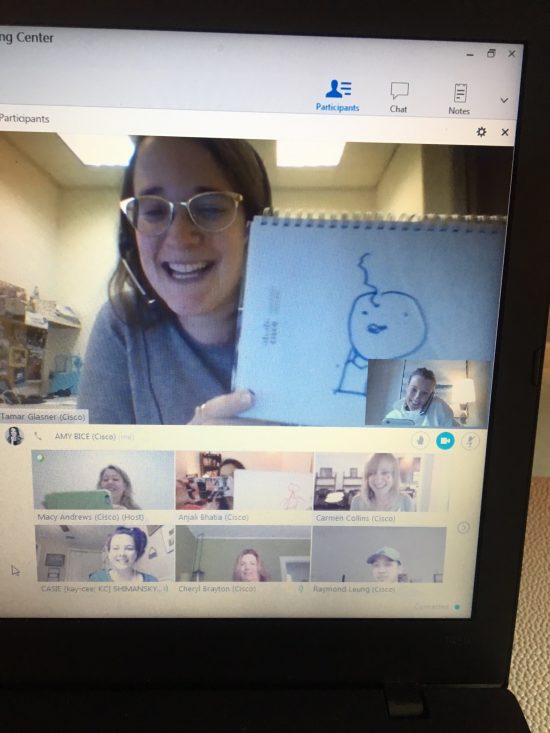
We played “Guess the Baby” – where each team member sent in a picture of them as a baby and we guessed who the cutie pie was. Then, we played a game where each person had four stickers on their shirt, and if you said the word “baby” you had to remove a sticker, and the person with the most stickers won at the end. And then we had to hold a notebook on our forehead and draw a baby while only looking at the Webex camera – the artwork was hilarious, as you can see, below.


After the larger team celebrated, our smaller social media team had a little surprise of our own. No need to explain when you can just watch.

https://youtu.be/dVxxKaVenDk

But you’ll say: “You’re the Talent Brand team, your team is fun anyway. No other teams at Cisco do this.”

And I’d answer “Oh no we’re not the only team that would!” And I’d also say, we don’t have baby showers, virtual or otherwise, for just the moms to be!

Just take Jason Potter for example. He’s a Hardware Engineer and Technical Leader at Cisco, and he and his wife just had a new baby boy! (Congrats!)


His team in Austin, TX couldn’t let that just go by without any fanfare. Oh, no. They went on a group outing to celebrate and got him a “New Dad Survival Kit.” It was actually an apron that they filled with all sorts of things a first-time dad would need. Things like:

  • Rain poncho & Safety Glasses – you know, for diaper-changing purposes
  • Tongs – to carry the diaper to the trash
  • Mask – babies can sometimes not smell so good
  • Plastic Gloves – again for the diaper changing
  • Bubbles – to entertain the baby
  • Clip on flashlight for a hat – better to see when cleaning the baby
  • Diaper cream
  • Hand Sanitizer
  • Tide wipes – so he doesn’t have any spit up on his work shirts
  • Lysol spray
  • Baby rattle – for Daddy/Son time

So you see, we’re more than just co-workers. And we’re more than just work. I can tell you that my team (and many others I see) work their tails off, but at Cisco, the people matter just as much as the results do.


Want to join us? You should check out our awesome new Careers site!


Authors

Carmen Shirkey Collins

Social Media Manager

Talent Brand and Enablement Team, HR