Avatar

I’ve been learning about customers who have kicked off their hybrid cloud efforts by using HyperFlex with CloudCenter—which is the Cisco UCS based hyper-converged solution that includes Cisco CloudCenter. Register for this Sept 26 webcast to find out what other customers are doing with HyperFlex with CloudCenter. And learn what you can do to jump-start your hybrid cloud initiative with Cisco.

HyperFlex is an industry leading hyperconverged solution. And CloudCenter is an application-centric management layer that spans HyperFlex and various public cloud environments. So all you need to get started with hybrid cloud are HyperFlex, a public cloud, and CloudCenter.

Throughout these interviews, I’ve identified several common adoption patterns that are not specific to company size, industry, or geography. Studying trail blazers exposes key success factors as you chart your hybrid cloud journey.

Key Success Factors

1. Start somewhere. It may sound obvious, but I’ve found IT organizations get analysis paralysis. If you have experience managing workload deployments in datacenters and now the cloud, and are looking for a common management framework across them all, taking the next step forward shouldn’t be a massive undertaking.

Everyone has their own business problems they are looking to solve with hybrid cloud. Some of the organizations have very critical workloads they want to choose where to deploy, such as a university IT department that deployed end of semester testing environments, or a retailer that stood up temporary marketing sites in either on-prem or cloud environments. Others want to influence those who are already deploying dev and test stacks in the cloud, and offer self-service to their choice of environment. One customer had a rapidly growing cloud bill because it was easier for their users to tap the cloud than go through IT’s internal help desk system. So, they wanted to simplify and automate the process by bringing the cloud user experience back to their data center.

Remember, you don’t need to solve for everything cloud and have a soup to nuts strategy to be able to move forward with hybrid IT. HyperFlex with CloudCenter give you an easy onramp with a common automation and governance layer that provides a single self-service on demand deployment experience to any supported public cloud environment.

2.  Involve the organization.  Many HyperFlex buyers are on the infrastructure team. But, even if you are using HyperFlex with CloudCenter to add cloud capacity to existing infrastructure, this new level of automation involves multiple parts of the IT organization. Deploying workloads in data centers often involves the VM, networking, security and IT ops teams. When adding cloud, a cloud architect or even compliance team may have responsibility as well. You don’t need to turn your IT organization inside out when moving forward with hybrid cloud. However, a solution that is built on a solid HyperFlex foundation may impact existing processes and roles. So, it’s better to build awareness and socialize a hybrid cloud solution with key stakeholders at the beginning of the project rather than the end.

3. Keep your options open.  Cloud strategies are still evolving. And technology advances within containers and serverless computing are coming on fast. So, it’s important to avoid solutions that are cloud-specific that can use automation and orchestration to lock your processes to a specific cloud or environment.

The good news is, CloudCenter works with vSphere that is part of the HyperFlex system, and any other supported public clouds. So, by utilizing HyperFlex with CloudCenter, your options stay hybrid and open, even as your cloud strategy changes.

4. One tool stack.   Your hybrid IT footprint may be intentional. Or it may be the result of different groups trying different approaches and ending up with different tools. But having unique, environment-specific tool stacks can drive up costs and reduce agility. And even introduce compliance and security risk. This is especially true if you want to have a single view of usage and spending, or have a set of policies and rules applied consistently across user groups and deployment environments.

Additionally, be sure to watch out for vendor-specific tools that are optimized for one environment. A better approach is to use a single automation and orchestration layer that abstracts the underlying cloud APIs and provides a single user interface and policy engine across environments.

Watch this webcast to find out more about these four key success.

Authors

Kurt Milne

Marketing Manager, US

CloudCenter Marketing

Avatar

As we move further into the digital transformation era, the amount of data being created and things being connected continues to explode. This explosion in connections and data combined with applied analytics has the potential to transform our cities, healthcare, transportation, manufacturing and energy industries. The Strata Data Conference is one of the world’s most influential data events and a great opportunity to learn how Cisco can help you unlock the power of your data with our technologies and solutions. Next week, Cisco’s Data Center experts will be at the Javits Center in New York to discuss the latest trends in big data and analytics.

If you plan on attending the event please be sure to add our speaking sessions and booth to your agenda:

Speaking Sessions

Cisco Keynote: Edge to Enterprise – New Challenges and Opportunities

Speaker: Raghunath Nambiar

When: 10:15am Thursday, September 28, 2017

Location: 3E, Javits Center

Cisco Speaking Session: Building the IoT Data Lifecycle

Speaker: Han Yang

When: Wednesday, September 27th, 11:20 a.m.

Location: Room 1E 17, Javits Center

Cisco Solutions Showcase Theater Session: Inside the Cisco IT Hadoop Journey: Secure, Scale, and Derive Value with Big Data

Speaker: Alan Stearn

When: Wednesday, September 27, 2017, 6:35 p.m.

Location: Javits Center Solutions Showcase Theater

Visit our booth (#407)

While you’re at the Cisco booth, stop by our new big data and analytics experience wall to learn about Cisco UCS integrated infrastructure for big data solutions. Attend presentations each day in our theater to hear the latest about Cisco and our technology partners big data solutions.  On Thursday at 2 pm, there will be a book signing by Raghunath Nambiar celebrating the release of his new book – Transforming Industry Through Data Analytics.

We’ll also have lots of great giveaways and raffle prizes.

Follow Cisco Data Center (@CiscoDC) on Social Media

We’ll be active on Facebook, Twitter, and LinkedIn throughout the conference, posting updates live from our booth, sessions, and more. Share your own Strata Data Conference experiences and interact with us using the hashtag #StrataData.

We look forward to seeing you in New York.

Authors

Tim Stack

Product Marketing Manager

Data Center and Compute

Avatar

Craig Tranter is a former educator, and now serves as a technology presenter for Cisco. This blog is the second in his series on advancements and opportunities in education. All views are his own. 

In our last blog post, we finished with an extremely broad question: What’s the future of education?

Truth be told, that’s incredibly difficult to predict. But, there are a couple of concepts that should be developed in more depth in order to benefit our student population.

To introduce this section, let me first bring something to your attention. It may seem obvious, but we have become an extremely visually-orientated society that relies on technology. Don’t believe me? Let me pose a few questions to you, with some of my thoughts, and then you can be the judge.


Can you live without your smartphone?


Quite probably yes, but why would you want to? Don’t you love being able to check the weather, look up when the shops are open, search for that key citation that you need for your dissertation, all from your own personal device? I for one certainly would not want to make do without.


Have you ever Googled how to do something?


Of course you have! Everyone does. In fact, we all do it so much that the word ‘google’ has become a verb and is now part of our everyday vocabulary. Just google it!


Have you ever used a video streaming site to see how to do something?


I most definitely have. When my car breaks down, I’m not going to follow a complex step-by-step guide. I want to be able to see exactly how to fix it. We all prefer to see a demonstration and be able to replicate it. It’s as simple as ‘monkey see, monkey do’, with the added benefit that we can pause content and work at our own speed.

With the process of flipped learning, students are now able to consume the content in their own time, in a way that suits them. This could be a simple PDF document, or reading key pages from a textbook, but now, through the use of technology, we are able to produce visually engaging content that encourages students to extend their own learning beyond the classroom.

Gone are the dusty old textbooks and boring 300-page PDF documents. Imagine being able to use this technology to send out visually engaging content that students can rewind; pause; fast-forward; at their own pace to suit their learning speed. Students are differentiated by their choice, not the teacher. They can learn at their own speed and come prepared to their lessons with all the groundwork done. With very few contact hours in a standard university timetable, lessons can now be used as a way of extending learning, not simply delivering content. I mean honestly, who wants to pay £12,000 a year for a lecturer to read off a PowerPoint?

Watch out for the next post about video collaboration and support.

Authors

Craig Tranter

Technology Presenter at Cisco

Avatar

An integrated architecture can help service providers get the upper hand over the ever-increasing range of cyber security threats

I’ve visited RSA, the world’s biggest internet security conference in San Francisco, for the past few years. And it’s really brought home to me how fast the world of cyber security is growing. The number of vendors with stands at the Expo has grown immensely. It almost feels like every year, they open up another hall . At this rate, they’ll need a new venue in a few years’ time…

And we get the same impression from Cisco’s 2017 Annual Cyber Security Report, which underlines how businesses are now using a huge range of different security technology. Two-thirds of companies use more than five security products. Most also use more than five vendors, and some are using more than 50.

Getting cyber security wrong can have devastating effects. So it’s hardly surprising that businesses are investing so much in it.

Our research found that most organisations that experienced an attack lost business opportunities. Four in ten said that those losses were substantial.

Naturally, service providers are among the businesses giving a lot of attention to security. They’ve seen how TV5Monde, one of the largest television operators in France, was taken offline for close to 24 hours while eleven live broadcast channels were showing malicious content by hackers.

But the more different solutions companies invest in, the harder it is to manage them all. The challenge for service providers is to make sure they’re protected against the ever-increasing range of threats, without letting it all spiral out of control.

The huge scale of the demands placed on cyber security teams is indicated by another finding of the report – that 44% of security alerts aren’t investigated.

Many of these may present little danger. But some could have the potential to cause millions of pounds’ worth of damage to systems and reputations.

So how can service providers make sure this doesn’t happen?

Simplicity through integration

The answer lies in taking a more strategic approach – and this is where Cisco can help. We’ve worked hard to bring together a comprehensive suite of best of breed security solutions, that provide both breadth and quality. And crucially, we also have the network expertise to bring them together into an integrated architecture.

One Telecom service provider  that we’ve worked with closely on security is British Telecom (BT). The company was looking to boost its defences after experiencing a 1000% increase in cyber threats over 13 months. We’ve helped them develop an integrated approach, bringing together a firewall and other elements, like our Next-Generation Intrusion Prevention System and Advanced Malware Protection

The partnership has enabled BT to stop more threats and brought new business opportunities. They’ve sold the largest cyber strategic security portfolio globally to a nation-state.

Mark Hughes, the chief executive officer of BT Security, says: “I see that BT and Cisco working together will actually deliver real security into increasingly complex and large IT infrastructures across the globe.”

Businesses like BT are realising that, while it’s important to be protected against a wide range of threats, it’s equally essential to make sure all the elements are working together.

Better technology isn’t the whole story – to get the most out of their investment, Telecom, OTT, Media and IT service providers also need to think about the bigger picture.

Find out more about how Cisco is helping BT develop an integrated cyber security architecture.

Authors

Yves Padrines

Vice President, EMEAR Sales

Global Service Provider

Avatar

One of the many cultural attributes that I truly love about Cisco is our amazing giving back spirit.  Over the last few weeks, I have witnessed how our employees came together to help fellow Cisco employees in Houston and Florida respond to the devastation that has occurred in both areas.  This week in Houston, our teams are coming together to help other employees get back up and running—everything from painting and light construction, to working in local food banks.

Last week, was an incredible experience as Cisco, family members, and partners teamed up to deliver positive results every day to those affected by the hurricanes.

Talk about giving back! The combined team…

  • Sorted and boxed over 25,000 pounds of food
  • Assembled 720 back pack meals
  • Unloaded two 18 wheelers and personally distributed the materials to donation drop offs
  • Loaded trucks with food, water, clothing and baby supplies for delivery into affected areas
  • And fed and walked over 50 dogs

Thank you to Cisco’s Laura Baker, Terry Edge, Mark Erkman, Rick Hill, our partners and the entire team that has been helping those in the Houston area. It’s times like these that the Cisco team shines brightest.

Thank you to Walter Fuller and team for leading the efforts in Florida. Now that power is back in most of Florida, we begin our giving back efforts throughout the state.

I want to encourage everyone to continue to do what they can and donate to the Disaster Relief campaigns on Bright Funds for Harvey and Irma relief efforts.

Partners can reach out to their local Cisco PAM to see how they can work together.

Through a combination of employee giving, matching gifts and direct grants, Cisco employees and the Cisco Foundation have contributed over $1.5 million to organizations helping those affected by Hurricanes Harvey and Irma in the US and Caribbean. Learn more about Cisco’s Response.

Let’s keep the amazing momentum going!

I am so proud of our Cisco employees and our partners, and I am truly inspired by their acts of kindness, love and support.  My personal thanks to all of these amazing people! We are blessed to have them in the Cisco family.

Authors

Rick Snyder

Senior Vice President

Americas Partner Organization

Avatar

The Industry is going through an enormous transformation, the likes of which we haven’t witnessed before. Cisco is leading this transformation with innovations that are changing the way we look at networking. The global Infrastructure that is slated to support more than 50 billion devices  needs to move with great agility, and be more customizable to the end-users.  Businesses are looking to IT, and the efficiencies it brings to the table, to be a core differentiator in the hyper competitive market. Across it all, programmability is the key.

What makes programmability unique among other technology feature sets is that it allows you to consume the industry-leading innovations from Cisco in a variety of manners, and add more value by solving your customers pain points better. Programmability helps you integrate with other solutions to make a more rich and customized experience for the customer. If you were thinking about how to differentiate your offerings from your competitors, or pondering how easy would it be to create your own technical solution– then look no further as programmability is the answer.

So how do Cisco Partner Systems Engineers consume these new innovations to add value to their offerings in this evolving Industry? For some, this could be a multi-million dollar question!   There are two key actions that partners (or prospective partners) can take to get started:

  • Develop a PoC/PoV demo around a programmability use case that you can show to customers during your existing sales engagements. Challenge yourself to create a PoC/PoV demo for your customer using programmability and be ready to be amazed by the fruit of your labor.
  • Apply to be a Solution Partner: Continue working on the PoC/PoV that was created, make them into a complete solution and have it showcased in the Cisco marketplace for consumption by customers and other partners.


Over the next two months, Cisco is sponsoring a virtual Coding Camp to help partners develop their PoC/PoV programmability demo.  The Coding camp is for people across all skill levels. Whether you are hearing about programmability for the first time, or are an experienced developer – this coding camp has important elements that will add tremendous value to what you do in your daily job. What we ask from you, is your understanding of your customer’s environment and their pressing needs.

In this Coding Camp, you will be introduced to an easy-to-use template that can help you in creating high quality use cases tuned to your customer’s environment. We will walk you through the basics of programming and make sure you are able to comprehend, start creating and be comfortable with basic scripting. We will then take you forward to using Cisco’s APIs and show you how to effectively combine them and create tremendous value for your customers.  And of course it wouldn’t be a “camp” without some fun along the way.  So there will be rewards, a fun and competitive leaderboard and above all –  a focused and dedicated team of Cisco experts there to help you with all the necessary support in augmenting your sales with programmability.

The Coding Camp is an invitation-only event, but if you’d like to apply please do so by going to the Coding Camp website.

After attending the Coding Camp and developing a PoC/PoV around your solution, you may want to join the Cisco Solution Partner Program. It helps you through the marketing and sales process to accelerate your go-to-market strategy. You would be able to get your solution tested, earn the cisco compatibility logo, and also get the opportunity to present your solutions in highly visible venues like the annual Cisco Live conference, so that it can reach more customers and generate more revenues. For more details, please visit: https://solutionpartner.cisco.com/site/

For more details on the DevNet virtual Coding Camp, please refer to this link : http://devnetevents.cisco.com/event/DevNet-Coding-Camp-Oct-Nov

Become a Developer Solution Partner and get the learning and coding resources you need to develop with Cisco platforms and APIs.


We’d love to hear what you think. Ask a question or leave a comment below.
And stay connected with Cisco DevNet on social!

Twitter @CiscoDevNet | Facebook | LinkedIn

Visit the new Developer Video Channel

Authors

Joel Jose

Systems Engineer

Sales

Avatar

Flexibility, scalability, agility. These are capabilities that everyone claims in the industry. How do you actually differentiate which company’s solution is the best? Instead of boring you with more buzz words, let me show you who really owns the crown for the best data center switches: Nexus 9000 Switches.

Nexus 9000 data center switches are the best in its category based on numerous tests. The data speaks for itself.

Spirent Selected to Conduct Record-Breaking Test of Cisco Data Center Core Switch

“…This test broke new records for Network World, with 10,000 unique IPv4 multicast group addresses, nearly twice as many groups than in any previous Network World project.” – David Newman, Network World

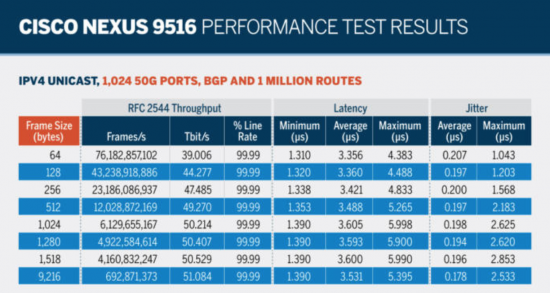
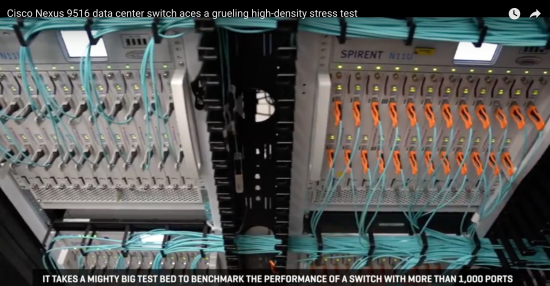
 Cisco Nexus 9516 data center switch aces a grueling high-density stress test

Our test of a Cisco Nexus 9516 with 1,024 fully loaded 50G Ethernet ports – the highest density core-switch test ever done by Network World – found it capable of handling the strain without dropping a packet – David Newman, Network World

Cisco Nexus 9516: Scaling 100G Performance to New Heights

Seven sets of rigorous benchmark test results demonstrated high performance and versatility in every case:

  • Zero frame loss in all tests, covering unicast, multicast, Layer-2, Layer-3, and routing across all 128 100G Ethernet ports
  • Low latency and jitter across test cases
  • Loss-free performance when forwarding to BGP and BGP-MP routes using IPv4 and IPv6 traffic Loss-free performance when forwarding to more than 520,000 IP multicast routes
  • Support for a variety of 100G Ethernet transceiver types

– networktest

Cisco Nexus 9508: A New High-Water Mark For 100G Performance

With 10G and 40G Ethernet speeds now standard in data center ToR switches, there’s no question that 100G Ethernet has become the de facto core switch technology. There is a question, however, as to how high this relatively new flavor of Ethernet can scale. Cisco Systems has a simple answer: As high as you’d like to go.

  • A series of rigorous stress tests demonstrated high performance and scalability in every case:
  • Zero frame loss in test cases covering unicast, 1-to-N multicast, N-to-N multicast, Layer-2, Layer-3, and routing across all 256 100G Ethernet ports
  • Low latency and jitter across test cases
  • Loss-free performance when forwarding to BGP and BGP-MP routes using IPv4 and IPv6
  • Loss-free forwarding to more than 1 million IP multicast routes, a new record, in both Layer-2 and Layer-3 configurations
  • Wire-speed performance across all Layer-2 and Layer-3 multicast test cases

– networktest

Cisco Nexus 9508: A New Speed Record in Data Center Switching

Let’s cut right to the chase: The Cisco Nexus 9508 is the densest, fastest data center switch we’ve ever tested. Even in the rarified world of data center core switches, Cisco’s new Cloudscale Technology ASICs moved more traffic faster, and with lower latency and jitter, than any other switch we’ve evaluated.

The Cisco Nexus 9508 proved its mettle across every high-stress test case. Among the major findings:

  • Virtual line-rate performance in every test, regardless of frame size. In previous tests at this scale using mechant-silicon ASICs, the switch could not handle smaller frame sizes at line rate without loss
  • Record low latency and jitter across all test cases
  • Zero frame loss across all test cases covering unicast, multicast, Layer-2, Layer-3, and routing across all 256 100G Ethernet ports
  • Zero frame loss in N-to-N multicast test cases, both in Layer-2 and Layer-3 configurations. In contrast, merchant silicon ASICs require gaps in test traffic to perform without loss
  • 100G Ethernet power consumption as low as 23 watts per port
  • Loss-free performance when forwarding to BGP and BGP-MP routes using IPv4 and IPv6
  • Loss-free forwarding to more than 1 million IP multicast routes*OIFs/OILs in Layer-2 and Layer-3 configurations
  • Wire-speed performance across all Layer-2 and Layer-3 multicast test cases

– networktest

Miercom: Speeding Application in Data Center Networks

“With the real-world traffic profiles, our testing results show that the Cisco Nexus 92160YC-X and Nexus 9272Q switches outperformed the Arista 7280SE-72 switch for congestion handling. The Arista 7280SE-72 switch has much deeper buffer than the Cisco switches, but with the built-in intelligent buffer management capabilities, both Cisco switches demonstrated clear advantage in flow completion time for small/medium flows over the Arista 7280SE-72 switch and provided the same or similar performance for large-size flows, which resulted in overall higher application performance.”

– Miercom

Authors

Emmeline Wong

Product Marketing Specialist

Data Center Marketing

Avatar

Apple and Cisco have partnered to help businesses in every industry accelerate their mobile transformation. From seamless user experience with collaborative applications to Wi-Fi optimization, the partnership has been grounded in a tangible reality.

Apple designed iOS to be simple, intuitive, and powerful, with security built into its core. But while the device is secure, the internet is not. For example, how do you protect users from clicking on phishing links in text messages or mis-typing domains in the browser? Businesses need to protect users at all times. And like any other enterprise owned asset, there is an inherent requirement to protect the user, device, and business from unnecessary risk. Whether that’s a company issued laptop or mobile phone, organizations require visibility into what is happening on the devices from a risk and compliance perspective.

Thanks to our partnership, we’ve developed deep visibility and control for iOS devices in the enterprise — enabling the business the expand iOS adoption in new ways and helping to remove potential roadblocks due to security or audit concerns.

Cisco Security Connector

Our new application provides organizations with the visibility and control they need the confidently accelerate deployment of mobile devices.

Visibility

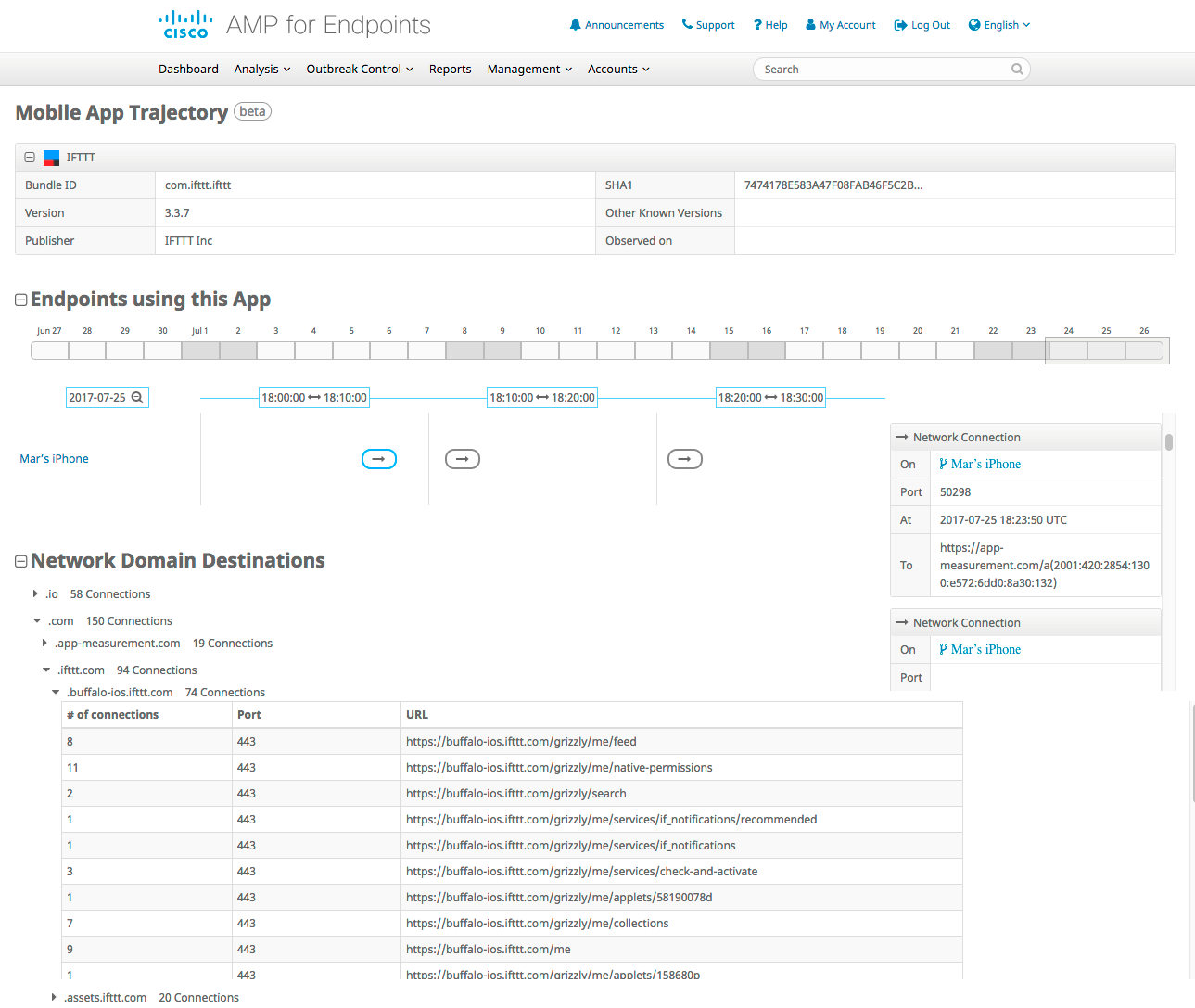
App Trajectory - Cisco Security Connector for Apple iOS

Following a security incident, IT departments must investigate what happened,who it affected, and what the risk is for the company. To do this accurately, they need to build audit reports across users and devices. The Cisco Security Connector gathers all network traffic generated by iOS devices to provide a holistic view of corporate assets, allowing security teams to identify the scope and characteristics of the incident with precision and ease.

Cisco Security Connector will provide a full inventory of the applications installed on devices, allowing companies to pinpoint when users are installing potentially unwanted apps, such as file sharing app like Dropbox, or apps that hide user activity such as Snapchat and Onion Browser.

Control

Users are often the point of vulnerability, as highlighted in our Anatomy of an Attack video. We’ve addressed this by increasing the protection the user receives when tapping potentially bad links. Whether it’s clicking a link in an email or text message that’s part of a phishing attack, or inadvertently mistyping a URL, employees can be taken to sites that try to extract sensitive information from them or deliver malware.

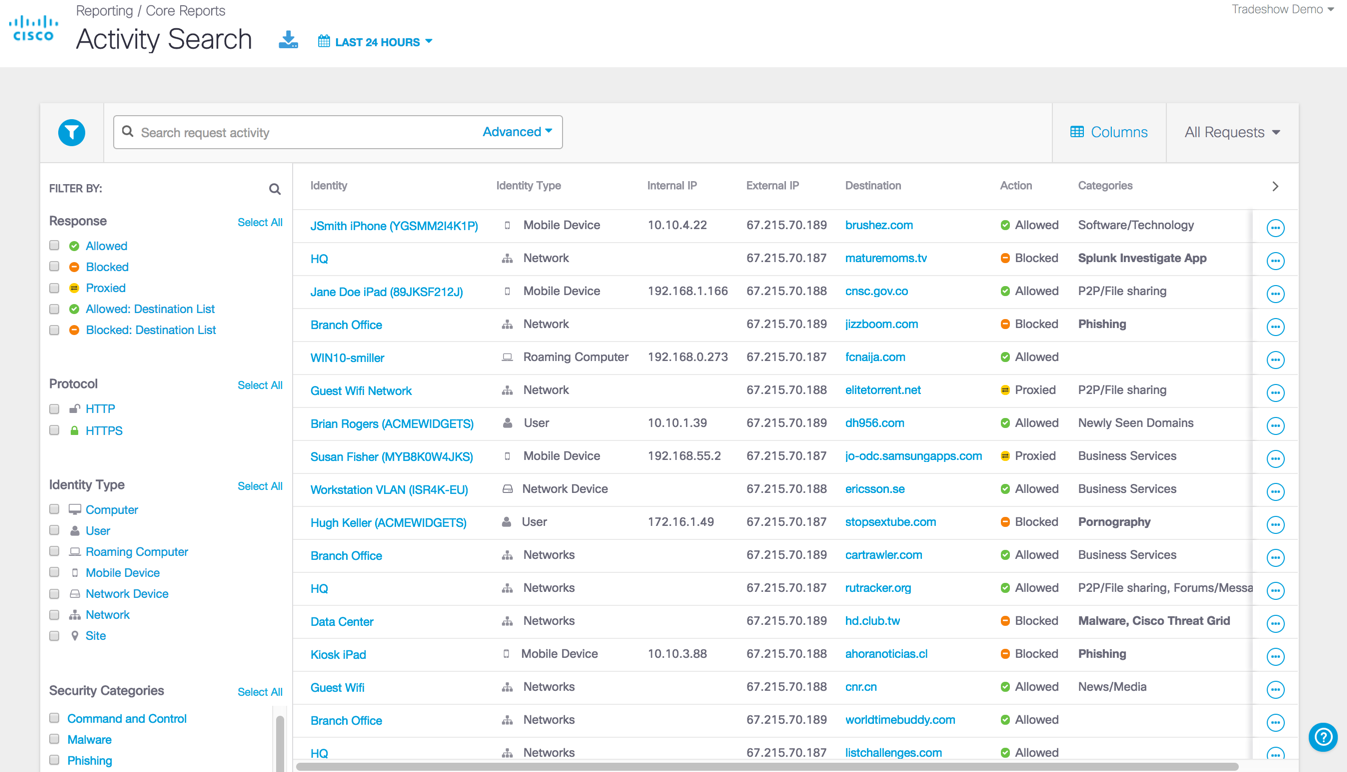
Activity Search - Cisco Security Connector for iOS 11

We are helping businesses protect their iOS users against threats on theinternet, anywhere they travel. When the company increases its control over sites that user’s access, users can be stopped from connecting to malicious destinations, so corporate data is protected. Previously this functionality was only available to users connected through a Virtual Private Network (VPN) but with Cisco Security Connector we’ve extended this to include Wi-Fi and cellular connections.

The Cisco Security Connector is designed for enterprise-owned iOS devices running in supervise mode, and managed by an MDM such as the Cisco Meraki Systems Manager.

Keep an eye out for the full release of the Cisco Security Connector, and if you need more information for now, here is a 1 page overview. Don’t forget to check out www.cisco.com/go/apple to see everything we are doing for the latest version of iOS.

Authors

Joe Malenfant

Director, IoT Marketing

Internet of Things (IoT)

Avatar

It’s that time again: SAP TechEd in Las Vegas!  Local temperatures have cooled to a balmy 150 degrees outside the convention center and 10 degrees inside, reminding us that SAP Data Center refresh season is once again upon us.

This year at TechEd, Cisco will focus on securing critical SAP data and systems, and leveraging HANA to improve business outcomes.  One topic we’ll present is Big Data and Analytics.

Top Ten Considerations for Implementing Successful SAP-based Big Data Solutions:

#1.  Leverage Award-Winning HANA Analytics:
You need a leader in SAP Big Data to help you tackle your HANA-based analytics. Cisco alone won SAP’s 2017 HANA Innovation award specifically for the work we’ve done with HANA, Machine Learning, and Predictive Analytics, to further improve business outcomes.
 

#2.  Go with an IoT Leader:
Your data comes from somewhere, and increasing that somewhere includes far-flung IoT sensors.  Cisco is the first partner to create an SAP-specific IoT Foundation architecture, and we’re the only SAP partner who has integrated our ruggedized routers with Leonardo for faster processing of data at the Edge.  SAP and Cisco IoT projects include Smart Cities & Buildings, Transportation & Logistics, Smart Entertainment for global sporting events, and Preventative Maintenance solutions.

#3.  Protect your Data!  

Cisco believes security should be applied at every level of your architecture and end-to-end across your whole environment.  Most analysts and journalists who cover cybersecurity have awarded Cisco Security their top honors.  We apply our industry-leading security to your entire SAP landscape: your data, your network, your servers, in other words, your complete infrastructure.

#4.  Reduce Risk – Don’t be a Test Bed:
This is a critical but emerging area with HANA and therefore it is important to reduce potential project risk wherever possible.  Cisco and SAP offer a co-developed and tested SAP HANA Vora Big Data & Analytics Reference Architecture, including unique Cisco Validated Design (CVD) support which significantly improves the quality of your implementation and reduces your risk of errors.  In fact, we’re running 2 Petabyte Vora workloads!

#5.  Maximize Network Speed:
High Performance doesn’t only concern your analytics engine, but also how fast you can ingest all that Big Data, especially if you’re dealing with multiple petabytes.  Cisco has the first certified 40GbE for SAP HANA.  What’s the use of having the power of a modern in-memory DB like HANA, if you’re still relying on grandpa’s ethernet to move your data around?

#6.  Prioritize Experience & Expertise:
It is not a surprise Cisco won SAP’s innovation award for HANA & Analytics; in addition to running our own business on it, much of the Big Data, Analytics, and HANA Vora development & testing has taken place in Cisco’s co-innovation lab with SAP. This is the largest SAP co-innovation lab in the world with more than $7M worth of gear and over 100 nodes.

#7.  Maintain your Storage Flexibility:
All your big data ultimately needs to reside somewhere.  Which vendor offers the broadest choice of all-flash and software-defined storage? Surprise, it’s Cisco!  Unlike others, we will never lock you into a one-vendor proprietary option.  Plus, we’re the premier supporter of SAP’s TDI option allowing you to save money by re-using your current storage assets.

#8.  Choose a Policy-based Architecture:
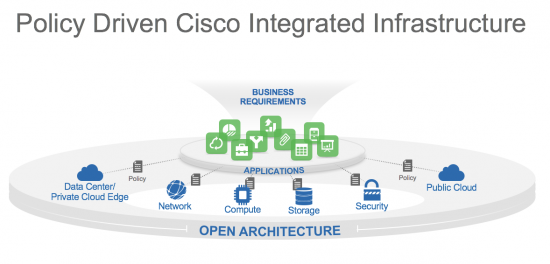
Deploying and managing Big Data and Analytics requires considerable resources and investment.  Why not simplify the cost and effort by having your infrastructure do much of the work for you? Cisco has the only Intent-based Data Center solution certified by SAP, creating what many refer to as “Zero-Touch Deployment and Management” of HANA and HANA-based apps like S/4 and Vora.   Only Cisco’s Data Center portfolio for SAP is designed from the ground up to allow you to establish policies that reduce manual and repetitive efforts, establish zero-trust security, and therefore improve your HANA implementation while simultaneously lowering your IT costs and freeing up resources for other projects.

#9.  Sign up for World-Class Support:
If you’re implementing next-gen HANA-based analytics, logically the best understood platform is the one on which it was developed & tested (hint: It’s Cisco). If you run into a question about your HANA analytics on UCS, Cisco’s & SAP’s support team already know the answer because of our extensive joint experience with the solution.  And Cisco will take your first call, seamlessly managing any needed escalation.

#10.  Visit Cisco at TechEd!
Interested in learning more?  Please click on our SAP TechEd site and visit us next week in Vegas at booth # 808.  And don’t miss our Sales Operations Director, Ted Tsortos, reviewing Cisco’s award-winning implementation of SAP HANA analytics on Tuesday, 9/26 at 2pm (Session #51894).

By the way, we’re giving out Drones and Yeti mugs!            

Authors

Brian Ferrar

Enterprise Marketing Manager

UCS & Data Center