Avatar

This Cybersecurity Month, I’m pleased to present you with the second installment of the Ask the IoT Whiz #CiscoChat podcast, Defending Your Operations in the Era of IoT. In this episode we take a look at the possibilities and potential threats of Internet of Things (IoT) technology.

As connected devices continue to proliferate across the extended enterprise — helping to drive revenue growth, optimize processes, increase efficiency, and make for more meaningful customer interactions — so too do the risks of security breaches. This is the challenge many companies now face: How to make the most of IoT opportunities while protecting infrastructure and data.

In this podcast episode, I chat with IoT Product Marketing Manager John Reno, Security Product Marketing Manager Steve Caimi, and IoT Security TME Mustafa Mustafa. John, Steve, and Mustafa walk through the current IoT landscape before sharing how Cisco’s IoT Threat Defense solution helps customers keep their operations secure. Tune in for answers to the following questions:

  • What are the primary IoT threats?
  • What are the key security challenges businesses face with IoT?
  • How does Cisco IoT Threat Defense work? What are best practices?

For perspective on this pervasive problem, as well as several solutions, listen to the podcast below or on Soundcloud.

To learn more about the topics on this episode, please visit the links below:

Want more of Ask the IoT Whiz? Check out Episode 1, Migrating M2M Networks to IP.

Remember to contribute to the conversation yourself in the comments or on social media by following  @Cisco_IoT on Twitter.

Authors

Stephanie Gaspar

No Longer with Cisco

Avatar

This October, the 14th year of National Cyber Security Awareness Month (NCSAM) focuses on educating consumers on Internet safety.  Consumers can be of all ages and backgrounds, so in the spirit of NCSAM, I’d like to share how beanbags and laundry baskets can be used to teach anyone the basics of Internet routing, security, and privacy.

“Pitching Packets: Cyber Security Edition” is adapted from a game called “Welcome to Packetville” designed by Cisco employees Jennifer Lowry and Marcie Pittman in 2006.  The original game aimed to describe the Internet in simple terms to a population of youth that were exploring the possibilities of STEM careers.  Fast-forward to 2017 and the Global Information Security Workforce Study predicts there will be a cybersecurity workforce gap of 1.8 million in the next 5 years.  For this reason, the original game was updated to concentrate on Internet safety.

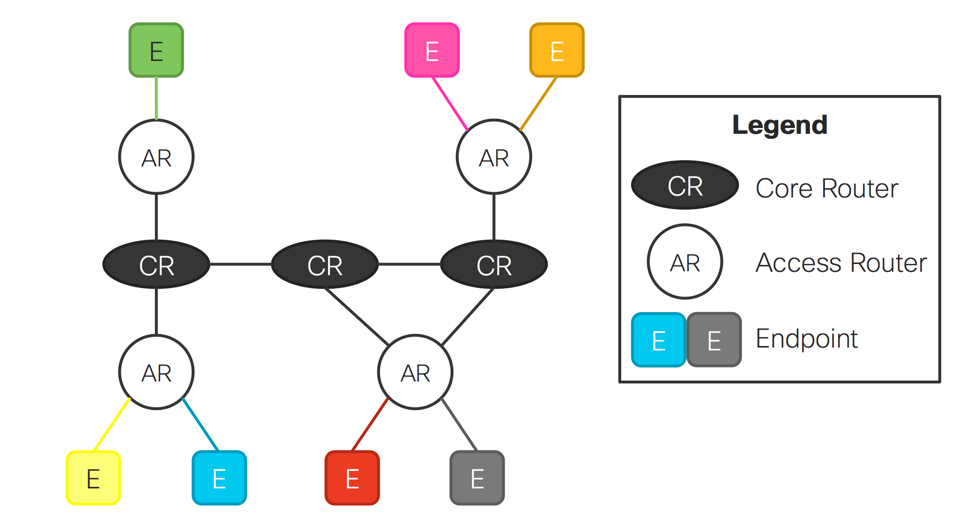
In Pitching Packets, laundry baskets represent the major components of the network (core routers, home or access routers, and endpoints).  To set up the game, create a network diagram by connecting baskets with routes, represented with colored tape between baskets.  While the color of the core and access routers doesn’t matter, the colors of the endpoint baskets represent their address. The network topology is also irrelevant, but the size of the network depends on how many participants are available each game.

Pitching Packets Network Topology

This example topology works well for groups of 20-25 students.

Once the workshop begins, assign students to a router or endpoint (represented by baskets) or to the role of packet sweeper.  Set up every round by giving each endpoint a set of beanbags to transmit (e.g. give the yellow endpoint all red beanbags, indicating it is transmitting to the red endpoint.)  The base rules that apply to all rounds of play include:

  1. The objective of the game is to toss beanbags amongst baskets until they reach destination basket, as indicated by the color of the beanbags. This corresponds to the technical idea that the objective of a network is to route all packets to their destination, as indicated by addresses.
  2. Students may only throw beanbags along a corresponding tape line, as packets travel along network routes.
  3. Students representing components may not pick up beanbags that miss the basket. Participants acting as packet sweepers are the only ones allowed to pick up beanbags and return them to an endpoint, as they represent dropped packets that endpoints are responsible for retransmitting.

These base rules demonstrate several important networking lessons:

  • Internet traffic is fragmented into small units of data, called packets.
  • Core routers handle the most Internet traffic, so that position is the fastest-pace in direct contrast to endpoints, which are only concerned with their own traffic.
  • Dropped packets slow down the network, a situation most have experienced while waiting for a webpage or video to load.

Multiple rounds of play with modified rules provide the opportunity to integrate Internet security and privacy lessons during a post-round discussion.  Rotating the students amongst various roles deepens their understanding of network operations.

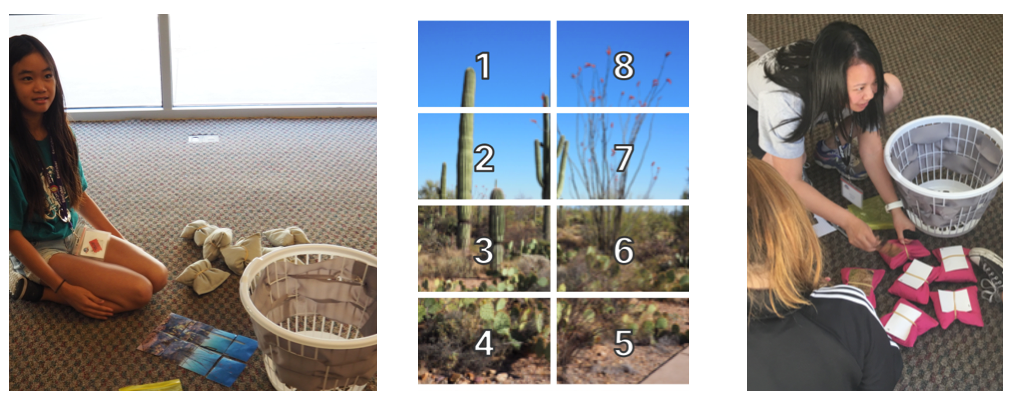
Round 1 introduces the idea that nothing is truly private on the Internet. Cut photos into pieces, number them, and have students attach them to the beanbags.  This directly correlates to the way packet fragmentation and re-assembly occurs at endpoints.  The addition of photos represents sending a picture message or posting a disappearing photo to a social media network.  Students quickly understand that cleartext messages can be read by any component it touches in the network and copies of supposedly private photos may exist on the Internet.

Left: Student playing the grey endpoint reassembles her photo message Center: Photos are cut and numbered for Round 1’s fragmentation and reassembly lesson Right: I demonstrate how to attach messages to beanbags for different lessons

Round 2 introduces the idea that privacy can be achieved through encryption (e.g. with HTTPS or VPNs.)  Instruct the endpoints to write messages and demonstrate information hiding by attaching them to the beanbags with the text facing the fabric.  Alternatively, teach a simple shift or substitution cipher so endpoints can generate encrypted messages.

The virus packet wreaks havoc on the game! Students dump the contents of the core router.

Round 3 introduces various types of network security (e.g., anti-virus, packet inspection, firewall rules) and the concept of a layered approach to defending networks.  Mark a beanbag (e.g. with an “X”) to represent a virus and inform students that if they receive the virus packet, they must pass it to any connecting route.  Afterwards, they must also dump their basket of beanbags onto the ground and await a packet sweeper’s assistance.   During game play, have instructors introduce the virus and allow it to spread amongst the network.  After a few minutes, quietly remove the marked beanbag (as a security researcher might stop a virus.)  Post-round discussion should include how quickly a virus spreads and its effect on the network speed.

I hope this blog post inspires you to recreate this game in your own community. Because it uses easily available materials and no computing devices, this highly energized analog game makes digital security education fun and accessible to all.  Please feel free to use the comments below if you have ideas on adaptations to expand the lessons!

October is Cyber Security Awareness Month, and Cisco is a Champion Sponsor of this annual campaign to help people recognize the importance of cybersecurity. For the latest resources and events, visit cisco.com/go/cybersecuritymonth.

Authors

Jennie Kam

Security Researcher

Security and Trust Organization

Avatar

In its October 2016 State of the Connected Customer Report, Salesforce Research revealed that a whopping 80 percent of business buyers expect companies to respond and interact with them in real time, versus the 64 percent of consumers with the same expectation. It’s clear we’ve reached a tipping point in B2B sales, as business buyers seek both a highly-personalized experience from—and real-time access to—the companies they transact with, even more so than consumers do.

The challenge today is to adapt our selling behaviors to this changing buyer mindset. And to make that happen at scale, we must also adapt our technology stacks.

In today’s digital economy, the technology that powers your B2B virtual sales organization should serve to replicate the consumer buying experience, making all touches and sales motions seamless, engaging and value-oriented. This requires three key components: collaborative technologies that enable buyer interactions (conferencing, chat, social, etc.), predictive analytics designed to help you best understand and anticipate the buyer’s needs, and integration across the data and systems that fuel personalized content marketing, digital commerce and sales enablement.

Get Current with Collaboration Tools

Collaboration tools have become a necessity in our industry for extending sales reach. But collaboration isn’t what it used to be: it now comes in many digital shapes and forms, allowing us to more effectively assist and influence buyers at various points in their journey. While each of our partners has differing business models and sales requirements, here are some key collaboration tools to consider:

  • Conferencing tools to deliver live product demos at the time and location of the buyer’s choosing.
  • Live chat tools that allow virtual agents to interact seamlessly with prospects and customers and provide highly personalized service and support.
  • Active participation in social networks to showcase your expertise to customers. Partners should use these channels to help define buying requirements, demonstrate thought leadership and gain valuable insights into buyers’ habits and preferences.
  • Digital engagement tools such as automated SMS and email push notifications or mobile/location-based apps that can be used to deliver targeted and timely messages to prospects and customers.

The Big Partner Opportunity: Predictive Tools

Two equally important goals of the virtual sales organization are to anticipate the needs of buyers and build relationships based on value delivery. While collaboration technologies can enable personal one-to-one interactions, the ability to integrate these conversations with predictive analytics helps facilitate a purchasing experience that feels more personal and organic to your buyers. In addition, cohesion across technologies allows your sales team to tie every touch — be it a personalized email offer, social media interaction, or product suggestion/landing page — to a direct business outcome.

As much as we tout predictive intelligence and how it can create more dynamic customer journeys, Salesforce Research reports that only 30% of sales teams today currently use it. This poses a significant opportunity for our partners to move ahead of the competition. By taking advantage of Cisco’s analytics-driven partner programs and platforms, such as Lifecycle Advantage, you can get in on the power of predictive intelligence to drive more upsells, cross-sells and renewals, along with stronger customer relationships.

Regardless of the sales tools you have in play, there’s no doubt that the way your buyers are engaging with you is rapidly changing. Now is the time to put in place the people, processes and technologies that will allow you to deliver the seamless experiences that today’s buyers demand. Your reward will be improved sales, faster growth and increased customer retention. It is our commitment to empower you in every way possible to ensure your success.

Watch the on-demand webinar, The Inside Scoop on Inside Sales to learn more about the evolution of virtual sales.

Authors

Nick Ewing

Senior Director, Systems Engineering

Global Virtual Engineering

Avatar

Ransomware and malware attacks have been capturing recent global headlines and like all industries, the education sector is vulnerable to this growing threat landscape. Although the full reputational and financial impact of these attacks are not known, it is a stark reminder of the significant cost that a malware outbreak can have on any organisation. 

Deakin University in Victoria, Australia supports the idea that tactical approaches to security are failing to provide the required level of cyber protection and resilience, and that a strategic approach and investment is necessary to identify and plug the gaps that allow attacks to be successful.

“Cybersecurity is by far the most important challenge we face these days” states William Confalonieri, Chief Digital Officer at Deakin University. Deakin’s motto is ‘Driving the Digital Frontier’ and they live this value by embracing all of the opportunities the digital age can provide and to translate those opportunities into benefits for staff, students and the wider community.

In such a fast-changing landscape, it had been challenging for Deakin to stay abreast of the cyber landscape. Top concerns were around visibility of malware, phishing and advanced threats. Deakin wanted to advance their capability and they were after a solution that would be simple, effective and would allow them to scale and to be able to manage it with less resources overall. 

Watch this video to better understand how Deakin have partnered with Cisco on an holistic end-to-end cyber security strategy, in order for them to be able to deliver on their digital transformation vision.

Interested in learning more about how Cisco is transforming education in Australia? Click here to explore.

Authors

Reg Johnson

General Manager, Education

Cisco Australia and New Zealand

Avatar

Many hyperconverged buyers have infrastructure responsibility in their data center. And if you are an infrastructure manager, Cisco HyperFlex make your job easier by combining hardware and software into a pre-integrated solution that scales out network, storage, and compute resources in the data center.

But what should you think about when extending hyperconverged to hybrid cloud?

Cisco CloudCenter adds hybrid cloud management orchestration that works across by HyperFlex and public cloud IaaS providers. But going hybrid with cloud is a new experience for many infrastructure managers, with new issues to consider.

Three questions to ask

If your IT organization is already going hybrid or just starting to think about adding public cloud workload deployment options, or if your IT consumers are already going to the cloud because it is easier than working through legacy IT service delivery systems — then ask yourself (and your broader IT organization) these three questions:

1. Is consumption variable and unpredictable?

Call it bursting. Call it hybrid capacity optimization. Call it flexibility to meet changing business needs. Whatever you call it, the issue here is that if you are responsible for keeping an eye on capacity, you may not know capacity requirements before a new business project is launched. Or demands for on-premises capacity may vary seasonally, or during specific stages in a development project.

That variable service consumption may be initiated by IT staff. For instance, IT may occasionally deploy a temporary marketing campaign platform that runs for weeks. Or, may deploy a student computerized test taking platform that runs for days, with staggered demand throughout the semester. But during end of semester finals, all the computerized tests are scheduled at the same time.

On the flip side, that variable service consumption may be initiated by people outside of IT. Maybe users such as Dev or quality assurance engineers may need to stand up and tear down short-lived workloads multiple times before production. Researchers may also deploy and access data sets with large compute and storage resource requirements for short periods of time.

Many workloads deployed on hyperconverged infrastructure are predictable and stable. But if you have variable and unpredictable IT service demand scenarios, adding Cisco CloudCenter to a HyperFlex foundation will help you automate deployment and balance workloads both on-premises and in the public cloud. And that actually improves return on Cisco infrastructure investments by maximizing capacity utilization.

2. Does IT want to bring cloud experience back on-premises?

Call it private cloud. Call it virtualization plus automation. Call it an easy button  backed by deployment automation and orchestration. Regardless of how you put it, “the cloud” is seen as a painless and streamlined option, and has trained IT consumers to get what they want, when they want it. Once people have undergone the “swipe credit card and deploy resources” experience, the traditional IT “submit help desk ticket and wait” service consumption process is viewed as unnecessary friction. In many cases, ease of use is pulling users to the cloud. Not cost advantage. Not pay per use billing. And not performance.

With CloudCenter added to HyperFlex, you can bring that easy cloud experience back to your data center. CloudCenter provides a single management and orchestration layer that automates deployment in the cloud and back on-premises. Users get a single interface, and can choose to deploy a VM or a fully configured application stack on HyperFlex just as easily as in the cloud. Plus, they can do this without IT having to manage big private cloud deployment project, and without turning their organization inside out.

If you have legacy processes, think of CloudCenter as a self-service portal that only offers users the ability to make a “pre-approved change.” Users can deploy right now, and IT can apply basic policies as well as cost and usage controls in order to stay in the loop.

3. Do I want to optimize capacity by harnessing the power of automation?

Call it resource optimization on-premises. Call it lowering the monthly cloud bill.

The good news is — there is no issue here. It is all opportunity. You can use automation driving both software defined data center technology and cloud APIs to be a better steward of your resources and funding. If everything is software defined – either via vSphere and HyperFlex connect on-premises or via cloud APIs – you can harness the power of automation to reduce consumption that doesn’t add business value. Adding CloudCenter to HyperFlex allows you to harness the power of automation to reduce unnecessary consumption and optimize resource utilization on-premises or cut your bill in the cloud.

See this webcast to learn more about these CloudCenter features that can help cut your cloud bill.

Getting started

So if you have variable workloads, want to offer the cloud experience everywhere, or want to harness automation to optimize resources, where do you begin?

All CloudCenter features are available with the HyperFlex bundle. There is no tiered functionality or limited feature set. Everything is available as soon as you add CloudCenter to HyperFlex.

In my next blog, I’ll go through a “walk then run” approach in more detail. But for now, start with allowing users to self-service deploy VM or application in a HyperFlex environment, with basic usage and policy guardrails to guide the automation. Or begin by automating scale out, with end-of-life policies that delete workloads after a set period of time. Both of these will get you started with immediate benefit.

Additional Resources

At a Glance: HyperFlex with CloudCenter

Webcast: 4 key success factors learned from customers with HyperFlex with CloudCenter initiatives.

Request a demo: Cisco is a big company. If you take time to request a demo, we will take the time to find right team in your global region to help you directly. Or, you can always ask your HyperFlex seller (Cisco Account Manager or DataCenter Sales Specialist) about HyperFlex with CloudCenter.


Authors

Kurt Milne

Marketing Manager, US

CloudCenter Marketing

Avatar

As more cities and communities undertake digital transformation, Cisco continues to lead with powerful research, vision, technology, and business models all designed to guide our customers’ journey. We continue to evolve our offerings—drawing on internal and partner resources and customer feedback—to lay a path forward and keep it clear, safe, and well lit.

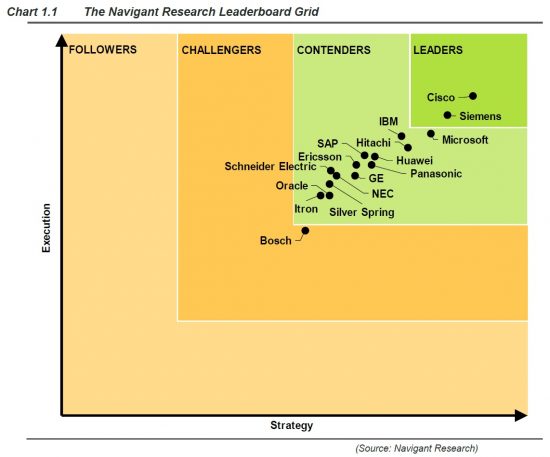
In fact, Cisco was recognized as the #1 Smart City Supplier in the recent report, Navigant Research Leaderboard: Smart City Suppliers, produced by leading smart cities analyst firm Navigant Research. We’re thrilled to receive this recognition!

“Cisco’s position as the leader in the smart cities market is based on its integrated perspective on urban innovation, strong sector-specific solutions, and a commitment to continued thought leadership and city engagement,” noted Eric Woods, research director at Navigant Research. “With the development of its connected digital platform and a range of vertical solution offerings, Cisco is providing an integrated environment for cities moving to IoT-based solutions and at the same time putting its smart city program onto a stronger commercial basis.”

One of the most exciting changes in how Cisco supports smart cities and communities going forward is that our connected digital platform and solutions strategy is now fully aligned with Cisco Kinetic, a new Cisco unified Internet of Things (IoT) platform strategy. As such, the “Smart+Connected Digital Platform” is being renamedCisco Kinetic for Citiesand integrated—along with the solutions for lighting, parking, crowd, environment and others—into the overall Cisco Kinetic platform strategy.

Jahangir Mohammed, VP/GM of IoT, explains: “Cisco Kinetic is a cloud-based platform that helps customers extract, compute, and move data from connected things to IoT applications to deliver better outcomes and services. Cisco Kinetic gets the right data to the right applications at the right timeacross edge, private cloud, public cloud, and hybrid environmentswhile executing policies to enforce data ownership, privacy, security and even data sovereignty laws. These are all critical requirements for any smart city and community deployment.”

“Cisco Kinetic represents an important milestone for Cisco and our customers who are eager to unlock the value of the data being generated by connected machines, things and spaces,” says Jahangir. “Cisco Kinetic for Cities is purpose-built to harness the power of all that data to drive smart city initiatives forward. We’re excited to align our efforts in the development of these IoT technologies that bring simplicity, scalability, and interoperability to organizations across all sectors.”

By integrating with Cisco Kinetic, we can leverage more resources, expertise, and visionary thought leadership across Cisco and a broader partner ecosystem to provide our customers with even better tools and services to help them manage, share, and leverage data and gain new insights.

Cisco Kinetic for Cities will continue to provide a horizontal, data aggregation platform—one tailored specifically to the needs and challenges of cities and communities. It will continue to enable a plethora of solutions and applications from Cisco, our partners and third-party developers through a growing set of application programming interfaces (APIs). The architecture and the approach to deployment for the platform and solutions will be built on the successes (and lessons learned) from current deployments of connected digital platform and solutions—from Copenhagen to Hamburg, from Jaipur to Adelaide, from Kansas City to Las Vegas, and many more—where the benefits of digitization and a platform approach are continuing to accrue.

The municipality of Albertslund, a Copenhagen suburb, participates in the smart city initiatives that Cisco is driving to help Greater Copenhagen achieve its social, economic and environmental goals.

Says Niels Carsten Bluhme—Albertslund’s senior director for city, culture, environment and employment—in a video chronicling the vision and progress of these initiatives, “[By] using sensors, digital management platforms, and analytics programs, we can achieve a number of benefits on the green transformation agenda in becoming carbon neutral. Today, we regard this as the most important accelerator for getting there.”

We are committed to continuing our strong leadership, development, and partnership objectives in the smart cities space. We’ll be making some more exciting announcements at the Smart City Expo World Congress in Barcelona (Nov. 14 – 16, 2017). Perhaps we will see you there!

Stay tuned…

Anil


Authors

Anil Menon

President

Smart+Connected Communities and Cisco Deputy Chief Globalisation Officer

Avatar

Craig Tranter is a former educator, and now serves as a technology presenter for Cisco. This blog is the third in his series on advancements and opportunities in education. All views are his own. 

We know that students no longer need to be physically present in order to attend a university course. And, from our discussions on flipped learning, we know that video is an incredibly powerful tool.

In fact, video calling is becoming ever more popular for conversations amongst staff and students. For many students, making video calls is the new normal.

Cisco offers staff and students a number of ways to connect and collaborate from home using their own devices, such as Jabber, Cisco Spark, and WebEx. There is also a wide range of video endpoints under the collaboration portfolio which are built to suit various learning environments. One of my favorites would be the Spark registered DX80, which is great for 1:1 mentoring sessions as you can share digital content, as well as physical content via the Document Camera, plus control the system through your own personal device. Another great feature of some of the larger systems is the use of SpeakerTrack and PresenterTrack, which allows educators to conduct video enabled lessons with ease. Check out the full range of products and explore example scenarios of each system and feature here.

The use of video collaboration not only means that students no longer need to travel into university to participate in lectures, or collaboration sessions, but they also can reach out via video when they need assistance.

In the past, students were quite often limited to the ever-elusive 1:1 mentoring sessions with their tutors when they needed help. Students would be expected to travel in to the university campus and find their own way to an out-of-the-way office in the bowels of the university. However, students no longer need to commute in to the university campus to get assistance, as there are more ways to reach out for support, in whatever way they feel comfortable, using their own devices. This could be via the university website using help links, or online chat; using Instant Messaging (IM); making a standard telephone call, or even a video call; while still having the option for face-to-face meetings.

In fact, different groups tend to have different preferences. Did you know that more mature students tend to prefer email, whereas the younger generation prefers IM? In addition, mature students still tend to prefer face-to-face meetings, whereas younger students prefer video calling. However, young male students actually tend to prefer IM rather than face-to-face contact when requesting assistance as this can be less embarrassing than talking to someone in person. By having access to support in a number of different ways, students are now able to reach out in the way they prefer and continue to extend their learning.

If supporting students isn’t enough, there are also financial benefits to supporting various means of communication.

There you have it.

Watch out for the next post about Digitally Connected Campus.

Authors

Craig Tranter

Technology Presenter at Cisco

Avatar

Supporting 5G mobility will require a holistic approach to security from service providers

Mobile networks are taking over the world. Our lives are increasingly based around connected devices. We already use phones and tablets almost constantly to keep in touch with friends and work more efficiently. Not to mention planning journeys, shopping, and watching films.

And this is just the start. We’re going to see an increasing number of online devices as the Internet of Things (IoT) grows. Our cars and our watches are already becoming connected. Not to mention our fridges and our toasters.

Evolving network structures

New mobile services will need new kinds of network to support them. As we make the transition from 3G to 4G, mobile networks are becoming more IP-based. With 5G, they’ll become entirely reliant on IP.

One of the service provider that we’re working with to prepare for the challenges of the future is Vodafone Hutchison Australia (VHA). Together with Ericsson, we’re using virtualisation technology to simplify the company’s network infrastructure.

This will enable VHA to become more agile, innovative and pro-active in the way it brings services to market. It will be able to provide a better customer experience, and ultimately save money through efficiency.

That’s why Kevin Millroy, VHA’s chief technology officer, said: “This transformation allows us to introduce new applications to drive innovation and improve customer services and user experience. The new infrastructure opens the door to new business models and markets, such as the IoT, for Vodafone – we’re excited about the future prospects this partnership offers.”

It looks increasingly likely that 5G mobile will depend heavily on virtualisation like this. Patrick Donegan, an analyst for the information company Light Reading, says:

“The telecom industry is arriving at a consensus that 5G requires a fully featured network function virtualisation (NFV) Infrastructure. The piecemeal virtualisation model therefore runs out of road at the 5G inflection point.”

New security challenges

Open, cloud-based network structures will open up many new business opportunities for service providers. But they also create more opportunities for hackers, by increasing the number of possible ways they can attack – whether that’s via a device, the network, or the cloud.

In future, the idea of enforcing a security perimeter around your network is going to make increasingly less sense. In order to make a success of 5G mobile services, service providers will need to take a different, more holistic approach.

Supporting the services of the future

Cisco technology enables service providers to create an integrated security architecture that can support the networks of the future. Last year, we partnered with Ericsson to support 3 Italia in its transition to a mobile IP network.

We used a range of technologies and services, including Cisco’s Firepower 9300 appliance, to help the provider improve its performance and stability.

Nunzio Mirtillo, the head of the Mediterranean region for Ericsson, said: “By leveraging complementary capabilities from Ericsson and Cisco, we are paving the way for 5G, meeting increasing consumer and data traffic demands.”

A comprehensive approach to security

Cisco is able to provide security like this through our comprehensive range of best of breed products . These are constantly being enhanced with the latest insights from Talos, our team of security experts that monitors global threats.

But what really makes us stand out is the ability to combine first class solutions into an integrated security architecture that can provide the visibility and analytics to combat threats across your network.

It’s the only approach that can support the mobile services of the future. You may read Gee Rittenhous’ blog to find out how Cisco security can help you prepare for 5G and the Internet of Things.


Get more resources about Cyber Security for Telecom and IT service provider here.


Authors

Yves Padrines

Vice President, EMEAR Sales

Global Service Provider

Avatar

Simplicity, flexibility, and cost-savings…these are just a few of the well-known benefits of a hyperconverged infrastructure. As an IT expert, you’ve likely seen first-hand how this technology has advanced over the years, outgrowing early challenges like network limitations, inflexible scaling, and silo difficulties to arrive where we are now. But what’s new, and what’s next? How are next-gen solutions helping hyperconverged infrastructure expand beyond the expected — to deliver the extraordinary? To find out, join in on our next #CiscoChat, Thursday, October 4th, at 10 a.m. PST.

The chat will take place on the Cisco Data Center Twitter account (@CiscoDC), and will be hosted by Marketing Manager Maggie Smith (@maggies_groton2), Senior Technical Marketing Engineer Michael Zimmerman (@mzim00), Marketing Manager Stephen Selgrade (@sfselgrade), and Veeam’s Senior Alliance Product Marketing Manager Andrew Lickly (@drewl17). In the chat, the hosts will discuss hyperconvergence and some of its many use cases, and open up the discussion to you — so you can share your challenges, your wins, and so much more.

To participate in the chat:

  • Make sure you’re logged into your Twitter account.
  • Search for the #CiscoChat hashtag and click on the “Latest” tab.
  • Follow the moderator’s account to participate.The Twitter chat will be moderated by the moderator of the Cisco Data Center Twitter account (@CiscoDC), who will begin welcoming guests at 10 a.m. PST (1 p.m. EST) and posting questions for discussion.
  • If you need multiple tweets to answer a question, preface each tweet with “1A,” “2A,” etc. in order to make it easier for others to follow along with the conversation.
  • Be sure to use the #CiscoChat hashtag at the end of each tweet, so that others can find your contributions to the discussion.

Have questions for the group? Ask away during the #CiscoChat. We look forward to talking with you! For more information around this topic, check out the resources below:

Authors

Maggie Smith

Marketing Manager

Enterprise Solutions - Data Center Marketing