Avatar

Cisco Intersight is a transformative cloud-based management platform. It delivers new levels of simplicity and actionable intelligence to achieve significant customer benefits. Industry analysts and partners affirm Cisco’s strategy.

Embracing the Transformation

In a previous blog I explained how Cisco Intersight is a transformative evolution in infrastructure management. Existing systems management tools are deployed on premise as separate tools and appliances. Cisco is moving the management of servers, hyperconverged infrastructure, and the associated fabric and storage to the cloud. By moving management to the cloud, we can apply analytics and machine learning to deliver new insights and deliver a more proactive approach to systems management. This is a bold move that is being implemented in an evolutionary manner to minimize the hassles for our existing and future customers.

Industry analysts responded to the Intersight announcement and commented on the potential benefits of Cisco Intersight for customers of all sizes.

“…many users that rely on the basic functionality of UCS Manager could benefit from the intuitive functions of Intersight”, said Chris Gardner, senior analyst at Forrester Research. (“Cisco Intersight rolls up data center management software”, TechTarget, Sep-22-17)

IDC analyst Ashish Nadkarni points to this cloud sourcing as “the big picture promise” of Intersight. “What you get in this kind of model is a secure way of learning from each other,” he said, explaining that a company with a 1,000-server data center is only going to have insight over those 1,000 servers. “But if I make that 100,000 servers, because now everybody’s infrastructure is pooled in terms of the learning, my chances of troubleshooting or finding out things before they happen goes up.” (“Cisco Starship Pushes Data Center Management to the Cloud”, SDXCentral, Sep-21)

Ashish elaborated on the benefits of cloud-based operations analytics in an interview with Todd Brannon, the director of UCS marketing. The interview was recorded at Cisco Live in June.

https://www.youtube.com/watch?v=B-YDpu1Iw7s

“Cisco’s grand plan is to provide context data to every IT group — network, storage, server and virtualization”, said Torsten Volk, an analyst at Enterprise Management Associates. (“Cisco Intersight to take data center networking to the cloud”, TechTarget, Sep-22-17)

Torsten provided further analysis of Intersight and industry trends in a report he recently published, “EMA Quick Take: Cisco Launches AI-Enabled, Cloud-Managed Infrastructure.”

You can download the report.

Partners Endorse the Advantages of Intersight

Our technology partners are also committed to working with Cisco to deliver improved benefits and differentiated solutions to our customers and channel partners. Eric Herzog, the VP of Product Marketing and Management with IBM Storage Systems and Software Defined Infrastructure, stated in a recent blog post,

The new Cisco Intersight cloud-based infrastructure management platform is an excellent step forward in the infrastructure managed marketplace. We are pleased to see the launch of this new technology and look forward to expanding the VersaStack market with Cisco.

In a blog entitled “Next Gen Infrastructure Management with Cisco Intersight”, Matt Burr, the VP Platforms at Pure Storage said,

Pure Storage looks forward to creating enhanced customer and partner value with Cisco through the Intersight management and analytics platform. With the development of new connectors, integrations and insights gained from machine learning that enable faster, proactive operations, we look forward to continued collaborations with Cisco to deliver the best-in-class data platform for the cloud era.

Providing customers with a revolutionary new way to manage their IT infrastructure while keeping it simple will be a journey. The experts agree that Cisco is heading in the right direction with this new management platform. Our partners are supporting the vision to empower users to “Be anywhere, act everywhere” using Cisco Intersight.

Learn more:

Authors

Ken Spear

Sr. Marketing Manager, Automation

UCS Solution Marketing

Avatar

Today, organizations around the US are turning their attention to the future of manufacturing.  Manufacturing Day (October 6) recognizes the critical role the industry plays in the county’s economy and workforce.

Across the US, manufacturing is viewed as an essential sector to economic growth: 76% of Americans say they think the country needs to make more investments in the manufacturing industry. The persistent myth is that American manufacturing is in decline. However, the reality is that factories have evolved to become more productive and are significant economic contributors when viewed across the entire value chain. As factories go digital, there’s a need for more technology, skilled workers, and processes that align to the shifting digital landscape. 88% of Americans say that manufacturing jobs will require a higher level of technical skills in the future.

While digitization introduces new challenges, it also brings a host of opportunities for innovation. Here are four technology-led areas we think will make the biggest impact.

  1. The Industrial Internet of Things (IIoT): 95% of organizations plan to deploy IIoT capabilities in the next few years. For manufacturers, connected machines and devices mean better agility, less risk, and increased visibility into operations. IoT spending will hit $1.3 trillion by the year 2020, with smart manufacturing being the largest segment at 22%1

Learn more about the Industrial Internet of Things

  1. Better wireless technology: With better wireless comes better mobility across the factory floor. Instead of being confined to a control room, manufacturers can quickly act on data via handheld devices, and collaborate in real-time with remote experts. And technology advances are combatting traditional concerns with wireless. Today’s technology is more consistent, reliable, and secure, enabling low latency and high throughput. As manufacturers upgrade their networks to take advantage of today’s industrial wireless capabilities, they can expect to experience significant business benefits.

Learn more about industrial wireless

  1. Data-driven decision making – The rise of connected machinery and devices means that manufacturers can tap into their data and gain full visibility into the performance and working conditions of their machinery and assets. The result is improved, overall equipment effectiveness (OEE) a reduction in downtime, faster new product introductions(NPI), and improved inventory turns.

Learn more about data management in digital manufacturing

  1. More collaboration between IT and OT: Traditional boundaries between IT and OT roles are blurring in the age of the digital factory. As these roles are reshaped, we see lots of room for better collaboration in areas such as fog computing, predictive maintenance, industrial wireless, and cybersecurity. As these two groups work more closely together, they’re unlocking new opportunities for manufacturing.

Learn more about IT/OT convergence in manufacturing

In the digital age, manufacturers will succeed when they’re connected, agile, and secure. And technology is leading the way. For more on digital manufacturing, explore our manufacturing site.

https://youtu.be/CXT8WdEa_Gk

  • Source: IDC Dawn of the DX Economy and the New Tech Industry, doc #DR2017_GS1_FG, February 2017

Authors

Eric Ehlers

No Longer at Cisco

Avatar

I came back from IBC week in Amsterdam amazed by the Cisco team’s hard work and energized by what we heard from customers. In all, we hosted more than 500 customer meetings in the Cisco booth and gave over 200 demos across our various product offerings. In case you weren’t able to join us, here is a snapshot of a few of my key takeaways.

Service Providers are now surely aware of Video Aware Networking

By far, this was the most-visited area of our booth. Video Aware Networking is the latest example of how our engineers are innovating for efficiency. By leveraging solutions such as segment routing, and Smart Rate Control, Cisco is able to collect information from both the network and the video application in real time, to create specific, automated actions. This technology is really going to simplify and improve the video experience and our customers are very excited about the work we have done in this space. In this space alone, we conducted demos with 80+ customers showing the significant benefits that Video Aware Networking offers to deliver multi-play services, including video to any screen, more efficiently.

Customers make the best salespeople

We were honored to have customers like Sky New Zealand and YES in our booth, talking to prospective customers about their relationship with Cisco and how our product portfolio is addressing their needs. Sky New Zealand, for example, spoke to their multi-phase technology transformation. By partnering with Cisco, Sky New Zealand will be able to utilize cloud technologies for network operations and video delivery, and introduce new services to their subscribers like multiscreen Cloud DVR.

Creating shared success

The decision to partner our Infinite Video Platform with Adobe’s Experience Cloud was an easy one. Our partnership with Adobe enables a more complete solution by offering clear direction on monetization, combined with powerful subscriber analytics and viewer insights. The outcome yields more personalized content and a tailored approach to advertising for end-subscribers.

From ideas to reality – check. 

We are getting really good at quickly turning innovative ideas into effective market solutions. When we say that we can create one platform for all devices, we deliver with Infinite Video Platform. When we say that we can make IP Video Better than Broadcast, we mean it. We are moving faster than ever, with purpose and undeniable results. For me, events like IBC offer a reality check opportunity where I ask myself, “How can we better deliver our vision to our customers?” Our goal is to lead the industry, not just keep up with it. We know that there is a lot of movement and transformation in the market, and we know that customers are desperately seeking innovative and efficient solutions not just to survive, but thrive and grow their businesses. Reflecting back on the show, we received incredibly encouraging feedback from both industry analysts and customers that they are excited about our new ideas, and they like where we are going. That is a great reality check.

Authors

Conrad Clemson

Senior Vice President, SP Platforms & Applications

Service Provider Platforms & Applications

Avatar

These vulnerabilities are discovered by Piotr Bania of Cisco Talos.

Today, Talos is releasing details of multiple vulnerabilities discovered within the Computerinsel GmbH PhotoLine image processing software. PhotoLine, developed by Computerinsel GmbH, is a well established raster and vector graphics editor for Windows and Mac OS X that can also be used for desktop publishing.

TALOS-2017-0387 (CVE-2017-2880). TALOS-2017-0427 (CVE-2017-2920), TALOS-2017-0458 (CVE-2017-12106) and TALOS-2017-0459 (CVE-2017-12107) may allow an attacker to execute arbitrary code remotely on the vulnerable system when a specially crafted image file is opened by the PhotoLine image processing software.

Read More >>

Authors

Talos Group

Talos Security Intelligence & Research Group

Avatar

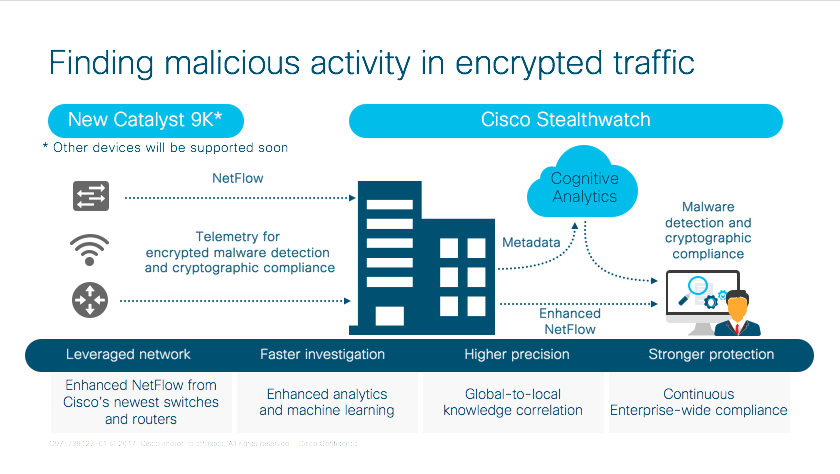
By now, you’ve heard of Encrypted Traffic Analytics, Cisco’s latest innovation that allows organizations to leverage the network to find threats in encrypted traffic.

Wondering why this is big news? Consider these statistics (Gartner and NSS Labs):

… 63 million new devices are attaching to enterprise networks every second by 2020 (Gartner) – that’s a lot of information traversing the internet

… 55% of that traffic is being encrypted. That number is expected to increase to around 80% by 2019

… 70% of attacks will use encryption in 2019

With these numbers in mind, traditional threat inspection with bulk decryption, analysis, and re-encryption will become impractical or infeasible. This is why Encrypted Traffic Analytics, a new innovation in flow analytics, is important. It helps you understand the characteristics of encrypted traffic, without the requirement to decrypt the payload.

What do you need to enable Encrypted Traffic Analytics?


  • The Catalyst 9300 Series Switches. It starts with the network infrastructure. Designed for security, mobility, IoT, and the cloud, these next-generation switches allow organizations to centrally manage policy, simplify operations, handle threats with built-in end-to-end security, and gain visibility into wired and wireless access networks.
  • Stealthwatch then collects enhanced NetFlow from the network and provides real-time monitoring and views into all network traffic. It improves visibility, security, and response times to incidents across the entire network and creates a baseline of normal activity for a user or host, and applies context-aware analysis to automatically detect anomalous behaviors.
  • Cognitive Analytics, a cloud-based threat detection and analytics capability now available in Cisco Stealthwatch, allows you to obtain deep visibility into both web and network traffic. This additional contextual information provides visibility and analytics allowing you to identify and prioritize new and emerging threats across the extended network.

Together, these three products deliver Encrypted Traffic Analytics, and help organizations address cryptographic compliance and detect malware within encrypted traffic on the network.


This is network security for a new world. The Network. Intuitive.  For more detailed information, check out the white paper here.

Authors

Jason Liu

Product Marketing Manager

Enterprise Networking and Mobility

Avatar

Back to school (BTS) 2017 is officially in the books, and retailers are getting ready for the upcoming holiday season. Now is the time to reflect on key lessons learned for retailers.

This year’s back-to-school sales were projected to be the most successful in the last five years, with total combined spending for college and elementary levels expected to reach $83.6 billion, according to National Retail Federation’s annual survey conducted by Prosper Insights and Analytics. With new confidence in the economy and stronger employment, consumers are spending more across all the retail channels. This might be a good sign for the upcoming holiday season forecast.

In addition to record sales numbers, new technologies are changing the way customers experience the year’s second-largest shopping season. Here are three key takeaways from BTS 2017 that have caught my eye so far.

1.  Cheaper fulfillment options

One of the most critical drivers for the back-to-school shopping experience has been in the area of fulfillment, which continues to change like the wild, wild West. This year, Prosper research shows that nine out of ten back-to-school shoppers are making use of free shipping offers. Around half are relying on systems that allow them to buy online and pick up in the store (also known as BOPIS).

This isn’t a surprise – shipping rates that range as high as the cost of the item have increasingly become a pain point for online consumers. I’ve noticed that stores often focus on speed of delivery, and indeed this is a priority for shoppers. But we’re also seeing that the cost of delivery is still probably the single greatest consumer concern: Offer them a discount on delivery, and they will be more likely to shop with you. One such approach is the Amazon premium program, Amazon Prime. However, unless they live in a large family household, many shoppers are still not willing to pay out almost $100 a year (I’m one – the math doesn’t work for me), and a lot more disruptive thinking remains to be done here.

2.  Almost half of shoppers are using mobile

A second twist for this year has been the growing use of third-party mobile apps on the family smartphone and in the store. According to NRF’s July 2017 survey, 43 percent of consumers planned to use their smartphones during back-to-school shopping, a 10 percent increase from five years ago. Shoppers are using their phones for everything from general product research to actual purchases.

Many shoppers also use their smartphones to compare prices, download digital coupons, use discount and loyalty finders, check product availability, and take pictures of items they’re considering purchasing (International Council of Shopping Centers, 2017). Such practices are the ones that retailers worry about the most. With shades of showrooming, it can feel like your competition is right in the store. Some retailers unfortunately still respond to this issue by refusing to provide Wi-Fi service in the store at all – a no-win answer that will lose you customers.

It’s better by far to follow the example of leading retailers by providing a good customer experience in the store by using apps that track consumer behavior, offer an attractive, mobile-based, opt-in loyalty program, provide back-to-school recommendations, send out a well-informed associate, and make your own discount offers.

3.  Helping your shoppers shop

Another trend this year is apps that help shoppers shop. These include school supply lists, wish lists and recommendations, allowance managers for kids doing their own shopping, as well as niche apps to help determine shoe and clothing sizes. These are available as third-party services, but providing your own similar functionality for loyal customers can help to optimize their shopping experience.

Creating a good customer experience

Creating a memorable customer experience doesn’t have to be complicated – it’s just the same story of good service, productive workers, up-to-date information, and making sure that what people want to buy is available. The only difference is that retail technologies are now available to help you achieve these goals easily and efficiently.

As you’re thinking about the technology you need to meet consumers’ digital expectations, take a few minutes to look over this eBook on digital transformation in retail.

Authors

Mary Freeman

No Longer with Cisco

Avatar

Uniserver, a leading cloud and IT services provider in the Netherlands, has a single, clear mission: to make IT simple. Internally, however, the effort involved in provisioning cloud infrastructure and services for customers was anything but. Today, Uniserver is using Cisco virtualization and network orchestration tools, including the Cisco Virtual Topology System (VTS), to make its data center simpler, more flexible, and much more responsive to customer needs.

Netherlands-based cloud hosting provider, Uniserver Headquarters

Managing Escalating Complexity

Uniserver has been a leading network and cloud services provider in the Netherlands for many years. But as the number of pure-cloud competitors has grown, their data center infrastructure needed to be prepared for the future. The company was moving to more virtualized resources and cloud capabilities in the hopes of becoming faster and more adaptable. Company leaders envisioned a day when they could deliver all applications and platforms, for all customers, from pools of virtualized functions. But their existing data center infrastructure wasn’t designed for a virtualized, cloud-connected world and was reaching its limits.

Onboarding new cloud and infrastructure services could take days, or even weeks. And a reliance on complex manual configurations for each new service or change left ample opportunity for human error—increasing the risk of delays and outages. In fact, Uniserver operations teams spent too much time simply “putting out fires.” Often there was not enough left over to focus on future developments.

Uniserver leaders knew it was time to make a change. And last year, they did: deploying Cisco VTS and other Cisco data center solutions with the help from Cisco Premier partner Quanza Engineering.

Building a Programmable Data Center Fabric

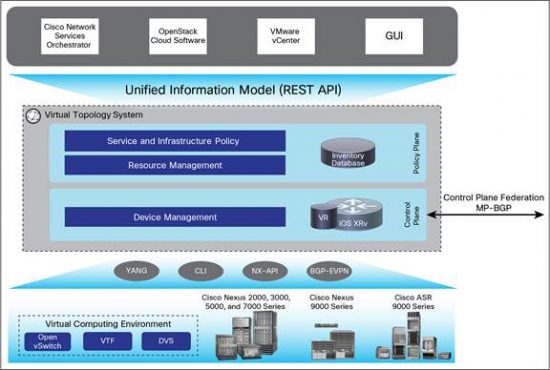
Cisco VTS provides a simple, powerful software-defined networking (SDN) framework to automate the provisioning of multitenant data center overlay networks. It’s helping Uniserver to drive out much of the complexity associated with building and managing resilient cloud services, and deploy infrastructure services—even complex chains of virtualized functions—much more quickly and easily.

                                            Cisco Virtual Topology System

Using Cisco VTS gives Uniserver a standards-based, open software platform-to manage provisioning of their data center fabric. Instead of complicated, time-consuming manual coding and configurations, they can now create reusable templates to deliver cloud and network services much more quickly and consistently—without human error.

The Cisco software makes day-to-day management and orchestration of the infrastructure much simpler, allowing even non-technical staff to provision physical and virtual infrastructure services to customers in minutes. In fact, during the Proof of Concept, Uniserver’s COO was amazed to discover that he could now provision a new customer-facing service or even a full data center—a process that used to entail extensive manual coding—with a few clicks of a mouse. That speed translates directly to better responsiveness to customer needs—and faster time-to-revenue for new customer orders.

Delivering a Better Customer Experience

Using Cisco VTS and other Cisco data center tools, Uniserver has also dramatically improved the stability of its environment. The new, automated data center fabric includes tools to segment traffic and ensure a much higher level of resilience and availability. Uniserver staff can now perform maintenance and software updates without impacting customer services. The result is fewer outages, much less downtime, and superior customer-facing services.

With Cisco VTS SDN capabilities, Uniserver’s data center fabric is also more open, flexible, and adaptable. The company can easily integrate programmable physical and virtual network resources from multiple vendors, as well as public cloud resources. And, they can integrate with multiple virtual infrastructure manager (VIM) environments and hypervisors—their current VMware platform, as well as OpenStack and bare-metal provisioning in the future if they choose—over the same Layer-2 network, using a single console.

Just as important, Uniserver’s operations teams can now focus on embracing new DevOps models and driving new innovations for customers, instead of spending all their time just keeping the lights on.

As Chango Eersel, Uniserver’s director of operations said, “Continuously innovating and investing in new network technologies is essential to provide our customers with quality services and offer the most reliable cloud infrastructure. With the support from Cisco and VTS, our automated data center network has allowed us to offer new services and solutions rapidly to our customs and partners.”

Chango Eersel, COO, Uniserver

Want to learn more? Check out the following.

Authors

John Malzahn

Senior Marketing Manager

Service Provider Cloud Solutions

Avatar

There’s an adage that goes “Out with the old; in with the new.” In the world of IT, that clearly fits. Our industry is constantly innovating, and there is always a shiny new object to catch the interest of the IT staff.

Unified communications are certainly a part of that IT innovation trend. From those early days of moving voice traffic over IP networks, we have advanced to today’s unified communications with a full suite of voice, video, instant messaging, presence, audio/video/web conferencing and collaborative workspaces. What could be better than using the latest collaboration tools?

The latest and greatest might seem the obvious choice, but let’s take a more careful look. Do the latest unified collaboration systems provide everything that you need? In fact, do they even provide some of the mandatory functions that you already have? For instance, does it handle vital services like E-911? Does your new system interface seamlessly to the public switched telephone network to make calls outside your enterprise deployment? Is there a mechanism to ensure that the most important calls can be guaranteed to complete? Last but not least, are the new systems capable of securing against growing cyber threats?

These questions are related not only to functionality but also to an important IT goal — cost savings.  The Time-Division Multiplex (TDM) technology that powered central office switches and enterprise PBX’s for decades is nearing the end of its life. To save soaring maintenance costs, enterprises, government agencies and service providers are all completing migrations away from their remaining TDM equipment.

Unified Communications can expand the power of collaboration, but you must ensure you don’t lose reliable service in the bargain.

In order to decommission a TDM switch, many issues beyond simply making a phone call have to be addressed. The new system must be capable of handling complex dial plan integrations. It must have the ability to handle alarms, integrate analog phones and even fax machines, and provide location for emergency calling.  These are mundane, perhaps, but absolutely necessary.

If we have ensured that our shiny new collaboration system retains all the needed functions while saving us costs, is there anything else we need to watch out for before we throw out the old system? I’m glad you asked. Yes, the user experience is key. Users should get a better experience, not worse one, when the new system arrives.

Consider this strategy: Replacing all hardware-based phones with software-based clients.  It sounds like a common-sense approach, but does it improve the user experience? In the old system, the phone on your desk is always there, and it always rings when someone calls you. The new software client on your desktop, though, may not. Your machine may reboot, or the app might not work correctly. Perhaps you’ve just logged out for the day. Whatever the reason, you’ve missed a call, and the new system has provided a worse user experience than the old.

A better approach would be to have a software client that augments the capabilities of an IP phone or video endpoint. This gives the user the best of the old and the new.

This principle applies to any modernization project. When you bring in the new, make sure you don’t lose any of the reliable (and mandatory) capabilities of the old in the bargain.


Authors

Kathy Talman

Systems Engineering Sales Manager

Collaboration-US Federal-DoD-Engineering

Avatar

From student data and intellectual property, to reputation and grant funding…higher education institutions are at risk if cybersecurity is not a foundational element in their operations.

This fall, more than 20 million students returned to their college or university. Each student will walk on campus with at least three personal connected devices. At a university with roughly 40,000 students – that’s around 121,000 devices, not including all the sensors and devices across the campus that are school property. That’s 121,000+ opportunities for a security breach.

Hacking is getting increasingly more sophisticated, but let’s walk through a few simpler hypothetical scenarios. A hacker doesn’t need to be complex in his approach to do serious damage.

Scenario 1:

A 20-year-old walks into a coffee shop to work on a class paper. He places his book bag on the back of his chair, and his smart phone and laptop on the table. Then, he walks up to the counter to order his coffee. Someone sitting close to the table he just chose reaches over and takes his smart phone. The table neighbor now has the ability to access to his school email, school apps and the campus network. Easy as that.

Scenario 2:

A freshman – new to campus – is excited about this new experience. She is connected on five different social media platforms, including LinkedIn, Facebook, Twitter, Snapchat and Instagram. Each of her platforms contain a fully populated profile – from name, age and school, to birthday and relationships. She constantly posts, like most students do, and wants to stay connected to the university through apps. An app promoting to be focused on university events lures in the freshman. With one click, that malicious app now gives the hacker direct access to her profile and personal information. They now have the opportunity to act as the student, and therefore, the credibility they need to attack other students with malicious links and phishing scams.

Scenario 3:

A teacher is checking her email – an address provided by the university. An email comes across with a subject of “A Message from the Dean.” It seems like an email she should read, seeing as it’s from the head of the school. The “Dean” has included a link to more information – an “exciting announcement” that would impact the school year. That so-called “Dean” happens to be a hacker from across the globe, who used simple bait to lure that teacher into clicking on a malicious link, and a security breach trap.

Each of these instances can be detrimental to the school with potential risks, including:

  1. The compromise of sensitive student information, possibly leading to identity theft or credit card fraud
  2. A black mark on the school’s reputation – impacting trust and future enrollment
  3. The loss of intellectual property, particularly at research institutions
  4. Withdrawal of grant funding because of the inability to keep information secure

In this digital era, it’s never been more important for security to be at the heart of not only IT strategy, but business and mission strategy; especially in higher education. Effective security everywhere, including Security Services, from the network to the endpoint to the cloud, will allow institutions to protect their data and enable their digital education mission. It’s too late to wait for a security breach to think about a cybersecurity strategy after the fact. To get ahead of threats and best enable digital transformation of education, cybersecurity needs to be a core part of the overall strategy of the institution.

October is Cyber Security Awareness Month, and Cisco is a Champion Sponsor of this annual campaign to help people recognize the importance of cybersecurity. For the latest resources and events, visit cisco.com/go/cybersecuritymonth.

Authors

Larry Payne

Vice President, Sales

US Public Sector