Avatar

Karen Walker is the Senior Vice President and Chief Marketing Officer at Cisco. As CMO, Karen is responsible for the company’s Marketing and Communications groups.


Together, Karen and Joe were co-sponsors of Cisco’s Global Service Month. Here are their reflections on the month.

What a month! As executive sponsors of Cisco’s Global Service Month, we are amazed and proud of Cisco employees around the world who pitched in to make a difference in so many ways. Here’s a snapshot of our collective impact:

  • In the month of September 6,433 employees in 48 countries participated in Global Service Month
  • Cisco employees participated in more than 300 volunteer events
  • All together, we contributed 43,120 hours to benefit a rich variety of causes


What makes us human is our ability to feel empathy and compassion. What makes us Cisco is our commitment to benefiting everyone by helping those in need—wherever they may be in the world.

What makes us human is our ability to feel empathy and compassion. What makes us Cisco is our commitment to benefiting everyone by helping those in need—wherever they may be in the world. And this past month, you demonstrated Cisco’s culture of compassion and service in some remarkable ways.

When we decided to extend Cisco’s service program from a week to a whole month, we wondered if employees would lose focus or burn out over the course of 30 days. Nothing could be further from the truth. In fact, we learned that many of the volunteer events were actually extensions of the service activities Cisco employees do without fanfare all year around.

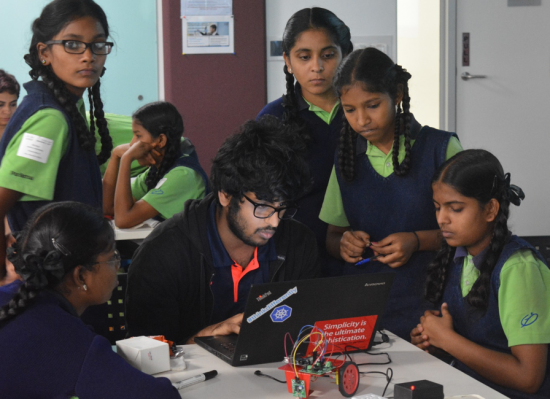
Cisco employees are opening up the STEM pipeline for students in India.

For example, 40 volunteers in India held a “Smiles through Science” robotics workshop for 100 ninth graders in four schools run by the Parikrma Humanity Foundation. Students worked in small groups with Cisco facilitators to learn the basics of robotics, including Arduino boards, sensors, and obstacle detection. This event was the first of four STEM workshops they will be conducting quarterly over the next 12 months, led by volunteers in Cisco’s Early Career Network. Each workshop will go deeper into how to build and work with a range of robotic capabilities.

One of the most inspirational and ambitious service projects was a 10-day cycling fund-raiser by 16 Cisco employees, who rode from the Cisco U.K. headquarters in Bedfont Lakes to Barcelona, Spain. They rode in memory of Cisco employee Nick Noakes’s son Joe, who died in 2012. So far, they have raised more than £44,000 for the Joe Noakes Trust, providing early intervention services to help children with autism reach their full potential. You can support this cause too by giving here.

 Cisco employees put their bodies on the line, riding 1450km to help autistic children.

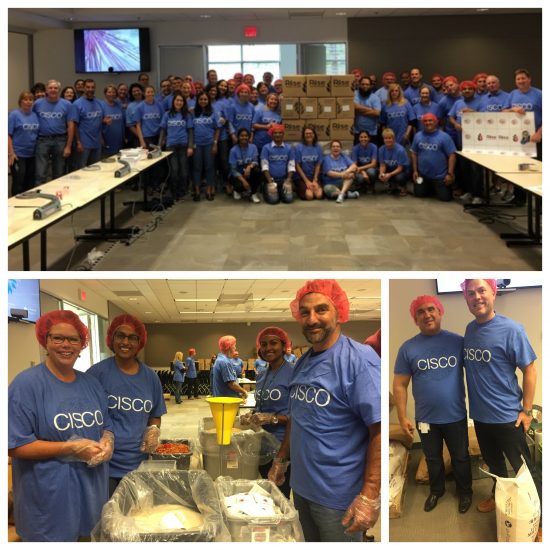
We got a first-hand look at the open hearts and willing hands of Cisco employees in Boxborough, Massachusetts, packing 10,500 meals that will be distributed to people in need by Rise Against Hunger. And in the United Kingdom, the EMEAR communications team worked with the charity FoodCycle to turn high-quality surplus food from local supermarkets into 90 amazing meals for people staying at the St. Mungo’s homeless shelter.

Joe Cozzolino joined Cisco employees in Boxborough, packing meals for the hungry.

And the list goes on—in addition to the stories featured in the mid-month blog, we saw employees painting and cleaning in Amsterdam, picking up a hammer for Habitat for Humanity in Durham, helping children in need through the Red Nose campaign in Lisbon, and working in food banks in several places around the world. People in San Jose joined with Samsung employees down the street to walk, run, and bike to support St. Jude Children’s Research Hospital and their fight against childhood cancer.

With an endless variety of causes and service activities, one thing is clear: there is no end to the ingenuity and heart of Cisco’s people when it’s time to give back. Thank you for being the bridge to those in need during Global Service Month.

Global Service Month around the world (clockwise from upper left): U.S, Netherlands, U.S., China, Portugal.

Authors

Joe Cozzolino

Senior Vice President

Cisco Services

Avatar

Co-Author: Larry Scherzer, Director, Financial Product Development

Digital transformation is really about business transformation and is driving the need for new consumption models. Gartner reports that 47 percent of CEOs are being challenged by their board of directors to make progress in digital business.  The demands are becoming more diverse and complex as new business applications and advanced technologies emerge such as artificial intelligence, cloud-as-a-service, IoT, machine learning, and mobility.

In our fast-paced, multicloud world of digital, how can IT drive business outcomes? Specifically, is it possible for data center professionals to balance the need to rapidly scale and accelerate technology adoption while managing IT spending?

This is where a consumption payment model can help.

“Organizations can prepare for (or get ahead of) change by starting data-driven discussions around flexible payment options – opening up opportunities to rapidly scale and accelerate technology adoption.”
– Kristine A. Snow, President, Cisco Capital
Read more

Buy the car? Or Uber?

Imagine the differences between owning a car and hiring an Uber for your transportation needs.

If you plan to do a lot of driving, then owning a car may make more financial sense. If you stick close to home or live in a big city, taking an Uber or taxi and paying for transportation as you need it may be more cost effective. There are pros and cons to each method of transportation.

Cisco’s Open Pay consumption model provides a hybrid-like experience, similar to owning a car and having the flexibility of hailing a cab at a moment’s notice. Consumption models can help organizations better align technology investments with operational and financial objectives through an on-premise cloud-like experience.

The ability to provide capacity on-demand to support seasonal spikes or rapid shifts is a huge obstacle from a technological perspective. Consumption models allow for greater agility and the ability to better match expenses with revenue.

Why Open Pay, and why now?

Unlike cloud offerings where 100 percent of the cost is variable, Open Pay enables flexibility at a more efficient cost by incorporating a fixed base-level component based on business needs and opportunities for growth.

For example, the financial impacts of a 70 percent fixed quarterly cost and a 30 percent variable cost, based on actual metered usage. The result is a financially flexible total solution.

Consider these additional benefits of Open Pay:

  • Improve velocity. Think HBO on the night of a big fight – there is no need for downtime. With Open Pay, businesses can go through the process of procuring and installing equipment all at once. Therefore, when there is a need for more equipment or storage, it is easily accessible.
  • Improve access to ongoing technology innovation. Open Pay is better than cash because it avoids the depreciation of equipment and allows customers to have the latest software and hardware for a predictable monthly fee.
  • Cloud experience with on premise security. With Open Pay, customers pay for their variable cost only when they need it, and their data stays on premise inside their own data centers.  The result is paying for resources only when needed, at a more efficient cost and without housing sensitive data in the cloud.
     

See how Open Pay helps Capgemini deliver flexible consumption models to their customers and expand into new countries.

Fast track to innovation

As technology innovation accelerates at an exponential rate, organizations can leverage Open Pay as a means of not only exceeding their business objectives, but also propelling themselves ahead of the competition.

Click here to learn more about what consumption models can do for your business.


Authors

Frank Palumbo

Senior Vice President

Global Data Center Sales

Avatar

Many of us feel constantly connected through our cell phones, but a missed call or text isn’t the end of the world. Except for lawyers, every phone call matters. A major California firm was going through some issues with their phones. Their provider’s solution couldn’t keep up with their workload. And they knew dropped calls could mean dropped clients.

Presidio says…

The law firm was on the lookout for a new partner to keep them connected. At first, they just wanted their phones to work properly. But at Presidio, we knew we could go beyond simple phone fixes, and help them get the tools for complete connection and collaboration.

We pitched a solution built with an on-premise Cisco Collaboration Suite. With features like Cisco Spark video conferencing and interactive boards, the firm could share information quickly and effectively. And with Spark Flex licensing, we’d set them up with a stable infrastructure so they could securely connect across offices.

We also offered our client these services with Cisco Capital Finance. So they could get the tools they needed right away, without breaking the bank by paying for the technology all at once.

It turned out to be a winning combination. With Cisco’s leading technology, Presidio’s top-notch professional services, and the cost-effectiveness of Cisco Capital Finance we stepped ahead of the competition. And now we’re helping the firm step ahead, too.

Find out more about how Presidio helps customers make the most of their Cisco products.

And learn more about our Lifecycle Advisor Program and Solution Partner Program here.

The story doesn’t end there. Read more stories on what our customers and partners are doing all over the world.

To hear more about this Presidio success story, check out this video:

https://youtu.be/J3JH5Ew1M7s


Authors

Gioia Ferretti

Partner Stories and Communications

Global Partner Marketing

Avatar

Enterprises are deploying more and more business critical applications on their networks, making it very important that these apps have higher priority for performance. With the recent partnership announcements between Cisco and Apple, application developers now have the power to enable “Quality of Service” (QoS) tags right from within their application.   As an app developer, you can now take charge of making your application standout in the enterprise.

Getting to know Fast lane validation
The chances that your enterprise iOS app runs on a Cisco Wi-Fi Network are very high. Network bandwidth is a precious resource in any enterprise environment, and now iOS 10+ ensures that your business-centric apps will receive priority service compared to non-business critical apps when connected to a Cisco Powered Wi-Fi network.

Let us now see what you as an iOS App developer need to do in order to get on the “Fast lane”.

1. Understand the traffic types that your app generates
The first thing is a simple code walk through of your app to examine the sections where you open network connections with the outside world. You could be using any of the iOS Networking frameworks. The bottom line is to classify the network traffic.

App traffic on Wi-Fi networks can be broadly classified as: Voice, Video, Best Effort and Background.

  • Voice: This is interactive voice for apps using Wi-Fi Calling (CallKit), Cisco Spark, Facetime or any other voice app.
  • Video: This is video traffic using Wi-Fi Calling (CallKit), Cisco Spark, Facetime or video capabilities within the app.
  • Best Effort: Examples of data include instant messaging, VPN tunneling, audio/video streaming, signaling, screen sharing etc.
  • Background: These apps include photo/media uploads or backups.

Step 2: Make code changes in your app

In iOS, specifying the appropriate network service type on the network connections used in your app will allow network administrators to configure their devices to optimize throughput of your data based on its type.

You set the service type property by using the following networking APIs:

  • For CFSocketStream set kCFStreamNetworkServiceType.
  • For NSStream, use NSStreamNetworkServiceType.
  • For Stream, use StreamNetworkServiceType.
  • For UDP sockets, use SO_NETSERVICE_TYPE.

Choose the appropriate service type for your app:

  • Specifying the background type allows your traffic for this connection to be delayed to yield to traffic of other types.
  • Specifying video and voice types imply your app provides a telephony service of sorts where the type of traffic is interactive voice or interactive video.
  • Specifying no service type means your traffic will be prioritized as best effort.

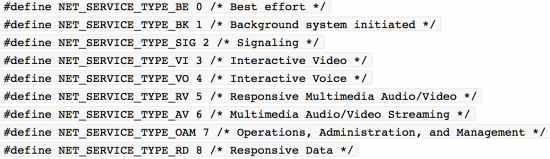
For example, in the UDP sockets, the following are the different service types that are defined.

Choose the service type and set the socket option as follows:

Check out the sample UDP client demo app.

Step 3: Get your app validated for the Fast lane

Now that you have made the code changes to your app, you want to test to see if your changes really work in a Fast lane network, right?  That’s where Cisco DevNet comes in.  DevNet has a Fast lane validation lab where you as a developer can submit your app for validation on a
live enterprise network. The goal of this lab is to do the following:

  • Validate if your app running on an iOS 10 device honors the Fast lane profile as well as checks with and without the whitelist being configured(apps in the whitelist get QoS, apps outside the whitelist are treated as Best Effort).
  • Test for the validity of the traffic generated by the app to the actual tag that is marked on the traffic flow.
  • Improve user experience (performance) of your app. Check for fewer drops and lower latency in a congested network.

You may also download the Fast Lane Network Check app from the iOS app store to check if your network supports Fast Lane already.

To summarize…
A simple code change in your app can get your app prioritized for performance in an enterprise network, with your traffic getting priority not only on the Wi-Fi network but upstream as well.

Have questions?  Interested in getting started? … Send me a comment on this blog and I’ll get back to you.


We’d love to hear what you think. Ask a question or leave a comment below.
And stay connected with Cisco DevNet on social!

Twitter @CiscoDevNet | Facebook | LinkedIn

Visit the new Developer Video Channel

Authors

Ashutosh Malegaonkar

Principal Engineer

Chief Technology and Architecture Office (CTAO)

Avatar

Peter J. Welcher is a Cisco Champion, an elite group of technical experts who are passionate about IT and enjoy sharing their knowledge, expertise, and thoughts across the social web and with Cisco. The program has been running for over four years and has earned two industry awards as an industry best practice. Learn more about the program at http://cs.co/ciscochampion.

==========================================

We hear a lot about digital transformation, hybrid cloud, and “lift and shift (to cloud)” from various marketing sources. Let’s examine that.

About two years ago I blogged and presented “Is Your Network Cloud Ready?” (See also the presentation with more basics in it.) See also some of my more recent blogs at netcraftsmen.com.

This blog updates that content from a more business-centric digital transformation perspective. This reflects some experiences and thoughts spanning between network/datacenter topics and the larger business strategic picture.

The marketing of digital transformation, hybrid cloud, and lift and shift lately has started sounding a bit like “it’s cool stuff, why aren’t you doing it?” Or business consultants saying, in effect, “most others are doing it, why aren’t you?”

You likely see past that. This really should be about the end game: having clarity about what are you hoping to accomplish. What are you really trying to do?

Why Lift and Shift?

Lift and shift is mostly about operational costs or service levels, or should be. If you are looking to get a better managed, more secure, more available datacenter, then moving server instances to a CoLo or the cloud might well work for you, especially if your datacenter is rather small. Providers should have economies of scale, with lower costs but also better processes and skills. One would hope they can do things better at lower cost than you can do it yourself, unless your organization is fairly large. I say “hope” because back in the ASP era, I saw a lot of expertise touted by companies with little to no prior experience or processes to speak of.

Lift and shift is not a no-brainer. Costs matter: cloud or a super CoLo might look great, but be beyond your budget. There are also other factors to consider.

The cloud might provide sites with higher speed connectivity. Some CoLo facilities tout their inexpensive high-speed connections to the Internet, other CoLo facilities, other companies, and cloud sites.  Creating a cloud or a CoLo-based datacenter/WAN might be relevant; see my recent blog about that. That’s part of the Equinix story, for example.

You should know and have in mind some of the technical things to be careful about: I’ve written before (and recently!) about cloud latency surprises. Adequate security is of course the other big consideration.

All that’s fine, but that’s about costs/quality. You might end up running your legacy app from the cloud, but it is still the same old thing. It’s likely not web-scale or highly available.

Note that VMware “active/active” refers to datacenters not applications – your application is generally active in one not both datacenters at the same time. Internet-scale applications are active out of multiple sites, simultaneously. That requires some real thought, coding, and work on the database backend, including consistency model.

Consequently, pure lift and shift of apps leaves you with apps not particularly well-written to run from the cloud. In short, it’s not digitally transformed. It’s taking small server-centric steps when much bigger, faster progress may be needed. Tactical, not strategic. That may or may not be what you’re looking for.

Hybrid Cloud

Cisco and others are pushing tools to manage hybrid cloud.

My question: is your hybrid cloud part of a considered strategy, or is it what you get when various DevOps teams run at full speed, fail to plan ahead, or fail to coordinate with other teams?

I suspect the latter — been there, seen that. Out of control costs or latency challenges might be the result. This is perhaps another case of “fast/ cheap/good: you get at most two.” I’ve seen from the sidelines a couple of instances of DevOps teams not looking ahead, and charging right into a wall, so to speak. In this particular case, it might be a wall (cloud) with lock-in, e.g. data gravity or cloud-specific tools that prevent you from moving / consolidating. Cisco CloudCenter might be something to consider in this context (capturing app flow essentials, portable instantiation).

Suggestion: “let’s be agile and fast, but let’s not charge blindly off as fast as we can; let’s do some planning as well.”

Digital Transformation

Digital transformation means changing business processes and activities to leverage new technologies. That is rather broad, and encompasses a multitude of things such as increased network usage, vastly more data, higher degrees of data-driven automation, external connections, Internet of Things, and others. It also should be strategic, whereas lift and shift and hybrid cloud are more tactical or operational.

There are waves of change, overlapping, coming faster and faster. We need to prioritize around the business becoming faster, more competitive, driving out cost, etc., while anticipating how the technology changes will impact the business. Which data needs to be accessible, by which apps? Which front-ends / apps need web-scale capabilities. That’s digital transformation according to Pete.

Getting to Cloud Ready and Accelerating Digital Transformation

A couple of my recent blogs discussed the New WAN Model and the Network of the Future.

Because of that, I’m going to skip over network, security, office spaces, and datacenter technologies here, to focus on items closer to the business side of things. Namely, applications and data. If you’re a network or security or datacenter person, you need to be aware of this in your designs and implementation.

Concerning data, organizations are discovering that it is necessary to manage it. That starts by sharing the data, not having private islands of data, and by not having multiple copies of very similar data. Then there’s data gravity — as in the costs of moving data around, cloud vendor lock-in and costs, etc. You pay a lot to export data from most clouds, or even externally access that data, let alone move it elsewhere. Having multiple copies of data adds cost. Moving large amounts of data takes time and has costs. To me, this is a hidden cost of hybrid cloud: thought needs to be given to where the apps are in relation to the data. Those that access a lot of data likely need to be “near” the data – latency, cloud external data transfer costs. How to architect things is not / should not be a purely coding or technical decision!

IoT is going to generate a lot more data. How are you going to manage storage, backup, archival, and access to all of your digital assets? OK, that’s perhaps some of what “data lakes” are about: raw data, not cleaned and structured data. That name makes me wonder how the data warehouses got all wet, melted, and lost structure. Humor intended, but perhaps also a somewhat appropriate way to think about it.

There’s also security for data. What we’re trying to secure is … the sensitive data.

Our present network security is rather focused on controlling and monitoring access to the servers and apps that gateway access to the data, at least where the data is in a database/SAN and not directly network accessible. Providing secure applications or micro-services as the only way to access the data helps with security, allows for ID- and role-based access controls, and allows for an API to make data access more uniform. Said differently, standardized and uniform access methods are easier to secure.

Yet how does security verify that all applications, let alone all micro-services, are properly coded with proper authentication and other security measures? (Which sort of takes us back to why we have firewalls in the first place: we know our apps aren’t all properly and consistently secured?)

For what it’s worth, Google has said security is about applications not firewalls. What’s your dev team’s perspective? Baked-in security or code then secure?

It’s About the Applications

One key item moving forward, under any name, is the application inventory and strategy. We’re seeing this in increasing numbers of organizations. Does your organization have an application inventory and strategy?

This is where network and security people come in. The business side of the organization may be able to provide the top-down list of applications and services, and business priorities. The technical side can (maybe, with effort) provide the bottom-up details: application flows, flow mapping, “app pods” (groupings of servers with heavy flows between them), etc. — what’s under the hood.

If you have a fairly complete list of applications, then the strategic thinking can begin. There are several “buckets” you might lump applications into:

  • Which ones are ripe for offloading as SaaS?
  • Which are limited use in-house apps, maybe single server apps, self-contained and not using any exotic or vendor-specific technologies, where migration to a VM, CoLo-based VM, or cloud instance should be fairly straightforward? (Many organizations have done the virtualization part of this, but maybe not the cloud side of the analysis.)
  • Which are important to the business, and would strongly benefit from a web-scale/micro-services rewrite?
  • The others, not worth trying to change them. What’s your strategy for fixing or retiring them?
  • What data do we need to open up controlled access to?

I view heavy virtualization as the precursor here. If you haven’t moved from physical to virtual machines, in a controlled internal environment, then is cloud really a good first step?

Re web-scale, I consider scale-out ready applications to be a key aspect. Scale-out, as in anycast or Layer 3 Global Server Load Balanced. I’ve been reading a couple of books about scalability, and it’s about people and process as well. Recommended reading:

Have you been doing your homework reading? (If you have other good books to recommend, please post a comment!)

There’s also some degree of scalable access to data, perhaps a migration plan to get to having well thought-out micro-services. Clear thinking about static data, eventually consistent data, and single systems of record matters.

Security also needs to be factored in. If an application is being heavily changed, where are you more likely to spot security issues like leaking sensitive data — in your physical datacenter, or in the cloud? Who is responsible for sanitizing sensitive data for DevOps coding using the cloud? Etc.

What needs to happen to make all this work?

  • Some detailed research into the application and data inventories
  • Some creative thinking about how the data and the functionality might be used in the future
  • Some prioritization
  • Some planning around evolving key applications, as a migration or a rewrite might take years (I’ve included this last item since I’ve seen some unrealistic thinking about timelines for app re-writes)

There are a couple of conclusions I draw from all this:

  • The right degree of cross-function conversation and skills is needed for application transformation to succeed.
  • Best results may require balance between DevOps speed and some big picture planning and coordination. If you don’t look ahead, you won’t see the pitfalls until you encounter them painfully. But avoid analysis paralysis.
  • Understanding flows, latency, throughput, and translating that to application performance. The time and costs for data transfers/access matter.


Authors

Peter J Welcher

Networking Consultant

NetCraftsmen

Avatar

Welcome to the fight of the century.

In one corner there are the prophets of doom, who say that no job is safe from automation, and economic chaos is inevitable. And in the other corner, we have the rosy optimists, who believe technology will usher in a new era of meaningful work, more leisure time, and improved quality of life.

And in the center of the ring…you’ll find the rest of us.

The truth is, both the naysayers and the optimists have a point. Automation and artificial intelligence (AI) are already disrupting many industries and causing sweeping economic changes in certain segments. But they are also creating opportunities for people to learn new skills and have more interesting work—perhaps even in job categories that don’t yet exist.

We’ve been here before

If we look back to the industrial revolution, we can see how factories and urbanization displaced the traditional roles of craftsmen, farmers, bakers, and artisans. People naturally felt threatened as technology rendered their skills obsolete and disrupted the social and economic order. Yet once we weathered that transition, the 20th century economy created new opportunities—with jobs like autoworkers, airline pilots, and engine mechanics—that previous generations could never have imagined. This time is no different, the optimists argue. We’ll have short-term disruption, and then go on to even greater growth and productivity.

Well, that may be true. But try telling that to someone in Detroit or West Virginia. They were on the winning end of the industrial revolution in the last century, but the wheel has turned and now they are on the losing end of global disruption.

The effects of automation and AI are happening now. The U.S. steel industry, for example lost 400,000 jobs—75 percent of its workforce—between 1962 and 2005, while maintaining the same output. A new technology called the minimill was behind this job-killing productivity boost. And it’s not just in steel. A 2015 study from Ball State University said that U.S. workers lost 5.6 million U.S. jobs from 2000 to 2010 because of increased productivity across the spectrum of manufacturing.

Now, productivity is not a bad thing! But it does have an impact on employment. And while we could spend all day fretting over technology-driven job disruption, I’d prefer to focus on how to respond to it.

Silicon Valley must lead

Let’s start with the proposition that since technology is driving the disruption, technology can help us deal with it. A report from MIT predicts that AI will create as many new jobs as it eliminates. Like the industrial revolution, the report says, AI will create brand new jobs that never existed before. Imagine an “empathy trainer” for AI devices, or an AI ethics compliance auditor. Imagine an “explainer” who bridges the gulf between technology and business or government leaders. These new jobs aren’t just for those with technical skills. In fact, they rely on people with a liberal arts education to bring our humanity into AI applications.

Closer to the here and now, robots in Amazon’s warehouses are taking the heavy, repetitive jobs and creating opportunities for workers to do the more interesting work of monitoring and controlling the robots. Even with more than 100,000 robots in action around the world, Amazon continues to hire human workers at a dizzying rate.

Technology companies must lead in creating opportunities—whether through training and development programs, or by planning technology roadmaps that consider the human factor. A new report from the World Economic Forum (WEF) found that 25 percent of workers in developed countries say their skills don’t match their current jobs—and 35 percent of the skills needed for jobs will change by 2020.

It’s time for Silicon Valley to step up and take responsibility for helping the world deal with the disruption we’ve created.  I’m proud that Cisco’s CEO Chuck Robbins is taking a leadership role in addressing this challenge. As chair of the WEF IT steering committee, he is leading an industry-wide global initiative on giving workers the skills they will need to be prepared for the new jobs of this century. He believes we can retrain masses of workers for the new jobs of the future. It’s a matter of vision and will.

The rise of the gig economy

As traditional jobs disappear, many people are moving into self-employment, freelancing, and task-based “gigs.” We need to take a new look at how we support workers in these non-traditional work roles. Shift: The Commission on Work, Workers, and Technology suggests this trend might give us the opportunity to “explore alternative arrangements: networks of small businesses, modern guilds, worker associations, and entrepreneurship training, while at the same time facilitating new ways to administer worker benefits.”

On the other hand, there is a dark side to the gig economy—“gigs” that are really full-time jobs with the benefits stripped away. The whole point of the gig economy is to be able to choose the work you want to do, when and where you want to do it. Hence, there is also a rise in lawsuits against the likes of Uber, pointing out the need for regulation to keep up with reality.

Cisco HR director Gianpaolo Barozzi has pointed out an interesting paradox: “…digital technologies are the potential cause for dramatic economic, employment and social collisions, drivers for a de-humanized future; at the same time they could be the force taking ‘work’ back to a much more human dimension.” By supporting the interconnected, yet self-directed work structures of the gig economy, Gianpaolo believes we enable human workers “to be the center and the core of the new world of work, yet keeping all the advantages of the post-industrial society and the economy we live in.”

Disruption of work is inevitable. It’s how we respond that matters.

It’s a choice

Disruption of work is inevitable. It’s how we respond that matters. We can focus on developing technologies that can complement and work alongside human workers. We can work hard at training and educating workers for the skills they will need. We can create new structures that support the needs of workers who are trying to make their own way in the gig economy.

The issue is ripe for innovation. That’s why we’re focusing on the Future of Work at our next Cisco Hyperinnovation Living Labs event. If you’re interested in co-creating industry-shifting solutions that can help shape the future, let’s talk.

Join the conversation on Twitter @katecokeeffe


Authors

Kate O'Keeffe

Senior Director

Customer and Partner Innovation

Avatar

Note to self: You ARE a woman in tech. You ARE part of the 11% of women in cybersecurity. You DO make an impact. You’re not alone – you have the #WeAreCisco fam behind you.

Don’t ever, EVER forget that.

For some time, I never considered myself a woman in tech because I did not have an engineering degree, and I didn’t even understand why it was such a big deal to be a woman in tech. In fact, I didn’t realize that there was whole community of women in tech until my manager nominated me to attend the Grace Hopper Celebration a couple years ago!

You must be wondering if I lived under a rock – how could I NOT realize these things? Well, I grew up with FIVE older brothers. Yep! Out of six kids, I was not only the only girl – but I was the youngest too. So, I was used to being the only girl, and even used to being tough so that I could hang with the big boys.

There have been many times in my career where I wondered if this was the right job for me. I am a people person – I don’t know how to program. Why is a non-technical emotional female in the role that’s generally dominated by technical engineering men? I’ve asked myself more than once, “Am I too emotional to succeed in this role?”

Since I joined Cisco, the number of women on my team in San Jose has TRIPLED! Being surrounded by women in the office every day made me realize that there were other women in a similar situation to me and I didn’t feel so alone anymore. We shared our common bond to build each other’s confidence. I know that Cisco has my back in whatever I want to pursue, and everyone is always so willing to jump in and help one another at any time – all you have to do is ask!

How so? I have a couple of examples for you!

    • Example #1: I am often called to participate in regulatory compliance audits where my role is to speak on the Computer Security Incident Response Team’s (CSIRT) incident detection and response. Whenever I have a challenging call come up, my team is always available to support me. This even includes group chats where my teammates are literally typing responses to me in areas I’m not familiar with.
    • Example #2: Despite our busy schedules, 1:1s with my manager are always prioritized. Most people would think that 1:1s are just for your manager to get status updates on what you are working on. However, my managers have always focused on what I needed to succeed and how THEY could help me. Prioritizing these meetings is helpful because I have the opportunity to ask when I do need help each week!

I am constantly asked what prompted my career in cybersecurity. Honest answer? Cisco got me into cybersecurity! During my internship, I was selected for the Information Security intern position in the CSIRT. I may have known nothing about cybersecurity at the time, but I knew that I had a passion for solving problems and tackling new challenges. I knew that the lack of my technical skills was my weakness and that problem-solving was my strength.

So, I used my strength to tackle my weakness!

My team’s way of teaching employees to learn and grow is by “throwing you into the deep end” then giving you all the support you need to learn how to swim – similar to Cal Poly’s “Learn by Doing” motto. This has worked out so wonderfully for me!

Are you a woman in tech, or just getting started with your career? Here’s my advice to you!


  • Don’t wait until you meet 100% of the qualifications to apply for a job or sign up to take on a new project. If you’re interested and willing to learn, jump right in!
  • Speak up! Talk to your manager about what your passions are, where you would like to grow, and also what you don’t like. It’s important for them to know your likes and dislikes so they can help to focus what you’re working on!
  • Network with a purpose. It’s important to build strong relationships with people. Keep in mind that if someone trusts you, they’re likely to be willing to move mountains for you. Here at Cisco we have ERO’s (employee resource organizations) that bring co-workers together, for women in tech we have our Women in Science and Engineering (WISE) and Connected Women EROs!

I know it is sometimes difficult to realize that you ARE in fact a woman in tech. I’ve spoken to many women who don’t realize that they ARE, until they come to work at Cisco. From social media managers and marketers, to engineers and cybersecurity – we are ALL working towards a better future through technology!

Am I a Woman in Tech? Heck, YES, I am!


Want to join Cisco’s Women in Tech? We’re hiring!


Authors

Tammy Nguyen

Information Security Analyst

Computer Security Incident Response Team (CSIRT)

Avatar

Cisco customers anticipate adding billions of new connections in the years ahead, and they are looking for intelligent networks that deliver automation, security and analytics to help them derive meaningful business value from these connections.  Cisco is well positioned to provide these capabilities through a combination of new platforms, as well as software and subscription-based services.

We have been focused on our customers’ need for a more autonomous IT environment.  We are providing customers with end-to-end visibility and automation through the entire IT stack from the application through the network. We started with Cisco Tetration Analytics, which discovers and secures applications in the data center and across the network. Next up was our acquisition of AppDynamics which monitors application and business performance. Recently, we launched the Digital Network Architecture which focuses on monitoring, automation and security in the enterprise network. In each of these areas, we are using real-time data monitoring combined with artificial intelligence and dynamic policy orchestration to bring more automation to our customers.

As we accelerate our innovation in these areas, we determined that our Data Virtualization (DV) business is not aligned with our long-term focus. TIBCO Software Inc., a global leader in integration, API management, and analytics, today announced it has entered into an agreement to acquire our DV business (formerly Composite Software).  This transaction will add data virtualization capabilities to their product portfolio to provide customers and partners a more complete solution. Cisco Data Virtualization already integrates with TIBCO Spotfire® and, TIBCO will be looking at how it can more deeply integrate the two to provide customers with a holistic view of their data, with less complexity and at lower cost than the current solution.

Cisco is committed to our goal of driving operational improvements in IT and application management. With analytics capabilities embedded in many of our products, we look forward to delivering even greater value for our customers’ digital transformations.

Authors

Thomas Wyatt

Chief Marketing & Strategy Officer

AppDynamics

Avatar

In the first blog of this series, we discussed the important role that an innovation maturity model (IMM) plays in creating a strategic, repeatable framework for innovation excellence. In this second installment, we will look at the process of creating an effective IMM, drawing on Cisco’s own IMM as an example.

While there are numerous IMMs already in existence, many of which are very good, Cisco was unable to find one that fully mapped to the guiding principles outlined in my previous blog. As such, we decided to develop a new IMM that would guide innovation program managers through consulting engagements and maturity assessments. Using the IMM, innovation program leaders no longer have to figure out everything it takes to run a successful program on their own. The IMM eliminates the painful process of self-discovery through trial and error.

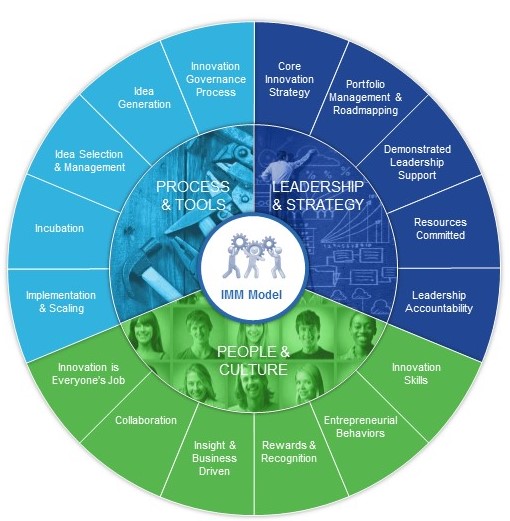
Cisco’s IMM identifies 16 key areas of innovation activity—called exemplifiers—that result in program success.

Understanding where innovation improvements are required

The starting point for an effective IMM is accurately identifying key areas of innovation activity that result in program success. Known as exemplifiers, these will become the key predictive elements of innovation maturity over time. Cisco’s IMM used heat-mapping to identify 16 key innovation exemplifiers, broken down into three main categories. These categories are industry-agnostic, meaning they can apply to any organization or division, regardless of business sector:

  • Strategy and Leadership—the ability to develop effective innovation strategies, along with the core leadership behaviors and accountabilities needed to bring them to life. Exemplifiers under this category include “Innovation Strategy,” “Portfolio Management & Road-Mapping,” “Demonstrated Leadership Support,” “Resources Committed,” and “Leadership Accountability.”
  • People and Culture—addressing the need to create the right mindsets and behaviors for innovating everywhere. Exemplifiers include “Innovate Everywhere,” “Collaboration,” “Insight and Business Driven,” “Rewards & Recognition,” “Entrepreneurial Behavior” and “Innovation Skills.”
  • Process and Tools—leveraging a balanced set of processes and tools that can unleash and accelerate innovation throughout an organization, driving successful business outcomes. Exemplifiers include “Innovation Governance,” “Idea Generation,” “Idea Selection and Management,” “Incubation” and “Implementation & Scaling.”

Creating exemplifier ‘maturation plans’

An effective IMM doesn’t stop at simply identifying areas for improvement; it will also direct attention on how to make those improvements. There are various ways you can approach this, but one of the most effective is to create a progressive, tiered system of excellence for each exemplifier. It’s important that the tier system represents a progressive rank sorting of innovation milestones, ranging from the most basic through to more advanced activities. Doing so ensures that organizations “walk before they run.” In that way, everyone involved in the innovation maturity process can clearly see if/when milestones are achieved, signifying a transition towards a higher level of maturity for each exemplifier.  So teams work from the most basic to the most complex levels for each set of success criteria, which helps eliminate the guesswork about where to start.

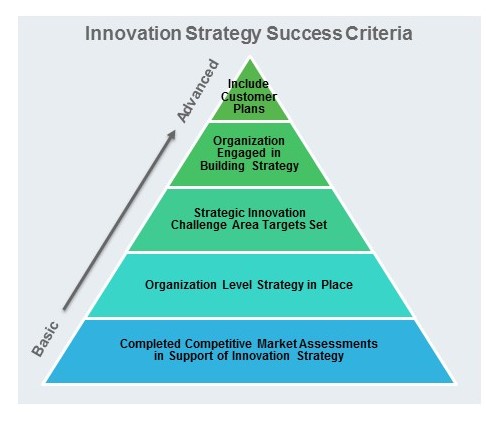
Let’s take the “Innovation Strategy” exemplifier from the Strategy and Leadership category of the Cisco IMM as an example. At the most basic level, the success criteria question is, “has the organization conducted a competitive market assessment in support of its proposed innovation strategy?” If so, the next level up would be to ensure an “organization-level strategy is in place” so there is consistency. Moving through the tiers, “have strategic innovation challenge area targets been set?” If yes, “has the entire organization been involved in building innovation strategy?” Finally, has there been any “co-creation of strategy with key customers?”

Assessing the success criteria for each exemplifier helps determine overall innovation maturity.

Answering yes to all these questions would indicate an advanced level of maturity for this exemplifier. Each exemplifier will require its own unique set of tiers, but a rank-sorting model like this not only makes the ongoing assessment process much easier, it greatly simplifies roadmaps for maturation plans.

Creating and implementing an effective IMM is a significant step toward developing a consistent and repeatable innovation strategy, but it doesn’t end there. Regular ongoing assessment is another critical part of the process, helping to ensure the innovation team continues to evolve based on what needs to improve. In the final blog of the series, we will look at the key elements of an innovation maturity assessment and optimal timelines involved.