Avatar

The University of Oklahoma (OU) is using October, National Cyber Security Awareness Month (CSAM), to emphasize the creative and common-sense actions they are taking to improve cybersecurity and educate users across campus about the importance of being smart online. Higher education organizations face many of the same cybersecurity challenges as commercial ones: assuring availability, keeping personal data safe, and protecting intellectual property, but they also want to keep their environments as open as possible to encourage creative teaching, learning, and engagement.

Aaron Baillio, Managing Director, Security Operations and Architecture, and Lynnetta Eyachabbe, Cyber Security Awareness and Outreach Coordinator, have tied CSAM to the university’s overall cybersecurity initiatives and will be working all month on raising awareness. Here’s why each of their IT Security Top 5 is important, and the steps they are taking to focus awareness and drive actions among their users this month:

Passwords—Stealing a password may be as simple as looking over someone’s shoulder to see what they type or as sophisticated as social engineering and password cracking programs. Many people use the same password on many sites, so once the bad guys have one password, they can quickly “own” the user with access to their accounts on many sites. At OU, CSAM will serve as a reminder to users to set unique passwords for each account (school, shopping, streaming, email) to cut down on password reuse.

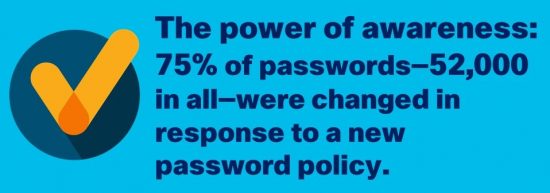
In fall 2016, the university implemented a new password policy that encouraged users to change all passwords and replace them with a 12-character password or passphrase. The results were significant: 75 percent of the approximately 70,000 passwords used—more than 52,000 in all—were changed before the university had to take the more drastic step of locking out accounts until new passwords were set.
Antivirus/Antimalware—Next-generation tools are gaining wide acceptance in the market as long-used signature matching intrusion prevention tools have been ineffective against newer, more advanced malware. These next-generation tools use machine learning, virtualization, cloud analysis, and other methods to guard against threats. OU has adopted these next-generation products and is finding them significantly more effective. They consume fewer system resources while detecting viruses or malware more quickly and accurately. The university provides enterprise endpoint protection for faculty and staff and during the month will be stepping up their recommendations for free applications for students.

Phishing—Phishing is one of the most common ways cyber criminals gain unauthorized access to users accounts. Email and web filtering, which are commonly used to stop phishing, can be tricky to apply in an open campus environment, so training users becomes even more important. Phishing is one of the most significant security issues facing the OU campus, and to combat it, the IT team regularly cautions users on phishing messages and how to identify them. The school even uses an “in-house” phishing effort with select departments—doing “on-the-spot” training when a user falls for the phishing attempt. For CSAM, they are increasing the cadence of their “Knowing the Signs” awareness program and are offering phishing assessments of school departments. Some tips they provide to faculty and students in email alerts and campus blogs are:

  • Always read what is being requested before granting permission
  • Verify with the sender before clicking or opening an attachment you are not expecting
  • Attempt to verify web address for links without clicking

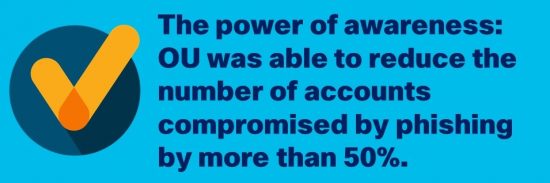
One year ago, OU experienced phishing attacks daily and the average response rate was about 15 percent per attack—with hundreds of accounts compromised each week. One year later, in September 2017, OU experienced fewer attacks, about two dozen, and had just 300 compromised accounts in all—a reduction in compromised accounts of more than 50 percent.
Encryption of Data and Secure Email—Use of encryption for data files and to secure email is growing quickly because it protects data from people who have gained unauthorized access to files, the network, or communications channels. At OU, they provide encryption for sensitive data, especially for those departments needing a higher standard of security due to regulations and compliance. In addition, they publish a sensitivity matrix showing which services are appropriate for storing certain data types. For example, to store HIPAA data, local file storage or O365 are the only allowed storage locations.

Multi-Factor Authentication (MFA)—In addition to requiring a username and password, asking users to present additional, separate evidence of who they are, such as a fingerprint, PIN, or smart ID Card, provides a higher level of security. OU offers an MFA solution to their users and continues implementation across the campus. They are stepping up user education on the importance of additional layers of authentication while also stressing that these multiple levels of security are needed to protect data.

National Cyber Security Awareness Month gives institutions of all sizes an opportunity to remind users of the importance of cybersecurity. As the team at the University of Oklahoma is showing, user education is vital to any successful cybersecurity initiative. Each of the IT Security Top 5 requires understanding and engagement from those who use the university network. In many cases, the actions are simple—like maintaining hard-to-decipher passwords or verifying a link before clicking—and gaining user acceptance and adoption can help ensure critically important protections online.


Authors

Peter Romness

Cybersecurity Principal, US Public Sector CTO Office

Avatar

As cable operators continue to look at facing the ever-increasing onslaught of data demand from subscribers, we must ask ourselves, “Is there a better way to do things?” We all have heard the unofficial definition of “insanity” as “doing the same thing over and over and expecting a different result,” we can’t just keep going forward blindly doing things like node splits forever as it is not a sustainable practice doing it the way it has been done for the last 5-10 years .

Invoking a New Thought Process

Step back and look at the problems we are facing and what we can actually change. So often, the industry gets so caught up in the low level “geek factor” of all the great products and technologies developed, that we forget to ask ourselves, “What problem am I actually solving?  Am I deploying this because it is new and cool or does it make sense to solve an actual problem now or one we know is coming in the near-term future?”

One of those technologies with lots of buzz right now is Remote PHY (RPHY). It is one of a few competing technologies that live in the arena of cable Distributed Access Architectures (DAA). At its most basic, root definition, RPHY takes the QAM modulation/demodulation portion of the CMTS and separates it to a location outside of the CMTS. This function will now typically be handled directly in an HFC node in the field or a “shelf” type unit located in a hub or cabinet. The connection between the CMTS and the Remote PHY Device (RPD) is traditional Ethernet.  But we are not here to talk about the broad technology that makes up RPHY. More importantly, we need to talk about what the benefits are and what problems it can solve.

It is important to first start by identifying some of the more pervasive problems that an HFC operator is currently facing. The number one question is “How will I deal with the ongoing, massive expansion of data bandwidth?” There is not a single operator in the US that is immune to dealing with this, but how the problem manifests for each operator can be very different.

Let Us Explain

Take the case of a rural operator that has multiple serving territories covered by multiple Headends/hub sites. Typically, each of these sites would end up with its own CMTS due to distance limitations of RF Optics performance and the DOCSIS protocol. Many times, in the past, we might have been able to get away with smaller CMTS at these locations due to a lower bandwidth demand. If we want to start slowing down node splits by employing forward-looking technology that is more efficient with RF spectrum like DOCSIS 3.1, this may require deploying a brand new, potentially larger CMTS that is capable of the protocol. This could become quite expensive. What if instead, we could centralize the functions of the CMTS and use nearly any type of IP network to interconnect to the sites in order produce the DOCSIS carriers via a RPHY shelf? If we can connect the sites to an existing network, leased wavelength or even a data circuit, we can run Remote PHY. From this example alone, we can see benefits of hardware reduction, power savings, support cost reduction and operational ease of only having a single CMTS. Not to mention achieving the goal of deploying the more forward-looking technologies that you set out to do which may have otherwise been too costly.

On top of this example, here are a few more benefits that we can see from Remote PHY:

  • By taking the RF QAM generation out of the CMTS, it turns the platform into an IP in and IP out piece of equipment. This typically allows the CMTS platform the ability to handle more bandwidth through it if it has the proper backplane and processing capability. This, in turn, allows an operator not to have to deploy as many individual CMTS units as in the past, thus saving valuable rack space, power, cooling and common control hardware along with management time and support and maintenance contracts.
  • By moving the PHY layer of the CMTS potentially out to the node, you can have a compounding effect on how much more efficient DOCSIS 3.1 is. DOCSIS 3.1 will run at higher modulation orders when SNR gets higher. When you take out any or all the typical RF Optical link and turn it into a digital IP link, you end up removing a sizable component of the SNR that can, in turn, lead to the higher modulations. Thus, having the capability of being able to push more data through the same amount of RF spectrum as before.
  • When looking at making an outside plant architecture change of cascade reduction of anything smaller than what the operator has today all the way down to Node + 0, the potential number of transmitters and receivers needed could potentially become overwhelming from a space and powering standpoint. In contrast, Remote PHY uses high-density Ethernet switching in place of an RF combining network and the Ethernet links in place of the RF optical links. This offers the potential to greatly reduce the space considerations needed.
  • There are another two benefits of using Ethernet as the transport for Remote PHY. The first is the ability to now potentially mesh the RPHY transport into an already existing long haul and/or metro IP network. This allows for a great efficiency of getting two benefits out of the same IP transport network. The second benefit of using Ethernet is the ability to gain the potential for true redundancy further out into the network due to the resiliency of many IP protocols.

Many of these benefits were realized recently by a customer of Cisco and CCI Systems that deployed a fully converged CMTS and video deployment (CCAP) over Remote PHY into a serving territory that needed to now have 1 Gbps/s services utilizing DOCSIS 3.1. This operator needed to provide all their services for voice, video, and data over a single leased circuit. This proved to be a perfect application for Remote PHY as it allowed the operator to garner much greater efficiency in density of their CMTS, minimized the footprint of gear needed to be deployed in the serving territory and increase the modulation profile of the DOCSIS 3.1 carriers that were implemented, thus giving the operator more data throughput in the same amount of RF spectrum.

CCI Systems worked with the operator from beginning to end on the project, starting with listening to the needs to understand the problem to solve. It was quickly determined that Remote PHY would provide the operator the best technical and financial solution for not only this opportunity, but also for the future for growth. CCI Systems then completely designed and procured the entire end to end solution including the CMTS, IP switching architecture, video ingestion and delivery, Outside Plant nodes and passives (N+0), and any OSP facilities needed like cabinets and powering. Moving to the delivery phase, CCI deployed the entire solution while working very closely with the customer staff so they would be able to quickly take over the solution for day to day operations.

From a solution perspective, CCI and the operator relied on multiple platforms from Cisco. The Cisco cBR-8 was used as the CMTS platform along with the GS7000 node to provide the Remote PHY delivery in the plant. Cisco switching was utilized for aggregation of the Ethernet network.  CCI also integrated multiple other 3rd party items to complete the entire solution from Headend to outside plant.

Do you want to know more about the end result of example presented above? CCI and Cisco will be on-hand all week at the SCTE Cable Tec Expo in Denver, CO to discuss RPHY options with operators. Visit booth #1319 to speak directly with blog author, Todd Gingrass, regarding your network’s challenges and future demands and better understand what solution is right for you.

Authors

Todd Gingrass

Cable and Media Solutions

CCI Systems

Avatar

This post was authored by Scott Garrett, GSSO, Cisco and Matt Gyde, Group Executive Security, Dimension Data.

The speed at which we operate in a mobile world can result in risky user behaviors that threat actors are taking advantage of in order to breach information. Attackers are targeting the human element of digital IT through phishing and other forms of social engineering.

The 2017 NTT Group Global Threat Intelligence Report (GTIR) distributed by Cisco’s top security partner, Dimension Data, highlights the latest ransomware, phishing and distributed denial-of-service (DDoS) attack attack trends —  demonstrating the impact of today’s threats against global organizations. One of the report findings reveals that phishing attacks were responsible for nearly three-quarters (73%) of all malware delivered to organizations. Last year alone, phishing attacks resulted in ~$500M in losses for US companies.

According to the Cisco 2017 Midyear Cybersecurity Report, approximately 49% of businesses globally experienced at least one cyber ransom attack in 2016, and of those, 39% were ransomware attacks. In the US alone, the number of attacks rose 300% from 2015 to 2016.

Cybersecurity awareness is not just for the security professionals. With the evolving threat landscape, we have to expand the conversation and communicate how we each play a role in cyber protection. Let’s make cybersecurity relevant and interesting to our employees organization-wide.

Improve personal security practices

  1. Share information on how to to safeguard employees’ personal data and devices, enabling practices that extend into the workplace and develop better corporate citizens. Visit StaySafeOnline.org to learn how to stay safe online, secure your personal information and what to do if you are the victim of cybercrime. StaySafeOnline.org is powered by the National Cyber Security Alliance (NCSA). As part of Cisco’s steadfast commitment to online safety, Cisco’s Senior Director of the Security and Trust Organization, Anthony Grieco, serves on the the NCSA Board of Directors with a mission to make the internet safer and more secure.
  2. Provide security awareness training to educate employees on phishing, social engineering, ransomware, how to identify attacks and how to report possible attacks. Recognize or reward employees that follow security procedures and report issues that impede breaches.

Defend against the threat to your business

  1. Ensure security is viewed by your organizational leadership as a long-term priority and that you have support for the development of a holistic cybersecurity approach.
  2. Download Ransomware: The Pervasive Business Disruptor to learn about the genesis of the most popular cyber weapon today, its impact on business, and how to respond before a threat becomes a business disruptor.
  3. Engage a third-party, such as Dimension Data and Cisco, to assess your vulnerabilities, strengthen your business continuity capabilities, and provide support and managed services to secure your network.

Taking a more proactive approach toward cybersecurity safeguards ourselves and our organizations. Security is technology, processes, and people working together. Our goal is to provide you insights to rev this engine into high gear and keep ahead of today’s evolving risks.

Get more insights into actions we can take today to become better corporate citizens by Cisco’s Chief Security and Trust Officer, John Stewart, in the blog “Preparing Today for Tomorrow’s Threats.”

October is Cyber Security Awareness Month, and Cisco is a Champion Sponsor of this annual campaign to help people recognize the importance of cybersecurity. For the latest resources and events, visit cisco.com/go/cybersecuritymonth.

Authors

Scott Garrett

Global Cybersecurity Partner Manager

Global Security Sales

Avatar

An Analysis of Remote PHY vs Analogue Deep Fiber Total Cost of Ownership

In a recently published white paper, The TCO Advantage of Remote PHY, we compare the CAPEX and OPEX of a Remote PHY deployment with an Integrated CCAP/HFC deployment. A next-generation Distributed Access Architecture (DAA), Remote PHY moves access hardware from the headend to smaller hub sites or into the plant, providing cable operators with a number of benefits including a reduced footprint, lower operational costs and bandwidth growth.

Although several options exist for deploying a DAA, the majority of cable industry equipment vendors are aligned with Remote PHY. It is the only DAA standard in the industry; the result of an industry-wide initiative, OpenRPD, chaired by CableLabs® with substantial contributions to the specification from Cisco. It is also the only DAA architecture that supports next-generation technologies such as Full Duplex DOCSIS 3.1 and Cloud Native virtualization. As a market enabler, the Remote PHY standard ensures product development is open and accessible to all equipment vendors. And most importantly, cable operators can select a standardized Remote PHY device (RPD) that best meets their needs, without being locked into a single vendor’s proprietary solution.

Remote PHY vs. the Status Quo

Why compare a Remote PHY and an Integrated CCAP/HFC deployment? Although Remote PHY offers a number of advantages, it does represent a new deployment model that must be operationalized.  As such, some operators may choose to continue splitting fiber nodes until they ultimately reach the same fiber depth as a Remote PHY Fiber Deep deployment. Theoretically, this approach would offer the same capacity expansion without the challenges of incorporating new technology and adapting to a new operational model.

This approach, which we will call Analog Fiber Deep, is really just continuing down the current path of splitting fiber nodes into new segments and adding corresponding integrated-CCAP capacity in the headends and hubs. Although not as flexible as Remote PHY Fiber Deep, Analog Fiber Deep would enable a fiber deep or node plus zero architecture but with analog modulated optics, i.e. traditional HFC.

The Comparison Model

To accurately compare the OPEX and CAPEX for Remote PHY Fiber Deep and Analog Fiber Deep deployments, we evaluated the costs associated with construction per cable mile, bandwidth per service group, segmentation, CCAP chassis density and scalability, equipment and HVAC powering estimates, headend footprints, and the Remote PHY CIN Network. CAPEX estimates were then developed for both scenarios. CAPEX was estimated based on bandwidth and hardware

CAPEX estimates were then developed for both scenarios. CAPEX was estimated based on bandwidth and hardware scalability and included the cable construction cost estimates.

The Flexibility of Remote PHY

As an inherently flexible platform, Remote PHY supports a number of deployment options that deserve mention.  With considerations such as geographic network distribution, short-term and long-term goals, and anticipated subscriber and bandwidth growth rates, an operator may choose to deploy Remote PHY using:

  • A Remote PHY Shelf. A shelf can contain a few or many Remote PHY Devices (RPDs).  This deployment option allows a hub to contain only RPD shelves, while centralizing the CCAP core.  Shelves can also be used as “port extenders” when paired locally with a CCAP core.
  • A Business as Usual fiber node location. Th
    is deployment uses the existing or traditional fiber node location, typically passing several hundred homes, and incorporates a number of actives or amplifiers in line after the fiber node.  An operator could deploy an RPD in an existing location or as part of a node segmentation effort.
  • A new Fiber Deep node location. Because of its extreme segmentation, this deployment offers the most benefit from Remote PHY as each fiber deep location typically serves 50-70 homes and there are no active components past the RPD/fiber node location. This deployment is also referred to as “node plus zero” meaning zero active components after the fiber node.

A combination of these deployments is possible and even viable in many situations.  For example, an operator could deploy both Business as Usual and Fiber Deep nodes when converting an existing node to Remote PHY.  This type of deployment would enable the operator to roll out Fiber Deep only to the areas that need capacity relief.  Alternatively, an operator could deploy a mixture of Remote PHY shelves and nodes in a given area. Whichever path they choose, the flexibility of the Remote PHY deployment architecture enables operators to directly address capacity needs.


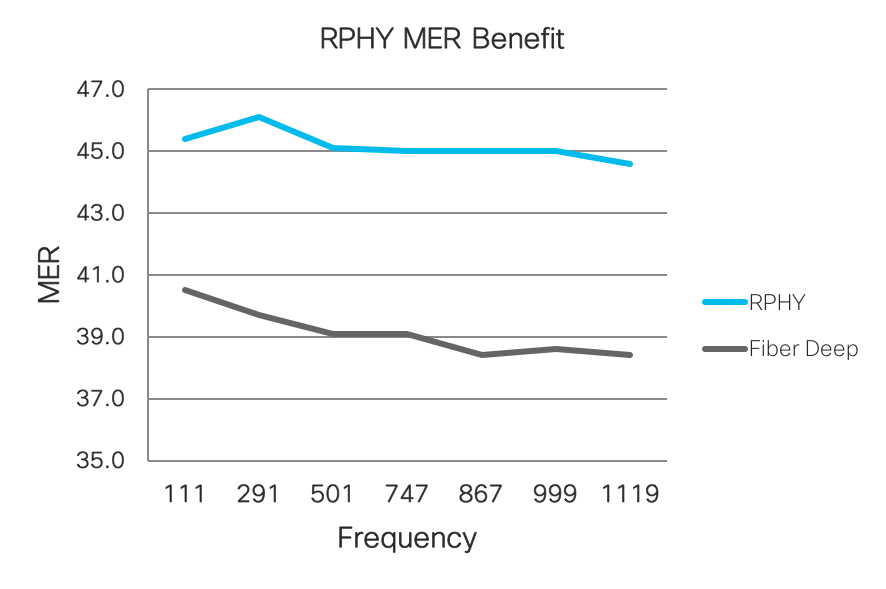
Remote PHY MER benefits; by replacing the Analog RF Optics with Digital Ethernet Optics the network MER improves dramatically as a result of a reduction in RF impairments.  The graph demonstrates the typical improvement that can be accomplished utilizing Remote PHY Nodes.


Advantage: Remote PHY

While the white paper comparison between a Remote PHY Fiber Deep and Analog Fiber Deep deployment is based on a representative but hypothetical hub, both the OPEX and CAPEX data clearly shows the cost-effectiveness and advantages of a Remote PHY Fiber Deep deployment.

Substantial OPEX and CAPEX gains are made based on CCAP chassis density and scalability, equipment and HVAC powering estimates, headend footprints, and the Remote PHY CIN Network. Particular attention should be paid to the Remote PHY Fiber Deep deployment’s reduction in headend footprint requirements, as this can often negate the need for facilities expansion.

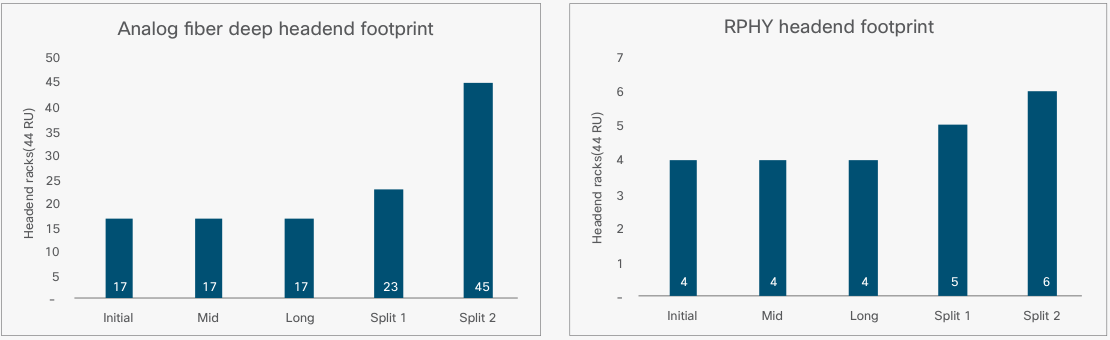
The graphs above show the number of racks required in a headend for both architectures based on three phases of Bandwidth service tiers growth and two consecutive Service Group splits. Ultimately the difference between the two architectures is 39 headend racks.

Find Out More

Download a copy of the white paper to read our full analysis of Remote PHY’s TCO benefits, including how a Remote PHY shelf or a Business as Usual fiber node deployment can be used to gain additional savings.

If you’re traveling to the 2017 SCTE-ISBE Cable-Tec Expo this month, make sure you stop by and see us at booth #987 where we will gladly walk you through a demonstration of the Remote PHY technology and explain the benefits in more detail.

Authors

Daniel Etman

Product Marketing Director

Cisco's Cable Access Business

Avatar

Contact Center Power Chord

On Thursday, April 24th, 1964, the four young Beatles walked into North London’s Abbey Road studio for a recording session. When they left that evening, the music industry was forever changed. Why? The Chord. The most famous chord in rock ‘n roll history.

The Beatles were seeking a dramatic opening for the song “Hard Day’s Night” in support of their upcoming movie of the same title. They achieved this result beyond all expectations. The combination of George Harrison’s 12-string electric, John Lennon’s 6-string electric, Paul McCartney’s bass, and a series of notes struck on a piano by the “5th Beatle” George Martin, produced an opening sound for the song never experienced before in music.

Two important results flowed from the impact of The Chord.

  • First, it motivated thousands of young people around the world to pick up a guitar and give it a try.
  • Second, it spawned a 50-year debate on what input notes and instruments used to by the Beatles to make such a sound. Some say it took extensive Fourier analysis to solve the debate in 2014.

We’ve been building our own power chord for customer contact products. At its core, a chord is three notes that played together produce a harmonious sound. Our three powerful notes include the right solutions, the right partners, and the right story. Our story is how the Connected Digital Experience benefits the digital journeys of customers worldwide.

From a solution perspective, we’ve just launched Release 11.6 of our customer care software. The new release features a powerful set of capabilities, focusing on improvements in digital channel interactions, new deep data insights, agent desktop enhancements, and security updates. The result? You can take advantage of advanced routing for personalized customer contact center, context to improve customer journeys, and new open web interfaces to integrate partner applications – including the ability to seamlessly integrate AI and bots.

Cisco’s industry-leading Technology Partner ecosystem has been expanded by 50% in 2017, delivering new pre-built integrations that speed time-to-value. This helps us deliver a clear and relevant goal for our customers – The Connected Digital Experience.

The industry recognizes we’re making some noise of our own!

Find out more how Cisco can help you create a differentiated experience for your customers.

Authors

Zack Taylor

Director

Cisco Global Collaboration

Avatar

Today, managing utilities and smart cities to achieve business outcomes require real-time decision making. In this age of digitizing critical infrastructure, managing renewable power generation, and dealing with the proliferation of electric vehicles – smart solutions must generate actionable insights from the edge of the network.  This is where Itron and Cisco can help. The OpenWay Riva solution is the next generation Internet of Things (IoT) network for utilities and smart cities from Itron and Cisco.

The solution meets the evolving needs of utilities and cities implementing smart solutions. It offers reliable connectivity and robust security as well as a flexible platform that enables easy adoption of new applications.

For those that will be attending Itron Utility Week in Houston, stop by the Cisco demo area located in the IoT and Smart Cities Knowledge Center. You will learn more about how our portfolio of tested, validated products securely connects IoT devices and applications to the enterprise.  You will also find Itron and Cisco technology together throughout the exhibit floor in Gas, Water, Electricity and Smart Utility Operations Knowledge Center areas.

For more detail, attend one of the Cisco speaking sessions:


For utility industry leaders that can’t make it to the event, follow the action and join us on Twitter using #IUW17 and @CiscoUtilities @Cisco_IoT. Visit us online to learn more about Cisco Utilities and Cisco Kinetic for Smart Cities


Authors

Scot Wlodarczak

No Longer with Cisco

Avatar

#CiscoChampion Radio is a podcast series by technologists for technologists. In this episode we’re talking to Sue-Lynn Hinson about the Cisco TacOps Team.

Get the Podcast

  • Listen to this episode
  • Download this episode (right-click on the episode’s download button)
  • View this episode in iTunes

Cisco Guests

  • Sue-Lynn Hinson, Cisco TacOps Team

Cisco Champion Hosts

  • Justin Cohen  (@cantechit), Solution Architect
  • Aaron Conaway (@aconaway), Network Engineer

Podcast Discussion Topics

  • How TacOps was founded.
  • The logistics involved in setting up for a disaster.
  • Learning lessons: The process and learnings from the TacOps team’s experiences on the ground.
  • How the TacOps team benefitted from Meraki and how it allows the team to expand their global footprint.
  • How the TacOps team consult with people around the world to help them build their own kits/solutions.
  • A walk through the technical specifications for the TacOps vehicle.
  • How security has changed how the TacOps team functions.
  • The importance of planning and documentation.
  • TacOps team structure and background.
  • What the team does between missions.
  • Sue-Lynn’s pinnacle career point at Cisco.
  • Post-incident support for team members and volunteers.
  • The vital nature of providing a communications structure.
  • The types pf deployments the TacOps team faces.

Listen in and provide us feedback, we would love to hear from you!

Resources:

Authors

Andi Fisher

No Longer with Cisco

Avatar

“If Microsoft calls and asks you for your password…it’s not real, ” said Steve LeBlond, VP of Technology and CTO of Ochsner Health System, while speaking at our Digital Health Summit on October 3. “We [Information Technology] will never ask you to log us in.”

Steve was talking about phishing attacks, one of the biggest cybersecurity risks that businesses—especially healthcare organizations—face today. You’d like to think you’d never fall for a scam like that, but the truth is, fraudulent emails, calls, and other penetration attempts aren’t always as obvious as the example he provided. These types of “social engineering” attacks rely on manipulating people and are becoming more and more sophisticated.

How do you avoid social engineering in your healthcare organization?

It starts with a creative, system-wide, ongoing education program.

Why “creative?” Well, let’s be honest: No one wants to sit through a three-hour PowerPoint presentation about security. To be effective, your education must be engaging and relevant. A few tips:

  • Consider role-playing the security pitfalls that different employees may encounter each day.
  • Illustrate how a phony request for medical records might unfold.
  • Acknowledge that password workarounds are tempting—but dangerous.
  • Offer tips on working efficiently without breaking security rules.
  • Join the growing trend of “penetration tests”—fake phishing emails sent to your own employees to test their knowledge. If they open the link, a page pops up letting them know they’ve been fooled and describing what to look for next time.

Above all, don’t talk down to employees about security—that will only turn them off. Instead, remind them that they’re the guardians of some of the most important information on earth. Help them understand why they’re attractive targets for hackers.

Of course, all the education in the world won’t help if an attack manages to get through, so it’s also important to have technology defenses in place.  For a deeper dive on cybersecurity for healthcare organizations, click below to read our white paper.

Authors

Amy Young

Marketing Manager

Healthcare

Avatar

Insights from Gartner ITxpo Orlando

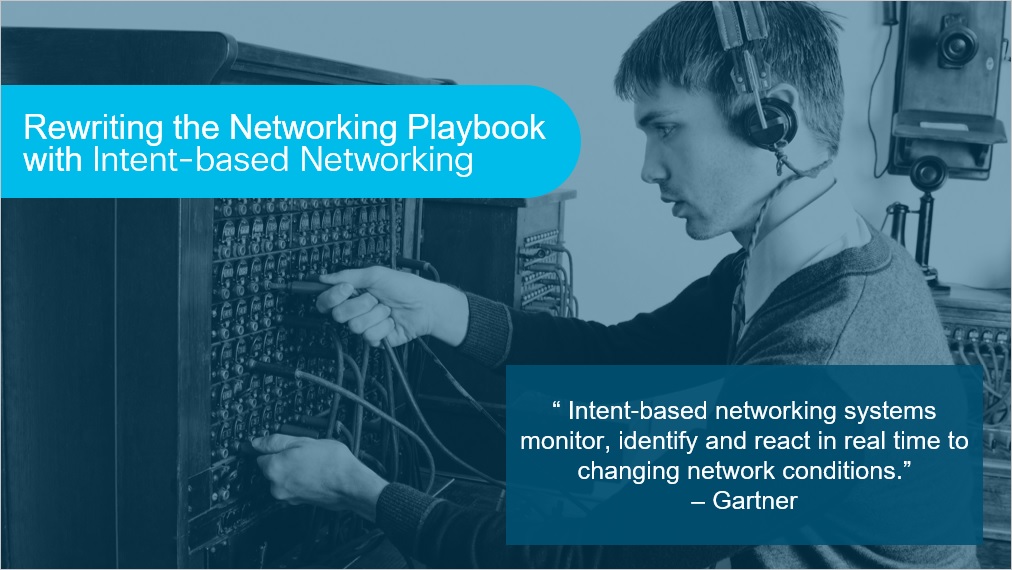
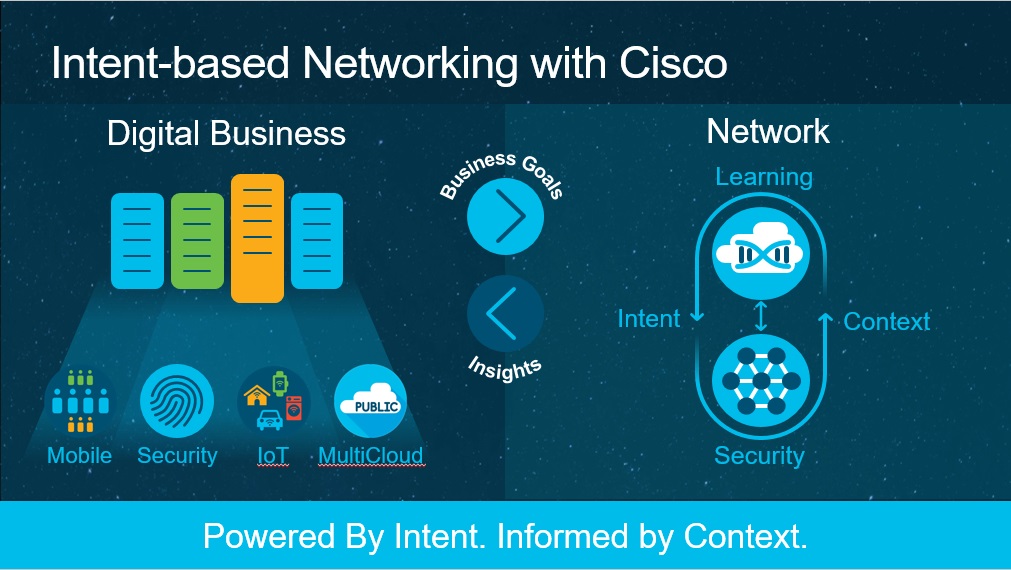
By now you’re aware that we’re on the verge of one of the biggest transitions the enterprise network has seen –  and intent-based networking is the name many industry leaders are using to describe it. Whether you’ve heard about the concept of “intent-based networking” or not, the approach is one we will undoubtedly be hearing a lot more about in the coming months and years. More than just a specific technology it’s the holy grail of networking. A  drastically new approach that enables the network to continuously align itself to the disparate demands of the organization. It brings together all the latest networking innovations including SDN, virtualization, machine learning, model-based APIs, and many security related innovations into a closed loop system capable of identifying, predicting, and responding to business needs. For all of us that have been in networking for any length of time, this is received with a healthy dose of skepticism – and rightly so. That’s why it is especially exciting for me to see this all come to fruition.

During Cisco Live! in June, we announced the network intuitive vision and the initial ground-breaking steps we are taking to transform the network to an intent-based system based on the Cisco Digital Network Architecture. I had the opportunity to share these latest developments with a senior IT audience at Gartner ITxpo last week. In fact, Gartner has been one of the leading proponents of intent-based networking – so what better venue to share these ideas?

All roads lead to an intent-based network.

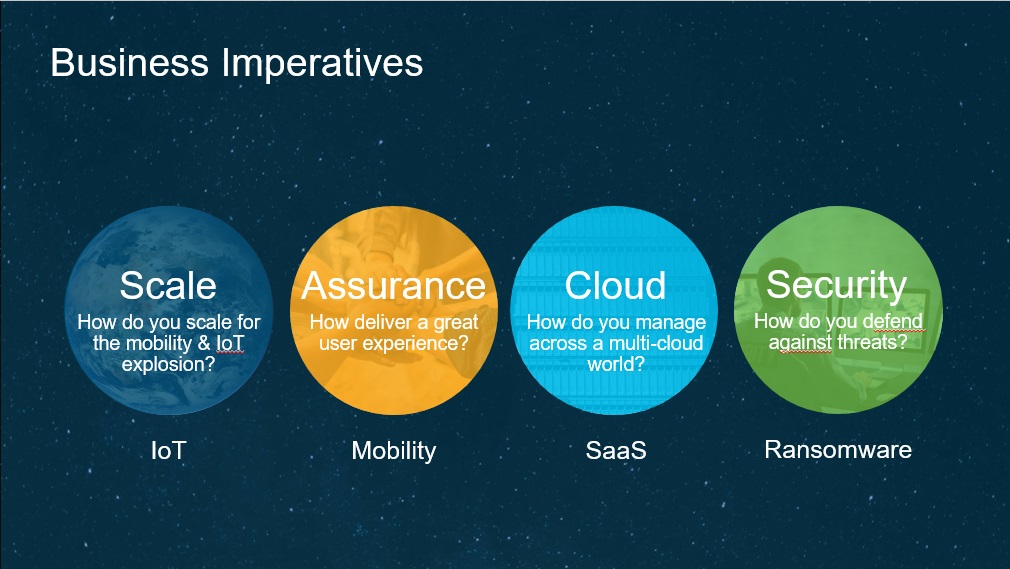
Most importantly, I wanted to acknowledge to the audience that intent-based networking will be a multi-phased journey for each of their organizations and provide some actionable approaches to start that journey. While there is a common destination, where the network automatically understands and responds to all business and IT service demands and security and compliance policies, the route will often be different. The route will largely depend on where your organization’s priorities lie. So where do your priorities lie? Is it with IOT and mobile, cloud, assurance, security – or something else?

Scaling for IoT and mobile

For example, is your organization most concerned with the complexity of managing and scaling the Internet of Things (IoT) and/or mobile devices? If so you should start by using intent-based networking to simplify and automate secure access policy across the network for all users and devices. This will require applying software-defined networking capabilities across all wired, wireless connections. By automatically creating granular software-defined segments based on identity across the entire network, you can protect workgroups, BYOD, guests, contractors, partners and IoT devices, regardless of where and how they are accessing the network.

Performance and security for cloud

Alternatively, if your biggest challenge is migrating workloads to the cloud, you should start by using intent-based networking to ensure the secure and high quality user experience of cloud apps. This means applying software defined networking to your WAN environment, so that you can provide secure direct access to cloud apps at branches. You’ll also want to segment access to cloud apps from other apps and extend your WAN to the various SaaS points of presence (POPs) through virtualized routing capabilities.

Assurance, security and optimization

Other examples include organization’s that begin by prioritizing the securing of their digital initiatives, or ensuring network and service assurance, or simply lowering IT costs and optimizing IT processes. In each case you will start your journey with the investment and at the point that is most critical to you. However, because intent-based networking is a systems approach, all deployments will eventually converge on an integrated system that requires a holistic closed loop approach to policy, assurance, and automation across all parts of the network.

Benefits and risks

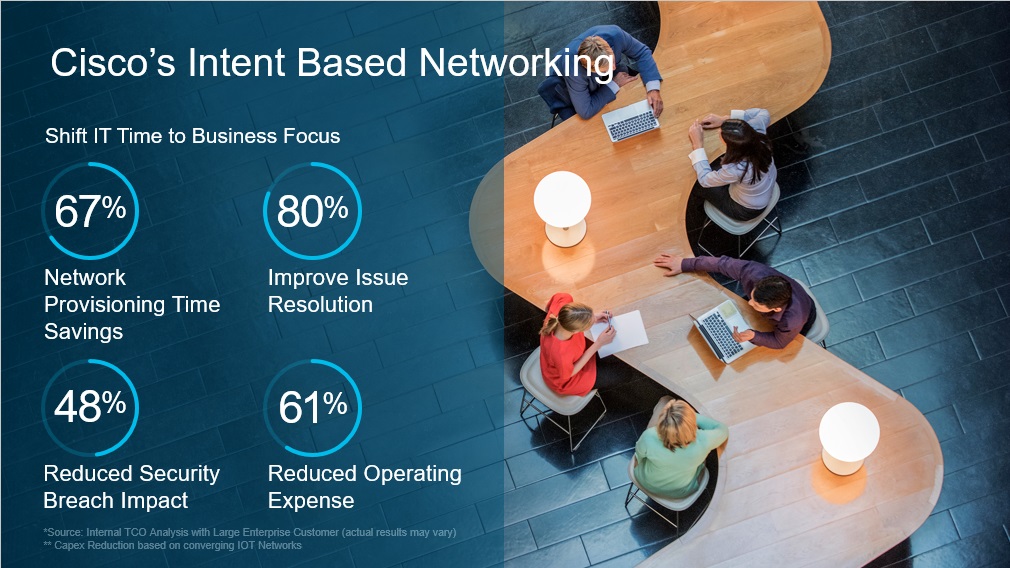
This journey comes with benefits –  but also risks. The reward for the organization taking this journey is a network that can keep up with the demands of your organization, while reducing operational costs and combatting ever more dangerous security risks. For the network team, it means moving away from cumbersome operational maintenance that yield very little true benefit to the business and towards creating value to the top and bottom lines. However this will require a fair amount of re-skilling and process change that are not without their own risks. Additionally, as with every major technology transition, there are technology and process risks associated with implementation. You will need to carefully plan your migration, so that you can quickly reap the rewards without affecting existing service levels.

How can Cisco help?

When it comes to guiding IT organizations through complex transitions, we have a proven success track record that we have no intention of spoiling. It starts with a commitment to our customers’ success. It includes a committed technology vision, strategy, and roadmap and includes a rich and open ecosystem, retraining resources and a rich set of Cisco and partner services. You are not alone – Cisco and our partners will be with you each step of the way.

Check out my presentation from Gartner ITxpo below, then take a quick self-assessment of your own network readiness.

Dive into the innovative Cisco DNA solutions for intent-based networking we are offering today.

Would love to hear from you on your own journey to IBN.

https://www.slideshare.net/Cisco/intentbased-networking-powered-by-cisco-digital-network-architecture-80787254


Authors

Prashanth Shenoy

Vice President of Marketing

Enterprise Networking and Mobility