Avatar

For many people, 2016 was a year full of surprises. Not only did the world lose some of the most famous names in music and film, but the outcomes of both the EU referendum and the US presidential elections caught many of the so-called “experts” off guard.

What does this have to do with innovation? More than you might think. It shows how we live in a VUCA world (Volatile, Uncertain, Complex, and Ambiguous) more than ever before. Disruption is everywhere and the events of 2016 have shown that predicting the future is neither simple, nor reliable.

As a result, many businesses are entering 2017 with more fear than in the past. Such fear will inevitably have an impact on the way you explore and implement new innovation projects. But with some inside knowledge, you can set aside some of that fear. I recently sat down with my team to discuss the three most likely trends to emerge over the next 12 months.

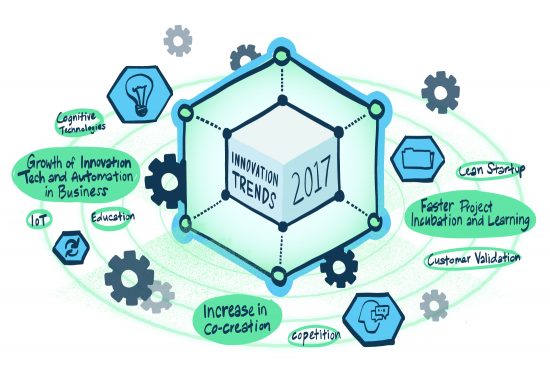
As you plan for 2017, you can use our insight as guideposts.
CISCO_Innovation Blog Post_V2_CCZ_010617-01

1. A move towards faster project incubation and learning

In the face of growing uncertainty, innovation project timeframes have to get shorter. More corporate businesses will adopt the Lean Startup approach of experimentation, rapid incubation, and fast failure.

By taking this approach, you create more rigor around the evaluation of both problems and ideas. This allows innovation teams to stay focused on genuine problem solving, while helping to identify dead-end ideas early in the process. Customer validation will play a more prominent role in the innovation process, testing concepts in the real world and helping to keep new concepts and initiatives relevant.

The Lean Startup is a strong framework for innovation, but this methodology must be understood and applied correctly. It’s not a linear process as genuine disruptive innovation is often messy and ambiguous. The best ideas will only emerge after several iterations and refinements, something that many businesses aren’t ready to allow.

So the question becomes, “Is your business ready?”

2. A growing presence of innovative technology and automation in business

The prevalence of technology in business continues to grow at an unprecedented rate. 2016 was the coming of age for exciting technologies such as augmented reality and virtual reality, which are now finding genuine uses in fields such as medicine and real estate.

2017 will also bring incredible innovation. Artificial Intelligence, machine learning, other new cognitive technologies, and the continued expansion of the Internet of Things (IoT) will transform the way many organisations fundamentally operate and interact with their customers. As a result, we’re likely to see more experimental innovations emerge using technology such as these at their core to push the boundaries of possibility.

New technology undoubtedly improves the way we live and work, but it mustn’t come at the detriment of people and jobs. Technological innovation should be accompanied by a conscious effort to reskill people of all ages for the future. Children must be educated for a workplace very different to the one we inhabit today, but older generations of workers, and their skills, must not be lost either.

Ask yourself, “How will my organization reskill for the future?

3. An increase in co-creation around innovation

The concept of co-creation has long been known, but largely unpracticed in the business world. However, a growing desire to protect their futures has led many companies to become less guarded in recent years, paving the way for an exciting new collaborative movement. Tesla Motors is perhaps the most extreme example of this, opening up all of its patents to the public in a bid to move the electric car industry forward. There are many other collaborations now taking place as well, between companies normally seen as direct competitors. Cisco itself works closely with Apple, Intel, and Microsoft on a variety of innovation projects that move all partners forward.

Of course, with collaboration of this nature there comes a point where a natural divergence occurs. By that point, however, a great deal of healthy innovation and progression has already taken place. Remember, as an innovator, you don’t need come with completely new ideas, but with fresh eyes or a new angle. This is often all that’s needed to make a breakthrough. Look out for the term “copetition”—cooperating with competitors!

Look around and be prepared to say, “Let’s co-create.”

As 2016 has shown, predicting the future is never easy. We’re confident, though, that we’ll be seeing more of these three innovation trends over the next 12 months.

What are you expecting to see in 2017? Let me know in the comments below.


Authors

Matt Asman

Innovation Manager

Services Innovation Excellence Center (SIEC)

Avatar

In 2016, there seemed to be constant reminders in the news about the latest hack or newest type of attack. As a result, the security market experienced a significant amount of growth. Gartner expects the cybersecurity market to cross $100 billion in 2019 from $76 billion in 2015.

To take advantage of this, numerous point products and solutions flooded the market and everyone seemed to talk about the network and how it needs to be secure. However, even with all the talk, security was and is still often seen as getting in the way of networking, adding too many controls, or slowing the network down. Talking to our network buyer customers, the common concerns that I’ve heard were:

  • I need to easily control who gets on my network
  • I don’t know if my network is exposed to threats
  • I’m not sure how to best respond to threats

Sound familiar?

Looking forward to 2017, these conversations will continue and the number of opportunities and challenges, when it comes to securing the enterprise, will increase. Jeff Reed recently blogged about Networking Trends for 2017 and Kiran Ghodgaonkar blogged last week about Predictions for SD-WAN, and they both mentioned the importance of security. Here is what I think will be important for enterprise network security in 2017 and what organizations can look for to make sure that security is in their DNA:

1. Integrated security

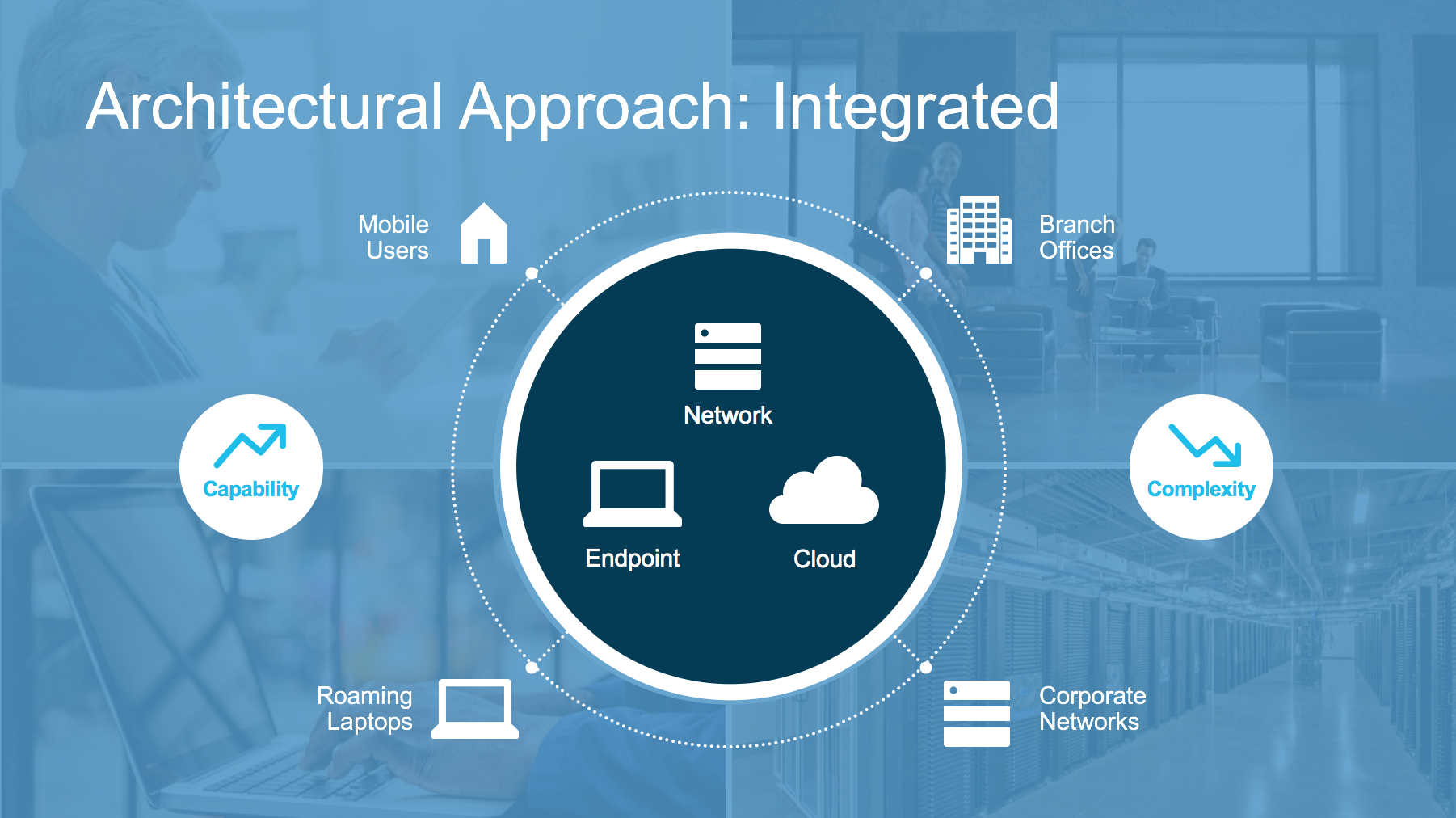
IDC predicts that 1 million new devices will go online every hour by 2020. With the exponential increase in devices and applications, the threat surface area for an organization has expanded beyond traditional means. To reduce risk and complexity, security will need to be embedded within hardware and software solutions, have flexible deployment options, and work with each other to provide integrated multilayered protection. Expect security architectures to be simple, open, and automated so your network has better performance, works with other solutions, and is easier to manage.

Integrated Security Architecture

2. Need for improved visibility

As a result of the amount of growth experienced by digital organizations, 76% of IT professionals say a lack of visibility is their biggest challenge in addressing network threats (Ponemon Institute). It is becoming more and more important to know what is going on with your network at all times – across all applications, users, and devices. Expect networking and security teams to work more closely and leverage network infrastructure to extend visibility everywhere.

3. Emphasis on analytics

Based on a SANS Institute survey, organizations are using analytics more across the board as part of their security strategy. The type of information you have and the amount of information you have is critical for lowering the time to detection. Sampling data may have helped identify and react to threats in the past, but look for contextual awareness and other proactive and more intelligent ways of gathering deeper insights and data, leading to more accurate detection of anomalous network and user behaviors across the network.

4. Move towards cloud

As organizations look to the cloud to enable their business with benefits like flexibility, simplicity, and scale, cloud security adoption will follow closely behind. This year, expect to see increasing interest in protecting data and applications in the cloud. Cloud-delivered and cloud-administered security solutions are gaining in popularity also. These solutions offer ease and speed of deployment and consistent, simple administration to provide an initial layer of defense.

In summary, just ask yourself this: what can your network do for you to secure your digital organization?

This is my view of the enterprise network security market for 2017. I’d like to hear yours! Comment below or reach out to me on twitter @jasoncliu.


Authors

Jason Liu

Product Marketing Manager

Enterprise Networking and Mobility

Avatar

The Consumer Electronics Show (CES) usually highlights important technology trends that could shape the future. This year, artificial intelligence (AI), the smart IoT sensors that fuel it, and increasingly powerful and seamless human machine interfaces (HMIs) topped the list for me.

On the AI front, almost every automotive company is working on driverless cars, powered by dramatic advances in computer vision and deep learning.  With regard to sensors, in the Honda booth we saw a tiny optical sensor that can fit in the rearview mirror and measure throat movement. This significantly improves the Honda Throat Motion Sensorclarity of speech in noisy environments.  In the Denso booth we saw a wide range of imaginative innovations from vacuum cleaner shoes to a robot barista; we also saw a novel contactless haptics system based on an array of ultrasound speakers. Combined with holographic projections and a leap motion hand sensor, this could create a revolutionary HMI where you not only see and interact with a software defined “virtual dashboard” but you can feel it as well!  In the ChangHong booth we saw a contactless EEG brain control device. Embedded in a headrest, this smart sensor picked up enough brain waves for a user to control the speed of a car in a video game!



While far from perfect, these smart sensors and HMIs, when combined with leading AI, could create some incredibly promising advances in the way we work, live, play, and learn.

Nowhere was this more prevalent at the show than in the automotive industry, where we saw smart new experiences in mobility as a service, with personalized driver and passenger journeys that surprise and delight.  In the Hyundai booth, for example, you could explore the future commute to the office – and even step inside the vehicle to choose your mood on arrival. The car monitors biometrics and facial expression, and controls temperature and lighting; it even emits scents like peppermint or sandalwood to help make sure you arrive highly energized or completely relaxed. No more stressful commute to ruin your day!  But this vehicle is only the beginning of the

Denso Contactless Holographic Haptic Controller

mobility experience – Hyundai also showcased a smart mobility chair that transports you seamlessly between the vehicle and the home – to which it docks. It controls music, video, lighting, appliances, security, and much more in a highly intelligent,

anticipatory fashion, based on rich context from ubiquitous networked sensors and actuators – all with voice control, of course!

These new experiences require continuing advances in the flexibility, robustness, and security of networks.  For example, while many auto manufacturers are working on very advanced self-driving capabilities, the “network” in most cars today is where it was 30+ years ago in the enterprise, with a variety of siloed protocols that are difficult to secure.  The Advanced Driver Assistance Systems (ADAS), highly automated vehicles, and next generation mobility experiences we saw at CES will revamp in-vehicle networks.  To that end, Cisco is working with Hyundai to create an IP / Ethernet backbone for the vehicle that will streamline and simplify the vehicle and its connectivity to other vehicles, to the infrastructure, and to the cloud.

If CES 2017 foreshadows the future the way it has in previous years, we have a smart new world to look forward to!

Authors

Shaun Kirby

Director and Chief Technology Officer

Cisco Consulting Services

Avatar

It’s hard to believe that 2 ½ years ago, in my role as Head of Network Services at Cigna, I was in NYC presenting a concept to an emerging community called the Open Network Users Group.  Prior to the event, I vividly recall Nick Lippis (ONUG chair) asking me if this was a concept that I would bet my career on.  The theme of the presentation was focused on transport independence, which later become our software defined WAN strategy, driving significant value in terms of cost optimization, security and agility.

Making decisions often requires us to look at problems from multiple angles. In our industry, decisions are rarely clear cut and often times are informed by our unique experiences and perspective. Today, as the VP of Strategic Planning and Chief Experience Officer here in the Enterprise Networking Group at Cisco, I am fortunate to be able to draw on my past experiences to make a real difference as the voice of Cisco’s enterprise customers, and forge a new path ahead for Cisco and its relationship with the Open Networking User Group (ONUG) – ultimately putting our customers at the center of everything we do.  It’s all about solving real IT problems that unlock value creation for the customer.

Having served on the ONUG board from 2014-2016, I am a true believer in the mission of the organization: enable greater choice and options for IT business leaders by advocating for open interoperable hardware and software-defined infrastructure solutions that span across the entire IT stack, all in an effort to create business value. Software-defined infrastructure is the future of the industry, and I believe taking an open, interoperable approach to solving customer challenges is most beneficial for both vendor and customer. In fact, customers are demanding this, and ONUG’s goal is just that – help make the customer voice heard.

My previous role at Cigna introduced me to Software-defined WANs, and the OPEX and service quality improvement opportunities that this new technology promised. We recognized the opportunity and became champions for change. At Cigna, we were effective in convincing the vendor community there was a market for SD-WANs, and were innovative in deploying a solution that solved a true customer problem statement. From completely revamping the security program at Cigna to demonstrating the reality of SD-WANs, my experience at Cigna taught me that innovation is a two-way street. Vendors can bring innovative solutions to the table, but they need to solve a customer problem. Customers can have innovative ideas, but without communicating their needs to the vendor community and collaborating in an iterative fashion on execution, they can face a long and arduous road to solving those problems.

While serving on the board and driving multiple working groups, ONUG truly helped shape the SD-WAN market. We made SD-WANs real and implementable. We helped organizations realize the value of a WAN transformation. In my own experience, my previous organization was able to realize the in-direct and direct benefits of these new initiatives, ultimately driving value to our shareholders and consumer. I couldn’t be prouder of what we accomplished. ONUG is becoming a powerful voice in the industry, but I do foresee a coming shift. Whereas ONUG helped push for new technologies and solutions over the last couple years, I see vendors again starting to lead the innovation cycle, but in a new way. Cisco is leading the way as companies start to think ‘outside-in’ when it comes to product development – using customer problem statements to create solutions. In this, ONUG has achieved their goal in giving voice to the customer.

Now, I have made the jump and am sitting on the other side of the table. I am excited about the future and working for the company that has the broadest and deepest portfolio, and the greatest opportunity to truly transform the industry. Most importantly, I’m ready to continue working with ONUG – though in a different capacity – to ensure we are providing customers with solutions that solve their problems. We are just getting started.

Authors

Michael (Mike) Elmore

Vice President

Enterprise Infrastructure and Solutions Group

Avatar

Tim Harmon is a Cisco Champion, an elite group of technical experts who are passionate about IT and enjoy sharing their knowledge, expertise, and thoughts across the social web and with Cisco. The program has been running for over four years and has earned two industry awards as an industry best practice. Learn more about the program at http://cs.co/ciscochampion.

==========================================

Welcome to the Cyber Security Capture the Flag (CTF) Series. This series is about how to develop and host a cyber security CTF and how to do it well. As from my previous blog (Cyber Security Capture the Flag (CTF): What Is It?”), cyber security CTFs are used to keep security professionals and students up-to-date with their skills in the cyber security industry. They are also used to determine what areas of security that professionals need to work on. There is a process in developing and hosting a CTF and this should help anyone who is interested in developing and hosting their own cyber security CTF. It is recommended that you have some experience in at least participating in CTFs before you develop and host your own CTF.

The first and most important phase of developing and hosting a CTF is the planning phase. Planning, or lack thereof, can make or break the event as there may be some delays on implementing the CTF due to situations arising from not enough planning. I know this from experience as my team did not plan enough and we had to figure out a backup plan to get the CTF to be ready. We ended up pushing the CTF back one week but it became a success anyway.

This phase consists of several decisions based on the answers to the who, what, where, when, why and how questions. There can be a few to a lot of questions for each section and all questions for the even should be at least attempted to be answered. Any question left unanswered can cause problems later on in the process. In this section, I will pose some of the questions that can be used.

Who:

  • Who is the target audience for the CTF?
  • Who, if any, are the sponsors of the CTF?
  • Who will promote the CTF in order to gain participants?
  • Who will secure the venue and equipment?

What:

  • What type of CTF will this be? Jeopardy-style, attack-defend or hybrid?
  • What equipment do we need for the CTF?
  • What will the participants need to bring?
  • What categories are going to be in the CTF?
  • What types of challenges will there be?
  • What will the scoreboard be?

Where:

  • Where are we going to host the CTF?
  • Where are the participants going to plug their laptop in? (if they need them)

When:

  • When are we going to have the CTF event?
  • When are we doing a run-through of the CTF before the actual event?

Why:

  • Why are we hosting this CTF event?
  • Why are we using this software over that other software?

How:

  • How are we going to secure a venue?
  • How are we going to get participants?
  • How is the scoreboard going to be set up?
  • How is the CTF going to be implemented?
  • How are the participants going to access the scoreboard?

After all of these questions are answered, the group will need to start developing the several documents that need to be filled out before anything else can happen. These documents include a Project Proposal, Design Document, Work Breakdown Structure (WBS), Rules of the CTF, Participant Sign-up, Pre-CTF participant survey, Post-CTF participant survey and CTF marketing flyers. Some of these documents can be worked on during the Developing stage. These include the Participant Sign-up, Pre and Post-CTF surveys and the flyers.


Cyber Security Capture the Flag (CTF) Series 01

Figure 1 – Screenshots of Design Document, Project Management Plan, Rules of Play and Sign Up

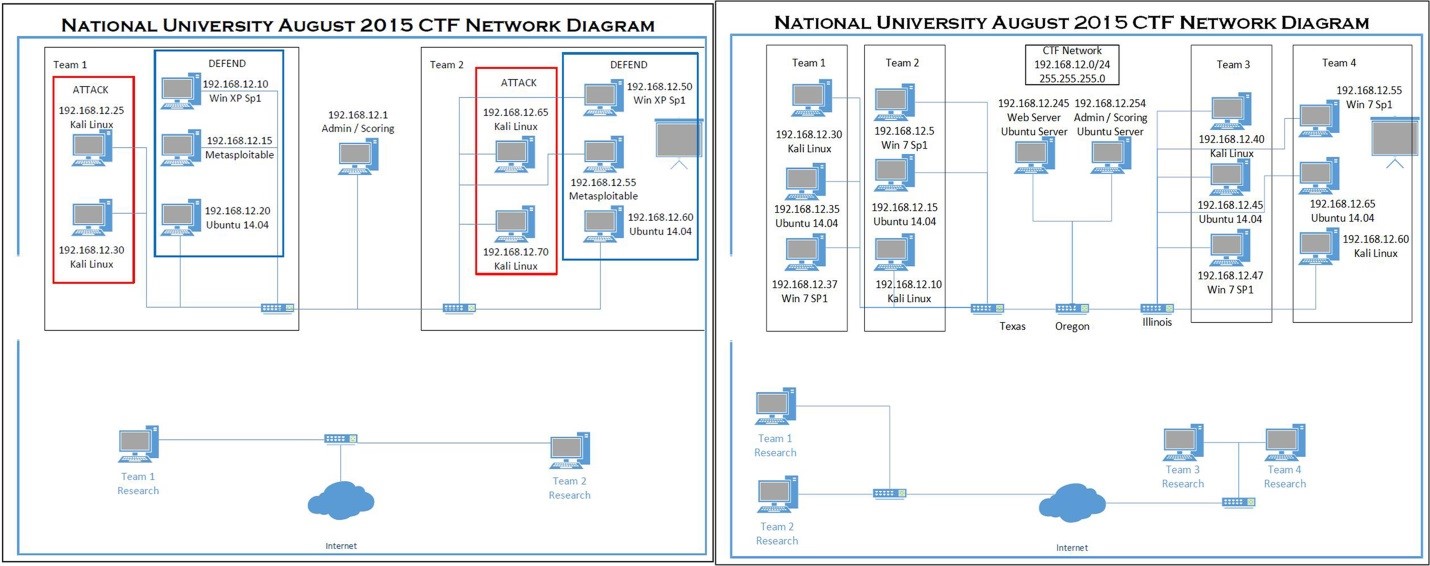
The Design Document, Project Management Plan and the WBS are very important documents that need to be completed as soon as possible because these documents help the process of getting the CTF to be successful. The Design Document includes what the layout of the CTF will be with the equipment at the venue. It will also include what the rules of play are and it will detail how the scoring system will be used. As you can see in the Figure below, my team’s network diagram changed throughout the process as we ran into some problems and could not get the attack-defend CTF to work so we decided it was going to be a Jeopardy-style CTF. We originally had it be two teams for the attack-defend but changed to four teams in the Jeopardy-style. Our CTF was held at Coleman University in San Diego, CA and we were using their equipment. This was possible by Mr. William Reid at Coleman University.

Cyber Security Capture the Flag (CTF) Series 02

Figure 2 – Network Diagram (Original on the left, revised on the right)

The Project Management Plan consists of a summary of the project that include assumptions and constraints and the management of the scope that will include the WBS and the project schedule. It will also include risk assessment/risk management, quality management, Human Resources management and the budget. A budget is highly recommended, even if the equipment and venue is being donated, as it can show how much you could spend and how much you could save. The WBS is a schedule of deliverables and milestones that will help the group to stay on track with being ready for the CTF event. Milestones can be the completion of each phase, the execution of the event and the final write-ups. Figure 3 below is an example of my team’s WBS for our CTF event.

Cyber Security Capture the Flag (CTF) Series 03

Figure 3 – Work Breakdown Structure for CTF

The pre and post CTF surveys for the participants to fill out can be done while the group is in the development phase as these are not the first priority and will be discussed in Part 2 (Developing) of this series. One person can create sign-up sheets for people to sign up as participants and this person can also create the flyers for the CTF event. After a date, time and location for the CTF event has been set in place, the group can start seeking participants. This can be the hardest aspect as some participants may end up not being able to make it. The sign-ups can be on paper or even online through social media or website.

You may be a little discouraged right now as there is a lot of work that needs to be done just in the planning/design phase of the CTF event. I encourage your group to not get discouraged as the hard work and dedication will pay off. You should be able to get help with the planning and design of the event through the Internet and local chapters of the professional cyber security associations. One association that was helpful with my team’s CTF was the Open Web Application Security Project (OWASP) San Diego Chapter. They held a CTF just a couple weeks before my team’s CTF and it gave us some insight. In Part 2 of this blog series, I will discuss the steps to take in the Developing phase of the CTF event.

Authors

Tim Harmon

Cyber Security & Network Professional

Cisco Champion

Avatar

I’m a journalist; a storyteller. My job as a social media manager for Cisco requires all the same skills I honed as a news producer at television news stations all across the country.

When I made the leap into the corporate tech world, I wondered how big of a learning curve I’d face. It turns out, it’s not as steep as I’d imagined. While I’m not sure I’ll ever know all the many acronyms used here, and I’m still learning how to master the perfect snap for Snapchat, Cisco has amazing stories to tell and I’m so excited that I get to share and tell them for a career.

As I near my three-month mark at Cisco, I think I’m just beginning to understand all that Cisco has to offer me, its customers, and – quite honestly – the world. Before Cisco, (which I will now refer to as BC because I wanted to come up with my own acronym), I had no idea just how much Cisco is steeped into the fabric of people’s lives. Sure, I knew about Cisco’s history with routers and switches and knew my desk phone at my old job was a Cisco phone, but honestly that’s all I knew about this company.

Here’re a few things I’ve learned in my short stint as a Cisco employee:

  1. Instantaneous connections are key.
    From a personal standpoint, I don’t know how I’d do my job in without with WebEx, Spark and Jabber. BC (remember, I’m creating my own acronyms), if I wanted to meet with someone, it would be face-to-face. While I was familiar with teleconferencing and occasionally used it for interviews, I didn’t think I’d get the same connection unless I was physically in the same room with someone. Now I realize you really can effectively communicate using WebEx and Spark. You save so much time and energy and I love how instantaneous it can be. Not to mention using Cisco’s products to do my job means a better work-life balance, something I know so many other Cisco employees appreciate.
  2. My co-workers break tech worker stereotypes.
    I’ll be the first to admit, BC, I had an image and stereotype of the typical Cisco worker. While I wasn’t naïve enough to think that all had engineering or computer science degrees, I worried if I’d fit in with the Cisco culture. From day one on the job, my team smashed my fears. They are some of the most welcoming and genuine people I’ve had the joy (yes joy!) to work with and collaborate with on all sorts of projects. They bring great ideas to the table and quickly come to the rescue when I’m stumped.marketing team
  3. Cisco tech is around you more than you think.
    You wouldn’t think about Cisco when you think about mining, but by innovating equipment, Cisco has made some of the most dangerous jobs in the world safer. Or, you wouldn’t think of Cisco when you order Starbucks on your mobile device, but yep, that’s us too! There are so many ways that Cisco transforms the world, and I’m psyched I get to share what we do and how we do it.

And this all brings me back to my job as a storyteller. I want to know the great things you are doing to innovate and make Cisco as relevant today as it was back in the early days of the co-founders Len Boswick and Sandy Lerner (That’s a shout out to the New Employee Orientation for doing a fabulous job of schooling me on Cisco’s history).

What’s your Cisco story?

Want to work at a company like this? Be sure to check our open career opportunities.

Authors

Liza Meak

Social Media Communications Manager

Global Corporate Communications

Avatar

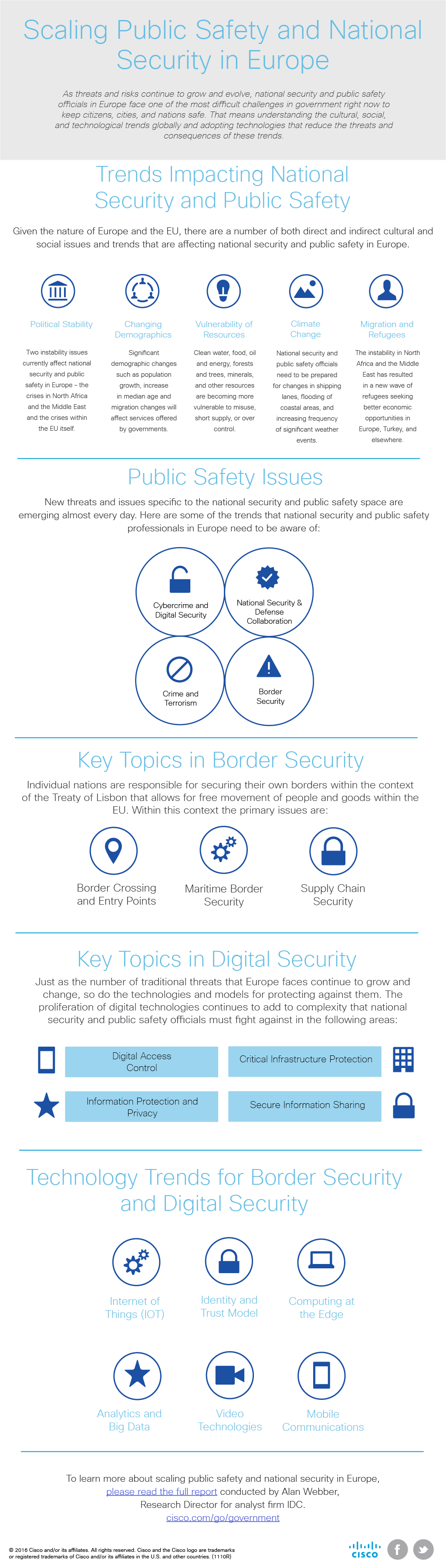
As the threats and risks from cyber criminals, terrorists, gangs, nation states, and others continue to grow and evolve, national security and public safety officials in Europe face one of the most difficult challenges yet in keeping citizens, cities, and nations safe.

Providing this safety often means understanding the global, cultural, social, and technological trends of today and adopting technologies that help to reduce threat. In addition to the ever-changing trends, the European Union (EU) also adds additional complexities with national borders and travel regulations.

So, how can European nations address these safety challenges? Analyst firm IDC produced the following research in partnership with Cisco around global megatrends and how officials can provide next-generation national security and public safety for their citizens, cities and nations. To read the full report, click here, or check out the infographic below.

GovernmentInfographic-EMEAR

Authors

Laura Re

Content Marketing Manager, Data Center Marketing

Ent Solutions- Data Center Marketing- UCS

Avatar

Regardless of the ongoing debate on the efficacy of legal action against illegal streaming, there seems to be more legal action initiated, with pretty significant judgments, across more territories and jurisdictions.

Two reports on action against illegal streaming caught my eye last month. The first was the conviction and four-year prison sentence for Terry O’Reilly in the UK. O’Reilly had apparently been selling IPTV devices which facilitated mass piracy, including the unauthorized distribution of Premier League football events from foreign channels. The second was the decision in Australia by a Federal court, which ordered major ISPs to block access to five big pirate-video sites.

While the industry is moving in support of new viewing habits: OTT and the expectation to watch any content, on any device, any time, everyone knows these services cannot come free of charge. And yet, many viewers – perhaps out of habit (or perhaps because it’s so easy) – make the effort to bypass payment. So it is no surprise that rights-owners are up-in-arms pushing for more legal enforcement of their copyrights. This is not trivial. There are territorial issues related to obtaining rights internationally. Enforcement relies on each territory’s legal and political system and the discretion of local, national legislative and judiciary institutions.

Clearly content owners and broadcasters have had enough. And the rise in legal enforcement and serious penalties against those offering content without authorization is a further reflection of greater public and government awareness that the issue of content-sharing (not to say stealing) has gotten out of hand.

Reports by the likes of MarkMonitor, NetNames, Muso and others who crawl the internet and count the instances and availability of pirated premium content such as live sports and high-profile drama series have certainly contributed to this awareness. Technology companies – Cisco amongst them – help turn the awareness into action with tools to detect illicit content and identify streaming sources; these provide rights-holders the evidence required to prove piracy – accurately and on a large scale. Indeed, in the last two years this has resulted in a marked increase in the requests for blocking and removal of sites that offer access to otherwise unauthorized or costly content, as well as in law suits against – and actual penalties on – the individuals who provide such access.

Several big cases, over the last two years alone – show that the trend is global and that more operators in more countries are seeking to protect their rights, with cross-regional legal action. In 2015, four Korean content rights owners sued a Chinese pirate network, TVpad, for copyright infringement, unfair competition and illicit distribution of pirate streaming devices and content in the US. While they estimated their loss to piracy at $358,741,454 US, the California judge awarded them $65,315,954. In a second case against the distributors of the TVpad device, a US District Court in California issued an injunction to stop the illegal distribution of CCTV’s and TVB’s content on TVpad. The injunction instructed ISPs to cease providing services used to illegally distribute the Chinese programming in US. This year in August, the Swedish police raided Advanced TV Network Sweden (ATN), which had been selling pirate IPTV boxes and subscriptions for several years. The prosecutor obtained a sequestration order for approximately $28m US, which was calculated based on 70,000 subscribers to the network over a 3-year period. Then, in November, a Spanish court ordered the streaming site Rojadirecta to stop offering links to football matches and instigated criminal investigations against the company. And just as 2016 came to an end, we completed a rounded globe-trot with two ongoing cases; the one case initiated by Bell, Rogers and Quebec’s Vidéotron against approximately 45 Canadian companies that are accused of selling Android boxes loaded with special software that enables unauthorized access to a multitude of TV content. In the second case, an Israeli court ordered local ISPs to block the popular streaming site SdarotTV, recognizing that the site distributes video content without the rights-owners’ authorization. The court acknowledge that the site is profiting from others’ intellectual property and causing them significant financial losses. The site-owners are currently challenging the court’s decision, and claim the servers are off-shore and the court ruling doesn’t apply.

It seems evident that the video industry’s battle against illicit streaming and content-sharing has stepped up a notch. There will be those who continue to question the legitimacy of this battle, or even the effect that legal action has on reducing the problem. How much of a dent legal action can make in reducing the losses to streaming piracy is yet to be seen.

Authors

Avigail Gutman

DIRECTOR.ENGINEERING

Avatar

Over the past several weeks, there have been ongoing discussions regarding cyber attacks that have occurred against several political, governmental, and private sector entities in the United States. These discussions have revolved around allegations that these cyber attacks were designed to interfere with the 2016 U.S. Federal Elections as well as identifying who is responsible for these high-profile compromises. On December 29, 2016, the United States Department of Homeland Security (DHS) and Federal Bureau of Investigation (FBI) released a joint analysis report detailing some of the tools and infrastructure used by adversaries to compromise these institutions. The DHS-FBI joint report is referring to this activity as GRIZZLY STEPPE. Talos is aware of these discussions and reports of malicious activity associated with GRIZZLY STEPPE and has responded to ensure our customers are protected.

Coverage for GRIZZLY STEPPE is available through Cisco’s security products, services, and open source technologies. The IP addresses listed in the DHS-FBI report have also been evaluated and applicable ones blacklisted. Note that Talos will continue to monitor for new developments to ensure our customers remain protected.

Read more »

Authors

Talos Group

Talos Security Intelligence & Research Group