Avatar

The upcoming collaboration launch at Cisco is a little more personal for me than most launches. Alan Kay, Doug Engelbart, and Steve Jobs have inspired me since I started designing collaboration products 12 years ago. This launch continues the journey they began.

Steve Jobs is widely recognized as one of the big visionaries of the digital age. He loved to talk about the Mac as “a bicycle for the mind,” empowering individuals to be more creative. But he didn’t come up with this idea all on his own.

The computer age started earlier, and Steve Jobs met and worked with some of the visionaries that set out the direction for it. Jobs would bring parts of these visions to reality, but completing them required reimagining what computers should do for people. That is just what we have set out to do at Cisco.

Creative Thinking for Kids of All Ages
When Jobs visited Xerox’s Palo Alto Research Center (PARC) in 1979, he saw the future in the form of a graphical user interface (GUI), which he later commercialized with the Macintosh. Alan Kay was one of the key contributors to this at PARC, and he later joined Apple as an Apple Fellow. Some of Jobs’s favorite quotes can be attributed to Kay:

“The best way to predict the future is to invent it.”

“People who are really serious about software should make their own hardware.”

But Kay’s true heart child was the Dynabook concept; a personal computer for children of all ages. His visionary concept, developed years before Apple was even founded, gives the impression of a blend between a tablet and a laptop. Most importantly, Kay envisioned the Dynabook as a collaborative device that could foster creative thinking in kids. It could handle any existing content but in a networked and editable form.

Dynabook-Illustration
Dynabook, from Alan Kay’s “A Personal Computer for Children of All Ages,” 1972

Kay’s original intent was not just passive consumption, but both creation and consumption where users could easily develop and modify simple applications. But even Alan Kay didn’t come up with this idea in a vacuum.

The Mother of All Demos
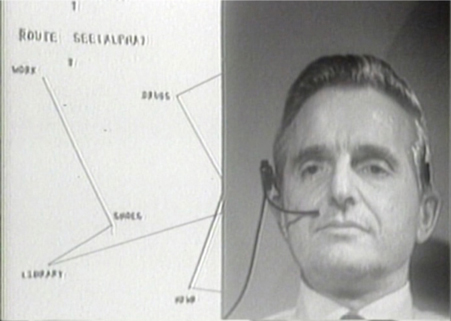
In 1968, a year before joining Xerox PARC, Kay attended an event in San Francisco that later become known as “The Mother of All Demos.” In it, SRI’s Douglas Engelbart revealed NLS, short for oN Line System, which included actual instances of:

  • hypertext
  • video conferencing
  • screen sharing
  • windows
  • word processing
  • revision control
  • collaborative real-time editing
  • a mouse as an input device

Remember, this was 1968. The computer professionals in the audience were blown away. Most key innovations that followed with the digital revolution trace back to Engelbart’s NLS.
Engelbart-Illustration
Douglas Engelbart demonstrates NLS, 1968; (Credit: SRI International)

Kay was one of the few in the audience able to grasp Engelbart’s ideas beyond the individual technical innovations he demonstrated. “It was one of the greatest experiences in my life, Kay later recalled.

Engelbart’s vision for the future was highly collaborative and clearly stated: He intended to boost collective intelligence by augmenting human intellect. Engelbart envisioned people working together in shared intellectual space to collectively solve urgent global problems in a symbiosis between computers and humans.

Fulfilling the Collaboration Vision
People picked up on Engelbart’s individual innovations but failed to see the bigger idea that gave birth to them. And so, the digital revolution happened with individual users in mind, and the personal computer became its poster child.

When Jobs shared the Mac’s capabilities with Engelbart in the early 1980s, Engelbart pointed out that it had no access to other people’s emails, documents, or shared information repositories. To Engelbart, the Mac was like having an exotic office without a door.

Jobs brought MacBooks, iPhones, and iPads to the market. Although similar to the Dynabook in form factor, Kay felt they were designed for individuals. He believed there was still a need for a device that enabled collaborative creativity and problem solving.

We agree. Merging hardware and software that fully materialize this vision of collaboration has proved difficult. We believe it’s time to see it fulfilled.

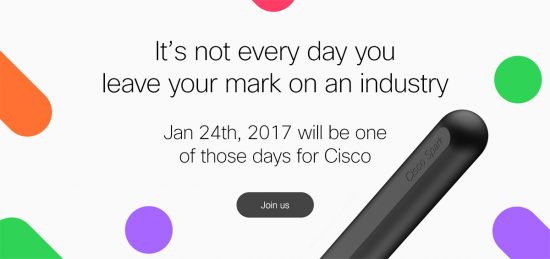
Join us on January 24, when we take another step closer to a device focused on collaboration, teamwork, and creativity.

Cisco Spark Event 1.24.17


Authors

Torkel Mellingen

Vice President

The Design Group

Avatar

What a giant year for Cisco Security!

In 2016, we pursued our effective security architecture with innovative solutions – from the network to the endpoint to the cloud. I couldn’t be more proud of our team and the strides we made to bring together so many elements of our architecture in an integrated approach that results in simpler, more effective security for our customers. I’m smiling as these words go down on paper because of how I’ve seen our customers and partners respond and benefit.

February

  • At Cisco Live Berlin we delivered the industry’s first, fully integrated, threat-focused Cisco Firepower Next-Generation Firewall (NGFW). Jon Oltsik, senior principal analyst with ESG called it our “latest chapter in [Cisco’s] network security pedigree.” The Cisco Firepower 4100 Series appliances were released, with integrated threat and access management and a compact footprint, designed for the Internet edge and in high-performance environments. Focused on threat defense instead of the legacy application control, Cisco Firepower keeps customers safer by detecting and responding to attacks faster and more effectively than ever.

June

  • Our Cisco Midyear Cybersecurity Report evidenced how customers can dramatically reduce time to detection of attacks and remediate them efficiently.
  • At Cisco Live Las Vegas, we asserted our leadership in cloud security. We advanced threat protection for the distributed enterprise with Cisco Meraki MX Security Appliances with Advanced Malware Protection (AMP) and Threat Grid. This completely cloud-managed unified threat management (UTM) solution now provides branch offices with protection against the most advanced threats.
  • To further protect branch offices, customers can easily activate Stealthwatch Learning Networks License on their Cisco Integrated Service Router (ISR), allowing it to act as a security sensor and enforcer to block malicious traffic on the local network – where there is often little security deployed.
  • Cisco Umbrella Branch, embedded into ISRs, and Umbrella Roaming, activated in Cisco AnyConnect, deliver a first line of defense for branch offices and roaming employees by blocking connections to bad IP addresses, URLs, and domains.
  • And with Cisco Defense Orchestrator network operations staff can easily manage thousands of security devices (Cisco ASA, Cisco NGFW, Cisco Umbrella, and more) from a single cloud-based portal, simplifying policy management while making security policy stronger.

September

  • Our acquisition of CloudLock soon followed and accelerates our vision to deliver the most comprehensive cloud security solution. By integrating the CloudLock technology into our security portfolio we’re eliminating the visibility gap common in traditional security infrastructure, giving security teams a complete picture of cloud app usage, risks, and security implications so they can proactively take action.

It’s clear that Cisco is sparking a cloud security transition like no other company.

November

  • We advanced our endpoint security strategy with Cisco Advanced Malware Protection (AMP) for Endpoints that combines prevention, detection, and response to simplify endpoint security – reducing complexity and preventing more threats from taking hold. It detects advanced threats in a matter of minutes, and then automatically stops and removes those threats from every computer in your enterprise in seconds.
  • Throughout the year we continued to enhance the Cisco Next-Generation Intrusion Prevention System (NGIPS) to help companies more easily protect their complex and dynamic networks. Even enterprises with an NGFW often choose to augment their firewall with an NGIPS for better visibility, threat detection, and response. An NGIPS can be deployed where firewalls simply can’t reach or are impractical, within the premises and in cloud environments. It can even serve as a quick “fix” for unpatched or “unpatchable” vulnerabilities.

Folks, I’ve just hit the highlights.  While each of these solutions on their own is impressive, what is truly interesting is that they integrate together into a security architecture to become a force multiplier of effectiveness.  Our architectural approach, combined with the power of the network, allows us to deliver integrated threat defenses – so you can see and know more, and stop more threats from the network to the endpoint to the cloud.

I’ll share more with you about Integrated Threat Defense later in the New Year. Until then, I hope your 2017 is off to a great start.

Authors

Jason Lamar

Senior Director

Security Product Management Group

Avatar

Adobe’s Marketing Cloud is a comprehensive set of digital marketing solutions enabling marketers to measure, personalize and optimize digital experiences. As the fastest growing of three business units, reaching its customer base on time became increasingly important as the company continued to grow and expand on new platforms. Adobe Marketing Cloud’s speed to market meant greater agility and mobility to deliver the ultimate customer experience. This required Adobe developers to transition to public clouds using Amazon Web Services (AWS).

Eventually, Adobe had over 700 AWS accounts across multiple regions. A variety of solutions were being used to keep the accounts connected and there wasn’t a centralized network solution. In addition, security teams wanted to ensure Adobe products were following security standards when moving data across public clouds. There became a pressing need to create a global network connecting public clouds to private data centers. With this goal in mind, network engineers began to develop a solution.

Adobe’s Growing Network

Adobe’s infrastructure design is based on edge collection and core processing. This design allows Adobe to deliver personalized content to end users within 300 milliseconds by extending its edge collection closer to the customer base. As Adobe’s customer base continues to grow, it must keep pace with additional edge collection facilities. As the company expands offerings to smaller regions around the world, it will take advantage of cloud edge collections like AWS.

The infrastructure design, called Adobe Multi-Cloud Transport, provides a global MPLS network built on Cisco ASR routers. It connects mixed data center infrastructures together and allows applications to cross end-to-end transparently. Using overlay protocols for end-to-end delivery, allows the data center infrastructure to remain independent and reduces the complexities of more specific technology integrations. The Adobe Multi-Cloud Transport integrates private and public clouds using this overlay protocol:

AdobeMCT

Using the Cisco ASR and CSR 1000V as MPLS routers simplifies the company’s delivery of AWS VPC’s and allows Adobe to integrate public clouds while maintaining the architecture. The CSR 1000V is the main edge solution when aggregating multiple AWS regions across Adobe’s private backhaul.

Within each AWS region Adobe has multiple accounts requiring collaboration across VPC’s, so traditional VPC peering does not scale. To solve this scaling problem, Adobe implemented a Hub and spoke topology using Cisco’s CSR1000V and AWS Direct Connect:

AWSVPCsCiscoCSR1KV

The adoption of the CSR 1000V seamlessly integrated with Adobe’s environment because it was a virtual platform. This configuration is the same as used with Adobe’s ASR 1000 platforms. The CSR 1000V was deployed in virtual infrastructures exactly how Cisco ASR 1000’s are implemented in physical data centers. CSR 1000V supports Adobe’s global MPLS configuration, routing protocols, BGP’s and ISI’s, GRE tunneling, and the company’s zone-based firewall policies.

Cisco CSR 1000V and AWS provide security and improve performance

Cisco CSR 1000V is a complete multiservice cloud networking platform that provides a transparent expansion into AWS, as well as the familiar user interface of Cisco IOS XE Software. By adopting the Cisco CSR 1000V, organizations can take advantage of existing networking management tools and processes. Cisco CSR 1000V and AWS together provide:

  • Secure Inter-VPC Connectivity – Multiregion deployments become simpler with an inter-VPC VPN connectivity. By deploying a Cisco CSR 1000V instance on an Amazon VPC in each region and interconnecting through VPN, you can create and secure a global network topology.
  • Branch Office to AWS and Interapplication Security – The Cisco CSR 1000V includes advanced Cisco IOS XE Software security, providing access control lists, MPLS support and a zone-based firewall. It extends enterprise security policies to the AWS Cloud, allowing Adobe to extend network segmentation and apply the same policies and tools across clouds.
  • Application performance monitoring and control – Monitor and analyze public cloud security and performance. Control what goes in and out of your environment and extend existing policies across the entire enterprise.
  • Branch-office, campus, and data center VPN aggregation – Deploying CSR 1000V enables every branch-office, campus, and data center location to directly access the Amazon VPC securely, without backhauling through an existing data center. This process reduces latency, eliminates expensive private WAN links, and avoids per-VPN-tunnel costs.

Watch the AWS Partner Series webinar, Cisco CSR 1000V: Securely Extend Your Apps to the Cloud, to learn more about how Cisco CSR 1000V and AWS can extend your enterprise network with consistent policies across your hybrid environments.

Try It FREE

Test drive the solution yourself in your own environment with a free 30-day trial on AWS.

Authors

Cathy Karaguez

Product Marketing Manager

Avatar

When people talk about the Internet of Things (IoT), they’re often thinking about the cool new technologies involved—nano-sensors, micro-cameras, cloud computing, machine learning, analytics, blockchain, or even drones and autonomous vehicles. But as it turns out, if you try to implement IoT technology without looking first (and last!) at business processes, you will likely be doomed to failure—regardless of your cool technology or elegant solution.

I’ve spent 30 years working in technology, so when I started looking at IoT my initial instinct was to focus on developing IoT technology solutions with partners that could solve the business problems of various lines of business (LOBs). But I soon learned that this was only a half-sided approach. You actually have to look at technology and business process together.

Consider remote operations—it’s one of the fast-payback solutions I’ve identified for those just getting started with IoT, and a great way to reduce costs and improve efficiency. But implementing such a solution without a corresponding change in business process will lead to disappointing outcomes. You may have a fantastic technology tool in your plant, but you’ll also need to adjust your business processes to take advantage of the new capabilities. This might include changing how plant workers manage assets, training employees on how to use the new tool, and reinforcing the new behavior over time. Otherwise you’ll be wasting your money.

You’ll need to take a close look at business processes from the very beginning of project planning. Without understanding the workflows and business processes, you won’t be able to design the right solution or make a convincing business case for it. In many cases, the problem you are trying to solve is more about entrenched business practices and operational culture than technology. There is no point in prioritizing the IoT solution if you haven’t also planned for the necessary process changes.

If you try to deploy IoT solutions in isolation from business processes, don’t be surprised if the expected ROI doesn’t materialize. In one instance, a city deployed a state-of-the-art inflow and infiltration detection system in manholes. The solution worked as designed, but the city didn’t realize the promised benefits. Why? The technical system installed below ground wasn’t integrated with the existing processes above ground. Street sweepers continued to operate as they always had, clogging the intake holes with leaves and dirt. When the project managers understood this and combined the street sweeping and cleaning processes with the IoT solution in one workflow, the ROI appeared.

So as you contemplate your first (or 10th!) IoT deployment, start with process. Make sure that someone on your team has an in-depth understanding of existing business processes and all the interdependencies involved. Next, identify the potential problems you want to solve. When narrowing down the problems to tackle, look carefully to see which ones are actually candidates for a technology solution, and consider potential roadblocks from both a technology and process standpoint. Finally, look at process again within the context of your completed solution. Work with partners and stakeholders on what changes in training, skillsets, organization, and business practices will need to happen to optimize the solution.

“Integrate technology solutions with business processes” is one of the key ingredients in my recipe for IoT success in my new book, Building the Internet of Things: Implement New Business Models, Disrupt Competitors, and Transform Your Industry. To truly fulfill the promise of IoT, think of business process change and your IoT solution as one project, from the beginning and throughout your IoT journey. They are two sides of the same coin.

Authors

Maciej Kranz

Vice President and General Manager

Corporate Strategic Innovation Group

Avatar

This is the first in a series of Cisco site guides to help employees who visit different offices or for those interviewing. 

Welcome to Cisco in in Raleigh / RTP (that’s Research Triangle Park for you non-North Carolinians). Should you ever have the opportunity to visit or interview at our location, we thought we’d share a few tidbits to make your experience a little more awesome (than it already will be, of course.)

Cisco Raleigh employees
Cisco Raleigh employees ready to welcome you to campus!

Fun Fact:

We’re number two! That is to say that we’re the second largest Cisco campus in the United States (after the San Jose Headquarters campus). But for those of us that work here it’s number one in our hearts.

About Us:

There are about 7,000 Cisconians that work here, in 12 buildings covering around 300 acres. So if you come and visit us, you’ll need to bring your walking shoes.

Coolest Spot to Visit:

Building 7 is my personal favorite building – be sure to stop in during your visit. The break rooms on each floor are unique to our campus.

  • Want to take a break from innovation? Sit in a first-class 747 airplane seat that comes with it’s own personal TV.
  • Need a beach vibe to help you relax? The Cabana room lets you adjust the lighting to either sunrise or sunset and sit in a lounge chair with sounds of waves hitting the sand. It’s almost like being there. (Almost.)

Where to Eat:

Let’s be honest. If you’ve seen the WeAreCisco Snapchat stories, you’ll know that Cisconians like to eat. If you’re hungry, my personal recommendation is that you hop over to Building 10 for the cafeteria there. We have three of them here, but it’s the biggest – don’t pass up the smoothies. Plus, there’s a coffee shop there. Coffee fuels innovation, in case you didn’t know.

If you want to take a campus break for a bit, one of the employee favorites for a local lunch is Backyard BBQ! This hole-in-the-wall barbeque pit is an absolute must. I recommend going at an off-hour though because the line to this place wraps out the door during peak hours. Traditional North Carolina barbeque at a super affordable price is no joke!

Where to Burn off Those Calories:

After you’ve gotten dessert in the cafeteria, or gotten that great North Carolina BBQ, the RTP site is one that has healthcare on campus. Pop over to the fitness center (right across from Building 9) and get your workout on. Have a Fitbit? Connect it to the machines to track your workouts (and even earn rewards.)

Here’s a secret – if the gym isn’t your thing, you can still get some exercise in after work by playing some disc golf with coworkers. We have an outdoor course near Buildings 4, 5 and 6 (and there are some of us that have gotten pretty good, be careful who you challenge.) We also have basketball courts, volleyball courts and a putting green. We also have lots of Greenway trails if you like to run.

RTP Greenway Trails
Ajantha, a Raleigh Cisconian wrote a blog post about running on the RTP Greenway trails. Check out the link embedded in my blog text!

Best Time To Visit:

There’s never a bad time to come to RTP, but the time of year I enjoy living here in the Raleigh area is spring and fall – both are great opportunities to get outside (it’s hot here in the summer, so come prepared for high air conditioning inside and fogged up glasses when you walk outside of the buildings into the humidity.) Our campus has a walking trail where you can experience the fall color and get those steps in.

Raleigh in the fall
This is Raleigh Cisconian Sabrina, enjoying the fall colors.

Best Photo Op:

RTP Cisconians tend to like to take pictures in Building 11’s entryway, because we have a very cool art installation in the form of the Cisco logo. You’ll see a lot of selfies here. Here’s a photo of a big group of employees filming a video there.

Cisco Raleigh Building 11 with logo art.
Some RTP employees shooting a video in our cool lobby in Building 11 with logo art.

Dress Code:

Dress code is casual in RTP. You’ll see almost everything from employees in t-shirts and flip flops, to pant suits, to active wear for those using the onsite gym. However, if you’re interviewing, you’ll want to look your best. Maybe not a suit, but first impressions matter!

Not the dress code
This is NOT the dress code, but we like to be a little goofy some days.

Best Hotel Close to Campus:

When people come to the offices from other campuses, they sometimes ask me where to stay. There are several hotels about 15 minutes from campus (you’ll still need a car or an Uber). Plus, the airport isn’t far! Hilton Garden Inn, Marriott, Wyndham – take your pick!

Hope to see you soon at Cisco RTP! Stop by and say hi when you’re here.


Want to join Cisco in Raleigh, or any of our other worldwide locations? See our open career opportunities.

Authors

Káli Pike

HR Representative

Human Resources Talent Brand

Avatar

Welcome to 2017! Cloud permeates everything we do, powering digital transformation. The impact on customer experiences, business processes and models, and workforce innovations is undeniable. Our customers are looking to Cisco and our partners for a complete cloud approach, regardless of where they are on the journey. The new year promises to be an exciting time for our customers in cloud. And we are here to help them navigate a multicloud world.

In December, we made some internal changes that generated some questions, and I want to take this opportunity to answer some of those and level set on our cloud strategy.


What is Cisco’s Cloud Strategy?

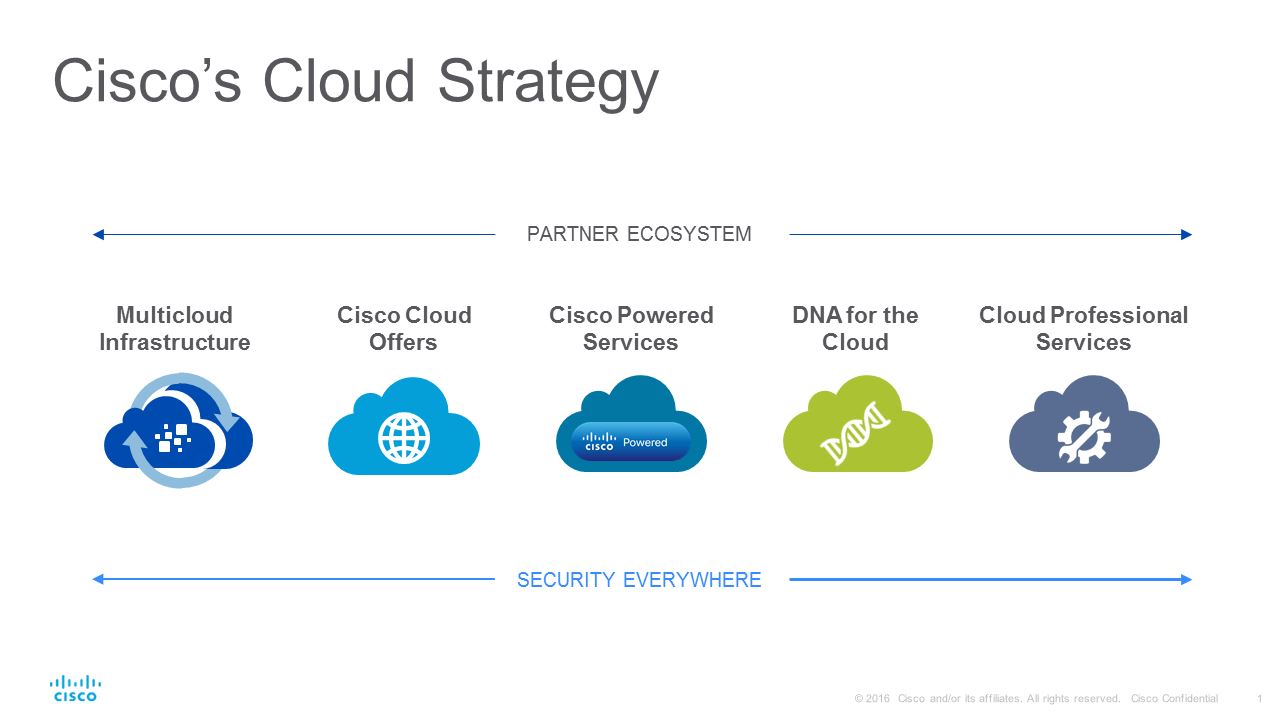
Cisco takes a complete approach to cloud with solutions that simplify, secure, and transform how customers work in a multicloud world to maximize business benefits. Whether it’s moving workloads across private and multiple public clouds, consuming software as a service, or writing modern applications that can run on any hybrid cloud, Cisco Cloud helps customers securely navigate their cloud journey. This strategy addresses applications and data everywhere—regardless of cloud technology or deployment model—and applies to headquarters, data centers, branch offices, remote users, devices and “things,” as well as  hosting/colocation and public cloud providers.

Cisco enables simple, intelligent, automated, and secure clouds. Foundational is security everywhere, designed to help customers securely adopt cloud.  And all this is accomplished in collaboration with our global partner ecosystem, spanning both technology partners (in software, tools, and infrastructure) and go-to-market partners (including builders, providers, and resellers).

CloudStrategy-pillars

The pillars of our strategy include:

  • Multicloud Infrastructure to help customers create and manage secure hybrid environments with cloud infrastructure and multicloud orchestration
  • Cisco Cloud Offers, like WebEx, Spark, and security services, help customers advance their business with enterprise-class Software as a service (SaaS) solutions to achieve business outcomes
  • Cisco Powered Services which are partner-delivered cloud and managed services based on Cisco validated designs and include more than 600 services from over 250 providers worldwide
  • DNA (Digital Network Architecture) for the Cloud to optimize the network for cloud, reinventing networking in a cloud era to provide the secure application performance required in a multicloud world
  • Cloud Professional Services from Cisco and our partners to help our customers develop their cloud strategy, extend existing capabilities, and implement and deploy a digital transformation plan

What happened to Cisco Intercloud?

Cisco Intercloud was a strategy launched in early 2014. Customer requirements have evolved since then, and we are moving to align to market and customer needs. We’ve pivoted our cloud strategy from federating clouds (Intercloud), to helping customers build and deliver secure hybrid multicloud infrastructures, platforms, and services. This gives customers the freedom to choose the best environments and consumption models for their traditional and cloud-native applications.

Is Cisco supporting private cloud?

Yes. We have multiple offerings to enable our customers and partners to build private clouds. Those include our core offerings of data center hardware and software, security, networking and routing–important infrastructure needed to run clouds. We also offer private cloud as a managed service with Metacloud. We are always refining and expanding elements of our private cloud offerings as new market opportunities arise.

What are Cisco’s plans for OpenStack?

Cisco is fully committed to OpenStack as an integral part of our multicloud strategy and as a foundational element of our Network Function Virtualization infrastructure (NFVi). We are OpenStack Foundation Gold Members and serve the community in a variety of ways including upstream plug-in code contributions and serving on the board of directors.

What’s next for Metacloud?

Cisco is committed to Metacloud as a standalone private cloud-as-a-service offering. We continue to make investments in Metacloud specifically and more broadly in overall private cloud infrastructure and software.

How do the Cisco Powered cloud offers fit in?

Cisco Powered cloud offers are essential to helping our partners succeed in cloud. We remain committed to the partner cloud programs like Cisco Powered that we have in place.


I look forward to sharing more on our progress, new use cases, insights, and new solutions in the coming months! 2017 will be an exciting time for our customers, and partners, and Cisco. Together we will tap into the power that cloud delivers.

For more info on Cisco Cloud:


Authors

Kip Compton

No longer with Cisco

Avatar

This is the time to write our New Year’s resolution, and for that we should learn from what we have achieved in the past to better prepare for the future. With that in mind, I invite you to look at the new innovations that Cisco brought to you in 2016, and how they have been perceived by our customers, partners, analysts and tech lovers represented in awards and test results.

This way, if you are considering data center solutions to meet your 2017 goals, you can definitely start by looking at the list of 2016 awards winning data center products and make better decisions!

To give you some background, in 2016, Cisco has formulated the most innovative Cisco data center strategy to provide an architecture that lets you AnalyzeSimplifyAutomate, and Protect your data and applications: the ASAP data center. Brad Casemore, Research director of Data Center Networks at IDC, shares his honest opinion about the Cisco ASAP Data Center:

“…an architecture devised to modernize infrastructure, simplify operations, prepare for next-generation cloud applications, fully leverage hybrid cloud, and provide comprehensive visibility and security throughout the datacenter and across all application environments.”

Enabling Digital Transformation in Datacenters and Hybrid Cloud: Cisco Analyze, Simplify, Automate, and Protect (ASAP).

Following are key solution components of the Cisco ASAP data center:

Best of Interop Awards

Picture1

Data Center | Cisco Nexus Fabric Manager

Networking | Cisco Enterprise Network Functions Virtualization (NFV)

Security | Cisco Next-Generation Firewall (NGFW)

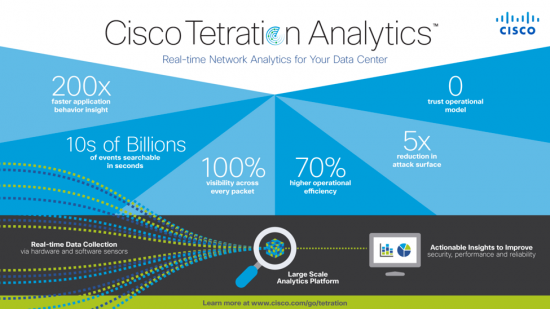
Cisco Tetration Analytics | The Biggest Launch in Cisco Data Center History

2

As Chuck Robbins proudly assured, Tetration is “…an open platform that provides data center visibility at a level that’s never been achieved before, and at a scale never possible before” (Cisco Tetration Analytics: Data Center Visibility on a Whole New Scale)


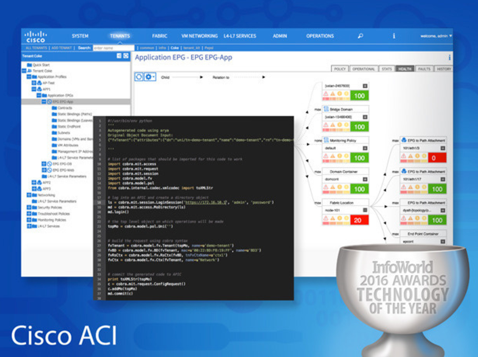
Cisco ACI: InfoWorld Technology of The Year 2016

Besides being chosen for this prestigious award, ACI has also been recognized by customers and partners. As of today, there are 2700+ ACI customers and a rapidly growing ecosystem of 65 technology partners, representing a 100% growth for the year. Learn more about ACI and the benefits of such a rich ecosystem here.

3


2016 Brand Leader Awards Voted By IT Pros

4

Cisco has been chosen as the award winner in market leadership, price leadership, performance, reliability, reliability, service & support, and/or innovation:

  1. SDN Platform (Cisco ACI)
  2. Unified Communications
  3. Best Fibre Channel Network Monitoring
  4. Network Performance Monitoring
  5. Ethernet Core Switches
  6. Ethernet Top of Rack Switches
  7. Servers for Software Defined Storage
  8. Integrated System
  9. Converged Network Adapters
  10. FCoE Switches
  11. Fibre Channel Switches
  12. Low Latency Ethernet Switches
  13. Fibre Channel Network Monitoring
  14. Network Performance Monitoring
  15. Virtual Router / Network Access Appliance
  16. All Flash Hyperconverged System
  17. On-Premise vs. Cloud Unified Communications
  18. Layer 4-7 NFV Services Platform
  19. SDN Enabled Switches
  20. Ethernet Network Monitoring


Network Test and Miercom reports: Cisco Intelligent Buffers Are Superior than Large buffers

In this past year, there has been a marketing buzz about having larger buffers. While there are benefits to larger buffer sizes, Miercom tests and reports that Cisco’s intelligent buffers demonstrate a clear advantage over large buffers. See the report to satisfy your curiosity!

Network Test: “Let’s cut right to the chase: The Cisco Nexus 9508 is the densest, fastest data center switch we’ve ever tested.” (Cisco Nexus 9508: A New Speed Record in Data Center Switching)

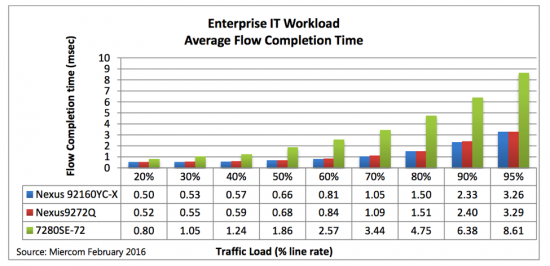
Miercom: “…our testing results show that the Cisco Nexus 92160YC-X and Nexus 9272Q switches outperformed the Arista 7280SE-72 switch for congestion handling. The Arista 7280SE-72 switch has much deeper buffer than the Cisco switches, but with the built-in intelligent buffer management capabilities, both Cisco switches demonstrated clear advantage in flow completion time for small/medium flows over the Arista 7280SE-72 switch and provided the same or similar performance for large-size flows, which resulted in overall higher application performance.” (Speeding Applications in Data Center Networks)

5

SIIA CODiE Awards:

6

As represented by the awards, ASAP brings you the most comprehensive collection of best of breed point solutions yet also integrated to work seamlessly together, something that no other single vendor can deliver. Nada! Cero! Ni uno! Learn more by visiting www.cisco.com/go/datacenter

Now that you start writing your New Year’s resolution, you might also want to read what analyst Zeus Kerravala has to say in What to expect from Cisco in 2017 , and of course, attend Cisco Live, where you can meet the experts and see all the latest innovations.


Authors

Emmeline Wong

Product Marketing Specialist

Data Center Marketing

Avatar

Cisco Live Europe Berlin

In February 2016, we gathered in Berlin and asked you if you were ready to experience Cisco in a new way. This year, we are heading back to Germany to make sure you know that Your Time Is Now!

Cisco Live Europe is taking shape, and will soon be welcoming customers and partners from around the world.  I’m here to extend a special invitation to all of you developers, to make sure you visit us in the #DevNet Zone!

Berlin


Reserve your seat now

Network Programmability and Using DNA to Automate, Simplify and Secure Your Network

Cloud Native Experts with CNCF TOC

Rebuilding the DevNet Developer Platform as a Cloud Application

The Power of Cloud Collaboration APIs – How Accelerating Features and Cisco Incubation Programs are Expanding Developer Opportunities

Open Source, Does it Pass the Sniff Test?

A Discussion of Cisco IoT Integrations and Solutions


Follow Cisco #DevNet
Twitter
Instagram
Facebook
and tag us in your photos.

Cisco Live Europe CLEUR Social Media Hub

Let us know when you are on your way to Berlin.
See you at #CLEUR!


Authors

Silvia Karina Spiva

No Longer at Cisco

Avatar

Happy New Year to our readers! Today marks the first Patch Tuesday of 2017 with Microsoft releasing their monthly set of bulletins designed to address security vulnerabilities. This month’s release is relatively light with 4 bulletins addressing 3 vulnerabilities. Two bulletins are rated critical and address vulnerabilities in Office and Adobe Flash Player while the other two are rated important and address vulnerabilities Edge and the Local Security Authority Subsystem Service.

Bulletins Rated Critical

Microsoft bulletins MS17-002 and MS17-003 are rated critical.

MS17-002 addresses CVE-2017-0003, an arbitrary code execution vulnerability in Microsoft Office 2016. Specifically, Microsoft Word 2016 and Microsoft SharePoint Enterprise Server 2016 are affected. This vulnerability manifests in the way Office handles objects in memory. Exploitation of this flaw is achievable if, for example, a user opens a specifically crafted Word document received via email or downloaded from a site hosting a specifically crafted document.

Read more »

Authors

Talos Group

Talos Security Intelligence & Research Group