Avatar

What better place than the International Consumer Electronics Show to shine the light on consumer experiences in the device landscape — and not just the sparkly, new, all-IP dandies, mind you — such that all devices are treated as first class citizens?

That’s part of what we will be demonstrating (at the Wynn Hotel,) this week in Vegas: A mixture of what we’re calling “smart streaming” and machine-level data, mined from across the video headend, network elements and end-devices. With it, service providers can deliver the highest possible video quality — securely, reliably, at scale, and without compromise — from encoder to screen.

Why? Because it’s our view that perhaps that greatest untapped source of competitive differentiation, in a saturated and fragmenting marketplace, is video quality. Let’s face it: Adding more HD (or even 4K) channels to a package (or slimming packages, for that matter) probably won’t do a whole lot to make consumers love you more.

This is even more important as video viewing shifts online; according to a recent survey from Limelight Networks, over 46% of respondents will stop watching an online video after the second time video buffers.

But what if you could simultaneously breathe new life into fielded, legacy set-tops, while at the same time increase the quality of streamed video and dramatically reduce latency on live streams delivered online?

This is what we mean when we say that our Infinite Video Platform, and the extensions we are building into it, creates a blended environment that qualitatively exceeds what’s possible in the individual “silos” of broadcast and OTT-delivered video.

Now flip to the existing streaming landscape. Up until now, the standard approach for adaptive bit rate (ABR) streaming has a client (phone, tablet, TV) request segments based on available bandwidth alone — and invariably ask for the largest segment, even if “bits are dropping on the floor.” In other words, no intelligence, no manners. And in a world of increasingly discriminating consumers, a leading cause of the two strikes and you’re out behavior (see above).

We are adding intelligence into online video. Machine level data captured from encoders, network elements and video clients that provides end-to-end visibility, which we can uniquely combine to deliver “smart streaming” solutions.

First, we used a video quality assessment score, and applied it to ABR encoded content on a segment-by-segment basis. The resultant quality data can be used as an input by network elements and end-devices to decide which segment to use. Suddenly, you have Smart ABR: clients that request segments based on the video quality score in addition to bit rate.

It’s an optimization technique that simultaneously saves bandwidth, and increases overall video quality delivered. In a fixed bandwidth environment: Dad’s watching the football game, Mom’s watching the news. Mom’s stream needs less bits (but still looks awesome), which can be applied to making the stream on the big screen look and sound pristine… Getting back to that football game.

If you’ve ever watched live sports on TV while streaming it on a social network or a TV Everywhere application, you’ve probably gotten a little (or a lot) blistered at the delay, between what you’re seeing on the TV, and what you’re seeing online. Anecdotal evidence suggests delays of up to a minute, and usually 30+ seconds. Ugh. Simply changing channels can be equally ugly, latency-wise.

That’s why I’m excited to report on our innovations from the output of the encoder, through the CDN, and to connected devices, that trim that latency down to … well, in less time than it takes to sing one stanza of the refrain of “Yellow Submarine.” So, yes, basic physics dictates the realities of transmission delays. But we have ways to make them as small — and un-irritating — as possible.

This is the kind of stuff that really is easier to explain if you’re looking at it live. So come by and see us! And Happy New Year!

Authors

George Tupy

Market Manager

Service Provider, Video Solutions

Avatar

We have been writing a lot of blogs for network engineers and developers. But, I recently realized that Cisco Partners may benefit from a little information about DevNet. If you are a Cisco partner, potential partner, or work for one, then this blog is for you.

Let us start off with some data, which you may know already, and which is, or should be, driving your business today. According to the Global Center for Digital Business Transformation, about 4 in 10 businesses will fail because of digital disruption by 2020. The full report is available on their web site.

Picture1.png

If you are in the technology business, the obvious take-away here is that you are (or should be) helping your customers avoid being digitally disrupted. In simple terms, you are helping your customers stay competitive. And, noting that we technology companies are also listed in this graphic, our ability to move faster, innovate the customer experience and embrace digital transformation is crucial to our own success.

Holding onto data for one more moment, we find that our partners, or potential partners, have over 5 million Picture2.pngdevelopers working for them. And, if you count ISVs, we’re looking at 11 million developers who are trying to innovate and solve problems. This data comes from Evans Data Corporation and is shown in the graphic pictured to the right.

That’s a lot of resources! Hopefully, those resources are working on digital transformation. The data says they should be. Given that the data says you are spending a lot of resources on developers, and that they are most likely working on digital transformation, let’s transition to how Cisco is relevant to this conversation.

DevNet Helps Your Developers Be More Innovative, Faster

If you want your developers to be more successful, then they should be taking a look at Cisco’s Developer Community. We call it DevNet and it is located at developer.cisco.com.

DevNet is the key resource for everything ‘developer’ at Cisco. It is the place to find inspirational applications, learn about our APIs and connect with other developers. Yes, Cisco has APIs. In fact, we have a ton of them and you can use those APIs to help your own business and your customers with digital transformation. I’d like to show you a few stories on how partners are successfully using Cisco technology, APIs and DevNet.

iland Uses Cisco APIs to Automatically Control Infrastructure

One Cisco partner, iland, is rated as one of the top providers of Disaster Recovery as a Service (DRaaS). iland sits in the upper right area of the Gartner Magic Quadrant – a great place to be. What may not be apparent is that the DRaaS service, by iland, is a Cisco Powered service. In other words, it is built on a Cisco platform and utilizes Cisco APIs you can learn about with Cisco DevNet.

We had the opportunity to talk with iland’s CTO, Justin Giardina, about their service and capture it on video.

What we learned is unique about iland’s DRaaS, and which is helping their success, is that they provide a northbound interface into their solution. This enables their customers to programmatically make more efficient use of the iland service. In turn, iland utilizes various Cisco APIs to automatically control infrastructure. So, throughout the entire architecture, APIs are enabling automation, which goes all the way from the compute and storage devices to the end customers. And, according to iland, Cisco DevNet was very helpful with documentation and example code for the APIs they used.

By Using a DevNet Sandbox, Phunware Saves Dollars!

What’s a DevNet Sandbox? It’s a 24X7 cloud based lab service where you can run your code on hosted Cisco infrastructure. In other words, you can start developing without having to buy the platform. You can use our labs and hardware to test your proof of concept ideas.

A great example of a partner that uses our Sandboxes is Phunware. Phunware provides companies with solutions that enable their customers to have an integrated experience across mobile and traditional delivery methods. I recently spoke with their CTO, Luan Dang about what they have to offer and how they have partnered up with Cisco to get there. Below, is the video of us talking about their technology, the Cisco API they used and how DevNet helped them.

If you want to see a great example of what Phunware does for folks, here’s their video, which shows an example of what they have done for a healthcare company.

Another exciting capability of Phunware is that they can help both do-it-yourself customers and customers that need a full suite of services. For partners, their SDK could enable you to write your own custom applications.

Turnstyle uses Cisco APIs to help Subway

Moving from healthcare to food, let’s talk about Turnstyle, another Cisco partner that has used our APIs and DevNet to help a customer with digital transformation. Our own Colin Lowenberg, who product manages the Meraki API, talked with Ryan Freeman, VP of Partnerships at Turnstyle Solutions. You can learn a little bit about their solution in this video.

Turnstyle is exciting because they increase customer retention at companies like Subway. As Ryan says in the video, wi-fi can be so much more than just access. The network platform, and its APIs, enable digital transformation that enables your customers to better market to their customers. Ryan says that our communities, where you can collaborate with other companies, and the API documentation, are the key value propositions that DevNet delivers to Turnstyle.

These are just a few examples of how partners have worked with us to become more successful. We’ve seen how they differentiate themselves from their competition. They have created innovative and unique offers. And Cisco DevNet has been part of their journey.

Three Things You Can Do

  1. If you would like to explore how you might work with us, then I invite you to visit DevNet Online. It’s free.
  2. If you are coming to Berlin for Cisco Live, we would love to meet your developers in the DevNet Zone. Please, bring em and have them come to the Zone, where we can talk with them about what they are doing and show them possibilities with Cisco APIs/technology.
  3. Finally, we really want to hear from you. We’d like to hear about your experiences with DevNet. Do you have an interesting application to share? Would you like to talk with our experts about an idea? Connect with us! To ask questions, head to DevNet and on most pages you will find a “Chat with us!” icon in the lower right. That’s a bot that adds you to a Spark room where we can talk. It was all written with APIs we can show you how to use. Or, if you want to share your innovation, direct message me and we’ll be happy to talk.

Authors

Chris Oggerino

Technical Marketing Engineer

Enterprise Networking and Mobility

Avatar

The end of the year is usually a time when we reflect on what we’ve accomplished in the past 12 months and set goals for the upcoming year. One resolution that should be easier to cross off your list in 2017 is to bring new life to your VDI projects.

VDI, or more broadly desktop and application virtualization, is a well-established technology by now and constitutes an important pillar for delivering on the promise of a digital workplace as part of an organization’s overall digital business transformation.

In order to be successful in delivering a VDI solution that will delight your end users while reducing the burden on your IT staff you should concentrate on 3 key factors:

  • Reduce overall complexity
  • Simplify management
  • Improve application availability

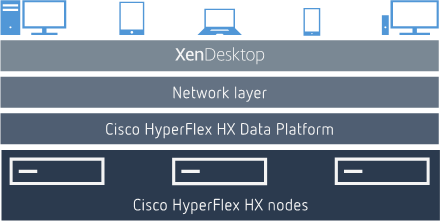
Cisco HyperFlex VDI for Citrix delivers on these key elements by providing an adaptive infrastructure for your VDI deployments. Together, Cisco and Citrix deliver simplified management and agility through a fully certified solution that can scale as you grow.

HX VDI for Citrix logical view

Logical view of Cisco HyperFlex VDI for Citrix

With an integrated network fabric, powerful data optimization, and unified management, Cisco HyperFlex Systems bring the full potential of hyperconvergence to your VDI deployments.

HyperFlex provides a cluster configuration that scales resources independently to closely match the resource needs of your VDI environments. You can start small and support tens or hundreds of users and easily and cost-effectively scale to support thousands. After a system is deployed, you simply add nodes to the cluster, and data is automatically re-balanced across all shared resources. You can easily tailor the configuration to support persistent and non-persistent desktops and deliver full desktop infrastructure or application streaming depending on the needs of your workforce. Cisco HyperFlex lets you scale nodes non disruptively, but also independently scale resources. For example, in the case of non-persistent VDI, you can scale compute-only nodes by adding blade or rack servers, increasing VM density and dramatically reducing the cost per VDI instance.

HyperFlex uses the same technology and service profile templates as Cisco UCS, a pillar of the data center. This means managing HyperFlex doesn’t require IT managers to learn new tools. You can provision your environment in less than one hour using automatic server configuration through Cisco UCS service profile templates and improve automation and scalability with UCS Manager and XenDesktop user profile templates that pre-define detailed user access policies.

Cisco HyperFlex VDI for Citrix supports virtual GPU sharing to bring high-end graphics and HD video processing to every device, giving even mobile devices and tablets the equivalent power of workstations costing thousands of dollars.

See how you can easily provision and deploy 1,000 virtual desktops with Cisco HyperFlex VDI for Citrix and deliver a spectacular user experience with sub-second baseline response time.

Also, for an in depth technical discussion on how to set up your HyperFlex environment and provision Citrix XenDesktop, check out this great blog series on the Citrix User Group Community.

CVD_LogoFurthermore, we are working on a Cisco Validated Design due out later this month that will provide you all the hardware and software guidelines for deploying a 1,200-seat mixed workload on an 8-node HyperFlex cluster with Citrix XenDesktop 7.11. So come back and visit our data center blog page often!

To learn more about Cisco HyperFlex VDI for Citrix check out http://www.accelerateyourworkforce.com/

And if you happen to be heading to Citrix Summit in Anaheim next week, stop by the Cisco booth to talk to me about Cisco HyperFlex VDI for Citrix or ping me on Twitter @FrancoiseBRees.

Authors

Francoise Rees

Marketing Manager

Customer Solution Marketing, Cisco Intersight

Avatar

This one’s for everyone careening out of the holidays and into 2017 — while necessarily keeping an eye on what’s about to happen at the upcoming International Consumer Electronics Show.

We’ll be at the Wynn Hotel again, with a hot lineup of products demonstrated– way more than I could possibly describe with any degree of brevity.

Here’s the quick version: We’ll be showing a healthy set of extensions to our Infinite Video Platform, which solve multiple riddles, like how to launch new, IP-based services on legacy boxes. And delivering video quality everywhere, accelerating service creation, and a new advanced watermarking method designed for eliminating live streaming piracy. That, plus preparing your network for the growth in IP traffic and video services with Cloud Scale Networking solutions. It really is a good time to come see what we’re up to!

On the news front, we’re unveiling a video innovation community, Infinite Video Platform Labs, with our customers to test new features with their users. It’s a real-world implementation of our agile development approach, and I’m pleased to report that YES, Israel’s leading providing of satellite-based multichannel video, is among the first operators to sign on.

And now, allow me to share our (pretty exhaustive!) reading of the tealeaves, here on the brink between ’16 and ’17, and as it relates to what’s ahead for content and service providers.

Let’s start with what’s for sure. We know where video consumption is going, for starters. It’s going all-IP and mobile. Millennials, for instance, watch 70% of TV online, and consume twice as much mobile video as 23-59 year olds; our Visual Networking Index (VNI) Forecast indicates that by 2020, 82% of the Internet’s traffic will be video by 2020.

AJ44256

While viewing is moving to IP global broadcast pay-TV is $400 billion market — $180B of it from advertising, $220B from subscriptions. (Yes, 2016 saw some major linear networks reporting significant (10%) subscriber losses. Yes, some (but not all!) multichannel video providers also saw slippage. Let’s face it: $400 followed by nine zeros is still a really big market. Doom is a choice.

Some interesting context: Recently I had the occasion to hear Joe Zaller, broadcast-side sage and founder of Devoncraft Partners, speak to this very issue. He was talking about ESPN, and the news earlier this year about economic differences between the network’s online and linear properties. “With 100 million unique visitors per month, approaching $500 million in digital revenue, ESPN (online) is making the equivalent of $0.42/sub/month … while linear ESPN gets $7.20/sub/month, and ESPN2 another $0.80/sub/month.” Conclusion: “There’s a problem there.”

I agree. It’s an interesting puzzle — moving video assets and services across any network, any platform, to any device. One issue (which gets clearer daily) is that “going multi-platform” doesn’t make sense with today’s operating models.

Why, because the very nature of broadcast TV involves high fixed costs, and few variable costs. But! If your costs scale as you deliver video over more networks and platforms — as is the case with point-to-multipoint IP delivery …. well, here we are.

Our premise, which threads throughout our Infinite Video Platform, is that there are ways to be better than pay-TV alone, or OTT alone.

Except it’s not a “1+1=3” thing. That’s far too finite. More, it’s about reinvention, the hard way. Hard, because this particular reinvention necessarily includes a commitment to do so perpetually. Continuous improvement = table stakes.

Here’s one actionable way the pay-TV community can exceed both broadcast and OTT: Commit to the highest available video quality, “broadcast quality” everywhere, on any device, no compromises. What constitutes video quality? Here’s a short list:

  1. Video that starts instantly.
  2. With rock-solid picture and sound.
  3. That only pauses when the viewer says so.
  4. And that same stream, is not 30 to 60 seconds behind what’s on TV.

solving the video quality issues consumer experience on OTT, , service providers are one step ahead on making IP video better than broadcast and OTT. If they could deliver a personalized service with video quality, everywhere, and do it in a cost effective way, service providers could win the hearts of today’s video consumers.

That’s a brief look into what we’re doing at CES, and why. Happy New Year and see you there!

Save

Save

Save

Authors

George Tupy

Market Manager

Service Provider, Video Solutions

Avatar

This post originally appeared in Latino Leaders Magazine in December 2016.

Laura joined Cisco in 1999 and currently leads the company’s Corporate Social Responsibility (CSR) field operations worldwide. She and her team, based in 40 countries, help shape and drive public-private partnerships to design, implement and operate strategic CSR programs in the areas of IT education and economic empowerment in 170 countries around the world.

These programs reach well over one million beneficiaries each year with annual in-kind contributions valued at over $240M USD. Laura holds a Bachelor of Science degree in engineering from Stanford University and lives in the San Francisco Bay Area with her husband and their three children.


What was given to you in terms of advice or mentorship that pushed you to where you are today?

The best advice I ever received was from my mom. She passed away 21 years ago, but the values she taught me are still with me. My parents immigrated as adults to the US from Mexico and my mother never studied past middle school because she had to go to work at an early age. She did not speak English well and never learned to drive so I was her primary interpreter and we took public transportation everywhere together.

I was extremely close to her growing up. She encouraged me to soar by emphasizing the value of education and the importance of working hard to achieve your goals, and always told me that “querer es poder” (where there is a will there is a way) and “nadie te puede quitar tu educación” (no one can take away your education). She also taught me to treat everyone with respect and dignity, and if I ever strayed from this, she was quick to put me in my place.

Thanks to her guidance I was the first in my family to go to college and studied engineering at Stanford. Even today, I look at every big challenge as an opportunity to learn something new and to make an impact.

What are your most important work and professional values?

To have a career where I can provide leadership and work with people and teams in a challenging and exciting environment (I get bored easily); to provide value that is appreciated by others; to do work that feeds my soul and benefits people and their communities.

I feel very fortunate to be working at Cisco, within a culture that enables teams to thrive, and in a position where my team positively impacts over 1 million students annually.

What is it like being a woman in the IT field?

There’s never been a better time for women in technology! As a woman, Latina, and mother of three children, I’ve had a wonderful career. My approach is twofold: 1) I always try to bring value to the table regardless of who I’m interacting with, and 2) I always assume positive intent and trust the other person is coming from a good place.

Part of bringing value means that I listen to the people I work with. Good ideas can come from anywhere, and I can provide more value by bringing out the best in others, and together focusing on what’s best for beneficiaries of our corporate social responsibility programs. However, I also speak up when someone says or does something off-putting. The vast majority of the time, it’s just a miscommunication that is best handled right off the bat.

What can be done to attract more young Latinos to the information and communication technology fields?

This is a big challenge that the public and private sectors can address by working together. I’m proud to work for a company that sees education as the critical enabler it was for me. According to the National Center for Education Statistics, the educational attainment gaps between minority and white students persist despite improvements made over the last few decades.

In Arizona, Latinos make up 30 percent of residents yet only comprise about 13 percent of business owners. Thus, Arizona is under-producing entrepreneurs in its fastest-growing cultural group, resulting in missed opportunities for job creation, outside investments, and new products and services. Arizona State University (ASU) and Cisco are partnering to correct this imbalance.

We created a comprehensive, culturally responsive learning experience to help minority youth gain entrepreneurial and digital skills. ASU Poder (Spanish for “to be able”) gives underserved community college students the opportunity to create solutions to address pressing societal problems using digitization skills acquired through Cisco curriculum, while receiving career and college preparation training.

How does the Cisco Networking Academy impact students? Can you share a specific case?

Cisco Networking Academy improves career opportunities for people around the world. We partner with academic institutions, governments, and non-profits in 170 countries to help over 1 million students a year develop workforce-ready technology skills. A diverse group of people takes Networking Academy courses – from traditional students (at high schools, vocational colleges, and universities), to people with disabilities, to prisoners, to people re-skilling for new jobs, to name just a few.

We have millions of success stories, but one of my favorites is that of Rebecca Baca, a single mother who was living with her parents and working in a low-paying service industry job. Wanting to become financially independent, she enrolled in a Cisco Networking Academy course at a local vocational institute. After completing the coursework, she landed a job with an ICT services company and became their first female project consulting engineer.

Subscribe to the Cisco CSR blog for more updates around our corporate social responsibility and how we’re positively impacting people, society, and the planet.


Authors

Austin Belisle

No Longer with Cisco

Avatar

People often talk about deploying the Internet of Things (IoT) as if it’s a discrete project—something you do once, and then you move on to the next thing.  Nothing could be further from the truth.

IoT is a multi-year journey, not a one-time event.

IoT is not just about implementing IoT technology, it’s about changing your culture, processes, and skills. It may start with just one small project—and, in fact, that is exactly what I recommend in my new book, Building the Internet of Things—but it’s never just “one and done.” That is why, before you implement the smallest bit of IoT technology, you need to step back and take a comprehensive approach:

  • Begin by building your vision. Talk about IoT in your organization and help people think about what might be possible when things can communicate with other things. Then identify some strategic goals; identify a specific problem to solve or an opportunity to grab.
  • Pick the “low-hanging fruit” first. Have a big vision, but start with a small project to generate early success.
  • Build a coalition of the willing. Bringing together your IT and operational technology (OT) teams is a great place to start. But also bring in line-of-business leaders who can see the potential of IoT in helping them achieve their business goals.
  • Identify key barriers to success. IoT often faces significant obstacles in four broad areas: 1) technical, especially in the areas of standards and interoperability; 2) security, which can be a show-stopper if not built in to the core of your operation; 3) government, which has a role to play in agenda-setting and regulating IoT; and 4) organizational challenges, which may be the biggest obstacle of all because IoT often demands cultural change. Understand who will resist the change and make a plan to address their concerns and win them over.
  • Make sure you have support from the C-suite. To drive cultural change and ensure long-term success, you’ll need support and commitment at the highest levels of your organization.

When you begin this IoT journey, you don’t know exactly where it may take you. As I have said, start with a small project, preferably in one of the four fast paths to payback I have identified—connected operations, remote operations, predictive analytics, and predictive maintenance. These areas of IoT have been tried and proven by thousands of your peers over the past several years. With the success of one project you can then more easily obtain investment in more complex—and impactful—initiatives.

Let’s look at the experience of Rockwell Automation, Cisco’s long-standing IoT partner. They decided to “eat their own dogfood” and implement the Internet of Things as part of their connected enterprise. They began by placing all elements of the assembly lines and operations in one plant on a single Ethernet/IP network, then expanded to more plants, and linked those plants to each other and the enterprise network. The results were impressive:

  • Reduced inventory cycle from 120 days to 82 days
  • Reduced rejected parts by 50 percent
  • Increased on-time delivery to 98 percent
  • Avoided 30 percent in capital expenses

This kind of success can only happen if you take your entire company with you on this journey. Make sure you have buy-in from stakeholders and support from the top. Break down silos, over-communicate, and check in often to make sure that everyone is along for the ride.


Authors

Maciej Kranz

Vice President and General Manager

Corporate Strategic Innovation Group

Avatar

Like many organizations, Compassion International, has dozens of data sources and thousands of data consumers eager to get answers to their business questions.

The difference with Compassion International is that good data directly impacts how well we serve children in poverty around the world. Compassion partners with over 7,000 churches in 26 countries to deliver a holistic child development program to over 1.9 million babies, children and young adults. This approach includes providing for the physical, educational, social and spiritual care of our beneficiaries. Our data has many uses in helping us to achieve these outcomes.

Data Virtualization in the Service of Children in Poverty

In 2004, we were serving over 500,000 children. In 2009, this grew to 1 million. Earlier this decade a vision was put forth to minister to 4 million children in the near future. As we march toward this goal, our data needs have increased significantly and range from consistent enterprise reporting on one end to rapid answers with high agility on the other. Our goal is to enable quick answers and harmonious stories – all rooted in meaningful, consistent data.

Our initial approach was to use traditional, circa-2008 data integration methods. It quickly became apparent that there were several problems to this approach, including:

  • The brittleness of ETL routines that are difficult to change
  • Loss of visibility into business rules
  • Unreliability because of load dependencies (e.g. one load depends on another load)

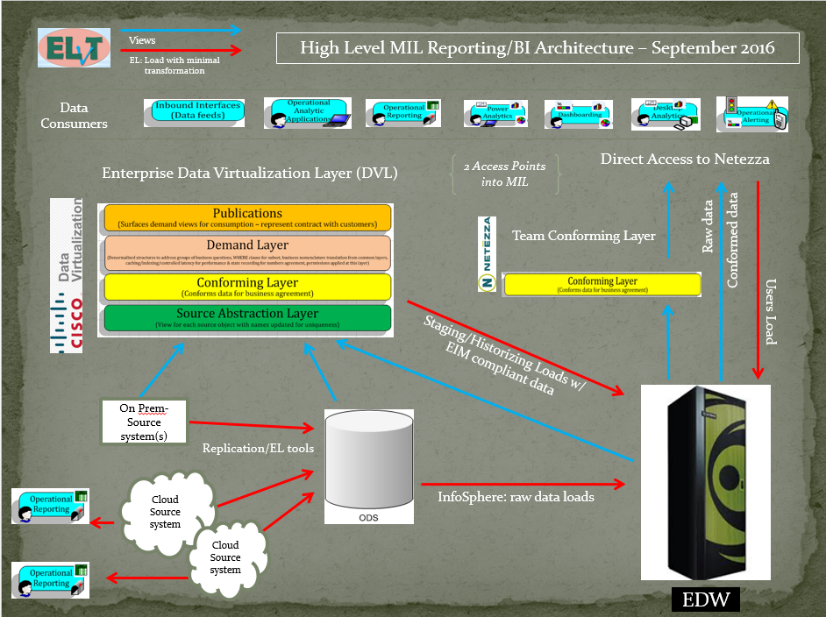
With the help of some answers to prayer and strategic relationships we started a journey towards a virtual enterprise single source of truth. It began with a prototype that gave a quick win in three weeks that solved a problem we’d been struggling with for over a year. In 2011, the doors really began to open as we revamped to an Agile development process and started incorporating enterprise-defined, core business entities into our logical data warehouse. At the heart of the new architecture was Cisco Data Virtualization. We worked closely with our Enterprise Information Management (EIM) group, and a series of cross-functional business teams, to revamp our Ministry Information Library (MIL) onto the new virtualized platform.

At Compassion, we strive to make our users’ access to the information they need as easy as possible. We hide complexity by abstracting and federating the source data, and making the data sources independent of data consumers. As a corollary to this, we also provide (secured) access to the raw data for full transparency and lineage.

With data virtualization, we’re able to ensure that definitions and business rules are applied consistently to improve information quality. (No more “where did you get your numbers?”) This also allows us to surface data at any level of latency required by the customers – ranging from near real-time to daily, weekly, monthly and yearly.

Compassion International Blog 1-17

The overall architecture can be summed up in the acronym ELvT – Extract, Load, virtually Transform. ELvT is based on three principles:

  • EL: Leave data where it is or copy it with minimal (preferably no) transformation. This allows us to leverage proven technologies such as replication, etc. The goal is dial-tone loads.
  • vT: Transform/conform the data virtually in views (not ETL routines). The goal is agreement with agility.
  • Minimize performance tuning by investing in good hardware. The goal is for people’s creative gifts to solve business problems not performance problems.

One of the most powerful features of an information factory based on virtualization is providing data in consumer-agnostic way. This frees business users to use whatever tools make sense for their data needs. “Any read only need at any latency” is the mantra.

Another benefit is the reduction of spreadmarts. Instead of having data scavengers trying to scrounge data from anywhere they can get it, we bring it all together into areas called “BI workspaces.” These workspaces include secure access to conformed data, raw data, and the ability to augment with “BYOD – bring your own data.” The combination of these three becomes a powerful information force in the hands of business users, data scientists and other consumers.

From an IT perspective, we simplified data integration – making us more responsive to new requests.  By standardizing our enterprise business logic and terms, with views instead of ETL, we are able to simplify maintenance and provide significant agility in new solution development.

Furthermore, we greatly improved data quality and a shared consciousness of trust and transparency. With data freely flowing to our customers, we are actively helping our organization’s goal of serving four million children in the near future.

In summary, great data is not the end game. For Compassion International, it represents one of many means to a much more significant goal of “Releasing Children from Poverty in Jesus’ Name”. . We invite you to join with us and change the life of one child.


Authors

Kenny Sargent

Industry Pioneer, Virtual/Logical Data Warehousing, Enterprise Information Management and Business Intelligence

Compassion International

Avatar

The latest release of Cisco Integrated Management Controller (IMC) features a HTML5 WebUI and vKVM as well as support for the Redfish standards-based API and XML API transaction support.

Guest Blogger: Jeff Foster, Product Manager, UCS Management

The latest release of Cisco Integrated Management Controller (IMC), version 3.0, makes the management of Cisco UCS C-Series servers simpler in standalone environments, because it eliminates dependencies on flash and provides an updated user interface and experience. The latest release also enhances the programmability of Cisco UCS with improvements to the APIs. IMC 3.0 includes support for the new Redfish RESTful API, and we’ve made improvements to the XML API.

Improving the User Experience

IMC 3.0 includes a HTML5 WebUI as well as a HTML5 virtual keyboard, video and mouse (vKVM) for supported M4 servers. This eliminates many of the hassles of using and supporting Java. In addition to remote console capabilities, the vKVM functionality also includes chat, embedded server power controls, and screen capture capabilities. These enhancements combined with localized language support in the WebUI for Chinese, English, Japanese, Korean, Russian and Spanish allow users worldwide to use IMC more effectively to manage their standalone server environments.

We wanted to allow you to see how easy it is to use the new HTML5 UI, so Greg Wilkinson, a Technical Marketing Engineer, created this new demo video.

Click on the Arrow to Start the Demo Video

This new release also includes some other features designed to enhance ease of use:

  • BIOS profiles (One-touch configuration)
  • One click hardware inventory collection
  • Cisco IMC asset tag configuration
  • One-time boot (supports precision boot devices)

Expanding the APIs

All Cisco UCS products were designed to be programmable. This makes them easier to manage and allows you to automate many routine provisioning and support activities. We’ve built on the existing XML API in IMC to provide a new method (configConfMos) for these systems that will allow users to make multiple configuration changes in a single transaction.

The new release also includes support for the new Redfish standards-based API. Redfish is open, industry-standard specification and schema published by the Distributed Management Task Force (DMTF). Our support for this API extends the programmatic capabilities of Cisco UCS C-Series which adheres to v1.01 of the specification.

If you’d like to learn more about Redfish support, read this blog.

Authors

Ken Spear

Sr. Marketing Manager, Automation

UCS Solution Marketing

Avatar

Cisco has added Redfish™ support to IMC to extend our unified and open API to manage server components and to help customers integrate solutions within their existing tool chains.

Guest Blogger: David Soper, Technical Marketing Engineer, UCS Management

Last month Cisco released version 3.0 of the Integrated Management Controller (IMC). This new release makes the management of standalone Cisco UCS™ C-Series servers simpler, and it enhances the programmability of Cisco UCS with improvements to the APIs. IMC 3.0 includes support for the new standards-based Redfish API. (IMC 3.0 adheres to version 1.0.1 of the specification.)

Why Redfish Is Important

Redfish is an open industry standard that specifies a RESTful interface based on the Open Data Protocol (OData) which utilizes HTTPS and JSON to transfer data. This standard was developed by the Distributed Management Task Force (DMTF) with the participation of many server vendors, including Cisco. It is ideal for cloud and web-based infrastructures, which typically have large quantities of servers in heterogeneous environments. Redfish also provides developers a familiar and comfortable suite of protocols.

The API is designed to be extensible. Features that are not explicitly supported by the Redfish API can still be made discoverable and addressable. Many common management tasks can be automated with Redfish, and additional automation can also be performed with the IMC Unified API and IMC Python SDK from Cisco.

Redfish In Action

I created this new demo video, so you could see how Redfish works with IMC 3.0 and the Python SDK:

Click on Arrow to Start the Demo Video

The Future of Redfish

Redfish is an important industry standard for infrastructure management that will continue to evolve. The DTMF has established the Redfish Developer Hub. They are also working with Alliance Partners, such as Cisco, and OEMs to “leverage and expand Redfish”. For example, the Storage Networking Industry Association (SNIA) is developing Swordfish, which builds upon Redfish’s local storage management capabilities. There are other extensions, such as Chinook, that are also being developed.

Cisco is a member of the DMTF leadership committee. We will continue to be involved in the development and review of these standards as they emerge, and we will adopt the standards when they are formalized. We’ll also look for ways to continue to extend Redfish with the UCS unified API and SDKs, just as we have done with the IMC 3.0 release.

If you’d like more information on this topic, including links to the programmer’s guide and example code, please read this blog on the UCS Communities site.

Authors

Ken Spear

Sr. Marketing Manager, Automation

UCS Solution Marketing