We’re in the business of creating tools and technology for collaboration. Everything we do is focused on making it easier for teams to work together and “get stuff done.” But putting the best tools in place isn’t going to create teamwork from thin air. If your organizational culture doesn’t actually reward people for working together, tools alone won’t make it happen.
Few people would disagree that teamwork delivers results. But for decades, recognition systems in business have focused on individual achievement. This encourages the belief that if you want to get ahead, you have to make all the magic on your own – or at least make sure you’re the person to get the credit for it.
Have you ever been in one of those giant quarterly team meetings where four or five people are called out as superstars? How many of those people truly did it all on their own? How many times have you been sitting in that meeting thinking that Bob and Jane got accolades, but the project was a massive team effort? It’s a good way to convince people that getting attention is more important than making an effort. And if you’re not likely to be rewarded for your effort, why put in the effort?
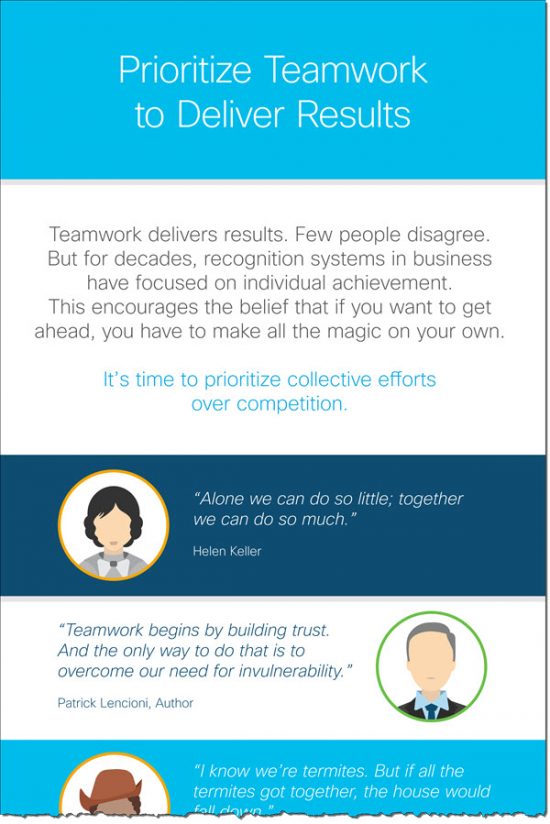
It’s time to prioritize collective efforts over competition.
Click image to download full file.
I’m not suggesting we hand out participation ribbons to people just for showing up. Nor am I saying that it’s time to abandon the Most Valuable Player recognition.
I certainly wouldn’t deny Madison Bumgarner his MVP award for the 2014 World Series. But although he was a standout player, the San Francisco Giants won the series as a team. And the rewards and recognition for that win are shared throughout the organization, from the field to the office staff. Would the full organization be as committed if all the glory went to the pitcher? Probably not.
Michael Schrage from the MIT Center for Digital Business nets it out pretty simply. If you want to encourage teamwork, reward it. And not just a little. In his Harvard Business Review article “Reward Your Best Teams, Not Just Star Players,” he turns it into simple math: a 50/50 split.
“For every executive utterance praising a high-impact individual, there should be an equally emphatic expression of support for a high-achieving team… Teams, not just individuals, should get their fair share of bonus pools. A perceived — or real — absence of fairness can cripple team culture.”
–Michael Schrage, MIT
For people to want to participate fully in teams, they need to feel that it’s beneficial to them as individuals as well. They want to know that leaders recognize the roles they play and reward their efforts as part of the team’s success. And that’s another important element – bringing together the right people in the right roles.
If you want employees to collaborate, the first two steps are simple: First, create an environment that prioritizes teamwork. Then provide the tools to make it work.
P.S. If American sports aren’t your thing, consider the recent Grammy Awards. Adele won several awards. And although it’s her voice you hear in the songs, this is who you saw on stage as she accepted – and intentionally broke – an award. Her team.
As our schools and universities prepare students to make a contribution to the world, it is important to benchmark the emerging critical skills they will need to solve increasingly complex problems. As we accelerate the speed of moving data and communications around the world, one strategic skill emerges that we traditionally have not taught: global empathy.
My own introduction to how valued this skill is came from an interview I had with the CEO of one of the largest banks in the world. He did not hesitate when I asked him, “Which skill is the most important one where you see a shortage in the workforce?” His answer: global empathy. He went on to explain why. “Global empathy,” he said, “is the ability to understand and respect different points of view. We invest in complicated projects across the globe. The shortage we see is hiring people who understand how to value the various points of view on a team who are digitally connected from all over the world. We can have engineers, bankers, architects, researchers, designers, marketing people, and more—all working on the same project who live and operate from dozens of countries.”
The executive continued: “It’s not hard to find employees who have high test scores. What is hard to find are employees who can effectively contribute to teamwork and be sensitive to the needs of people from other cultures, religions, and regions, who might have very different perspectives from their own.”
The boundaries of relationships prescribed by our traditional classrooms typically limit students to conversations with peers sitting next to them. In many classrooms, this means that when we assign work that challenges students to understand geographically diverse topics, or different points of view on a local topic, there is a complete lack of authentic global empathy. If the global banker is correct, we must tap our investment in Internet connections to our classrooms and provide our students with meaningful experiences to develop a sense of working with the world. It is no longer sufficient to earn high test scores without global empathy.
Fortunately, technology makes it extremely easy for today’s students to become globally aware. From web and video conferencing platforms, to social media channels and collaborative software (like Cisco Spark and WebEx), educators now have incredibly powerful tools to connect their students instantly with classrooms and subject-matter experts from around the world—a development that has profound implications for education.
My consulting work takes me to schools all over the world, and I regret to say that many educators I’ve met still are not taking full advantage of this ability. Some teachers might believe there is not enough time in the school day for them to get through everything they have to cover in the curriculum, while also connecting their students with others around the globe; others might fear the loss of control that comes with opening their classrooms to the world at large.
What if you could cover the curriculum and leverage authentic global connections to motivate students to work harder on required content and develop global empathy? The teachers I have met whose students are globally connected have witnessed a dramatic increase in student engagement. Globally connected classrooms do not have to give up focus on basic skills such as reading and writing in elementary school or subject content in secondary school. Not only are their students learning essential skills that will prepare them for success in work and life, but these students are more fully engaged in their learning. They’re also gaining rich experiences that will stay with them long after they have handed in their final exam.
Here are some of the key aspects of global empathy:
Listening. This is such a vital skill. By actively listening, students are showing that they value the ideas of others.
Balancing different points of view. This requires careful and critical thinking. Students should be able to identify biases, assumptions, and whether some arguments are more valid than others.
Developing lines of inquiry. Learning how to ask good questions helps deepen students’ understanding. Effective questions give students further insight into how their peers see the world—and why.
Publishing reflections for authentic feedback. Students should be given the time to reflect on what they have learned from others, and how this has affected their own way of thinking. By sharing these thoughts online, students can get real, authentic feedback from their peers and others around the world—which is much more meaningful than just getting a grade from their teacher.
Understanding Different Points of View
Bergen, Norway: Terje Pedersen’s students have authentic conversations across the curriculum from North America, Europe, Asia, and Africa. His students have come to expect and value that they will be challenged to think, reflect, and reconcile various points of view.
Terje teaches English and social studies to what would be the equivalent of high school freshmen in Bergen, Norway. He taps various social networks to challenge his students to learn more deeply about topics in the curriculum. His global network includes teachers from around the world who are willing to open their classrooms to his students, a policeman in Chicago, a state senator from Brooklyn, New York, grandparents in Russia, survivors of Apartheid in South Africa, a teen behind bars in the U.S., and students in Australia who are studying Aborigine culture.
“Students need to connect with others around the world,” he said. “We need to be giving them the tools to understand different points of view. Plus, they love to debate their peers.”
Making these global connections not only builds empathy among his students; it also helps them understand there are multiple perspectives about the issues they are learning. When his students are studying the Cold War, for instance, Terje has them connect with students in Russia to hear Russian points of view about defining events such as the Cuban Missile Crisis. Each class shared their interviews with their grandparents about how they felt growing up during the Cold War. This personal connection to a historic event gave his students a much deeper sense of what that period meant to people on both sides of the Iron Curtain. Differing facts about what happened and how it happened led his students to learn to think critically, ask probing questions, and challenge their assumptions—all while taking their learning deeper.
“We spend very little time memorizing dates,” Terje said about his classroom. “We need to be going more in-depth. I’m not going to give my students an assignment where they can just copy an answer from Wikipedia or a textbook.”
In talking with their peers from around the world, Terje’s students are learning how to be culturally sensitive, and they’re developing important communication skills. In one project, his students connected with an American teen serving time in a juvenile prison. The American’s story moved them deeply, and around Christmas they sent him letters to cheer him up.
Making global connections is a much more motivating way for students to learn than reading from a textbook, Terje said—and his students agree. “This makes school more motivating” one girl told me. “We look forward to talking to other people. We get to learn in more ways than just reading information.”
Not Just for Older Students
Moose Jaw, Saskatchewan Connecting with others around the world isn’t just an effective learning strategy for older students. Canadian teacher Kathy Cassidy has her first graders in Moose Jaw, Saskatchewan, connect with students worldwide.
“We follow other classrooms because it’s a way for kids to improve their reading and writing,” Kathy said. She noted that her students are far more engaged when they are reading something that was written specifically for them by children their own age from around the world. They are also naturally curious to learn more about their new global friends: where the students live, what their school is like, and what they like to do. As Kathy’s students are practicing their reading skills, they’re also learning geography, how to ask questions, and how to be globally aware.
One day, her students came to school worried. They had heard there was a flood in Brisbane, Australia, which was where one of the classes they had met on Twitter was located. Kathy contacted her colleague in Australia, who assured them the students were safe—and she sent pictures, maps, and videos of the flooding.
“My kids were fascinated that there were sharks in the water,” Kathy said, noting that Moose Jaw is far from any ocean. “It was such a learning experience for them. And it all started because my kids thought the same way about these students in Brisbane as they do about the kids next door. They were able to empathize with someone far away because of this connection.”
If Kathy didn’t have her global connections, she said she would lose opportunities for what she calls “serendipitous learning.” For instance, her students saw a tweet from a class in British Columbia referring to “samn eggs.” “What are those?” they wondered. In tweeting back and forth, they learned the B.C. students were referring to salmon eggs. Kathy’s students knew what salmon were, but they hadn’t realized that fish start out as eggs. That triggered a discussion about which types of animals come from eggs and which give birth to their young.
Often, Kathy and her students will see ideas from different classrooms for projects they’d like to try themselves. “We saw kids who were doing these Lego challenges, like: Can you make something out of Legos that floats?” she explained. “My kids were thrilled by this. They tried it themselves, and that led to conversations about why some designs float when others don’t. Ordinarily, we would not cover buoyancy. Our connections are leading us to expand our wonderment of the world.”
Because her students are young, she takes precautions in how they use social media. For instance, they aren’t allowed to tweet a message themselves without showing her first—and she previews the account to make sure new posts are appropriate. “If someone tweeted something inappropriate to us, I would see that first, and I would block that user,” she noted. “But since I’ve been using Twitter in my classroom, I’ve never had that happen.”
Besides following other classes on Twitter, her students connect with “reading buddies” from around the world through real-time video to practice shared reading, and they also maintain digital portfolios of their work. These first graders from remote Moose Jaw are learning how to have a global voice early on in their lives, which is empowering them to become lifelong global learners.
“One day, one of my students was reading a book he had written about snowmen,” Kathy relayed. “When he asked his reading buddy in Brisbane if she had any questions, the Australian girl asked, ‘Why aren’t there any snow women in your story?’ Of course, none of our students in Moose Jaw would ask that question. These relationships provide our students with the opportunity to reflect on their work in new ways and from different perspectives. That’s priceless.”
She added: “With the internet, we can do anything and be anything. Our students have wonderful imaginations. We need to nurture this natural curiosity in a safe globally connected way. We live on the prairie. What used to be a relatively limited set of conversations with children in the neighborhood is now global.”
Overcoming Objections
Both Terje and Kathy recommend tapping social networks to connect to authentic global relationships. Kathy happens to use Twitter to connect to other first-grade classrooms around the world. Terje uses Facebook, LinkedIn, and Twitter to meet his contacts.
A common concern among many teachers is that they don’t have the time to make global connections in their classrooms, because they’re too busy covering the required curriculum. But everything that Terje and Kathy do online is related to their curriculum goals.
“All of what we do is curriculum-based,” Kathy said. “It’s just a different way of doing it. Instead of reading on chart paper, we read on Twitter. I’m modeling reading and writing for my students in a digital way instead, and I’m getting all of these side benefits as well: teaching them to be good digital citizens, teaching them geography skills, and teaching them to have empathy for others around the world.”
Making global connections also requires teachers to let go of some degree of control. When Terje had his students connect with an incarcerated American teen, he had no idea where the conversation would lead. But Terje said it’s well worth the risk—and his students agree as well.
I had the privilege of talking with three of Terje’s students about how they have benefitted from the global connections they have made, and they were remarkably self-aware of their own learning.
“You learn that there are different opinions than what you might find online,” one boy said, adding that teachers shouldn’t be afraid of trying something new. While making global connections requires more work on the front end—teachers have to find classes to connect with, and students have to prepare questions they will ask—this extra work definitely pays off.
“I remember more from these conversations,” another boy said. The lessons he has learned from making global connections are “something you will carry with you for the rest of your life.”
Action Steps:
If you’re ready to inspire global connectedness in your classroom, here are three simple ways to start:
Search in Google for “Twitter second grade” and you can begin to search for partner teachers by grade. Find Twitter accounts you want to follow to build your global network.
Use epals membership database to contact teachers by country around the world.
Head to Global School Net to search for scheduled projects designed by educators around the world.
Have you had a fantastic experience connecting your students to peers globally? Tell us more in the comments below.
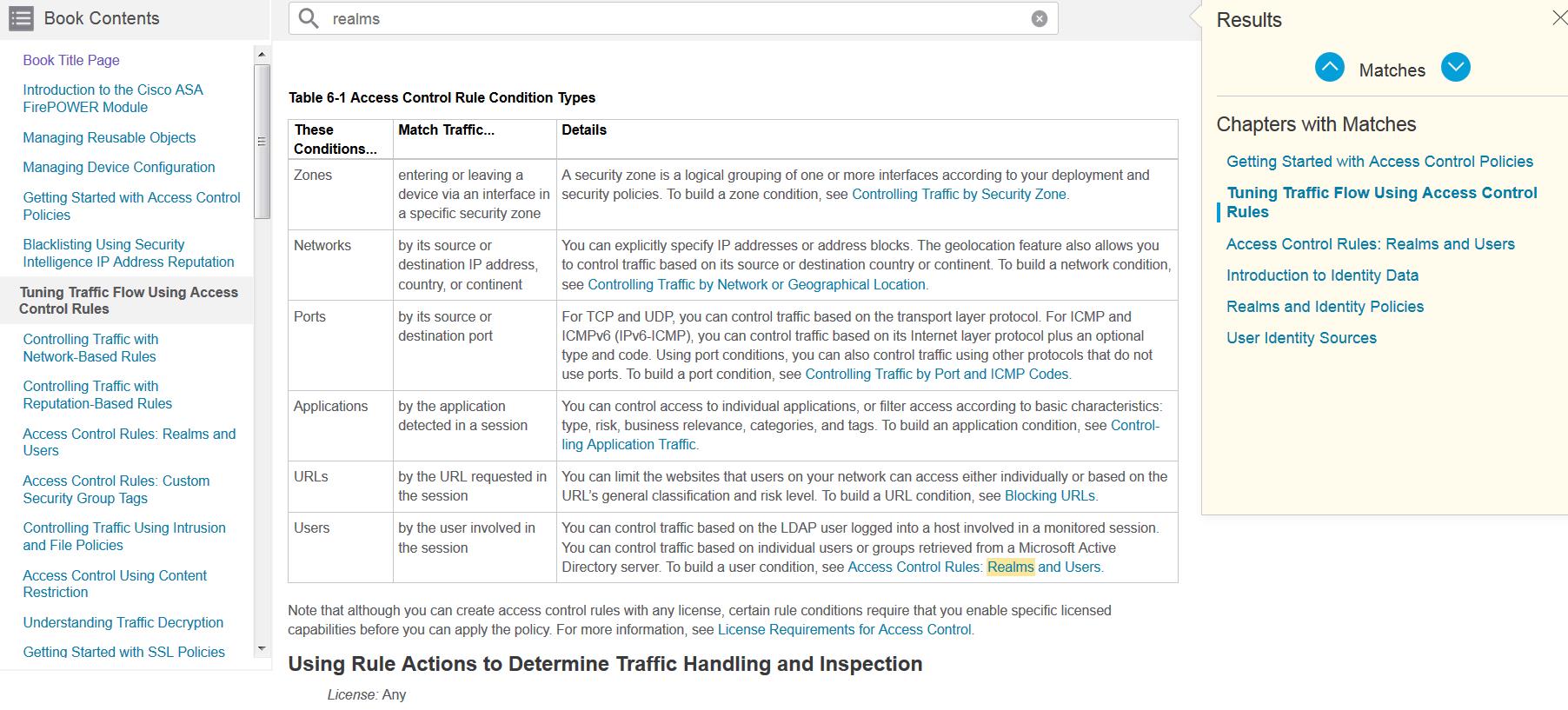
When we first launched the template for Product Books and Chapters (in 2016), and then improved search functionality, Our focus was on desktop-sized screens. Thousands of customers have benefited from the new functionality since. In fact, more than 20,000 visitors leverage the search feature every week.
Now, in response to user needs, we have…
Adapted the enhanced search functionality for smaller screen sizes, making it easier to search a book when on the go.
Added light shading to the search results panel to distinguish results from the rest of the page.
Ensured documents can expand to match the browser, for full-screen viewing on desktops and large monitors.
Made the Table of Contents persistent in the left column (where the screen is wide enough to show that information)
We live in an era of rapid technological change. Across the world, global problem solvers are using digital innovations to take on some of the world’s biggest challenges. As we continue to apply creative digital solutions to age-old global problems, one thing becomes clearer: when we work together, invite and nurture diversity, and encourage everyone to contribute, we speed the pace of social change exponentially.
To celebrate diversity in the quest for global change, the Cisco Corporate Social Responsibility (CSR) team will be hosting a #CiscoChat at 9 am PST (12 pm EST) on March 8th in recognition of International Women’s Day. We invite all #GlobalProblemSolvers who are using technology and digital skills to create more opportunities for women to participate in this conversation.
During the #CiscoChat, we will be joined by Vicki Escarra (@VickEscarra), Global CEO, Opportunity International; Sara Chipps (@SaraJChipps), CEO, Jewelbots; and Diana Nassar (@dianadhn), 2016 Techwomen Fellow and Product Manager, Souq.
To participate in the chat:
Make sure you’re logged into your Twitter account.
Search for the #CiscoChat hashtag and click on the Live tab.
The chat will be moderated by the Cisco Corporate Social Responsibility channel (@CiscoCSR) on Twitter. Be sure to follow the account to participate. They will begin welcoming guests at 9am PT (12pm ET) and posting questions for discussion.
For @ replies to specific participants in the discussion, please use a “.” at the beginning of the tweet, so that your question or comment will appear in your public twitter feed.
If you need multiple tweets to answer a question, please preface each tweet with “1A, 2A,” etc. in order to make it easier for others to follow along with the conversation.
Be sure to use the #CiscoChat hashtag at the end of each tweet, so that others can find your contributions to the discussion.
Don’t forget to bring your own questions to the discussion as well! See you there!
Which Cisco site is where you can find employees watching soccer on the huge media walls, watch technology make you the perfect cup of coffee, and has some of the best people around (at least I think so.) That would be the Cisco office in Munich, Germany! Come on a blog tour with me.
Here are some facts about our office. It was inaugurated in February of 2017, and it’s one of the most modern offices worldwide! There are about 300 Cisco employees working here in what is the German headquarters. It’s perfectly connected to the city and the motorway, and close to lots of shops and restaurants and has plenty of parking places around.
Where do I start?
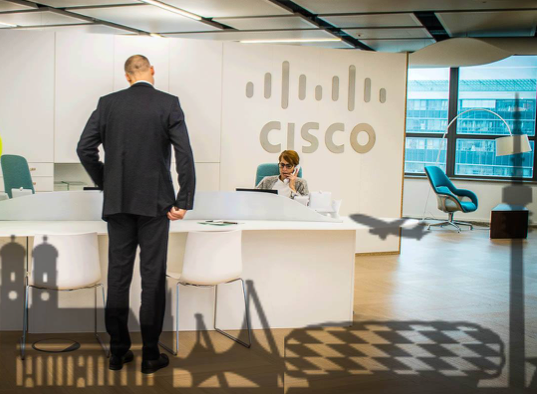
First, you enter through Parkring20 on the 4th floor. That’s where the main entrance and reception desk are. Plus, it’s where you’ll find the customer experience zone. It’s a short walk to the employee-only areas.
Insider tip: If you are late (or in a hurry) you can also enter the office through building 22, it’s like a back door into the employee-area on the 4th floor. 1. If you should have any questions or need help, our lovely ladies at the reception desk (customer experience zone, 4th floor) will be there for you.
What should I wear?
Unless we have customer meetings, jeans/business casual is the office attire.
I can’t function without coffee. Where is the coffee?
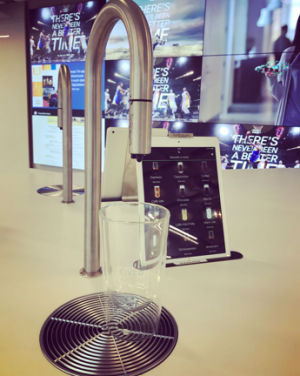
We have arguably the coolest (and best) coffee in our office. Use one of the digital coffee machines in one of the three kitchens. Select your coffee/milk ratio right down to the last gram using the iPads or by an App and then have fun watching how your perfectly invidualized coffee freshly grinds, brews and serves it up in your mug. Pick your favorite – all of them are good, but I prefer the classic “Latte Macchiato.”
Where’s the coolest place to set up my computer and do some work?
I think choosing a seat at the window in the “interact” zone is pretty cool. From there you’ll have a lovely view over the lake, and when the days are shorter, you can watch a stunning sunset. (Or if you’re working late.)
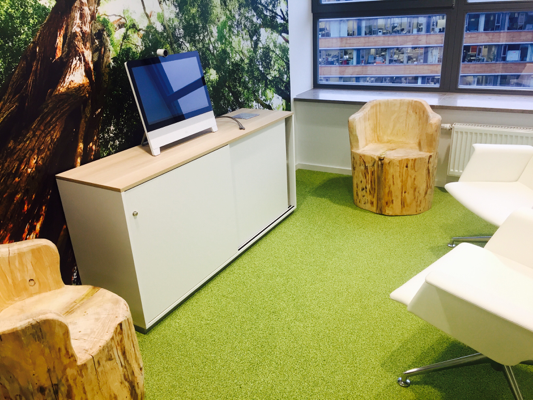
If you want more nature, and are visiting and want to feel like you’re really a part of Bavarian culture, you can have a relaxing meeing in the “Nymphenburg” conference room. It’s furnished with beautiful seats made of tree trunks and a wall of woods – it’s like you’re really out in our countryside.
What’s the “office secret?’
That depends!
In summer, you should definitely choose that coffee I mentioned and enjoy it on the 5th floor’s rooftop terrace, featuring a Hollywood swing.
For some stress relief, you can come to the internal cafeteria for Flipper and Kicker (which translates to pinball and foosball for the Americans.)
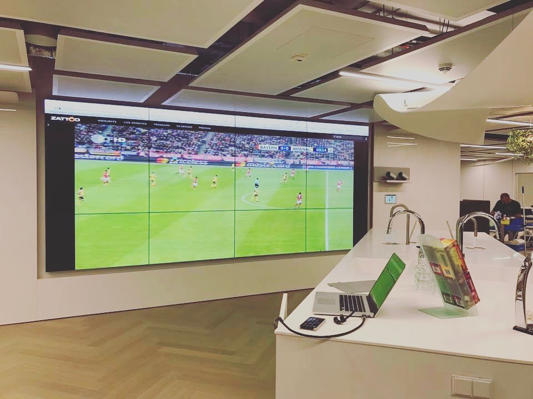
One of the most fun times to visit is during a soccer match. Germans are crazy about soccer. Get swept away with us as we watch on the big screens! The office is quite near the famous illuminated “Allianz Arena” – which is the soccer stadium of FC Bayern München. Again, we love soccer. Did I mention we love it?
Okay, now I’ve worked up an apetite. Where shall we have lunch?
The closest lunch spot is the one in the canteen “Freiraum” opposite the office, about a two-minute walk. There are special rates for Cisco employees, and the food is high quality and tasty. The daily menues are in different areas, Asian, Italian, Grill, Pasta and Vegitarian. You can combine anything with a salad or desert (or both!) The best time to go, I’ve found, is after 12:30 or 1:00 p.m. to avoid the crowds. Most employees eat here.
Or, if you’d like, there is an in-store café in the Edeka supermarket right next to the office, about a three -minute walk. There are two menus for lunch every day. It’s small, so not great to sit and eat, but if you want to eat when the canteen is crowded, the food is good.
After, we can stop in a small bakery on the other side of the lake. It’s opposite of the office and also a five-minute walk. You can get sandwiches, snacks, drinks and pastries here.
If you’re looking for lunch companions, Fridays are hard, because thanks to Cisco technology, we can work from anywhere, and that’s the day when the office is least populated.
Now I may need to work off my lunch. Is there a gym?
Not yet, but there will be a gym by end of 2017 called “Fitcompany.” They tell us that it will be an extraordinary and very modern gym concept that is different to everything we might have seen before. We’ll see, I am curious! 😉
If I’m visiting or interviewing from another location, where should I stay?
There are a lot of hotels within walking distance but personally I would prefer either the Motel One or the Ibis Hotel. They have nice and modern hotel rooms and a normal breakfast (not these extraordinary and huge brunch buffets for 35 EUR p.p. which no one can ever eat.)
If I have a bit of extra time, what tourist stops should I not miss?
Definitely the Allianz Arena, as it’s just one station with the subway away. It’s impressive and I am sure you will love the illuminations, plus, there’s soccer (we love that, did I mention?)
If you have a little more time, take the same subway and drive to the city centre (Marienplatz) and enjoy a walk through the pedestrian zone.
If you are lucky enough to visit Munich in the end of September/beginning of October timeframe you might want to visit the famous Oktoberfest. Feel the very special Bavarian spirit on world’s largest festival with a lots of beer, rides, nice people and fun sound. It’s worth an experience!
Of course, any time that you visit, be sure to stop by and say hello to me. I hope to see you in our Cisco Munich office soon!
Berlin.
Europe’s Europe.
Where someone thought of doing this so you can smile when paying to park your car:
Where this was also happening the week before the last:
In other words, the first Cisco Live for 2017 (and unsurprisingly the subject of this post).
But before I get into the details of the event, one small point:
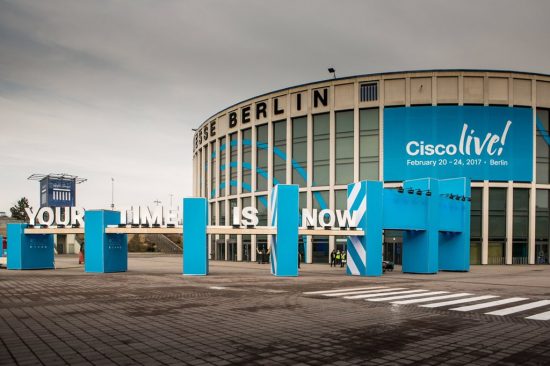
Am I the only one who noticed how amazing the venue was?
I mean we are talking about some serious “form meets function” Bauhaus stuff. But the most interesting part was the way the keynote and presentation areas were left with an industrial and minimalistic feel that worked extremely well when the speakers were delivering their sessions.
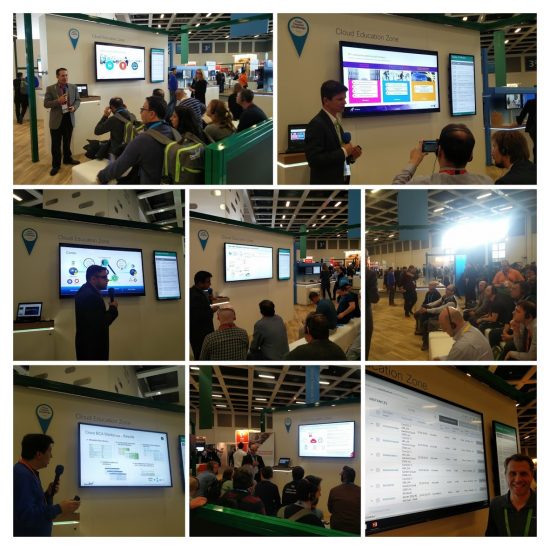
So between 20-24 or February, almost 13,000 people including customers, partners and distributors from Europe and around the world took part in tech talks, presentations, demos and so on. The sessions addressed not only Cisco products and services, but also a vast spectrum of industry and technology.
It was an excellent opportunity to talk about our cloud positioning and story, breaking it down with our partners and customers. And I’m delighted to say we received great feedback.
Exactly. Some asked for “the hybrid cloud management thingie”. Others for CliQr. And others for “dragging and dropping apps to AWS and Azure”. They all meant the same thing of course, and we had a live demo that was always busy. Even I was able to fire up an app that was running live in the cloud in 2 minutes. (Okay, it wasn’t me, someone else was holding the mouse but still…).
Another area of our booth that got significant traction was Business Cloud Advisor (BCA). Bringing validation and actionable insights to our cloud story, BCA is the smart framework Cisco developed with analysts at IDC. It’s designed to make use of data points garnered from interviews with more than 6,000 organisations across 31 countries and multiple industries, and provide insight and vendor-agnostic guidance to realise maximum benefit from cloud adoption.Take the BCA and you start with a quick self-assessment questionnaire after which you can request a complimentary workshop delivered by your Cisco partner and/or Cisco. And no, there is no catch here.
The cloud booth featured an area dedicated to Contiv, one of our latest cutting-edge innovations, as well as Cisco’s contribution to the open-source community around containers and the work we are doing with Docker. Similarly on the OpenStack side of things, a live Metacloud demo was running to demonstrate how to unleash the power of IaaS in seconds, firing up managed compute resources for any DevOps teams within just a few clicks.
On a more personal note, I was amazed to see my fellow Greek friends from Space Hellas presenting their company’s partnership with niche Big Data / analytics platform Web-IQ. I also saw my friends at Incelligent, an Athens-based start-up, presenting an innovative machine-learning / predictive analytics stack that can be used in a variety of use cases.
Last but not least, this final image captures my reaction (on multiple occasions) as I was preparing my best smile to talk all things-cloud to visitors to my booth, only to realize it was yet another technical question about how Tetration works…
An Innovation Funding Board (IFB) can play an effective role in reducing innovation-related struggles. In my second blog on this topic, I share key principles and questions to consider before putting an IFB in place. But first, it’s important to establish a little more clearly what an IFB is and when it’s most needed. An IFB can be defined as:
A governance process, decision-making group and forum for selecting, funding reviewing and guiding early-stage innovation opportunities.
In short, it’s a mechanism to nurture and support higher-risk business opportunities that otherwise would be less likely to obtain funding through existing core business processes. All successful organizations should be developing and managing a diverse portfolio of innovation projects that support their business and growth goals. However, as many organizations grow they tend to become increasingly risk averse, and over time can develop a strong bias toward low-risk projects at the expense of truly innovative ideas and projects. This is where an IFB can play a critical role in getting innovation back on track.
Understanding the need for a new approach is the starting point for improving innovation, but an IFB requires careful planning and management for a lasting positive impact. Organizational leaders should begin by thinking about existing circumstances to determine if an IFB is the right way to go. Three of the most important questions to ask are:
Q. Are there existing funding mechanisms in place for higher-risk innovation projects?
If yes, an IFB may be unnecessary. However, if not then it can be used to ensure appropriate levels of funding are apportioned to projects most likely to contribute to the organization’s future growth.
Q. If established, will the IFB be standalone within the organization or part of a larger funding governance group?
If it’s the latter, the IFB must remain free of interference and be able to make decisions based on longer-term innovation goals. If not, it risks losing its core purpose.
Q. Is there internal support for an IFB?
More specifically, is senior leadership committed to supporting one? If such support doesn’t exist there’s a risk the board will be created but not funded consistently–or that members of the leadership team will circumvent IFB decisions they don’t personally agree with. The end result is failure.
The Guiding Principles of Success
If, after considering these questions, it’s decided that an IFB is the right strategy, there are a series of guiding principles behind a successful implementation.
First, ensure there are clear and disciplined processes for all participants in the IFB initiative—from the senior leadership team and the IFB members to the innovation teams in charge of idea generation. Removing ambiguity and clarifying requirements on all sides is fundamental to success.
Second, the IFB portfolio should encompass a diverse range of investments, which follow a select number of themes. Investments should be diverse enough to provide a spread of strong bets along related themes, but not so diverse that the organization can’t react to rapid market movements.
Third, project funding should never be provided up front, in full. Given the nature of innovation project funding, there’s a high chance that many ideas will never be seen through to development and release. As such, providing full project funding up front is a risky approach. Instead, funding should be provided in periodic tranches, with each tranche unlocked once a pre-agreed set of project milestones are achieved.
Finally, an IFB should never be afraid to kill a project going nowhere. A central pillar of any IFB is the ability to spot projects that aren’t going anywhere early so funds can be channeled elsewhere.
Planning effectively and adhering to these guiding principles is the key to getting a successful innovation programme off the ground, but it’s just the beginning.
In my next blog, I’ll share the best way to establish an IFB governance framework and the key parties involved. I’ll also discuss how to ensure innovation remains on track throughout the entire IFB process.
One of my favorite days of the year is coming up this week. Cisco’s 5th annual Women of Impact Conference is happening on Wednesday, March 8. This powerful event, which coincides with International Women’s Day, is devoted to the professional development of women. This year, some 10,000 Cisco employees, partners, and customers are expected to attend from over 30 countries, and I hope you will register to attend the virtual broadcast from wherever you are in the world!
This day is so personal to me. As the first generation in my family to go to college and have a career in corporate America, I feel I have the opportunity to pave the way for my own daughter and to support other women and girls who share the hopes and aspirations I had growing up. It also gives me time to reflect upon the mentors who have given me their guidance and trust, and in some cases, taken a “chance on me.” I am forever grateful to them. Women of Impact engages people in that same spirit of connection and mentorship, and I am so proud of Cisco for providing this forum where women and men can come together in solidarity with others who are passionate about advancing women’s careers.
Over the past 5 years, our Women of Impact conference has explored themes like “Be Extraordinary,” “Be Fearless”, “Be Unstoppable,” and this year is my favorite so far: “It’s Time. Collaborate. Lead. Inspire.” At the end of this powerful day, women will emerge with an expanded network of allies to support them in the future, ideas for collaboration, and a new empowerment to lead and chase the career of their dreams.
At Cisco, we have a commitment to Diversity, Inclusion, and Collaboration – that’s how we unleash the full potential of our people to create exponential value for Cisco, our employees, partners and customers. Women of Impact is a premier example of this commitment, and I hope you will join me March 8, 2017.
Based on Gartner, vendors will ship almost 8.5 billion connected “things” to users and companies in 2017 and that the total spending on these endpoints and services will reach almost $2 trillion. Amidst this digital transformation, your data center infrastructure is the backbone of your business and key ingredient for success. But what if I told you most of the off-the-shelf switches are similar? This is because most data center switches in the market are based on the same Merchant silicon with limited differentiation, and hence, little room for innovation.
Cisco wants to make sure that you are ready for the digital transformation tsunami. This tsunami is about having the performance and scale combined with intelligence to handle a large scale of applications that will bombard the data center in the form of microservices and containers. To fulfill this promise, Cisco brings you a new generation of Nexus 9000 data center switches powered by the Cloud-scale ASIC technology. The Clouds-scale ASIC is designed from the ground up by our best engineers, and is deployed across the Cisco Nexus 9200 , Nexus 9300-EX , and Nexus 9500 modular switches.
One may think, a custom ASIC doesn’t mean better solution. But I am going to prove to you that “different is better” when it comes to the competitive advantages of Nexus 9000 switches with Cloud-scale ASIC.
These switches deliver :
Greater scale by leveraging your existing infrastructure so you can connect to more servers, run more apps, provide more services, host more tenants with 7x increase in endpoints density.
Direct impact on your bottom line: these switches provide you the highest density in the industry, at 50% lower system cost, and 50% energy savings, offering 25GE/100GE at the price of 10GE/40GE. For example: Delivering cost optimized spine-leaf architectures for the data center with 2.5 times more bandwidth at the same price.
Deliver superior and secure user experience with exceptional application performance: Cloud-scale ASIC’s smart buffers are proven to solve network congestion problems more efficiently, bringing low latency and secure package delivery regardless of application or traffic type. For example, financial industries are more concerned about latency due to the nature of stock trade transactions, versus health care applications require ability to deliver an user experience to view high resolution X-Ray and MRI images. Your app developers and DevOps teams will love it! Watch Tom Edsall video here if you want to learn the science of smart buffers. Smart is the new sexy, and Network Test and Miercom prove it.
Network Test: “Let’s cut right to the chase: The Cisco Nexus 9508 is the densest, fastest data center switch we’ve ever tested.”
Miercom: “…our testing results show that the Cisco Nexus 92160YC-X and Nexus 9272Q switches outperformed the Arista 7280SE-72 switch for congestion handling. The Arista 7280SE-72 switch has much deeper buffer than the Cisco switches, but with the built-in intelligent buffer management capabilities, both Cisco switches demonstrated clear advantage in flow completion time for small/medium flows over the Arista 7280SE-72 switch and provided the same or similar performance for large-size flows, which resulted in overall higher application performance.”
In addition, The Cisco Nexus switches run NX-OS, the industry’s leading operating system,which is feature rich, scalable, extensible, robust and self-healing. Its open APIs enable programmability with various 3rd party tools like Puppet, Chef and Ansible for DevOps and IT workflow automation. This allows customers to deliver technology changes faster, release high quality and reliable software, and do it securely, thus enabling IT teams to be more responsive to the lines of business. Learn more!
As customers look to add automation and orchestration, they can build on their Nexus 9000 infrastructure and deploy Cisco Application Centric Infrastructure (ACI). Cisco ACI is the industry’s #1 Software Defined Networking (SDN) and data center automation solution with 3100+ customers worldwide. So why are customers excited to use Cisco ACI? Well the simple answer is that they can:
Deploy applications faster, from weeks to minutes.
Simplify operations, by using consistent application based policy, you can now orchestrate your entire network with few clicks, increase visibility and faster troubleshooting.
Top notch built-in security that helps you simplify IT security tasks, ensures PCI Compliance and accelerates application deployments. Thanks to ACI’s APIC SDN Controller, you can push security policies down to the individual tenant, application or workload level. Furthermore, ACI’s whitelist model automatically disallows connectivity between devices until policy specifically allows it.
Open architecture that Cisco ACI and Cisco App Center supporting over 65 ecosystem partners to date and enabling customers to build a heterogeneous network integrating 3rd party vendor products. This way, you can innovate while creating synergy and decreasing costs. See more ACI case studies.
But what about security and application performance? Do you know what apps are running in your data center and how your apps are interacting with each other?
As your data center continues to grow and scale, applications and policies mushroom across not only on-prem data center and also hybrid cloud. How do you think you will manage constant change in applications and their dependencies? Most IT organizations don’t know or aren’t sure. If you do not see, you cannot control and secure your application environment. Truth is, securing your infrastructure will become even more challenging due to the increasing number of endpoints, and applications that span across 100’s of servers in various locations. This is why Cisco Tetration Analytics was invented.
Make changes rapidly and with peace of mind: Thanks to Tetration’s fine grain application segmentation, you can continue to update and make changes to your applications and don’t need to worry about application components and dependencies. Tetration will ensure that the application policy stays intact even when the workload moves. This way, you can deploy applications rapidly per LOB.
Predict the future and avoid disasters: Tetration provides you advance machine learning, network and security analytics, and network forensics. These powerful tools turn Tetration into a powerful time machine that allows you to inspect every flow, every packet at any time. You can go back to past events to identify anomalies in your system. To predict the future, Tetration provides you policy recommendation and simulation, so before you decide to introduce new features or changes, you know exactly what the results will be.
These are only 2 of the many benefits of Tetration. Learn more here.
Cisco is achieving what off-the-shelf switches never could, and the world is lining up to see what’s next.















 , we were also called the