
Avatar

Written by John Holobinko, Director Access Strategy, Cable Access Business Unit

Traditional cable access systems can only transmit data in one direction across any part of the spectrum.  Compared to PONs, a cable access network is severely limited in the maximum symmetrical data speed it can support, usually under 200 Mbps.

What if spectrum was no longer dedicated to a single direction, but supported simultaneous data transmission in both directions simultaneously?  The technology for doing this is being developed now, and Cisco is in the forefront of this breakthrough.  FDX is a new technology that enables simultaneous downstream and upstream communications over the same cable RF spectrum.  With FDX, D3.1 channels can be transmitted simultaneously in both directions without data throughput loss in either direction.  FDX is being developed primarily for N+0 plant architectures, i.e. systems where there are only optical nodes and only passive coax with no amplifiers following.

The biggest challenge in bidirectional transmission on the same frequencies is how to recognize return path signals at the point where they are at their lowest RF level while forward path signals on the same frequencies are at their highest level.  The point in the network where this occurs is at each optical node output/input port.  In an N+0 network the output level of the highest forward path carriers can be over 60dBmV.  In contrast, the received carriers from cable modems can be 10 dBmV.  If you think of only the return path, this means that there is somewhat coherent “noise” level that is represented by the forward path signals, that is virtually 50 dB greater than the signal level!

Knowing the forward path signal and using digital subtraction, you can remove this unwanted forward path “noise” to recover the return path signal.  If this were the only thing required, FDX would be easy.  However, when forward path signals leave the node and reach the first coaxial cable tap they are reflected back towards the node.  Assume the best taps provide 25 dB of return loss.  If there is 2.5 dB of cable loss to the first tap, that means that the reflected signal is 60 dBmV – 2.5dB – 25.0dB – 2.5dB = 30 dBmV compared to a return path modem signal of 10 dBmV!  We are used to measuring the signal to noise ratio as a positive number.  In this case, the relative SNR is a negative 20 dB!  Consider that there are many reflections at various frequencies.  This makes recovery of the return path signals far more complicated.

FDX technology uses powerful digital signal processing algorithms to derive return path signal from forward path signals and reflections, and Cisco has led the CableLabs effort in contributing technology for the FDX standard. Based on cable modem output signal power limitations, the standard currently defines symmetrical operation up to 684 MHz. FDX supports traditional cable modems and FDX modems in the same network simultaneously. Therefore, to support the FDX standard requires a node based Remote PHY and requires that the node return path gain sections support 700 MHz bandwidth operation.

Cisco is currently developing an FDX capable node based on its 1.2 GHz GS7000 super high output node technology.  Customers with existing GS7000 nodes will be able to upgrade these nodes to Remote PHY and FDX.

Authors

Daniel Etman

Product Marketing Director

Cisco's Cable Access Business

Avatar

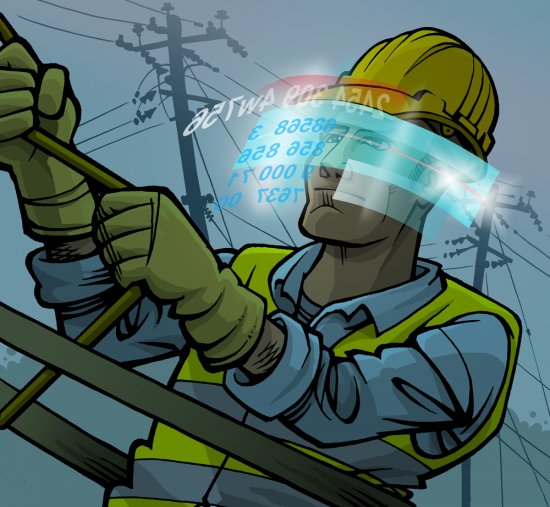
Cisco has worked to bring the cloud closer to the ground through Fog and Edge Analytics, but what if we could bring the cloud right to the point of origin, to the place where the data is needed most? This is where IoT crosses the chasm between analytics and proactive interaction. It’s the new distortion field… called Augmented Reality.

Virtual reality systems have been available now for over a decade, but as interesting as the technology is, it still hasn’t caught on. Outside of robotics control for military and research applications, the furthest the science has reached is in the gaming world. Even with the introduction of toys like the Oculus Rift, gaming content that utilizes the technology is sparse and there are still missing pieces to the puzzle to make the experience fully immersive.

More recently, developers have reached what seems to be an integrated solution with real value. Augmented Reality takes what one sees in the real world and combines it with actionable and relevant intelligence that can be used in remote situations.

Suddenly, the industrial world is taking notice.

With today’s rapidly changing workforce – and just as disruptive – rapidly changing technology, field workers are faced with daunting challenges to keep critical assets running and functioning efficiently.  With the number of diverse devices residing in a typical substation these days – some new and some very old – it is nearly impossible to have at hand all of the relevant maintenance and repair data in the form of hard-copy manuals and papers to get the job done.

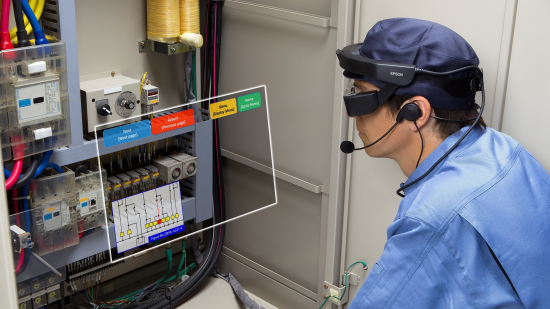
With Augmented Reality, a worker can pull up to a job site, don a pair of AR glasses, and have at their fingertips every piece of information necessary to perform their task. In some instances they can connect live to a remote technical service agent to help walk them through particularly difficult activities.

The potential is real. The Electric Power Research Institute, a nonprofit agency funded by the utility industry, has initiated a large-scale study with some of the largest utility players in the world to see how AR could better enable the industry’s workforce. EPRI hopes to have 15 utilities participating in the study, which is expected to last around 18 months.

Cisco has readied itself for this burgeoning technology. Introduced in 2015, the IR 829 industrial router combines powerful features to enable Augmented Reality in the field. When mounted in field service trucks, the built-in GPS functionality can sense the location of the truck and initiate an upload of relevant content to the vehicle computer through its 4G/LTE WAN connection.  The included 802.11 b/g/n Wifi can then connect with the user’s Augmented Reality portable system to make available the data necessary to complete the task. With Cisco IOx, real-time data can be fed from the systems to the worker’s field of view.  All of this is tightly wrapped in a secure envelope using Cisco’s advanced VPN technologies, ensuring highly secure data, voice, and video communications.

Augmented Reality is truly a new reality for utility field work and you can find out more about all of Cisco’s Digital Grid products here.


Authors

Jon Judson

Marketing Manager

Industry Marketing

Avatar

Healthcare law in the U.S. is anything but settled. The first effort to repeal and replace the Affordable Care Act (ACA) failed, but what’s coming next?

Amid instability, the big-picture ambitions of healthcare professionals haven’t changed. If there’s any doubt that improved population health remains an unwavering goal for U.S. healthcare professionals, look no further than the conference circuit. The HIMSS Population Health Forum, held in Boston last week, drew hundreds of attendees. Throughout the event, the message was clear: Population health (and value-based care) aren’t going away, no matter what happens at the federal level.

Population Health: The health and well-being of the greater human population

Why? Well, for one, healthcare professionals want to make a difference in societal health. That’s why they got into the profession in the first place. But there’s no denying that cost plays a major part in population health, too. According to the Centers for Disease Control and Prevention, chronic disease (diabetes, asthma, and COPD, and the like) accounts for approximately 75 percent of the nation’s aggregate healthcare spending—or an estimated $5,300 per person in the U.S. each year. An oft-quoted statistic is the 80/20 rule: 20 percent of patients account for 80 percent of spending.

Obviously, preventing patients from getting sicker (and requiring more advanced—read:  expensive—care) will help reduce costs. But another way to improve the bottom line is to focus on creating more satisfied patients–coincidentally, often a positive side effect of population health initiatives. Deloitte recently reported that hospitals with “excellent” HCAHPS (Hospital Consumer Assessment of Healthcare Providers and Systems) patient satisfaction ratings over a six-year period had a net profitability margin of 4.7 percent, on average, compared to 1.8 percent for hospitals with “low” ratings.

Value-Based Care: A focus on the long-term effectiveness of treatment over the volume of patient encounters

And then there are regulatory pressures. The Medicare Access and CHIP Reauthorization Act (MACRA), a federal law that increasingly compensates providers based on treatment effectiveness, will be rolled out in stages over the next few years, with the aim of tying 50 percent of Medicare fees to performance by 2018.

Private players have an even more ambitious goal. An alliance of health systems, payers, purchasers, and patient stakeholders have declared their intention to link 75 percent of reimbursement to performance by 2020.

This all sounds great in theory, but how can providers and facilities actually make it happen?

Enter the Digital Healthcare Revolution

Undeniably, the move to value-based care requires a shift in mindset and major changes in processes and workflows. But very little change would be possible without the technological innovations being implemented today.

Just a few examples: Outreach campaigns driven by advanced data analytics are helping to automate proactive patient engagement. Remote monitoring, connected devices, and telemedicine are keeping doctors and patients connected. And apps and portals are finally starting to catch up with consumer digital behavior (think Amazon).

One facility that’s ahead of the curve is the Mercy Virtual Care Center in Chesterfield, Missouri. Mercy’s facility is unique in that there are no patients in the building–just healthcare professionals and technology. Through the power of the digital network (and in partnership with Cisco and World Wide Technology), they’re making sure people with chronic conditions get the care they need.

Dr. Randy Moore, President of Mercy Virtual, sees a direct connection between advanced technology and quality patient care. “I want to see a person on Wednesday, when they have a minor issue, instead of Friday, when they have a major issue,” he said. And that, in a nutshell, is exactly the goal of population health.

At the recent HIMSS Population Health Forum, Nathan Tierney of the Department of Veterans Affairs argued that the key to improving healthcare is creating the health outcomes that matter most to the population. “Value for patients should be the overarching theme,” he said.

Improved health and better value? Why, there’s never been a better time.

Authors

Amy Young

Marketing Manager

Healthcare

Avatar

It’s no secret we live in a world of political and economic upheaval. When India demonetized its currency last fall, Prime Minister Modi gave the country two hours’ notice that all 500 and 1,000 rupee notes — 86% of the currency in circulation — would no longer be legal tender. And people had 50 days to redeem their cash before it was officially worthless. Not only was it an effort to combat corruption and counterfeiting, but also to help the cash-dependent economy go financially digital.*

Cisco partner Softcell was able to help a large, legal services customer manage the rapid increase in business.

Softcell says…

We do a lot of work in India, and the recent demonetization put a lot of pressure on the cash flow of many local companies. It also meant that legal and financial businesses facilitating much of the change needed a network infrastructure to support higher demand. We noticed an opportunity with our customer, a research-based law services firm. They provide strategic, legal, and tax services from their headquarters in Mumbai and offices around the world.

Technology is foundational to their practice and they keep their system updated to match global demand. And they needed an R&D center with a completely digital infrastructure.

So, we recommended Cisco, and built them a solution with products from every single Cisco architecture including services, including Cisco One, Nexus 9k, ISE, Open DNS, IP Cameras, and soon, Stealthwatch. And Cisco Capital made the proposal more attractive and helped us close the deal by the quarter’s end.

We have plans to install more Cisco solutions with them. And internally, we’re building out a dedicated Cisco team to give other customers in India a vision of Cisco’s Digital Economy.

Thanks, Softcell!

To meet more Cisco Partners, visit: www.cisco.com/go/meetpartners

For more info on Softcell, visit: www.softcell.com

Authors

Julie Colwell

Marketing Manager

Global Partner Marketing

Avatar

Pressure to transform is coming from every direction:  customers, competitors, heads of departments and the C-suite.  Convert high cost manual services to lower cost automated ones.  Create development environments or place applications into multiple clouds.  Change the way employees and customers interact with technology by offering on-demand consumption.

Your company lives or dies by the applications you provide to customers and employees.  Their expectations on how they access these applications have changed. Access without delay or interruption 24 hours a day is the new normal.  If they can’t get want they want, they go elsewhere.

Transforming your business involves a shift from an IT-centric focus to a customer-centric focus.  This shift requires automation across all layers of your organization. Deliver technology in hands off manner.  Add orchestration to combine automated tasks into the right sequence that delivers services accurately the first time – every time. The result:  your business can move with greater speed and agility.

Go Fast with Cisco ONE Enterprise Cloud Suite.  This solution delivers a multi-cloud capability that allows you to keep pace with a 24×7 world.

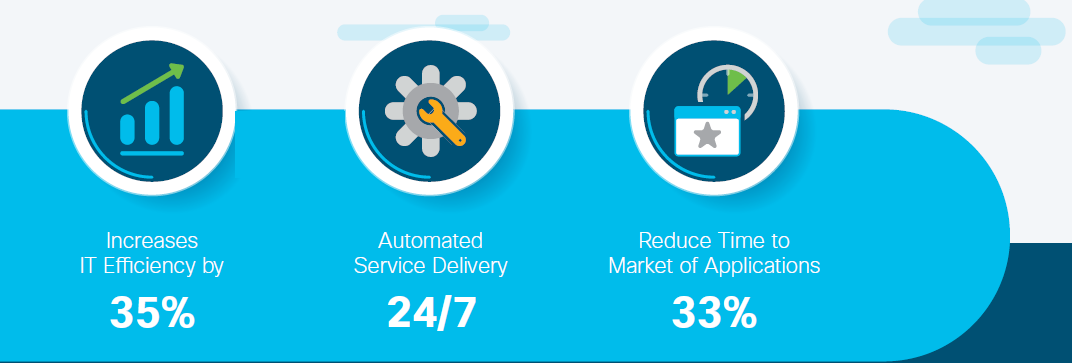
Cisco ONE Enterprise Cloud Suite increases IT efficiency, allows you to deliver services 24 hours a day and reduce time to market of applications.  It delivers the technology and processes your data center staff needs to say “yes” to any service request – regardless of location.

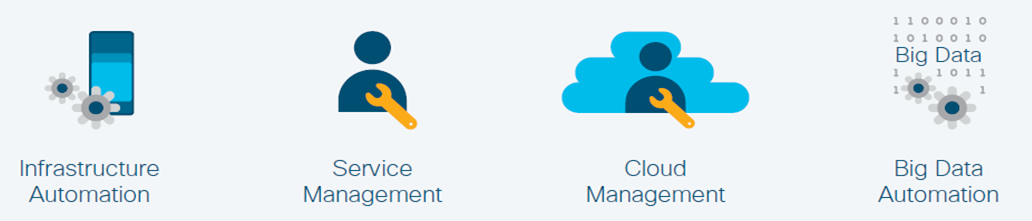
This solution is composed of four offers which can be used individually or together to create a cohesive approach to automated service delivery. Your business experiences ROI faster.  Adopts automation at a pace comfortable to them.  Your business encounters the outcomes and value of hybrid cloud.

  • Increase IT efficiency by 35% by automating your data center
  • Increase user satisfaction up to 12% through on-demand ordering of IT and business services
  • Achieve time savings of up to 60% by eliminating the need to write, update and maintain custom application scripts
  • Deploy and manage Hadoop clusters, associated network and compute resources from a centralized management interface

Organizations are faced with rapid and far-reaching changes as a result of digital transformation.  Move to the head of the pack with Cisco.  Get the full story or watch this video.  See how your business can move faster with Cisco ONE Enterprise Cloud Suite.


Authors

Joann Starke

No Longer with Cisco

Avatar

Thanks for following our 2017 E-rate and funding blog series. Did you get your Form 470 posted? Today is the last date applicants can file a Funding Year 2017 Form 470 while still allowing the required 28 days for competitive bidding. If you missed this important deadline, or if E-rate is not going to cover everything you need for your digital learning environment (which it likely will not), we are here to help.

Have you considered financing? We would like to start off by reminding you that you cannot pay for or pay off E-rate projects using financing. However, you can and should consider financing other projects and/or expenses. Why, you ask? Financing could be a viable option for projects you had earmarked for cash, such as school buses and other capital equipment. Using financing for these types of purchases could free up cash for you to use for technology projects. Financing is also a great solution if your E-rate funding falls through, enabling you to still move forward with your planned project.

Schools can now take advantage of the Public Sector Financing Program from Cisco Capital. As a wholly owned subsidiary of Cisco Systems, we specialize in providing innovative financing options for Cisco products and services. Our flexible financing options can help you take advantage of unique, below market financing and leasing rates to deploy new technology today using your existing and future budgets. Find out more about Cisco Capital financing options here.

Thanks again for tuning into our E-rate and funding blog series. We look forward to hearing about your successful digital learning initiatives, made possible by E-rate funding and/or alternative funding options like Cisco Capital. Please reach out to your local Cisco account manager or public funding advisor if you have questions or need further assistance.

Authors

Peter J Kiron III

Region Manager

US Public Sector SLED

Avatar

Digital transformation, digital business, digitization, digital disruption. There are countless ways to phrase it, but it boils down to this. When digital technologies enable new business models, that’s digital transformation. Digital factory initiatives are generating incredible business outcomes, and at the core there’s a common denominator—a digital-ready infrastructure.
Manufacturers’ Distinct Take on Digital Transformation

In manufacturing, digital transformation means consumers using virtual reality to design their own products. It includes collaboration across multiple engineering teams or between customers and plant floor experts. It means robotics bringing new levels of automation and accuracy to the plant floor. Digital transformation cranks up efficiency by connecting every extremity of the supply chain for total visibility. It pushes efficiency by using sensors to track assets, tools and people for improved safety and security. Digitally savvy manufacturers increase agility by connecting machines for predictive maintenance, resulting in fewer unplanned outages, improved quality and greater yield.

What Does “Digital-Ready Infrastructure” Have To Do With It?

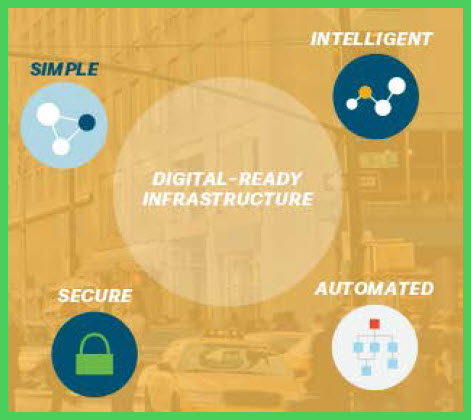
Peel back the exterior of these advancements and there’s a common denominatora technology foundation that integrates connectivity, security, automation, collaboration and analytics across the entire business value chain. As you think about this foundation, consider these four essential attributes of a digital-ready infrastructure and how they apply to manufacturing.

Secure

The threat landscape is changing extraordinarily fast. The growth in connected devices is creating exponentially more targets, and attacks are growing in sophistication. A factory gains enormous value by connecting machines and analyzing data at the network edge to predict failure and perform maintenance before a machine goes down. Despite the benefits of reduced downtime, higher yield and greater efficiency, the potential exposure to risk grows as well. Manufacturers need a secure infrastructure that delivers the performance and reach to see more, protect better, and respond faster.

Automated

Millions of endpoints, thousands of virtual machines, and hundreds of applications are being connected for digital transformation—even as Operations and IT staffing remains flat. It’s becoming almost impossible to manage anything manually due to the scale and complexity of factories, network environments and real-time response expectations. With rigorous and rapidly changing business demands, manufacturers need to be proactive, agile, and responsive. An automated infrastructure is a critical means to help companies achieve those ends.

Intelligent

Manufacturers are aggressively seeking ways to unlock the full value of data using contextual awareness of sensors, machines and tools. Analytics at the edge of the network can differentiate between data best handled locally versus data to send back to the control room and data center. Sensor data saying “I’m fine” do not need action. Yet companies need to know ASAP when there’s a problem, its location and its severity to direct rapid resolution. Additionally, factories need predictive and prescriptive insights to ratchet-up efficiency, boost productivity and respond faster to market changes. The more data you can collect and analyze, the more opportunities will emerge.

Simple

As the Internet of Things (IoT) marches forward, manufacturers are connecting millions of endpoints and disparate data sources. Additionally, their infrastructures are becoming more dynamic and distributed with cloud, edge and mobile capabilities woven into factory operations. All this leads to complexity. In the face of this, forward-looking manufacturers are increasingly converging OT and IT to integrate processes and information flow. Close alignment is necessary to drive success in this new climate and simplicity in the infrastructure.

Manufacturers who establish a digital-ready infrastructure can sharpen and accelerate their digital factory initiatives. That infrastructure needs to be designed around the above four attributes—secure, automated, intelligent and secure—that combine to propel effective business outcomes.

Explore this e-book to spark your thinking about how to jump-start your digital journey today.

Authors

Nada MacKinney

Marketing Mgr, Digital Transformation

Enterprise Solutions Marketing

Avatar

There’s an undeniable rise in the number of people illegally streaming pay TV. In recent years, there have been many reports of police actions and criminal prosecutions of pirates and the many businesses that support them. The challenge when reading and compiling such reports is quantifying the overall scope of the situation.

The global, multi-lingual, anti-piracy team at Cisco has spent decades monitoring the activities of hackers and pirates to gauge current and future threats. In recent years, we have added analytics components to quantify the scale of those threats, and the nature of the illicit streaming ecosystem worldwide. In this new series of blog posts on anti-piracy, we’ll present some insights from our knowledge of this space and our recent findings regarding the crisis facing broadcasters everywhere.

Unlicensed streams of live television generally break down into two types: ‘free’ or ‘open’ networks, and ‘closed’ networks. The open ones are freely available to anyone who knows (or can find) the site online and generally provide a poor user-experience, supported by flashing banner adverts and the occasional unwanted malware infection.

Closed networks are far bigger operations because everyone watching has paid to do so. Whether they’ve bought one of the many Android boxes sold online and on high streets around the world that come with preinstalled subscriptions, or whether they’ve simply paid for an account and are streaming it to their existing computing devices at home, these networks give a better experience than the “free” services…. until they’re raided by police in whatever country they’re based and the end-users have to find another provider.

One product that bridges the two types of networks (open and closed) is the frequently discussed “Kodi Boxes”. These are sometimes sold barebones, ready for people to install ‘add-ons’ for viewing open networks, and sometimes sold pre-configured with access to closed networks for a predefined amount of time e.g. a one-year subscription.

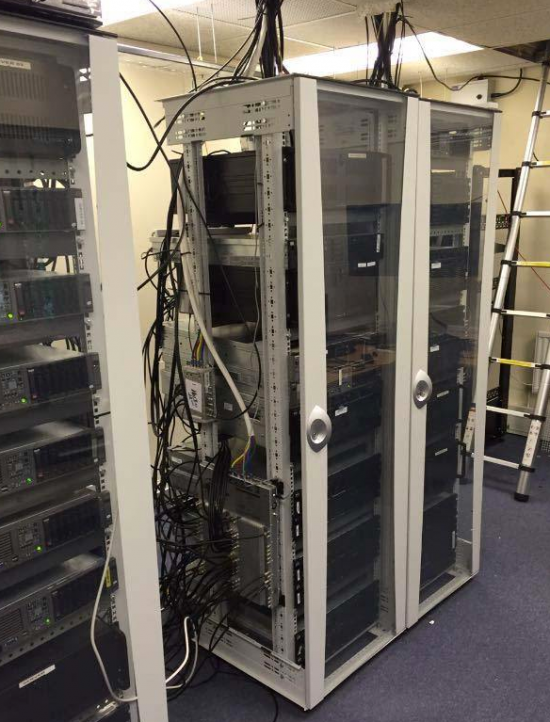
There are many online forums where people discuss ways to watch paid-for content without paying full-price to the rights holders and broadcasters. We typically see justifications for these practices based on cost and convenience. Also on these sites are organizations offering streaming services. These services vary greatly in size but the internet is a great equalizer – the end user is typically unaware of whether they’re paying for a service run by a teenager on a home PC, or a 15-person company with racks of servers and multiple satellite installations.

Consequently, the volume of trading done by these services ranges enormously too. For example:

  • One operation had “tens of thousands” of customers: In August 2016, a raid in the UK of a streaming operation resulted in the seizure of approximately 30 servers and 15 satellite dishes providing content from many broadcasters worldwide. The head of the UK’s Police Intellectual Property Unit described the outfit as “a significant and highly resourced operation to distribute pirated television on an industrial scale to tens of thousands of people across the globe.” (Source)
  • One operation had 70,000 customers: According to court papers during the investigation into a network in Malmö, Sweden in September 2016, there were 70,000 customers of this service.

  • Another had 100,000 customers: In December 2011, the “Australian arm” of a global piracy group was raided on intelligence generated by a private investigator hired by a Chinese broadcaster. Police estimated that the shop “L&D LED Signs” was “part of a global piracy operation worth A$150 million a year and with 100,000 customers” (Source)

  • A very large organization claims 170,000 subscribers: On the site of RAPIDIPTV they openly boast of having 170,000 subscribers. Even if it’s an inflated number, it’s an indicator of the potential size of this group.

Cisco’s anti-piracy team is highly active wherever piracy is discussed and conducted. From our experience, we know that those are examples of large players in this industry.

To get a greater understanding of the bigger picture, it’s worth analyzing one of the main places where live streaming servers are advertised: forums. Our investigations have shown that:

  • Servers which have only been recently launched can be expected to have hundreds of subscribers
  • Well-established servers might have 5,000-10,000 subscribers
  • The most significant players (as shown above) might have tens of thousands of subscribers

We sampled one of the most active online forums for streaming services and saw 285 servers advertised. It’s not unusual to see them promoting their services openly like this for many years:

Conservatively, it’s fair to assess that for these 285 servers, there’s an average of 1,000 viewers per server in this highly competitive environment. When we extrapolate from the forum described above, we can conclude that this single forum can easily reach 285,000 viewers. An average forum has offerings of hundreds of servers and each one has thousands of customers. So, with hundreds of popular forums worldwide and thousands of customers per site, the global scale of the problem is clearly visible to those of us visiting the forums and maintaining statistics.

This series of blog posts will continue to highlight the findings of our ongoing research.

What do you think about the rise in illegal streaming of Pay TV? If you feel strongly about any of the topics raised in this piece (or ones we’ve left out!), use the comment box below to share your thoughts with us.

For more on our piracy intelligence research findings, please see these related blog posts:

Authors

Melvyn Mildiner

Anti-Piracy Researcher & Analyst

SPPA (Service Provider Platforms and Applications)

Avatar

The 2017 Cisco Mobile Visual Networking Index (VNI) forecasts, for the first time, 5G connections and traffic. We estimate, there will be about 25 million global 5G-capable devices and connections by 2021 (representing 0.2 percent of total mobile devices and connections). Those 5G devices and connections will generate nearly an exabyte of monthly traffic (or 1.5 percent of total annual mobile traffic in 2021). From this modest initial base, 5G has the potential to build a prodigious, but different future compared to prior cellular technologies.

While 4G was the network that made smartphones prolific as a personal infotainment device, 5G is going to be network of the IoT. Theoretically, 5G is much more than just a “next generation” innovation. In terms of performance, 5G will be capable of offering a new high bandwidth benchmark of 1 Gbps or higher and sub 1 millisecond (ms) latency. Operationally, 5G’s support for dynamic resource allocation and application prioritization will accommodate a variety of M2M devices, including those that require very low bandwidth. 5G is capable of supporting the growing volume of M2M nodes and sensors with mobile connectivity.

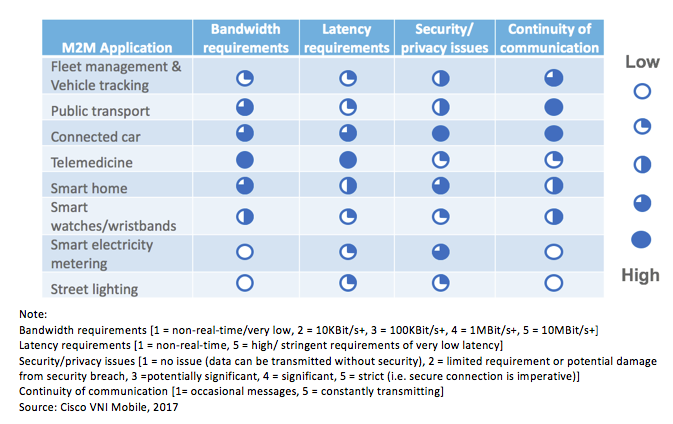
Cellular connected M2M applications have widely varied requirements in terms of bandwidth, latency, security and continuous network availability for communication. On the one hand, there are applications such as street lighting that have very low network requirements. On the other end of the spectrum, there are applications such as connected car (including autonomous cars) and telemedicine that require very high bandwidth, low to ultra-low latency, very high security and continuous communication with networks.

The great strides in the cellular network connectivity are helping the evolution in M2M applications. They are becoming more video capable and gaining increasing functionality. 5G networks can support very advanced applications such as remote surgery, immersive experiences through virtual and augmented reality, autonomous cars and so on. Each of these applications can be game changers. Recently there have been several announcements about testing of autonomous cars – though there is a great difference in opinion on when these cars will become commercially viable. Just autonomous cars alone can have a big impact on many industries such as air travel, hospitality, and other ancillary functionalities and systems such as traffic management, automobile servicing and maintenance etc.


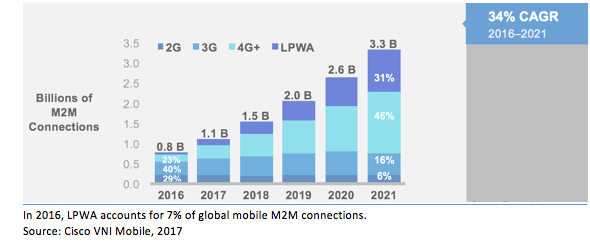
Out of 3.3 billion global mobile M2M connections by 2021, Cisco Mobile VNI estimates that over 1 billion (31 percent) will be connected over low power wide area networks (LPWA). 5G can potentially accommodate many of these LPWA connections as the 5G networks have high power efficiency so that devices are expected to last 10 times as long, resulting into much longer battery life– solving one of the key issues of cellular connectivity for M2M that do not have ready power access.

Among wearables, a category that we include in our M2M forecast, we have also seen a changing trend with different devices being more popular each year – initially smart glasses were at the forefront then came smart watches which were followed by health monitors and now virtual reality (VR) headsets. This latest wearable popularity is also driven by the higher network performance in terms of speeds and low latencies. VR headsets are going to grow from 18 million in 2016 to nearly 100 million by 2021, a fivefold growth. More than half of these will be connected to smartphones by 2021. The remaining VR headsets will be connected to PCs, consoles and a few will be standalone. 5G with tactile Internet capabilities is expected to further augment the adoption of virtual reality and augmented reality applications over cellular networks.

5G is going to be an important mobile network evolution driven by IoT growth. In the midst of what some might consider 5G hype, there are legitimate questions that are yet to be answered. There are standards and regulatory hurdles that will need to be addressed for many IoT applications. While there are different views on when 5G networks will become commercially available (before or after 2020), the anticipation (and demand) for truly ubiquitous and reliable mobile connectivity is also palpable. We’re interested in your perspectives — please share your comments below.

To read more on our projections for 5G, IoT and other mobile trends, please visit our public web site.


Authors

Shruti Jain

Leader, Project & Program Management

X-Architecture Marketing, Enterprise Networking & Cloud