Avatar

Once again, MPLS World Congress 2017 proves to be a major event for the Networking industry and a key milestone for Segment Routing debates between vendors and customers.

Industry at large is backing up Segment Routing:

  • we are seeing adoption across all customer market segments – Telcos, Web Providers, Enterprise
  • we’ve been working with lead operators and IETF since day one
  • there’s a strong consensus across vendors that participate into Interop testings

I’m really pleased to see how the conversations around Segment Routing have evolved. Attendees are no longer questioning whether they should be implementing Segment Routing … They are all convinced they should be doing so.

Now the question revolves more around the breadth of implementation. Segment Routing is no longer contained to Core networks – it is not only spreading to Metro and Aggregation networks but also to Data Centers and even to the Host!

With Segment Routing, you can set up end-to-end policies across your independent Metro, WAN and Data Center domains. This way, you avoid complex protocol conversion between network domains while maintaining scalability – simplification at its best.

This is a game-changer as this was simply not possible before! What makes that possible?

On-Demand Next Hop

Provisioning multi-domain services (L2VPN & L3VPN) comes with complexity and scalability issues notably when routing information need to be redistributed across domains … With the On-Demand Next Hop (ODN) feature, no need to do any redistribution. ODN does trigger delegation of computation of an end-to-end LSP to XR Transport Controller (XTC) – a PCE controller, including constraints and policies. It then installs the replied multi-domain LSP for the duration of the service into the local FIB.

That way, you can easily set up a path from the Top-of-Rack through your entire network infrastructure up to an Egress Peering router with constraints such as low latency or disjointness.

On-Demand Next Hop is a great example of what Segment Routing architecture has been designed for – seeking the right balance between distributed intelligence and centralized optimization.

Broad Segment Routing support

Since day one, we had this end-to-end vision in mind and made the decision to have Segment Routing support across our portfolio, encompassing both IOS XR, IOS XE and NX-OS hardware platforms.

And there’s even more on the horizon – Segment Routing IPv6 starts getting increased traction in the industry and several IETF drafts have just been released.

Segment Routing not only works in a native IPv6 environment but when combined together they open up a complete new paradigm.

IPv6 packet header has been designed from the ground up to support Extension headers, notably Routing Extension Headers. Without getting too technical here, you should consider these Extension headers as a mean to pass instructions to each packet … By using the Routing Extension headers to pass Segment Routing IDs, you can simply direct your application on the appropriate path in the network. But in an IPv6 world, your Segment Routing ID has 128 bits! You don’t need all these bits for destination addresses … that leaves you with let’s say 64 bits to use for pointing to a function and passing some arguments to this function!

Doesn’t ring a bell to you? I bet so –that should remind you about 101 programming courses.

Welcome to the world of Infrastructure as Code – that’s what the new paradigm is about.

If you’re interested into getting more details, listen to the following videos recorded at MPLS World Congress 2017:

You can stay up-to-date on Segment Routing by following us on LinkedIn, Facebook or Twitter.

Authors

Frederic Trate

Marketing Manager

Service Provider Business Architecture, France

Avatar

As the saying goes, time flies when you’re having fun. And there probably isn’t a better phrase to sum up our experience since Cisco acquired CliQr and we became the Cisco CloudCenter team just one short year ago.

A Quick Look Back

Time has moved quickly—and so have we. While many acquisitions kick-off with a slow-pace transition period, we were aggressive and were added to the Cisco Price List in just four short weeks—what we’re told was in record time. We also launched two important new product releases, CloudCenter 4.7, with a deeper Cisco ACI integration and simplified networking; and earlier this month, CloudCenter 4.8, delivering support for brownfield workloads ingested into CloudCenter management – a really important add. Together, these releases deliver on our promise of being able to put the right workload in the right place at the right time.

It’s Not Just About Product

The former CliQr team and Cisco worked hard to enable the field force and global partners to be able to sell, deploy and support CloudCenter. Cisco CloudCenter has experienced more customer wins from around the globe and across every industry, from government and manufacturing to healthcare and insurance, demonstrating impressive business growth along with the satisfaction of seeing customers capitalizing on the real power of cloud computing.

While it hasn’t always been easy—especially in the early days of the cloud—we always held to our convictions of how the cloud delivers value and what is needed to manage what we knew would ultimately be hybrid cloud environments.

We couldn’t have done this without an amazing team and we’re proud that the industry has taken notice as well. Over the years, CliQr and its CloudCenter solution has been recognized by Gartner as Cool Vendor of the Year for Cloud Management, received Best of Show in the Cloud Platform category at Interop Tokyo, and won the Software and Information Industry Association CODiE Awards in the Best Cloud Management category.

Recognition like this means more to us than a trophy in our case. Rather, it is an indicator of our passion for making the cloud, in all of its forms, the new way for businesses to exploit and optimize the use of information technology to run their operations and compete.

It’s Only Going to Get Better

As you can see, it’s been an amazing 365 days and we can’t thank our customers, partners, and employees enough for making this a tremendous first year at Cisco. We’re proud of where we’ve been—and the fun is just getting started. The cloud is at an exciting inflection point where it is both relatively new and being broadly adopted by businesses—all at the same time. This combination proves that the pace will increase, while still incurring a lot of change. It’s in this environment that we can help businesses the most.

Learn more about Cisco CloudCenter.


Authors

David Cope

Senior Director, Cisco CloudCenter

Insieme Business Unit (INSBU)

Avatar

When you run an Innovation Centre, people often turn to you for clarity on what innovation means—or should mean—to their business. Problem is, innovation can be a vague term.  Worse, innovation is often an overused, overstated, and an under-delivered concept.

Do you need to create massive business transformation to be innovative? Or do micro-innovations count? Or how about incremental-innovations? Or could you just use existing technology in a new way to be innovative?

To help you decide, let me explain what innovation means to me.

Our Toronto Innovation Centre is a tech networker’s dream, aimed at start-ups, incubators, developers, customers, universities, ecosystem partners. You get the idea. It’s a busy place. We’ve become a community dedicated to innovation. Specifically, improving our customers’ digital capabilities.

Toronto hosts quarterly Art of the Possible, with recent focus on healthcare.

As a society, we have a solid understanding of major industry disruptions in our everyday lives. Uber has turned the taxi industry on end. Netflix has changed how we consume media. And Airbnb has the hotel business on edge. So what’s next?

No one knows for sure. But one thing is clear. Your business has to take steps now to innovate. Knowing which steps to take, however, can be complicated. At our centre, we untangle the innovation confusion by:

  • Demonstrating how digital capabilities will impact industries, business models, and routes to market
  • Stressing the value of mapping digital strategies to business goals
  • Applying new digital capabilities to existing operations, go-to market strategies, and customer interaction.

Digital Business Transformation is at the centre of our work, providing us the resources we need to take a thoughtful, informed approach to innovation. The team has done great work building awareness of the flood of new digital technologies and capabilities just around the corner. And one thing’s for sure. Digital is no longer a wait and see. Industries who want to stay in the game must transform.

And we agree. That’s why we work with industry to guide them on what products to offer customers and routes to those customers. We do this by working alongside our customers. We co-develop solutions for implementation in proof-of-concept settings, including a customer’s environment or our own test lab.

Understanding where we can help drive new solutions, we use Cisco architecture as a building block. We then add:

  • Third-party technology
  • Start-up solutions
  • Partner solutions
  • Customization/API integration
  • And more…

The results are brand new, innovative solutions. In our view, this is true innovation is—and what will carry an industry into the future.

And, yes, innovation sometimes comes through large, disruptive solutions. Uber, Airbnb and the like. But just as often smaller, incremental innovations have big impact. Helping our customers figure this out is an incredible opportunity for digital innovation.

So what’s it going to be? Sit back and wait. Or learn more?


What does innovation mean to your business?


Authors

Wayne Cuervo

Director of Innovation

Cisco Canada

Avatar

The results of the annual OpenStack User Survey are scheduled to be released today, and we at Cloud Unfiltered were lucky enough to bag an interview in advance with Heidi Joy Tretheway, Senior Marketing Manager at the OpenStack Foundation, and administrator of the survey in question. Heidi Joy shared all kinds of interesting highlights from this year’s data haul, including:

  • What size most of the companies are that adopt OpenStack
  • Which regions of the world these companies are located in
  • Which industries they represent
  • How old most of their clouds are
  • How much of the average user’s cloud is on OpenStack vs. other cloud platforms
  • What kind of workloads they are running on OpenStack

She also got into several subjects outside the scope of the survey, such as:

  • How the Foundation came into being and how it works
  • Why you should go to the OpenStack Summit in Boston
  • Why the grocery store is the best place to go for souvenirs when traveling abroad

See the video podcast on our YouTube page or listen to the audio version on SoundCloud. And if you like what you hear, we invite you to subscribe to our channel so you don’t miss any of the other exciting podcasts we have scheduled over the next several months.

Authors

Ali Amagasu

Marketing Communications Manager

Avatar

New building, new views (of Sydney Harbour!) and sweeping open spaces – that’s what it’s like to work at Cisco Sydney! Let me take you on a virtual tour, so if you visit or come in for an interview, you’ll know what to expect.

How to start the day off right?

Get into the office early! You’ll get the best parking spot (sometimes all the spots are gone!) and have a chance to grab some coffee to kick start your day. You can get some at a nearby café – such as the Roots Café – but if you like espresso, the new office has espresso machines on every floor.

What should I wear?

We don’t really have a strict dress code. Dress for the job you do, and the job you want. Generally, sports jackets or suits if you’re meeting with customers, but Casual Fridays are almost always jeans.

Where is the best spot to camp out and start working?

We have some really, really nice views from the office. You can face Sydney Harbour, Spit Junction and Manly Beach. (Beware, the views can be distracting!) There are some standing desks (and sitting desks) looking out on the views.

If you’re having a meeting, there are two meeting rooms on level 23 that also offer great views.

Sydney office view
If it’s not too distracting, you can get quite the view!

What’s your favourite, secret spot?

One of the floors is called the “Experience Level” – it’s amazing and it’s not even finished yet! Rumour has it that there will be small nap pods on the Experience Level soon. When you visit, we’ll find them together!

The eCafe is also really nice – it’s a relaxing place to sit and eat your packed lunch or if you bring something back when you go out for lunch.

Speaking of food, where are the good eats?

Nearby, you have the infamous 5 Points Burgers. It’s American-inspired, as the burgers are named after New York Boroughs.

Cisconians in our office also really like Pita Pit, and nearby Greenwood Plaza also has a food court with lots of options in one place.

What should we do after lunch?

If you want to nap off the food coma, there’s the Parents’ Room on Level 23. 🙂

Seriously, though you can walk off lunch and meeting stress with a stroll over the Sydney Harbour Bridge, or at the new Barangaroo site along the Harbour. We also have a Fitness First and Anytime Fitness within five minutes of the office, where you can take a boxing or yoga class either after lunch or after work. Freshen up back at the office as the basement floor of the building has showers so you can be presentable for your afternoon meetings.

Sydney
What’s not to like about our city? (Photo by employee Kiran Karki)

Fun fact about your office?

500 Cisconians recently moved down the Pacific Highway (in November of 2016.) The new office is inspired by the workplace of the future, and it really puts our collaboration architecture into practice (we practice what we preach to our customers.) There are “hot desks” (not assigned) and all of the conference rooms on levels 22 and 23 aren’t bookable – which allows for greater in-the-moment team work.

Sydney office
Open workspaces for greater collaboration!

Where should I stay when I visit?

Meriton is the nicest place that is the closest to stay in North Sydney. It is brand new, five minutes from the office and offers fully serviced apartments. Otherwise, five star hotels abound in the city, and also over the Bridge if you want a nice 20 minute walk to the office.

Okay, you’ve convinced me to extend my trip. What touristy things should I do?

For sure you should explore the beaches in summer (remember, summer in Sydney is winter in the northern Hemisphere – January, February and March.) Everyone loves Bondi Beach, but there are smaller beaches like Bronte or Balmoral.

If it’s colder out, the Taronga zoo has every Aussie animal, and all of the animals (and visitors) have complete views of the Harbour.


Don’t you want to come work for Cisco Sydney now? Be sure to look for open roles at Cisco, and we hope that you’ll stop by and say ‘g’day’ when you’re in town.


Authors

Eden Galea

Virtual Sales Account Manager

Global Virtual Sales and Customer Success

Avatar

Scale, speed, new consumer experiences — these goals all come to mind as drivers of the massive transformation happening in media & entertainment. When it comes to the underlying IP and cloud technology needed to bring this transformation to life, Cisco has a unique ability to deliver comprehensive solutions, which we have laid out in the Cisco Media Blueprint.

Security is one of the core components of the Media Blueprint, and its role is to let our media customers digitize, connect and cloudify with confidence that their digital assets remain safe. But before we talk about solutions — more on that coming next week! — I’d like to take a moment of your time to reflect on the growing challenges that make it so important to take a proactive stance on security, and to implement a robust security strategy.

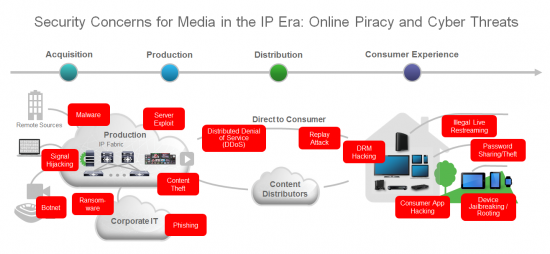
In the IP era, media companies wishing to protect their businesses, the content and services that they create and deliver, and the consumers they serve, need to address a new and ever evolving range of cyber-attacks and piracy threats. These attacks can originate at multiple points and target multiple places across the entire content path, from acquisition to consumer experiences.

Cyber-attacks, which have traditionally been a concern for enterprise IT departments, are now very relevant for the media space. With video production and delivery increasingly moving to IP and cloud, the traditional boundaries between media infrastructure, corporate IT, and the outside world are blurring. This change brings great opportunities but also poses new cybersecurity risks.

Attackers seeking to steal sensitive business or consumer data, pirate content, tamper with broadcast streams or impair consumer services now have many more ways to achieve their targets.

And there’s no need to be a hacking whiz to launch an attack. Consider this example — a simple online search gave me handy guidance on creating a botnet in 15 minutes using available tools. In case you are not familiar, botnets allow remote control of an Internet-connected device such as an employee’s PC or phone even without the device owner’s awareness. Attackers use them for hacks such as distributed denial-of-service (DDoS) and corporate espionage.

Piracy always has been and will remain a fundamental security issue for media & entertainment. As the industry evolves, so do the pirates’ techniques, meaning that anti-piracy solutions have to adapt constantly in tow.

First, as pirates have more sources from which they can pilfer content in various stages of production, distribution and consumption, accurately identifying and stopping those sources of leakage — while ensuring superb experiences to legitimate consumers — is a growing challenge.

Second, the ubiquity of broadband, which is fueling the transformation of consumer expectations and experiences around the globe, is also fertile ground for pirates to distribute video content and services illegally. At any given time, the latest popular series or live sports games may be available illegally on pirate web sites, IPTV-like paid services, online streaming and social media platforms to name a few.

So, what should we do about the challenges ahead? How can media companies achieve the security needed to thrive, without compromising their customers’ experiences or their business goals? A sustainable solution needs to take into account the operations and economics of the media industry as well as that of pirates and hackers. Then, of course, the technical ability to see, quickly react and effectively protect against evolving threats is critical.

If you are as passionate about the changes happening in this industry as we are, or curious to hear more about the security solutions Cisco has to offer, talk to us! If you are attending NAB Show, be sure to stop by — we’re in booth SU8502CM.

Authors

Michal Brenner

Marketing Manager

Service Provider Video Marketing

Avatar

With Alexa, Google Home, smart TVs and connected cars, consumer IoT applications are getting a lot of buzz. But it is too early to gauge the actual value of these solutions beyond their “cool” factor—we are still experimenting with the connected home value propositions in terms of building end-user loyalty and data mining opportunities for vendors. And we’re still asking, is having your washing machine ordering detergent really something consumers want to do?

In the business-to-business (B2B) sector, however, IoT is quietly generating measurable and substantial value. How much value? The estimates of IoT impact vary widely, with several analysts projecting trillions of dollars in value over the next five to 10 years. By 2020, IDC forecasts IoT global spending will reach $1.29 trillion. But for you, what matters is the value of IoT in your own organization. Specifically, you can expect fast payback of your IoT investments generated by reduced labor costs, lower production costs, increased productivity, improved quality, and better, faster decision making. Subsequent projects can lead to new value propositions (such as mass customization or personalization), new markets, and better understanding of the needs and concerns of the people who use your products or services.

So how can a company begin to realize that value? Over the last few years, I have met with dozens of customers across the world and in every industry. Many of them have not heard about IoT, or are confused about how they can implement IoT for business impact. But there are also thousands of customers who have already started on their IoT journey. I have looked at the use cases these customers have picked as their first small projects, and grouped them into four categories, which I call fast paths to payback. Here is a quick summary:

  • Connected operations: Rockwell Automation connected assembly lines and operations in 20 manufacturing plants, then connected those plants to each other and to its enterprise infrastructure. As a result, the company reduced its inventory cycle from 120 days to 82 days, reduced rejected parts by 50 percent, and increased on-time delivery to 98 percent.
Connected operations and remote monitoring can increase efficiency, lower costs, and improve employee productivity.
  • Remote operations: A dairy company in India began remotely monitoring the freezers in its 150 ice cream stores, providing alerts in case of power outages. The company began realizing a payback within a month and saw a five-fold return on its investment within 13 months.
  • Predictive analytics: My employer Cisco is using energy analytics software to improve energy efficiency and reduce costs in manufacturing plants. Our supply chain team deployed a network of 1,500 sensors across one factory floor, then used predictive analytics to identify problem areas. They reduced energy consumption by 15 to 20 percent in the first plant, and are implementing these capabilities in more than 20 others, with a goal of 30 percent energy reduction.
  • Predictive maintenance: Global mining company Rio Tinto uses sensors to monitor the condition of its vehicles, identifying maintenance needs before they become problems—and saves $2 million a day every time it avoids a breakdown.

These four well-proven scenarios are ideal candidates to help you get started on IoT projects. Armed with an early success, companies can then build momentum and begin to tackle more transformative IoT solutions. Here, IoT provides rich opportunities across many domains, including:

  • New business opportunities and revenue streams—Connected operations combined with 3D printing, for example, are making personalization and mass customization possible in ways not imagined a few years ago.
  • New business models—IoT enables equipment manufacturers to adopt service-oriented business models. By gathering data from devices installed at a customer site, manufacturers like Japanese industrial equipment maker FANUC can offer remote monitoring, analytics and predictive maintenance services to reduce customer costs and improve production uptime.
  • New business structures—In many traditional industries, customers have typically looked to a single vendor for a complete end-to-end solution—often using closed, proprietary technologies. Today IoT, with its flexibility, cost, and time-to-market advantages, is driving a shift to an open technology model where solution providers form an ecosystem of partners. As a result, each participant provides its best-in-class capabilities to contribute to a complete IoT solution for their customers.
  • New value propositions for consumers—IoT is helping companies provide new hyper-relevant customer experiences and faster, more accurate services than ever before. In healthcare, for example, remote monitoring capabilities can provide in-home diagnostics and prompt patients to take their medication. A 24×7 stream of real-time data reduces the need for elderly or disabled patients to visit the hospital, while alerting caregivers when an intervention is needed.

So, while industrial IoT hasn’t garnered the headlines of its consumer-oriented cousin, it is real today and is already having a tremendous impact. It is gaining traction across many industrial segments, logistics, transportation, and smart cities. Other industries, such as healthcare, retail, and agriculture are following closely. We are just beginning to understand IoT’s potential. But one thing is certain: 10 years from now, you’ll have to look hard to find an industry that has not been transformed by IoT.


Authors

Maciej Kranz

Vice President and General Manager

Corporate Strategic Innovation Group

Avatar

From cloud computing to devices that allow us to take work anywhere, everywhere, right in our pockets, the last few years have seen some of the most redefining, technology-driven shakeups in the history of business. Now, IoT has taken the stage as the next big thing in digital transformation. How is IoT already changing the way we do business? What are the pain points, challenges, and barriers to adoption? And, as IoT becomes more integrated into our work lives, what does the future hold?

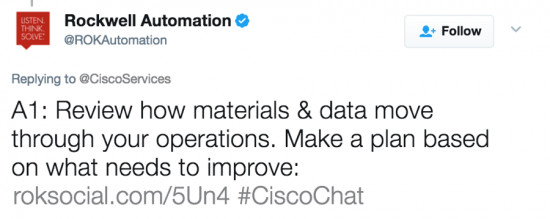
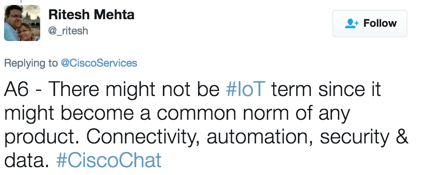
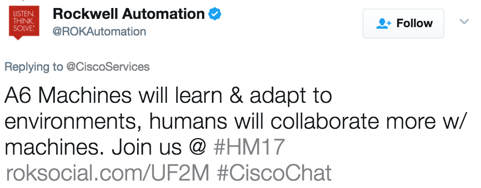
On April 5th, we held a #CiscoChat called “How Can IoT Accelerate Digital Transformation” to discuss some of these pressing issues. It was a fascinating conversation with contributions from individuals and thought leaders all over the world. Below, we’ve captured some of the questions and standout responses from the Chat. Enjoy, and feel free to add your voice to the conversation on Twitter with the hashtag #CiscoChat.


Question 1: How should companies approach the bright shiny object that is IoT?


Question 2: What outcomes are businesses seeking when they start their digital transformation?


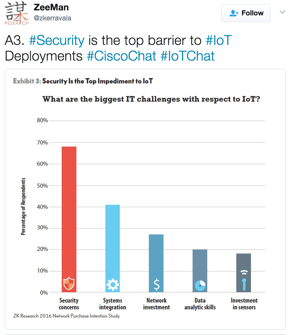
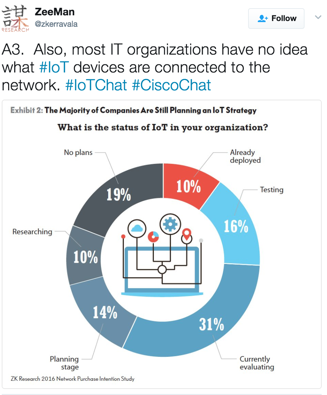
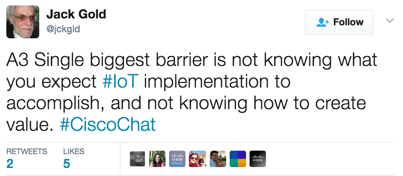
Question 3: What are the grueling barriers when a company adopts the IoT?


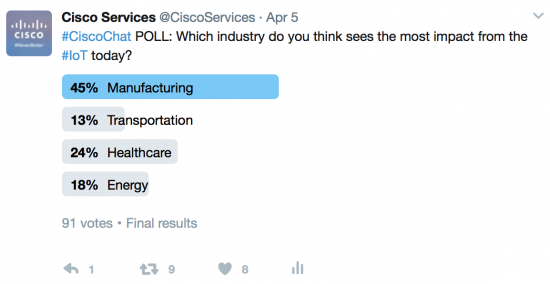
POLL Question: Which industry do you think sees the most impact from the IoT today?


Question 4: What are business pain points when integrating Information Tech and Operational Tech?


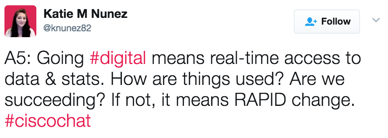
Question 5: By going #digital how can businesses benchmark and maximize their ROI?


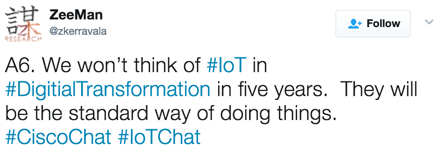
Question 6: Where do you the IoT and digital transformation will be in 10 years?


Special thanks to those who participated and made this such a fun and insightful #CiscoChat! We look forward to continuing the conversation. Join @CiscoServices on Wed, May 3rd at 11AM PT to talk about why businesses are turning to collaboration as a service in today’s digital era.

To  learn more about how IoT is enabling digital transformation, take a look at this report.

Authors

Srinivas Hanabe

Director, Enterprise PSM

Enterprise Networking and Mobility

Avatar

Communication and collaboration between employees, anywhere, using any device has never been more important. Secure communication is critical for all organizations.  But it has never been more top of mind for U.S. federal, state, and local government agencies.

Cloud collaboration services offer quick and cost-effective onboarding of new services and highly scalable deployment. The U.S. Federal Risk and Authorization Management Program (FedRAMP) helps government agencies save cost and time in selecting and evaluating secure cloud services.

The Federal Government spends hundreds of millions of dollars a year securing the use of IT systems. –FedRAMP

Last year our Cisco WebEx conferencing service achieved FedRAMP certification. Today we are delighted to announce that the Cisco Hosted Collaboration Solution for Government (HCS-G) is also FedRAMP-authorized. This authorization represents adherence to National Institute of Standards and Technology (NIST) certifications and process requirements. And it’s key to enabling secure collaboration among government agencies at the federal, state, and local levels.

FedRAMP authorization represents the culmination of over 12 months of hard work by the HCS engineering team. The team has worked closely with the FedRAMP Program Management Office to show that the Cisco HCS-G service meets the demanding criteria required by the program, including:

  • Implementation of more than 300 baseline security controls, including end-to-end encryption with FIPS 140-2 validated cryptography
  • Regular audits by a third-party independent system assessor and monthly reviews of security stature with a sponsoring agency
  • Provision of continuous monitoring reports and updates

There’s much more, but we didn’t stop there either.  We believe that the best collaboration experiences result from a combination of great software and services with great devices. That’s why we also applied many of the NIST requirements to our IP phones and the Jabber unified communications client.

With Cisco HCS-G services, U.S. government agencies are retiring legacy telephony and unified communications systems. They are saving on maintenance costs, reducing management overhead, and delivering services to new locations faster.

More important is what the service delivers for government employees. They can extend rich collaboration experiences from their desk environment to their remote and mobile work environments. They can choose the right communication tool for the task at hand, with voice and video calling, messaging, presence, and conferencing all included.

Cisco HCS-G delivers on the promise of innovation with world-class collaboration tools that are changing the business of government. They are helping government employees connect with co-workers, constituents, colleagues, and partners more efficiently. The result is greater clarity, simplified operations, and faster decision making.

In addition, Cisco HCS-G solutions help agencies to deliver against programs such as telework, connected justice, telemedicine, and real-estate reduction.  As a result, agencies can make better use of resources, make them more accessible, and enhance the citizen experience.

The Cisco Hosted Collaboration Solution for Government is hosted and managed by Cisco, exclusively for U.S. federal, state, and local Government agencies. It is sold by Cisco HCS partners.
Get started: Visit cisco.com/go/FedRAMP


Authors

Rowan Trollope

Senior Vice President and General Manager

IoT and Collaboration Technology Group