Avatar

Imagine a room full of food from all around the world, maybe some of your favorite dishes are present – perhaps there are foods you’ve never even heard of before! What about Tapixte from Veracruz, which is a dish used for local parties and weekend events on Papaloapan. We also tried Costa Rican tamales and Chifrijo, a dish commonly found in bars in Costa Rica.  Now that you can smell the food, where do you think you are – maybe a five start restaurant or even a fancy hotel room? What if I told you that Cisconians experienced this – at work!

At the Cisco offices in Mexico City, we hold a Year End Cooking Contest. The rules are pretty simple; each participant must prepare a dish from their region or country of origin. They have to make enough for three judges to evaluate the meals and for 20-30 people within our office to taste.

Always up for a challenge, Cisconians took to this idea immediately.  We have people from all around the world working with us – and we all love learning and celebrating each other’s cultures whenever possible.

On the day of the Cooking Contest, we were introduced to Venezuelan, Costa Rican, Brazilian, San Vincentian, and European dishes. This cultural diversity through food culminated to an intense explosion of flavors and ingredients on every dish!

As this particular event helps us to close out the end of the year and celebrate some holidays as well, there was a large line of food enthusiasts ready to have a taste of what all these countries had to offer – but it was worth the wait! I managed to taste three different dishes and even dessert! As I am not much of a desert person, I went with the Chifrijo – that was my favorite dish when I visited Costa Rica last year.

I loved hearing each contestant’s presentation on the history of their dishes, the ingredients they used, and learning about the region we were getting to know through food. You might be wondering who won the contest, though – and I can’t blame you! I’d like to think that it was everyone who got to enjoy all the amazing meals! But we had to choose a winner, and the winning meal was a delicious Pierna Mechada – a roast pork leg with the bone in.

The End of the Year Cooking Contest reminds me of why I love working as a TAC Engineer at Cisco so much. The Cisco workplace facilitates and encourages learning about so many different cultures, and we do this without forgetting the roots of our own backgrounds – which, for me, is my Mexican heritage.

On a daily basis I work with fellow Cisconians, customers, and partners from all around the globe. I am pushed to always learn, and to view every situation from as many different perspectives as possible. Whether it is a brand new way of thinking for solution solving, or to consider the different ideas and thoughts of each unique culture – I am never bored here at Cisco because I never know who is going to be on the other end of the line when I call, and what I’ll learn from that person and experience. Maybe I’ll even make a new friend!

I have great friends from all around the world thanks to Cisco – and we all value and respect one another, while still being encouraged to broaden our horizons so that we can learn together, innovate together, and grow together.

Being a part of events that are like our End of Year Cooking Contest reinforces what I believed to be true since my very first day at Cisco: I am working in a multicultural company, with significant cultural diversity. I am encouraged to participate, learn and grow – and to, most of all, be myself. So not only am I learning through co-workers about other countries and cultures, but I am also able to contribute to my own heritage as I educate those around me about Mexico.


Want to join a company that encourages you to celebrate your culture? We’re hiring!

 

Authors

Daniel Benitez

Customer Support Engineer

Mex-Sec

Avatar

These vulnerabilities were discovered by Lilith Wyatt of Cisco ASIG

Summary

Zabbix is an enterprise monitoring solution that is designed to give organizations the ability to monitor the health and status of various systems within their networks, including: network services, servers, and networking equipment. Cisco recently discovered multiple vulnerabilities in the Zabbix Server software component that could be leveraged by attackers to write directly to the Zabbix Proxy database or achieve remote code execution on the Zabbix Server. Cisco worked with Zabbix to responsibly disclose these vulnerabilities and ensure that a patch is available. Zabbix has released public advisories regarding these vulnerabilities which are located here and here.

Read More >>

Authors

Talos Group

Talos Security Intelligence & Research Group

Avatar

Over the past decade, telehealth has transformed from a fledgling tool into a comprehensive solution that enables healthcare systems to connect to their patients without limitations of geography or time. The majority of healthcare organizations have launched or are actively exploring how telehealth technology can solve ubiquitous pain points including physician shortages, unequitable access to care, payment reform, chronic disease management and increasing consumer demand for convenient, cost effective care. However, the path to a unified, system-level telehealth approach, as well as an easy trajectory towards a return on investment, is not always clear and varies considerably across markets.

 Reimbursement and policy

One of the main determinants of telehealth adoption is the national and local reimbursement landscape. While reimbursement has improved dramatically over the past 3 years, gaps in coverage have traditionally presented a substantial financial hurdle for most health systems. Without proper coverage and reimbursement, organizations are hesitant to invest in the technology.

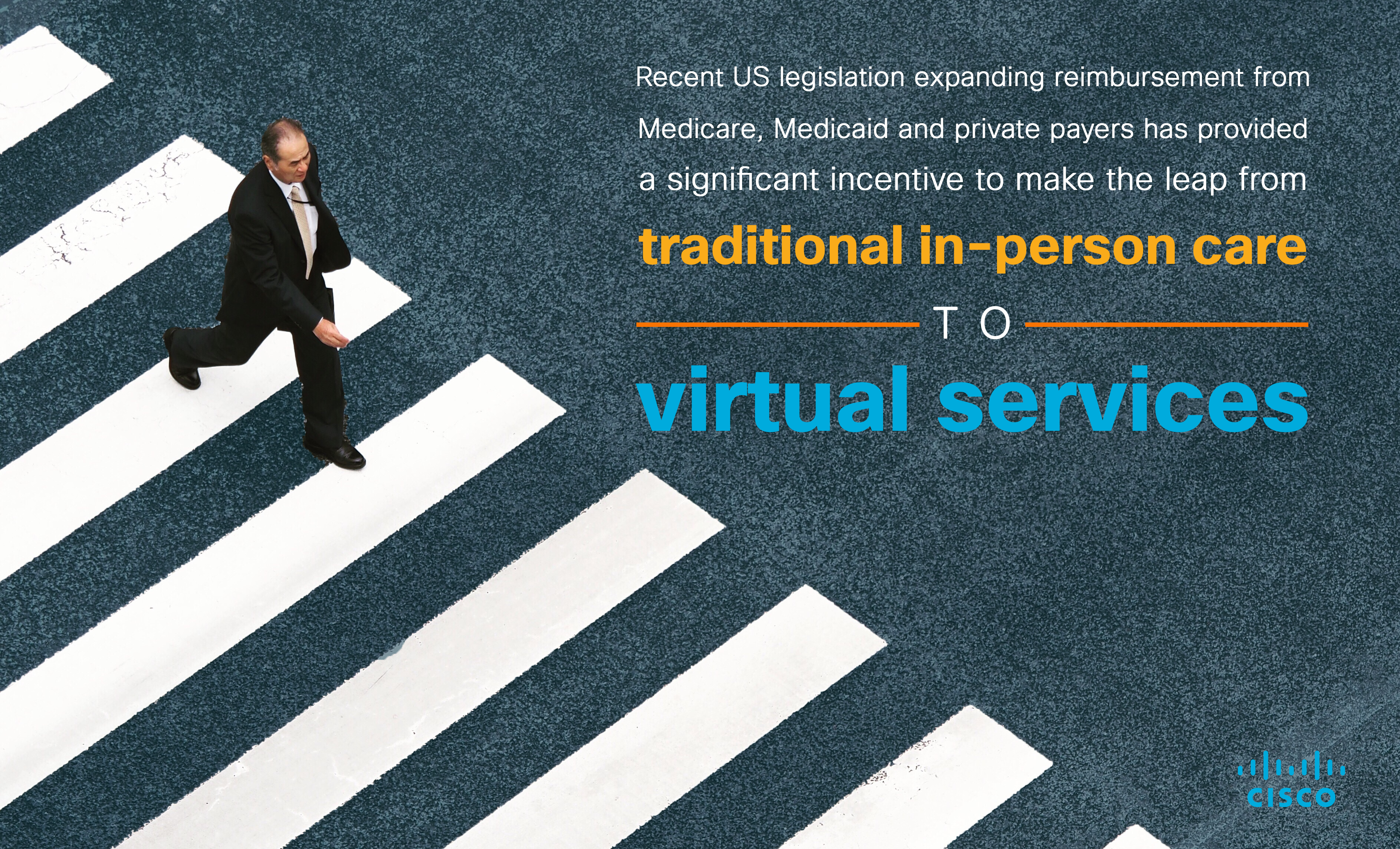
That being said, recent US legislation expanding reimbursement from Medicare, Medicaid, and private payers has provided a significant incentive to make the leap from traditional in-person care to virtual services. Medicaid reimbursement has soared of the past 2 years with every state offering some type of Medicaid reimbursement for telehealth. Many states have waived geographic limitations for reimbursement thus allowing sites like the patient’s home or schools to be considered eligible originating sites of telehealth services. In addition, 32 states plus D.C. have enacted parity laws for private insurers requiring these payers to reimburse telehealth services at the same rate as in-person care.

 Organizational culture and structure

In addition to properly aligned financial incentives, a health system’s culture and organizational structure is a key factor in ensuring the development of a successful and sustainable telehealth program. Many organizations start small and pilot a telehealth program in a single service line or only for a specific patient cohort. While this approach is typically successful in the short-term, it can lead to a siloed telehealth approach with multiple workflows and consumer-grade video communications spanning multiple areas of the organization. This often results in user experience issues associated with disconnected workflows, hampering utilization and adoption.

Progressive organizations are skilled at consolidating early, individual telehealth efforts into a single internal department enabling the integration, coordination and expansion of a unified telehealth vision across the broader health system. A key success factor is the investment in a telehealth solution that provides a vendor agnostic, integration framework that allows expansion of telehealth strategies by pulling together applications across multiple devices and enabling telehealth use cases from any location.

 An integrated solution

We’re excited to announce the release of Extended Care – a virtual video integration platform that enables scheduled consultations supporting provider to patient or provider to provider workflows and can also enable non-scheduled, on-demand video visits. This vendor-agnostic solution enables video integration with any relevant workflow offered by a third party solution thus offering endless opportunities to extend and expand quality care.

Cisco Extended Care leverages API frameworks and Dynamic Link capabilities to receive scheduled appointment data from the EMR or portal application’s telehealth workflow and then uses that to launch the virtual video experience. With capabilities like a native virtual waiting room, flexible redirect options for video endpoints, and running EMR client applications in a virtual desktop environment, Extended Care offers a natural and scalable experience for both patients and providers.

Stay tuned for two more installments in our Extending Care blog series, which focuses on telehealth, and learn more about Cisco Extended Care at cs.co/extendedcare.

Authors

Allison Heddon

Global Strategy Lead, Healthcare & Lifesciences

Digital Transformation Group

Avatar

Few years back, enterprise storage was primarily dependent on spinning disks built into stand-alone arrays. Then advent of flash storage changed everything in the storage industry landscape in terms of key performance factors. This includes flash storage arrays being able to transmit data at line rate, even for random reads, a behavior which is observed for the first time by many enterprises under production.

Server virtualization is another game-changer that is rapidly approaching maximum adoption thresholds within most enterprises. Server virtualization has also increased application density on the same physical HBA port, which has created new high-performance requirements for server-to–storage connectivity.

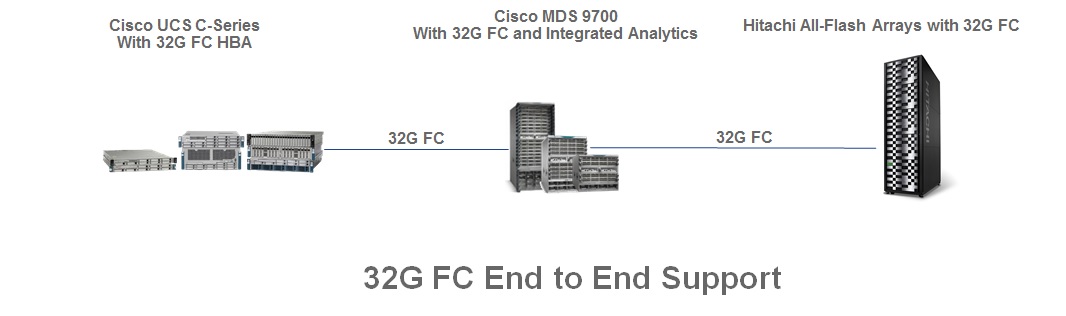
To meet these needs and accelerate ongoing digital transformation, Cisco and HDS recently introduced new hardware systems and software that enable customers to achieve end-to-end 32G Fibre Channel connectivity from server to network to storage.

Specifically, HDS innovations includes 32G support on VSP F-Series and VSP G Series along with other software enhancements, helping customers to respond quickly to new business needs, and to, scale without sacrificing performance. Cisco contributions included upgrades to its SAN portfolio in the form of the highest-density 32G directors in the industry today, offering advanced flash storage support, embedded analytics, and improved server-to-storage connectivity via the 32G HBAs for UCS C-series.

Why HDS + Cisco 32G FC Offering

Jointly, the Cisco and HDS 32G SAN solution sets new standards for storage networking, providing customers with choice as well as breakthrough levels of user experience and operational efficiency. This next-gen joint solution is the latest success from the decades-long HDS and Cisco partnership that has continually delivered state of-the-art innovations designed to accelerate the speed of innovation and deliver real-time high-performance storage solutions to customers.

Continue reading “Flash and Virtualization Give Customers More Reasons to Appreciate the Cisco/HDS Partnership”

Authors

Tony Antony

Marketing

Solutions

Avatar

We see the pattern all the time. An innovation launches a trend. The trend coins a phrase. The phrase becomes a top-of-mind topic, prompting lively boardroom discussions. Generally, everyone agrees why the topic is important, but the practical aspects—the what and the how—sometimes lack clarity.  The increasingly urgent buzz around digital transformation fits the pattern.

This is a very good thing for CIOs.

There is strong consensus as to why digital business is an imperative. You no doubt have plenty of examples from your personal life as well as professional life. My recent transportation to the airport comes to mind – think Uber versus standard cabs. I hired a small, local company that I had used many times before when visiting out-of-town relatives. I  didn’t expect anything beyond the basics. Yet this time, the service featured a digital experience prior to the van’s arrival that was radically different from—and vastly better—than the routine of the past. Real-time updates. Two-way communication. On time arrivals. Expectations set and met. No surprises. Even a driver with a sense of humor who joked about his “wrong turn that I probably saw!”

The digital business buzz reflects reality not hype. Profound changes are coursing through organizations and entire industries. Whether by way of your Amazon shopping or my hired car experience, it’s clear that the manner in which an organization addresses the what and how of digital transformation could determine whether it will live to see the buzzwords of 2020.

CIO’s Golden Opportunity

This presents CIOs with a golden opportunity to become the key enablers, arbiters, and architects of digital transformation.

The CIO has the ideal perspective and firsthand knowledge to make a business case for transformation. This position is uniquely equipped to guide a group of business leaders and technology experts that can lead the organization down the path toward digital business. The 2016 Harvey Nash / KPMG CIO Survey observed that CIOs are evolving into “transformational business leaders, technology strategists and business model innovators.” They are excelling by using their knowledge and skills in new, creative, imaginative ways.

This evolution entails the CIO collaborating closely with line-of-business (LoB) leaders seeking to change their business processes to generate improved—or entirely new—business outcomes. The key is to establish a digital-ready infrastructure that enables digital business innovation. The first step is to cultivate a single conversation between business and IT, establishing clear points where the priorities of business and IT converge.

Six Key Considerations

I encourage you to review Cisco’s new e-book, CIO-Driven Transformation, that helps CIOs consider the what and the how of digital transformation. Ideal for time-pressed CIOs, the eBook covers:

  • What digital transformation actually is—and what it means for business
  • Why digital transformation presents an important opportunity for CIOs
  • How to start—and continue—a successful digital transformation journey

The “how” discussion delves into six key considerations that underpin successful digital transformation in virtually any organization.

  1. Facilitate new business models.
  2. Simplify everything; deliver IT as a service.
  3. Build modular IT and automate.
  4. Deliver data that informs business decisions.
  5. Adopt continuous delivery.
  6. Embed security everywhere.

Download the e-book “CIO-Driven Transformation” to spark your thinking. Your golden opportunity awaits.

Authors

Nada MacKinney

Marketing Mgr, Digital Transformation

Enterprise Solutions Marketing

Avatar

Many of you are already working in multicloud environments – a combination of public and private clouds (i.e., AWS, Azure, Google, and on-premise IT). In fact, IDC found that 84% of IT executives surveyed expect to use multiple clouds from multiple cloud providers. Organizations are pursuing multicloud for a variety of reasons including increasing revenue, reducing costs, decreasing time to market, or simplifying IT infrastructure. While a mulitcloud approach can deliver tremendous benefits, it can also create complexity, exposing a gap between the business need for digitization and what IT can reliably and confidently support.

This growing complexity has less to do with the value of the individual services and more to do with how to efficiently and effectively manage, secure, deliver, and gain insights across all the cloud services you use. However, there is little to no connective tissue between these vendor-specific clouds; each having their own tools, APIs, configuration requirements, SLAs, analytics, and more. Taking this complexity into account will be critical to connecting the dots when it comes to your cloud strategy and doing more with cloud.

Here are a few questions to ask yourself as you refine your cloud strategy for the complexities of multicloud:

  • How will you manage these different cloud providers? Managing multiple cloud, SaaS, hosting, network and colocation vendors can be complex and require IT time, resources, and tools to juggle and correlate the multiple infrastructure options. The ability to manage the span of applications, clouds, and users regardless of where they reside will be critical. Do you have the right solutions and infrastructure to manage and maintain these multiple clouds?
  • How will you make sure your users, data, and applications are secure? You want the ability to apply security capabilities in an integrated fashion. A security strategy with lots of seams that are different for every vendor, is not really a best practice. If data and users are now dispersed among multiple cloud providers and services, it is extremely difficult to enforce a strict, uniform security policy everywhere. The ability to secure users, data, and applications everywhere is essential to a successful multicloud strategy.
  • How will you balance what’s on and off prem? Customers tell us they want a common framework that ideally mirrors on and off prem. They don’t really want to have multiple ways of connecting to each of their different cloud providers. Organizations must strike the right balance between control and innovation across their on- and off-premises environments and multiple clouds from various providers. You’ll need ways to securely connect public cloud workloads to your own data centers or to users on prem.

The complexity gap is not going away; it will continue to grow. Making sure your cloud strategy is designed for a multicloud world will help you capitalize on the ever-growing business and digital requirements transformation impacting every industry. What are you doing to address the complexities of multicloud?

For more information:

Authors

Kip Compton

No longer with Cisco

Avatar

“FCC Chairman Ajit Pai today laid out his vision for revising net neutrality policy.  The proposal will review what is needed to protect consumers and prevent anti-competitive behavior, while rolling back Title II reclassification, which has inhibited investment.

The balanced approach Commissioner Pai unveiled will encourage new investments in broadband networks and speed the development of innovative services, including Internet of Things technologies, telemedicine, distance learning, emergency services, and mobile 5G.

The Internet ecosystem continues to evolve at an unprecedented pace, creating significant opportunities for Americans.  It is our hope that this new vision will be the first step in creating sustainable light touch regulation for the Internet once and for all.”

Authors

Jeff Campbell

Senior Vice President & Chief Government Strategy Officer

Government Affairs and Public Policy

Avatar

Reuven Cohen works for Aporeto—a company that delivers comprehensive security for cloud native apps, containers, and microservices. But that is probably the least interesting thing about him, and to his credit, he didn’t actually pitch the company’s products at all during our interview with him on Monday. What he did do is rock our collective worlds with an explanation of how artificial intelligence is already impacting our lives, and speculation as to how it may in the future. Oh, you think you know your AI, and you know how it’s already showing up, but I can guarantee that Reuven and Niki brought up things you’ve never thought about before. Like how it’s seeping into the creative realm, where music and art are now being created by bots. How it’s influencing politics. And how it may very well create an existential crisis for our kids.

On the upside he explains how he already uses AI every day to help make decisions about everything from how to invest to what he should say to Niki during this very interview.

If that’s not enough, he also gives us the inside scoop on what went down between him and the organizers at DockerCon last week, and he touches on:

  • Why it makes sense to embrace containers and serverless architectures
  • Which companies are doing containers right
  • Why NFV hasn’t caught on as quickly as it might have
  • What he means by “apathy as a weapon”
  • Whether legacy investments are a legitimate reason to avoid change

See the video podcast on our YouTube page, or listen to the audio version on SoundCloud. And if you like what you hear, we invite you to subscribe to our channel so you don’t miss any of the other exciting podcasts we have scheduled over the next several months.

Authors

Ali Amagasu

Marketing Communications Manager

Avatar

Digital transformation starts with people and an organizational culture that’s aligned toward a unified vision of business transformation. Creating a more virtual, collaborative, flexible, and productive workforce is very important to become a digital business. If you are going to attract and retain the best people, you need to create a work environment that empowers them to feel engaged, productive, satisfied, and valued in an increasingly digital, global, and mobile workforce.

Workforce transformation is needed to:

  • Drive productivity and engagement
  • Attract and retain talent
  • Optimize Real Estate portfolio

Cisco has 80,620 employees and 23 million sq. ft. of real estate in 94 countries. Cisco is making its workforce more digital and transforming the way its employees work by implementing the following:

  • Connected Workplace: Activity based neighborhood environments that provide choices of different space types to support variation in worker needs, socialization and down time.
  • Collaboration Technology Integration: Ubiquitous wireless, choice in video endpoint devices, Extension Mobility to provide free movement through space with the right device in the right space.
  • IoT and Experience Applications: Applications like Visitor Management Systems, Digital Signage, Occupancy Sensing and PoE lighting help to enhance the employee experience and make them more productive.
  • Workplace Resources Organization: Cisco has strong workforce organizations that look after the site strategy and operations. Strong brand alignment is there with HR. Strategic Planning and Portfolio Optimization is done to optimize real estate portfolio.

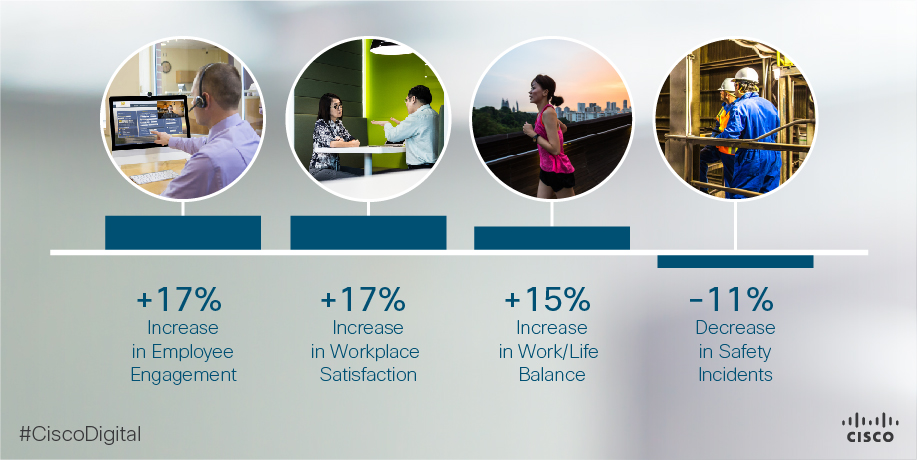
In the last 5 years, Cisco’s workforce has increased by 20% but the real estate portfolio has decreased by 30% due to optimization. It has closed 239 buildings generating $294 Million in sales and saved $196M in OPEX. During these years employee engagement has increased by 17%, work/life balance has improved by 15% and safety incidents have decreased by 11%. Cisco has achieved much on its workforce transformation and is continuing to build new capabilities every day. We’re ready to apply the lessons we have learned to help you transform your workforce. Learn more at www.cisco.com/go/digital.


Authors

Aditya Mohta

Sr. Manager, Solutions Marketing - Full-Stack Observability

Strategy, Incubation and Applications Group