Avatar

We are very excited to share that Contiv is now officially integrated with OpenShift Origin, and OpenShift Container Platform 3.5. Contiv is also joining the OpenShift Primed Program, a technical readiness designation by Red Hat that recognizes Contiv’s integration with OpenShift technology.

This integration brings the production-grade container networking and policy features to OpenShift via a simple, 1-step set-up which is tightly integrated with OpenShift installer. You can now seamlessly start using OpenShift with Contiv as the container networking fabric.

OpenShift is a comprehensive container management platform built on Docker and Kubernetes. OpenShift is built on open technologies, and so is Contiv, a 100% open source container networking fabric initiated by Cisco.

Enterprises are rapidly adopting containers to accelerate development and delivery of applications while gaining datacenter efficiencies. Containers provide greater portability benefits to develop highly resilient and scalable modern cloud applications.

According to a study done by Bain & Co., enterprises adopting containers frequently report 15-30% reduction in development time as well as 5-15% cost savings due to higher density deployments and better resource utilization. Bain makes a strong case that traditional enterprises (not digital-native) which are furthest on their journey to digitally transform themselves are using containers as an integral part of their technology strategy.

Challenges remain in widely adopting containers in the production environment. According to the latest survey done by Cloud Native Computing Foundation (CNCF), most respondents cited networking as the biggest roadblock to deploying containers in production.

Contiv team is collaborating with others in the container community to provide the most comprehensive and unified networking fabric. Last month, Docker announced that it had certified Contiv as the Docker Certified Networking Plugin for Docker Enterprise Edition. We also announced the expansion of Cisco Services to include Container Networking advise, implement and optimize services to help our customers accelerate container adoption with confidence.
Today, we are happy to report that Contiv is now OpenShift Primed Certified signifying the first steps that Contiv team is taking to integrate with OpenShift.

Why OpenShift + Contiv:

Multiple Networking Modes

By default, OpenShift installs with OpenShift SDN, an overlay networking approach for connecting Docker containers in an OpenShift cluster. For certain use cases, overlay networking is easier to set up or even necessary if containers are deployed in a hybrid cloud or cross data-center scenarios or for the simplicity it provides in dev/test scenarios.

Often, for on-premises, production deployments it will be beneficial to avoid the extra layer of encapsulation overhead for performance reasons as well as additional processing overhead at compute nodes.

Contiv offers flexibility and choice by supporting multiple networking backends including Layer 2. This mode gives you superior performance by avoiding encapsulation and gives you complete container traffic visibility at ToR or aggregation switches enabling you to leverage the existing traffic monitoring and network troubleshooting tools and processes.

Policy-Based Automation

Scale and speed requirements for containerized workloads are unique and policy-based automation is the key. With Contiv, cloud architects, and IT admin teams can create, manage and consistently enforce operational policies such as multi-tenant traffic isolation, micro-segmentation, bandwidth prioritization, and policies for L4-L7 network services. Contiv’s policy model enables portability, so it doesn’t matter whether developers are experimenting with containers on their laptops or deploying applications in production across hundreds of nodes, there can be one shared and consistent view of operational policies, accelerating DevOps practices.

Hot to get started:

Follow the simple steps to get Contiv goodness in your OpenShift clusters using upstream OpenShift repository and Ansible playbooks.

> git clone https://github.com/openshift/openshift-ansible.git

Since Contiv is now integrated with OpenShift, you also get Contiv along with OpenShift. Edit the inventory file to match your cluster information

openshift_use_openshift_sdn=false
openshift_use_contiv=true
os_sdn_network_plugin='cni'

netplugin_interface=net3
netmaster_interface=net1
contiv_default_subnet="29.70.0.0/24"
contiv_default_gw="29.70.0.1"
contiv_default_network_tag="2070"

Now run the Ansible playbook and your OpenShift cluster will be set up with Contiv as the networking fabric. To use a Contiv network in your application, add a label to your application yaml file before creating OpenShift Deployment object.

labels:
      app: my-web-app
      io.contiv.network: contiv_web_net

> oc create -f k8s_apps/my-web-app/my-web-app-deployment.yaml

That’s it! Now, all the networking and security policies that you or your DevOps team has created for your web-tier are available for your application. For a complete reference on how to create and manage Contiv policies, please refer our step-by-step tutorial.

Meet Contiv at Red Hat Summit in Boston

This week, Contiv team will be at full strength in Boston at Red Hat Summit to showcase to our customers how Contiv meets even the most demanding networking requirements for their containerized workloads and to collaborate with OpenShift community.

We have planned an action-packed agenda for you at the summit. Join Contiv team at Cisco booth 404: Rohit Agarwalla, Sanjeev Rampal and I will be presenting Contiv sessions, and we will be there to answer any question or to help you get started with Contiv.

Contiv: A Policy-Based Container Networking Fabric for OpenShift

Tuesday, May 2 10:30 AM and 5:00 PM

Wednesday, May 4:00 PM and 6:00 PM

Don’t forget to join a power-packed panel, moderated by Niki Accosta with Kiran Kamity, Sr. Director, Engineering, Cisco on May 3, 2017, 11:30 a.m. room 105 to learn how Contiv is enabling organizations just like yours to adopt containers with confidence.

Follow @projectcontiv and @ciscocloud to get the live updates from the conference. We look forward to seeing you at the Red Hat Summit!

Learn More:

  • Get started with Contiv using guided hands-on tutorials
  • Read more on OpenShift Origin and OpenShift Container Platform 3.5 integration

Authors

Amit Sharma

Product Marketing Manager

Avatar

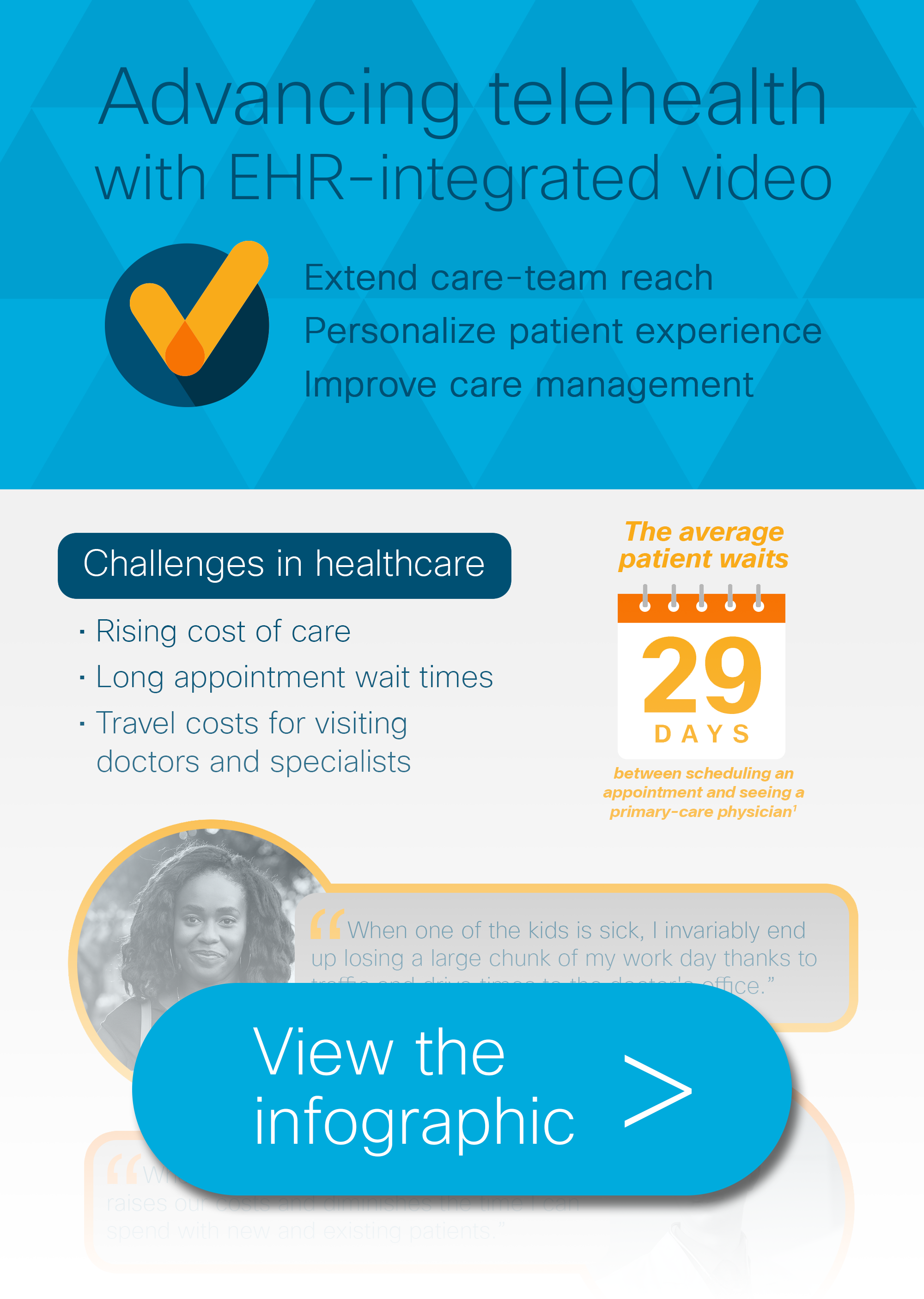
Welcome to the second installment of the Extending Care blog series, a discussion of what’s possible in telehealth.

When care isn’t constrained by physical boundaries, a world of opportunities opens up. Healthcare providers are now turning to video communications to help close gaps in patient care and management. Both patients and providers can save time and money by avoiding transportation costs and appointment wait times. High quality care is no longer just possible for those who live close to leading medical centers or clinics. With telehealth, both patients and providers reap the benefits.

Check out the infographic below to learn more about opportunities and challenges with telehealth, and how Cisco’s Extended Care stands apart from the crowd.

Stay tuned for the third and final installment in our Extending Care blog series, and visit cs.co/extendedcare for more information on our telehealth solution.

Authors

Barbara Casey

Senior Executive Director, Healthcare

Americas Business Transformation

Avatar

Teachers, we appreciate all you do. During Teacher Appreciation Week—and every week—we thank you for inspiring our children to excel.

As a parent of two sons in public school, I have seen first-hand how great teachers can motivate children and enable their success. I know that today’s teachers must mindfully impart the skills students need to thrive in an ever-changing world. And I recognize that the best teachers are exemplary listeners, perceiving their students’ needs and personalizing the learning experience to inspire engagement, passion, and curiosity in the classroom.

While there are so many things we appreciate when it comes to teachers, here are just a few examples of where you shine:

  • Supporting and adapting to the needs of your students: You serve as role model and guide, always listening and thinking about ways each student can thrive and be their best.
  • Being open to new ideas: Whether it’s bringing a device into the classroom or trying new assessment tools, you bravely embrace the challenge. You are clever, creative, and ready and willing to do what it takes for your students’ success.
  • Constantly exploring, innovating, and inspiring: You are responsible for the achievements of your students, ensuring they learn in a meaningful way. We know a teacher’s work is never done, and we applaud you for being agile, challenging your boundaries to empower your students to reach new heights.

From the Cisco family to all teachers around the world, please accept our heartfelt “Thank you!”

Authors

Lyanne Paustenbach

No Longer with Cisco

Avatar

You’ve heard us talk about it for months!

#DevNetCreate: Cisco’s first developer conference, where applications meet…

Applications have met a variety of challenges and ideas.
We’ve collected our favorites here: blog.devnetcreate.io


Susie Wee and Team DevNet DevNet Create

Now, we invite YOU to join the conversation!  Team #DevNet will be available to answer your questions about our inaugural developer conference.

Tune in on May 10, at 10:00 a.m. California time.  Find us on Twitter, following the hashtag #CiscoChat.

For those of you wondering about the iconic DevNet Zone at Cisco Live, worry not: it still lives!
DevNet Create is a whole new… creation.

Will you join us?


Authors

Silvia Karina Spiva

No Longer at Cisco

Avatar

UTC’s annual conference speeds into the home of NASCAR to highlight telecommunications in the Utilities industry. This highly anticipated event offers the opportunity for thousands of information and communications technology (ICT) professionals and technology partners to network and learn how experts from around the globe are modernizing their utilities.

Conference-goers will have the chance to attend pre-conference training, workshops, round-tables, summits, and three days of education covering all aspects of the ICT industry. At the center of this event, over 200 industry-leading companies like Cisco will be showing their latest technology at work.

Among many different speakers and education tracks, Cisco’s security expert Edna Conway will examine and discuss the next generation of Supply Chain Risk. Edna serves as Cisco’s Chief Security Officer for its Global Value Chain and oversees the deployment of Cisco’s strategy to assess, monitor, and continuously improve the security of its global third party ecosystem.

Also speaking from Cisco will be Jared Carter, Industry Advisor of Digital Utilities. Jared works with our Internet of Things group, and he will be discussing how Utilities can lead the way with Data Analytics, applying solutions to address their most important business challenges. These Line of Business solutions focus on operational systems and often relate directly to system reliability, adoption of next-generation capabilities, and lower system operating costs.

In between sessions come to the exhibit hall to visit the Cisco in booth #715. At our booth we will demonstrate the latest in telecommunications tech, including our robust line of MPLS-capable devices. Worldwide electric utilities are increasingly planning for a future based on smart grid applications requiring advanced telecommunications systems. MPLS positions utilities to support diverse legacy systems as well as modernizing for next-generation applications.

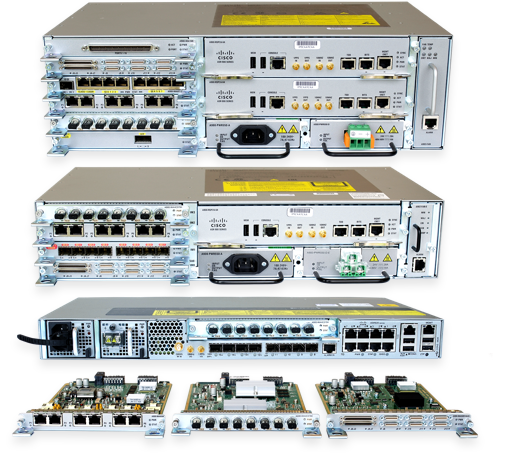
Launching in our booth this year will be the latest release of our popular ASR 900 series routers. The ASR 900 router offers cost-effective migration from legacy SONET/SDH/TDM to a converged IP/MPLS multi-service communications infrastructure.  The ASR 900 offers scalability with 10GE and 1GE interfaces across multiple typologies, combined with high availability and an intuitive, easy-to-use network management interface.

We will also be demonstrating our state-of-the industry substation and distribution network functionality, along with Cisco’s robust security capabilities, designed to keep the network locked down from outside interference. Additionally, as cities become more integrated with services and connected infrastructure, you’ll see how Cisco transforms the deployment of IoT devices with a unified network management system known as the Field Network Director in Cisco. You will discover how FND can connect a city’s smart lighting system for efficient power management and reliable service communications.

Charlotte offers much to see and do in the off-hours from visiting the NASCAR Hall of Fame just adjacent to the convention center, seeing the actual “Miracle on the Hudson” aircraft at the Carolinas Aviation Museum, or just a walking or pub crawling through Charlotte’s tree-lined streets.

Come visit us next week!  Or see us virtually here.

Authors

Jon Judson

Marketing Manager

Industry Marketing

Avatar

Over the past several years, an immense transition has taken place as networks have become more diverse and complex. Companies large and small have many branch sites – users at the edge that need to connect securely and quickly to the network and the cloud. Software-defined wide area networking (SD-WAN) technologies are enabling customers to tackle this transition efficiently and effectively. Today, Cisco announced the intent to acquire Viptela Inc., to help customers connect and manage multiple branches, while lowering WAN costs and improving security.

Cisco has been providing SD-WAN technology and services to customers for several years; the Cisco IWAN solution delivers an on-premises SD-WAN solution for customers needing advanced routing features and other advanced network services, and Cisco Meraki provides a cloud-based solution for customers needing maximum simplicity and unified threat management functionality in their SD-WAN solution. Acquiring Viptela will enable us to expand our portfolio, with increased functionality delivered through the cloud.

Since 2012, Viptela has been developing solutions to help customers anticipate and manage branch connectivity across their networks. Their cloud-first approach to SD-WAN includes cloud orchestration and management of branch networks, as well as overlay technologies. Customers can centrally manage the WAN with a real-time dashboard view to monitor the health of their network and improve connectivity.

With Viptela, Cisco can offer customers more choice in their enterprise branch offices and WAN deployments, with a compelling SD-WAN solution that is easy to deploy and simple to manage. Together, Cisco and Viptela will be able to deliver next generation SD-WAN solutions to best serve all size and scale of customer needs, while accelerating Cisco’s transition to a recurring, software-based business model. Viptela will join the Enterprise Routing team within Cisco’s Networking and Security Group led by Senior Vice President and General Manager David Goeckeler.

Authors

Rob Salvagno

Vice President

Corporate Development and Cisco Investments

Avatar

Want to watch cartoons? VEM Sistemi’s customers do. When this Italian partner had Cisco marketing dollars, they created some animated videos for their digital marketing strategy. These focused on a character named Elliot (Ell-IoT – see what they did there?).

Engagement shot up. Millions of views. Hundreds of thousands of downloads. Bookings of IoT solutions increased.

How did they do it? Watch the making of Elliot.

VEM Sistemi says…

Selling IT is a competitive business. Unless you have something that sets you apart, it’s easy to get lost in the noise. We wanted show customers a future where things, data, processes, and people are interconnected. To allow them to experience digital transformation.

Marketing at VEM is going digital –  real-time and social communication. To do that and explain a complex subject like IoT, we had to find a way that was exciting but also immediate and simple, like a cartoon.

A single video wouldn’t work. So, we designed a miniseries that shows the advantages of IoT -both in work and in private life – making fun of the lack of technology with a fun character. We named him Elliot (Ell-IoT).

We watch him in two worlds. First, the present day: technology works okay, but not great. And then hyper-connected, showing how the solutions we build using Cisco make Elliot’s life better.

The videos have been a great success, thanks to the supporting social campaign. Not only does this position us as an IoT systems integrator and trusted advisor, but it’s increased the sales of our IoT projects.

Thanks, VEM Sistemi! And congratulations on your Marketing Velocity Award at last Partner Summit.

Want to see Elliot in action? Check out his IoT Stories.

Need to jump start your own digital marketing? Learn how to market like you mean it with ENGAGE.

Authors

Julie Colwell

Marketing Manager

Global Partner Marketing

Avatar

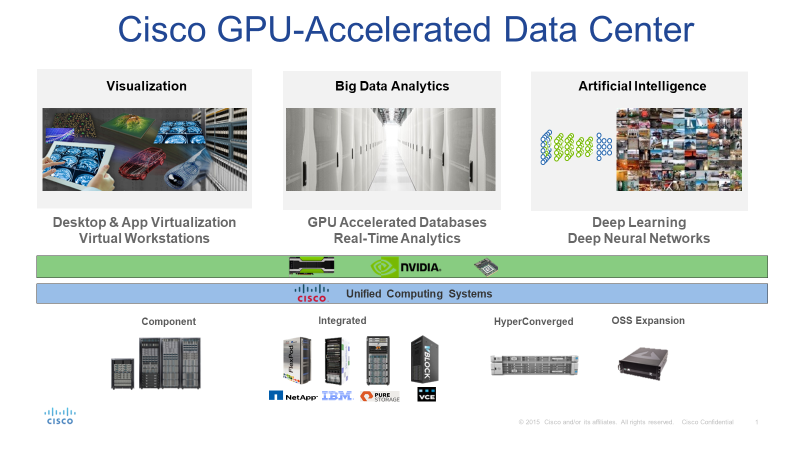
NVIDIA GPU Technology Conference, aka GTC, is around the corner and it is a good time to reflect on the rise of GPUs in the data center and what they make possible.

When I first attended GTC four years ago, machine learning and deep learning were barely on anybody’s radar outside academic circles and research lab; today these technologies are effectively deployed in many industries from healthcare, to banking, to autonomous vehicles and many more.

Four years ago, at our first GTC, Cisco had just a tabletop with black drapes and a PowerPoint presentation on a laptop. This year, we are a platinum sponsor showcasing our GPU-accelerated data center solution.

One pillar of the Cisco GPU-accelerated data center is support for virtual workstations running on Cisco UCS and Cisco HyperFlex systems. With support for the NVIDIA M6 Tesla card on our UCS blade servers, and M60 & M10 cards in our UCS rack servers and HyperFlex hyperconverged nodes, Cisco can deliver the infrastructure needed to run the most demanding graphics applications on virtualized workstations, effectively untethering engineers from their desks.


CannonDesign, an architectural and engineering firm, has successfully deployed NVIDIA M6 GPU in Cisco UCS blade servers to deliver virtual desktops to run their graphics-intensive applications. Catch their GTC session for more details. Mayfran International, a manufacturing company, is using Cisco hyperconverged system, HyperFlex, and NVIDIA GRID to speed up the design of its conveyor belts. By having their Autodesk Inventor files located in the data center next to their virtual desktops, they are able to load these files in about 4 minutes instead of 20.

The combination of Cisco UCS Integrated Infrastructure for big data and analytics with NVIDIA K80 or P100 cards provides the robust infrastructure needed to run real-time analytics. See Cisco and NVIDIA solution with Kinetica here.

Cisco is also working with deep learning and machine learning in our IoT practice.

Stop by our booth #311 and see for yourself. We will be demonstrating how the right infrastructure can support your virtual workstations as well as your Windows 10 virtual desktops. We will also show an application of deep learning/machine learning for IoT, with a spatial predictive analytics demo where we will analyze and count crowds in a live setting.

We will also be introducing our Cisco Spark Board for team collaboration, powered by NVIDIA Jetson TX1. Read the NVIDIA blog on Cisco’s use of the Jetson platform in the Spark Board.

Finally, you won’t want to miss Hugo Latapie’s session, The Future of IoT and intelligent Applications, on Thursday at 2:00 PM, when he will discuss Cisco’s foray into deep learning and machine learning and talk about the new capabilities and use cases Cisco is targeting with this breakthrough technology.

So stop by Cisco booth 311 and catch a demo with one or our engineers. Hope to see you in person at GTC.


Authors

Francoise Rees

Marketing Manager

Customer Solution Marketing, Cisco Intersight

Avatar

Network programmability is such a generic term, like SDN and the whole Software Defined X paradigm, that it means different things to different people. Not so long ago network programmability was synonymous with Openflow but as time passed and pragmatism kicked in, the industry settled around a common view. Driven by real benefits like time and cost savings, reduction of human error, customization and innovation, network programmability is currently understood as a set of tools and best practices to deploy, manage and troubleshoot network devices.

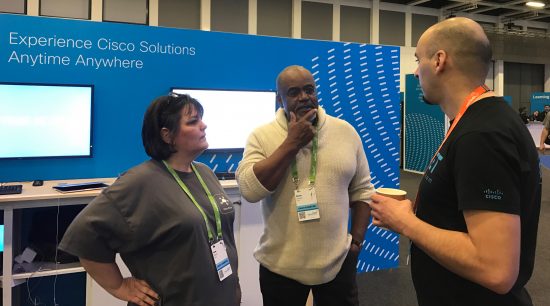
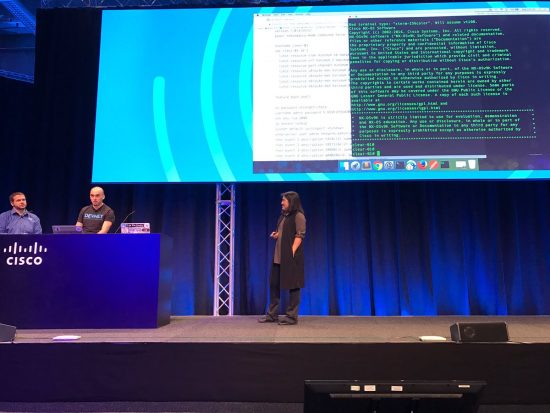
Agreement on Network Programmability Cisco DevNet dCloud Anne Robotti Steve Dickson Adrian Iliesiu

Designing the flexible network 

The times when we could configure and manage one device at a time are going away. In a dynamic DevOps world when entire testing and development environments are built and destroyed within minutes, we expect the network to keep up and be just as flexible. This means that we have to look at the way we’ve done networking so far from a different angle. When a new VLAN needs to be added to our infrastructure, or a new application requires a set of QoS parameters to be applied end to end in the environment, we need to be capable of performing these changes safely and within minutes.

Networking vendors have seen this challenge and are at different phases of adopting and implementing solutions for it. The common solution across the industry seems to be revolving around providing application programming interfaces (APIs), sample code, and reliable software development kits (SDKs). Besides the good old Command Line Interface (CLI) that has faithfully served us for so many years, vendors are now exposing APIs with their products. Repetitive tasks in an environment that provides programming interfaces leads organically to network programmability and automation.

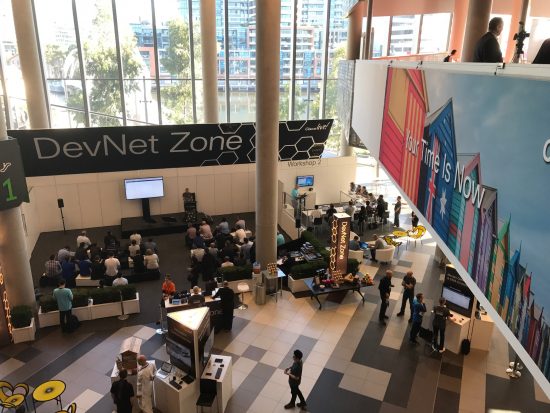
Designing the flexible network at Cisco Live Melbourne DevNet Patrick Riel and Kareem Iskander

Pushing the boundaries of automation

Network programmability and automation is not new. Engineers have tried to simplify their work since the first ARPANET in the late 60s. From screen scraping, to bash and Expect scripts, the pain has been real. What is new is that we have reached a point in which the scale of our networks, the agile nature and dynamic requirements of our network infrastructure cannot be realistically configured and managed one device at a time. It is now time to start interacting with the APIs, use them to automate most of the mundane and repetitive tasks that used to take so much time to get done, and manage as many network devices as possible with a few scripts. As an industry we learn from our mistakes and always try to improve and push the boundaries.

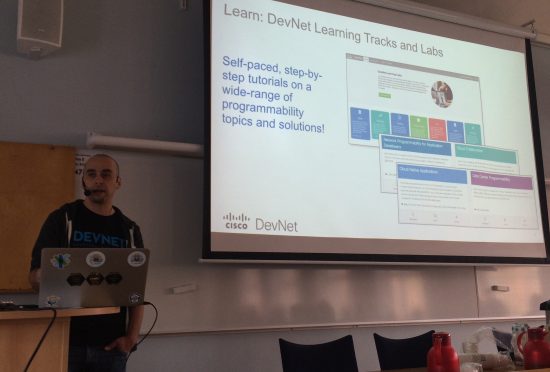
DevNet Zone training Cisco engineers NetAcad instructors Developers


Your time is now 

So, what does all of this mean for us who have been in the industry for a while, or for new students looking to improve their knowledge and trying to get a job in networking? Is this the end of world as we know it? Hardly. Networking has been constantly changing and evolving, much like programming. Although you still see requirements for Fortran or Cobol developers, mostly for maintaining very old legacy applications (I am sure somewhere out there there’s still a network running on 10Base5), the vast majority of the world has long changed and evolved, in most cases for the better. If you follow the Cisco certification program and the NetAcad community, you can see the same change patterns. All the certification tracks have been in a constant evolution process based on new technologies, new requirements from the job market and feedback received from the students. This time is no different. The difference is that now the network has become even more critical, and the requirement for highly skilled network engineers will only increase. The network has become a business differentiator and the more agile and dynamic your infrastructure is, the quicker you can develop and bring those applications into production.

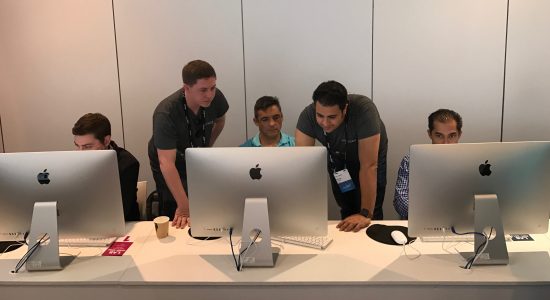
Cisco Live Europe Developer Demo Hank Adrian Susie

Training and retraining 

Networking students: I recommend that you keep an open mind!  Know that you will have to constantly learn and be interested in new technologies. If you enjoy this and are passionate about it, you are in for an amazing journey.

Networking veterans (me included): I tell you, this is no different that what you’ve done so far. Remember when you had to learn about ATM and Frame Relay, and then MPLS, L3VPNs, LISP and OTV? We all have to learn now about data formats, APIs, mostly REST hopefully, parsing and manipulating data programmatically in a way that makes your life easier.

Based on the maturity of the language, the amount of libraries and support, as well as ease to learn, the general consensus is that Python is the best fit at the moment to tackle the challenge of network programmability. As network, DevOps or systems engineers we need to be able to talk to developers in their own language and be able to understand their problems.

Adrian Iliesiu Cisco DevNet NetAcad Instructor Engineer Developer Training

Following the server virtualization and hypervisor revolution at the end of the 90s and more recently the move to the cloud and the whole DevOps style of management, it is now time for the network to become more agile and accommodating to the requirements of the applications. There’s no better place currently for massive innovation than the network. The network sees and hears everything that moves through it! From more intelligent WAN routing with solutions like Cisco iWAN, to embedded security in which the network acts as a dynamic sensor and policy enforcer, to traffic anomalies detection and instant analytics, with products such as Cisco Tetration, there’s more and more intelligence being moved to the network layer.

I would like to invite you to join me on this trip as we start exploring network programmability in more depth. All questions, beginner and advanced, are appreciated. Add them below, or find me on Twitter @aidevnet.

And remember… the only constant is change.


Authors

Adrian Iliesiu

Principal Engineer

Cisco DevNet