Avatar

I like to think that I am pretty passionate about technology. And I like to work with others who share my passion. So when I hear about a group of 150 engineers working 24-hours straight in a race to make our products better…that gets my attention.

On April 26 & 27, our Infinite Video Platform (IVP) teams across the globe joined in our first Infinite Video Platforms Labs Hackathon. But this Hackathon was different than most – we invited our customers to take part, not just as judges, but as collaborators, critics, and colleagues.

Focus: Customer

The hackathon was not a stunt. It is about transforming our relationship with customers, building trust, and changing the way we do business. As we have migrated from an appliance waterfall organization to a cloud dev/ops continuous integration, continuous deployment organization, it is more important than ever that we engage our customers as much as possible in co-innovation.

So when we offered our customers a chance to step behind the scenes with us, meet with each other to discuss their needs, and tell us how they think IVP could evolve to better meet their needs… they jumped at the chance.

Idea: IVP Labs

The idea for this hackathon began in January of this year, at the Consumer Electronics Show, where we first unveiled Cisco’s IVP Labs. More than just a test kitchen for our products, the IVP Labs are designed to enable all of our Infinite Video Customers worldwide to participate in the innovation process and help us redefine the future of the consumer video experience.
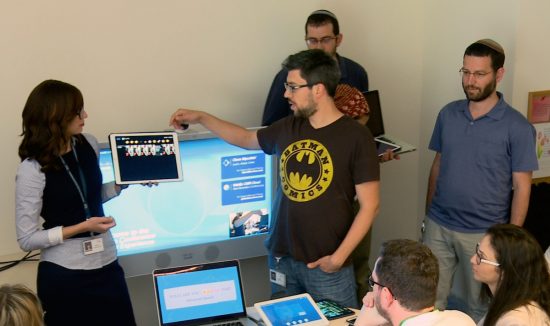
Which, of course, leads us to the very first IVP Labs Hackathon.  We were honored to have representatives from three of our valued customers who brought specific challenges to the 144 participating engineers.

Over 24 hours and four locations around the world, our engineering teams…who tend to be competitive…hacked at IVP in a race to find the best outcomes for our customers. In the end, each customer selected a winning feature that best met their solutions.

With 22 new features prototyped, our customer quickly realized that selecting one feature over another was a challenging task… They eventually managed to select winning hacks that focused on Content Discovery and Music Content, allowing subscribers to get recommendations from friends, searching based on the consumer’s mood, and identifying soundtracks from movies or series.

Most of those 22 features reflected what really is a challenge for our Service Provider customers: how to improve content discovery in video services that typically offer thousands of content assets.

IVP Labs Hackathon 2.0
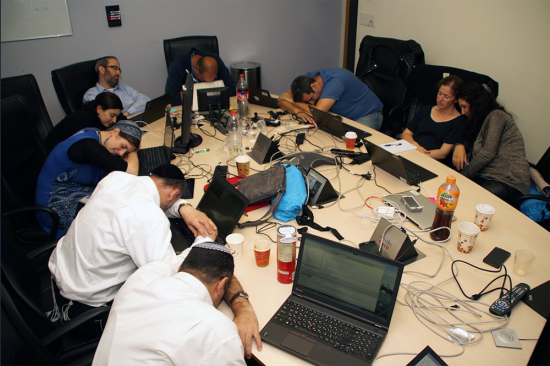
Our next step is to move the winning ideas into the development pipeline, where they will be tested in our IVP labs in partnership with our customers. Features will then be prioritized based on user data and feedback and folded into the IVP roadmap process.

We are already planning our next hackathon for later this summer, complete with another team of great customers, and 24 hours without sleep for a good cause: Making IVP the best video platform in the industry.

Authors

Conrad Clemson

Senior Vice President, SP Platforms & Applications

Service Provider Platforms & Applications

Avatar

Proliferation of mobile devices, cloud moving enterprises and data hungry applications are creating the need for the next generation of enterprise campus infrastructure. Cisco is always ahead of the curve when it comes to providing all these capabilities way before the competition. Cisco Digital Network Architecture (DNA) offers the scalability, resiliency and ease of operation without compromising the security.

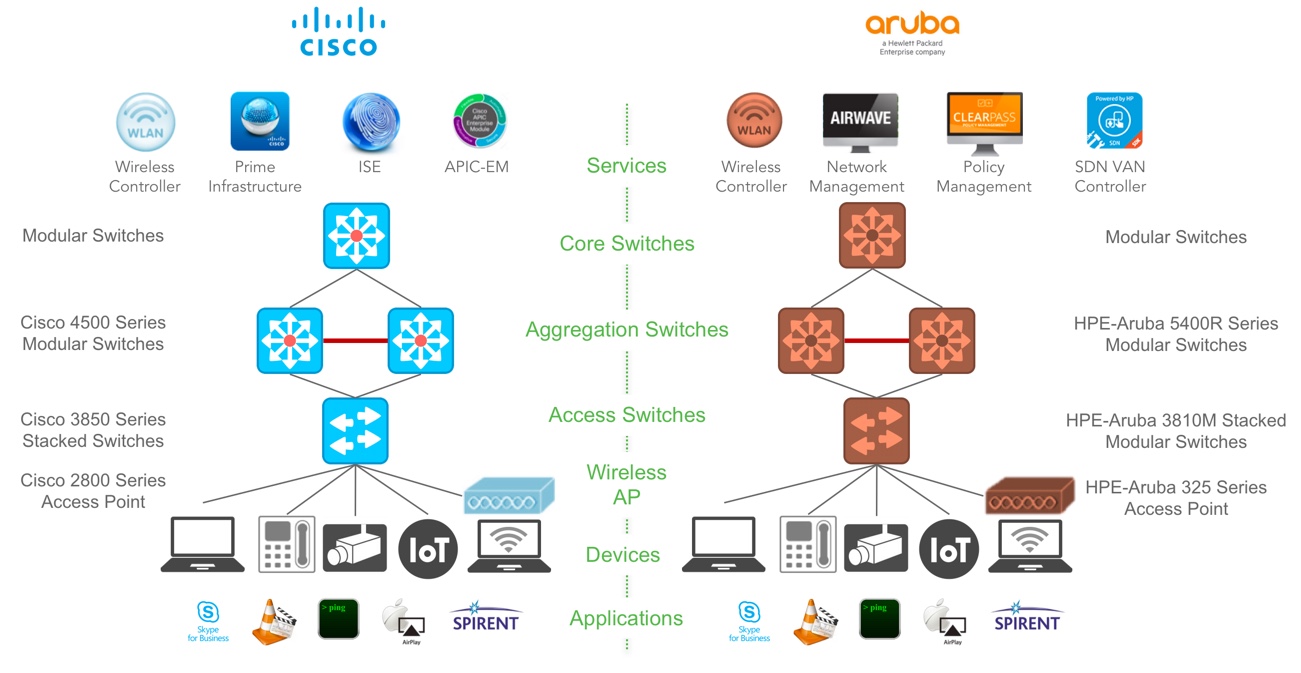
To build the future-proof networks with high-level applications and services, you need a strong underlying network foundation. Resilient underlay infrastructure is an absolute necessity to provide a robust networking pipeline. Cisco believes in high availability at every level of your enterprise architecture and provides these resiliency options at every level of your underlying switching infrastructure. Numerous access switches, aggregation switches and core switches form the foundation of your network infrastructure. This is where most of your network’s arteries converge and go through the core and aggregation switches.

To achieve the highest level of resiliency, Cisco access switches offer unique stacking mechanisms like power sharing using PowerStack—no other competition in the market offer this feature—and data stacking using StackWise. Similarly, Cisco core and aggregation modular switches offer Virtual Switching System (VSS) stacking technology to allow for sub-second failover in case of unfortunate failure scenarios like power down, hardware failure or link failure.

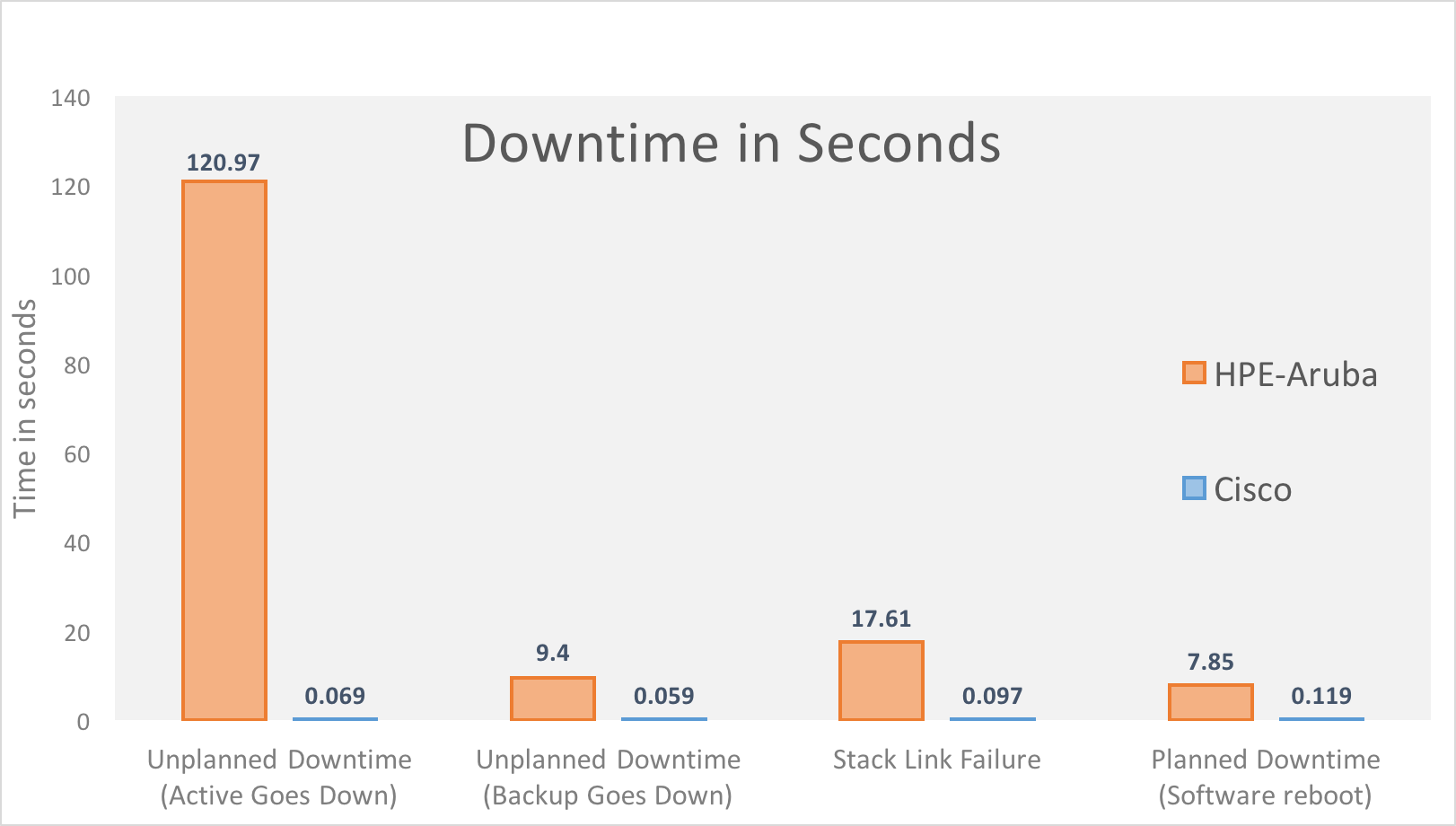
The independent test lab, Miercom, recently evaluated Cisco’s modular stacking technology against the HPE-Aruba’s modular stacking technology and published the results here.

As expected, Cisco honored its promise to offer sub-second failover in case of outage with no impact on the connected wired and wireless devices such as laptops, IP phones, video cameras, wireless APs and other IoT devices.

HPE-Aruba failed to provide the box level redundancy using redundant management module. On top of that, HPE-Aruba took a whopping ~120 seconds of downtime. This lead all of the Wired, Wireless, IoT devices and wired-wireless user devices disconnected from the network! End user applications such as: Skype for Business Audio/Video Call, Video Streaming and Screen Mirroring got severely impacted in case of HPE-Aruba.

With Cisco, there was only a sub-second failover. This meant that it showed no impact on applications and the end user experience.

The point is, the Miercom report proves that Cisco offers a robust network infrastructure with resiliency and simplicity that offers a strong underlay that is ready for today and tomorrow’s applications. The Cisco stacking capabilities offers extremely resilient solution to withstand failures and offer sub second failover without impacting users and applications.

Please download complete Miercom report here.

Authors

Kshitij Mahant

Technical Marketing Engineer

Enterprise Networking Group

Avatar

Jeff Dickey doesn’t believe in the open source business model, and he doesn’t think that cloud is going to make your life any easier.

Provocative, right? Not exactly the song that most people in the industry are singing. But here’s the thing: Jeff works for Redapt—a company that builds enormous cloud systems for companies in all kinds of industries—so he’s got a front row seat to the most current action in the cloud space. He speaks with the IT leaders ordering the systems, with the operators using them, and with the vendors creating the hardware and software these systems are running. He hears what’s working, he hears what’s not working, and he sees trends developing in real-time, before analysts are able to uncover them by crunching the numbers. Which all makes him a very interesting guest—to put it mildly.

Want to hear more? Tune in to hear Jeff’s opinions on:

  • What could have been done differently with OpenStack
  • Why vendor lock-in is not necessarily a bad thing
  • Which companies are winning in the container space
  • Why CEOs who think cloud will reduce headcount are completely wrong
  • How the industry giants may have the advantage in the next wave of cloud
  • How a cloud can work perfectly, but still be unsuccessful

See the video podcast on our YouTube page, listen to the audio version on iTunes or Stitcher, or browse the archive for previous episodes. And if you like what you hear, we invite you to subscribe to our channel so you don’t miss any of the other exciting podcasts we have scheduled over the next several months.

Authors

Ali Amagasu

Marketing Communications Manager

Avatar

MPLS+SDN+NFV World Congress 2017 was a great success this year.  I was extremely pleased with momentum in the area of Cisco’s IOS XR Software Innovations supporting our customers network transformation use cases for Cloud-Scale Networking. In the pre-show blog I alluded to this conference as the place where the “software innovation rubber meets the road” and once again this conference did not disappoint!

Below is a picture of industry leaders from Bell Canada and Cisco discussing IPv6 Segment Routing use cases at the conference.  I share this picture to point out the type collaboration needed to move the industry forward.

Given the amount of quality real world experiences shared from leading customers and Cisco technologist, I could hardly wait for the session videos to be posted so I could share these resources widely with the rest of the industry.

Let me give you two examples of the “software innovation rubber hitting the road” at the conference.

First, it has been amazing to watch Segment Routing come to life over the past four (4) years at this conference.

Reflecting back to 2013 when I interviewed Clarence Filsfils, Cisco Fellow, we discussed Segment Routing when only a handful of people knew what this game changing software innovation would mean to providers around the globe. At the time, Clarence and team were beginning to develop Segment Routing use cases with distinguished engineers from lead customers and Segment Routing software innovations were written into Cisco IOS XR early first test code.

Fast forward to Clarence’s presentation at this years conference; Segment Routing Deployment Experience and Technology Update; and you will see how collaboration between industry technology experts pays off in software development and actionable network transformation use cases.  Segment Routing software innovations are available and deployable in Cisco IOS XR software code and will anchor SDN-Ready Cloud-Scale Networks to deliver on the promise of simplification, automation and virtualization for operators around the globe.

In case you missed it, see this recent blog on Segment Routing Innovation which includes a link to an important presentation at MPLS Congress by Paul Matte’s from Microsoft describing  Segment Routing for Data Center Interconnect at Large Scale.  Check this blog out if you are interested in seeing another great example  Cisco IOS XR Software Innovations In Action!

Second, Central Office Transformation is Hot! Hot! Hot!

Take a look at this blog featuring a quote from Bell Canada’s Daniel Voyer, Technical Fellow, on the importance of BGP MPLS-based EVPN.  In a nutshell, Simplification, Automation, and Virtualization are no longer marketing terms for our customers.  The Central Office Transformation use case takes advantage of Cisco IOS XR software innovations in the areas of Segment Routing and Ethernet VPN (EVPN) to simplify networks and transform central offices into data centers at leading customers.  The Central Office Transformation use case is  great example of Cisco IOS XR Software Innovations In Action! 

To learn about Cisco IOS XR Software innovation and Central Office Transformation  see the following resources:

Presentation on Central Office Transformation by Daniel Voyer, Technical Fellow, Bell Canada

Presentation on Ethernet VPN (EVPN) by Patrice Brissette, Distinguished Engineer, Cisco

Finally, if it is not obvious at this point — MPLS+SDN+NFV World Congress in Paris is the place to be if you are on the tip of the spear of network transformation and want to see software innovation in action. I could present a customer story with each Cisco presentation at the conference because as I like to say, “We Transform Networks Together”.  Instead, I’ll leave you with the above customer examples and some homework:

  1. Watch the suggested videos from MPLS WC 2017.
  2. Block your agenda for MPLS+SDN+NFV World Congress 2018 – April 10-13, 2018 at the Paris Marriott, Rive Gauche.
  3. Get involved by bringing your use cases forward at conferences like MPLS World Congress or via the IETF.
  4. Pick-up a copy of Segment Routing Part 1 and learn how to implement this game changing IOS XR software innovation in your network.

We’d love to partner with anyone who is interested in participating in the development of software innovations to transform and shape the networks of the future!  We hope to see you in Paris at MPLS World Congress in April 2018!

Authors

Gina Nienaber

Marketing Manager

SP Infrastructure

Avatar

Customer Success Management (CSM), at its core, is about ensuring that our customers thrive, and it centers on accelerating time to value at each stage in the relationship lifecycle (Land, Adopt, Expand, Renew). As sellers, the importance of integrating a CSM practice cannot be underestimated in today’s subscription economy. But the shift to becoming truly CSM centric isn’t easy, no matter what size your organization might be. It involves developing a charter and bringing together the right people, process, analytics and more.

Each partner is understandably at a different stage in their transition to CSM, and my question to you today is, how would you rate your progress? Are you just getting started or is your program already operating at full throttle? If you’re wondering how your initiatives stack up, take a look at the progression chart below, which is based on information published by the CS experts at TSIA. Before you get started, sign up for our May 16 webinar, “Understanding the Customer Experience.” TSIA will be joining us to explore the CSM maturity framework in greater detail and discuss how partners can benefit.

The Journey to Customer Success Management Maturity

  • Phase 1 (Discovery) – This is the initial phase of building a customer success practice as you pivot away from point sales and toward a recurring revenue sales model. It is here that you will define what customer success is for your business and how it can be executed in the early stages before a formal CS team or plan is in place.
  • Phase 2 (Pilot) – Customer success is embraced as a theme and a formal program is being established. Typically, a customer experience leader is assigned, but he/she may still have responsibilities across other parts of the organization. Customer success costs are likely covered by project-based funding, and you will begin collecting limited information and data insights. Your CS team may even start to survey customers or use Net Promoter Scores or other measurement tools to benchmark customer satisfaction, loyalty levels and more.
  • Phase 3 (Organizational Execution) – Low-adoption collection of information is automated, and best practice customer success activities may exist. (For example: customer journey maps, quarterly business reviews and/or formal onboarding programs.) A team is typically in place to support these processes although it is often reactive in nature. The team is frequently established as an extension of your organization’s support or sales and marketing disciplines.
  • Phase 4 (Maturity) – At this stage of your CS practice, multiple or all charters of customer success are enacted across adoption, retention and expansion motions. Customer engagement activities are highly automated, monitored and prescribed. Workflows are aligned to value-, event- and time-based triggers. There is a very proactive CS team in place, driven by a formal customer success organization with C-level authority and responsibilities. At this phase, customer success is a critical business objective shared across the organization.

Navigating Your Progression to CS Maturity

Greek philosopher Heraclitus said it best: the only thing that is constant is change. Leaders in their respective markets are those that possess the ability to recognize and adapt to change, thus seizing the opportunities that change presents. In the subscription economy, your business success is intimately tied to that of your customers – so investing in a CSM practice is win-win into the foreseeable future.

At Cisco, our future is driven by the success that you and your customers achieve. It is our hope that with a deeper understanding of your own progression towards CSM maturity, you can more effectively advance your efforts, form tighter relationships, align technology with value realization and uncover new opportunities for growth.

Learn More

Join us on May 16th at 2pm EST for our next Customer Success Talk webinar: Understanding the Customer Experience.

Authors

Ed Daly

Senior Director

Global Customer Success

Avatar

Last week in Germany, we attended the Hannover Messe event, where the hot topics were three new products officially announced at the show:


https://www.youtube.com/watch?v=IUzQ547BF-E


From northern Germany to the beach

This week, these “hot topics” will continue their momentum in a truly warm climate, as the Cisco manufacturing team heads to Ft. Lauderdale for the annual CSIA Executive Conference, an event focused on bringing together technology partners and industrial system integrators. Cisco is a member of CSIA, along with our industry partners Panduit and Rockwell Automation, which will have teams in Ft. Lauderdale (and also attended Cisco at Hannover Messe).


Across various booths at CSIA, Panduit, Rockwell Automation, and Cisco will have representatives available to discuss how to build a secure, connected factory, improve asset management, and improve worker safety and tracking through a connected workforce based on the validated Converged Plantwide Ethernet (CPWE) architecture.


https://www.youtube.com/watch?v=S0x9nbD8bwA


We look forward to seeing you in Ft. Lauderdale and working with you on digital transformation together at booth 56.

To learn more about our new Connected Factory solutions, take a look at our Industrie 4.0 eBook.


We also invite you to explore the following manufacturing topics:


Authors

Eric Ehlers

No Longer at Cisco

Avatar

Twenty years ago, Cisco Capital began with a simple purpose: to enable companies of all sizes to transform and develop through the acquisition of Cisco technology.

While Cisco Capital has grown substantially since then, our mission has remained unchanged. Over the past two decades—from the dot-com boom and bust, to the banking industry’s collapse and rebirth, to today’s era of digital transformation—Cisco Capital has helped organizations of all types rethink how they acquire technology and leverage it to gain competitive advantages, improve sales effectiveness and enhance operational efficiencies.

As Cisco switches, routers, and portfolio of products have become the technological foundation of both established businesses and start-ups, Cisco Capital financial innovations through the years have allowed organizations to scale, meet market demand and stay competitive by acquiring new technology and refreshing outdated equipment.

Cisco Capital in the 90s – Adapting to the dot-com boom and bust

The dot-com boom fueled an era of seemingly endless growth opportunities, catapulting both established businesses and new technology startups to the upper echelons of the global marketplace. To support this rapid growth, companies needed secure, scalable equipment to accommodate new market variables like internet traffic and the impact of rapidly expanding customer bases.  While Cisco provided the practical hardware and software to solve scale-related challenges, Cisco Capital delivered the financial means for organizations to acquire these solutions in the form of loans and leases.

The nineties were an era of unprecedented growth for technology companies. Then the dot-com bubble burst.  Market growth slowed drastically in 2001, forcing companies to adapt to reduced demand by cutting costs and conserving capital.  In response, Cisco Capital began offering Cisco-certified refurbished equipment through the remarketing of these assets, creating affordable options for organizations to acquire technology despite resource limitations.

The Cisco Capital remarketing business grew alongside that of its customers in the aftermath of the market crash, as did the need to meet market fluctuations head-on with adaptable financial solutions.

Cisco Capital in the 2000s – Policy, change, and dynamic transformation

Policy changes, banking deregulation and the subsequent 2008 market collapse forced many organizations to once again reconsider their technology acquisition strategies and think more creatively about how to finance them.

The evolving tie between IT infrastructure and revenue generation led many businesses to seek dynamic financial offerings that could add value to the bottom line while delivering against organizational goals. Businesses needed something that could not only help meet market fluctuations but enable competitive advantage by optimizing the accelerating technological lifecycle.

In the 2000s, Cisco Capital introduced financing to help companies proactively manage technology lifecycles. With lifecycle financing, companies could redefine the internal relationship between finance and IT by aligning technology investments with a new end-to-end solution.  Companies could invest in the latest Cisco innovation while simultaneously reducing operating expenditures and limiting capital expenditures with a single financial solution.

As with remarketing and the financial options introduced following the dot-com boom and bust, lifecycle financing provided businesses with an innovative new option to help them transform and meet market demands.

2016 and beyond – New consumption models and Open Pay

Today, organizations face another significant shift in the way they do business and how they use vendor financing to adapt. Digital transformation and the exponential acceleration of innovation and business development present a new set of challenges—today’s ‘consumption-based economy.’  Consumption models more accurately reflects usage  and provides customers with more convenience at a fraction of the cost.

In this evolving market, consumers now rely on apps and services like Airbnb and Uber to enjoy the benefits of ownership without the hassle. A similar paradigm is developing in the financial sector with evolving demand and scalability requirements.

Organizations no longer want a static technology investment plan. Instead, customers require something that can dynamically adapt to and reliably address today’s fluctuations in demand. In order to help customers pay for variable capacity as needed, Cisco Capital developed Open Pay to better align to future payments and actual usage.

Looking forward to the next 20 years

From the initial loan and leased-based relationships of the nineties to today’s end-to-end financial solutions, the transformative nature of business and technology proves that a little bit of ingenuity can pay big dividends in an industry fueled by innovation. As we celebrate Cisco Capital’s 20th anniversary, we want to thank our customers, partners and team members around the world for helping us reimagine the role of financing in the acquisition of technology.  We eagerly anticipate the challenges and opportunities of the decades to come.


Authors

Kristine Snow

President

Cisco Capital

Avatar

Translated from Italian, vivere una vita bella means “Live a beautiful life” and I do, both at home and here at Cisco. Raised in a tight knit Italian family, the majority of my life has been spent in the kitchen or around a table. My grandmother, Nonna, immigrated to the U.S. from Italy 55 years ago and brought with her some super yummy, super-secret recipes that may or may not have influenced my husband’s decision to marry me.

Gnocchi, a traditional potato dumpling served with sugo, or sauce, has always been a family favorite. My mother and her sisters grew up watching Nonna mix, cut and roll these tiny pillow of deliciousness by hand every Sunday, and as the next generation came along, my cousins and I were also able to witness her covering every flat surface in the house with them.  Nonna, with flour in her hair and spotted on her face, hands still covered in dough, was unable to catch us as we would grab one from the counter and run off to enjoy it.

As we all grew up and my grandparents aged, our regular Sunday dinners became fewer and  farther between, but recently my mother was able to herd us all to her house so Nonna could give us all a lesson in gnocchi making… on a Tuesday evening. Luckily my job as a recruiter allows me to be pretty mobile and with Cisco’s tools and technology it makes it easy to take my talent acquisition show on the road! What made this Tuesday evening even more special was that my own daughter, Fiorenza (named after my gnocchi making Nonna) was able to come and relive a bit of my childhood with me. I was even able to snap this sweet picture of four generations of women making memories, passing down traditions and sharing the joys and comfort of family.

As a recruiter my job is connecting amazing talent with meaningful careers at Cisco. Not only do I get to connect great people to innovating and challenging roles, I also get to introduce them to a company that values “your beautiful life”. At Cisco we believe that the diverse perspectives and lifestyles of our employees help us shape who we are as a company. Most of my team is spread out across the United States, and many of us work virtually. We have adopted some fun activities to keep us connecting on a personal level and sharing our lives and traditions. One of my favorites happens during the holidays when we submit our silly family photos, celebration, traditions and even recipes that we hold dear. We compile those into a slide show that we share on our final team call before the year end shutdown and everyone gets an opportunity to bring a bit of their family to the team.

The support from company leadership allows me to make my family a priority, and our inclusive environment makes it easy to be who I am.  My advice to future Cisconians would be to bring us your authentic self, and/or family traditions. Come join us and #lovewhereyouwork.


To find your perfect Cisco career and join our family, visit our career site!


Authors

Jennifer Kindel

Recruiter

Talent Acquisition, Corporate Functions

Avatar

Cisco has always been focused on providing customers with the best innovation, under an umbrella of choice and openness, in our next-generation virtual switching portfolio.

Last month, VMware notified customers of its intention to remove the 3rd Party virtual switch APIs in Update 2 of vSphere 6.5. These APIs allow customers to choose a virtual switch to best fit their unique network and data center requirements. This includes Cisco’s portfolio of AVS, Nexus 1000v, or VM-FEX products, the HPE 5900E, or the IBM DVS 5000v.

Instead, VMware has chosen to close the APIs and the open ecosystem to steer customers to its virtual networking products only. Cisco has deployed virtual switch solutions in thousands of customer networks worldwide. We regret that VMware has chosen to impose such a significant operational burden with challenging timelines for so many customers.

We understand customers need to plan and are eager for more information regarding these changes. Cisco believes customers deserve choice. Customers compare and evaluate Cisco solutions with alternatives, and they choose Cisco based on the merits of our technology, services and support.

In anticipation of VMware’s decision to remove the 3rd party virtual switch APIs, we have been working on a platform-independent solution to bring choice back and to free customers from being locked into the VMWare-only virtual switching option. This solution will provide customers with a high level of consistency and control, extending beyond on-premises VMware vSphere environments.  This solution will also provide a migration path forward for current AVS and Nexus 1000v customers when they upgrade to a vSphere version that does not have the 3rd party vSwitch API.  Cisco will not leave our customers behind.

In the meantime, customers and partners should realize that in the spirit of openness and choice, Cisco ACI-based networks do not limit customers to VMware vSphere or mandate the Cisco AVS in vSphere environments. Cisco ACI delivers advanced network virtualization and microsegmentation with all the major virtualization platforms — Microsoft Hyper-V, KVM, and VMware vSphere. When using ACI with VMware vSphere, customers are free to choose and deploy virtual networking and microsegmentation with the native vSphere Distributed Switch (VDS). In fact, more than half of Cisco ACI customers operate their ACI fabrics with the VMware VDS.

We will continue to share more details on our approach with our account teams and partners in the coming weeks. Thank you for your business and partnership.


Availability disclaimer: Products, features and solutions described herein remain in varying stages of development and will be offered on a when-and-if-available basis. These products, features and solutions are subject to change at the sole discretion of Cisco and neither Cisco nor its suppliers will have any liability for delay in the delivery or failure to deliver any of the products, features or solutions referenced herein. 

Authors

Frank Palumbo

Senior Vice President

Global Data Center Sales