Gone are the days when going to class meant simply sitting, listening, taking notes, and studying for an exam. Today’s learning environments need to offer so much more. With Cisco Spark and Cisco Spark Board for education, you can personalize the learning experience, helping students, educators and researchers work together across boundaries.
Educators today want to open new possibilities for their students. They want to enable blended learning in their classrooms so that students can learn how they learn best – from any device, anywhere and anytime. They want to facilitate project-based learning, so that students can focus on core curriculum skills while thoughtfully investigating tough questions and challenges. And, they want to do it simply, within one platform that makes it easy for them to monitor, assess and grade.
For today’s educators, communication is key. And it doesn’t necessarily have to be in-person. Office hours have gone virtual, and students, educators and researchers rely on technology to communicate, brainstorm and share collectively.
In part one of this blog, I discussed the benefits and challenges of bringing to market and selling IOT solutions that are composed of hardware, software and services from multiple companies to deliver digital transformation. Over the last few years, there have been many discussions of digital transformation on the topics of vision, strategy, competition, and threats, but there have been very few, if any, proven approaches put forward describing how to effectively bring these complex multi-partner IOT solutions to market and sell them.
Accelerating Cisco Ecosystem Sales (ACES) provides a proven methodology that squarely answers these challenges. In this blog, I will describe ACES, how it works, provide proof points from actual ACES engagements, and explain how you can get started today.
What is ACES?
ACES is Cisco’s proven framework for selling multi-partner IOT solutions that enables us to align several partner sales teams, avoid unpleasant surprises, and accelerate the delivery of value to our customers. ACES assumes that a solution owner has previously created a solution that is at least 60% to 100% ready to go to market, and that they have previously secured buy-in from one or more sales leaders.
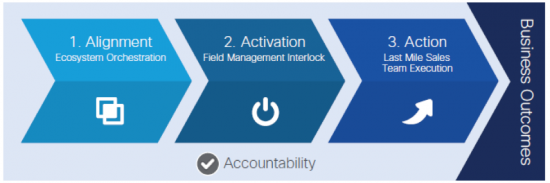
ACES is a three-step model managed by a trained ACES facilitator that includes these steps: Alignment, Activation and Action. It does NOT facilitate building solutions, but instead focuses on the go-to-market and sales. We designed and created ACES to enable Cisco and our partner sales teams to overcome the obstacles of selling a digital IOT solution by using a predictable, repeatable and proven sales model with built-in governance that drives accountability.
Here is how it works:
Facilitation – A trained ACES Specialist is assigned to offload the sales team from having to manage the multiple partner interactions, and takes them through the following three steps.
Step 1: Alignment – We assemble the core solution team members to include Cisco, value added resellers, ISVs, SIs and consulting partners who have contributed to the solution or will contribute to its sales process. We ensure that the solution is ready to go-to-market, and align all partners on how we will sell together based on simple but concrete and proven tools.
Step 2: Activation – We select one territory, for example a city, and then bring together all of the first line sales managers from each partner that will be involved in the sales process. We educate these sales managers on the solution, gain their agreement to sell the solution in their territory, select a list of accounts, and prioritize these accounts based on a proven selection criteria from the tools.
Step 3: Action – We bring together the sales teams from the relevant partners for the territory selected. We educate these sales teams on the solution, get their agreement on the prioritized accounts, and create a simple, but joint go-to-market sales plan for each account based the tools. View my six-minute presentation that summarizes ACES.
Proven Results
The ACES program and the drive by the Cisco ecosystem team to focus on ‘customer in selling’ are great tools to be able to hit the ground running.
-Steve White, IDC Program VP of Channels & Alliances
Over the past 13 months, Cisco has conducted over 30 joint ACES digital solution engagements with more than 50 Cisco partners.
These worldwide engagements have shown that ACES delivers better IOT enterprise solutions to customers faster. That’s because there is a predictable sales model with accountability that ensures the solution is ready to sell, and defines and gains agreement on the role each partner will play BEFORE the teams arrive at a customer’s doorstep. Using the ACES tools, each step incorporates each partner’s knowledge and experience. In essence, the framework provides the joint sales team with a road-map, but the team drives the car. The sales team stays in control as they accelerate together to close the deal.
Cisco and CenturyLink teamed up and used ACES to bring to market a CenturyLink solution named Digital Data Platform (DDP). Team collaboration and systematic approach of the ACES program allowed Cisco and CenturyLink to reduce the go-to-market timeframe of the DDP solution by at least 9 months.
-Mahesh Dalvi, VP IT Services at CenturyLink
Get Started Today
As the digital world accelerates and companies embrace digital transformation, we need to sell IOT solutions differently! We need to learn how to sell collections of products and services from numerous companies that are integrated into digital IOT solutions if we are to remain relevant to our customers’ digital transformation needs. Cisco ACES provides this framework.
If you want to learn more about ACES and you are a Cisco partner, go to Continuous Learning. Also, partners can read more details about ACES in this ACES White Paper. Finally, for further information contact me at bvizza@cisco.com.
This post was written by Gary Coman, who oversees engineering and development for Cisco Networking Academy. It originally appeared on the Huffington Post.
Everywhere in the world, technology is changing the way we live and work. As director of engineering with the Cisco Networking Academy program, I am part of a global community dedicated to training the next generation of students who can build networks, develop apps, secure devices, and analyze data. Combined with an entrepreneurial spirit, these digital skills can help you stand out in the job market, forget your own path, and even empower you to do work with a purpose.
Whether you’re just planning a career or considering a career change, here are 5 reasons you should include networking technology in your studies.
1. Opportunities abound
People with IT and networking skills are in short supply worldwide. The U.S. Department of Labor estimates the employment of network and computer systems administrators will grow by 31 percent from 2014 to 2024. In Brazil, the IT industry is expected to grow by 3 percent through 2019, with more than 160,000 jobs expected to remain unfilled in the next two years.
The story is the same in country after country, from continent to continent. As organizations and institutions invest in mobile devices, cloud computing, social media, and big data, they depend on a workforce with the digital skills to make the most of these technologies.
Right now, the number of people working and studying technology simply won’t match the expected demand. Individuals who choose to add networking to their studies or professional skills discover new opportunities in today’s digital economy. For example, the hands-on, practical training Diana Nassar received through Networking Academy prepared her to thrive in a technical career and inspire other women in Jordan to follow in her footsteps.
https://youtu.be/Lr7Y_0EtFwU
2. You don’t have to be a math wiz
Networking starts with basic logic and connections. The only prerequisite for the Networking Academy IT Essentials course is an interest in technology and basic math and reading comprehension. If you are in or have completed high school, you probably have the skills you need to launch a networking career.
In India, Anudip provides Networking Academy courses at 150 centers, where 60,000 low-income women and youth have trained since 2007. Their experience shows that you can study networking technology at a broad range of educational institutions—high schools, community colleges, institutes, community knowledge centers, and universities—as part of your degree studies or while you work.
3. Innovators are always welcome
Digital skills give you an edge and an opportunity to make a career in almost any sector you can imagine: financial services, education, transportation, manufacturing, technology, government, hospitality, healthcare, retail… you name it.
If you have an interest in a particular field, technology is probably part of it. For example, networking technology is transforming the healthcare industry, and students are finding ways to better use it in practice. At this year’s Rice Business Plan Competition, Cisco awarded its Innovation Challenge Prize to Luso Labs LLC, a student-founded startup using technology to make cervical cancer screenings more accurate and accessible to women worldwide.
Former military members are also enjoying the benefits of IT training. Veteran Arodi Fernandez became a Customer Support Engineer after completing Cisco’s Veteran Talent Incubation Program (VTIP). Whether you see yourself with your own business, as part of a small company or inside a global corporation, networking basics open the door to help advance your career.
4. Get connected to the most connected people
There is a worldwide community of people just like you. More than 6.9 million students in 170 countries have participated in Networking Academy courses since 1997. That’s a lot of friends to find and connect with on LinkedIn or Facebook, which has over 1 million student and instructor members who use it to stay in touch, ask questions, and discover new learning opportunities.
5. The places you’ll go and the things you’ll do
Networking standards are global. That means your skills and certifications are recognized anywhere in the world your career takes you. Cisco-certified professionals have worked their way up through global corporations in places all over the world. They live in every sized community, supporting small businesses, schools, and social services in every town or village where someone connects to the Internet. They build networks for essential communications after disasters like the 2015 earthquake in Nepal. They connect isolated places like refugee camps to the world, giving displaced persons a bridge to a more promising future.
I know that networking can take you wherever you want to go because I’ve lived it. I started out as a systems analyst with Fidelity Investments. But I had ambitions to build life experience and travel the globe. I used my knowledge in networking and technology to move to Europe and then to Asia for over 10 years, advancing my career from systems to sales to business development. Now, as director of engineering for Cisco Networking Academy, I ensure that people everywhere benefit from the power of technology. When you choose to add networking skills and Cisco certification to your résumé, you open the door to opportunities.
Visit NetAcad.com and start studying networking technology today!
Increase reliability and efficiency with converged WAN infrastructure
Over the last several years we have worked closely with utilities across all areas of the Cisco IoT portfolio to accelerate grid modernization initiatives. Leaders in the industry have generated high impact business outcomes ranging from improved grid reliability to new customer engagement services informed by smart grid data. Today utilities such as BC Hydro and First Energy benefit from Cisco Validated Designs that specify implementation guidelines in solution areas such as field area networks, connected workforce, distribution automation and substation automation. The Cisco Connected Grid architecture ties all solution areas together into a unified, cost-effective and flexible system. Today we are announcing a new advancement for the utility WAN that delivers a highly reliable, converged IP/MPLS network for secure data delivery from the grid edge to the operations center.
Utilities have traditionally relied on private time-division multiplexing (TDM)-based solutions such as SONET/SDH for controlling critical infrastructure. However, today utilities demand increasing grid reliability and operational efficiency. By migrating to a converged IP/MPLS network, utilities are able to cost-effectively support SCADA, teleprotection, cyber security, and additional grid modernization programs.
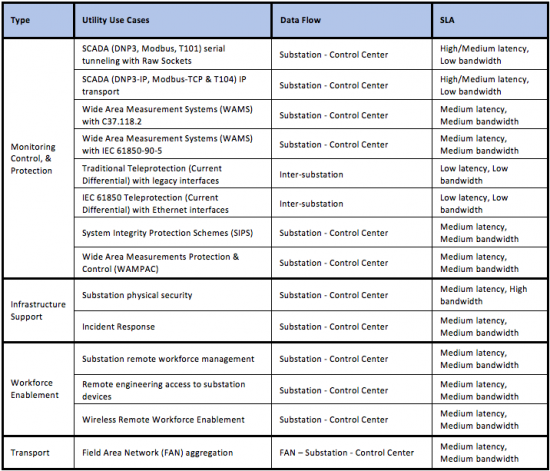
What’s called for is a converged WAN infrastructure capable of supporting multiple categories of common use cases reliably delivering mission critical data from field area networks to control applications across a range of latency and bandwidth requirements. Table 1 outlines common utility use cases and their associated characteristics:
Table 1. Common use cases for converged WAN infrastructureEffective WAN
Effective WAN infrastructure capable of supporting these common uses cases must deliver consistently several key areas including:
Scalability
10GE and 1GE interfaces across multiple topologies for access and aggregation
Local and pass through capacity for both ring and linear nodes must be supported
High Availability
Disaster recovery across redundant control centers
Fast failover (<50ms) for node and link failures
Power supply, forwarding plane, and control plane redundancy
Intuitive, Easy to Use Network Management
Modern, graphical user interface
Point and click, rapid provisioning of new services
Performance / SLA monitoring for mission critical services including
SCADA and Teleprotection
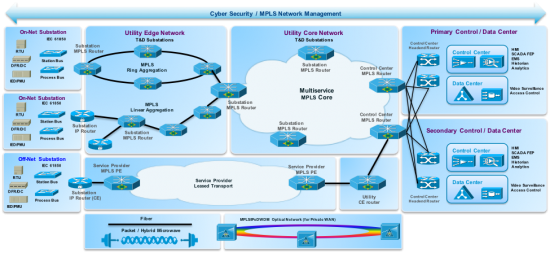
To meet these needs Cisco has introduced a new series of ASR 900 MPLS routers combined with the EPN-M management system to produce a cost-effective solution for converged utility WAN infrastructure. The solution offers utilities cost-effective migration from legacy SONET/SDH/TDM to a converged IP/MPLS multi-service communications infrastructure and addresses immediate utility customers needs for improved reliability and efficiency. Common deployment scenarios include transitioning SCADA and Teleprotection applications from siloed legacy networks to a converged IP/MPLS WAN. A typical deployment scenario is highlighted in figure 1.
Figure 1. Deployment of Cisco MPLS WAN infrastructure
The combination of advanced MPLS routing with the ASR 900 series and cost-effective management with Evolved Programmable Network Manager (EPN-M) offers utilities industry leading capabilities across several critical parameters:
Performance
The ASR 900 series uses custom ASICs offering industry leading throughput,
low latency and jitter, path symmetry, and deterministic traffic flows
Flexible Transport Options
MPLS-TE, MPLS-TP, and FlexLSP (RFC 7551)
Optimized transport based on utility use cases and deployment scenarios
Multi-service
Flexible VPNs – L2VPN, L3VPN, Pseudowire, and Raw Socket transport
Point-to-multipoint and point-to-point services such as SCADA
Wide set of network interfaces for existing and future end devices across multiple use cases
Interface modules (IMs) shared across all three platforms (ASR 903, ASR 902, ASR 920)
Hierarchical QoS, with hardware support for line rate performance
Scalable multicast for video end points and PMUs
Operations, Administration, and Maintenance (OAM) functions per service
IEEE 1588 and SyncE timing, and Stratum-3E on-board clock to ensure precise network synchronization
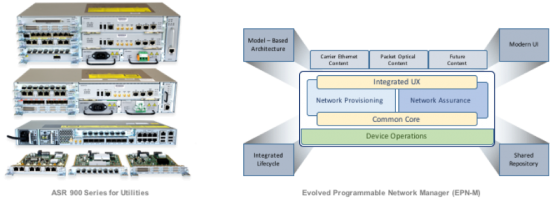
The capabilities outlined above for high-performance, flexible MPLS WAN infrastructure result from the combination of new ASR 900 series routers purpose built for utility needs and cost-effective network management at scale using the Evolved Programmable Network Manager (EPN-M).
Figure 2. ASR Series 900 MPLS routers and EPN-M network management system
The solution offers also offers support from Cisco ecosystem partners for integrated, tested solutions across mission critical use cases. Examples of ecosystem partner integration include Schneider and Siemens.
You have just been notified by a “TLA” (Three Letter Agency), a law enforcement agency, that your organization has suffered a data breach. Depending on your Threat Management Maturity level, you will either approach this methodically or ad-hoc. A TLA notification will generally involve leveraging the expertise of an Incident Response team, either your internal team, or a trusted third party, such as Cisco Security Incident Response Services.
Now that you have the notification, how are you going to further investigate? If you have rehearsed for a TLA notification through table-top exercises, you know to immediately activate your organization’s incident response plan. The result of a data breach to your organization can be a massive hit to your financials, impact branding, loss in consumer confidence, and involve legal or compliance obligations. During Incident Response activities, you will need to answer questions about the incident and historical artifacts that may, or may not be available on the endpoint. Attacker methodologies continue to evolve with anti-forensic techniques, such as timestomping and clearing event logs. Do you have the skills in-house to quickly and correctly triage any suspected compromised systems?
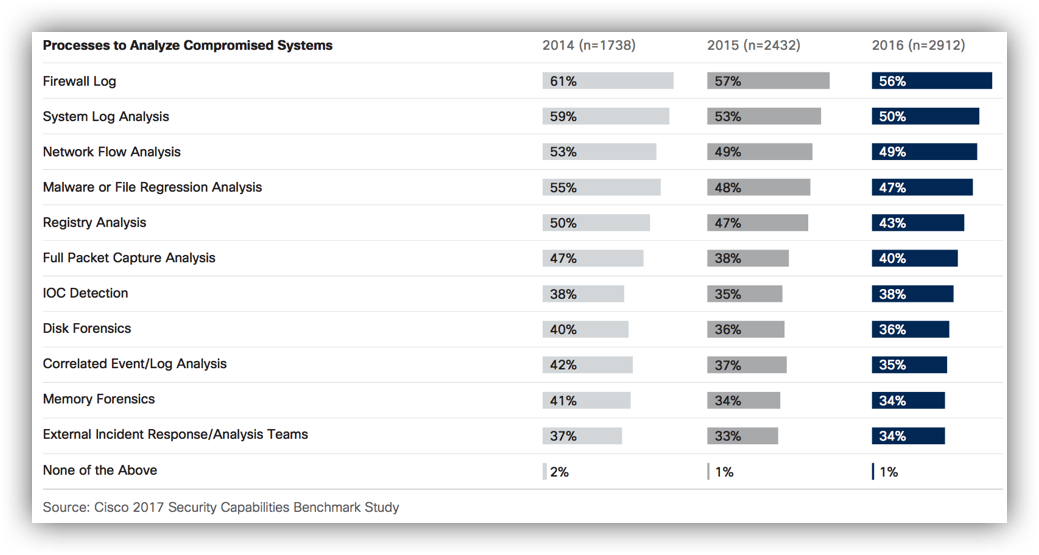
According to the Cisco 2017 Annual Cybersecurity Report, 50% of the respondents stated they used system log analysis, 36% of the respondents stated they used disk forensics, and 34% of the respondents stated they used memory forensics as a process to analyze compromised systems. All of these processes are critical to incident response. Most organizations either do not have a digital forensic capability, or fully outsource digital forensic capabilities to a 3rd party. This means that time to collection (“TTC”) critical host artifacts can be days, weeks, or even never, leading to loss of time-sensitive, or dynamic artifacts.
Figure 1: Processes to Analyze Compromised Systems
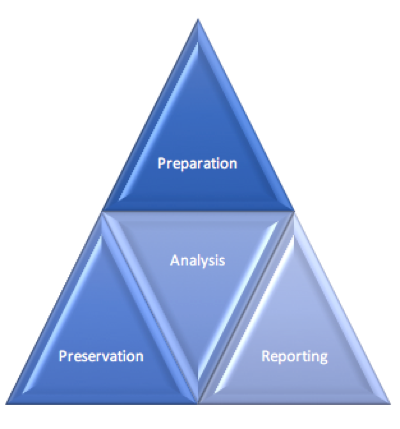
Digital forensics is required during Incident Response and will continue as new compromised systems are identified. Digital forensics also supports root cause analysis, which is required for your organization to recover from an incident. The National Institute of Standards and Technology (NIST) maintains a series of documents called the 800-Series Special Publications (SP). One document titled “NIST Special Publication 800-86: Guide to Integrating Forensic Techniques into Incident Response”, which describes the forensic process as follows:
Figure 2: NIST 800-86 Forensic Process
The NIST 800-series documentation provides guidelines, references, and recommendations for creating various computer security frameworks. These frameworks allow organizations to build out functioning capabilities, such as integrating forensic techniques during Incident Response.
As a senior incident responder with the Cisco Security Incident Response Services team, I have worked with many customers that have fallen victim to a data breach. Oftentimes and during the early hours of Incident Response, there are often “DIY” (do-it-yourself) processes that customers perform on compromised systems, prior to engaging with an external Incident Response team. While customers have the purest intentions to quickly remediate and get back to business as usual, oftentimes these DIY actions destroy volatile forensic artifacts that the attacker left behind in the environment. Specifically, I am referring to Locard’s exchange principle in forensic science, which states: “the perpetrator of a crime will bring something into the crime scene and leave with something from it, and that can be used as forensic evidence.”
Figure 3: Triage Forensics Process
Fortunately, there are some forensically sound methodologies that you can perform to preserve digital evidence and save your organization on costs, legal/compliance issues, and even brand reputation long-term. A colleague and I will be teaching this Triage Forensics methodology (see Figure 3 above) at Cisco Live! US 2017: LTRSEC-2051 Triage Forensics. If you are an information security, network security, or an IT professional-that-wears-many-hats, and you are looking to wow your boss with new forensic super-powers, our instructor-led lab course is for you! Four (4) hours of technical, hands-on labs giving you the skills to go back to your organization prepared to be the superhero in the event your new Triage Forensics super-powers are needed for an Incident Response.
Preparation
In the Preparation phase, students will learn why every successful Incident Response starts with preparation. Training, table-top exercises, budget, communication plans, processes, and even creating your own Incident Response Go-Bag with a gamified approach!
Preservation
During Preservation, students will learn about rules of evidence, chain of custody, and proper note-taking. A hands-on lab exercise includes capturing physical memory, creating a forensic image (logical vs physical), and targeted artifact collection.
Analysis
Over 50% of the course is lab intensive, where students will spend time performing basic forensic analysis on common artifacts critical to early incident response. Each lab is designed around common artifacts left behind by an attacker and quick-wins students will be able to implement into their organization’s incident response workflow upon return from Cisco Live US!
Reporting and Communication
Reporting and Communication rhythms are very important during the Incident Response. Generally, reporting is the last phase of the forensic process. Students learn the sections of an Incident Response report, and how to effectively communicate highly-technical material to the executive. Incident reports can be used as a tool to drive security budgets, allowing the organization’s threat management model to further mature.
Calling All SuperHeroes! Get the education, connections, and inspiration you need to be a Triage Forensics SuperHero! Come see Bruno Mars at Cisco’s Annual Customer Appreciation Event, and make sure you register for LTRSEC-2051: Triage Forensics!
In the light of inserting various L4-L7 services, deploying infrastructure for multi-tenant applications can be very complex! Catena, the latest innovation from Cisco can help. But don’t just take our word for it. Previously chosen as the product of the week ,Catena has now been selected as Best of Interop 2017 finalist in each of the Cloud, Data & Analytics and Infrastructure categories. Finalists were chosen from nine categories including Data Center, Mobility, SDN and Cloud Technologies.
What is Catena?
Catena is a multi-terabit , switch/router native service chaining, security, load-balancing, analytics and L4-L7 applications integration solution. Catena can perform these operations at multi Tbps! The solution works with all L4-L7 virtual and physical devices, such as, Firewalls, IPS, IDS, WAAS, DDoS protection, load-balancers, SSL offload engines, network monitoring, etc.
With our patent pending algorithms, Catena allows users to create multiple chains with multiple elements in each chain. User can configure security policies to configure which traffic goes through which chain. An element, could be a cluster of devices, in which case Catena load-balances to the cluster. Catena performs health monitoring and failure handling of devices.
Here are some key points:
Catena does security, service chaining, load-balancing, analytics, L4-L7 integration and orchestration as a single solution.
Significant performance improvement: Today’s solutions only solve a small part of the problem at a maximum performance of 400Gbps. Catena can scale to multi Tbps.
Scale improvement: Catena can create large number of chains, with multiple elements (ex. VNFs) in each chain.
CAPEX savings: Today, partial solution costs around $20K for up to 100 Gbps performance, Catena works at multi Tbps for a fraction of that price.
OPEX savings: Today, the user has to do VLAN stitching or create default gateways, which is very hard to deploy, error prone and inefficient.
With existing solutions in the market, either all the traffic is in a chain or not. Catena allows for secured partitioning of the traffic through multiple chains.
Catena allows user to create multiple chains using the same network elements.
Today, Microsoft has release their monthly set of security updates designed to address vulnerabilities. This month’s release addresses 56 vulnerabilities with 15 of them rated critical and 41 rated important. Impacted products include .NET, DirectX, Edge, Internet Explorer, Office, Sharepoint, and Windows.
In addition to the coverage Talos is providing for the normal monthly Microsoft security advisories, Talos is also providing coverage for CVE-2017-0290, the MsMpEng Malware Protection service vulnerability in Windows reported by Natalie Silvanovich and Tavis Ormandy of Google Project Zero. Snort rule SIDs for this specific vulnerability are 42820-42821.
At this year’s Open Networking Summit, there was a touch of nostalgia looking back to how far the open source community has come since Bill Joy worked on the Berkeley Software Distribution (BSD) version of Unix in the late 1970s. There was also an implicit challenge to the IT industry: Offer more integration of solutions with open source products. Yes, it’s expensive. But customers have demonstrated that they want open solutions. They’re wary of vendor lock-in. They want extensibility and interoperability with multiple vendors.
Open source is the future. We ignore it at our risk. It isn’t to be feared. But open source is not a panacea; there are a few different aspects to openness that deserve clarification.
Correcting Some Misconceptions
An open source product doesn’t mean it’s cheap or free.
Open source communities and projects have helped the networking industry work together to build a common set of tools. Each is like the ability to communicate using the same language in the same country. The tools (the language) may be open but the products (books, newspapers) have a cost, which is as it should be in a marketplace. And integration costs for open source technology can be significant.
Open source solutions don’t provide a cookie-cutter approach – every solution needs customization.
Let’s say you want to build a video solution. You download some code from an open source community that allows you to do transcoding, for example. But then you need a transport solution with a resilient path so the quality of experience is acceptable. And that part of the solution―and many other pieces―has a cost. Ditto for business or mobile services.
So it’s important to understand that to be commercially viable, open source solutions require integration. And integration has a cost.
Today, tech words and concepts pervade our speech. We talk about hacking our lifestyle or how much bandwidth we have or our individual solution stacks. Open source has also entered the global lexicon. In a new book, “The Chessboard and the Web: Strategies of Connection in a Networked World,” Anne-Marie Slaughter writes about a new world order where the inherent openness of networks will lead to greater transparency and citizen participation.
In our own industry, the benefits of open source are becoming ever clearer. That’s why it’s important for networking and other IT vendors to support open source and to also invest in integration of your products with open source tools and open standards. We’ve done so at Cisco. And it’s no mere coincidence that we call our solution stack to help service providers address the requirements of the digital business the Cisco Open Network Architecture.









 This post was written by Gary Coman, who oversees engineering and development for Cisco Networking Academy. It originally appeared on the










 Get the Podcast