Avatar

Artificial Intelligence represents a tremendous opportunity to expand the reach and enhance the capabilities of enterprise technology. At Cisco, we have already been introducing AI into our solutions across security, orchestration, application performance and collaboration. Today, I’m excited to share Cisco’s intent to acquire MindMeld Inc., a San Francisco-based company that has developed a conversational platform based on natural language understanding (NLU). This acquisition, Cisco’s third in two weeks, represents how the buy pillar of our innovation strategy continues to impact our strategic shift to become more of a software company.

Since 2011, MindMeld has focused on building intelligent conversational interfaces for companies to interact with their customers across almost any device or application. They have become an industry leader in AI, providing natural language interfaces for such use cases as shopping online, ordering products or contacting customer support.  At the core of MindMeld’s technology is a powerful machine learning platform that is able to ingest customer data and create a highly accurate and customized natural language model, tailored to each company’s industry and requirements. MindMeld also delivers a dialog manager that enables a computer to respond to user requests through chat and voice applications in a human-like fashion.

With MindMeld, we will enhance our Collaboration suite, adding new conversational interfaces to our collaboration products starting with Cisco Spark. I’m excited for the potential represented by the MindMeld team and their technology, coupled with Cisco’s market-leading collaboration portfolio, to enable us to create a user experience that is unlike anything that exists in the market today. Together, we will work to create the next generation collaboration experience. The MindMeld team will form the Cognitive Collaboration team and report into the IoT and Applications group under Jens Meggers, senior vice president and general manager. To learn more, check out Rowan’s blog on MindMeld.


Authors

Rob Salvagno

Vice President

Corporate Development and Cisco Investments

Avatar

Recently Lightreading announced the finalists for the prestigious leading lights awards.

One of the most coveted categories of these awards is Most Innovative Telecoms Product or Service (Fixed/Carrier Ethernet/Optical).

Catena has been selected as finalist in this category.

Organizers mention that there were 294 entries competing for these awards.

Catena is a multi-terabit service chaining, security, segmentation, analytics and L4-L7 applications integration solution.

The innovative solution works with all L4-L7 virtual and physical devices, such as, Firewalls, IPS, IDS, WAAS, DDoS protection, load-balancers, SSL offload engines, network monitoring, etc.

With our patent pending algorithms, Catena allows user to determine the path of various types of traffic. User can configure security policies to configure which traffic goes through which elements in the network. An element, could be a cluster of devices, in which case Catena load-balances to the cluster. Catena performs health monitoring and failure handling of devices.

The solution is natively embedded into the switch/router, i.e., the user doesn’t have to buy any service module or external hardware.

Currently, Cisco Nexus series of switches natively has Catena.

Here are some key points:

  • There is no solution today which can do all of these: security, service chaining, load-balancing, analytics, L4-L7 integration, orchestration.
  • Catena doesn’t use any additional packet headers (neither proprietary, nor standards based)
  • Catena doesn’t mandate the use of any particular hardware
  • Catena doesn’t mandate the use of any particular controller

Catena allows the user to create, orchestrate and scale an elastic network. It could be a data center, service provider or enterprise network.

A number of customers are deploying Catena.

Here are some of the links:

Catena blog

Catena configuration guide 

Catena command reference guide

NetworkWorld lists Catena as Product of the Week.

For more information and slide deck, please email nxos-catena@cisco.com
Catena selected as Finalist in Leading Lights Awards

Authors

Samar Sharma

Intelligent Traffic Director for Nexus 9k/7k/6k/5k

Avatar

You use an app to figure out the fastest ways around town. Why not an app that allows your mobile device to use your wireless network’s fast lane?

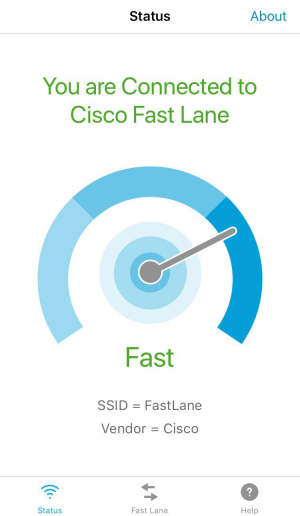
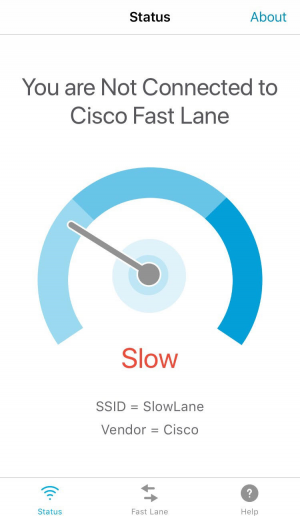
Technology is best realized when its entities can be visualized and are tangible. With this principle of simplicity, business app prioritization, or “fast lane” was developed as part of the Apple and Cisco collaboration to help IT prioritize apps by automatically configuring quality of service (QoS). We are proud to introduce the “Fast lane QoS” app for iOS 10.x devices that address a key question: Is my Wi-Fi Network fast lane enabled?

You can download the app here.

“Fast lane QoS” is an extremely simple and effective utility app that works with no configuration requirements. Just connect your iPhone or iPad to the wireless network and launch the app to find out whether your device is on the “fast lane”.

Once the key question on the fast lane status is answered, this leads to the question: How can we ensure quality of service is honored end-to-end?

The app answers that question too.

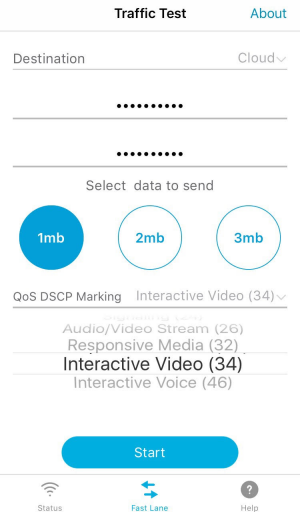
Simply switch to the “Traffic Test” screen that defaults to the cloud hosted traffic test server, select the data payload (1MB, 2MB or 3MB) and choose the QoS priority from the dropdown menu. Once you begin the test, the “DSCP In” markings can be verified on the Cisco Wireless LAN Controller (WLC) dashboard. Also, if you choose to execute the test against an on-premise server, the app has provisions to support this requirement.

There is more for the app developers who can leverage “fast lane” capabilities and ensure their apps receive guaranteed quality of service without worrying about any network complexity. More on this coming soon on a Cisco DevNet blog.

In the meantime, download this visual treat to your iOS devices and check the fast lane capabilities anytime, anywhere, on any Wi-Fi network.

Frequently Asked Questions

1. How can we activate “fast lane” on our Wi-Fi infrastructure?

    • a. Cisco WLAN –

Documentation

    • b. Meraki WLAN –

Documentation

NOTE: If “fast lane” status shows not connected on your existing Meraki Deployment, then make sure to request for firmware upgrade.

2. Can the app be used for performance testing?

      • a. The intent of the app is test the fast lane functionality end-to-end from the device to Wireless Infrastructure to ensure QoS DSCP markings are honored.

3. How can we verify the “DSCP In” markings on the WLC dashboard?

      • a. Navigate to “Monitor > Clients > AVC Statistics > Upstream” to view the “DSCP In” markings. Ensure Application Visibility & Control (AVC) is enabled on the WLC.

And for more information on taking the FastLane in your wireless network, click here.

Authors

Karan Sheth

Technical Marketing Engineer

Cisco’s Enterprise Networking Group

Avatar

Hello!  I’m reporting from the OpenStack Summit in Boston. There’s one and a half days left in the summit, and it’s been great so far.

I’d like to draw attention to an OpenStack group which is near and dear to my heart, the Women of OpenStack.  I am a female engineer, and have been working in the field of engineering for quite some time. The low ratio of women in engineering has always been rather obvious to me, but with the advent of things like Girls Who Code and #ilooklikeanengineer, the gender gap has become part of a larger dialogue about diversity in engineering. As a population, we need to think with all of our brain power, and that includes people of all types, from all walks of life.

When I went to my first OpenStack Summit (this is my sixth!), I attended several of the Women of OpenStack events. I have to admit, I was a bit leery of getting involved, because I worried whether I would come across an “us” versus “them” mindset, which is not at all representative of how I feel. When I walk into a room full of predominantly male engineers, I do not “lead with my gender” or feel apart; rather, I think to myself “This is my tribe!”  With all of that said, the attitude and charter of Women of OpenStack is very much one of encouragement and inclusion. I’ve had many men ask me if the events are solely for women, and to be honest, I have yet to encounter one that does not welcome a diverse audience. Just as we need to think with all of our collective minds, we need to close the gender gap collaboratively. Advocacy from our male coworkers is not only encouraged, it is essential.

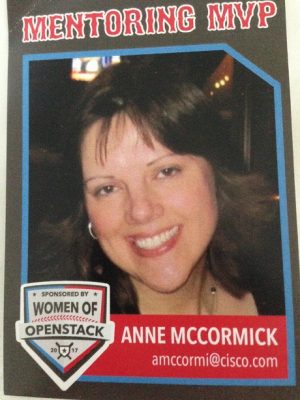
While in Boston, I’ve had the privilege of being involved in some of the activities sponsored by the Women of OpenStack. I participated in speed mentoring for the first time, which is kind of like speed dating, but for OpenStack (not nearly as awkward as it may sound, I assure you). The mentoring hat that I wore that day was focused on career mentoring, and it was an amazing experience to talk with several people who were either just getting started in their careers, or just getting started with OpenStack in particular, and to encounter their energy and enthusiasm. As part of volunteering for speed mentoring, I also signed up to hand out fliers for the session beforehand, and I can now sympathize with the people who work in mall kiosks and have to spend all day trying to attract attention. All kidding aside, people were really obliging, and the session was well attended.

In addition to speed mentoring, I’ve signed up for a six-month stint as an OpenStack mentor, which is also sponsored by Women of OpenStack. I’ve enjoyed getting to know my mentee and finding out what his goals and aspirations are, not just for OpenStack, but for his career in general. I’m finding that being a mentor is not just a way to give back to the community, though that in and of itself is amazing, but that it also energizes and inspires me.

Women of OpenStack activities include much more than just mentoring. Earlier in the week, there was a working lunch session that included lightening talks and a subsequent discussion. Also, there was a git and gerrit lunch and learn session, which has been included in several previous summits, and has been well received. And there is a Women of OpenStack lounge area for taking a break, and perhaps getting to know someone who is part of the community.

To close, I’d like to mention an interview that I did with my colleague, Sandhya Dasu, for The Cube this week, where we talked about Women of OpenStack and gender diversity issues.

Thank you for your time, and that’s it from Boston for now!

Authors

Anne McCormick

Software Technical Leader

DevNet

Avatar

We wrapped up the Hannover Messe event at the end of April in Hannover, Germany, and I can say one thing – Wow!  The official numbers are still not in, but there were an estimated 225,000+ attendees, 6500 vendors, 2,500 journalists from all over the world , and 5 full days of exhibits.  This is the Olympics of manufacturing shows where we also launched Connected Factory for Industrie 4.0, a suite of new products to help manufacturing customers on their digital transformation sprint:

https://www.youtube.com/watch?v=IUzQ547BF-E&feature=youtu.be

A Better Way to Tap into the Power of Your Data

Walking around a show dominated by robots and moving cars, and every Industrial Automation vendor, including partners Rockwell Automation, Intel, NetApp and Panduit in our booth, I also saw a continued trend towards digitization.  There are many vendors claiming the ability to open up data from the plant floor, in a variety of ways, the most popular being “IoT gateways”.  I would argue that adding additional hardware to liberate data may not the best way to break up the silos of information locked in different network protocols.  Additional hardware means more components in cabinets, more power supplies, more wiring, and increasing complexity and cost.  I also saw software solutions, which need to be run on industrial PC’s around manufacturing facilities.  That presents another challenge since managing a fleet of PC’s, with the maintenance and patching required for those systems means higher support costs, more downtime, and additional potential security risks.

An alternative method would be to use devices that you already require, and potentially have on your plant floor to do that data translation; your network switches with edge compute.  You already need a robust switching infrastructure, so why not use the capabilities of those switches to liberate the data from those old control system protocols?  Cisco partners like Telit allow you do just that on select Cisco switches.  Sorry to guzzle too much of my own kool-aid, but I truly do believe this is a better solution!

The Cisco Connected Factory for Industrie 4.0 suite helps our customers with the key solutions they need to enable their digital transformation:

  • Connected Asset Manager for IoT Intelligence— a software product that converges different levels of automation systems, discrete devices, historians, and business data systems to help monitor and manage all of their connected assets.  This can help you with tracking asset location and utilization, managing power consumption, and monitoringreal time equipment health data to enhance visibility.
  • The Industrial Network Director— empowers your operations teams with full visibility and control of your industrial automation network and a familiar user experience to drive up productivity.
  • Support for a new standard for Time Sensitive Networking specifically for deterministic applications to help our customers converge their industrial networks.

Check out our ebook for more details on these 3 solutions.

In short, Hannover Messe was a great show!  Check out this quick video wrap-up, and we will see you next year.

https://youtu.be/51m4CDkAHdI


Authors

Scot Wlodarczak

No Longer with Cisco

Avatar

Today, very few business leaders need convincing evidence about the benefits of digitization. That’s because they no longer ask “why” digitalization should be a business imperative. They’re at the “what” needs to be done stage – what are the steps IT must take to build a strong network foundation, on which the fruits of digitization can be realized.

Would you build a house without a foundation?

In most situations, the answer is no. The same applies when building a digital-ready network. But to build the right one (the what needs to be done), IT must know what they’re building for. The new foundation must withstand the “digital tsunami”. Let me explain.

What is the Digital Tsunami?

Today there a plethora of mobile devices, application types, and IoT sensors – some of which cannot be fortified within a branch perimeter. Every day, 15 petabytes of information are created. Anything that connects, will connect, expanding the surface area of attacks to as many as 20B devices by 2020 (Gartner). Together, the compounded effect of IT management, infrastructure and data security is the Digital Tsunami. It is the “perfect storm”, and if your network foundation is not methodically planned and thoughtfully built, your organization could be at risk of extinction.

Old Methods Won’t Work

The piece-meal approach of the past and present won’t work for the future.

The scope and complexity of managing possibly up to 1 million devices per IT person increases management complexity and security challenges, not just costs. In addition, if your organization still operates a myriad of disparate devices to accomplish required network functionality, such as network appliances performing WAN optimization, firewall protection, intrusion detection system (IDS) and prevention (IPS) or voice services operated alongside routers and switches, these devices will impede IT speed and flexibility, stifling innovations and business agility.

For these reasons, Cisco introduces Cisco Digital Network Architecture(DNA). One of the key innovations in DNA is Enterprise Network Function Virtualization (Enterprise NFV) and how that can be architected to resolve the challenges faced by IT teams in enterprise networks.

Enterprise Branch Virtualization with NFV

The NFV approach to branch virtualization opens up new technology avenues by providing a platform for customers to deploy virtualized network elements, as and when, required. Coupling this with an easy-to-use, end-to-end automation, orchestration and management framework, enterprises are able to:

  1. Significantly reduce costs by achieving a much better TCO than deploying multiple appliances for specific network services.
  2. Get better return on investment (ROI) by avoiding expensive truck rolls (technician dispatch costs) to enable services at their branches.
  3. Simplify the Day 0 and Day 1 deployments with a better Day 2 experience by gaining better visibility and serviceability of the network.

The key aspects of branch virtualization:

  • Simplicity—Reduce complexity from services and operations and provide more nimble and innovative business models. Gain the ability to manage all branches with a single pane of glass and respond to network challenges more quickly.
  • Agility—Gain flexibility in deploying services in a timely manner. Improve business efficiency in capital and operations by meeting the evolving business requirements, including traffic growth, diversity of traffic types, performance, reliability demands, and expectations.
  • Programmability—Leverage open APIs to enable better automation of network services while improving visibility.

Branch virtualization leverages a specialized platform customized to take care of NFV requirements and offload special functions, such as encryption and customized drivers, to provide increased performance for different NFV elements. These are the foundation blocks for building this next-generation branch network:

  • Customized x86 hardware to host VNF elements
  • Optimized hypervisor platform to launch VNF elements
  • Solid foundation of orchestration engine
  • Flexible I/O options for network connectivity
  • Enterprise class storage devices which provide higher performing IOPs and throughput
  • Secure development lifecycle, run-time integrity and secure standards

Cisco DNA provides the hardware, software and management building blocks to achieve the simplicity and flexibility required by CIOs and IT managers in today’s digital business landscape.

Read more about network virtualization:

Extend Virtualization Beyond The Branch

Make network virtualization a reality with Cisco DNA Virtualization

Lookout for part two of my Enterprise NFV design recommendations blog series soon.

Authors

Jay Chokshi

Director Product Management

Enterprise Networking

Avatar

Google XTC and you find out it was an English rock band formed in 1972 and active till 2006 … It probably does not ring a bell to most of you – at least for me, I can’t recall any of their songs. XTC had another connotation in the 1980’s, but that’s not the point here either.

So, what does XTC mean in the context of networking?

XTC is the acronym for XR Traffic Controller and can be considered as a Path Computation Element (PCE). PCE has been around for quite some time now (e.g. RFC4655 has been published back in 2006), so what’s really noteworthy about XTC?

The uptake of SDN and the increasing level of network automation shed new light on the major role a PCE can play to deliver a new and broad range of advanced network services.

As an example, Service Providers have been exploring solutions to run their networks hotter, e.g. to make the most optimal use of their infrastructure assets. Traditionally, providers run their networks at about 45% utilization but have the objective to run it at around 70% percent of capacity. This can be accomplished only if you have a feedback loop that can extract real-time information from the network, compute and analyze this data and then dynamically reprogram the network.

Telemetry combined with Segment Routing and XTC can deliver such a feedback loop.

So, what’s the role of XTC here?

You can make an analogy with Waze, the traffic and navigation app you’re likely have on your smartphone. Waze is collecting live traffic information from drivers’ smartphones to get the most accurate view of the traffic, then processes these data to compute the most optimal route to user’s destinations of choice.

XTC does to networking what Waze does to traffic jams.

XTC has 3 main elements – SouthBound interfaces, NorthBound interfaces and a core component that does algorithmic computation.

Compute

As Segment Routing was designed from the ground up to seek the right balance between distributed intelligence and centralized optimization, we quickly realized that the algorithms we had for RSVP-TE could not be reused as such. We had to come up with brand-new algorithms that fully leverage the new paradigm Segment Routing was setting. That’s exactly what we did and that’s what sits at the very heart of XTC.

SouthBound interface

XTC is collecting network topology information through multiple routing protocols: OSPF, IS-IS, BGP Link-State (BGP LS). The topology database is by design multi-domain to overcome the limitations of former Traffic Engineering solutions. This end-to-end topologic data view can be supplemented by a bunch of other information extracted from the network by model-driven telemetry.

XTC is making use of PCEP (Path Computation Element Communication Protocol) to push updates to the network.

NorthBound interface

This is a very important interface for integration with other applications/products. You don’t want to be overly innovative here but you want to make sure you deliver the right set of protocols that are widely used in the industry – you name them NETCONF/YANG, REST/JSON and gRPC.

Let me now give you 3 examples of Use Cases that XTC enables.

Disjointness

XTC can compute two distinct paths (not sharing the same fiber, not sharing the same duct and so on …). That way, you increase network resiliency and can offer advanced SLAs to your end-customers.

Low Latency

XTC can compute a path where latency is guaranteed and is delivered below a certain threshold. With looming 5G and its latency-sensitive applications such as self-driving cars, this will be an increasingly important service the network will have to deliver.

On-demand Next Hop

Provisioning multi-domain services (L2VPN & L3VPN) comes with complexity and scalability issues notably when routing information needs to be redistributed across domains … With the On-Demand Next Hop (ODN) feature, there is no need to do any redistribution. ODN does trigger delegation of computation of an end-to-end LSP to XTC, including constraints and policies.

XTC addresses Traffic Engineering limitations in large, multi-domain networks where path computation is complex due to limited visibility into neighboring domains, such as another Autonomous System or neighboring IGP areas.

You may ask yourself whether this product is shipping or under development. The good news is XTC is already shipping but the even greater news is that it has already been implemented in live networks!

Stephane Litkowski, Network Architect at Orange Business Services, not only tested the product but also rolled it out in live networks. Discover what he has to say about XTC:

“In the framework of SDN and network automation, the Path Computation Element (PCE) is a critical piece for steering the traffic in the IP/MPLS network. The distributed traffic engineering model that has been used for years has unfortunately some limitations like non- optimal LSP placement and the inability to provide disjoint paths starting from multiple head ends. The introduction of a central computation (the PCE) in a network allows to solve those limitations.

In the market of PCEs, where the product architecture may be complex to deploy and operate, Cisco XTC feature (provided in IOS XR) provides a very simple way to implement a PCE in the network as it is managed as a regular IOS XR network node. XTC has been intensively tested in our labs, and we demonstrated that it can provide disjoint paths (for both RSVP-TE and Segment Routing LSPs) with an optimal LSP placement whatever the disjoint flavor requested: link disjointness, SRLG disjointness, node disjointness…

XTC has been successfully deployed in our network to provide a path disjointness service and it runs as a virtual machine (thanks to virtual IOS XR).

We are also working on some global network optimization scenarios leveraging on the northbound API available on XTC to program the network.

XTC is definitely a simple and powerful PCE solution for both RSVP-TE and Segment Routing: easy to deploy, easy to operate, with powerful algorithms and programmable interfaces.“

I hope this blog triggers your ideas for interesting new use cases. If that is the case, please reach out to us to discuss them. We value your ideas and we are always ready to partner.

If you want to see XTC in action, go and watch the recording of this SDx Central Demo Friday webinar on Multi-Domain Network Optimization and Simplification – Why and How…

Authors

Frederic Trate

Marketing Manager

Service Provider Business Architecture, France

Avatar

Making a trip to the doctor’s office isn’t a whole lot of fun for anyone. But if you happen to be in jail, well, it’s downright grueling.

You can probably picture it based on what you’ve seen on TV and in the movies: the searches, the restraints, the uncomfortable bus ride–all part of the reason why inmates often refuse to see a doctor if it means being transported to another facility.

But avoiding doctor visits can lead to some pretty bad outcomes down the road, especially when your health isn’t great to begin with. According to the Bureau of Justice, 44.7% of jail inmates report having a chronic condition such as hypertension or diabetes–nearly twice the rate of the general population (26.9%).1 And when it comes to mental illness, the numbers are even higher. More than half (64.2%) of inmates have a mental health problem, compared with only 11% of the general population age 18 and older.2

When New York City Health and Hospitals, the largest municipal health care system in the United States, went looking to solve this problem, they found the perfect solution–in technology. How? You guessed it: telemedicine. For clinical encounters that don’t require a physical exam, it’s the perfect fit. Video-based telehealth is already taking off in private healthcare organizations (see our infographic for more on this rising trend), so it only makes sense that it would work in a public setting, too.

So far, the telehealth program is going very well–with plans to expand in the future.

One early success is the management of Hepatitis C, a viral infection common among inmates. (According to the CDC, there are 2.2 million people in U.S. jails and prisons, and one in three have the disease.3) Using telehealth to treat Hepatitis C is “a relatively new approach,” said Dr. Dr. Vingh Pham, an Infectious Disease Specialist at Bellevue. “But with Cisco collaboration, it feels very natural.” He notes that every telehealth session to date has ended positively, without the need for security intervention.

Click the button below to read more about NYC Health + Hospitals’ journey to improve the patient and staff experience, reduce transportation and security costs, and see more patients in less time.


Sources:
1. Bureau of Justice Statistics, Medical Problems of State and Federal Prisoners and Jail Inmates, 2011–12 (NCJ 248491).
2. Bureau of Justice Statistics, Mental Health Problems of Prison and Jail Inmates (NCJ 213600).
3. Centers for Disease Control and Prevention, Hepatitis C & Incarceration (Publication No. 21-1306).

Authors

Amy Young

Marketing Manager

Healthcare

Avatar

A loaded question? Perhaps. But in today’s digital landscape it is one that many companies are trying to answer.

Regardless of industry, brands that wish to remain competitive and offer optimized services and more engaging customer experiences are seeking digital flexibility. Many have turned to cloud computing to achieve these goals and more, including reduced operability costs and streamlined efficiency.

We’re all more than familiar with the “big three” when it comes to cloud deployment – public, private and hybrid. However, while the cloud-obsessed among us can jump headfirst into the flurry of discussion around cloud, the changing nature of cloud services, exposures that are out there and the fear of being “locked-in” with one provider, often leave business leaders left to ponder if there is a way they can enjoy the best that all of these options have to offer. In other words, how can they have all of the cloud, without being “locked in?”

Providers Are Feeling the Push

In many ways, it’s up to providers to assist customers in answering this question. In an effort to avoid rapid commoditization, cloud providers have rapidly moved “up the stack”, providing higher level services on top of their IaaS. That means brands are in a mad race to separate themselves from the pack, presenting to customers a plethora of cloud features that will both attract workloads to their cloud but also create “stickiness” once there, making the tension between portability and provider lock-in seem less significant.

The Case for Agility, Flexibility and Portability

With technology in general, today’s latest and greatest development is tomorrow’s “remember when” tech segment, making the case for agility, flexibility and portability within cloud networks that much stronger. This means a greater adoption of hybrid cloud strategies by businesses that want (and need) these benefits to mitigate cost complexities, support today’s (and future) innovation ambitions and enhanced security.

Recently, IDC found that 73 percent of enterprises are pursuing a hybrid cloud strategy and that 68 percent are running more than one or two apps in both public and private cloud environments. What’s behind these surges? Various use-cases – higher availability in disaster recovery, keeping operations on pace with developers and dynamic capacity expansion – are just a few driving hybrid cloud adoption.

So How Can Cloud Customers Have It All?

Now on to our answer.

I honestly feel cloud customers can have it all by simply choosing a cloud management platform that lets one optimize portability, remaining cloud agnostic for core primitives such as compute, storage and network, and that also allows one to easily model unique services offered by the cloud provider as a part of an application profile and model. They can use one management platform to be portable or make a conscious choice to get sticky with one cloud. But the key is that the choice remains theirs and that they get to choose. As they weigh their options, customers should see if they value unique services provided by any one cloud and determine if these unique features are portable or if other providers have equivalent services.

The cloud landscape, in many ways, is still relatively very young. The terrain is always changing, which leaves a lot of room for innovation. However, the outage of Amazon Web Services (AWS) S3 proves that malicious agents are out there.

All of us at Cisco have a unique vision for cloud to reach its full potential. Hybrid cloud is very important to this vision because having one environment is not as effective. We know our customers need a new approach to move their applications to environments of their choosing. In spite of skepticism around hybrid cloud, we stuck to our principles and beliefs to create Cisco CloudCenter’s scalable architecture, “deploy on demand” infrastructure and a cloud-agnostic blueprint, enabling cloud customers to modernize their data center as they see fit. So they can yes – have it all.

Authors

David Cope

Senior Director, Cisco CloudCenter

Insieme Business Unit (INSBU)