
Avatar

This post was guest-written by Marie Zwickert, Corporate Social Responsibility Manager, Cisco

As a manager for Cisco’s corporate social responsibility programs, I focus on public-private partnerships that support an inclusive digital economy, specifically by applying technology to create positive, sustainable change in education and workforce development.

At Sustainable Brands’17, during a panel ‘How to Use Technology and Creativity to Boost People Upward in a Rapidly Changing Job Market,’ I shared insights into one of these programs, the Cisco Networking Academy, which is providing digital skills that boost people upward in today’s rapidly changing job market.

As Cisco’s largest and longest running CSR program, Networking Academy has provided IT skills education and career support for nearly 20 years, reaching 6.9 million students at 9,600 academies in over 170 countries since 1997.

Digitization is connecting cities, companies, countries and people, and igniting growth in new ways. By 2020, 70% of the global population will use a mobile phone and 93% of people in the U.S. will use the Internet.[1]

It is creating new jobs (research shows 1.4 million full-time and an additional 300,000 entry-level employees will be needed to deliver IoT services by 2020[2]) and new job functions, such as network managers, business analysts, and product designers.[3]

Though demand for workers with IT skills is growing, there is currently a mismatch between the skills employees have and the skills companies need. While more than 7 million people across the U.S. were unemployed in March 2017[4], there were simultaneously 5.7 million unfilled jobs[5] and nearly half of U.S. employers couldn’t find qualified candidates.[6]

This is where Cisco’s Networking Academy comes in. Our program provides the balance of technical skills, business understanding, and innovative thinking that employers seek today. Networking Academy reached over 1 million students worldwide in 2016 alone, with 120,000 in the US. Since 2005, 1.4 million graduates have reported the program helped them obtain a new job after completing the program.

We provide foundational and career-ready skills in networking and IT and constantly develop new courses to keep our curriculum relevant, such as IoT fundamentals, a new three-module course that covers big data, analytics, and device connectivity, some of the fastest-growing job areas.

Additionally, Networking Academy’s dynamic, hands-on program focuses on collaborative learning via activity to develop deeper, transferrable problem-solving skills. From the start, Networking Academy students are encouraged to work together and collaborate to solve real-world problems.

For example, Cisco’s Packet Tracer, a network simulation and visualization tool, is free to anyone in the world who registers and allows for student-directed, open-ended networking building. Our students are challenged to develop entrepreneurial skills through courses such as “Be Your Own Boss”, as well as in-person and remotely-accessed lab competitions and hackathons.

As you’ll see in this video, Cisco’s Networking Academy also fosters dynamic partnerships to give our students real-world experience, like the one with the National Basketball Association. Since 2015, 135 top students have participated in 23 global NBA events, like the NBA Draft and NBA all-star game.

Networking Academy curriculum is delivered through traditional and non-traditional education channels, reaching learners across a broad spectrum of life-stages, across diverse backgrounds and career paths.

Courses are offered to high school, community college and university students, professionals looking to re-skill or find new jobs, and those in traditionally underserved communities such as remote populations, veterans, prisoners, people with diverse abilities and those at rehabilitation centers.

For example, many of our students worked in non-technical fields before enrolling in Networking Academy. One of these students, Rebecca Baca, was a 27-year-old single mother living with her parents in Albuquerque, New Mexico, when she enrolled. After several years working in low-paying hospitality jobs, she wanted to make a better life for herself and her daughter.

Though she had very little computer knowledge, through hard work, dedication, and supportive mentors, she completed her CCNA courses, landed an internship at Network Architects and after three months was offered a full-time job.

Using the business skills she learned at Networking Academy she was able to move into project management and was the first woman in the organization to become a project consulting engineer. Millions of students like Rebecca have changed their lives through the Cisco Networking Academy, and we encourage you to read their stories.

In addition to providing the workforce needed to transform industries and change people’s lives, we believe we can go further and empower a new generation of global problem solvers that apply their digital skills to address our most pressing societal issues, such as water scarcity, climate change, and economic inequality.

With digital skills, we can leverage technology to reach more people faster, use data to make better decisions, and innovate as technologists to develop solutions that have a positive benefit on people, society, and the planet.

This year marks 20 years that Cisco Networking Academy has been working to foster the digital and entrepreneurial skills people, educators, and companies need to change the world for the better. There has never been a better time to leverage digitization to create the workforce of tomorrow and empower a new generation of global problem solvers.

We invite you to review the below presentation, given at the Sustainable Brands ’17 Conference, and hope it inspires you to join us!

https://www.slideshare.net/Cisco/changing-lives-tomorrows-digital-workforce-and-a-new-generation-of-global-problem-solvers



[1] VNI Forecast Highlights Tool, Cisco, 2016
[2] Launching a Generation of Global Problem Solvers, Cisco, 2015
[3] Ibid
[4] Employment Situation Summary, U.S. Bureau of Labor Statistics, 2017
[5] Job Openings and Labor Turnover Survey Highlights, U.S. Bureau of Labor Statistics, 2017
[6] 2016-2017 Talent Shortage Survey, Manpower 2016

Authors

Austin Belisle

No Longer with Cisco

Avatar

Here’s one of the big questions facing cable operators today – can their existing HFC infrastructure, built on a proprietary analog network, meet their evolving technical and business requirements?

Once an integral component of the cable access architecture, the proprietary analog network is now the weakest link. It limits an operator’s ability to scale to consumer bandwidth demands, it’s expensive to own and operate, and the racks of equipment required to convert digital services for analog optical transmission – are costly to manage, power and cool. They also occupy some very valuable real estate in the hub site.

Legacy CMTS platforms add to the problem. To compete with pure fiber, cable operators must scale bandwidth to meet the needs of the market. In the past, they relied on two “tried-and-true” techniques to achieve this end – segmentation and spectrum management. Unfortunately, network segmentation to improve bandwidth distribution has all but reached a physical limitation with legacy CMTS platforms. And adding more “boxes” in already cramped hub sites is not the answer. These kinds of network changes are complex, expensive and don’t solve the long-term problem.

The HFC architecture, however, is not all bad. Remember, that the “F” in HFC stands for fiber and wonderful things can happen when networks convert from analog to digital using fiber. Costs are lowered, performance is enhanced, management is improved through telemetry and automation, which together can be used to simplify every step of the operational lifecycle.

Today, Cisco announced the availability of its Infinite Broadband solution, which uses Remote PHY technology to overcome the limitations of analog fiber and break through the HFC bottleneck. In its most basic form, Remote PHY unlocks major bandwidth increases in existing access networks, allowing cable operators to transform their infrastructures to simpler all digital networks, reduce space and power requirements in the hub, and enable higher bandwidth for each subscriber.

How does it work? Together, Remote PHY and DOCSIS® 3.1, two CableLabs standards, expand the capacity of cable HFC plants. With the Cisco® cBR-8 converged broadband router and GS7000 node platforms, Remote PHY reduces power, cooling and space requirements, all resulting in significant total cost of ownership (TCO) benefits. These technologies are also the foundation for Cisco’s virtualization and Full Duplex DOCSIS strategy.

Cisco’s Infinite Broadband solution has two key differentiators that deliver tremendous value to cable operators. The first is the RPHY platform’s open, standardized software, which allows cable operators to select an Remote PHY device (RPD) vendor that best meets their needs, without being locked into a single vendor’s proprietary solution. Cisco contributed their open software to the Cable Labs OpenRPD forum and its ecosystem of RPD vendors in 2016.

To help facilitate better interoperability among different vendors participating in the OpenRPD ecosystem, Cisco has launched a program to allow RPD vendors to test their interoperability with the Cisco cBR-8 Remote PHY core. This testing will be conducted at a third-party industry lab and will follow specific acceptance testing plans. Ultimately, this work will accelerate time-to-market of Remote PHY architectures. Among the companies that have committed to participate in the initial rounds of testing are VECTOR Technologies, BKtel networks, and Teleste.

The second key differentiator is Cisco’s RPHY deployment automation software based on model-driven network configuration protocol (NETCONF) and YANG technology. Cisco’s vendor-agnostic cable automation software ensures that the new Remote PHY devices can be easily and automatically provisioned, resulting in significant savings over existing manual provisioning solutions.

As Sean Welch, vice president and general manager of the Service Provider Infrastructure Group recently noted, “RPHY is the next step in the evolution to an all-IP network that is faster, more scalable, and simpler to operate. RPHY provides a foundation for further network evolution, such as Infinite DOCSIS and Cloud Native technologies, allowing our customers to reduce the total cost of ownership, while keeping their cable networks competitive for the future.”

If you’re in Cologne this week for the ANGA COM 2017 event, we invite you to stop by Hall #7, Booth E10 to see our cable access evolution path across key technology areas including infrastructure, virtualization, management and automation in action.

To find out more about Infinite Broadband solution, visit the cable access solution page on cisco.com or download our Road to Cisco Infinite Broadband E-Book today.


Authors

Daniel Etman

Product Marketing Director

Cisco's Cable Access Business

Avatar

The data from an integrated video platform has huge potential to make advertising more effective.

Updating their video infrastructure makes it possible for telecoms companies to supply the flexible and personalised services that their customers increasingly expect.

That’s a pretty big deal – but it’s just the start. An integrated, cloud-based platform like the Cisco Infinite Video Platform can also be the springboard to a wealth of further revenue opportunities.

We now live in a world of big data. Service providers know a huge amount about their customers’ viewing habits – what content they have watched, and when and where they have watched it. As the volume of content and number of devices used to consume it grows, these businesses are able to understand what makes people tick in ever-greater depth. And they’re now beginning to explore the potential of this insight.

A detailed picture through integrated data

Typically, service providers use separate distribution pipelines for broadcast, cable, on demand and over the top content. But the Cisco Infinite Video Platform brings all of these together into a single platform. As well as making it possible to deliver services more efficiently, this brings together all the customer data into one place, providing richer information that is easier to analyse.

This means they can develop a sophisticated understanding of people’s tastes, personalities and interests. And this can be combined with demographic information from billing data to create an even more detailed picture – which allows them to show people advertising that’s likely to interest them.

If a service provider knew that someone was keen on watching health programmes, they could advertise them fitness DVDs and nutritional supplements. And by linking this information to their location, they could also promote relevant businesses in the viewer’s local area. Data on age, income, and other interests could be used to personalise the advertising even more specifically.

A growing revenue opportunity

Seeing the potential in this area, some service providers are now creating their own advertising platforms.

Sky’s AdSmart allows companies to target advertising using 90 attributes such as their life stage, affluence and local area. We are familiar with this kind of precision for advertising on websites. But the difference with video is that it is linked to some of people’s most intense and enjoyable experiences – whether that’s a thrilling live sports broadcast or the latest must-watch TV show. And the lower costs compared to traditional advertising mean that this is now possible for emerging brands as well as major players.

Jamie West, the deputy managing director of Sky Media, explains the appeal by saying: “What brands are really trying to capitalise on is that amazing brand-building power of TV. AdSmart enables advertisers to target who they want, when they want, and how they want”.

Some companies have already achieved real results using the platform. An AdSmart audience were 62% more likely to have bought Lego after seeing advertising, and a Ford dealership saw a 100% rise in sales following a campaign.

A mutually beneficial relationship

But we’ve only begun to glimpse the possibilities of targeted advertising. As systems generate more data and we get better at understanding it, we’ll increasingly see the business benefits being realised.

The better you know people, the easier it is to let them know about products and services they are likely to want. And viewers are less likely to find advertising intrusive when it’s of genuine interest. So an integrated video platform brings service providers the opportunity to create a mutually beneficial relationship with customers, that’s always improving.

An investment in the Cisco Infinite Video Platform can pay dividends in more ways than one.

Find out about the integrated video technology that can enable you to develop significant new revenue streams. Get more resources here.

Authors

Adam Davies

Technical Leader, Engineering

Service Provider, Video Solutions

Avatar

Catching up on emails some two months after the event, I finally got a look at the impressive Wi-Fi network metrics from Mobile World Congress (MWC) 2017, where Cisco again worked with the GSMA to successfully provide one of the world’s largest carrier-grade Wi-Fi networks.

During the event at the Fira Gran Via in Barcelona, more than 108,000 attendees from 208 countries had access to free Wi-Fi on the high-density network consisting of Cisco SP Wi-Fi and Cisco Meraki solutions. During the four days over 100,000 Internet-connected devices generated a total of 59 terabytes of traffic. An analysis of the unprecedented volume of Wi-Fi data reveals some interesting facts:

  • Over 100,000 Internet-enabled devices were connected, a 4% increase over MWC 2016;
  • 3 gigabytes per second of peak Internet traffic was achieved;
  • 59 terabytes of data were carried, a 17% increase over the prior year;
  • Peak concurrent devices reached nearly 30,000;

Delivering a carrier-grade Wi-Fi service in a venue as large as the Fira Gran Via requires precise planning, monitoring and management. A team of Cisco network engineers worked closely with the Fira staff in the months prior to the event to prepare the network for the four-day conference and exhibition. This year, we saw that the Wi-Fi network became more important to a successful MWC event than ever before. Attendees received high-speed Wi-Fi service for business and general communications use, and the Fira offered tiered Wi-Fi services to meet the varying needs of exhibitors in the halls. As we’ve done in previous MWC events, Cisco is proud to have played an important role in making this happen, and to have collaborated closely with the Fira de Barcelona and the GSMA to deliver a great experience for the event.

Watch this video for a nice summary of the Cisco Meraki and Universal Wi-Fi solutions in action at Mobile World Congress:

https://www.youtube.com/watch?v=VmfwTY32WDI

Authors

Brian Walsh

Senior Marketing Manager

Avatar

Today, Talos is publishing a glimpse into the most prevalent threats we’ve observed between May 19 and May 26. As with previous round-ups, this post isn’t meant to be an in-depth analysis. Instead, this post will summarize the threats we’ve observed by highlighting key behavior characteristics, indicators of compromise, and how our customers are automatically protected from these threats.

As a reminder, the information provided for the following threats in this post is non-exhaustive and current as of date of publication. Detection and coverage for the following threats is subject to updates pending additional threat or vulnerability analysis. For the most current information, please refer to your FireSIGHT Management Center, Snort.org, or ClamAV.net.

Read more »

Authors

Talos Group

Talos Security Intelligence & Research Group

Avatar

In my last blog post, we discussed how the Cisco SAFE methodology can help you to implement a reliable security solution for your store. This approach can help you define and address each threat to the retail branch with corresponding security capabilities, architectures, and designs – guiding you to a complete security solution against everything from worms to ransomware attacks.

Now, let’s take a closer look at the methodology itself. For a true security solution, your store needs to be protected on a number of different fronts, or “attack surfaces.” The SAFE methodology breaks these down into five core components: Humans, Devices, Access, Distribution/Core, and Services.

The 5 components of a secure store

1. Humans 

The people who use your store network are generally either employees or remote access users such as partners (increasingly supply chain partners). No amount of technology can prevent successful attacks if people in your company, both internal and partner users, aren’t trained to keep security in mind. That’s why we recommend complementing your security technology with regular awareness training and acceptable use policies for internal users, partners, and customers. In other words, security is also a change management responsibility.

2. Devices

Mobile devices such as tablets and phones are also part of the security architecture. This means that, if you aren’t using the network as a sensor, you’re not secure. Such visibility allows for effective containment through intelligent architectural design. It’s equally important to ensure that client devices are secure and that malicious devices are promptly quarantined.

3. Access

The access layer is where users and devices connect to the company network. As you can imagine, this is a major target for hackers and should therefore be the first line of defense within the Secure Branch architecture. For example, the access layer is where the recent WannaCry attack took place, over a Microsoft-based TCP port. The network as a sensor uses flow analytics to capture anomalies and provide visibility to attacks. Its purpose is to identify the users, to assess compliance to policy of devices seeking access to the network, and to respond appropriately.

4. Distribution/Core

In-store networks have traditionally been built with the singular purpose of connecting point of sale (POS) systems to the corporate network. Recent security breaches, however, make it clear that such network architectures are no longer viable (Cisco, 2016). Instead, by segregating access from services, the core separates business traffic into discrete flows, helping assure security of cardholder and other data.

5. Services

Services connect the Secure Store to the outside data center, cloud, and Internet via service providers. It connects the access and distribution layers inside the branch to the security and inspection capabilities as well.

Thinking about applications

The 2016 Cisco security study also found that the highest security risk came from connected third-party cloud apps: nearly one-third (27 percent) of these apps created an issue. These open authentication connections touch the corporate infrastructure and can communicate freely with corporate cloud and software-as-a-service (SaaS) platforms after users grant access. However, the Ponemon Institute also found that application security controls can minimize the cost of cybercrime, and that overall, a strong security profile lets companies innovate while reducing the average cost of cybercrimes by nearly $3 million annually (2016).

Never stop thinking about security

A multi-layered approach to security such as SAFE can help you increase visibility and preparedness before, during, and after an attack. This enables a stance of constant readiness, response, and resiliency, and is designed to address threats throughout every business operation, process, and interaction.

For a more detailed description of the SAFE methodology in the branch, please see the new report, Why Hackers Love Retail: And What You Can Do About It with Cisco SAFE.

Be sure to follow Cisco at @ciscoretail.

Authors

Mary Freeman

No Longer with Cisco

Avatar

Written by Shawn Tylka, Cable & Media Field Marketing Lead

Cisco is committed to the transformation underway in media, a vibrant and growing industry, and the National Association of Broadcasters Show (NAB) is a key opportunity for us to show off what we have been up to and how we are helping advance the industry. Cisco has exciting technology for media companies, but with the traditional video clips of sports loops, grand landscape loops, and movie menus, even the coolest technology can seem canned.

Live 4K capture

Looking around at all the amazing television shows available today, the marketing team wondered how we could enhance the demo experience within our booth at NAB, improve the content we were showing, and excite our customers with our solutions. At the same time we wanted to push the envelope to show live feeds with our demos. It was a challenge, but an exciting challenge.

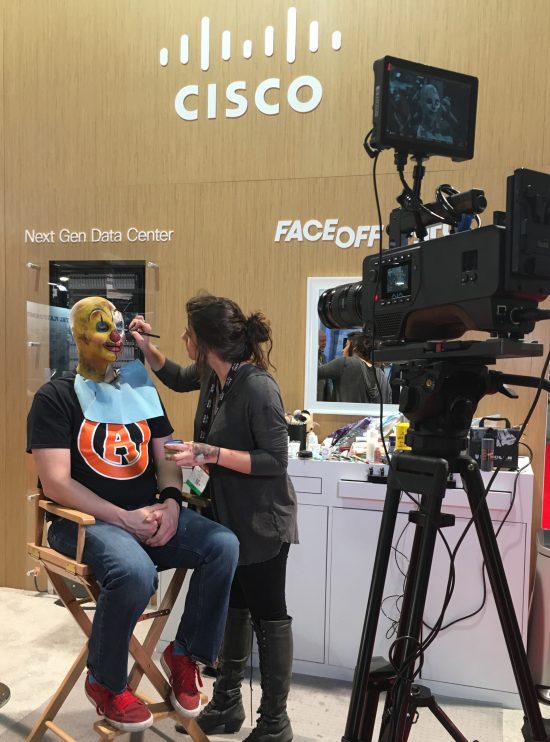
We partnered with Syfy and Mission Control Media, the producers of Syfy’s special effects make-up competition series, Face Off, to help showcase Cisco’s capabilities.  Over the course of the four day show Face Off All-Stars, Jasmine Ringo and Emily Serpico, transformed seated models into elaborate characters and monsters.

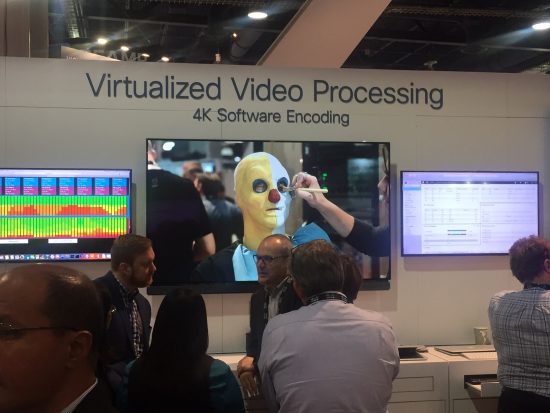
Our in-booth production required a 4K camera manned by an operator from Cisco TV, our in-house broadcast production outfit, who worked closely with the artists during their make up production. We had two new characters created daily. Each step of the make-up application was filmed and shared in 4K video, crossing the footprint of our booth, and creating stunning visuals and a hum of excitement. Customers and show attendees stopped by to check on progress of each character as it came to life. Seeing the live feed started new technical conversations, and it was all live!

Technically, this was a real-world demonstration of glass-to-glass live IP production. For those in the industry still on the sidelines on whether IP networking is ready for live production: we carried uncompressed video, at 12 Tbps over our IP Fabric for Media solution based on Cisco Nexus 9000® switches – continuously for 30+ hours over 4 days!

If you are worried about the transition from SDI to IP, we had the 4 traditional cables from the camera (3 Tbps each) accessing the network through an Evertz gateway, which converted the video to IP packets. Yes, I did just say Evertz. We’ve worked hard to make our IP Fabric for Media an open foundation for the industry, and with an open API, the broadcast vendors have responded favorably. And did I mention the integration? API simple. Next, we compressed the video down to a 20 Mbps 4K stream using Cisco HEVC software-based encoders running in the virtualized data center infrastructure at our booth. Live content and recordings were distributed to the 4K screen in our booth: IP. Cloud. Virtualization. 4K.

Working live production into a Cisco booth was a challenge, but we made it possible. Having a cool and artistic way to feature Face Off in our booth, and demonstrate our amazing technology made it all worth it.

Authors

Yoav Schreiber

Marketing Manager

Service Provider Video Marketing

Avatar

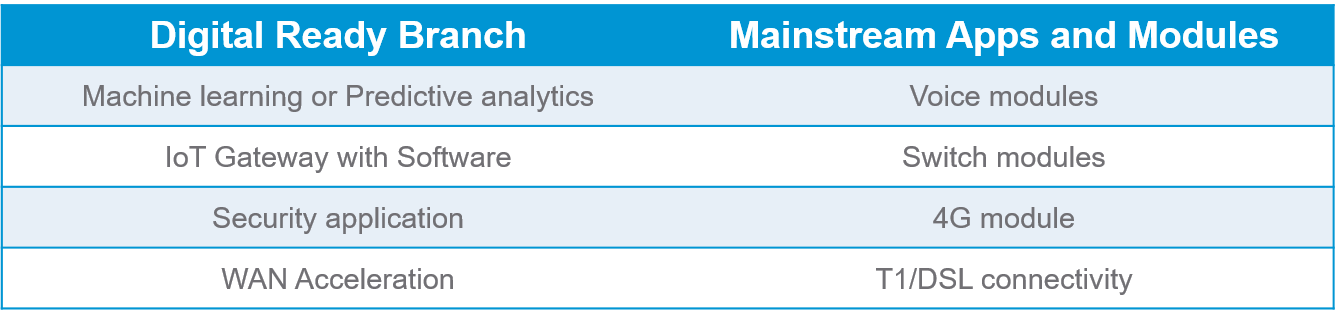
Today CIOs are stuck in the midst of technology trends. On the one hand, CIOs are under pressure to grow the business by transforming their traditional branch to a digital-ready branch. On the other hand, network admins ask for continued investment in mainstream applications to streamline day-to-day operations.

The dilemma is that CIOs cannot forgo investment in mainstream applications because those applications are the foundation of branch IT. But, to win against competition, CIOs need the features of a digital-ready branch. This leads to an allocation challenge because IT budgets are limited. In essence, this is a

Chicken-and-Egg problem:   CIOs want a digital ready branch to enable growth, but growth is required in order to increase the IT budget and invest in a digital ready branch.

This problem grows larger as businesses expand to global locations in search of growth and continue to invest in low quality products, which eventually need to be replaced. Before your business dies under its own weight or it is too late, CIOs need a solution.

Solution:

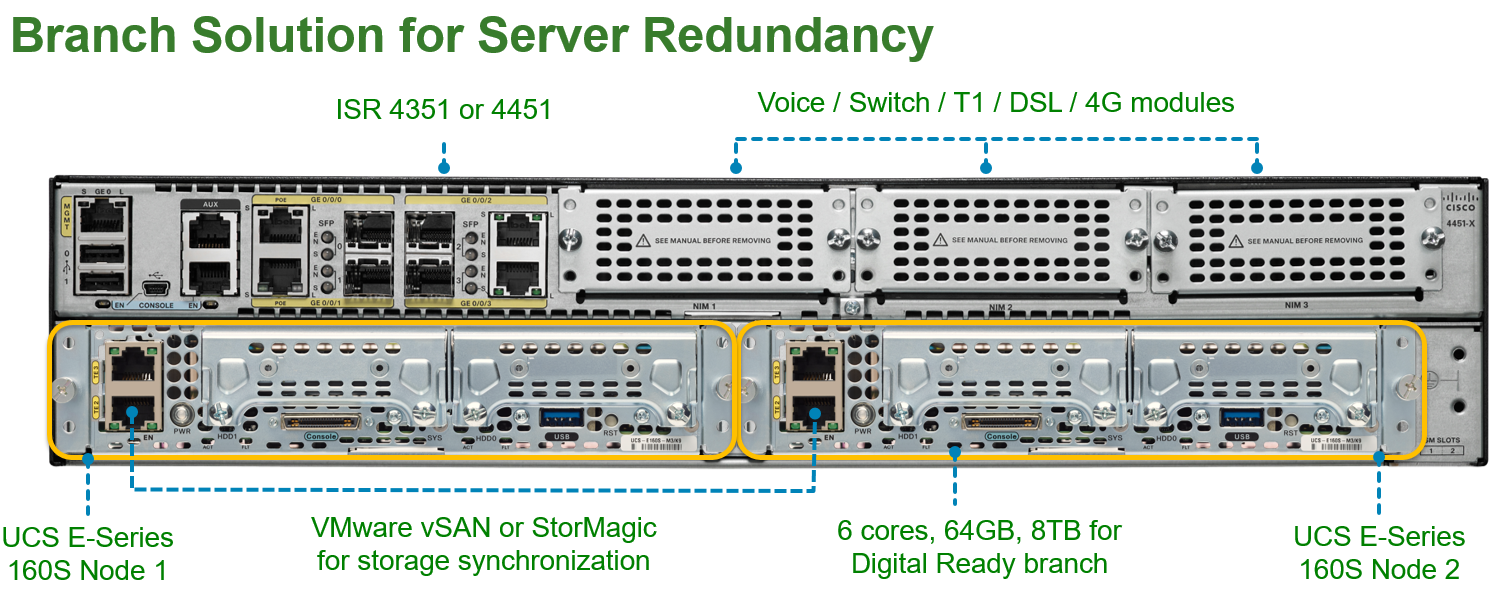
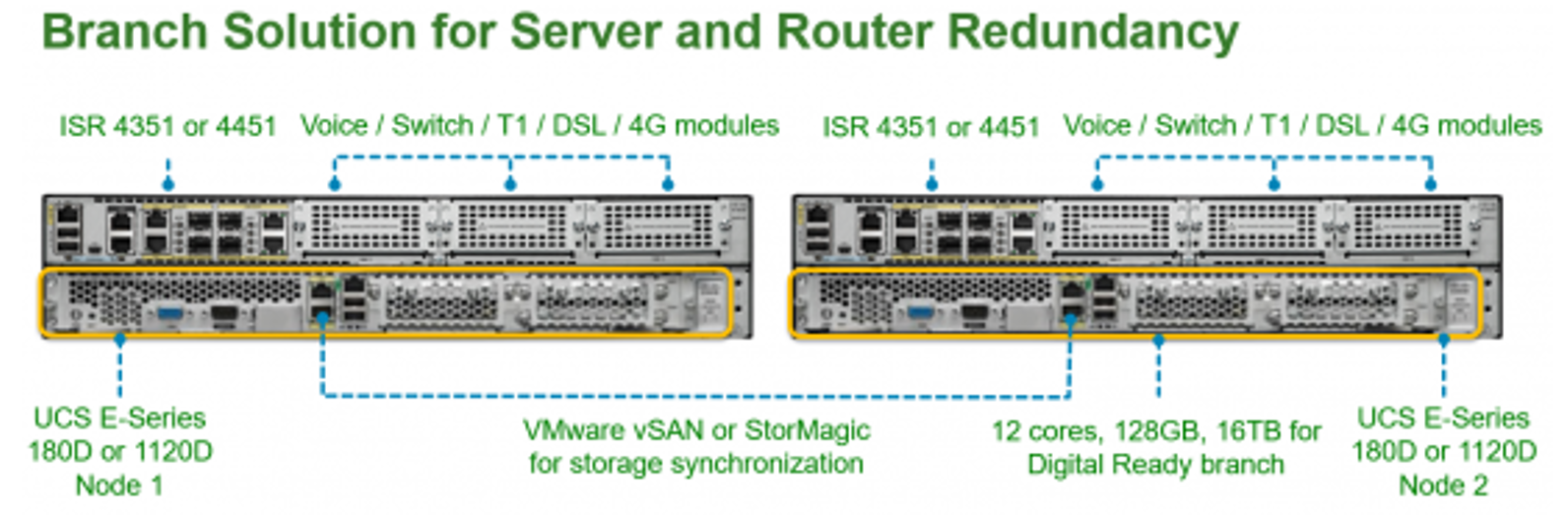
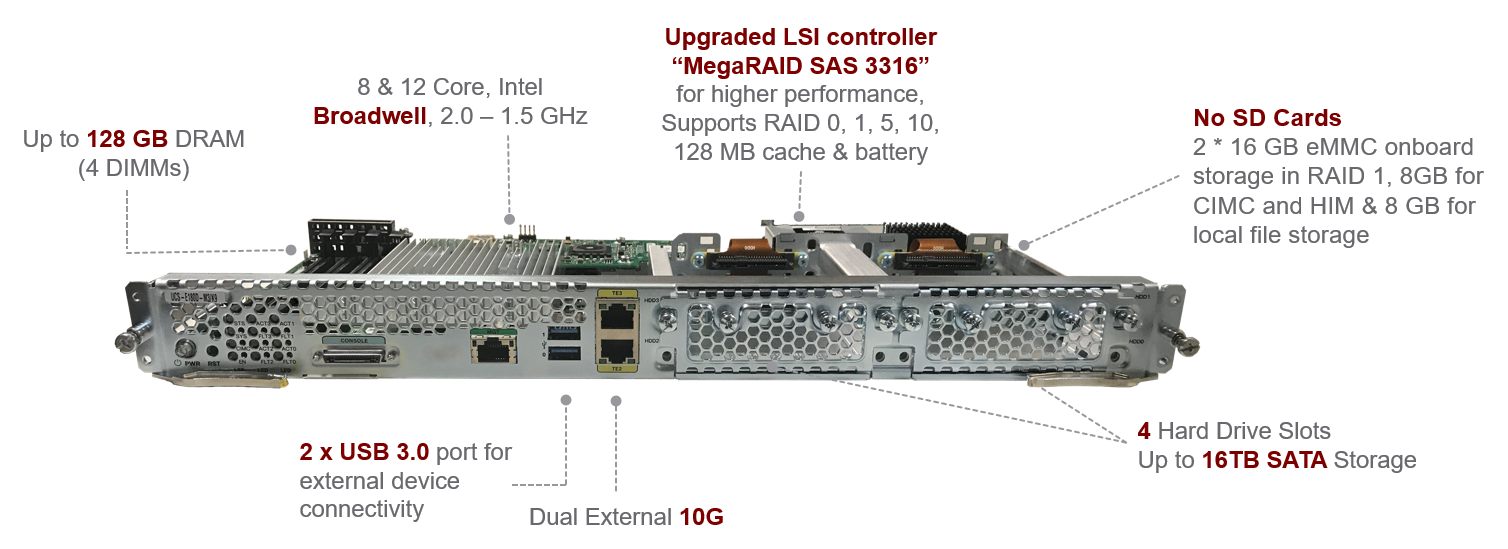
Cisco has your back! We solved this problem by designing a solution that does not need huge investment to transform your branch into a digital ready branch. After listening to many customers, we took this engineering challenge and innovated extremely dense yet powerful computing platforms (UCS E-series M3) for modular ISRs (Integrated Service Routers). Together with ISRs and new UCS E-series M3, our partnership with leading vSAN providers (VMware and StorMagic) and a wide variety of modules offer an unparalleled hyper-converged solution for your branch. With the following benefits, it is undoubtedly the best solution:

  • Less Incremental Cost – Add a new blade to your existing Cisco ISRs to enable a digital ready branch
  • Ease of Management – a highly consolidated solution that allows you to run both mainstream and digital-ready applications in one box
  • Effortless Scalability – scale to 1000s of branch offices with a single centralized orchestration software
  • Highly Real Estate Efficient – no other product can host all apps and modules in as small a footprint
  • Hyper-converged Capability – our solution is offered at a fraction of the cost of other market solutions


3 Key Differentiators:

  1. Broad palette of modules for Voice, Switch, T1, DSL, 4G and more.
  2. High Availability offerings from our industry leading vSAN partners (VMware and Stormagic)
  3. We designed UCS E-series M3 blades keeping in mind the number of applications and performance required for a digital ready branch. These shock-proof, dust-proof ninjas offer great performance even in tough environments.


This UCS E-Series blade is a one-of-a-kind – powerful, real-estate efficient, modular – hyper-converged solution. Bring this beauty to your branch and say goodbye, not only to your IT problems, but also to your competition!

We will offer a special bundle price promotion to all folks visiting us at our launch during Cisco Live Vegas (25-29 June’17). Stop by Demo POD 3 in Enterprise Network and Mobility section to experience the solution first-hand.


Feel free to reach to me on linkedin or twitter for further questions.

Look out for my next blog on Virtualization solutions.


Authors

Vikramjeet Singh

Product Manager

Avatar

With over 100 billion corporate emails exchanged each day, it’s no wonder that email remains a major threat vector. Organizations around the globe depend on email to quickly communicate and collaborate. And as long as organizations use email to send and receive files, communicate and interact, malicious files, links and attachments will continue to plague corporate inboxes.

Protecting the enterprise against email attacks is no easy task. No longer do we have the 9-5 mentality where we come into the office and connect via hardwire to the network. Work is no longer somewhere you go, it’s now something you do. We want to be able to connect and send emails on any device, at any time of the day from anywhere. And this makes security very difficult. Simply put: organizations today face an ever-increasing number of email-based threats focused on getting employees to click on links or open attachments and download malware.

So, given today’s security challenges, what is the safest and smartest approach to email security? You need a comprehensive and intelligent defense model that provides multi-layer protection across the security attack continuum: before, during and after an attack:

  1. Advanced detection and prevention

With hackers constantly on the lookout for ways to infiltrate your system, reliance on traditional defenses such as antivirus and other signature-based technologies is no longer sufficient. Threats change quickly and hackers can adapt and change malware at the drop of the hat. As such, email content and attachments must be analyzed using real-time threat intelligence to analyze anomalies, uncover new threats and monitor traffic trends.

  1. Multi-layer Defense

Dealing with today’s modern email threats means having a multi-layered email security defense allows each layer to act as a safety net- filtering out additional threats to keep your network safe. Combining tools such as reputation based filtering, anti-spam engines, AV scanning, and sandboxing capabilities ensures that your organization will catch as many threats as possible up front as possible.

  1. Ongoing, network wide visibility

Visibility is critical to protecting your network. But if you don’t know what’s on your network how can you be expected protect it?

Scanning and inspecting emails at the point they cross your email gateway is important, but does that give you full visibility? Not even close. What happens if a file is deemed malicious after it crosses the gateway? Would you even know the disposition changed? To get full visibility into your network, files need to be continuously inspected and analyzed, regardless of their initial disposition. This allows you to see changes in behaviors and patterns inside your network and be alerted if malicious behavior is spotted down the line. This guarantees that even sophisticated malware that manages to evade your front-line defenses can be caught before it does damage.

  1. Investigation and response

Eventually you will be compromised and something will get in. When a malicious or unknown file is spotted, it should be sent to a sandboxing solution to be thoroughly analyzed to identify malicious behavior and activity. This analysis helps you understand what the malware is doing, or attempting to do in your network, and how big of a threat is poses so your security team can prioritize and block sophisticated threats.

  1. Integrated Protection

It is important for your email security solution to easily integrate into your larger security strategy to thwart coordinated attacks and eliminate silos created by the inability to share critical threat intelligence. Disparate systems that don’t integrate and share information, leave blind spots that limit visibility into your network, and create gaps of time and space where cybercriminals can launch attacks.

Every day cyber criminals send malicious emails targeting your organization in an attempt to steal financial information, credentials, data and other confidential information. According to Verizon, for 95 percent of breaches, email is the primary means of communication to the target. Cisco’s own Annual Cybersecurity Report found that global spam volume is growing, with spam accounting for nearly two thirds of total email volume, and earlier this month the FBI issued a new report that business email compromise (BEC) losses have reached more than $5 billion worldwide. Now, more than ever organizations need to be certain that their email security solution will truly protect their users, data and assets. Today’s enterprises need a multi-layer email security defense that provides advanced protection to not only block and detect email-based attacks, but also deliver visibility and control to find and remediate malware once it has entered your network.

To learn more about how Cisco AMP for Email can protect your organization watch the below video or visit: www.cisco.com/go/ampforemail

https://www.youtube.com/watch?v=dq7VTVCluiU

Authors

Lindsay van Gemert

No Longer with Cisco