Avatar

There’s been a lot of big talk about IoT for the past several years, and I admit, I’ve been skeptical.

Thermostats. Toasters. Fitness trackers. So what? Why is this so transformative for Cisco’s customers?

I wanted to understand this “transformation” more deeply. So, I read every report I could get my hands on. I talked to our customers, partners, academics, and other IoT experts. I even looked back at the history of IT itself.

Here’s what I learned.

IT has fundamentally transformed business twice in the last 50 years. First, in the 1960s, the entry of computers and IT into business changed processes and activities.  Then, in the 90s, the introduction of the “Information Superhighway” connected processes and activities together.

Now we are entering the third era — the Internet of Things.  However, I believe the term “Internet of Things” is fundamentally misleading. It’s not so much about the Internet, which is just a mechanism for transmitting information. It’s actually about the changing nature of the “Things” themselves. The true power of smart, connected Things and the data and insights they generate will create the next era of business.

To be clear, by “Things,” I do not mean smart phones or tablets. I mean everyday Things – from pillows to snow plows, from turbines to tents, from whistles to wind farms. These are the Things our customers make. And these Things have remained largely unchanged, despite how IT has transformed business processes and productivity for the past 50 years.

What we are seeing now is a shift in which IT becomes a fundamental part of a company’s products, not just that company’s operations. Thus, the real magic of IoT will be inside the products themselves.

IoT is underhyped – Yes, underhyped.

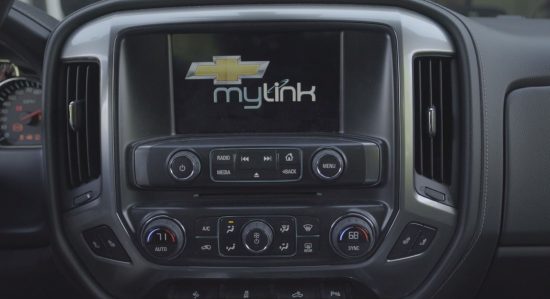
IoT is producing tangible business outcomes – today.  Just ask the automakers. GM will net $350 million in net new revenue for GM over the next three years using Cisco Jasper to underpin all of its connected car offerings in all new vehicles to provide entertainment, safety, vehicle diagnostic capabilities and other services.


And this is just the beginning for GM and others. In Q1 of this year, new cellular connections in cars surpassed new cellular phone connections, (source: Chetan Sharma) – incredible. In fact, Cisco is working with over 50 brands from 23 different auto manufacturers, and industry forecasts predict that by 2025, all vehicles will have connectivity built in as standard.

Cars, elevators, beer kegs, and literally every other product in the world could be affected. This will transform business models, and I believe there’s a real opportunity for IT to go from a cost center to a revenue generator as its company’s Things become connected.
GM image 2At Cisco Live this week, I outlined several ways that we’re making it easier for IT to take advantage of this unprecedented shift by addressing the following challenges:

  • Connectivity – How does IT connect everything, identify and authenticate devices and then handle the volumes of data that result?
  • Data Intelligence – Today’s networks tend to be focused on connecting systems, whereas future networks will be data, information and resource-based. Increasingly, IT will need a higher-level view of the network to make it more consumable and robust for IoT services.  So we are looking at how data flows can enable intelligence and analytics.
  • Security – The other major inhibitor to IoT success today is security. We are taking a secure end-to-end approach to help customers evolve their existing networks to cope with this influx of new devices, users and data flows.

Cisco offers numerous solutions today to help. We recently announced several new industrial IoT solutions that provide a highly secure architecture for connected factories, and help eliminate unplanned downtime by bringing IoT to connected machines.

We also have new, incredibly powerful IoT Cloud solutions through our acquisition of Cisco Jasper.  The Control Center solution from Cisco Jasper is being used to monitor, manage and control cellular connected devices for use cases as diverse as optimizing route planning in logistics to a farmer knowing exactly when a cow is about to give birth.

Get IoT today
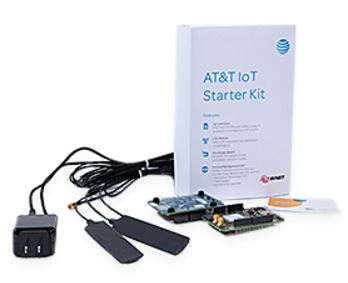
attWe know getting started may feel daunting. That’s why we launched an IoT Starter Kit with AT&T today, and we invite you to take the tour.

The kit provides provides everything needed – including hardware, software and services – to help developers take advantage of next-generation 4G LTE connectivity and start developing new IoT services. This also includes a major evolution of the service development model with six months of IoT data services for new customers. This is the most advanced starter kit available today!

While the opportunity is real and here now, only 7% of IT managers report having an effective IoT strategy. I cannot wait to take this journey with the other 93%.


Authors

Rowan Trollope

Senior Vice President and General Manager

IoT and Collaboration Technology Group

Avatar

Although Deakin University in Melbourne, Australia is relatively new in terms of universities (it was founded less than 50 years ago) they have made significant achievement in this time in reaching the the top 3% of rankings in higher education institutions worldwide.

Critical to the university’s continued success is its commitment to driving major digital transformation through their smart campus and fully interconnected digital learning hub. Recently, BBC Future ran a feature on Deakin University and their innovative use of Cisco technology to enable students to learn virtually, on any device, anywhere, at any time.

p03xr89m

Deakin University’s digital vision? To create a comprehensive digital layer sitting atop their existing physical environment.

According to William Confalonieri, Chief Digital Officer and Vice President of Deakin University, the university’s motivation for digitization is to stay ahead of competitors and provide students with a better standard of learning. He said, “If we don’t move with the times, we run the risk of being unprepared for the potential disruption by other players.”

Utilizing the Cisco digital network infrastructure, students and faculty can easily connect to the WiFi, allowing for asynchronous learning across campus and beyond. And, using Cisco Mobile Experience and data analytics, Deakin University can better track campus traffic, allowing for more efficient and innovative student services, for both learning and practical resource administration.

DeakinQuote

One of the extremely innovative ways that Deakin University is utilizing Cisco technology is through their take on a library of the 21st century. Using Cisco CMX and analytics platform, Deakin allows students via mobile apps and digital signage to see which parts of the library are most crowded, request help and check out books from any device.

Watch this video to get a glimpse of Deakin’s digital campus, and read more about their use of Cisco technology in this case study.

https://www.youtube.com/watch?v=QeOWJL1QlEY

Authors

Reg Johnson

General Manager, Education

Cisco Australia and New Zealand

Avatar

Are you ready for the new mobile gold rush? Of course you’re not. Though truth be told, the pending growth in mobile video may be more like a video tornado and only a handful of mobile operators are prepared.

Mobile operators across the world face the same twin challenges of slowing growth and ongoing disruption of core services by new Internet & OTT players, even as the broader mobile ecosystem continues to see significant revenue growth. So if you are tired of being just an operator that carries mobile video and prefer to be able to able to monetize it, read on.

Content and Video

video deliveryVideo now accounts for the majority of global mobile data traffic and is forecast to be the key driver of data traffic growth globally. To date, mobile video (and the ability to monetize the content) has been dominated by Internet players, such as YouTube, Netflix, with the operator role simply one of connectivity provider.

However, a number of operators are developing their own content delivery platforms. Singtel, Verizon and PCCW are three prominent examples of this trend, with their HOOQ, Go90 and Viu video platforms respectively. While HooQ and Viu are variants of the subscription-based model, Go90 more closely resembles the Internet business model, with a reliance on advertising for revenues and a focus on millennials.

But for operators many of which have only recently seen their interest and presence in this sector grow—it has spurred something else, a very real monetization opportunity.

If mobile operators can combine connectivity with compelling content, they can play a central role in the emerging online video value chain. And as they capture new customers, they can boost the penetration rates of their mainline mobile broadband services. It is a very tempting proposition, and a potentially a very lucrative one. But turning opportunity into growth will require mobile operators to make careful choices—and to make them soon.

Video from the Cloud

The cloud is transforming the way video content is created, aggregated, and distributed to an myriad of connected devices, as well as the way users engage with this content. And in recent years, the adoption of over-the-top (OTT) technologies has emerged as a critical platform for delivering rich audio, video and other media via the Internet.

With OTT adoption rapidly accelerating, a cloud based platform is the best means for many mobile operators to deliver video services that help businesses in the media and entertainment industry scale their video infrastructure efforts and deliver high-quality, live video and on-demand content to consumers on any device — be it their smartphone, tablet or connected television.

Target Opportunities for Mobile Videomobile video 2

The television industry that we’ve long known is gone—or at least, it’s looking mighty different. Forget the days of gathering around the living room TV for a favorite Saturday night show. Today’s viewers are pulling out tablets, laptops, and smartphones, accessing video content when—and increasingly where—they choose. This transformation hasn’t been subtle. And for industry players, neither are the consequences. In growing numbers, consumers are replacing their traditional cable and satellite TV packages with smaller, more customized, and often less expensive mixes of programming, cobbled together from an array of online and on-demand services.

The TV and video industry are quickly transitioning to video opportunities with smartphones, tablets, and streaming video available anytime, anywhere. As more consumers replace their big-bundle TV packages with à la carte online offerings, an opportunity is emerging for mobile operators and other service providers. Mobile operators can combine mobile broadband (MBB) packages with compelling “over the top” content to become key players in the new TV and mobile space.

So what else can a Mobile Operator do?

And watch this space for a series of blogs on Mobile Video.

Authors

Jim O'Leary

Sr. Manager Mobile Solutions Marketing

Avatar

The Internet of Things (IoT) is accelerating the digital world at a pace the industry has never seen. Businesses are faced with the ever increasing number of smart things interacting with their line of business (LOB) operations in a manner that was never fully realized. This trend of needing contextual insights from intelligent IoT information has become an imperative for organizations in all industries. This phenomenon continues to expand at hyper-scale and can also reveal new services or business opportunities, if adopted at the right time. Though this new, connected universe is still in its infancy and evolving daily, organizations can potentially face as many challenges from jumping in too quickly as they would from moving too slowly. They need to crawl before they can walk or run—and set the right foundation for success.

When it comes to the possibilities of IoT, there have been many technological evolutions from which we can learn. Beyond the laws of luminaries such as Moore, Metcalfe, and Bezos, we are seeing a causal relationship between tetration and attestation. To put it another way, the rate at which data is interacting with each other needs to be coupled with the need to guarantee that this layer two thing is truly this thing in context. As things become more homogenous in compute capability, the need for contextual control that is agnostic to location will become the dominant paradigm.

Let’s take a look at a common path that many organizations are following with IoT, to illustrate the breadth of outcomes that have come to fruition and the massive potential yet to be realized through IoT innovation.

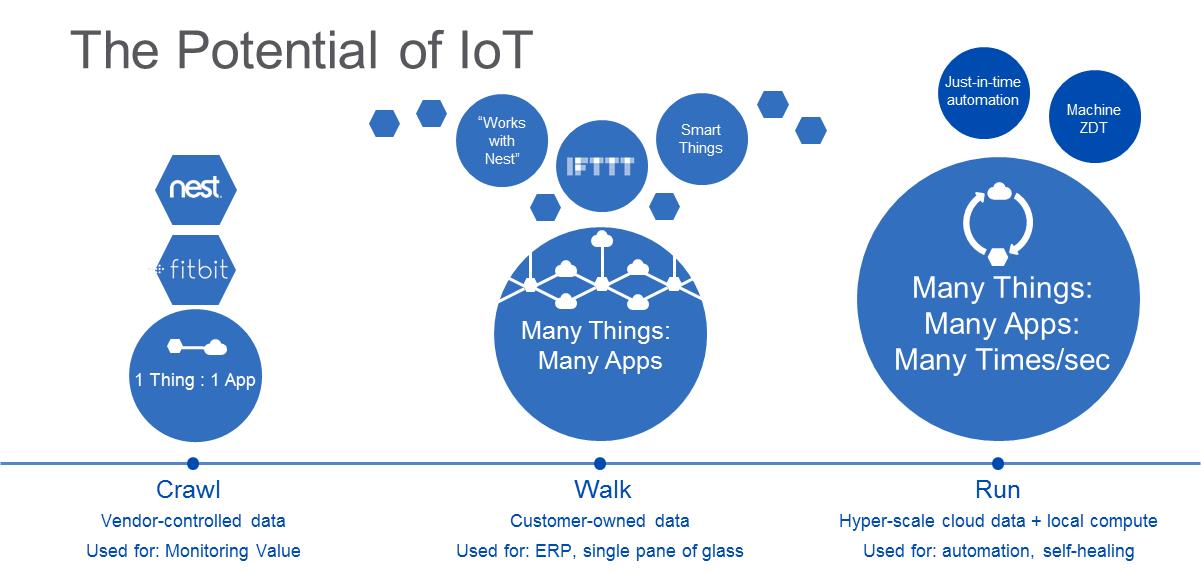
The Potential of IoT crawl/walk/run journey


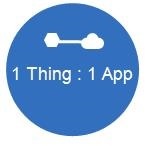
1 thing 1 app IoT crawl walk run journeyCrawl: Data goes from one thing to one app.
Businesses first start lighting up dark assets by making things smart and connecting them to the Internet. This may be driven by a “thing maker” who provides an Internet connected thing, or by a customer who physically adds sensors that connect through a gateway to a companion app. The app often becomes the only way the customer can see the status of that thing. You may be familiar with what happens when you have to have a dedicated app for every IoT device you own; just consider how many separate mobile apps you have for wearables and smart home appliances that you personally own.


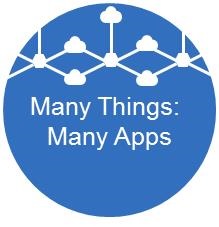
many things many apps IoT crawl walk run journeyWalk: Data can be exchanged from many things to many apps.
This is the stage where customers want to do more with their data. As customers adopt more smart things from different vendors, they want to combine or repurpose data across devices and have open access to choose which apps use the data. For example, enabling data from a smart HVAC device to trigger smart window shades to open or close based on temperature conditions and to share that same local HVAC information with the local utility company to automate energy efficiency measures during peak hours. Another example is location sharing on a mobile phone where permission to access your location is a function of the phone’s operating system and accessible to any app in the ecosystem. This is enabled today by openly sharing application programming interfaces (APIs). To enable the transition from crawl to walk, a common, secure, neutral, and universal platform is needed to transport data between things and apps. Platforms must be truly agnostic to the data transmitted, things used, or apps running.


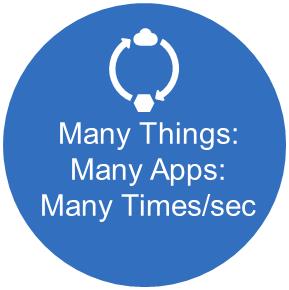
many things many apps many times per sec IoT crawl/walk/run journeyRun: Many things to many apps, many times a second.


Once data streams are truly owned by the customer, they can control what data is transmitted across apps and things to make real time decisions and calculations. This phase combines cloud and big data analytics with local streaming analytics for just-in-time automation. Extra hops to the cloud or across vendors (which could cause delays in data transmission) are eliminated when decisions must be made in milliseconds. A good example of this is with self-driving cars that have to make instant decisions about the surrounding environment like traffic signals or conditions, other cars, obstacles, or people, in order to react in real time.

But we’ve only touched the surface, and the impact of how IoT extends far beyond the examples I’ve shared here. Industries like manufacturing and energy are leveraging IoT to connect and innovate industrial processes in billion dollar factories; and retailers are using it to connect and deliver better experiences for customers. And like previous technology game-changers, IoT will transform over time and look completely different in adolescence and full maturity. The promise and potential for IoT is out there—and the race is on for organizations to get onboard with IoT and devise smarter and more innovative ways to inspire new business models. The right application platform, that is secure, offers open APIs and application development environments, and lays the foundation for tomorrow’s IoT opportunities is needed before we can even start walking.

There’s never been a better time to start thinking about what IoT can mean to your business, city, or country. Where are you on the journey?

Twitter: @joberon

LinkedIn: linkedin.com/in/johnoberon

Authors

John Oberon

Vice President

IoT Software Platforms

Avatar

Cisco redefines what a UTM can be with AMP and Threat Grid for Meraki MX

Cybercriminals don’t discriminate – every organization is a target. With the threat landscape continuing to evolve and ever expanding connectivity, digitization and the Internet of Everything (IoE) it has never been more important to have powerful security tools at your disposal to provide protection before, during and after an attack.

Providing a simple and effective way to detect and stop known and emerging threats faster, Cisco is now delivering Advanced Malware Protection for the Meraki MX. No longer do SMBs and distributed enterprises need to choose between simplified security management and advanced threat protection- with the integration of Cisco AMP and Threat Grid on Meraki MX, now they can have both!

Taking the MX’s threat protection to the next level, Cisco AMP and Threat Grid give you leading security effectiveness, as tested by NSS Labs, to defend against threats before, during and after an attack. No other UTM can provide the superior visibility, continuous control and advanced threat protection that AMP and Threat Grid bring to the Meraki MX.

So what do Meraki MX customers gain from a functional perspective?

  • Continuous file monitoring – real-time monitoring of files and file activity across all branches and remote locations on the network for deep visibility into threats
  • Retrospective security – receive an automatic alert if a file that initially appeared to be safe later exhibits malicious behavior so you can quickly contain the breach and remediate
  • Global threat intelligence – MX customers can now take advantage of AMP’s global threat intelligence from Cisco Talos. This minimizes management and investigative work with automatic updates and correlation of files, telemetry data, and file behavior against millions of malware samples a day.
  • Advanced Sandboxing – send unknown files to a cloud or on-premise sandbox so that they can be executed safely in a virtual environment and inspected for malicious content.

Known for its simplicity and ease of deployment, the 100% cloud-managed Meraki MX Security Appliance makes it easy to setup and manage Cisco AMP and Threat Grid from the cloud. This advanced threat protection complements the other integrated security services of the Meraki MX, like firewall, IPS, content filtering, and application control.

AMP for Meraki will be available in mid-August as part of the MX Advanced Security License. Already have the Advanced License? Simply reach out to the support team and schedule a time to upgrade. Threat Grid will be available this fall and will be an additional add on to the Advanced License.

As attackers continue to evolve their tactics to evade detection, Cisco continues to innovate so you can stay more secure and do it simply. To learn more visit meraki.cisco.com/amp.

Authors

Lindsay van Gemert

No Longer with Cisco

Avatar

The ability to analyze and act on data is more important now than ever as digital business is rewriting the rules of competition. To stay ahead, it’s more than the ability to react quickly. It’s the ability to respond strategically, supported by data-driven decisions in the moment. Yet, as the world becomes more digital, so does the amount of connected devices creating data – in more places than ever before.

The challenge is how to pinpoint the business value within the massive amounts of machine-generated data in an organization’s environment.

For those looking to sustain competitive advantage in the digital era, traditional approaches that require all data to be moved to a central repository for analysis will need to be supplemented with a distributed analytics model. A big reason for this is because much of the data coming off of connected devices (i.e. sensors) loses value minutes after it is collected. A distributed analytics approach filters, aggregates, and compresses data at the edge, in the fog, or in the data center as appropriate for an organization’s needs.

This is exactly why Cisco designed Edge Analytics Fabric (EAF), an open architecture platform that captures, stores, and analyzes data where it is actively created. And we see it as a game-changing innovation for many industries.

Today, at Cisco Live in Las Vegas, I had the honor of co-presenting with Nigel Hook, CEO and Co-Founder of SilverHook Powerboats. SilverHook designs high speed racing watercrafts that reach speeds of up to 200 mph with each boat containing two engines worth approximately $1.5M USD.

Nigel knows a thing or two about competitive advantage. Nobody today has more experience or wins racing high-speed mono-hulls in the open ocean. Nigel’s background in data and analytics has been a key differentiator in achieving peak performance in the racing world.

In fact, SilverHook is leveraging edge analytics to help race pilots react immediately to environment and multi variate engine conditions in real-time, indicating the need to throttle back in a split second, for example, to help prevent the boat’s systems from failure and to perform optimally. Previously, without this instant insight into the critical data, the outcomes could spell disaster. I encourage you to check out Nigel and his team in the video below.

https://youtu.be/4heDhMQ3fOY

For Cisco and our customers, it’s more than just accessing and analyzing data; it’s about putting it into the exact context in the moment in order to act for your business. Whether you are optimizing machinery on a manufacturing floor or racing a speedboat 200 mph, the true value from data and analytics comes from acting on the insights found when connecting the unconnected.

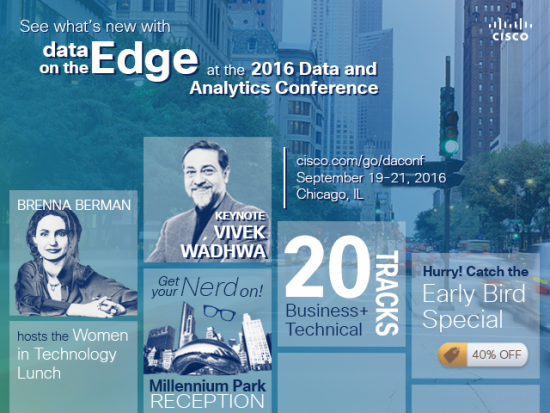
Want to hear more? Don’t forget to sign up for Cisco’s Data & Analytics Conference, September 19-21 in Chicago, where you’ll have the opportunity to hear directly from more customers like SilverHook.

Join the Conversation

Follow @MikeFlannagan and @CiscoAnalytics on Twitter.

Learn More

To stay on top of all Cisco Data & Analytics news and highlights, check out our blog: Analytics & Automation. Read the blogs of Mala Anand, Kevin Ott, Bob Eve and James Jamison.

Authors

Mike Flannagan

No Longer with Cisco

Avatar

Since the announcement of our unprecedented next phase of analytics with IBM, the wave of steady validation from the market has been growing. We are approaching analytics like never before, leveraging our strengths in hardware, software, services, and partnership to embed powerful analytic capabilities—from the data center to the cloud to the edge, providing insights across the most   1MAnand_tweet pic_vernon turner_7.11.16distributed and remote data, to solve critical challenges in multiple industries like energy, manufacturing, and financial services. Until now, IoT data has been managed in centralized, cloud-based systems. In traditional settings, data is moved from a connected ‘thing’ to a central system over a combination of cell-phone, Wi-Fi and enterprise IT network, to be managed, secured, and analyzed.
For companies generating data in many different places with intermittent connectivity to a central cloud system, the solution optimizes data for immediate analysis and decision making at the edge of the network and beyond. For the first time ever, customers have the first holistic experience of the connected condition of things (machines, networks, apps, devices, people, etc.) through the combined power of Cisco and IBM. I’m thrilled to see this momentum and it’s just the beginning of great things to come.

In September, 2MAnand_history collage pic_7.11.16you’ll be able to get an in-depth view of this solution, Cisco’s ongoing data and analytics innovation and more when you join us at the 2016 Data and Analytics Conference. You will hear how Cisco, our partners, and customers are using data to gain insight through analytics, both at the center and the edge of the network to accelerate digital transformation.
Our partnerships with heavy-hitters like IBM are future proofing data & analytics for hyper-distributed environments. We’ve taken an entirely new approach to analytics that provides the flexibility of processing and analyzing data everywhere—at the edge and in the cloud, so it can be leveraged in time and context as the business needs to use it. This technology collaboration with IBM is in direct response to requests from customers that were struggling with complexity in their distributed data environments, like IoT.  Industry analysts, customers, partners, and even competitors are taking notice, demonstrating the increasing need for an intelligent IoT edge, linked to powerful cloud-based analytics.

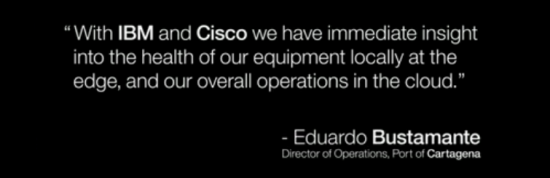
The positive, cross-industry response to our game-changing approach to analytics reflects how we are solving critical challenges for businesses looking to transform their operations in the age of IoT. Customers like Columbia’s Port of Cartagena, 3MAnand_Eduardo Bustamante quote_7.11.16a modern container terminal in the Caribbean, are using Cisco Edge analytics and the Watson IoT Platform to expand its monitoring of equipment conditions such as engine temperature, engine speed and run hours to improve maintenance costs. Bell Canada is pushing the edge with analytics to deliver 4G LTE connectivity throughout the country, regardless of the location of the business.



And SilverHook Powerboats are taking on this wave tapping into Cisco’s edge analytics software and Watson IoT business analytics, to help race pilots react immediately to environment and multi variate engine conditions in real-time, indicating the need to throttle back in a split second, for example, to help prevent the boat’s systems from failure and to perform optimally. Previously, without this instant insight into the critical data, the outcomes could mean disaster at high speed.4MAnand_eweek pic_7.11.16

As we lead this next chapter in analytics innovation, I hope you can join some of our key events in the next few months to learn more about where we are taking it to the edge—building innovative pathways to new analytics experiences that can change your business for the better.


We’ve just touched the surface and there is more to come! I look forward to seeing you in September at the 2016 Data and Analytics Conference!

Join and Follow the Conversation

Twitter: @MalaAnandCisco and @CiscoAnalytics

Cisco Blogs: Analytics & Automation


Authors

Mala Anand

No Longer with Cisco

Avatar

Kohn Pedersen Fox Associates (KPF), an international architectural practice based in New York City, employs comprehensive architectural design practices that strive to obtain optimal solutions in terms of environmental responsibility, social awareness, contextual design, and client value. Project results are achieved through collaboration and dialogue, informed decision-making, concerning contextual sensitivity, flexibility, and performance. As successful global design has no universal solution, every project must respond to its unique environment, needs and aspirations. Architectural design on the building scale as well as the scale of the city requires an integrated, multidisciplinary approach, with the solution viewed holistically as a system made up of interdependent components, including leveraging new digital technologies as a data collection network. The collective effect of these systems including the digital network as they respond to place, climate, density, use and program creates a building ecosystem whose goal is to optimize both efficiency and occupant comfort. This approach is then extended beyond the individual building to the scale of urban design. Multiple building types, infrastructural systems, and now digital networks need to work together at the scale of the city. Responsive strategies through data collection and analytics allow for the optimization of resource use and occupant comfort and therefore reinforce the objectives of good design.

Currently 54% of the global population lives in urban areas and by 2050 this proportion is expected to rise to 66%. As new urban areas are planned and existing ones are adapted to accommodate an influx of inhabitants, integrating technology with design will be critical. Cities are increasingly leveraging sensors and data analytics to drive operational efficiencies and create new services for their inhabitants. There are many examples of responsive systems that have been deployed in cities around the world, such as traffic lights in Helsinki that give priority to public buses and trash bins in New York that automatically notify sanitation workers when they need to be emptied. However, these technologies can offer even more value when they are integrated during the initial design process and can be designed from inception to leverage data across different systems.

Across an extensive international portfolio developed over 40 years of practice, KPF’s experience with integrating advanced technological systems at the city-scale range from New Songdo City in Korea, one of the very first urban environments conceived as a Smart City, to the upcoming Hudson Yards project in New York, which will be the nation’s first “quantified community.” A similar approach is taken with smaller projects, including Ernst & Young Tower (by Oxford Properties), a Class AAA office building in downtown Toronto. The building will feature an integrated fiber backbone for building systems, lighting controls, security and communications. The project is also targeting LEED ® Platinum certification and promises to offer comfortable, flexible and easily accessible office space to its tenants.

Cisco is a world leader and innovator in the integration of technology in architectural design. A good example is RBC Waterpark Place III (see above, picture source www.urbantoronto.ca) by Oxford Properties where a collaborative design process was used and all parties involved understood and agreed to implement a next-generation, enterprise-grade converged-base building network. Cisco and EllisDon led that process and ensured the developer’s requirements, under the form of use-cases, were translated into user experiences and/or benefits for either the building owners, the operators or the tenants of the building.

To ensure the tenant experience considerations are easy to implement, the different technologies involved need to be interoperable and open, just as what Cisco is driving with its Digital Ceiling framework. This framework is accelerating digital transformation and extends the benefits of the Internet of Things throughout your facilities. It unlocks new experiences and efficiencies for employees, while simultaneously lowering facility operating costs. It also puts high-resolution sensor data at your fingertips, so you can gain deeper insight into your environment to make better business decisions. Our recent ‘Best Technology Innovation Award for 2016’ at the RealComm/IBCon conference gives us confidence that the wider industry is starting to see the same benefits we are driving through the ‘openness’ and the increased network convergence.

Want to find out how end-result at EY Tower in Toronto will look and feel like? Want to better understand how the integrated experience use-cases enable a more happy and efficient workforce? Let us know via a reply to this blog or keep following us in the relevant social media channels. We plan to release a more in-depth joint KPF/Cisco paper on this soon.


About KPF

KPF is a unified architectural practice focused on the design of buildings of all types and scales, in all geographic regions. Our projects include the world’s tallest towers, longest spans, most varied programs and inventive forms. The goal that binds our work – and what motivates our efforts – is finding the smartest solution for each project. We believe that the best design is the product of an open-minded search, one without preconceptions or stylistic formulae. The firm consists of 600 staff led by 24 principals, with offices in New York, London, Shanghai, Hong Kong, Seoul, and Abu Dhabi. You can learn more about us and our work at www.kpf.com and follow us on Twitter, Facebook, and Instagram.

Authors

John Baekelmans

Chief Technology Officer

Internet of Everything (IoE) Solutions group

Avatar

Activate your Cisco network as a sensor and enforcer for branch-level threat detection and response

Return on investment. We often hear this phrase not only in business, but also in life. For example, when choosing home renovation projects, conventional wisdom says that updating a kitchen will yield greater return on investment than creating a guest room in an unfinished basement. Renovating your kitchen not only increases your home’s future value but also the value of its current usage. It may mean that you are free to be more creative or innovative.  An updated kitchen may mean learning to cook, more dinners with friends and family, or using and displaying your grandmother’s fine china, previously stored in your attic.

Your network infrastructure is also an investment, and you want to gain return on that investment, as well. Just like a house, your network infrastructure needs to be updated and adaptable to change over time in order to improve its current and future usage and value.  An updated network infrastructure fuels business innovation and growth, and knowing that your network is secure is a key driver of that freedom to innovate.

That’s where Cisco Digital Architecture (DNA) comes in. Trends such as mobility, the Internet of Things, cloud, and analytics, are driving organizations to reap the benefits of digitization. To do so successfully, organizations need an adaptable network that can operate at digital speeds as well as an architecture that is secure. Cisco has reimagined network architecture to become open, software-driven, and service-centric to rapidly deliver services that enable IT to innovate faster, reduce costs and complexity, lower risk, and meet compliance.

However, new opportunities come with new security challenges, and properly securing the virtualized network is key to the success of DNA. To ensure this new architecture is secure, Cisco has included its Network as a Sensor and Network as an Enforcer solutions as critical components of DNA.

Cisco Stealthwatch Learning Network License embeds security anomaly detection into the network element, using packet capture and machine learning intelligent detectors for breach validation. It eliminates suspicious packets at the device level for security without impact to branch level network performance.

The easy to use web based tool allows visibility, control and the ability to take action, across multiple routers on the network from a single console. It also enables orchestration and interaction with remote agents at the branch to collect data to make intelligent decisions about branch network traffic behavior, even between branches.

Most importantly, although Cisco Stealthwatch Learning Network License uses new machine learning technology on the newest Cisco Integrated Service Routers to turn your branch network into a security sensor, it also leverages your existing investment in your Cisco infrastructure.

Learning Network License also uses the Netflow generated by Cisco networking devices to improve visibility and security at the branch. It also leverages existing Cisco infrastructure investments such as  Cisco Identity Services Engine (ISE) for user contextual data, identity, and telemetry as well as the Talos database to reference this large threat detection network when making decisions about reputation and indicators of compromise.


For more, visit the Cisco Stealthwatch Learning Network License product page.

Authors

Beth Barach

Senior Manager, Product Marketing, Email Security