Avatar

When I think of data protection, I think of it like the protection of our homes: We know burglars may be out there “watching” us where we live, picking up on our daily patterns and scouring our home’s exterior to find the easiest way “in.”

Acknowledging this, we buy door and window locks, alarm systems and perhaps even security cameras. With these safeguards in place, we can then prepare for incidents that require quick, decisive action by assessing all possessions in the house and prioritizing their value – what do you need to save first if your house catches fire?

Enterprise data protection is much like that: We know the bad guys are watching, scheming for a way to compromise our network and systems. We develop a strategy for the implementation of modern cyber defense tools. Then, we inventory our data to prioritize what is most mission-critical and/or potentially valuable for our adversaries to target, and therefore identify that which demands the greatest attention.

A sampling of recent research reveals that enterprises need to focus on putting their data protection “house” in order: There were more than 1.9 million data records lost or stolen every day in 2015 – at an average cost of $158 per record equating to $300 million per day.  Malicious outsiders account for nearly three of five breaches, with the remainder mainly attributed to accidental loss.

With the expected boom in the Internet of Things – an estimated 500 billion devices will be connected by 2030 – hackers will have more attack vectors to exploit. Organizations must respond with data protection programs that take advantage of tools that are easy to deploy. These programs must seamlessly navigate within on-premise and cloud-based environments, providing security teams the insight to make quick connections to potential incidents – and immediately act upon them.

Cisco’s Data Protection Program focuses on eight key elements: Policies and Standards; Identification and Classification; Data Risk and Organizational Maturity; Incident Response; Oversight and Enforcement; Privacy by Design and International Privacy Policy; Security by Design and Data Loss Prevention; and Awareness and Education.

Last week I shared case studies on the elements of our Data Protection Program at Cisco Live U.S. in Las Vegas. Here’s a recap of a few of those areas – Incident Response, Oversight and Enforcement and Awareness and Education.

Incident Response – Cisco’s incident response process is integrated with business continuity plans enterprise-wide. Time is of the essence when corporate or customer data is at risk, so Cisco’s Computer Security Incident Response Team (CSIRT) members are monitoring 24×7 and providing the initial triage of possible incidents in swift, systemic fashion. Whether it’s a training video on YouTube or unintentionally compromised employee credentials, the team is fully prepared to investigate and respond to potential data leaks.

Oversight and Enforcement – There is ongoing, internal governance of the Data Protection Program, which includes policy adherence monitoring, remediation, third-party vendor management and, when appropriate, engagement with the Cisco Board of Directors. IT and business leader’s work together to ask questions like:

  • What data do we have access to?
  • Why is the data important?
  • How can we segment and protect what matters most?

With this information we are able to prioritize data, so defense layers’ are assigned accordingly.

Awareness and Education – Data protection isn’t only about technology solutions. It’s about people too. Employees at all levels of the enterprise must understand their role in the process, and the need to focus on creating a security and privacy-aware culture. Security must to be part of the fabric of the organization, using education and best practices during all activities where data could be breached. The ‘think before you click’ mentality.

Like all companies, we feel the pain of adversaries seeking to “break in” to our house.  Our Data Protection Program is a “cybersolid” foundation that provides the framework and processes to ensure we keep the bad guys out. Our number one goal is to protect the security, trust, privacy, and resilience of Cisco, our partners and customers. Let us lead the way and keep the lights on. For more information on Data Protection at Cisco, visit https://trust.cisco.com.

Michelle Fleury is a Senior Director and the Chief Data Protection Officer at Cisco.

Authors

Michelle Fleury

Senior Director

Supply Chain Transformation

Avatar

Last week’s Cisco Live US was certainly one for the books.

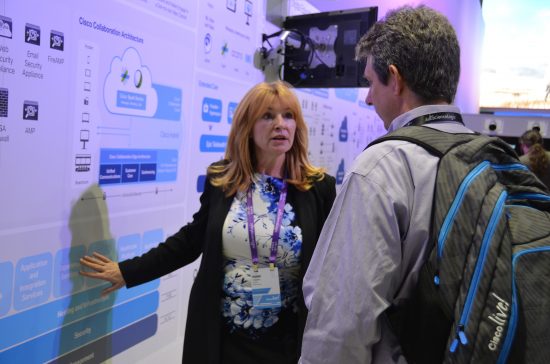
During the four-day conference, our healthcare team showcased six solutions that allow healthcare organizations to protect patient privacy and data security by securely managing their networks, improving operational efficiencies and providing better patient experience. We also gave a theater presentation that taught customers how to develop a strategy for a Threat-Centric security model.

_DSC0250 (1)

Cisco Live officially kicked off on Monday with a keynote presentation from Chief Marketing Officer, Karen Walker and CEO, Chuck Robbins. In the presentation, Karen shared the importance of technology, saying, “84% of Cisco Live attendees agreed that technology is the single largest driver of change.”

CLUSQuotes

Chuck also gave a nod to the importance of technology, especially in industries such as healthcare, government and education. He stressed the value of using technology for the greater good, saying, “We must leverage technology to solve the greatest challenges in our world today.”

CLUSQuotes5

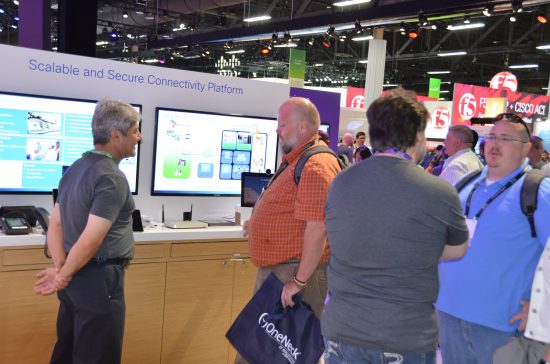
Following the opening keynote, the World of Solutions opened, giving us the opportunity to showcase our technology to customers, industry analysts, partners and employees alike.

_DSC0248 (1)

During the rest of the conference, there were numerous Innovation Talks that sparked attendees’ interest, including those for Collaboration, Security and IoT. We learned of new launches, such as Cisco Spark integration and digital assistant Monica. Throughout these presentations, one key theme emerged – great new technological advancements are definitely on Cisco’s horizon.

If you weren’t able to join us in the World of Solutions, take a look at these videos to learn more about the solutions we demoed.

Demo Overview:

https://www.youtube.com/watch?v=MUztZaiOPf8

Scalable and Secure Connectivity Platform:

https://www.youtube.com/watch?v=VF07_1GBPVw

Remote Patient Observation: 

https://www.youtube.com/watch?v=rUlYutRXu0E

Empowering Digital Health Innovation:

https://www.youtube.com/watch?v=Ozoq4kbyoSo&index=1&list=PLC4FDE43F3C7B4395

Automate Communications:

https://www.youtube.com/watch?v=h9e_Ut6a3do&list=PLC4FDE43F3C7B4395&index=2

For more from Cisco Live, visit #CLUS on Twitter.

Authors

Tapan Mehta

No Longer with Cisco

Avatar

ACI 2.0 – released earlier this month –  delivers strong new SDN and Cloud capabilities.  These enable Scale, Cloud Automation, Security & Analytics, as well as Optimized Operations.  Yeah, I know that sounds kinda ‘buzzwordy’, but read on and you’ll get a sense for the power that ACI 2.0 delivers.

I’m posting this on behalf of Srini Kotamraju, who is Director of ACI Product Management within INSBU.  

As technology megatrends go, both SDN and cloud computing are perhaps considered too mainstream to merit mentions in fashionable “top 10” lists these days. What is not in dispute are the massive investments companies of all sizes are making in both cloud services and SDN to modernize their data center infrastructure and operations. There has been less clarity in how these two technologies inter-relate, either as complementary or even competing approaches. We agree with this analyst and his view that implementing an effective SDN solution in the data center is the path to “cloud networking” that can support resources and services on a massive scale.

In fact, Cisco is delivering on this promise with our newest code release for the Cisco Application Centric Infrastructure (ACI 2.0) that includes a comprehensive set of new features and functionality in both infrastructure and operations. There are notable advancements in this code release across four categories: infrastructure scale, cloud automation, security & analytics, and optimized operations. The key, overarching benefit is that these new innovations will make it easier for our customers to use the Cisco ACI at greater scale to support their applications across both on-prem data center and cloud domains. By doing so, the connection between SDN and the cloud becomes even tighter, resulting in higher levels of efficiency in data center network and resource management. Here’s a brief overview of each:

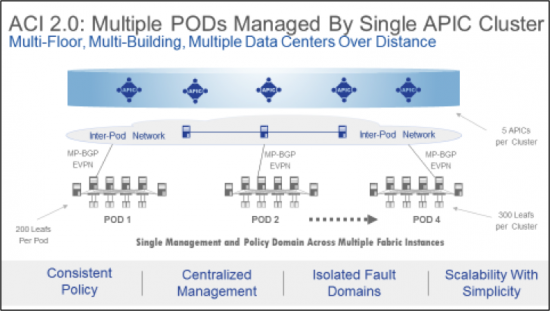
Infrastructure Scale: Cisco ACI now supports multiple ACI fabrics under a single ACI policy domain, while providing domain isolation of control plane within the pod. Cisco ACI Multi-Pod is an ongoing evolution, which began with single pod, then to stretched fabrics where you could have a single fabric stretch over distance. By going to a multi-pod ACI fabric design, customers gain the benefit of increasing performance and capacity to massive scale with a single management point among the different pods. The flexibility of the multi-pod design opens up a number of deployment models and use cases.

blog pic 1

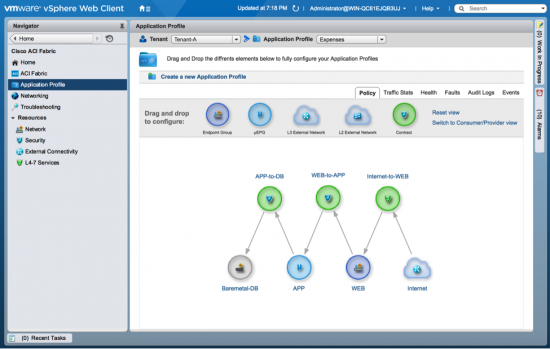
 Cloud Automation: Cisco ACI 2.0 also includes a number of cloud automation tools that enable customers to accelerate deployment of applications across multi-hypervisor virtual environments of their choice. Specifically, ACI is now interoperable with the latest tools from VMware automation and cloud management products including vRealize 7.0, OpenStack for VMware, and ACI Plugins for Floating IP, etc. For example, the vCenter plugin in ACI 2.0 is designed to simplify the installation and monitoring of resources between the Cisco ACI and VMware environments. This plugin gives users the ability to easily configure, monitor, and automate the management of ACI fabrics from vSphere environment.

blog pic 2

Security & Analytics: Achieving greater levels of visibility throughout the entire infrastructure using better analytics perhaps remains a “holy grail” quest for any enterprise. Security is one, if not arguably the most important, use case of enhanced visibility – supported by the premise that one can’t secure what one can’t see.

Cisco is continuing to innovate in the security and analytics realms in ACI 2.0 with new features such as Copy Service, Port Security, and Permit Logging. Copy Service is a step up from traditional switch port analyzers (SPAN) in terms of making it easier to copying traffic for inspection and analysis through automated replication of target traffic flows, at a granular levels such as End Point Groups (EPG). Copy Service also offers real-time capabilities for troubleshooting, monitoring and analyzing. Permit Logging enables users to get deeper visibility into their traffic flows.

These new ACI features complement breakthrough Cisco innovation in the analytics space that we recently introduced through the Cisco Tetration Platform, which, of course, supports Cisco ACI environments. All of these security and analytics advancements will help ACI users better address their governance, risk management, and compliance (GRC) requirements. These GRC costs have been going up steeply in face of increased regulatory, security and other mandates. Better managing these costs and requirements has become mission-critical for any enterprise today.

 Optimized Operations: Optimizing operations is perhaps the hallmark benefit for any SDN deployment that promises to improve data center efficiency and agility. Cisco ACI 2.0 is certainly no exception exemplified by new routing enhancements such as Policy-Based Redirection (PBR), Symmetric Multipath Load Balancing,Layer 3 Multicast and FCoE NPV. ACI policy automation now extends to WAN with OpFlex support for Nexus 7K and ASR 9K platforms, for automation of provisioning and exchange of tenant-specific information across Data Center and WAN infrastructure. In general, these new features simplify operations through more flexible deployment models at scale and by incorporating more automation.

In summary, ACI 2.0 delivers significant capabilities for automation and scaling data center, cloud-based infrastructure through a consistent policy framework. It intersects the capabilities of both SDN and the cloud, driving value in both environments. For more information about ACI 2.0 features please visit the ACI home page. ACI customers can download the latest software from the links – Cisco APIC 2.0(1m) and Cisco NX-OS 12.0(1m).

Authors

Craig Huitema

No Longer with Cisco

Avatar

Kleiner Perkins Caufield & Byer’s Mary Meeker recently released her annual “2016 Internet Trends Report.” As always, it was a wealth of information. That being said, all her data — 213 slides worth — blew my mind.

The seemingly endless facts and figures opened my eyes to both the good and the bad, to the disheartening and the hopeful. As a rising college senior and a proud member of the Millennial generation, I like to believe that I know everything — or at least all the important bits. But as I dove into Meeker’s collection of charts and graphs, I learned so much more than I thought I would.

Smartphones & GDP Go Hand in Hand?
Global smartphone user growth is slowing year over year at +21% compared to the previous year at +31%. This is understandable considering everyone I know has either an Apple or Android device, except one friend of mine (whose nickname is appropriately Flip-phone Frank).

The number of new smartphone users is not the only thing slowing, so is global GDP growth. The growth of the past 4 years has fallen below the 20-year average of 3.8%. This is not encouraging news for me and my peers. Ever since the crash in 2008, I’ve been told over and over again that the odds of me finding a good job straight out of college are ever dwindling. (Keeping my fingers crossed that things work out here at Cisco.). This off-putting news is further compounded by the fact that in 2015, North America, Europe, and Japan made up only 29% of the global GDP, whereas in 1985 they comprised 63%.

As a finance major, I especially loved the data on the essentially nonexistent yields of U.S. Treasury and other global bonds.

At this point, I am about 40 slides into the report, and honestly it’s ruining my morning. Thankfully, Meeker throws in a few positive statistics to uplift my mood. Global life expectancy is up 36% at an average of 72 years since 1960. Good job world!

Becoming a Techie
The majority of the report focuses on the future of our ever-expanding and fascinating technology. Even though I work for Cisco, I would have to describe myself as somewhat technologically oblivious. I don’t know what the latest trends or gadgets are and I stick with the basic apps. However, as I read about all the groundbreaking and innovative technology that was being tested and brought to life, my inner geek was aroused from its slumber.

Currently, most of our communication over technology is through manually entering text, but that will soon become a thing of the past. Voice interaction is the new leading trend, with the accuracy of voice-recognition technology presently at 95%. In 2010, it was only 70% accurate, and in just a few years it will reach 99%. That 99% percent is a game changer.

Google voice search queries have increased by over 35 times since 2008’s original introduction of voice- search software. It’s only fair to mention that the voice command to “Call Mom” is significantly higher than “Call Dad.”

According to Andrew Ng, Chief Scientist at Baidu, “at least 50% of all searches are going to be either through images or speech” by 2020.

Vroom Vroom
As interesting as this is, it starts to pale as Meeker switches to the topic of “Car Automation” or self-driving cars.

I was completely unaware of how close we actually are to widely using this new technology. Tesla and Google are leading the pack and currently have self-driving cars on the road! Tesla customers have already driven 100 million miles with the Autopilot active. You can lock, monitor, and summon your Tesla through an app. This is crazy! The genius behind this technology is astounding, and its potential benefits are immeasurable.

2016 & Beyond
When I was first reading through Meeker’s report I wasn’t uplifted by her initial facts and figures. I had this sense of “Oh great, we’re all doomed.”

As I resisted the urge to switch my browser to Buzzfeed or Pinterest, I discovered that our technology, and therefore our world, is at a precipice. Some people might not find new apps, voice interaction, or self-driving cars as adding that much value to the world, but I do. I can only imagine the potential for this new technology; the problems of the world that can be fixed and eradicated through my generation.

I truly believe that us Millennials can turn things around. My peers and I share a passion for change and betterment — and the time is coming for us to rise to the forefront. It’s 2016 and it’s only the beginning.

I highly encourage you to take the time to read through Mary Meeker’s report, and hopefully it will inspire you as well.


Authors

Maggie Harper

College intern

Collaboration Business Unit

Avatar

This past week, the Republican National Convention took place in Cleveland and on Monday, the Democratic National Convention will kick off in Philadelphia. During this time, both cities are transformed, with thousands of political leaders and eager participants flying in from around the country to converge on both the Quicken Loans Arena and the Wells Fargo Center.

From the outside in, most don’t realize these are more than just mere events. To make these conventions successful, the Quicken Loans Arena and the Wells Fargo Center are transformed into mini cities in and of themselves. Just like in an actual city or community, in order for things to run smoothly, everything needs to be connected. Cisco is helping make that happen.

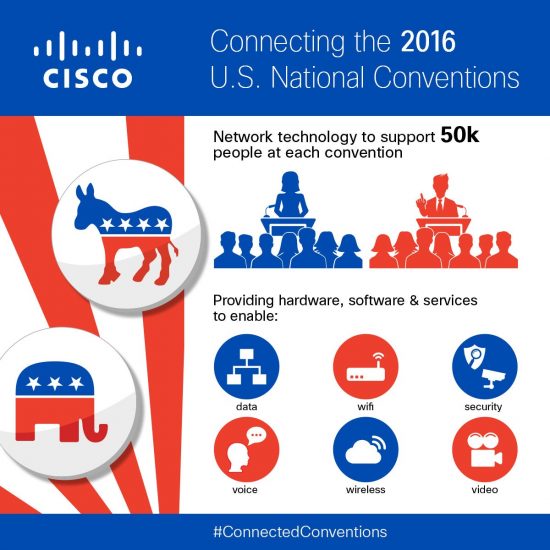
ConnectedConventionInfographic

The 2016 national conventions are shaping up to be the most connected conventions ever – the technology advancements that have been made just since the last convention in 2012 are incredible – and Cisco is playing a major role. For the fifth consecutive U.S. presidential election cycle, Cisco is the official Network Technology Provider for both the Republican and Democratic National Conventions. We’re responsible for the core network infrastructure for the RNC and DNC, which means we’re providing the backbone for the network. Need to look up where your next event is on your phone? Need to show a video clip during your speech? Need to file a story from a press lounge? Cisco’s got you covered.

We know attendees are rushing around trying to see and hear everything, so we’re providing wireless mobility services to help people stay connected while they’re on the go. We also know that it’s important to secure the information are sharing over the network, which is why we’re providing our world-class network security for both wireless and wired solutions. Both conventions will also use Cisco’s IP phone system to stay connected on the convention floor and at surrounding official venues.

Stay tuned in the coming week for more information on how Cisco is making the Q and the Wells Fargo Center into mini-smart cities for the conventions both here on the blog and on social media using the hashtag #ConnectedConventions. Also, be sure to check out the We Are Cisco feature on Larry Hutchins, a Cisco network consulting engineer who is leading the #ConnectedConventions effort.

Authors

Brenda Germundson

Global Industry Marketing Leader

Revenue Marketing

Avatar

Speed. Scale. Agility. They’re the top priorities of every modern business, and the cloud promises to deliver them. What businesses don’t want is more costs and complexity. They don’t want to have to use different processes to develop and manage applications depending on whether they live on-premises, or in private or public clouds.

blog 1

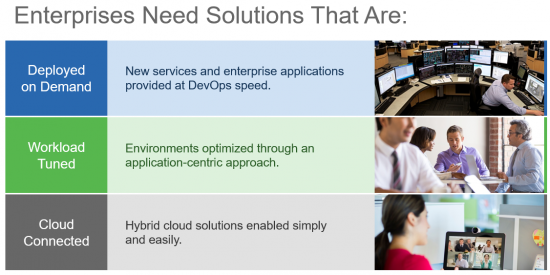
Bottom line, businesses want a consistent experience. They want to be able to provision workloads wherever they choose, on a workload-by-workload basis. And they want to be able to do it in the same way, with the same platform.

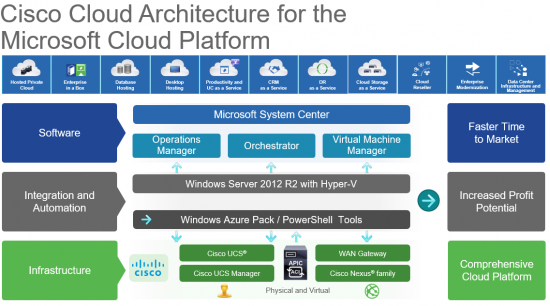
It’s a big ask. But today, leading cloud service providers like Optus are making it happen with the Cisco Cloud Architecture for Microsoft Cloud Platform.

blog 2

Raising the Bar for Cloud Services

Optus is one of the premier IT and cloud service providers in Australia, serving customers in practically every industry, from small businesses to large enterprises. That kind of diversity is great news for Optus’ business. But meeting the unique needs of all those diverse customers can be a tall order.

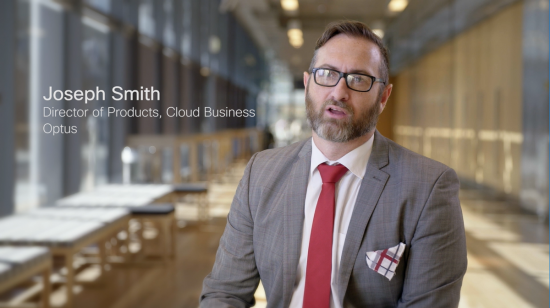
“Optus’ challenges are speed, agility, and costs,” says Joseph Smith, Director of Products, Cloud Business, Optus. “Every customer has been asked to do more with less. Do it faster. Do it more often. And don’t break anything. We need to deliver a platform that gives our clients speed and agility, but in a way that’s controlled, that provides clarity of workloads.”

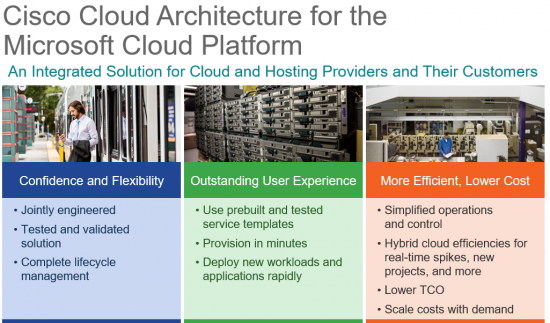
Optus is using the Cisco Cloud Architecture for Microsoft Cloud Platform to give customers more choice, flexibility, and interoperability. The platform combines Cisco’s world-class cloud data center solutions with Windows Azure Pack. And it makes it easy for Optus to deliver comprehensive hybrid cloud solutions—faster and more profitably.

blog 4Consistent Experiences Across Clouds

With the combined Cisco and Microsoft platform, Optus can offer a wide range of pre-integrated services—database as a service (aaS), desktop aaS, even backup aaS. And they can provide a consistent experience for all of them, no matter where customers deploy a workload.

“We can now deliver the same experience on our cloud versus Azure, and enable our customers to seamlessly move workloads between them in a hybrid fashion,” says Smith. “It’s so fast, so quick, so easy to deliver. And it’s blurring the lines between what’s on our cloud, what’s on the public cloud, and what’s in the customer’s environment.”

This flexibility is a huge boon for development. Customers can start developing an application on premises and then push it out to the public cloud, or vice versa. They don’t have to take on the additional effort—or costs—of separate development efforts for each environment. They can use a single governance, management, and security structure that spans all cloud models. And they retain the flexibility to pick and choose the right platform for each workload.

That consistency and flexibility has become a major differentiator for Optus’ cloud business. And with the ability to scale the platform from small architectures to the largest organizations, Optus can meet the needs of a broader range of customers with a single cloud framework.

Partnering with Cisco for Hybrid Cloud

Optus and its customers will only continue expanding their cloud capabilities. As they do, they will continue to benefit from the combined strengths and support of Cisco and Microsoft.

“What I find most exciting about this solution is that we not only get what we develop in our own R&D, but also the solution sets that Cisco and Microsoft bring to the table,” says Smith. “One of the key benefits we get from that relationship is Cisco’s investment in R&D and technology. It’s the breadth and depth that Cisco brings to the table that helps us cover any area, from the networking server to cloud software. It’s a very comprehensive portfolio and very deep.”

blog 3

Learn More

For more details about how Optus is using the Cisco Cloud Architecture for Microsoft Cloud Platform, watch the video below.

https://www.youtube.com/watch?v=LD3LyOSGbqc

Find out what the Cisco Cloud Architecture for Microsoft Cloud Platform can do for your business and customers here.

Authors

John Malzahn

Senior Marketing Manager

Service Provider Cloud Solutions

Avatar

Five is our magic number for the week as we look back on 5 ways to earn more revenue from fewer customers, 5 takeaways from Cisco Live, and our (almost) 5 pillars of partner marketing.


5 ways to earn more revenue from fewer customers

Here’s something we all know but don’t all act on: it’s more costly to land new customers than it is to retain existing customers. Fifteen percent more costly. This week Steve Cox, Director, shares five ways you can earn more revenue from fewer customers in this blog. Hint: think about trust, value, dialogue, data, and automation.


>> Fast Forward: We’ll talk about Tech Data’s success using automation to bring more value to their customers and more revenue to their business. We’ll also recap highlights from all of our recent blogs on how to bring more value to customers.


5 takeaways from Cisco Live

Announcements from Cisco Live are saturating the market, newsfeeds, social media, and your inbox. Whether you’re trying to make sense about what it means for you or just want a refresher of all the big news, Rick Snyder, SVP, has you covered. He recaps his top 5 takeaways from the event in this blog.

Related news:


(not quite) 5 pillars of helping partner marketers become engaging marketers

What makes our marketing enablement program stand out from the rest (ahem, our competitors) and consistently win awards? And why is it so important to us? This week Channel Management digs into our four pillars of partner marketing success with Chad Reese, Director, in this article.


“Cisco is one of the rare organizations that have a partner digital marketing team embedded in its digital marketing group. It is not unheard of for global partner marketing teams to promote digital marketing. But the fact that Cisco has an entire team dedicated to digital marketing in the channel demonstrates just how important it is to them that their partners make this transition—and make it fast.”


Find out more about how your marketing team can enhance their expertise, create conversations, and help your company stand out. It all starts when they Engage.


What’s next?

The partner weekly rewind and fast forward is designed to give you a snapshot of what you missed and what’s to come. Tell us what you think and what you want to hear about in the comments. And come back next week for more.

Authors

Jill Shaul

No Longer With Cisco

Avatar

HIG00648This weekend, I evinced a big change in my youngest daughter. She emerged from her summer couch potato cocoon and blossomed into an active youngster chasing after fictional creatures in natural sunlight. Within 2 days of its launch, Pokémon Go had number of users almost at par with Twitter, the popular social media network that has been around for more than 10 years. What does this latest of mobile gaming phenomenon have in common with the latest global Cisco VNI Complete Forecast? Besides the fact that both are good for health (one for the body and the other for the brain) the common linkage is growing prevalence of virtual reality (VR).

Our latest global IP traffic forecast projects that virtual reality is on the rise and the traffic associated with virtual- and augmented-reality applications quadrupled in 2015 and is poised to grow 61-fold by 2020. One of the main applications of VR is currently in the gaming sector.

HIG00641VNI service adoption research also projects that out of the 8 consumer mobile applications that we track, mobile gaming will be one of the higher growth services with a healthy 20.5% compound annual growth rate (CAGR) from 2015-2020. The number of users for mobile gaming will grow 2.5-fold during this period. This growth is driven by improved hardware performance; launch of new form-factors, new interactive, social media integrated as well as VR augmented games.
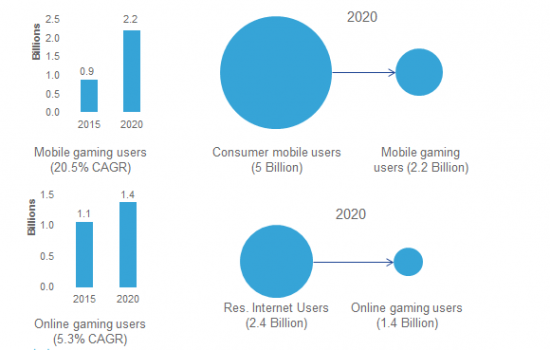

While gaming is a growing mobile service, it is also growing on the non-mobile online platforms as well. Online gaming is forecast to be the fastest growing residential Internet service although at a more nominal rate of 5.3% CAGR from 2015-2020. Online-gaming growth is primarily influenced by technology enhancements in PCs such as graphics, motion sensing, gesture recognition, etc.

vni pokemon

The slower growth in online gaming vs. mobile gaming reflects the different addressable markets in total number of users. The reach of mobile is more than double of the residential Internet users. By 2020, there will be nearly 5 billion mobile consumer users as compared to 2.4 billion residential Internet Users.

In summary, mobile/online gaming and virtually reality are on the rise and they are having a tangible impact on driving IP traffic up. As a mother, I’m delighted to see my daughter active and engaged in an outdoor activity, with a constant reminder to her of being watchful. As an analyst, I see that gaming has taken on a new dimension (and global networks will need to evolve to keep up).

Authors

Shruti Jain

Leader, Project & Program Management

X-Architecture Marketing, Enterprise Networking & Cloud

Avatar

The Cisco Innovation Grand Challenge is an exciting way for us to uncover new opportunities and game-changing trends. It’s also a great way for entrepreneurs and startups to further their ideas. And the good news is we’re still accepting submissions to the challenge until August 31.

Like last year’s competition, winners of the 2016 Grand Innovation Challenge, take a share of $250,000 to jumpstart their ventures. They also get access to the Cisco Innovation Centers and receive mentoring and coaching from Cisco. Not sure how winning the Innovation Grand Challenge could change your world? Don’t take our word for it. Listen to what former winners have to say.

In the second of my three-part “Innovation Grand Challenge: Where Are They Now” series, I caught up with Tom Caldwell, co-founder and EVP of Products at CyberFlow Analytics.

Q: Tom, I know your team is incredibly busy. Thank you for speaking with us. Each member of your team has quite an impressive background. How did those backgrounds shape the founding of CyberFlow Analytics?

A: Dr. Hossein Eslambolchi and I founded CyberFlow Analytics to develop a new type of behavioral Anomalytics that would detect cyber threat activity in network cores. Anomalytics is the term we use to describe real-time network anomaly detection using predictive analytics, threat intelligence, and advanced visualization.

As for our backgrounds, Hossein was previously president of AT&T Labs and CTO of AT&T. I was a director of engineering at Cisco for over 11 years. And Steve Nye, who recently joined the team, was formerly at InfoBlox and also a VP/GM at Cisco.

Each one of us is passionate about seeing the network as the first line of defense for cyber security and we believe it can propagate threats faster than humans can stop them.

Q: Obviously there are some Cisco connections on your team. Was your work with Cisco how you learned of the Innovation Grand Challenge?

A: Actually, no. We saw the information through a posting on LinkedIn.

I entered the competition thinking it was going to be a weekend hobby or side project that I would work on for fun—pretty much a learning experience. But as we progressed to the semi-finals and beyond, it became a much more serious effort that involved our entire team.

Q: Clearly it was worth the effort to enter the Innovation Grand Challenge. Looking back at your venture, there’s not a single company that doesn’t understand the importance of cyber security. What prompted you to concentrate on that when creating your company?

A: Enterprise IT and Industrial IoT are rapidly converging. And we found there’s a need for behavioral analytics in the security framework that doesn’t involve adding significant complexity or management overhead. You don’t want to add an army of security staff just to deal with the output that a new analytics tool brings.

At CyberFlow, we deliver cloud-scalable and real-time streaming Anomalytics. We improve detection and response capabilities while keeping the analytics complexity hidden. And with a “plug-and-play,” zero-configuration approach, the management overhead is nominal. Through a smart integration with SIEM and other tools, we’ve created a very efficient analytics platform that supports both IoT and IT.

Q: A simple approach to a major problem. We’re surprised it took winning the Innovation Grand Challenge to get CyberFlow Analytics the backing it needed. Why do you think that is?

A: Well, behavioral analytics are a new paradigm in security tools. Security teams don’t have data scientists and are not familiar with supervised versus unsupervised machine learning and how it works in threat detection. Venture capitalists also lack an understanding of the pain that Enterprise IT and Industrial IoT have in converging their networks. Today, we see the industry maturing and now every Enterprise and IoT deployment considers security behavioral analytics as a must-have tool in their security framework.

Q: How has winning the Innovation Grand Challenge affected CyberFlow Analytics’ opportunities?

A: We continue to see growth in our market and interest from large enterprise and government accounts that are grappling with how to protect these new converged IoT and IT infrastructure. Winning the Cisco Innovation Grand Challenge gave us much more visibility to new customers and new partnerships on a global basis. It accelerated our credibility in the market for both Industrial IoT and Enterprise IT.

Q: It’s said, “In our digital era, those who disrupt win.” What’s your perspective on that statement?

A: I totally agree. You need to be disruptive or transformational to help organizations deal with the massive data and large number of IoT devices being added to the network.

From a CIO’s perspective, you need to help them add new capabilities, while simultaneously lowering cost and reducing complexity. A new approach is needed in the industry that embraces cloud, big data, analytics and new innovative software stacks.

Q: This was a great conversation, and it’s always nice to catch up with a previous winner. Now that the Innovation Grand Challenge is open for 2016, do you have any advice for this year’s competitors?

A: Having come from Cisco myself, I know it can be an overwhelming opportunity to present to the armies of talented people across various domains. But, I encourage all startups to enter the competition and go through the experience. Focus on the customer’s problem and highlight the use cases for how you deliver true value in a disruptive manner. 

I also asked a mentor in marketing to come in and grill us on our final presentation. We ended up spending three hours going through every slide and each concept behind the slide. It was well worth the investment and mentoring.

Do you have a disruptive idea that will transform an industry or impact societal change? The Cisco Innovation Grand Challenge is open for submissions through August 31. Enter it now and visit the FAQ page to learn more.

To see what other winners of the Innovation Grand Challenge have to say about their experience, check out part one of my series.

Authors

Alex Goryachev

Senior Director, Innovation Strategy & Programs

Corporate Strategic Innovation Group