Avatar

This blog originally appeared on The Platform.

We live in the age of digitization where astonishing opportunities emerge when people and devices connect. Mobile technology empowers remote workers. IoT-based factories achieve new levels of efficiency. Sensors monitor the availability of clean drinking water. We are innovating and reaching people in ways never before possible.

At Cisco, we strive to bring the benefits of digitization to every person in the world by…

  • Empowering individuals and organizations by developing digital skills and catalyzing an innovative and entrepreneurial ecosystem.
  • Advancing positive social and environmental change by investing in global problem solvers who apply innovative, technology-based solutions and multi-stakeholder partnerships.
  • Promoting sustainable outcomes across our business operations, supply chain, and customer base through good business practices and transformative solutions.

…to positively impact 1 billion people by 2025.

This approach is enabling us to change the way we address—and ultimately solve—the world’s most pressing social and environmental challenges.  Our 12th Annual Corporate Social Responsibility Report – Accelerating Global Problem Solving – demonstrates how, through our technology and expertise, Cisco empowers global problem solvers to make a positive difference for people, society, and the planet.

People

Our work to enable people to reach their full potential in a digital economy begins at Cisco, where our focus is to attract and retain the best talent. By focusing on connecting everything, innovating everywhere, and benefiting everyone, we transform the employee experience. Our people are able to flourish as global problem solvers in a way that is both responsible and ethical so they can make a meaningful difference in communities worldwide. In

In fiscal year 2016, 36 percent of employees supported non-profit organizations through their time, donations, and expertise, resulting in $12 million in donations and matched funds and more than 187,000 hours volunteered.  Our goal is to have 80 percent employee engagement by 2020.

Outside of Cisco, we actively nurture the talents of problem solvers around the world by providing foundational digitization and entrepreneurship skills to individuals of diverse backgrounds, preparing them to thrive in the digital economy. In fiscal year 2016, our Cisco Networking Academy Programreached more than one million students in 170 countries.

Beyond education and training, we also provided our students with career resources and connections to employers seeking IT talent. We believe this drives value for Cisco and our customers, ecosystem partners, and society at large. Our goal is to extend the reach of the Networking Academy to two million students a year within the next five years.

Society

Cisco strives to make positive inclusive social and economic impact in countries across the planet by investing in early stage, technology-based solutions that have the potential to be scaled, replicated, and sustained. In fiscal year 2016, we provided cash and in-kind contributions of $309 million to organizations.

Our nonprofit partners report that our cash grant investments positively impacted 78 million people across our key focus areas of critical human needs, economic empowerment, and education. We also sponsored a Cisco Innovation Challenge within the Rice Business Plan Competition (RBPC).  The winner of the challenge,

We also sponsored a Cisco Innovation Challenge within the Rice Business Plan Competition (RBPC). The winner of the challenge, Neopenda, is developing a wearable device that continuously monitors the vital signs of critically ill newborns in hospitals with limited resources. With more than 2.7 million babies dying every year within their first month of life, this technology has the potential to have tremendous impact.

Planet

Our goal to achieve sustainable growth in a connected world extends to the environment as well. We invest in transformative solutions and share energy-efficiency best practices with our customers and partners. Our products improve productivity, reduce the need for traveling, increase utilization of company assets, and enable energy-efficient cloud computing for organizations around the world.

In fiscal year 2016, we implemented more than a hundred energy efficiency and onsite renewable energy projects.  Our use of low-carbon, renewable energy is up to 77 percent of our global electricity demand. And we are on target to reduce our greenhouse gas emissions by 40 percent worldwide by the end of fiscal year 2017 compared to our fiscal year 2007 baseline.


We believe that innovative solutions can arise and their impact multiplied when passionate people and transformative technology connect. By working together, we can move toward eradicating poverty, unemployment, climate change, and hunger everywhere.

Everyone has the potential to become a global problem solver. Won’t you join us?

Read Cisco’s 2016 CSR Report today and learn more about our Corporate Social Responsibility.

Authors

Tae Yoo

No Longer with Cisco

Avatar

Ever wondered what it’d be like to be a part of Cisco’s Virtual Systems Engineering team? Curious how a day in the life might look, working among this impassioned team of technology geniuses and evangelists as they enter the landscape of the future, bringing customers to the cutting-edge of virtualization, digital, and innovation? Cisco’s team of Virtual Systems Engineers (#CiscoSE) stands with our customers at the vanguard of business technology, offering solutions that change the way people live and work. And on December 19th, they want to talk to you! Continue reading “December 19 #CiscoChat – Reality VE: My Virtual Career at Cisco”

Authors

Greg Hamilton

Program Manager

#Cisco Chat & Cisco Digital Training and Certification

Avatar

The final patch Tuesday of 2016 has arrived. Today, Microsoft has released their monthly set of security bulletins designed to address security vulnerabilities within their products. This month’s release contains 12 bulletins addressing 48 vulnerabilities. Six bulletins are rated critical and address vulnerabilities in Internet Explorer, Edge, Microsoft Graphics Components, Microsoft Uniscribe, and Adobe Flash Player. The remaining seven bulletins are rated important and address vulnerabilities in various Windows components including kernel, crypto driver, and installer.

Read More >>

Authors

Talos Group

Talos Security Intelligence & Research Group

Avatar

#CiscoChampion Radio is a podcast series by Cisco Champions as technologists. Today we’re discussing Umbrella Investigate.

Cisco Champion 2016Get the Podcast

  • Listen to this episode
  • Download this episode (right-click on the episode’s download button)
  • View this episode in iTunes

Cisco Guest
Jeremy Linden, Umbrella Investigate Product Management

Cisco Champion Hosts
Bill Carter (@ccie5502), Senior Solutions Analyst

Moderators
Brian Remmel (@bremmel)

Continue reading “#CiscoChampion Radio, S3|Ep. 30: Umbrella Investigate”

Avatar

Vulnerability discovered by Tyler Bohan

Overview

Talos is disclosing a series of vulnerabilities in Joyent SmartOS, specifically in the Hyprlofs filesystem. SmartOS is an open source hypervisor that is based on a branch of Opensolaris. Hyperlofs is a SmartOS in-memory filesystem that allows users to map files from various different locations under a single namespace.  Additionally, hyperlofs allows the creation of new virtual file systems quickly and easily. There are three core vulnerabilities that are being disclosed. However, since they are found in both the 32 and 64-bit versions there are a total of six CVE related to six Talos reports. For all of the vulnerabilities discussed an attacker would need the PRIV_HYPRLOFS_CONTROL privilege in order for them to be exploitable.

Read More >>

Authors

Talos Group

Talos Security Intelligence & Research Group

Avatar

The core principle of model-driven telemetry is super simple:  as much usable data out of the network as fast as possible.  The implementation is also pretty subtle:  a push mechanism, data models, open-source encodings.  In fact, it’s all so simple and subtle that some folks look under the hood and say, “so what?”   To that, I say…great question!

After years of riding the roller coaster of hype curves (SDN anyone?  Cloud?  DevOps?), experienced network engineers are rightly skeptical of “the next big thing.”   So let’s get at the who should be looking at telemetry and why.

The big Web companies who worked with us to develop telemetry were clear about their first use case: SNMP replacement.  As I explained in a previous blog, SNMP simply could not deliver the speed and resolution they needed to monitor their networks.  But what if you’re not operating at Web scale?  What if you’re fine getting network stats every 15 minutes?  What if you like your monitoring tools and they give you all the insights you need?

In that case, the answer’s pretty simple: stick with SNMP.  Seriously.  I’m not a fan of chasing the shiny new object just because it’s shiny and new.  If your monitoring solution works for you, then stick with it.  By implementing best practices, most people can probably even squeeze a little more out their current SNMP deployment.

But just to be a little contrarian (this doesn’t come naturally for me, but I’ll try), I would encourage you to take a good hard look at the future.  The big winners in the current consumer technology space (see, for example, Farhad Manjoo’s article on The Frightful Five) have been the ones who relentlessly pursue simplicity, speed and automation in their networks. And since you cannot automate what you don’t understand, better network visibility is a non-negotiable prerequisite.  To get that kind of visibility, you need more data, faster – in other words, you need telemetry.

Sometimes “more” means more variety.  The truth is that SNMP doesn’t always have the data that you need.  With hundreds of YANG models available today in IOS XR and more to come, model-driven telemetry exposes a much larger space of operational data than SNMP.  But for the initial telemetry use cases, “more” means more of the same old, boring data.

Take the simplest statistics you can imagine: bytes in and bytes out. With some simple mathematical correlations, you can use these statistics to detect dropped traffic, black holes, infiltration attacks, bundle link polarizations, and many other significant network conditions.  Some operators already do these calculations with SNMP data.  But if you’re only getting data every 15 minutes, you’ve got a built-in limit on what kind of events you can detect and how quickly.  By collecting data an order of magnitude faster, you get an order of magnitude better resolution.  Boring is really a function of scale.  The more data you get, the less boring it becomes.

So, embrace boring!  It’s the new awesome.   You might not need more boring data today, but you will eventually.  Automation is unstoppable and the pace is relentless.  Model-driven telemetry will help you keep up.

If you want to learn more about model-driven telemetry, visit us here.

Authors

Shelly Cadora

Technical Marketing Engineer

Avatar

In the aftermath of Thanksgiving, it’s easy to think the holiday season is about crazed crowds and Black Friday pricing. But retailers aren’t just competing on price. They know that it’s the in-store experience that brings customers back. And digital transformation is providing new ways for retailers to build customer loyalty and increase basket size.

The effective retailers are the ones that identify a customer experience that differentiates them from their competition and uses technology to support that experience.

Cisco Connected Mobile Experiences, or CMX, is the perfect technology to power this approach. Here’s how:

Guest Wi-Fi
Today’s consumer is a connected consumer. Guest wi-fi is becoming a must have as a whopping 84 percent of millennials use their smartphones for assistance while in the store. They want to be able to access product reviews. To request gift ideas from family. Or, to use social media to solicit input from friends. The retailers that have guest wi-fi access—either free or as part of a loyalty program—are the retailers that will attract more shoppers.

CMX Connect provides an easy-to-use tool for creating captive portals in as little as ten minutes. You can add customer imagery, customer offerings such as daily specials, and SMS authentication with a click of the mouse. So not only can you provide customers with the wi-fi they demand but you can use the sign-on process as a touch point for their in-store experience.

Omnichannel Support
Several studies have shown that 70 percent of shoppers research their purchases before entering a store. Through APIs, CMX can integrate with backend e-commerce, CRM, and customer loyalty programs to provide a more complete, 360-degree view of the customer’s interactions. If you know what a customer searched prior to entering the store, you can provide them directions, promotions, and relevant products that are pertinent to their intended purchase.

Relevant Content
Studies have shown that 34 percent of shoppers use their smartphones to research product details while in the store. Using the location capabilities of CMX, the retailer can build loyalty by proactively sending relevant content to the shopper. For instance, a shopper may be considering an HD action camera. Based on location and dwell time, the retailer can push content about the available action cameras while the customer is making a decision. Ninety-five percent of customers that receive such information find it valuable. And fifty percent of them act on it.

Pop-Up Promos
Using CMX and a loyalty application, retailers can provide pop-up promotions to customers at two moments—upon entering the store and based on a dwell time threshold. The “upon arrival” promotion can inform the customer of storewide specials. This type of promotion may be especially effective during the holiday buying season. The “dwell time” promotion can be sent when a customer has been in one location for a pre-determined amount of time that denotes a heightened level of interest for a specific type of product.

Let’s use our HD action camera example above. After the dwell time threshold, the loyalty app can inform the customer of special pop-up promotions for accessory packages for one or more of the action cameras. This added information can help spur the purchase and can increase the basket size at the same time.

Sales Assistance
For many retailers, personalized assistance is the key to an enhanced customer experience. Studies have shown a 20 percent increase in sales when a sales associate is engaged with the customer. CMX can help identify customers based on location, dwell time, and loyalty status and send the right sales associate—whether based on location or expertise—to assist the customer. And, if the customer has opted in, the associate can greet them by name.

Loyalty
Loyalty apps have grown in popularity for retailers. They provide a means to both engage and reward customers.  CMX can help improve these applications and provide a more engaging in-store experience. First, for high-value loyalty customers, the application can be used to alert sales assistants of the customer’s arrival and they can provide that customer with a higher level of service in alignment with their status. Second, the loyalty application can be used to authenticate free guest wi-fi access as one of the benefits of program participation. And, finally, CMX can detect the loyal customer’s presence and reward them for visiting even if they don’t purchase. The retailer can follow up with a thank you note offering a discount on the next visit.

Free wi-fi, better information, better service, and better offers—what better way to provide a better customer experience at any time of the year. And CMX powers them all.

Authors

Daryl Coon

Cisco Customer Solutions Marketing

Avatar

Perhaps you need to develop a consistent understanding amongst staff and leadership of the value of technology in education. Perhaps you need a clear picture of the benefits of technology in schools, to build support in the community, among citizens, taxpayers, parents, and policy-makers. Perhaps you need to generate enthusiasm and buy-in for your technology efforts.

The visioning process can help move forward on all of these fronts.

As your school district is working to digitize and transform the way technology is being used by your students and teachers, it’s vital to get support from stakeholders, and help positively inform the change management that is to take place in your district. Through the visioning process, you can work alongside educators, administration and students to pave the way for your district’s technology vision to become a reality.

While we can expect each city’s vision to be different, there is a proven multi-phase process that will help develop a clear vision of the future of a school, and the top-level plan to get there.

Working as a team in the visioning process, representatives of the community examine the changing world around them, consider the energy and industry of their students, and paint a picture of the school that serves that world and those students.

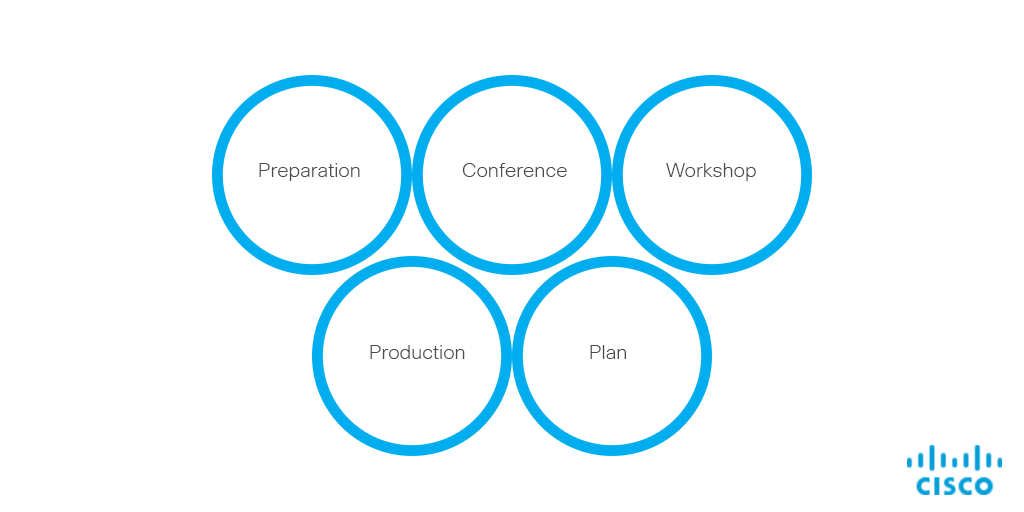
The vision and plan involves five phases, preparing for and following up on a day-long face-to-face workshop. The phases are:

FiveStepProcess

The visioning process starts with a preparatory discussion between the CIO and a key instructional leader, to explain the purpose and outcomes of the process. Next comes a meeting with a core planning group: the CIO, the instructional leader, a principal, a teacher, and a student. Here you plan the details of the face-to-face workshop day. The vision workshop day consumes six hours with everyone in the same room, where they sketch a vision of a Day in the Life of a Student in their transformed city.

After the workshop day, the CIO or a designee develops these sketches into a presentation for circulation among key constituents, and that presentation is then used to develop a plan of what exactly needs to be done to move the school toward making its vision a reality.

Once the vision and plan are in place, your district will be ready to partner alongside technology providers to transform the student experience, and with much of the foundation already laid through vision planning, your school will be well positioned to effectively manage change and increase adoption amongst educators.

To learn more about this proven, phased approach to vision management, read the full report here.


Authors

Avatar

According to the Merriam-Webster dictionary, container is a noun, and is defined as a receptacle for holding goods. Alternatively, it also means, a portable compartment in which freight is placed (as on a train or ship) for convenience of movement.

In this blog, I’ll be talking about containers in the networking sense and the important role they play in virtualizing data center resources and computing capabilities.

Today, data centers represent the digital foundation for delivering most IT services and providing storage, communications, and networking to the growing number of connected devices, users, and processes that we rely on in our personal and business lives. The increased focus on business agility and cost optimization has led to the rise and growth of cloud data centers. Virtualization is at the heart of the efficient and effective use of data center technology. There are various forms of virtualization, but containers offer a unique set of benefits for particular implementation types.

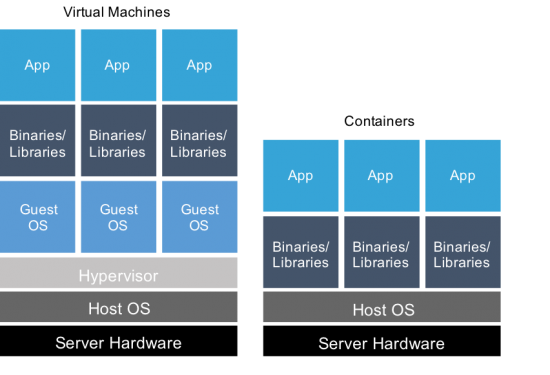
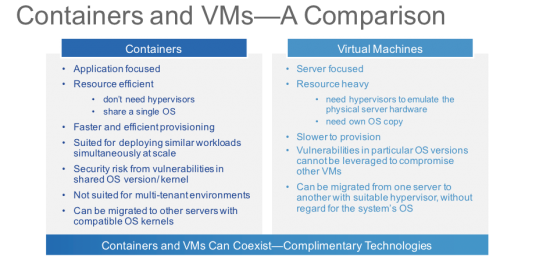
Containers can be defined as operating system (OS) level virtualization. The physical server and the common single instance of OS gets virtualized into multiple isolated guests – each replicating the real server. This approach to virtualization is resource efficient and particularly well suited for the devops culture, allowing development teams to streamline develop-test-production processes. While not suited for multi-tenancy, containers can be deployed for grouping web servers into a single VM, or web applications at scale.

Container blogVMvsCont pic

For agile development, applications are often disaggregated into many component-level micro services. By simplifying these complex applications into highly portable, smaller and less risky software components, response times can be reduced to meet business and customer needs. Each component service now becomes an end point to be accessed and shared across network. While containers should not be considered synonymous with a micro-service, they are very well suited for developing and deploying micro-services as well as the associated tools that manage micro-service based applications.

Container blog Comparison pci2

In our latest Global Cloud Index (GCI) Forecast 2015-2020, we include containers in the workload analysis. A server workload is defined as a virtual or physical set of computer resources, including storage, that are assigned to run a specific application. For the purposes of quantification, we consider each workload being equal to a virtual machine or a container. In fact, containers are one of the factors enabling a steady increase in the number of workloads per server deployed. While, we have not parsed out the number of containers separately, we estimate, based on our conversations with industry experts, that today containers are about 5 percent of the total workloads. By 2020, that share will grow to be at least 20 percent or more.

Please feel free to share your comments or opinions about this blog below. For further details on data center and cloud trends, please visit our public website. To further engage and ask questions, we invite you to join the GCI community.

Save

Save

Authors

Shruti Jain

Leader, Project & Program Management

X-Architecture Marketing, Enterprise Networking & Cloud