Avatar

This week we’ve been talking a lot about security, and especially security for video applications. One challenge facing everyone – mobile, cloud, video – is Distributed Denial of Service (DDoS) attacks.

Three key points –

  1. Attacks are getting bigger. We’re now seeing volumetric attacks of up to 400 Gigabits per second.
  2. DDoS attacks are getting more frequent – even daily.
  3. The latest DDoS attacks are becoming more sophisticated and multi-vector. Not just one mechanism is being used, which makes them harder to defend against.

Worse of all is that DDoS is being used to cover-up other threats. While you’re distracted fighting off a Denial-of-Service attack your content could be in the process of being stolen. With the right protection however, DDOS attacks can be squashed at the edge of the network, before any firewall or other device gets overwhelmed.

We recently caught up with Tom Bienkowski of Arbor Networks to hear what’s going on in DDoS – both trends and mitigation techniques.

https://www.youtube.com/watch?v=nDWM6cJMe1k&

Arbor and Cisco have teamed together to develop an integrated solution that combines technologies from both companies to mitigate DDoS attacks at the edge of the network. To learn more about DDoS mitigation watch this Cisco Knowledge Network event,  “Stopping Distributed-Denial-of-Service Attacks at Your Network Edge

Authors

Greg Smith

Sr. Manager, Marketing

Cisco Solutions Marketing

Avatar

Tech Field Day covers a wide variety of events such as Mobility Field Day, Storage Field Day, Data Field Day, and now Cloud Field Day. Cisco will be presenting at #CFD1 to a panel of 14 influencers from 1:00 – 3:00 pm PST September 14 .

For those of you who haven’t seen or heard of Tech Field Day, here is the breakdown: the top influencers (bloggers, podcasters, speakers, and freelance writers) come to Cisco to listen to a few experts talk about exciting topics in a presentation and discussion format. The influencers may ask questions throughout the presentation which makes the sessions more interesting and interactive.

To watch the livestream of Cloud Field Day at 1:00pm PST, click here.

Continue reading “Tune into the First Ever Cloud Field Day”

Authors

Breana Jordan

Product Marketing Specialist

Products and Solutions Marketing

Avatar

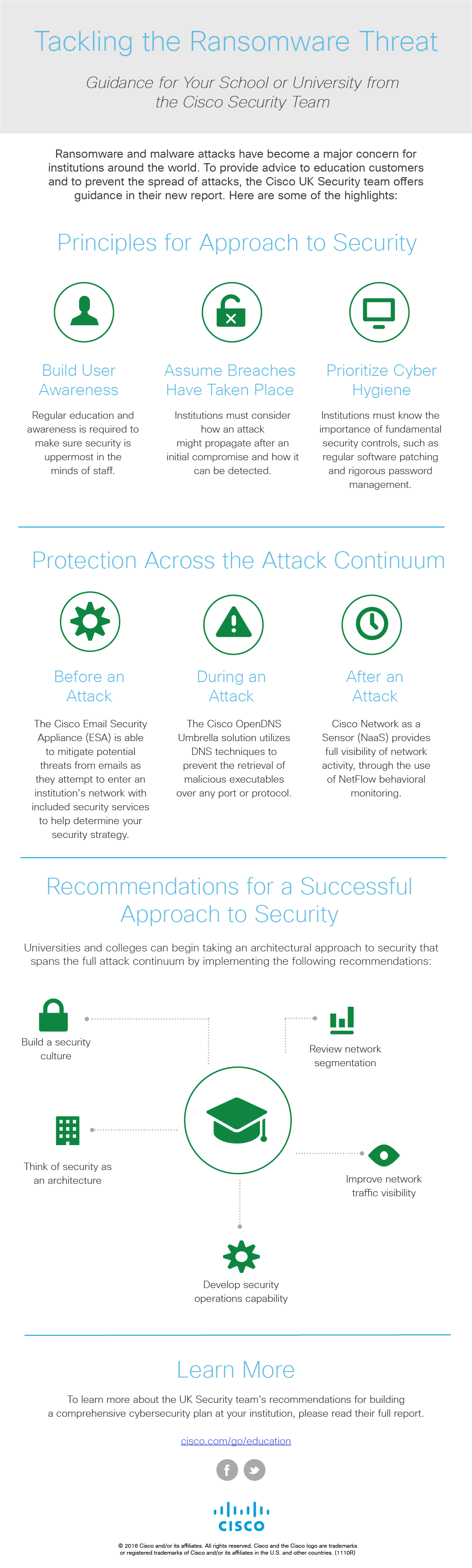
Ransomware and malware attacks have certainly been capturing recent headlines, and local governments, organizations and education institutions around the world have reportedly been targeted. These attacks have now spread across private and public sector industries, and are becoming a major threat. 

So, how can you protect your school or university from these malicious attacks? Our cybersecurity experts recently published a paper which outlines the steps you can take to protect your school before, during and after a breach.

Check out the infographic below for a brief summary of their recommendations, and read the full paper for more comprehensive guidance on protecting your institution.

Ransomware&Malware

Authors

Alexia Crossman

Senior Cross-Portfolio Messaging Manager

Cisco Marketing

Avatar

Once an organization has deployed technology infrastructure that enables visibility into the network (discussed in the first part of this blog), that organization now requires the properly trained security personnel to bring that time to detection (TTD) down to acceptable levels and to respond appropriately to a security breach.

Once detected, a breach must be stopped, and the security team must then coordinate and launch an appropriate response. A CCTV system requires a security guard to review the footage and respond to a suspicious event. A burglar alarm won’t be effective without someone to connect it to the key card system, to the sensors attached to doors and windows, and to the local police for emergency response.

Deliver power to the people

Hiring people with absolutely the right security skills is one of the most effective security investments an organization can make. For example, if a company has a security technology with 1,000 features, and if the security staff only knows how to use only one percent of that, then the company is far less effective than it could be.

While some consider humans to be the weakest link in the security-chain, the right people can be one of the strongest points of a security program. Humans with the best training will be those who map the technology to maximize effective protection. No amount of security technology can do that by itself.

Cisco is funding the future of security

Cisco recognizes the need for security staff with these skills, and it has responded by announcing the new Cisco Certified Networking Associate (CCNA) certification for Cyber Ops. This certification prepares candidates to begin a career working with associate-level cybersecurity analysts within security operations centers. Those certified with the CCNA Cyber Ops will have the skills necessary to vigilantly monitor and manage security systems, responding to threats and becoming valued protectors of their organizations.

To further help fill this pipeline, we took it a big step further.

Cisco recently announced $10 million in cybersecurity scholarship awards to get more individuals into the cyber security market with the CCNA Cyber Ops certification. Now individuals who want to increase their career options can tap into this unprecedented resource and make huge steps forward in cybersecurity.

We invite you to become involved in the next generation of security evolution. Explore the resources below, and leave your thoughts in the comments section.

Authors

Tom Gilheany

Product Manager

Learning@Cisco

Avatar

The concept of no-touch automated bookings is a very straightforward one: How do we reduce the need to “touch” or spend time and energy on the low-dollar contracts that we renew in the market? How do you enable a sales team to focus on the larger revenue opportunities and still drive solid renewal capture in the low-dollar space? And how do we automate the revenue capture from that segment of the contract opportunity?

Watch the On-Demand Webinar: Renewals for Low-Value, High-Volume Customers

The reasons to aggressively pursue this strategy are simple: automated revenue is lower cost and higher margin revenue.

Pursuing a low-dollar renewal automation strategy is smart and necessary. However, the very fact that these service contracts require a renewal event – a defined period after initial purchase when the contract expires and must be manually renewed (by human hands or platform automation) – is, in fact, a strategy that must be evolved even further. The very act of having to pursue and capture a renewal of these agreements is an outdated concept and strategy. We need to think bigger.

The Power of Recurring Revenue

There has been an unrelenting shift in IT over the last decade toward recurring revenue business models – selling IT products and services on perpetual, or recurring contracts. These are contracts with no defined end date – meaning the contract entitlements do not end or expire.

A recurring revenue or subscription model is defined as a product or service that is delivered to a specific expectation for a defined period of time (or unlimited period of time) for a specific dollar amount per month or year (subscription fee). This subscription fee might be fixed or variable, depending on the terms of the product or service being delivered.

We are all familiar with these types of contracts: SaaS subscription software licensing, cloud computing models for storage and backup, and content streaming services such as Netflix and Hulu. A monthly gym membership is an example of this type of service contract. There are even commodity products being sold in this manner, such as Dollar Shave Club.com. These revenue models are typically called “subscription revenue models” or “recurring revenue models.” You can check out my deep dive on the economics of recurring revenue in my post here.

What are the true value drivers of such a revenue model for the companies that invoice revenue this way? The significance of recurring revenues and the importance of the recurring nature of those revenues to the companies that earn them cannot be understated.

Perpetual Contracts Deliver Recurring Revenue

The concept of a perpetual contract is simple: It is a contract with no specific end date. If linked to a hardware product, it may have an end date at the end of life of the equipment it covers, but otherwise there is no set expiration of contract entitlements so long as the customer is current on their payments against the contract.

Basically, a perpetual contract is a subscription contract – payments can be structured to happen every month or annually. The important thing is that the contract does not end and then necessitate a costly and logistically complex effort to renew or re-capture that contract. The customer is automatically billed each contract term. If the customer stops paying, the contract terminates (perhaps with penalty fees or other such restrictions) and the entitlements go away.

Perpetual contracts and recurring revenues are where every IT provider is headed – there is no choice. This is not optional. It’s critical that we continue to evolve to a model where service contracts, and other offerings, behave and are structured in similar ways as subscription software offerings and cloud service contracts are structured – as recurring, or deferred revenue.

The Move Toward Deferred Revenue

Deferred revenue is revenue booked today, but recognized over a future period of time. What does that mean?  Let’s say I sell a two-year service contract today, and the customer pays me for the full two years up front. I can book the two-year revenue total today – meaning I can tell Wall Street that I got the money and can account for it as booked revenue. However, because the value of the contract will be delivered to the customer over a future period of time – in this case two years – I cannot recognize the full booked value in revenue immediately – I must defer the revenue, or recognize the value of the contract over the period of time in which the contract entitlements are being delivered to the customer.

In the two-year contract example above, let’s say the customer paid me $24,000 (upfront) for the two-year contract. I book the $24,000 today and that money sits on my balance sheet as deferred revenue. Because the contract terms is 24 months, what I must do is defer the revenue recognition over the 24 months. One option to do this would simply be to recognize 1/24th, or $1000, of revenue each month over the 24-month contract term.

Why Is Deferred Revenue So Important?

Deferred revenue is critically important to a business because it is contracted over a future period of time and guarantees a future revenue stream that the business can forecast and count on. These contracted revenue streams are highly valuable, and a company is worth more if it can demonstrate large contracted future revenue streams. Contracted future revenues also make it easier to make investments in the business and plan for growth.

Deferred revenue, and the transition to deferred and recurring revenue streams, also poses challenges for businesses that have traditionally booked and recognized large amounts of revenue up front, such as selling hardware and other transaction oriented offerings. Why? Because the company typically suffers a loss of up front revenue in favor of longer-term deferred or subscription revenues.

Let’s use the $24,000 contract example above to illustrate this concept of the balancing act that companies must manage through this deferred revenue transition.

Suppose I have a choice to sell either a piece of hardware worth $24,000 to a customer today, or a two-year subscription revenue contract to a customer for $24,000 dollars. If I sell the hardware, I get the $24,000 today and can recognize the entire $24,000 of revenue today as well.  My current revenues look strong in this model and I have also generated cash today.

If, instead, I sell the service contract for $24,000, I can record $24,000 of booked revenue today, but must defer revenue recognition over the 24-month term. So my up front revenues don’t look as strong, even though I have strong deferred revenues, typically at higher margins. The deferred revenue stream is actually more valuable to the company because it is higher margin and demonstrates contracted future revenues, but my lower current revenue number needs to be managed carefully so that I am not punished by analysts and other short-term revenue dependent measurements. I also have lower cash to work with today, since I cannot recognize the full revenue up front, so cash flow and other cash-dependent metrics need to be managed carefully through this transition.

Getting Out Ahead of the Market Transition

It’s clear that recurring, subscription and deferred revenue offerings are growing, both in prevalence and importance. Their potential for partners is powerful, but they also create new levels of complexity. As we all make the transition, the challenge is to keep pace with current contract vehicle types while preparing for requirements that future contract types will demand of us. One thing is clear though – digitization and automation of business practices are going to play an essential role in the transition and beyond. Cisco recognizes this and is investing in programs to help partners adapt.  Innovative, data-driven platforms such as Cisco Impact and AutoQuote are already helping partners transition to the new economy and digitize customer engagement. Powered by data-driven automation, these tools and others can give partners entirely new capabilities and a leg up for capturing recurring, subscription and deferred revenue — and competing more effectively as the dynamics of the market are changing.

The age of perpetual contracts is here. Are you ready?

Authors

Justin Crotty

Director of Business Development

Cisco IMPACT

Avatar

This post was authored by Jaeson Schultz.

Well it’s Microsoft Patch Tuesday, again, and that must mean we are girding our systems against another round of security vulnerabilities. This month Microsoft has released fourteen (14) bulletins covering fifty (50) security vulnerabilities. There are seven bulletins in the set whose severity is considered “Critical”. These “Critical” bulletins affect Internet Explorer, Microsoft Edge, Microsoft Graphics Component, Microsoft Exchange Server, Microsoft Office, OLE Automation for VBScript Scripting Engine, and the Adobe Flash Player. The remaining seven bulletins impact products such as Silverlight, Windows, Windows Kernel, Windows Lock Screen, Windows Secure Kernel Mode, Windows SMBv1 Server, and the Microsoft Windows PDF Library.

Read More

Authors

Talos Group

Talos Security Intelligence & Research Group

Avatar

Next week, Cisco and other industry leaders will flock to Berlin for the biennial transportation event InnoTrans 2016. The international trade fair for transport technology, highlights railway technology, railway infrastructure, public transport, interiors and tunnel construction as well as a new bus display area for transit vehicle manufacturers. InnoTrans will welcome nearly 135,000 attendees to discuss and showcase what’s influencing this evolving industry.

During InnoTrans, Cisco will showcase end-to-end solutions that are being utilized across the rail and transportation industry. Here’s a first look at what Cisco will demonstrate.

Cisco Connected Rail Solution:

Cisco Connected Rail lets rail operators converge multiple aging, proprietary networks onto a single, secure IP network that supports a variety of rail services.  With one connected IP network, railways can improve safety, mobility and efficiency while enhancing the passenger experience and increasing ridership.

The Cisco Connected Rail solution includes ruggedized routers, switches, wireless LAN access points and IP video surveillance cameras along with third party applications that can be deployed on-board trains, in stations, and trackside. One third party application that Cisco will display at InnoTrans is Cubic Corporation’s smart fare payment solutions.

Efficient data management and analytics further help rail operators increase rail capacity and proactively maintain rolling stock to reduce costs and complexity while keeping trains running smoothly and on time. Intelligent video surveillance increases the safety and security of both passengers and employees onboard trains, in stations and at the trackside.

  • Cisco Connected Train: Onboard high-speed, wired and wireless IP network that support voice, video and data for passenger services like Wi-Fi, entertainment and live scheduling applications.
  • Cisco Connected Trackside: Replaces multiple, older proprietary railway networks with a Cisco Unified MPLS Mobile Transport (UMMT) network.
  • Connected Station: Integrates multiple in-station networks and retail communication systems with into a standards-based IP network.

Cisco Validated Designs for Connected Rail are based on proven, well-established technologies and architectures that help minimize deployment risk and let railways take advantage of commercially available products and services. This lowers costs and protects their existing investments while improving performance, all with the network security they’ve come to trust.

Cisco Travels the Road to Innovation
When I think about Cisco’s vision to transform the transportation industry, I’m reminded of a quote by Ralph Waldo Emerson:

“Do not follow where the path may lead. Go instead where there is no path and leave a trail.”

At Cisco, we strive to blaze our own trail rather than follow what’s already been paved ahead of us, and this holds true particularly in our focus on reimagining the passenger experience on trains.

For many rail passengers, regardless of where they commute, riding trains can be a disjointed process.  A major challenge for rail commuters is seamlessly traveling from point A to point B since transit systems don’t often communicate with each other.

For some of these commuters, the system they use to purchase their train ticket is not connected with the transit system. Some then use ride sharing services like Uber after arriving at a train station, since for most riders, the train station is not their final destination.

That’s why Cisco is proud to announce a new collaboration with Fluidmesh, which combines our Connected Rail solution with their train-to-ground wireless technology to help deliver more reliable Wi-Fi to trains. Working together allows us to help make the train riding experience more fun and more productive for passengers so they can stay connected online during their journeys.

In addition to our new collaboration with Fluidmesh, Cisco has already been working to tackle these very same challenges through a new type of fiber technology called SWIFT (Superfast WiFi In-carriage for Future Travel), that is being developed as a proof of concept by our collaborative research team: Cisco CREATE.

But at the end of the day, riding trains should be a simple and enjoyable experience. Technology gets us one step further to achieving that so we can continue leading the way.

To learn more about Cisco Connected Transportation and our Connected Rail solution, visit us at www.cisco.com/go/transportation.

To learn about how cybersecurity is changing the transportation industry, check out this whitepaper from Cisco “Transportation: Improving Cybersecurity to Protect Emerging Systems”.

You can also take a look at several videos on the Cisco Connected Transportation YouTube channel.

Authors

Barry Einsig

Global Transportation Executive, Internet of Everything

Vertical Solutions Group

Avatar

Technology, when implemented correctly, can create immersive, next-generation learning environments. For students like Kajsa, technology is like the air she breathes, from the time she wakes up in the morning until she closes out her day. She makes no distinction between joining a class from her dorm room, the library, or a classroom. 

Screen Shot 2016-09-12 at 3.13.57 PM

The leadership at the University of Nebraska Omaha (UNO), has embraced this philosophy. They have used technology to remove barriers from teaching and learning. What’s most exciting is that UNO is training our future teachers and educational leaders. We often hear that Schools of Education aren’t changing fast enough – this one is.  

Professors in the UNO School of Education move seamlessly between a range of technology mediums: using recorded lectures, including guest lecturers in the classroom, ensuring that students receive feedback over video or in person, and in holding virtual tutoring sessions.

Screen Shot 2016-09-12 at 3.14.41 PM

Watch this video and imagine the possibilities to increase student engagement and expand access to quality learning with technology. There’s never been a better time to use technology to prepare our future teachers!

https://www.youtube.com/watch?v=qsgJlXG6OaU

Authors

Renee Patton

No Longer at Cisco

Avatar

It’s September and once again time for a very rare happening: an industry trade show in Las Vegas!

Get ready for #SAPTechEd the week of September 19. But unlike other Vegas behavior (you know who you are), we hope this time what happens in Vegas does not stay in Vegas. In fact, Cisco is showcasing two very cool new developments we want the whole SAP world to hear about: Tetration and Software Defined Storage.


Tetrationinfographic_1920x1080

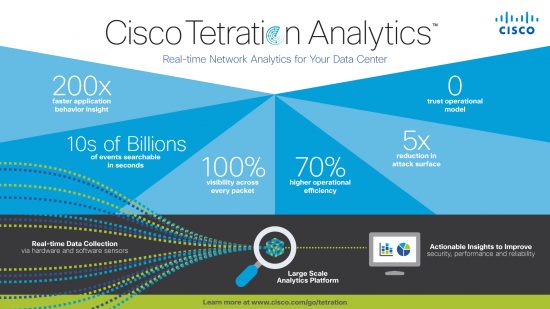
  • Tetration: SAP environments often represent a company’s most mission-critical IT investment. Therefore SAP users depend on efficient, secure data center operations and real-time analytics. Cisco Tetration adds unique value for SAP us
    ers by delivering enhanced visibility across everything in their network, in real time; ideal for intense, always-on applications running on SAP HANA.


  • Software Defined Storage: Cisco SDS is an innovative approach to Integrated Infrastructure for SAP.   SDS brings additional cost efficiency and flexibility to SAP users’ storage investments. Based on MapR, the new SDS solution is ideal for scale-out use cases such as big data applications, SAP VORA, and Dynamic Tiering.   It also gives you minty fresh breath* and makes IT staff look like geniuses to their management.

We are presenting these topics in a number of main speaking sessions and show-floor-networking sessions, as well as in a variety of partner booths.

Cisco will also showcase our track record of exclusive co-innovation with SAP – innovation that IDC found to deliver an amazing average of 528% ROI to SAP customers running on Cisco UCS.
We call these our SAP “firsts”:

  • 1st SAP-certified Policy-Based TDI for Management, Security, & Provisioning
  • 1st SAP-certified Reference Architecture for HANA Vora & Big Data
  • 1st SAP-certified One-Click Deployment of SAP HANA Applications
  • 1st SAP-certified Software Defined Storage for SAP HANA
  • 1st SAP-certified 40 Gigabit fast Ethernet for SAP HANA
  • 1st SAP-certified hosting platform to truly dominate the SAP Cloud Hosting market (more SAP Partners host HANA-as-a-Service on Cisco than on any other Platform – 75% of them!)

So if you and your loved ones are planning a vacation at SAP TechEd, stop by booth #603 to learn why more and more SAP users are betting their future on Cisco UCS.


* Disclaimer: Fresh breath measured in lab environments; your personal results may vary.


Authors

Brian Ferrar

Enterprise Marketing Manager

UCS & Data Center