National Health IT Week (September 26-30) is a collaborative forum that brings together key healthcare constituents to advance health through the best use of information technology (IT). Cisco is one of more than 400 healthcare stakeholders expressing the benefits that health information technology (IT) brings to healthcare delivery.
Hospitals and healthcare providers are using Health IT to expand their outreach within and outside their healthcare organizations. As National Health IT Week comes to a close later today, we want to share some examples of how Cisco can help you implement Health IT changes for accessing quality care and bringing expert care to your patients.
Niki Fassler, a 12-year old student with Down syndrome, was diagnosed with leukemia and was unable to attend school due to the severity of his illness and potential risks associated with being present in a classroom. Using a Cisco video collaboration solution allows Niki to be part of the class and to actively participate in lessons while receiving chemotherapy and other treatments at St. Anna Hospital. The technology is simple and secure, allowing Niki to call into his classroom by himself, speak and engage with classmates, and see the entire classroom with a panning camera. Being included in the classroom has had an incredibly positive influence on his mental and physical health.
Ten-year old Peyton Walton used Cisco video conferencing to shrink the 600 miles between her hospital bed and her classmates. By using innovative video technology to attend class during cancer treatments, Peyton stayed connected with her school, teachers and friends while she fought to become cancer free. Peyton’s story is a story of courage and commitment and the power of connection. Giving Peyton the opportunity to be included in the classroom had a huge impact on her treatment.
Teleradiology pioneer vRad is using live video radiology diagnostics to reduce patient anxiety while assuring more effective care through face-to-face collaboration. Combining teleradiology—which provides immediate access to a subspecialty-trained radiologist—with live video conferencing, makes investigating anomalies more efficient and collaboration more effective, assuring quicker diagnosis. Enabling the patient to communicate with the experts with real-time video assures a more human connection on such personal topics.
In President Obama’s National Health IT Week statement earlier this week, he stressed the importance of accessing information quickly and securely through electronic health records. Union Hospital in Maryland turned to Cisco to implement a data center solution that provides a reliable, secure foundation for their Meditech electronic health records (EHR) system and the picture archiving and communications system (PACS) used for storing medical images. Cisco technology ensures an IT infrastructure that is fast, available, scalable, and secure.
Want to learn more? Cisco can help your healthcare organization to coordinate services across the care continuum, connect clinicians with patients, and enable analysis of data in order to incorporate new and innovative ways to improve the efficiency of care delivery. Let us know how we can help you get started on your digital transformation.
I just got back from MineXpo in Las Vegas and had the pleasure to speak with both our partners and customers in this exciting market. The conference is very unique because it is only held every four years and to me this is telling of the industry. Not that the industry doesn’t change, but that change takes some time and is built for the long haul.
An example of this is the work that we are doing with partners such as Caterpillar and Komatsu. Walking through their booths took a long time due to the incredible amount of square footage at each. What kept coming up was that data is the key to success in mining going forward. Here is a photo of how Caterpillar defines this with their customers:
Getting to the data has been difficult, but it’s getting easier as we have been working to understand the nuances of the market and building robust, pervasive networks across customer sites. One output that customers want is advancements in the Autonomous Vehicle space. Here is a shot of the new Komatsu haul truck and if you look closely, you will notice that there is a piece missing – the driver’s cab!
Not only has Komatsu designed a fully autonomous vehicle, but there is no turning back. There is no way to have a driver in this vehicle so you are either all in for autonomous or it will not work. We are working with Komatsu to ensure full compatibility and integration onto the operations network and ensure their uptime needs are met.
The market is in an upswing and digital ideas & implementations are at the forefront of companies’ thoughts. Our recent announcement with Barrick Gold shows this as they have committed to a full transformation into a Digital Mining company. They have also stated that they will be up and running with these concepts within three years, which is an incredibly quick turnaround for us to implement. The great thing is that we hope to talk about these real life examples and stories at MineXpo 2020!
For more info on digital mining, visit our website:
A wireless network with zero downtime? For a network made up ancient LAN switches, a few isolated access points and a single gigabit Ethernet uplink, that’s a lofty goal. Now imagine that this network is in an airport. Forget lofty goal, you’re talking Mission: Impossible.
But for Romania’s National Company Bucharest Airports (CNAB), the reality was they desperately needed to upgrade its network. And fast. Not only did the airport have to upgrade, but it had to make sure that the merger of two companies that managed the airport, Henri Coanda and Baneasa Aurel Vlaicu, were included in this project too. To add another level of difficulty, CNAB is staffed by 1300 employees and is responsible for 70% of all Romanian air traffic.
This project had the potential for turbulence.
The airport turned to Cisco, who had a great solution in mind. The most important piece to this updating puzzle is the modernization of the infrastructure. Using products such as the Cisco Aironet 1140 and 3500 Series Access Points in conjunction with Cisco Catalyst 2960, 3750, 4500 and 6500 Series Switches, Cisco laid down the proper building blocks.
This created a network where real-time information began to flow around the airport improving all forms of day-to-day operations. Whether it’s customer check-ins or making a purchase at one of the airport kiosks, the experience is now user-friendly, and most importantly, secure.
Now the airport is seeing nothing but blue skies!
“We have achieved a ten-fold increase in data transfer speeds compared to the previous network,” said Vasile Darla, CNAB’s CIO. “Crucial information and communications are more widely available and easier to access. Staff productivity improved from the moment the Cisco solution went live.”
Not only that but now that the IT department is no longer fighting infrastructure fires, they have the ability to focus on delivering new service innovations.
There is no better venue than Strata + Hadoop 2016 to talk about digital transformation, big data and Hadoop.
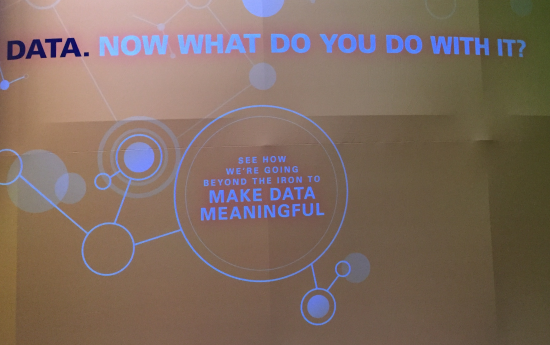
Let me start with the Internet of Everything which represents a global market transition driven by a surge in connections among people, processes, data and things. The Internet of Things is focused on devices, but when you connect the unconnected, the Internet of Things becomes the Internet of Everything. It’s important to understand when you bring something online it’s not just connected to the Internet – it is connected to everything else. As these connections multiply, the result is exponential change, creating new revenue streams, better customer and social experiences, and new operational models that deliver ever-greater efficiency and value. By 2020,
world population will increase from 7.45 billion to 7.58 billion
those who have internet access will increase from 3.61 billion to 5.0 billion
number of connected devices will increase from 15 billion to 50 billion
global mobile IP traffic will increase from 50 exabytes to over 350 exabytes
the digital universe will grow from 15 zettabytes to 40 zettabytes
An example … Consider the Olympics, the largest sporting event in the world. The 31st Summer Olympics were recently held in Rio De Janeiro, Brazil. Thousands of athletes from more than two hundred nations participated and five billion people watched the games, that’s more than two-thirds of the world’s population, and a forty percent increase from 2012 London Olympics. Cisco partnered with NBC to provide the experience. It was the most connected event in history. The network provided by Cisco had over 100,000 ports and 5,000 WiFi access points connecting 15,000 athletes, 8,000 rooms at the Olympic Village alone, 25,000 media personnel, 70,000 volunteers, 85,000 law enforcement personnel, and over 3,000 officials on the ground behind the scenes. Do you see the exponential increase in the number of connections? During the games 54 million competition data feeds were transported and processed in real-time. Over 23 million network attacks were detected and blocked. 170,000 hours of online video content was uploaded, that’s almost 20 years of continuous video watching. 130 million hours of online video were watched via mobile devices – the world is definitely going mobile. See the magnitude of the challenges and opportunities? The technology we implemented and the lessons we learned have broad applications to the world at large with digital transformation.
Challenges … This digital transformation is a disruption and it threatens organizations, public sector and private sector alike, it is a reality that cannot be ignored. As with all change, there is tremendous opportunity to create new value. Organizations that meet the challenge will drive their own disruption, but only if they fully embrace digital business transformation. Gartner estimates that by 2020, seventy five percent of businesses will be digital, or have digital business transformations underway. However, only thirty percent of those efforts will be successful, owing in part to a lack of specialized talent and technical expertise. All of this requires a fundamental rethinking of business and operational strategies as organizations adopt new models for agile information technology, edge analytics and platform-based security.
A digitally transformed organization is hyper-aware, predictive and agile – with dynamic processes enabling it to adapt and thrive in an environment of continual change. One of the primary drivers of digital transformation is sophisticated analytics with big data technologies. Big data is the engine that drives today’s analytics. But, note that big bata has evolved to meet this need. It was originally focused on batch processing of offline data; now, it is the primary enabler of analytic engines running on streaming data in real-time. With digital transformation, data becomes the most valuable asset – you could even call it the lifeblood of the organization. Another important point to note is that these emerging analytics are not likely to replace traditional analytics but they coexist with and complement each other. Data from connected things: sensors, smart devices, mobile phones, connected automobiles and social networking, will be combined with traditional business transactional data and then analyzed in real-time. Collecting more data, and preparing for increasing growth in data, will be more critical than ever before.
So what is Cisco doing at Strata + Hadoop – a big data conference? … (This was one of the top questions that we heard
at the early Strata conferences. Not anymore, but let me address it once again). The answer is simple: Cisco is not just a leader in networking. In just a short span of seven years, Cisco’s Unified Computing System (UCS) has grown into one of the top server platforms in the world adopted by over 52,000 unique customers.
With digitization, all the data will require two fundamental aspects: transport and processing. Cisco’s long-time expertise is in networking and we are all over the transport problem, but we have done so much more. Cisco UCS is a fully integrated infrastructure bringing together computing, storage and networking to create one of the best performing systems in the world, demonstrated through more than 100 industry standard benchmark records, including several big data benchmark records.
Here are the top ten reasons for you to visit the Cisco booth at Strata + Hadoop 2016 by Rex Backman.
Our Solution Offers .. We introduced our big data solutions four years ago and have seen wide adoption across major industry verticals and have been endorsed by leading analysts like IDC and Forrester Research.
Big data systems have a lot of moving parts and a key differentiator for Cisco is the partnerships we have formed with leading big data software vendors. One of the reasons for our success: we made the complex architectures easy for our customers to implement by working closely with our partners using our validated designs and end-to-end automation tools.
These Cisco Validated Designs (CVD) employ a fully integrated infrastructure that can scale as business demands using a simplified centralized management approach allowing one to see the whole infrastructure as a single unit, dramatically reducing the complexity of provisioning, monitoring, troubleshooting and growing the system.
While our portfolio is much broader, let me describe our Hadoop solutions at a high level:
Data Lake and Data Hub – Hadoop has emerged as an integral part of enterprise data management driven by the cost of ownership and scalability advantages. We have created an array of Cisco Validated Designs with leading Hadoop software partners: Cloudera, Hortonworks, IBM and MapR. These solutions have evolved inline with the advancement in the Hadoop ecosystem technologies such as support for tiered storage, SQL compliance, advanced automation and many more.
End-to-End Analytics – Internet of Things devices such as sensors, smart devices, mobile phones, social networking, and online transactions are all generating data at unprecedented scale. All of this data needs to be captured, monitored and processed in real-time. We’re seeing this with systems that provide sentiment and exploratory analytics, as well as edge nodes issuing real-time alerts, often as part of a larger framework known as the Lambda Architecture. Our vision of the evolution of the Lambda Architecture combines both historical data, in Hadoop or traditional relational systems, and real-time streaming data under an end-to-end unified management plane.
Big Data meets Traditional – Hadoop and other big data technologies are not necessarily replacing traditional technologies but coexisting and complementing each other by the integration of traditional analytics with emerging datasets built on big data systems. One example is SAP HANA Vora, a new in-memory query engine which leverages and extends the Apache Spark execution framework to provide enriched interactive analytics on Hadoop data. Cisco and SAP have invested in a joint initiative – project Benjamin – a platform for joint innovation, testing and customer proof of concept.
Industry Vertical Solutions – Big data has been adopted across all major industry verticals. We have a broad range of expertise and a partner ecosystem to work with our customers to understand their businesses, challenges and opportunities, and to identify big data solutions appropriate to their needs. Some of the areas of focus include: finance, healthcare, media, manufacturing, retail, energy and utilities. Stay tuned.
Cisco is your partner in this journey towards a digital transformation. We can help you navigate through the disruption you’re experiencing, by enabling you to be hyper-aware, predictive and agile in your operations, significantly reducing your time-to-value as you move from data to insights.
Tofsee is multi-purpose malware that has been in existence for several years, operating since at least 2013. It features a number of modules that are used to carry out various activities such as sending spam messages, conducting click fraud, mining cryptocurrency, and more. Once infected, systems become part of the Tofsee spam botnet and are used to send large volumes of spam messages in an effort to infect additional systems and increase the overall size of the botnet under the operator’s control.
Earlier this year, Talos published a blog post discussing how the RIG exploit kit was delivering this malware to compromised endpoints using malvertising. Malvertising is a technique commonly used by exploit kits to infect users that browse web sites that are serving compromised advertisements. This activity seemed to disappear in June, however Talos has recently observed a marked increase in the volume and velocity of spam email campaigns containing malicious attachments that are being used to distribute Tofsee.
It’s time to complete the foundation and launch your own innovation disruption—companywide.
This is the last of my three-part series. I lay out the final three building blocks needed to shake up bureaucracies and turn them into startup-like cultures. To transform employees into entrepreneurs. To fire up innovation. And to jumpstart disruptive, game-changing solutions.
Best Unique or Innovative Talent Management Program
Best Advance in Employee Engagement
Emerging Stars Program
“Winning a Brandon Hall Group Excellence Award means an organization is an elite innovator within Human Capital Management. The award signifies that the organization’s work represents a leading practice in that HCM function,” Rachel Cooke, Chief Operating Officer of Brandon Hall Group and head of the awards program, said in a recent press release.
Now, adding to Part 1 and Part 2, here are the final three building blocks needed to ignite innovation across most any organization:
Seventh Building Block:Provide open platform to communicate, connect and collaborate
In the Silicon Valley, it’s well known that startups rely on trusted relationships and success is a team sport. Open and engaging communications reinforces this culture of entrepreneurism. Open communications empowers innovators at all levels to connect, converse and collaborate on projects. Transparently!
Corporations must also nurture an environment of open communications to build trust, unleash talent, form teams and experiment. All media channels, events and champions should reinforce these messages of cultural change frequently and consistently.
Walk the talk. In a startup, everyone can gather around the coffee machine or nearest open space to brainstorm. In a multi-national corporation, you must provide a virtual break room. Make sure everyone can access an open collaboration platform where it’s easy for employees with like-minded ideas to find each other and form teams. Founders can search a directory for the missing talent on their teams. Someone with a particular skill or passion can find the right team to join. Innovators can create localized communities online to share ideas instantly. Shape your own version of Silicon Valley.
When developing ideas, the platform should also allow teams to connect with executive sponsors, mentors, coaches and concierge services. And everyone should be able to quickly access all types of support, tools, and resources throughout their innovation journey.
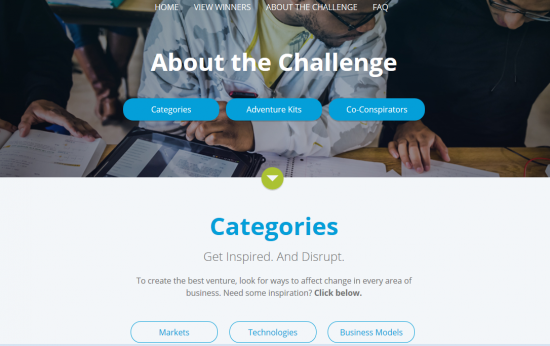
At Cisco, we also provided a resource-rich web site. Here, employees could not only find and download everything they needed to model a lean startup, enter and win the challenge. They could also track the progress of entrants, cast votes and make comments. All this stimulated participation and excitement.
I cannot overstate the importance of collaborating closely with employee communications to help make your program successful. In our experience, an exceptional partnership with employee communications not only ramps up buzz, but also helps inspire your own team to think more imaginatively. Join communications at the hip to raise engagement by co-creating impactful experiences and regular updates that spotlight successes and failures, key milestones, and team progress from start to finish.
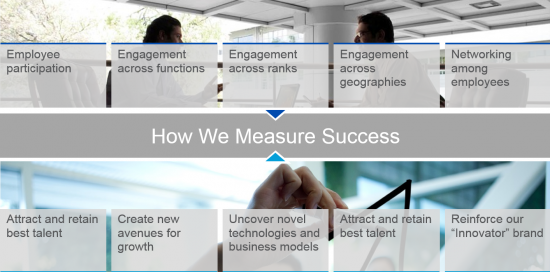
Eighth Building Block: Establish right metrics to assess practical results
Some people say that innovation can’t be measured. I disagree. Innovation can and should be measured. However, one of the biggest mistakes companies can make is applying traditional measurements to transformational work such as innovation. Financial measurements such as Net Present Value or Rate of Return really aren’t always relevant when gauging the success of an internal innovation program.
Innovation projects also have different levels of risk, uncertainty and relationships in both the short- and long-term, requiring new ways to determine success. It requires a vision, a leap of faith.
We do measure revenue impact, but we also gauge employee engagement, formation of informal networks, or the growth and strength of our community of innovation mentors and coaches. We also look at the impact of the program on attracting and retaining the best talent and uncovering novel technologies and business models.
Of course, the ultimate measure for any internal or external innovation program is how well it unearthed new solutions that add leapfrog value for customers, the solution provider and their employees. Not all innovation projects though can be monetized. Strong teams, for example, might not necessarily bring in money, but they help the company down the road.
Ninth Building Block: Gamify it and have fun!
Last but not least, make this serious business a fun and exciting experience that inspires employees, where the stakes and passions are high, and the winners celebrate victory with their colleagues. Don’t make it a grueling competition.
Gamify it!
Engagement will soar when employees have creative ways to vote, root for their favorites online, hoist banners at events, search for like-minded team members, or brainstorm in online communities of their own making. We haven’t incorporated Pokemon GO-type features yet. The lesson, however, is to fuel dynamic interactions through collaboration technology, exciting live experiences and the latest social media sensations.
From ideation to seed funding and full venture development–from selection of 15 semi-finalists to three winners—employees worldwide should join in the action, whether at in-person events or via live-streamed broadcasts. Excitement grew to a crescendo when the six finalists pitched and demoed their ventures to a panel of judges, and leaders announced the three winners at an All Hands meeting a few days later.
With cash rewards and new resources in hand, the winners now are taking time off to develop solutions that they can bring to the market. It doesn’t stop here. It’s actually the end of the beginning. It’s critical to sustain momentum and credibility by featuring the winners’ progress companywide, even as you plan your next series of innovation disruptions.
These nine building blocks in our Innovate Everywhere Challenge helped to ignite innovation, inspire employees, and engage about half of Cisco’s 72,000-person workforce. Employees formed more than 2,000 teams and generated 1,100 ventures worldwide—nine of which the corporation is funding for further development.
We in the Corporate Strategy Innovation Group spearheaded co-development of this innovation disruption as part of a grassroots movement. We enlisted the collective support of “co-conspirator” rebels, business unit executives and the C-suite, including CEO Chuck Robbins and Chief People Officer Fran Katsoudas, and so many energized partners across all employee functions. Thank you all!
There you have it. Now the nine foundational building blocks are set. Whether you’re in Strategy, HR, Engineering or wherever, you can be the catalyst for a companywide innovation disruption. Build that coalition. Get air cover all the way to the top. Develop deep resources. Incentivize innovators.
Igniting an innovation disruption companywide is hard. The risks are high, but the potential rewards are much higher. In today’s digital age, there really is no choice but to transform into a startup culture of innovative entrepreneurs. The time is now.
Ready, set, go!
Meanwhile, if you have questions, get stuck, or need an innovation therapist, don’t hesitate to contact me:
Sometimes having a effective and innovative solution goes in a confrontation with the local country requirements. Especially when we want to deploy as cloud based security service.
Using a cloud security service will one the one hand address quite nicely the need for better security and easy deployment , on the other hand a CxO must also follow local privacy laws and deal with the agreements between the company and workers unions. This can very often lead to delays, discussions and even preventing a solution from being installed. This short post should give you an idea how to use a cloud based Security Service and at the same time, provide granular local logging without compromising privacy.
In a customer environment we faced the following situation:
The customer was using a Cisco WSA as a Web Security Gateway
The customer was looking for additional security layers against threats from the web
They were concerned about sending Usernames and IP addresses to a cloud service
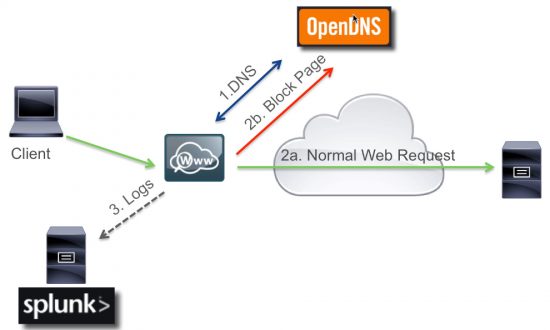
To provide an additional security layer, we decided to take a look at the Umbrella Service from Cisco (umbrella.cisco.com). This service provides security at the DNS Layer, being able to detect requests to malicious domains and block them right away before anything else needs to be filtered.
In case a malicious request is detected, Cisco Umbrella delivers a block page back to inform the client that his request could not be fulfilled.
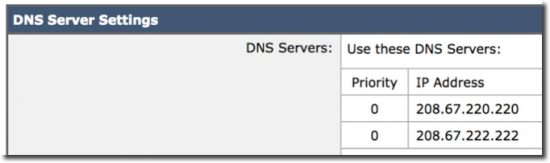
So, for our deployment, the already installed Web Proxy is a nice point to start an evaluation. Just set the proxy to resolve the external URLs via the Cisco Umbrella Servers. This is especially nice for a first test because it does not require any other changes in the client or network infrastructure.
All the logs are sent towards a Splunk server, running the Splunk provided app for the WSA.
On the Cisco Umbrella portal you need to define your networks from where usually the DNS requests are sent.
In our case, it is not a full network but actually only the proxy IP address:
Fortunately, the block pages that are sent back from Cisco Umbrella are well known IP addresses:
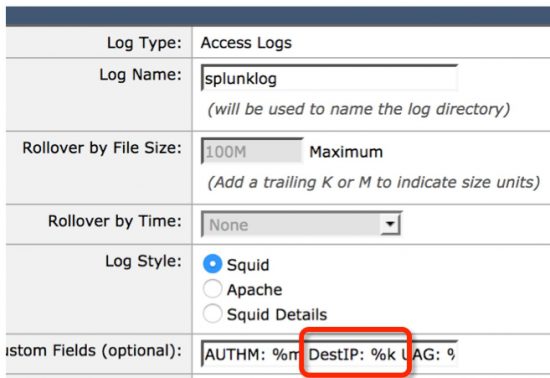
On the WSA side of things we need to enhance our log files to also include the destination IP.
The variable to get the destination is “%k”
This is enabling us to see the actually requested IP address.
In case Cisco Umbrella declares a Website as “malware” we will see the respective block page IP mentioned above.
Working with IP addresses only is not so nice, so we want to create a “nicer” report on Splunk.
First, within the Splunk app, extract our destination IP:
This gives us a new variable “dst_ip”.
Define a new lookup with a lookup table containing the different categories of malware and the block pages:
So we are getting now another variable called “odnstype” that we can use in our reports, which is easy to do in the SPLUNK system
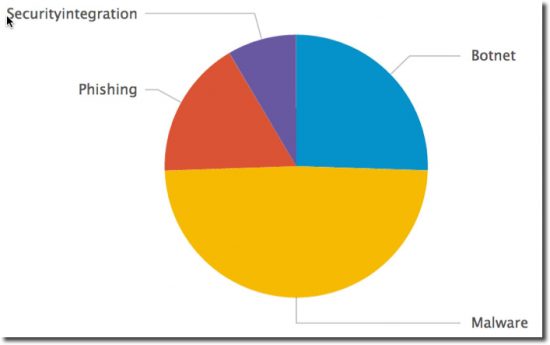
Some examples how to use it from a simple diagram showing our malware requests:
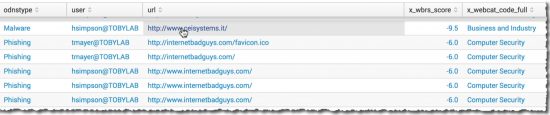
Or showing a detailed drill down who requested malware sites and is potentially infected, comparing it with the Web Category of the URL and the Web Reputation Score:
So, in summary, what did we achieve?
we are using the Cisco Umbrella Service as an additional Security layer with minimum impact on the deployment because we only activated it on the Web Security Appliance (WSA).
The Cisco Umbrella Cloud sees only the IP address of the proxy but no internal IP addresses and no usernames
The local Splunk server has all the information that is needed to track down infected client without compromising privacy on the outside of the company network
You know that updating your wireless network has a lot of benefits.
But one of the challenges of an organization updating its own network is the speed in which it can be done. You want to make sure your new network is deployed quickly AND correctly. Universidad EAFIT located in Medellín, Antioquia Colombia wanted a new network but were dismayed to learn how long the project would take.
With 16,600 students spread out over 28 school buildings and eight annex houses, Universidad EAFIT occupies a lot of acreage. They found that timeframe network upgrades took was way too long. It was estimated that a crew of 25 IT employees would need two to three weeks to equip each building with the new technology.
The university felt this was far too long.
After considering other vendors, Universidad EAFIT chose Cisco to implement the new solution. With more than 200 wireless access points (Cisco Aironet 2700 and 3700) running with Cisco Catalyst 3500, 3700, 4500 and 6800, the university was able to set up the network and improve WiFi performance quickly.
The reason? Easy deployment. Engineers were able to configure and monitor each switch and access point from the Cisco Prime Infrastructure manager. This was a much better—and less time consuming—solution than individually configuring each of the wireless devices. Add Cisco Identity Service Engine for simple security deployment and the college was set up in a fraction of the time.
“The web interfaces for Cisco Prime and Identity Service Engine (ISE) are very easy for even entry-level admins to understand and use,” said Hugo Giraldo, Head of IT Infrastructure Universidad EAFIT. “Three people can equip an entire building with 400 computers in just two days.”
The new network has proven to be a great upgrade for the university as professors are creating connected classrooms. The college has even started offering courses via virtual classrooms. In the future, Universidad EAFIT is planning to improve its efficiency with smart lighting and air conditioning as well as digitizing its library collections.
Fall is finally here! Last weekend, the temperature dropped, so I cruised to the store with my windows down and my stereo playing Jack Johnson. I parked to run inside and get the few quick items. For a moment, I debated whether or not to roll up my windows. What’s the harm?
Spoiler alert: I rolled them up and locked the car. Why? I’m in the business of security and threat mitigation. I knew I would be tempting fate.
But what does my trip to the store have to do with a security breach? If I left my car open and it was stolen, I would have felt like a bonehead (and my wife may echo the sentiment). I would be dealing with police, the insurance company and car dealers all day instead of enjoying the sunshine. Just like a stolen car, a network security breach can happen any day, any time – but it can also be prevented. So why aren’t you doing the simplest combination of things to protect yourself?
Now, we all know that using the best solution isn’t always simple and vice versa. Wait…that’s not true! We offer both.
Your customers are looking to you to make sense of security solutions. But which one will truly protect their businesses and their people? Which one stops breaches before they happen? Which one has the best time-to-resolution in the industry?
The answer: Cisco.
We help you deliver everything your customers need from advisory and managed services to integration of all the right solutions to support after the installation. And how could I forget to mention that these solutions will help you maximize your profits!
How? By giving you everything you need to sell and market such as:
Security sales incentives ensure that you maximize your profit with security Ignite while selling the best simple, comprehensive solution to your customers.
It’s simple…just like rolling up the windows and locking the door.
This blog series explores how Cisco helps before, during and after a security breach as well as supply chain breaches. Learn how to take advantage of Cisco’s security product sales incentives and how to best market them. Come back next week to learn how Cisco helps you during a security breach.



 one of more than 400 healthcare stakeholders expressing the benefits that health information technology (IT) brings to healthcare delivery.







 Let me start with the
  he top ten reasons for you to visit the Cisco booth at Strata + Hadoop 2016 by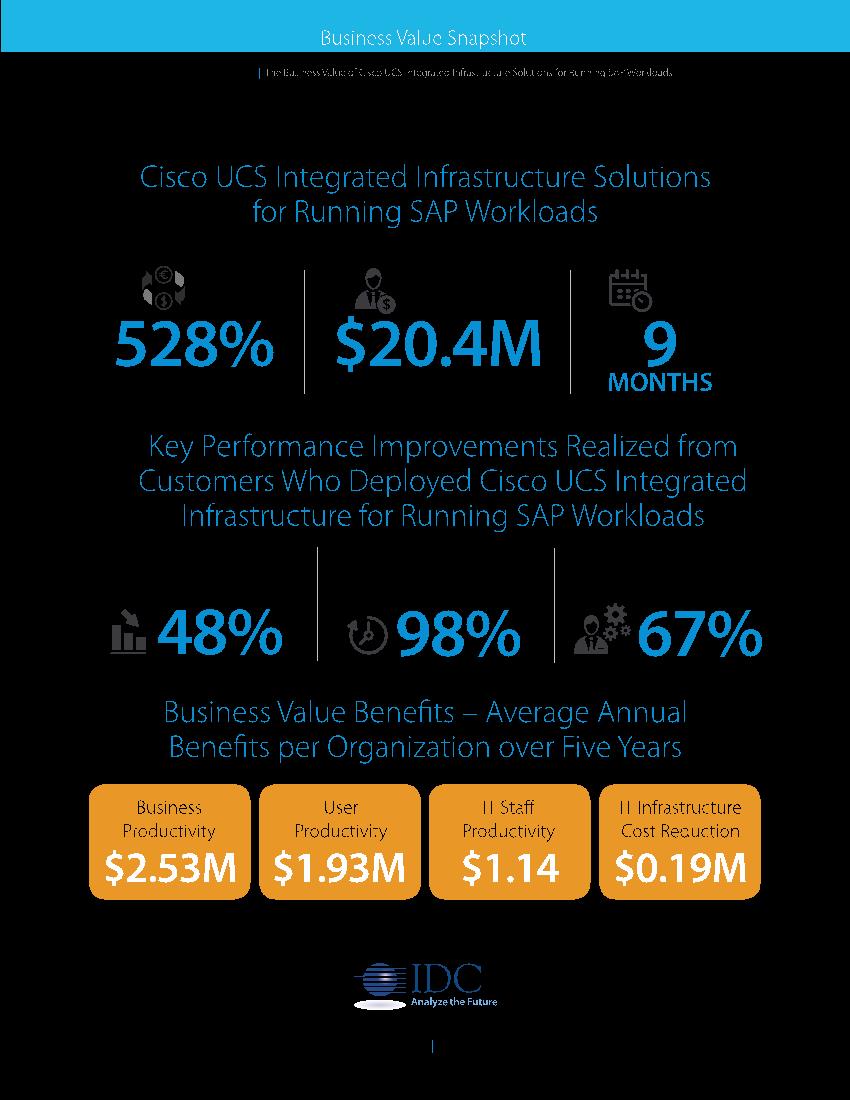




 “Winning a Brandon Hall Group Excellence Award means an organization is an elite innovator within Human Capital Management. The award signifies that the organization’s work represents a leading practice in that HCM function,” Rachel Cooke, Chief Operating Officer of Brandon Hall Group and head of the awards program, said in a recent press release.
 reinforces this culture of entrepreneurism. Open communications empowers innovators at all levels to connect, converse and collaborate on projects. Transparently!
 companies can make is applying traditional measurements to transformational work such as innovation. Financial measurements such as Net Present Value or Rate of Return really aren’t always relevant when gauging the success of an internal innovation program.
 winners celebrate victory with their colleagues. Don’t make it a grueling competition.