Avatar

Has anybody ever actively encouraged you to hack your own car?  Did you know that hacking your car could mean diagnosing problems easily and for a lower cost than you would find at the local dealer? Did you know that the aviation industry has built in both safety and security from the ground up? How old, really, are the robots used in manufacturing plus the Operating Systems that control them (answer: some are older than the internet itself)?  If this ignites your curiosity, read on. . .

On September 7 in Milan, Italy, the Politecnico University of Milan and Cisco brought together a group of expert panelists for the “Internet of Broken Things,” an event open to both students and industry. The goal was to discuss nascent cybersecurity issues for an ever increasing connected world.  The expert panel included lawyers, professors, researchers, engineers and product marketing.  This mix sounds a bit like the groups we have across the board at Cisco working on cybersecurity, and shows how cross-functional and cross-sector parties can be brought together effectively to solve difficult problems.

For me, as a Product Marketer, sitting side by side with IoT security researchers, entrepreneurs and law professionals brought me to the conclusion that the need for IoT cybersecurity is both far in the future as well as very relevant today.

For example, the ‘connected car’ is now making headlines. The “insider” secret that the manufacturers of connected cars don’t tell you is that cars have networks inside of them that run everything from RPM, anti-lock braking systems, radio and air conditioning. And it is possible to compromise all of these systems, even from something as simple as a wire in the brake light. The truth is that we have been hacking cars for years. Any owner who has ever eliminated the limits of their car’s allowed KPH or MPH is a “hacker.”

One thing to take comfort in is that, for all intents and purposes, it is possible to keep IoT security risks to a minimum by building in security and safety from the ground up. Interestingly, the aviation industry provides us with valuable best practice examples. Believe it or not, this industry has long been incorporating security and safety into the design of every aspect of the experience from the ground up.  This may go unnoticed by the passengers and media coverage and the secrecy around the industry’s safety and security measures provide little supporting evidence. However, the airline industry pours incredible effort and resources into classification and management of different security threats. Put simply, they are absolutely obsessed over safety and security in every single process from conception of a plane on paper and route mapping all the way to a commercial flight.

Security should be built into all IoT connected things from conception through to production and delivery. But it is not yet the case.

Cisco is preparing for the reality of millions of connected devices that have not incorporated safety or security. Cisco has proposed a standards-based approach to IoT cybersecurity called the Manufacturing Usage Description (MUD), which is currently being reviewed by the IETF. A manufacturer should know what a device is intended to do; for example, a light bulb shouldn’t be communicating with a finance server, but it should be communicating with its controller. So the concept is to use the manufacturer’s product knowledge, expressed in an XML file, to create network policy that we can then enforce.

We are proposing that the IETF allow for an additional field in the DHCP protocol for a Universal Resource Identifier (URI). That URI points to the device manufacturer’s web site from which the network security controller pulls the XML file declaring the device’s appropriate usage. That usage file can then be merged with the existing network security policy and enforced. Because MUD will be standards-based, this functionality will be available to any network controller that adheres to the new standards; it’s not Cisco-proprietary. This approach provides another layer to a defense-in-depth strategy and means you don’t to have to rely on protection being built into IoT devices from the ground up to achieve basic IoT security.

In plain English: let’s automatically find out what a device should be allowed to do and enforce policies that prevent it from overstepping those limits.

MUD is the future – what about today? Today, Cisco is serving IoT customers with Jasper, Cisco Connected Factory, Smart Cities, Cisco Trust Anchor Technologies and Ruggedized Next Generation Firewalls to name a few specific offerings.

I wasn’t expecting that an event outside of Cisco, in a discussion around theory and unsolved IoT cybersecurity, could make me more confident in Cisco’s intense focus on its customers. Even in a space as cutting edge and forward-facing as IoT Security, we have the right team, the right focus, and the right principles to serve IoT customers today. Thanks to events like the Internet of Broken Things, we are also ensuring that industry and academia alike are working together to bring customers safely to the IoT of tomorrow.


Authors

Story Tweedie-Yates

Product Marketing Manager for Cisco Web Security

Security Business Group

Avatar

As our world becomes more connected, we have access to an increasing volume of data. This is exciting for organizations of all types. For example, retailers can begin to correlate customer data across multiple sources to identity shopping patterns. Utility companies can track usage throughout regions to optimize availability and avoid blackouts. And businesses of all sizes can experience faster growth, improved efficiency, and reduced operating costs by having greatly visibility into their operations.

Solving business problems in this way is known as Big Data for a reason. Big Data requires the ability to collect and analyze huge amounts of data, potentially terabytes or petabytes, depending upon the organization. The benefits can be significant to the bottom line. Big Data analysis can uncover hidden insights about how a business operates and how its customers act. Leadership can improve decision-making through access to enriched information. Many complex business processes can now be automated.

However, taking advantage of Big Data brings with it a new set of challenges. In addition to managing so much data, the network needs to be able to combine and analyze data from different sources quickly and at a reasonable cost.

The cloud offers many solutions for bringing the benefits of Big Data to businesses. Infrastructure-as-a-Service (IaaS) provides a flexible, programmable, and secure foundation for application development. Apache Hadoop offers a large-scale distributed computing framework that supports a wide range of data analytics tools to meet needs of every industry. These tools give users the ability to collect, explore, and analyze large data sets efficiently.

Businesses also have the option of implementing Big Data as a managed service. The primary advantage of a managed service is that an organization retains control of the security of its operations while a service provider handles the day-to-day details of implementing and managing operations.

For example, Cisco Metapod is an IaaS-based solution with enhanced OpenStack capabilities to assure superior stability, performance, and scalability. Cisco Metapod is offered as a managed service by providers such as Cloudwick.

Cloudwick offers Cisco Metapod as a managed Big Data platform combined with open source software and Cloudwick One to power Hadoop cluster administration, development, and advanced analytics. As the leading provider of open source, cloud and advanced analytics for modern enterprises, Cloudwick is also able to provide expert guidance on how best to deploy new and existing Big Data analytics applications to the cloud and manage them effectively.

Learn more about how Big Data can improve your business operations and help you understand your customers better.


Authors

Xander Uyleman

Senior Manager

Global Partner Marketing

Avatar

Contemporary education systems face a range of challenges, including delivering on their equity commitments and ensuring that all students regardless of location or socio-economic status have access to a high quality education.  While governments have invested in a range of proactive initiatives to mitigate the effects of isolation for remote and underserved students, more can be done. The installation of collaboration technology into schools is becoming increasingly important to education systems that want to be able to make `live’ video available to students.

How live video technology is used in education

Live video technology describes a set of tools, including web-based platforms and room-based systems, that enable real-time video communication between people at multiple locations. Live video technology is part of a broader suite of tools referred to as ‘digital collaboration technology,’ which includes a diverse range of applications such as screen casting, social networking, document collaboration and multimedia learning. The value of live video – and its capacity to positively impact student learning – becomes even more powerful when augmented with these other digital collaboration tools.

This infographic helps identify how live video technology is being used in education settings, with a particular focus on remote schools, understand barriers to effective use and opportunities to use the technology in the future.Video in Education


Pre-requisites for sophisticated use of technology

Global literature and consultations identified four factors critical to effective uptake of technology and realisation of benefits:

  1. Winning hearts and minds (motivation): Change management is critical
  2. Digital literacy and technology-enabled pedagogy (capability): This is one of the most crucial of all the prerequisites because it involves getting teachers and students to actually change behaviours, not just attitudes
  3. Compelling curriculum and learning opportunities (content): While content abounds on the Internet, the availability of compelling, relevant and high quality live video content has proved challenging. This is starting to change with a number of institutions now offering virtual exclusions to school classes
  4. Robust, scalable and secure platform (infrastructure): The transformation of education is not possible without the right underpinning infrastructure

Screen Shot 2016-09-28 at 11.18.10 AM

Future use of technology

Schools are generally positive about the outlook for digital collaboration and video technology and there is significant potential to increase the amount and sophistication of use. Doing so will also position schools to more effectively meet government policy objectives.  The majority of schools Cisco works with believe that the use of live video is likely to increase over the next two years, and in a recent survey a network of remote schools indicated overwhelmingly that live video technology will have a positive impact on the quality of student learning over the next 5 years.

Screen Shot 2016-09-28 at 11.20.03 AM

Conclusion

The investments at the network layer have equipped schools for ‘digital learning,’ and the deployment of live video technology is gaining momentum. The challenge is to realise the full value of its investment within schools to realise anticipated benefits from use of the technology and achieve a true digital transformational impact in education.


Authors

Reg Johnson

General Manager, Education

Cisco Australia and New Zealand

Avatar

Written in conjunction with my fellow Human Resources Leadership Program colleague, Josh Skelton. 

Have you ever attended a meeting with a robot? Well, I recently attended a meeting as a robot.

That’s the amazing thing about working at Cisco – the opportunity to use our technology to connect with colleagues in a very real way while being thousands of miles apart.

How did I become a robot for a day?

So it’s Monday, and like most Mondays, there’s an important meeting I need to attend in person, in Toronto, where I’m based. However, the next morning I need to be in San Jose for a quarterly meeting for the Human Resources Leadership Program (HRLP) that I’m a part of.

I tried every combination of flights possible. I was even willing to take multiple connections and zig-zag across the map. I was looked at not only planes, but trains and automobiles. However, nothing could get me to the Bay area in time for the meeting.

Attending this meeting was very important to me. It’s a way to connect to my peers in the program and hear from Cisco leadership. Yes, I could connect virtually via Cisco’s Telepresence technology, but I was looking for more interactivity with the people in the room – being able to work in break-out teams, to have one-on-one conversations, and to navigate around the room and building.

The perfect solution? Becoming the Ava iRobot (or the Nick Bot for that day.)

So what’s it actually like to become a robot? There is definitely a learning curve. I downloaded the Ava iRobot app onto my iPad and was given a quick run-through of how to control the robot from Linda, our resident iRobot expert. Now I was ready to begin my journey.

I first had to get from the charging station to the room where the meeting was taking place. This was simple enough. With just a press of a button on my iPad I was off. I saw everything in first-person as the Ava iRobot navigated through the halls and corridors of the office. After a few minutes, the iRobot arrived at the meeting room.

First robot challenge: the door into the room was closed, and with no arms this was a tricky situation. I saw that I had two options: I could send a Jabber message to someone in the room to open the door or I could attempt to navigate the iRobot to hit the door hoping that someone inside would hear and open the door and let me in. Luckily, a passerby saw me waiting outside of the room, knocked on the door and opened it.

Robot Nick with Fran Katsoudas

I couldn’t tell what was happening in the room, yet, so that’s where fellow HRLP’er Josh Skelton takes over the tale.

“As that knock on the door happened, Fran Katsoudas, Cisco’s Chief People Officer, was answering a question from one of our fellow HRLPers. Everyone turned towards the door to see who it was, and their faces were a mix of surprise, interest and confusion as they saw the iRobot standing there with Nick’s face on it.

The sentiment immediately turned to laughter as the iRobot got stuck on the lip of the doorway for a moment. Fran paused to wait for the Nick Bot to enter. She wasn’t sure whether to continue to answer or wait. Nick Bot finally made it into the room and went right towards Fran. We captured that moment perfectly.”

Robot Nick with Fran Katsoudas

After initial awkwardness, the real value of being the Ava iRobot became clear to me. As the meeting participants broke off into break-out teams, I was able to navigate the Ava iRobot to join my team. It was a unique experience to be able to collaborate with my colleagues as if I was actually live in the room. For my colleagues in the room, the Ava iRobot also emulated a life-like Nick experience.

Cisco’s collaborative technology enabled me to still show up; to still be human. Maybe someday we’ll all attend meetings as robots. But we’ll still need to be our awesome human selves. #LoveWhereYouWork.

Want to learn more about the HRLP program or being a robot? You can Tweet Josh (@JoshJSkelton) or myself (@NicktheHRGuy) or comment below.

Want to join the Cisco team? Check out open opportunities.

Authors

Nick Born

People Planning Consultant

Human Resources Leadership Program (HRLP)

Avatar

AL60976

Even though what an organization produces is vastly different, there’s one thing that is the same for business: the need to lower expenditures. With more and more employees on the move—going in and out of the office and working remote—many business are starting to realize that too much overhead is bad news. Quite simply, a lot of that office space and the overhead that comes with it, can be reduced. With Cisco Open Workspace, your organization can optimize real estate costs, save energy and resources and improve employee productivity.

How?

By clicking here and exploring Cisco Open Workspace.

Powered by Cisco Digital Network Architecture (DNA). Open Workspace uses:

• Insights and Experiences to drive business innovations.
• Automation and Assurance for speed, simplicity and visibility.
• Security and Compliance for real-time and dynamic threat defenses.

With a more efficient, versatile and reliable wireless network from Cisco, businesses can take advantage of Open Workspace and reduce real estate costs, save energy and resources and improve employee productivity.

For additional information, read the following:

Open Workspace Web Page
The Benefits of an Open Workspace White Paper
Flexible Radio Assignment At-A-Glance

Authors

Bill Rubino

Product Marketing Manager

Enterprise Networking and Cloud Marketing

Avatar

Today, we released the last Cisco IOS & IOS XE Software Security Advisory Bundled Publication of 2016. (As a reminder, Cisco discloses vulnerabilities in Cisco IOS and IOS XE Software on a predictable schedule—the fourth Wednesday of March and September in each calendar year).  Today’s edition of the Cisco IOS & IOS XE Software Security Advisory Bundled Publication includes ten advisories that disclose vulnerabilities in the following technologies:

  • Authentication, Authorization, and Accounting (AAA)
  • Common Industrial Protocol (CIP)
  • DNS forwarder
  • H.323
  • Internet Key Exchange Version 1 (IKEv1)
  • IP Detail Record (IPDR)
  • IP Fragment Reassembly
  • Multicast
  • Network Address Translation (NAT)
  • Smart Install

Make sure you take a look at the Cisco Event Response—our go-to document that correlates the full array of Cisco Security resources for this bundle, including links to the advisories, CVSS scores, Security Impact Ratings, and OVAL and CVRF content. And don’t forget about the Cisco IOS Software Checker, the quickest way to determine your exposure to vulnerabilities disclosed in this advisory bundle and to identify the earliest release (“First Fixed Release”) that corrects all the vulnerabilities described in a particular security advisory. Cisco updates the Software Checker data daily to include the most current information. And, as you may  recall from the last bundled publication, the Software Checker now supports queries for Cisco IOS XE Software releases. You asked for this functionality and we listened.

As the project manager who oversees the management and delivery of these bundled disclosures, I have unique insight into the level of effort and collaboration involved—a dedicated team of incident managers, a variety of partner organizations, special tooling, months of preparation, and thousands of communications. All of these come together to deliver a bundled disclosure on the fourth Wednesday of March and September each calendar year.

Cisco PSIRT is committed to improving our disclosure processes to meet your needs. We hope the publication timeline, enhanced tooling, and additional “bundling” help your organization plan and ensure resources are available to analyze, test, and remediate these vulnerabilities in your environments. Please let us know in the comments below. We take your feedback seriously!

The next Cisco IOS Software Security Advisory Bundled Publication is scheduled for March 22, 2017. Mark your calendars now. And don’t forget—for all things security, visit the Cisco Security portal, the primary outlet and home for Cisco security intelligence content.

Authors

Erin Float

Project Manager

Security Research and Operations Group

Avatar

Four years ago when I came to Cisco, I had an “aha” moment about video. Cisco had created incredible technology that shrinks the distance between people, but it was bottled up in the boardroom; I wanted to get it in the hands of everyone. It was an exciting goal. It felt urgent and important.

Then I got a note from the mother of ten-year-old Peyton Walton. “Urgent” and “important” took on a different level of meaning.

Peyton and her mother have endured the unthinkable. “If cancer was to take my child,” her mom wrote to me, “I did not want her last days spent watching “Teen Titans”. Peyton has always loved going to school and I knew that if I could get her to attend school, it would give her something positive to focus on and change her mental outlook…it would give all of us hope.”

https://www.youtube.com/watch?v=Bf1QUYXUZrY

Thanks to her mom’s tenacity and her teacher’s commitment, Peyton used Cisco video to shrink the 600 miles between her hospital bed and her classmates. Being able to take part in class, her mom said, “had a profound effect on her demeanor and unmeasurable effect on her ability to fight her cancer”. That sentence makes me choke up with emotion.

It touches me deeply, knowing that the technology our team makes played a small role in Peyton’s recovery story. It also inspires our team to work harder to get this technology—and the next, even better versions—to more people, faster.

When I was Peyton’s age, I usually had my head buried in science fiction magazines. They had these crazy futuristic, hand-drawn cartoons showing people talking to other people over screens. I was fascinated. And I became obsessed with the idea of computers being able to make distance disappear. Many of the engineers on my team have similar stories—ask around and you’ll find a lot of people here watched a lot of Star Trek and still want their very own holodecks.

We still have that childlike passion. And now, working at Cisco, we are in a position to make these things real. When you combine passion and capability with inspiration from a story as powerful as Peyton’s, incredible things happen.

Thank you for sharing your story with us, Peyton. It is so brave of you to do that. Our team is honored to have played a small part. We are still on a mission to get this into the hands of everyone and your inspiring story just might help us be able to make it happen even sooner.

For more on Peyton’s incredible story and Cisco’s innovative efforts to drive inclusion, read Shari Slate’s latest blog.

Authors

Rowan Trollope

Senior Vice President and General Manager

IoT and Collaboration Technology Group

Avatar

InstagramStories

Instagram. It’s a little ship that brands started jumping on board in 2013. In fact, in that year alone, brand adoption on Instagram jumped 80%. It was easy to pick up. Post a great photo, add a fun caption, hashtag, hashtag, hashtag, reap the rewards of organic reach then repeat.

Brands were lightning quick to pick up Instagram, but many feared (and still fear) Snapchat for just general “not-getting-it-ness” — How does a brand ‘market’ on Snapchat to Millennials who ignore marketing and where content just disappears? Oh, and it’s vertical video! Gasp!

And then Instagram showed up to the party wearing Snapchat’s clothes throwing everything off. What’s a brand to do? What’s a talent brand to do?

We’ve posted here before about how Cisco’s Employer Brand team looked fear in the face and created our WeAreCisco Snapchat account. Yes, it took some time, and diligent planning around a consistent content calendar. But we’re now off and running with daily employee takeovers and behind the scenes fun from the Cisco Life, and we haven’t looked back, with nearly 3 million minutes viewed in the four months since we started.

Now, we’re bringing the same general formula to Instagram Stories, mixing up the math a little, and getting similar results. How?


1.We made sure Instagram stayed Instagram.

You can’t simply regurgitate content from Snapchat (or Twitter or Facebook) onto Instagram. We also wanted to stay true to the platform’s base with that one, great, curated photo moment in the feed. Plus, if you consider the overlap of fans/followers across platforms, why would they come to Instagram if you’re showing them the same exact thing on your other channels?

In the social family, these platforms are all kids — with extremely different personalities, and different audiences.

This was not our Snapchat channel. It was not going to be “Snapchat Light.” Employee takeovers (in the sense of handing over the channel keys like we did on Snapchat) didn’t feel like the right way to proceed for Instagram Stories. But . . .

IGStories_Employees


2.We continued to feature our employees, just in an Instagram-Stories way.

When we first took to Snapchat, we built an incredible team of super ambassadors who host our daily employee takeovers. So they were naturally some of the first people we asked for photos, vertical videos (which we’ve now fully embraced) and content ideas.

But Instagram Stories also lets us reach outside of our super ambassadors. We make sure that within these Instagram Stories we ask our employees (and possible future employee followers) to “Send us a Message” to answer fun questions, or to send us a photo or video that we will actually ADD TO THE END OF THE STORY.

Having employees who are excited about these initiatives and what we’re achieving throughout social media helps us tremendously when it comes time to try something new. They feel as if they’re part of the process, and they truly are.

“Hiring great people isn’t the challenge, attracting them is,” says Macy Andrews, Director of Culture and Talent Brand. “By harnessing the power of the We Are Cisco tribe, we are able to change existing perceptions of our culture and truly make those personal connections.”

3.We helped our employees get familiar with Instagram Stories:

Training our teams is a big part of what we do. The Talent Brand social team is face-first into social media all.the.time. This is what we love, but we get that we’re way more invested than most employees. So we quickly developed a recorded training to help walk our employees through this new feature on Instagram – how it works, why they might want to use it, and how they can interact with us on there as well. We then extended this message out to our Talent Acquisition team and encouraged them to become familiar with Instagram Stories to reference when interacting with future talent.

4.We helped our followers get familiar with Instagram Stories.

That one highly curated photo a day we’re still sharing on Instagram? Yeah, we’re tying that into our Instagram Stories. We’re using the space that people are used to looking at, taking the one shining moment captured in a photo, and prompting them to see “the rest of the story” in our Instagram Story when we feature one.

InstagramStories_IGPost

The hashtags we use open up the doors for a new audience who is searching for similar content to walk in and check out our Instagram Stories.

5.We had a content plan before we launched.

It took a full week of just watching what was happening on Instagram Stories for a concept to emerge. It took another week following that to develop a plan that kept to our Instagram voice and tone. Yes, we wanted to be “one of the first” brands to use this feature, but it was more important that we do it right. Taking the time to step back enabled us to focus on a direction, develop a well thought out strategy, and gave us an opportunity to really consider the many possibilities ahead of us with Instagram Stories.

We realized that we didn’t need a daily story, just stories when it made sense, once or twice a week. Plus, we created a content calendar that is already full through the end of the year. It’s not enough to just be in a social space, you need that actionable plan as well to help build your success.

“As a team, we have a strong belief in storytelling,” says Carmen Collins, Social Lead for the Talent Brand Team. “We’re not marketing. We’re not trying to PR our way to an employee culture. We’re just continuously adapting in the social media space to show what it’s like to work at Cisco in an authentic way.”


Watch our full Instagram Story below of Cisco Portugal’s Give Back Day:

https://www.youtube.com/watch?v=Y1Wl37GRWRE&feature=youtu.be

Tell us what you think about our WeAreCisco Instagram Stories, and participate with us!

Authors

Casie Shimansky

Content Strategist | Provider of Pixie Dust

Employee Storytelling

Avatar

IMG_0483[1]

It was an event that transfixed the nation Monday night: Democratic Presidential Candidate Hillary Clinton and Republican Presidential Candidate Donald Trump met for a televised debate for the first time. Cisco was literally on top of the action as dozens of Cisco Aironet 3700 and 3800 Access Points were sent to the campus of Hofstra University in Hempstead, NY.

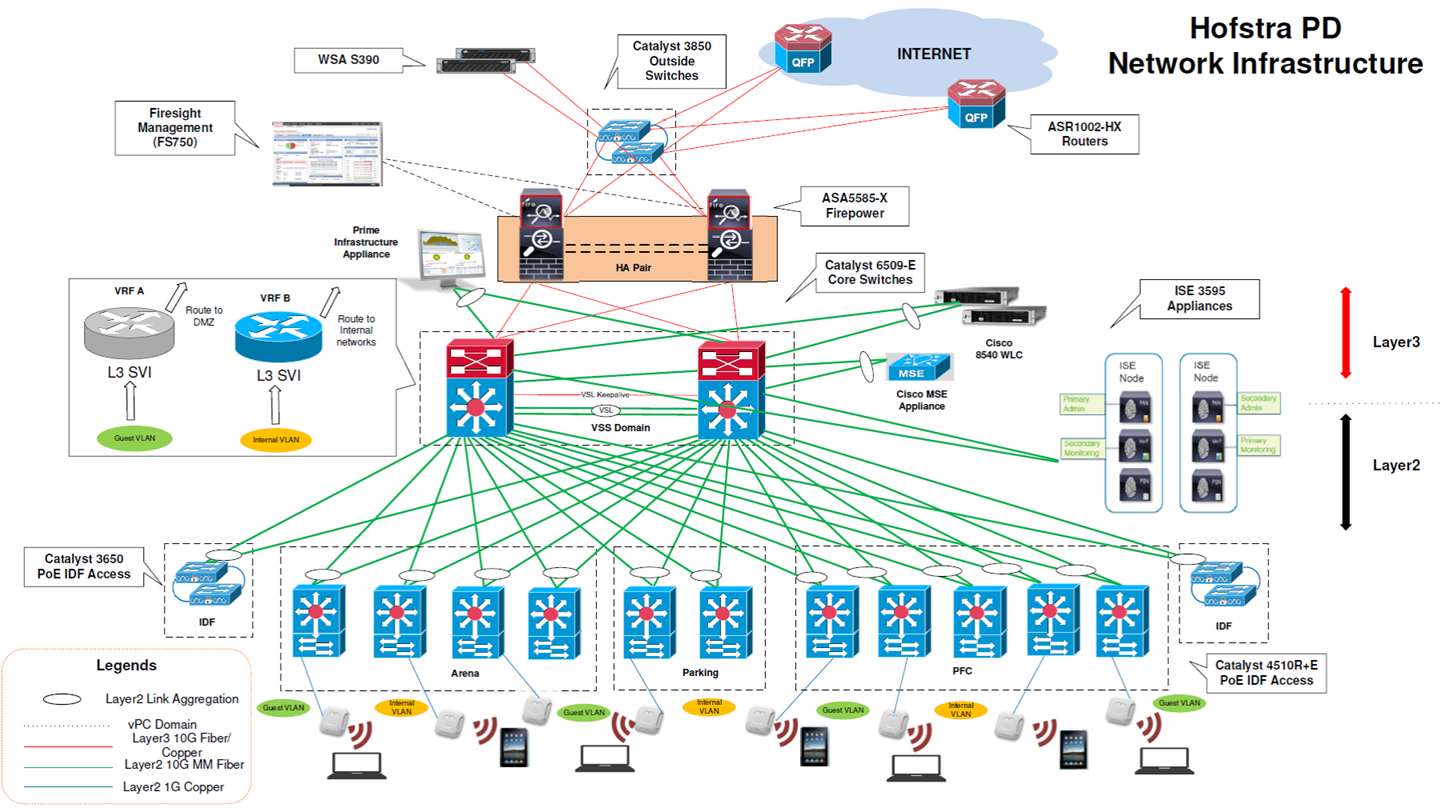
In all, 42 Aironet 3700 and 3800 Access Points with high-gain antennas were deployed at the debate site. The access points along with Cisco Catalyst Switches (6500, 4500-X, 3850 and 3650), the Cisco 8540 Wireless LAN Controller and Cisco Connected Mobile Experiences (CMX) created the infrastructure for the wireless network needed to make sure that everyone—from the audience to the moderator to the press to the candidates themselves—was connected and on-point.


default

From design to delivery, the entire network was dispatched in less than nine weeks.

During this time, the Cisco team worked to create a network that could handle the thousands of devices being used at the same time but also the security needed to make sure that the network was safe. The latter was especially important as the Presidential Debate Committee has stringent guidelines when it comes to security. Thanks to Cisco products like Adaptive Security Appliances (ASA), Identity Services Engine (ISE) and Web Security Appliance (WSA) the guidelines were reached and the network remained ironclad.

No matter what your thoughts on who won Monday’s debate, one thing is for certain: the security and the speed of a Cisco-powered wireless network is a winner.

To read more about our wireless solutions, click here.

Authors

Byron Magrane

Product Manager, Marketing