Avatar

Ha llegado uno de los momentos más esperados del año: Cisco Live Cancún! Un evento donde aprenderás sobre las tecnologías más inovadoras de Cisco.

Pero, ¿ Sabes como sacar el maximo provecho de este evento?

A continuación encontrarás las sugerencias que tenemos para ti en cuanto a  innovación para centros de datos. Durante el recorrido serás testigo de tecnologías, herramientas y soluciones que están ayudando a nuestros clientes a seguir liderando en sus respectivas industrias. Si haz de seguir las sugerencias que tenemos para ti,  podras sacar mayor provecho del tiempo de tu experiencia en Cisco Live Cancun 2016.

Por qué han de importarte los temas de Data Center?

Este tema ha de importarte si deseas mantenerte al dia en cuanto a los requerimientos que los ultimos y más avanzados desarrollos de  aplicaciones de software imponen sobre la infrastructura de redes.

La arquitectura de Cisco Data Center ofrece una solución completa que combina analítica, simplicidad, automatización y protección en infraestructuras de IT híbridas convergentes e hiper-convergentes, que te permitirán ejecutar cualquier tipo de aplicación, sea tradicional  o cloud-native.

Las soluciones principales de data center que tienes que echarle un vistazo  incluyen Infraestructura centrada en aplicaciones (ACI), Cisco CloudCenter, Hyperflex, Nexus 9000 Switches, y Cisco Tetration Analytics.

Guarda esta mapa para ubicar facilmente la zona de data center y el teatro de soluciones:
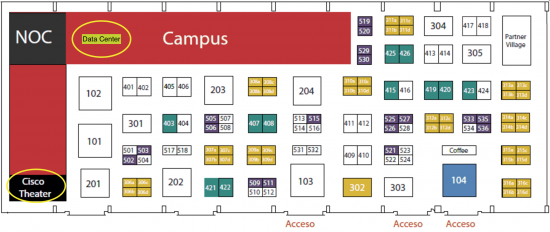
Screen Shot 2016-10-11 at 1.42.11 PM

Demos de Data Center

Dónde: Zona Data Center

Cuándo: Martes 6:30pm – Jueves 6:30pm

Todas las demostraciones contienen las versiones más recientes de nuestras soluciones, especialmente la  solución de Infraestructura centrada en aplicaciones (ACI). La demo “Administración de Hybrid Cloud Con Cisco ECS” es la solución más nueva de Cisco para tecnologías de nube hibrida cuyo motor es CliQr. Y claro nuestro más reciente lanzamiento, Tetration, que es mostrada por primera vez en Latino America y con la cual podras tener una visibilidad total del centro de datos. Esta nueva plataforma está diseñada para recopilación de telemetría intensiva de tráfico y ejecución de análisis avanzado con un enfoque algorítmico. Es tan poderosa que parece de películas. Asi que no te lo pierdas.

Tour personalizado: Si no estás seguro cuáles son los demos que deberías visitar, comenta en este blog o @EmmelineWong en twitter y te veré en la zona de Data Center para darte un tour personalizado

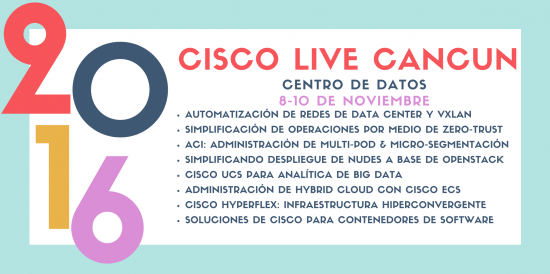
Guarda esta imagen en tu teléfono móvil:Screen Shot 2016-10-12 at 9.25.52 AM
Presentaciónes:

Dónde: Localización varía

Cuándo: Martes a Jueves

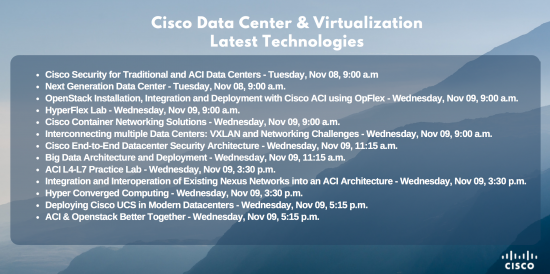
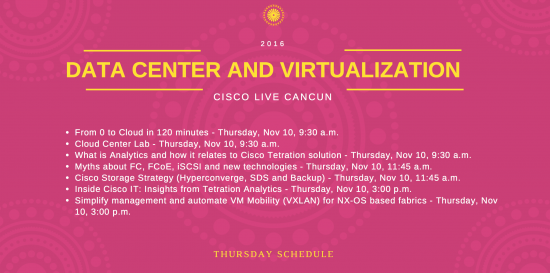
Te recomiendo ampliamente que antes de visitar las demos escojas unas cuantas presentaciones que son impartidas por nuestros reconocidos expertos en tecnologías de centros de datos. En la imagen de abajo podrás ver el detalle de las mismas.
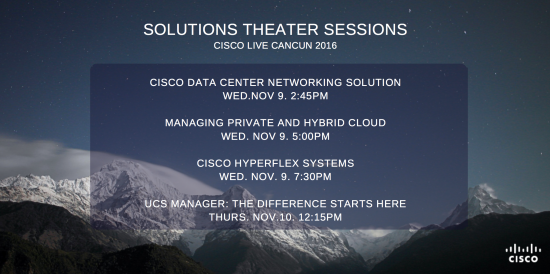
Screen Shot 2016-10-12 at 9.25.28 AM

Guarda esta imagen en tu teléfono móvil y haz click en la imagen para registrarte:
Screen Shot 2016-10-12 at 9.26.42 AM

Guarda esta imagen en tu teléfono móvil y haz click en la imagen para registrarte:
Screen Shot 2016-10-12 at 9.27.58 AM

Grupo de Usuarios: La Fiesta Sigue Después de Cancún! 

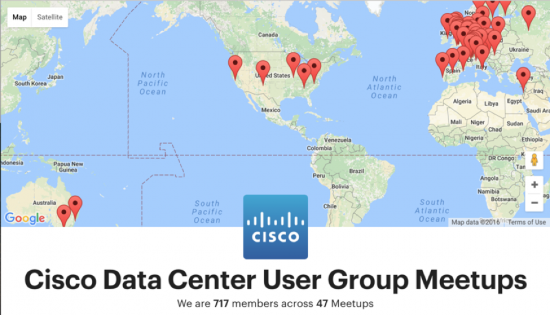
¿Te interesa contactar  con profesionales de tu industria? Encuéntrame en la zona de Data Center o suscríbete al Grupo de Usuarios Data Center en  www.meetup.com/pro/cisco Miembros del grupo compartirán sus propias experiencias y consejos usando tecnologías de Cisco Data Center. Existen 717 miembros en el dia de hoy, y tu serias el #718
Picture1


Esta es nuestra sugerencia de lo que deberías hacer en Cisco Live Cancún! Y como prometí en el comienzo de este blog, Los siguientes son los mejores lugares para visitar basado en un amigo Mexicano. Tal vez iré a unas cuantas también:

  • Holbox
  • Xcaret
  • Tullum
  • Cozumel
  • Cocobongo
  • Isla contoy
  • Cobá

También, trata de tomar bus en vez de taxi, ya que los buses cuestan alrededor de 2 dolares, y los taxis te puede costar 50 dolares por 30 millas de viaje. Mejor compra otro tequila con ese dinero (XD)

Te veo alli! Por mientras, no dudes en escribirme en la sección de comentarios, o por twitter @EmmelineWong




Authors

Emmeline Wong

Product Marketing Specialist

Data Center Marketing

Avatar

If you’re responsible for network, compute infrastructure, or even VM administration – DevOps can sound like mumbo jumbo: Continuous Integration. Continuous Deployment. DevOps tool chain. Branching. Release trains. Agile Development. Green/Blue. A/B. Yadda Yadda Yadda.

You don’t need to understand all of that.  What you need to understand is that with Cisco CloudCenter, an automated Jenkins build triggers an automated deployment of a clean environment and the latest build package to any data center or cloud, without a “ticket and wait” deployment process.

Watch this 2 min CloudCenter plus Jenkins overview

https://www.youtube.com/watch?v=fkIdhG7ZXeE


Why does that matter to network or infrastructure professionals?

All the fuss about things like big data, mobile apps, and digitization – is about the transformative power of the application. And your company is probably making changes this year to speed the time between software “done”, and software in user’s hands realizing business value.

So, while you may not be involved in writing code, you have a great opportunity to help speed up the process and as a result be more relevant in the software development and release process. If you don’t get DevOps savvy – you risk becoming irrelevant. Especially in the cloud era where developers can literally swipe a credit card and rent infrastructure in the cloud.

  • Question: How can you as a network and infrastructure focused IT professionals be more relevant in a DevOps conversation?
  • Answer: Make it easy for developers to quickly deploy their software and consume all the great infrastructure services you deliver.

You don’t have to learn about software development practices. It doesn’t matter if your developers release new features every year or every day. Doesn’t matter if the code changes are branched, or forked, or trained, or whatever.

What matters is that developers can build AND deploy their applications on as needed, without a ticket and wait through multiple IT teams. Without learning infrastructure APIs. Without needing to know port settings. And also that deploying their latest code is easy in development. Or in user acceptance testing or systems integration environments. Or pre-production staging. Or production.

Here’s what’s important:

  • On Demand – deploy process is immediate. When developers push a button to deploy, (or deploy is called via an API), it starts the process. The easy button or API call replaces a help ticket and wait as the request is passed from IT team to team. On demand eliminates complex scheduling, and the associated friction that causes developers to spend less time developing. With on demand deployment, developers don’t hoard resources. And that minimizes security and compliance risk associated with the “server under the desk”. If they know they can get what they need when they need it, they are willing to destroy each deployment and free up infrastructure resources when each task is done.
  • Repeatable – push button works the same every time. Unpredictable doesn’t mix with fast. What drives process improvement and behavior change that speeds up the process is that each deploy works the say way every time. With a manual process, developers may wait two weeks then spend another day debugging. Fixing issues leaves the new deployment in a modified state which can cause all sorts of problems that are a drag on agile development methods. A repeatable deploy process reduces unnecessary trouble shooting trying to determine if the failure is the result of the code change, or some issue with the deployment environment.  The deploy process should be repeatable in data center or cloud. And at different stages of the software development and release process.
  • Clean Environment – each deploy is identical. When developers deploy a new build into a used environment (app server, database, middleware, have been previously used etc.) they are asking for unnecessary trouble. Environment drift can lead to code working in test or staging, but not production. Or version x.1 working but version x.2. Effective environment management is a top predictor of DevOps excellence according to the 2015 State of DevOps Report. With high performing IT organizations deploying 30x more frequently with 60x fewer failures.
  • Automated – end-to-end or key workflows. Whether you want true continuous delivery with end-to-end chained automation, or just want to eliminate sources of process delay, automated deploy is key. An automated deploy process frees up network and infrastructure cycles and gets skilled personnel out of the “request and respond” cycle. And it means that the most skilled personnel can help build and maintain the automation, and lower skilled (read less expensive) resources can initiate and run automated processes.
  • Integrated – one workflow triggers another. Development managers don’t want developers wasting time learning yet another tool and user interface.  If a familiar and existing Dev tool can trigger a downstream automated Ops workflow, that saves time and eliminates tool hopping and distraction. An integrated tool chain ensures repeatable execution and minimizes developer distraction.

If do all this – you get:

  • Faster – Accelerate the overall software lifecycle where each build gets deployed multiple times at each of multiple process stages.
  • Better – Increase software quality, with less time guessing if issues are related to the code or the environment.
  • Cheaper – Developers are more efficient. IT ops are more efficient. Resource utilization goes up. Cloud costs go down.

If don’t you get:

  • Errors – process is plagued by troubleshooting.
  • Hoarding – developers hold on to used deployment environments causing quality and control risk
  • Request response – key personnel are bogged down in repetitive and unfulfilling work. Which takes time away from innovation.
  • Delay costs – developers who wait for deployments get distracted, start other work, and then waste time re-engaging after a disruptive wait.

Cisco CloudCenter plus Jenkins is a great solution

If you are a network or infrastructure operator or admin – now you have a solution that can make your life easier AND make life easier for developers as well.

CloudCenter sits on top of your infrastructure, or network, and automates the application deployment process. It works with vSphere, OpenStack, Azure pack, UCS Director in your datacenter. It also seamlessly integrates with Cisco ACI. And extends your data center to public clouds such as AWS, Azure, Google, Softlayer and more.

CloudCenter with Jenkins closes the gap between developer tools and automated deployment. Each code change triggers a build and deploy in a clean environment. So you get the faster better cheaper benefits of automated deployment. And your business gets the benefit of better software faster.

Now you can “move upstream” in the development process and increase IT’s relevance with a solution that make life better for developers, makes software lifecycle move faster, and help optimize network and infrastructure operations.

Authors

Kurt Milne

Marketing Manager, US

CloudCenter Marketing

Avatar

Picture in your mind a typical US federal agency. Go ahead, close your eyes and imagine it. Seriously, do it. As you think about that agency, pick the first two adjectives that came to mind. Did they happen to be fresh and innovative? 

If not, then maybe you should take a look at today’s National Institute of Standards and Technology, or NIST for short. They’re one of the nation’s oldest physical science laboratories and part of the massive US Department of Commerce that employs over 45,000 people. I know, I know. These days it’s getting harder to connect big and old with fresh and innovative. With NIST, though, it’s actually true.

NIST is at the forefront of many things, and cybersecurity is definitely one of them. They’ve been publishing computer security standards and guidelines for decades now but in recent years they’ve taken a fresh, new approach. They sat down and collaborated with both public and private sector organizations to come up with an innovative new cybersecurity framework – one that’s easy to understand, one that helps organizations prioritize and cost-effectively tackle cyber risks, one that provides a common language to discuss cybersecurity, and one that references existing best practices from around the globe.

It’s the NIST Cybersecurity Framework, or CSF for short. As today’s cyber threats continue to grow in volume and sophistication — without enough cyber experts to go around — it’s more important than ever to have a simple and solid way to bring cyber risks down to an acceptable level. That’s what the CSF brings to the table. And it’s gaining momentum: In this infographic NIST cites Gartner research that says 30% of US organizations already use the CSF — a number that’ll grow 50% by 2020.

Recently NIST updated their website with a fresh new look and brand new tools. There are slick videos to explain what they do. For example, there’s a cool animated video on the Cybersecurity Framework page to make the CSF easy to understand. They’ve also published the CSF Reference Tool to help your organization adopt the Framework and customize it to your needs. And they’ve just drafted a Baldrige-Based Tool for Cybersecurity Excellence to help you measure just how effectively you’re using the NIST CSF. Today’s NIST looks nothing like a boring old laboratory.

So how does Cisco tie into this? Well, as an experienced IT company with thousands of employees worldwide, some might wonder whether there are any new or innovative ideas here either. Hey, we have news for you: Today’s Cisco is the clear cybersecurity leader. Did you hear that SC Magazine awarded us with the Best Security Company and Best Security Organization Awards this year?

There are many good reasons for that. In short, we’re making truly effective security simple, open, and automated. We’ve aligned our solutions with the NIST Cybersecurity Framework so that it’s easy to see and take advantage of the full range of our capabilities. And equally important, we’re ready to talk in the language of the Framework just as soon as you are. Check out our cool animated video to see how. 

https://www.youtube.com/watch?v=Mo0-O_qAsGU&feature=youtu.be

Still don’t believe me that today’s NIST is fresh and innovative? Maybe you’re in doubt whether today’s Cisco is too? Then follow both of us on your favorite social media platform, like Twitter (@usnistgov and @CiscoSecurity). You’ll see.

Join the National Cyber Security Month conversation on Twitter @CiscoSecurity #CyberAware.

Authors

Steve Caimi

Industry Solutions Specialist

US Public Sector Cybersecurity

Avatar

Last year, I wrote a series of blogs exploring the various technology and business factors to keep in mind while considering an Internet of Things (IoT) deployment. Since then, IoT has continued to accelerate its drive toward transformational change across industries. And I have continued to log in thousands upon thousands of miles meeting with people around the world to discuss their unique IoT successes and challenges.

The culmination of all these experiences is my forthcoming book, Building the Internet of Things: Implement New Business Models, Disrupt Competitors, and Transform Your Industry. It’s a practical guide to IoT deployments, firmly rooted in the experience of walking a few miles in our customers’ shoes. Over the next several weeks, I’m going to share with you some of the principles for success that have emerged from this IoT jourIoT Hype Graphicney.

In recent years, there has been a lot of hype around the promise of IoT to transform everything. In this series, I’ll go beyond the hype to share the real, here-and-now potential of IoT.

We’ll look at IoT not from the standpoint of big numbers and bold predictions, but from the perspective of thousands of customers who are deploying IoT today. We won’t just discuss the promise of IoT, but the reality: how people solve real business problems, improve their business outcomes, and transform their business value. We will view IoT as a journey not just a one-time event.

American motorcycle maker Harley Davidson is a good example. A few years ago, when this iconic company found itself facing intense global competition and changing buyer expectations, it pulled together a cross-functional, cross-organizational team to converge its isolated systems and connect its factory. The results were impressive:

  • 80 percent faster decision making
  • Dramatically reduced costs and setup time
  • 8 percent increase in production throughput
  • Reduced build-to-order cycle times from 18 months to two weeks
  • Profitability increase of 3 to 4 percent in just one factory

Similar results have been repeated over and over around the world—by manufacturers, retailers, transportation companies, and energy providers. No matter what industry, IoT success is rooted in eight principles that I’ve identified in my experiences with customers on factory floors, deep in mining operations, and in the buttoned-down world of corporate headquarters. The specifics of their challenges and business models vary widely, but these principles apply across the board:

  • Build a partner ecosystem; learn to co-develop with them
  • Attract and train new and existing talent
  • Focus on solving real problems
  • Prepare for a journey, not a one-time event
  • Integrate technology solutions with business processes
  • Start with low-hanging fruit
  • Make security everybody’s top priority
  • Transform culture along with technology

Check back here from week to week as I dive deeper into each of these topics, as well as updates on standards, best practices, and the emerging class of employees, customers, partners, and innovators I call “Generation IoT.”

Welcome to the road to IoT success.


Authors

Maciej Kranz

Vice President and General Manager

Corporate Strategic Innovation Group

Avatar

This post walks through the models for building resilient applications on OpenStack infrastructure with Cisco Metacloud, OpenStack Orchestration, and configuration management tools like Ansible.

Agile Infrastructure, Some Background

In 2001, when a group of software developers discussed a growing trend of lightweight methods for producing software, they decided to group those together and write a new Agile Software Development Manifesto. By providing a shared set of values and trust, along with methods for disciplined practice, these technologists gave us all ways to think about software development, and we can simply lift those over to the infrastructure on which the software runs. Agile infrastructure embodies the characteristics of cloud: on-demand, flexible, elastic growth, with workloads and resources set up and torn down with costs based on use. Just as agile software development is responsive, collaborative, and interactive, you can create agile infrastructure as well.

What Models for Cloud Architecture Offer Agility?

For applications, you can group workloads by need for infrastructure capacity over time.

On and off: Some applications are on and off, such as an event-based web application. During the event time period, you’d better be sure you have enough capacity for the on time period.

Fast growth: Other apps require fast growth, and rather than rack and stack physical servers, ensure you can flexibly grow the infrastructure over time. Think of a retail store that starts selling a trendy product. Their app had better be ready for traffic.

Variable: Then there’s the variable workload, where you might have peak needs that would be unmet with traditional infrastructure. Think of a mobile run tracker app. When the sun is shining in a particular region and lots of runners decide to track their run, can additional servers be deployed at a moment’s notice?

Consistent: Finally there’s the consistent workloads, such as a payroll tracking system. Of course we know that the payroll calculation timeframe has the highest usage, so why pay for infrastructure while the payroll calculation doesn’t need to run?

Those examples are all for the workload itself; how do you create application architecture that offers agility? You monitor the infrastructure and automatically build new resources as your monitoring indicates a need.

Also consider that you want to be able to release new code regardless of the traffic patterns. Agile infrastructure enables code releases without taking down the entire application.

Let’s walk through the principles that Metacloud delivers:

  1. Early and continuous delivery. Cloud servers on demand offer exactly this: providing value as quickly as possible, with new capacity always available.
  2. Changing requirements even late in the overall process. When your traffic patterns indicate a change in required data capacity, our agile infrastructure lets that change happen right away.
  3. Shorter timescales abound in cloud workloads. Think of a time when your CEO had a time-bound idea for giving back to a community, but your base business is selling blankets online. You can create the application for the charity work while letting your business infrastructure continue, hands-off.
  4. Business needs met by eager developers and infrastructure providers. By working with a provider’s cloud infrastructure, business needs win prioritization over the overhead of running a cloud.
  5. Collaboration. By offering REST APIs on each service, you can provide connection points across data resources, compute power, and storage capacity. In some places the storage group is far separated from the computing group; an API gives a common language for the groups to speak.
  6. Give users the environment and support they need, and let the get their job done. This one rings true for any private cloud’s value proposition.
  7. Working software is a primary measure of progress, and so is working infrastructure.
  8. Sustain. This idea of agile infrastructure offers a sustainable, consistent pace for infrastructure provisioning.
  9. Continuous attention to great technical solutions. This principle means monitoring effectively and good initial design enhances that agility.
  10. Simplicity and ensuring work is not wasted is an essential component. At the simplest layers, your application treats each resource – server, database, network, storage – as a piece that can be brought in and out as needed. Your application shouldn’t need to know the difference in a given resource whether it’s on a local development computer or a different host entirely.

How does Cisco Metacloud deliver resilient applications?

Many customers have found that when Cisco provides the cloud infrastructure, they are freed to add speed and agility to their teams. Our customers are examples of “born in the cloud” companies that understand the value to their business model when they can provide IT services automatically. When they’re on the front lines, delivering business-critical IT, they appreciate that Metacloud backs them up with an operational, expandable private cloud based on OpenStack. Plus, with integrations from solid providers like Pivotal and Apprenda, the infrastructure becomes invisible and the platform provides everything their teams need to go fast, be strong, and maintain uptime.

We have a couple of Learning Labs on Cisco DevNet that walk through how to orchestrate applications. Check these out:

Authors

Anne Gentle

Developer Experience Manager

Developer Relations

Avatar

When people think about the impact of technology on education, they tend to focus on how the Internet has changed the classroom experience. Blended learning is now a common delivery model in universities and vocational education, and the use of video to connect students in remote locations is common to all education sectors.

The impact of technology, however, is far broader than the classroom experience. It’s also changing the nature of jobs and creating demand for new types of skills and competencies.

Today, students need to be educated to solve problems, become social entrepreneurs and to think critically. Social consciousness and social entrepreneurship are at the heart of the biggest business opportunities for this century.

SkillsGap

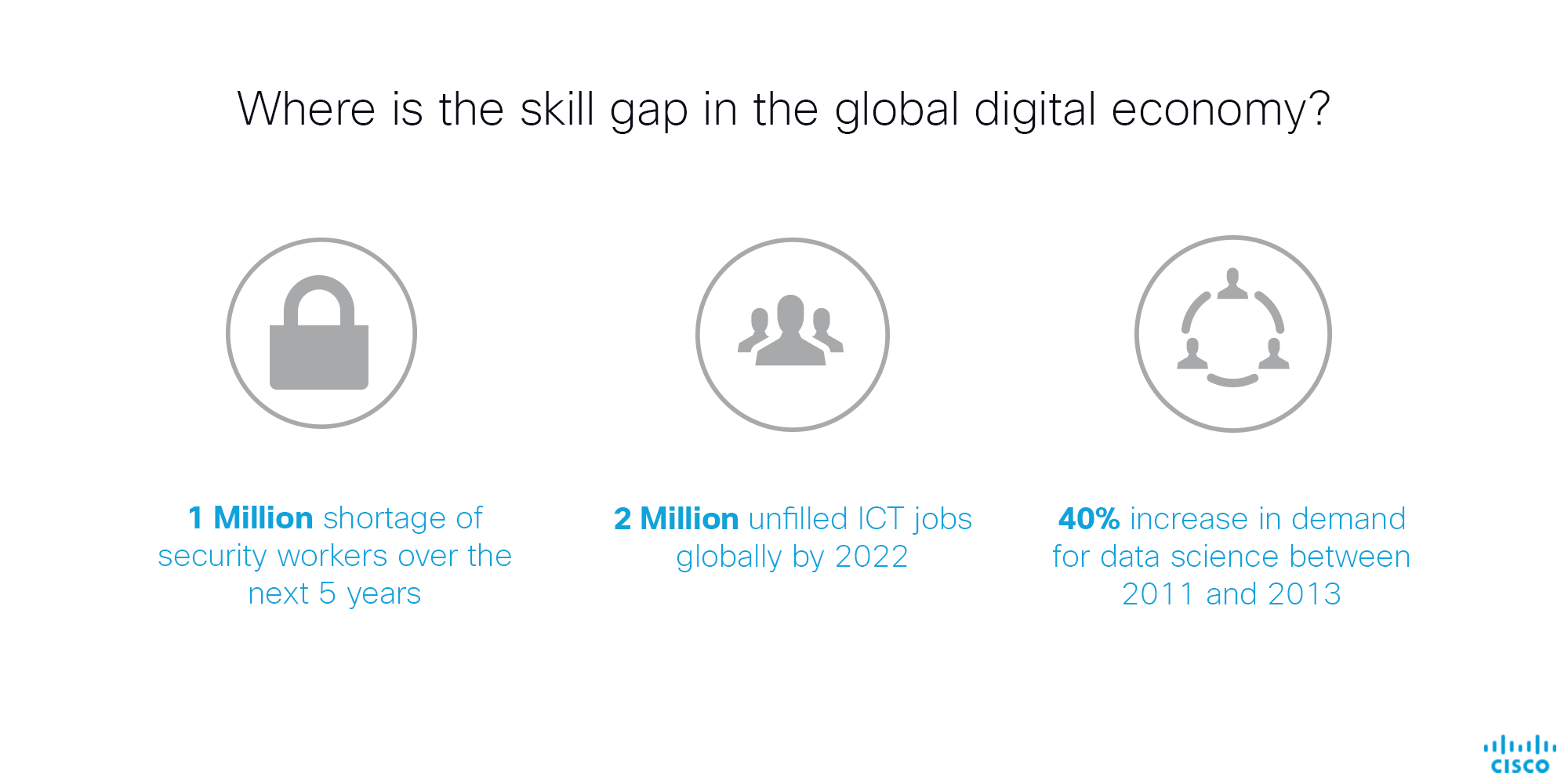
The rise of the digital economy represents a major shift in the way that people are working and will work in the future. It is estimated that 47% of today’s jobs will be automatable over the next decade or two. What is less understood as the economy transforms is the specific nature of `reconfigured jobs’ that will be required as replacements, and the foundational skills required to do them. While the answer is not straightforward, there is overwhelming evidence to suggest that STEM competencies are and will continue to be in high demand in the future. Around 75% of the fastest growing occupations require STEM related skills and experience. By 2020, 90% of jobs will require digital skills.

The way people are working is also changing. A US study estimates more than 40% of the US workforce, or 60 million people, will be independent workers, freelancers or contractors by 2020. This increases the need for students to have entrepreneurial skills so they can navigate the labor market.

To meet these new demands, Cisco is partnering with education institutions to help prepare the workforce for the digital economy. Here’s how:

Investments

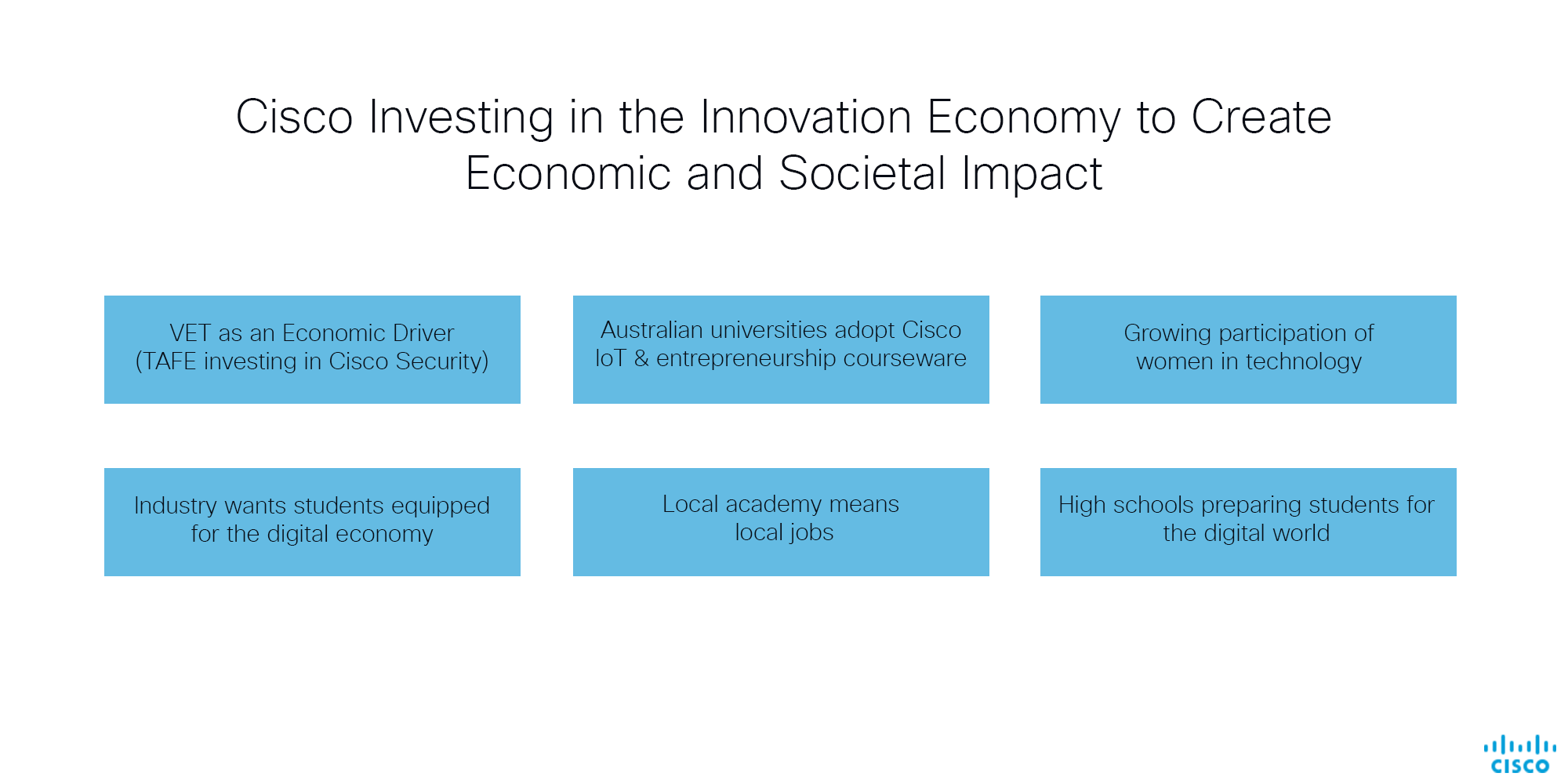
Cisco, is combining technology and education with the goal of creating a pipeline of global thinkers to tackle the future’s most difficult challenges. Cisco Networking Academy has been educating workers since 1997, when it started the Cisco Networking Academy, as a set of courses and certificate programs. Today the Networking Academy partners with more than 9,600 institutions that teach one million students each year in over 170 countries.

In Australia specifically, we partner with 124 institutions that have taught 142,000+ students since inception. 12% of students are female. Between 2005 and 2014, more than 1.3 million students have started new jobs as a result of the program globally. We also support institutions with cutting edge technology that allows them to improve the student experience, promote engagement and ultimately improve learning outcomes.

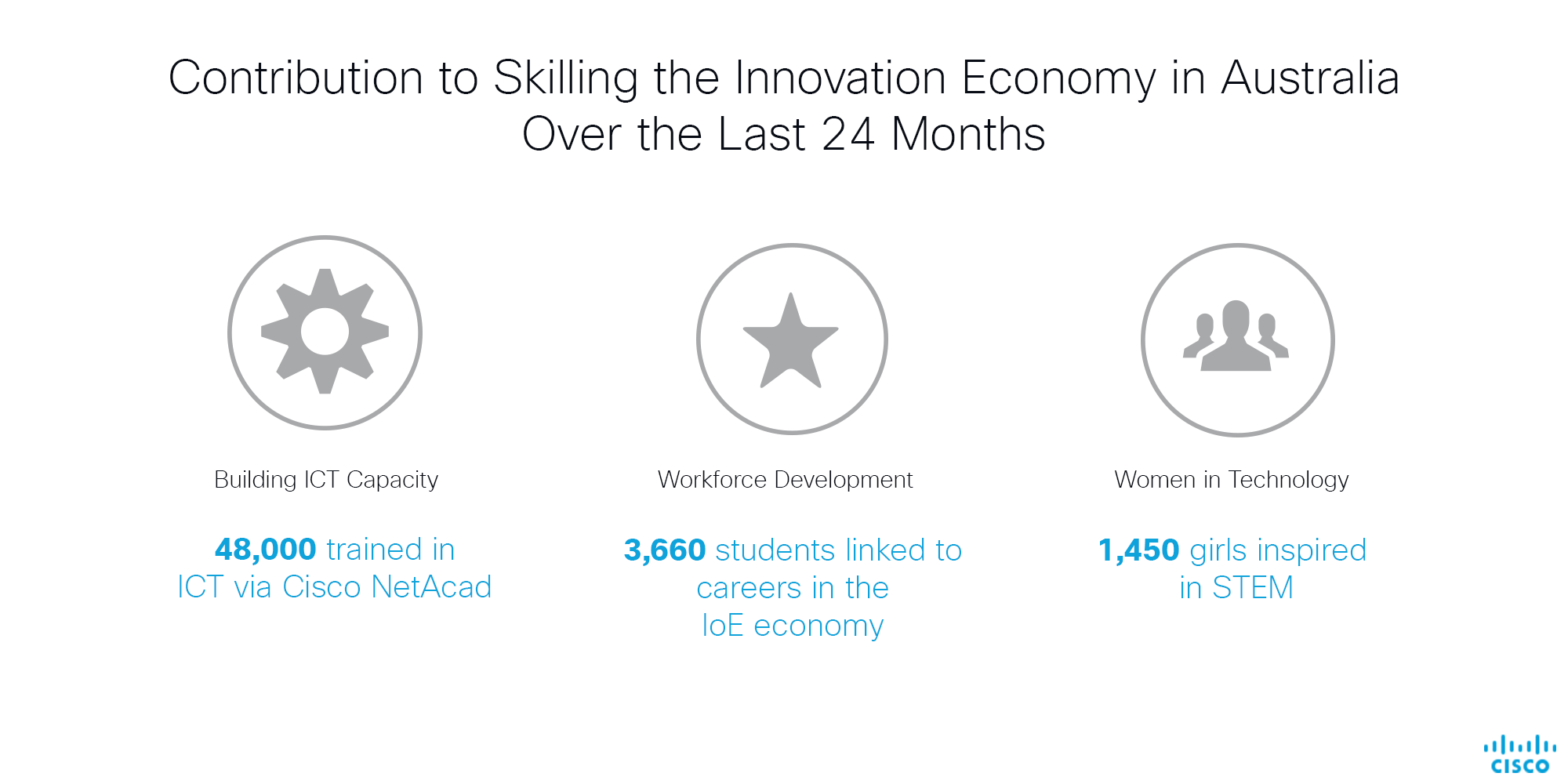
See the graphic below to understand the impact of our investment in the digital economy.

EconomicGrowth

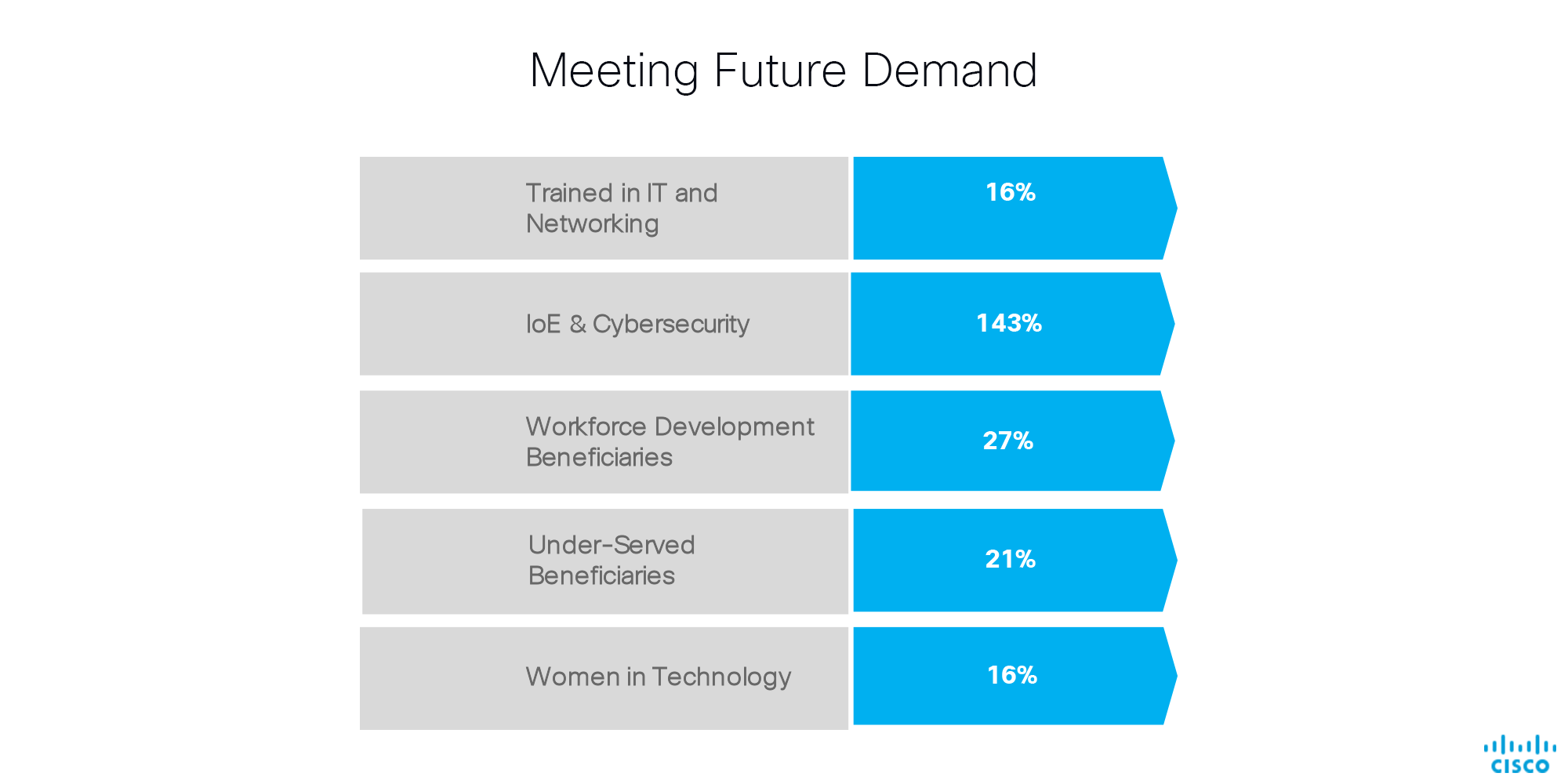
Beyond what Cisco has already done to invest in Australia’s digital economy, we’re looking forward to meet future demand. Over the next twelve months, we’re projecting massive growth in key investment areas, as shown in the below graphic.

MeetingFutureDemand

Through our current initiatives in Australia, we harness the power of technology to launch a generation of problem solvers. Networking Academy students are challenged in hackathons and problem-solving contests to find solutions using Internet of Things and other technologies. They’re connecting their skills and critical thinking to real-world problems big and small. They are being taught to innovate like technologists, think like entrepreneurs and act as social change agents.

Authors

Reg Johnson

General Manager, Education

Cisco Australia and New Zealand

Avatar

Fun fact: as many of you know, I am an avid triathlete. Not only do I constantly strive to achieve my personal best but I also like to encourage others to achieve their goals! About five years ago, I started a running group in Tampa, Florida. Since then, the group has grown to have over 1,000  members, and I have the privilege to run with athletes from all over the world. Several years back we partnered with Team RWB, whose mission is to enrich the lives of America’s veterans by connecting them to their community through physical and social activity. Almost every Wednesday, you can find me with my family, friends and neighbors running for a common purpose. Though every race is different, there are two commonalities – preparation and recovery.

Your approach to security should be the same. Prepare to avoid attacks; be ready to recover when one inevitably gets through your best defenses.

Since you read my first blog I know you are already doing everything you can with best-in-breed security systems to prevent the attack. But inevitably, no matter how much you prepare, malware will get through.

It happens.

Hackers are working every minute of every day to get into your systems. But, the good news is, with the right recovery options, you can mitigate any adverse effects and become stronger for the next go-round.

Just as important as immediate recovery (aka the beer at the finish line) is the analysis on how to get stronger and create even stronger defenses against these new types of breach.

In both situations, if you just prepared and you didn’t recover, you’d run into a host of problems. First, you’d be weak and your system wouldn’t be damaged. Second, you’d never get any better/stronger without learning where to improve.


But how does that work in the security world?


Our Security Incident Response Service experts get to the source of infection – where it entered the environment and what data was compromised. This identifies malware movement throughout the environment in order for organizations to minimize the cost and overall impact of any breach and identify methods to reduce future risk.

Every event is unique. Using intelligence from the Cisco Talos Security Intelligence and Research Group, this provides expedience and allows for flexibility to continuously adjust to the dynamic threat landscape.

Oh, and Retrospective Security and Attack Trajectory are mechanisms that ONLY Cisco provides.

Now, recovery from a breach is a bit more complicated than a Mylar blanket, a banana and some race analysis. Don’t you want to work with a company that not only helps you prepare to your fullest but is also there to help you fully recover?

You can hear more about our security portfolio and what it can do for your business and your customers with a front row, virtual seat. Register now for Virtual Partner Summit.


This blog series explores how Cisco helps before, during and after a security breach as well as supply chain breaches. Learn how to take advantage of Cisco’s security product sales incentives and how to best market them.  Come back next week to learn how Cisco helps your supply chain during a breach.

Authors

Shawn Yuskaitis

Director, Global Security Go-to-Market Strategy & Sales Acceleration

Global Partner & Routes to Market Sales

Avatar

Patch Tuesday has once again arrived! Microsoft’s monthly release of security bulletins to address vulnerabilities provides fixes for 37 newly disclosed security flaws. Today’s release sees a total of 10 bulletins with five of the bulletins rated critical, addressing vulnerabilities in Edge, Graphics Component, Internet Explorer, Video Control, and Adobe Flash Player. Four bulletins are rated important and address flaws in Office, Windows Diagnostic Hub, Windows Kernel-Mode Drivers, and Windows Registry. One bulletin is rated moderate and addresses a flaw in Microsoft Internet Messaging API.

Bulletins Rated Critical

The following bulletins are rated critical: MS16-118, MS16-119, MS16-120, MS16-122, MS16-127

MS16-118 and MS16-119 are this month’s bulletins for Internet Explorer and Edge respectively. The Internet Explorer bulletin fixes 11 vulnerabilities while the Edge bulletin fixes 13 vulnerabilities. Seven vulnerabilities were found to affect both Edge and IE. The majority of the vulnerabilities fixed are memory corruption flaws that could lead to arbitrary code execution. Several privilege escalation and information disclosure flaws were also fixed in this month’s release.

Read more >> 

Authors

Talos Group

Talos Security Intelligence & Research Group

Avatar

Guest post by Matt Melton, BlueLine Grid

The International Association of Chiefs of Police (IACP) annual convention will kick off during the third week of October 2016 in San Diego. Planning is in full gear, and Cisco is highlighting its partnership with Washington, D.C.-based BlueLine Grid. BlueLine Grid is solving the mission critical collaboration challenges of law enforcement agencies.

Cisco together with public safety ecosystem partners are showcasing digital public safety solutions at the conference.

BlueLine Grid is integrating Cisco services to bring state of the art capabilities to the market. By leveraging Cisco Spark, BlueLine Grid offers accelerated critical communications between law enforcement agencies and private sector stakeholders over a secure, trusted network for a real-time, collaborative response.

In the event of law enforcement incidents, cyber events, natural disasters and accidents, a successful response obviously depends on how quickly, accurately and efficiently agencies share information. The joint Cisco-BlueLine Grid solution is focused on increasing speed and efficiency of communication while reducing cost of ineffective alternatives. Agencies can:

  • Track officers on foot
  • Send mass notifications
  • Invite individuals into secure group messaging and file-sharing environments
  • Initiate instant one-click teleconferencing or push-to-talk (PTT) channels.
  • Collaborate on any device
  • Share information and intelligence with other agencies and jurisdictions

BlueLine Grid is already deployed across the national network of fusion centers to share real time intelligence across the country. Fusion centers, such as the Boston Regional Intelligence Center and Northern California Regional Intelligence Center, use the solution every day to communicate with their mission partners – local law enforcement, first responders, and private sector security. Leading agencies like the Los Angeles Police Department use BlueLine Grid to replace archaic practices such as phone trees to mobilize officers. Even small departments can leverage the solution as a cost-effective way to manage and task their workforce.

The BlueLine Grid solution an excellent way to get a quick win with Cisco collaboration tools. The low cost of ownership is driving interest from clients across the country and throughout the world, while enabling a common identity credentialing and access model that can be leveraged by Cisco Public Safety and Spark solution architectures.

To learn more about Blue Line Grid, go to Cisco and BlueLine Grid  or find us during #IACP2016!

Authors

AJ Ramsey

Global Industries Marketing Lead

GMCC-Services Marketing