This blog was guest-written by Sandy Walsh, Director, Social Innovation Group – Asia Pacific and Japan Cisco
Digitization is changing the world. More than ever, there’s a tremendous opportunity to be a global problem solver who can innovate as a technologist, think like an entrepreneur and act as a social change agent.
According to the European Commission, in the near future, 90% of jobs – in fields as diverse as art, engineering, accounting, nursing, medicine, and architecture – will require digital skills. But today, women make up only 32% of science, technology, engineering, and math (STEM) graduates worldwide and represent a mere 27% of workers in computer science, engineering, and physics fields in some of the world’s emerging economies.
In Australia, women account for less than a fifth of the 460,000-strong IT workforce, according to the Australian Bureau of Statistics, and the figures have changed little over the past decade. If current gender gap trends continue, women are at risk of losing out on tomorrow’s best jobs.
So, there is an amazing opportunity for young women to shape the future. If you want to influence our society, if you want to help shape our increasingly digitized and connected world, you need to have a seat at the table — the tech table.
Women haven’t always pursued tech careers, though. Some think it’s boring, that it’s a boys club, that it’s not for them – stop! As a woman who has been working in the tech Industry for the past 25 years, I understand why these gender stereotypes have evolved.
Although I’ve had my share of being the only women in the room, working in the tech industry has given me the most fantastic career opportunities; it’s been anything but boring or a boys club. I’ve traveled the world, I’ve never spent my ‘9-5’ in the same office, and I can work from wherever I choose.
And the best part is that I have had the privilege of using technology to drive social change and improve peoples’ lives.
On a recent trip to Cambodia, I was fortunate enough to meet students from Passerelles Numeriques Cambodia (PNC), an international NGO that’s also a Cisco Networking Academy. They prepare impoverished youth for technology careers, helping them break the cycle of poverty and raise the standard of living for them and their families.
In a country like Cambodia, where many people live on less than $1 a day and more than half are under the age of 21, it was inspiring for me to see that 50% of PNC students are female. After three years, these graduates are earning nearly five times the national average salary and are not only changing their futures, but those of their families and communities.
And the great thing about having tech expertise is that it doesn’t just prepare you for future job opportunities in existing companies, but opens up the potential to start your own business and create your own social impact.
There are plenty of reasons young women should aspire to work in technology. It offers a wealth of opportunity, and these opportunities are only going to continue to expand in an increasingly hyper-connected world. More importantly, the industry needs future female leaders. According to McKinsey, companies with a critical mass of female executives perform better than those without women in leadership positions.
Technology studies can put students at the forefront of innovation and technological breakthroughs, and these skills have never been more relevant in society and played such an important part in driving economic success.
In Asia Pacific and Japan, Cisco will launch the third Women Rock-IT Cisco TV series on November 29 with a focus on female Global Problem Solvers who are shaking up the tech world. So I urge you all, join the tech revolution!
Join us and meet the amazing women using technology to change the world. Sign up for Women Rock-IT today!
Online video piracy is growing and becoming one of the most significant threats facing Pay TV service providers. With a prior focus on low-resolution streaming through web sites that were notoriously riddled with inappropriate advertising and malware, streaming piracy has transformed to match consumer demand for high definition multiscreen delivery. In the past pirate streaming sites have targeted the highest profile sports events; now pirate services are delivering whole channel packages into smart devices (mobile, tablet, smart TVs), IPTV set-top boxes, and plug-ins for video streamers and other such devices.
According to piracy monitoring specialist Friend MTS, in the last month alone its online threat analysis has uncovered over 12,000 unique instances of HD channels (1280 x 720 frame size or higher) on pirate services, being sourced from Pay TV service providers around the world. Expand this to SD resolution, often targeted at mobile devices, and the number increases to over 22,000 channels. With almost no operator is exempt, content is being source from the smallest to the largest Pay TV providers in the market.
The demand for premium content, in every language and into every market, has led to a surge in the supply of pirate services offering a high-quality user interface. The video quality offered is unprecedented, rivalling that on the Pay TV platforms themselves. Bitrates of 4-6 Mbps for HD channels are common, with 1 Mbps H.264/AVC for SD channels. Even an Ultra HD (3840 x 2160) channel being delivered in HEVC at 15 Mbps is on offer.
To effectively monetize live content, both the service providers that distribute content and the rights owners that license it need to ensure that it is available exclusively through licensed channels. Wide availability through illegal services or sites diminishes the value of the content, as paying viewers opt for the cheaper or free options made available by the pirates. Increasingly, rights owners are requiring their licensees to implement greater levels of platform security in order to gain access to their ultra-premium content. But deploying additional security is not always possible or practical, especially on older platforms. And sometimes even the enhanced protections deployed on newer platforms is defeated by pirates, so content remains vulnerable to piracy.
A new approach is needed. Traditional takedown mechanisms such as sending legal notices (commonly referred to as ‘DMCA notices’) are ineffective where pirate services have put in place infrastructure capable of delivering video at tens and even hundreds of gigabits per second, as in essence there is nobody to send a notice to. Escalation to infrastructure providers works to an extent, but the process is often slow as the pirate services will likely provide the largest revenue source for many of the platform providers in question.
For live events the need for a timely detection of piracy and an effective response is even greater.
So, what does one do?
Cisco is pioneering a new approach to piracy prevention. Its Streaming Piracy Prevention (SPP) service utilizes technology to locate illegal redistribution of content on the open internet and closed pirate networks. Using a forensic watermark it identifies the subscriptions/sessions used to source the content, and shuts down the source through the video security system – all in real-time. The process is fully automated, ensuring a timely response to incidents of piracy. Gone are the days of sending a legal notice and waiting to see if anyone will answer; SPP acts without the need to involve or gain cooperation from any third parties, enabling an unmatched level of cross-device retransmission prevention and allowing service providers to take back control of their channels, to maximize their revenue.
In order to tackle live event piracy, Cisco and Friend MTS (FMTS) have partnered to put their respective technologies to work. FMTS’s market leading piracy monitoring capabilities feed the Cisco SPP service with real-time pirated video feeds found on the open Internet, which are used by SPP to locate the source of the leak and shut it down.
This post was authored by Jan Kohout, Veronica Valeros and Petr Somol.
Increasing adoption of encryption in web communication significantly contributes to protection of users’ privacy. However, it also brings tough challenges for intrusion detection systems that need to analyze the traffic without actually decrypting it. There is not much information left in encrypted web traffic logs that could be leveraged for malicious activity detection. Information about visited URL, user agent used and other important fields are no longer available. If users’ privacy is to be preserved, a detection system has to rely only on very high-level information. Clearly, simple rule-based solutions can hardly achieve satisfying accuracy in such environment.
Figure 1 – Adoption of encrypted HTTPs helps to preserve users’ privacy but it also hides fields bearing the richest information usable for detection of malware.
However, the situation changes when machine learning algorithms and smart representations of gathered information are called up for duty.
Cisco Cognitive Threat Analytics leverages machine learning to identify malicious behavior even in encrypted traffic. In this blog post, we demonstrate on real-world examples, that even very basic features of communication – just the sizes and timings of transferred information – can bear a lot of useful information if we correlate the observations in the right way. Imagine putting together a complex puzzle: from just one piece of puzzle with few colored dots, one can not say what the final picture is, but when many of those pieces are put together, then the final image appears clearly. Similarly, by observing sizes and timings of communication between two computers, we can have a clear view of the communication patterns.
Figure 2 – Encrypted traffic resembles a complex puzzle. Individual requests may not tell much. Correlating multiple flows can reveal otherwise invisible characteristics of the whole connection over time (although the transferred content remains secret).
Fight Infections with Connection Fingerprints
The challenge we face is how to differentiate encrypted malicious traffic over HTTPs from benign communication, when the only source of data is a log from web proxy. The roots of success of our methods are in putting many small pieces of information together. If we repeatedly observe simple behavioral characteristics of some object (e.g., a web server or a communication session) for a certain period of time, we will collect enough information to discover the behavioral pattern which is typical for the given object. We see this problem of information gathering as the problem of capturing probability distributions based on limited number of observations. We work with so called fingerprints ofconnections, formed by histograms capturing properties of the communication. The communication belonging to one server is treated as determined by some unknown probability distribution over the observed quantities. Each observation – for example, quantities extracted from one request-response pair to the given web server – is treated as one realization of that probability distribution. Under this setting, the server can be represented by a histogram which models the unknown probability distribution by capturing frequencies of the observed values. On top of the histograms, it is easy to train a classifier for some specific malicious behavior or use unsupervised techniques such as clustering to discover new behavioral patterns. In the following examples, you will see that with the help connections fingerprinting, CTA is capable of:
training a classifier which detects data exfiltrations
finding a structure of an unknown service to improve detection of its misuses
linking together servers contacted by similar malware
Detection of data exfiltration
In Cognitive Threat Analytics, the connections fingerprinting and a classifier trained on top the fingerprints are used to detect possible exfiltrations of data via encrypted connections, as shown in Figure 1 (see the related blog here). With this representation, the only features extracted from web traffic logs by the classifier are the timings and sizes of the connections. In this way it is able to identify suspicious exfiltrations without relying on any features that would be hidden by TLS encryption.
Figure 3 – Exfiltration of data via encrypted connection which was detected by Cisco CTA with the help of encrypted connections fingerprinting.
Sub-Service Identification
Understanding the structure of a service helps to model users’ behavior more accurately and, thus, significantly increases our chance to detect anomalies and misuses. The modeling of probability distributions can be successfully used to discover functional parts of a complex but possibly unknown web service, such as on-line file storage or even more complex cloud platforms. This decomposition can be done even if the target service is accessed via encrypted connections, because – as we showed in the previous example – the fingerprinting technique can work even with very basic features that can be extracted even from encrypted traffic without decryption.
As an example, we show how the servers under the dropbox.com top level domain can be clustered into groups that represent individual functional parts of the Dropbox service. We observed the behavior of totally 188 servers for a couple of days and created their fingerprints capturing frequencies of the observed values. As most of the servers are accessed by HTTPs, the only observed quantities were:
Bytes sent in one request
Bytes received in the corresponding response
Duration of the request-response loop
Inter-arrival time between two consecutive requests from the same client
After the fingerprints of servers were created, they were clustered according to their pairwise similarities. The result of the clustering can be seen in Figure 4 below in a form of a similarity graph:
Figure 4 – Clustering of servers under the dropbox.com TLD visualized by a similarity graph. Each node of the graph represents one server, the servers with similar fingerprints are close to each other while servers with dissimilar fingerprints are repulsed. Colors mark different clusters discovered be a clustering algorithm which uses the fingerprints’ similarities (grey color marks unclustered servers – 9 out of 188 – that are not members of some dedicated sub-service). Clusters are annotated with the type of service they provide (the annotations were obtained from the work [4]).
Relationship Modeling for Malicious Campaign Discovery
Relationship modeling is the topmost layer of data processing in Cognitive Threat Analytics which correlates information from detected incidents to discover new threat campaigns (see this blog). Relationship modeling in CTA uses the fingerprinting technique to find malicious servers that are contacted by the same family of malware. Malware typically uses multiple servers for its C&C communication. If not all of them are blacklisted (often they won’t be), the malware is still able to contact the C&C server on the remaining ones. Our method of fingerprinting can help to find those additional servers. Malware usually uses the same communication protocol to contact the C&C servers. Therefore, their histogram fingerprints will be very similar to each other due to the similar patterns in the communication. The C&C servers used by the same malware can be thus viewed as members of one specific sub-service on the Internet. If we apply the clustering algorithm on a set servers’ fingerprints in which we include also fingerprints of known malicious servers, the new malicious ones can be easily discovered by looking at those which belong to clusters containing the known malicious ones. Together with other algorithms, the fingerprinting of servers helps CTA to extend the list of confirmed infections.
How Does Building of Fingerprints Work?
As we mentioned earlier, the fingerprints are histograms modeling frequencies of observed features. Just capturing a probability distribution with a histogram might seem simple. However, there are multiple challenges that have to be addressed. First, how to reliably model a joint probability distribution of multiple quantities without need of large amount of data. Second, how to make this approach practically usable, as we face the limitations with respect to computational requirements. To overcome these problems, we introduced so called soft-histograms.
Soft-histograms are a smoothed version of standard histograms. Commonly, if a standard histogram is updated with a new observation, one nearest bin is selected and its value is increased by 1. In soft-histograms, additional filtering functions centered at each bin divide contribution of each update among multiple bins proportionally to their distances to the observation. This has a smoothing effect on the resulting histogram which helps us to suppress noise present in the observations and which would otherwise make the histogram-based approach unreliable. Parameters of the filtering functions can be optimized jointly with the positions of histogram’s bins during supervised training such that the number of effectively used bins is low which memory and computational requirements. There is a large variety of filtering functions that can be used – for example, the triangular filters as illustrated in Figure 5.
Figure 5 – Illustration of an update of a soft-histogram. In this example, the histogram’s bins are centered at points 0, 1, …, 5 and it is update with the value 2.6. This update contributes to two nearest bins (as determined by the highlighted triangular filters) centered at 2 and 3. The contribution is divided proportionally to the distances from these two bins. The proportions are determined by the shape of the filtering functions.
The triangular filters are not the only functions that can be used. It is possible to use, for example, Gaussian functions for filtering and tune their bandwidths in each dimension to change sensitivity of each bin for different feature, which we show in the next section.
One step further: Understanding a malware’s behavioral pattern
When used in supervised learning, the fingerprinting technique helps to find the most important properties of malware’s behavior. If we have samples of some specific malware family, a classifier can be trained, working on top of the histogram-based representation of its behavior. Together with the classifier’s parameters, the learning algorithm can also optimize positions of the soft-histogram bins and filtering functions’ parameters to support the classification performance. Then, by looking at the positions of the bins to which the learning algorithm assigned the highest weights, we can determine which values of which feature represent the important patterns of the malware’s behavior. Again, let us use another example found in networks protected by CTA – for this demonstration, we used fingerprints of connections belonging to Miuref/Boaxxe malware, which is identified as the #CMST01 threat by Cognitive Threat Analytics (see Figure 6).
Figure 6 – The #CMST01 threat as seen by CTA which was used for the malware’s behavior analysis.
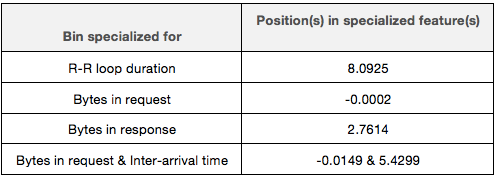
As seen in the screenshot from CTA’s user interface, the connections can be identified thanks to the considerable amount of encoded data tunneled through the URLs. However, this is not the only evidence usable for detection of this malware. This malware also exhibits a specific pattern with respect to communication timings and sizes of individual requests. These features were used to create soft-histogram fingerprints of the connections and to train a classifier for the Miuref/Boaxxe malware. However, in this case, we used Gaussian functions as the filters and the learning algorithm was able to move the bins’ centers and also adjust their sensitivity for each feature by changing the bandwidth of the Gaussians. Thanks to this, the classifier could use only limited number of bins positioned such that they had maximal discriminative power for identification of this specific malware. The classifier ended up with just four bins with weights significantly higher than zero and, moreover, each of these four bins was sensitive for different feature(s). The sensitivity of the bins for specific features could be achieved by appropriate setting of bandwidths of the Gaussian filtering functions for the respective features.
The positions of the most important bins are summarized in the table below:
By looking at the distributions of individual features, we can find answer to the question why did the classifier “choose” these positions for the specialized bins (we use logarithmic scale for all the features). In Figure 7 below, we compare distribution of values of each feature for the legitimate (background) traffic to distribution of values observed in the traffic belonging to the malware for which the classifier was trained. As we can see, the most important bins are placed at positions that represent values that are observed in the malware’s traffic with high probabilities. This helps an analyst to discover the malware’s behavioral pattern. In this example, the pattern is: always zero bytes in the request body, the server’s response has mostly around 16 bytes. Furthermore, the malware appears to be operating in two modes – in one mode, the R-R loop duration is about 245ms (5.5 in log-scale), while in the second mode, the duration is about 3000ms (8 in log-scale). The second mode of operation is what makes the malware detectable – the similar pattern is shared by only few percent of benign traffic. Finally, repeating requests with inter-arrival time between 3 and 4 minutes contributes to the typical behavioral pattern of this malware.
Figure 7 – Distributions of feature values observed in the legitimate background traffic (blue) and in the traffic belonging to malware marked as #CMST01 threat campaign by CTA (red).
For many government agencies, cybersecurity can be an afterthought, a one-off, single product they add on after the fact to meet regulation or protect from basic hacks. What these agencies don’t realize is that cybersecurity isn’t an afterthought – it’s closely tied to an agency’s core mission. Whether that mission is public health, national security, financial regulation or energy, a strong cybersecurity strategy fuels agency innovation and growth. It reduces costs and lowers risks, while also making agencies more efficient and inventive. It fosters – not inhibits – the development of digital offerings and business models that help agencies operate.
My point is this: security is, at its core, a mission-enabler. So for so many in government, why does it just seem to be an afterthought or something that gets in the way? A big part of the reason is that agencies aren’t placing enough importance on cybersecurity, seeing it as an extra thing they have to do instead of a core component of their IT strategy. Without a holistic, mission-driven cybersecurity strategy that’s integrated throughout your agency, it is going to continue to get in the way.
For example, say your agency gets a new cloud application. If you’re treating cybersecurity as an add-on, you’ll need a new single-use security product that will require a new, secure sign-on – and another password for employees to remember. But if you had planned, budgeted for, and executed on a holistic cybersecurity strategy, you might have invested in a solution like Cisco ISE integration with Microsoft Active Directory and Pin Identity. This would give your employees single sign-on access across multiple applications like Box and Smart Sheet. Because employees only have a single password for everything, it’s easier to remember, increasing productivity and reducing help desk costs. It also keeps your agency even more secure, since employees with multiple sign-ons tend to write their passwords down, which is a huge security risk.
With agencies racing to prove relevancy in the new digital economy, there are more opportunities than ever to be hacked – mobile, cloud, IoT, analytics, etc. At the same time, adversaries are becoming more sophisticated, creating threats that are increasingly pervasive and harder to detect. This new landscape makes it even more important for cybersecurity to meet – not defeat – business purposes.
Here at Cisco, we’re constantly pushing the idea of mission-driven cybersecurity for government agencies. We believe security should be made simple – it shouldn’t be getting in the way, but should play a crucial role in achieving your agency’s mission. We build our industry-leading threat intelligence directly into our solution offerings to help your agency easily get a holistic security approach. Through integration, automation, and openness, our purpose is to help cybersecurity drive the mission for your government agency.
Next week the Open Networking User Group meets for its fall conference in New York City. I am looking forward to learning how the SDN landscape is evolving and what is top of mind for IT architects and business leaders.
One hot topic across the board is digital transformation. It has become clear that the network has a key role in determining how quickly organizations can roll out new digital initiatives. Success will ultimately lead to competitive advantage and failure can lead to increased competition or extinction as we have seen with Uber vs Taxis, Netflix vs Blockbuster and Amazon vs Barnes and Noble.
So how will networking need to change so organizations can succeed with their digital transformation? In March, Cisco launched Digital Network Architecture (DNA) to provide IT organizations with a blueprint on how to build out their networks for the digital economy. Cisco DNA clearly outlines the business outcomes that networks will need to deliver:
These outcomes will require IT to ensure that their network architectures can support the following technologies – Automation, Analytics, Cloud Managed, Virtualization – while also being open and secure. IT will need to look at their networks holistically rather than as individual components e.g. branch, WAN, campus and data center. Today, solutions like SD-WAN and SDN have been targeted toward that WAN and data center. But what about the branch and the campus LAN? Networks that are ‘Digital Ready’ can no longer be built in silos. You have to look across the network from the user all the way to where applications are hosted in order for organizations to deliver better business outcomes that will accelerate their digital transformation.
If you are attending the ONUG fall conference, this is a quick overview of the activities Cisco will be participating in:
Day 1: Monday 24th October
12:40-1:40pm. The Lunch and Technology Showcase will give you an opportunity to see a demo of Cisco’s SD-WAN and Branch Virtualization solutions, IWAN and Enterprise NFV
1:30-1:40pm. . POC Theater. Liad Ofek, Director Product Management, will give an overview of Cisco’s Enterprise NFV solution and how it will enable branch virtualization.
3:10-3:40pm. Open SD-WAN OSE Exchange Update. Steve Wood, Cisco’s Principle Architect will give an update on the work he is doing to drive open standards into SD-WAN working group.
Day 2. Tuesday 25th October
1:30-1:50pm. As part of the Luncheon Partnership series, Senior Network Engineer Chris Bregar, will be provide insights into how MTD Products is redesigning its WAN to help achieve its business goals.
Elianna Goldstein is a Cisco Intern who shared her story with us this summer before returning to school. We hope your semester is amazing, Elianna!
For two summers in a row, I worked at small non-profits and volunteered, as I sought out that sense of high value (and subsequently not much money) from my future career path. This past summer, however, I did a 360 and went corporate when I chose Cisco.
Working at a Fortune 500 company, I struggled with some seemingly large questions:
What value did I need work to bring into my personal life?
What value can my work bring to others?
Can I find value and give to others in large, for-profit companies?
As a brand new, little engine that could – in a company of more than 70,000 – I was unsure of the value that my work would ever bring to the corporate world. Even if I could bring value, with the large scope of my projects, would I ever feel the effects of my work? What is the value of an intern marketer?
It’s not uncommon for an intern to wonder how much impact they might bring to the table as they venture out into the world. But I needed to know…and I felt like Cisco might be the place to try it out.
This past summer, while I’ve seen an emphasis on data – more than data, I’ve seen an emphasis on people and two stories help me share that focus here at Cisco.
Following my first two weeks, I was put to real work with amazing adults and children as they prepared for battle (aka: The Special Olympics). As I trekked up and down the stairs with luggage in late June, laughing with my fellow interns and volunteers, Cisco showed me just how lucky I am.
Yes, I’m definitely privileged and thankful for my health, but beyond that, fortunate to work for a company that enables and pushes its employees to serve the community. Cisco is a part of the whole value train, a company with values that looks beyond short term, and seeks to establish roots and make a true difference in a community.
You are correct by the way, if you think that time alone will not achieve enough in the work that needs to be done throughout our communities. I guess Cisco thinks so too, because beyond just encouraging their employees to take the time to give back – Cisco matches its employee’s service hours with monetary donations. It’s just a small part of their mission, alongside having 100% of their employees engaged in volunteering.
They saying giving back is in their DNA, and having lived it, I can tell you, they’re right about that.
My second take away from my experience at Cisco was when I took part in the STEM speed mentoring day for young girls. The girls I spoke with questioned how Cisco could change the world, shared their ideas of how Cisco should do it, and explained how they had just learned about html coding. Already, they were on track for great things!
I had the chance to be a mentor, but these young girls were mentoring me as well. They were smart, driven, and excited, which in turn made me feel like I needed to be all of those things as I returned to work later that day. This was not an activity being filmed for PR, or a once a year event. My manager, and many other managers, are firm supporters of girls in tech and in business throughout the year as encouraging young girls with technology is a key focus for Cisco.
It took me months to realize, but stepping beyond my Cisco internship I now see:
Everyone is nervous about feeling like a small part in a large machine. But I am learning that it is all the parts of the machine that make it unique and different. Everyone plays a part, and at Cisco that is something they live by.
I do not have to lead a profit or nonprofit company to find value. All I have to do is work with a company, whether it is a successful and inclusive tech company, or a robust and nascent small firm, and people who share my values. We can all work together to make a difference in our world.
What I saw in my time at Cisco is that this corporate company truly does care. They encourage and enable their employees to bring together all the people of the world and necessarily parts for change. Whether they are courageous athletes, tough girl scouts, or newbie interns, Cisco believes in everyone and truly showcases how together we will move forward.
Want to join a company that cares? We’re hiring. Join us!
Most C-suite leaders think about cybersecurity as a way to stop threats. But in today’s intensely competitive digital economy they should be thinking about cybersecurity as a strategic advantage that not only protects business value, but enables new business value.
The prevailing focus on threats to protect business value isn’t surprising. Modern digital businesses go beyond traditional walls and spawn new attack vectors in today’s dynamic threat landscape. Businesses face a cybercrime wave that is increasing in intensity and sophistication. According to a recent article in Forbes, “Corporate and home computers have been hit with an average of 4,000 ransomware attacks every day this year, a 300% increase over 2015,” citing United States Department of Justice sources.
While we must continue to work diligently to protect valuable data and assets, to achieve growth, the biggest opportunity comes when we make cybersecurity a foundational component of our digital strategies. One of the biggest downsides to cybersecurity weakness is how it inhibits innovation. In fact, 71% of respondents in a Cisco survey said cybersecurity risks and threats hinder innovation in their organization.
Organizations that have any doubt about their cybersecurity capabilities delay important digital initiatives and risk falling behind the competition tomorrow.
As Mike Dahn, head of data security and industry relations at Square, Inc., put it in this Cybersecurity as a Growth Advantage report, “I think it’s really important that we stop thinking about security as a defense-centric approach that is sold by fear, uncertainty, and doubt. We need to start thinking of it as an enabler that supports innovation … and helps the business go forward.”
You know your organization is well-positioned to move forward when:
You recognize that cybersecurity concerns can hold back innovation and hinder growth. While cybersecurity concerns can hinder the development of new digital business models and driving innovation, smart organizations realize they must move forward, or be left behind by digital disruptors and other agile competitors.
As a business leader, you are much more engaged in cybersecurity issues than your typical peers. Sixty-six percent of Boards do not believe they are properly secured against cyber-attacks. (Source: Cybersecurity in the Boardroom, Veracode 2015). And, the Board, the CEO, and other key stakeholders likely hold you responsible for cybersecurity issues, even if you don’t hold an IT or technical role. That’s because the success of digital programs that are shaping the future of the business, is predicated upon strong security practices. As business leaders develop digital initiatives they proactively collaborate with IT to ensure that security is included in plans from the earliest stages.
You believe your organization is prepared to address cybersecurity challenges in three key digital capabilities – Big data/analytics, cloud computing, and the Internet of Things (IoT). These capabilities are critical to digital growth strategies that depend on connectivity. The level of confidence you have in incorporating these digital technologies into your business processes and offerings allows you to accelerate innovation and time-to-market and capture a greater share of digital value at stake.
The digital era is here. Those who embrace it will have a competitive edge, but not without a secure foundation that allows innovation with speed and confidence.
Take time during this year’s Cyber Security Awareness Month to evaluate how you can turn cybersecurity into a strategic advantage. If you are not sure where to start, our Security advisors can help. If you are already on your way to a digital transformation, we can help you assess your readiness and work with you to design and implement a secure digitization strategy.
How often do you attend meetings that start late due to technology issues? According to Ovum, the average delay is 10 minutes and 40 seconds. When technology isn’t easy to use, it impacts productivity and can cost millions in lost time. But when everything works and everyone can join the meeting on time, you can accomplish great things.
At Cisco, we’re focused on finding ways to bring people together. That’s why we are excited that Cisco WebEx Meeting Center video conferencing works with Microsoft Skype for Business.
Because when everyone can see, hear, and view the same content in real time – without worrying about connectivity glitches – you can get more done. Maybe you’ll even have some fun.
https://youtu.be/TpBssZojsn4
Everyone’s welcome: Microsoft users can meet reliably with even more people to connect and collaborate. They can start, join, and share content in Cisco WebEx Meeting Center from their own meeting client. This way, up to 1,025 people can participate in a meeting with video conferencing concurrently.
We know that you need to choose the best technology to meet your needs. And we also know that there’s no “one-size-fits-all” solution and many organizations select a mix of Cisco and Microsoft products. By taking steps to ensure that our collaboration products work with Skype for Business, we’re helping you get the best conferencing solution for the Microsoft desktop experience, too.
We’re committed to interoperability. In a post, Rowan Trollope shared his thoughts on interoperability and Cisco’s dedication to making connective technology simple for everyone. And as we move forward, we will continue to offer products that are simple to use, scalable, flexible, and that solidify our reputation as a leader in video conferencing. Projects like this validate our goal to provide an amazing meeting experience to users and help them take their organization to new levels.
Are You Ready?
Are you ready to start using Microsoft Skype for Business with WebEx?
Lead the change. Turn on video. If video isn’t yet part of your team’s culture, lead the change. Embrace it for yourself and encourage the colleagues you connect with most frequently to join you on screen.
Invite all users to video conferences. Everyone can use WebEx. If you use Microsoft Skype for Business, just dial this format to join the video conferencing meeting:
<meetingID>.<sitename>@lync.webex.com
(for example sitename@lync.webex.com)
or
<username>.<sitename>@lync.webex.com
(for example jdoe.sitename@lync.webex.com )
Share the benefits. Sharing the knowledge you’ve gained from your video conferencing experiences can help others as they begin to host their own meetings. And, it serves as a way to encourage teams across your organization to explore the possibilities of video for themselves.
We’re setting a new standard by making sure Microsoft Skype for Business works with WebEx Meeting Center video conferencing. Now, people from all over the world can come together easily, regardless of the platforms they use for work.
With tools that contribute to your flexibility and agility, you can work from anywhere – and with nearly anyone. You can strengthen relationships and build trust using video for great collaborative experiences, just as if you were meeting in person.
Want to know what industry analysts say about how to evaluate your conferencing solution? Take a look at Dave Michels’s “User Experience Drives Conferencing Adoption” white paper.
Current WebEx Meeting Center video conferencing, formerly known as Collaboration Meeting Rooms (CMR) Cloud, users have immediate access to this capability. New WebEx Meeting Center users receive video conferencing functionality built in with their subscription, available to everyone. For more information, visit our help page or www.cisco.com/go/webex. Consider solutions for events, training, and support from Cisco WebEx Event Center, Training Center, and Support Center.
The nation of Iraq is frequently in the news, but up until now not because of its ultra-modern IP and optical network. This week we announced that Cisco is playing a key role to restore and rebuild the Iraqi National Backbone, a multi-layer IP and optical project that both spans a long-haul terrestrial route from southern Iraq to Turkey and reaches most major Iraqi cities. The Iraqi National Backbone is a partnership between Symphony and EarthLink and is building the first terrestrial optical network linking Europe and the Middle East. It will provide an alternative to existing submarine networks that connect via the Suez Canal.
The new network will offer the highest capacity and lowest latency of any Europe-to-Middle- East communications solution while improving route diversity.
One of the key solution requirements was the ability to provide an extremely high level of network resiliency, even in the face of separate simultaneous span failures. The Cisco proposal was extensively tested against other solutions and highlights the benefits of third-generation multi-layer restoration algorithms, and features a mix of Cisco networking technologies including the Cisco NCS 5500 router platform and the NCS 2000 for dense wavelength-division multiplexing (DWDM).
The entire solution is based on industry standard protocols, while Cisco Software Defined Networking (SDN) coordinates restoration events between the optical and IP portions of the network. Long haul DWDM services at 100G and 200G provide high capacity while minimizing project capex to minimize the number of wavelengths required.
To learn more, check out the Cisco NCS 2000 or contact your sales team or authorized partner.



 Innovation Group – Asia Pacific and Japan Cisco





![Figure 4 - Clustering of servers under the dropbox.com TLD visualized by a similarity graph. Each node of the graph represents one server, the servers with similar fingerprints are close to each other while servers with dissimilar fingerprints are repulsed. Colors mark different clusters discovered be a clustering algorithm which uses the fingerprints' similarities (grey color marks unclustered servers - 9 out of 188 - that are not members of some dedicated sub-service). Clusters are annotated with the type of service they provide (the annotations were obtained from the work [4]).](https://blogs.cisco.com/gcs/ciscoblogs/1/cta4.png)












 The nation of Iraq is frequently in the news, but up until now not because of its ultra-modern IP and optical network. This week we