Guest Blog by: Roger Sherwood, Cisco Manager of Sales Business Development for Service Provider
The idea was born in Paris late 2015. 42 Mediatvcom and the R&D Department of public broadcaster France Televisions wanted to build a proof‐of-concept demonstration for broadcasters interested in interconnecting their television studios over IP.
The design parameters: it had to be end-to-end, interoperate across multiple vendors and showcase how studios can migrate to IP using open source components.
Today’s attackers deploy complex and clever threats that are difficult to combat with just one method of defense. In some cases, defenders must go beyond tools for detecting attacks and devise a different approach for obstructing our adversaries’ ability to operate.
This week, I’ll navigate Davos with hundreds of global business and government leaders to tackle the opportunities and obligations we have to improve the state of the world. The theme for this year, “Mastering the Fourth Industrial Revolution,” could not hit closer to home. Klaus Schwab of WEF has defined the Fourth Industrial Revolution as the “fusion of technologies across the physical, digital and biological worlds, creating entirely new capabilities and dramatic impacts on political, social and economic systems.”
These conversations about the almost infinite potential of technology are ones we have on a daily basis at Cisco. We believe in the power of technology to transform industries and lives, and we see it moving faster every day. Our conversations, however, go far beyond the technology. They are about the people, the relationships, and the trust necessary to execute against the opportunity in front of us.
Even in a digital world where machines can now learn on their own and mimic our intelligence, it is still about people. It is people who build and benefit from the technology, and it’s also people who must adapt in order to participate in this world where technology is pervasive across every aspect of our lives.
We have much to learn from the past three industrial revolutions. In each case, the disruption of the various industries has led to a disruption of the workforce where new skills were necessary for economic survival. Often times, the reskilling of workers lagged far behind the revolution, creating significant societal challenges and even leaving much of an entire generation stranded. I know we can do better this time. In the last year, we have committed – together with the local leaders – to train nearly one million new students in countries around the world such as France, Italy, Australia, India, UK, Saudi Arabia and Germany. These public-private partnerships are immensely powerful – a country can lower unemployment while creating new, higher value jobs, and a company can address talent gaps in critical areas and train a loyal base of future employees. The time to move is now, the opportunities are significant, and the obligation is ours.
Another important focus area is the significant global shortage of security talent. As technology connects everything, the amount of data generated is growing exponentially – and it’s only going to increase. In this new world, data becomes one of the most critical assets that any organization has, and we need to start thinking of it relative to its importance to our future. This data is incredibly important, therefore protecting this data is more critical than ever. Continue reading “The Fourth Industrial Revolution is Still About People and Trust”
When wireless for LAN burst onto the scene, companies were a lot slower than their employees to embrace it. Employees didn’t want to be tied to their desks. So they brought in their own wireless access points, stashing them under desks and in conference rooms. Soon companies began realizing they had a big mess of unsecured Wi-Fi AP’s on their hands—a problem for any organization trying to keep their data and intellectual property secure.
Shadow IT isn’t new. As new technologies emerge, employees leap frog over IT in search of better ways to do their jobs. Cloud is no different.
What makes cloud stand out from past shadow IT situations is the magnitude of the challenge.
To shed light on shadow IT cloud use, we analyzed actual network traffic data and statistics garnered from Cisco Cloud Consumption Service engagements with large enterprise customers six months ago and again at the end of 2015. The conclusion: the shadow IT challenge is rampant, pervasive, and growing explosively.
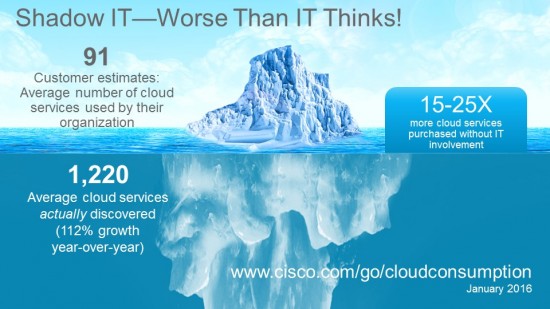
Shadow IT is indiscriminate. It is found in every industry, in every organization (even those who block internet traffic), and in organizations of all sizes. The average large enterprise now uses 1,220 individual cloud services, up from 730 six months ago. That’s up to 25 times more than recognized by IT—who estimate that they are using 91 public cloud services. The number of cloud services used by large organizations has grown an astonishing 67 percent over the past six months, and 112 percent over the past year.
We’re essentially witnessing a democratization of IT. The business groups have spoken and they want the flexibility and innovation cloud services can deliver. There’s no turning back the clock here. In fact, a recent IDC study commissioned by Cisco clearly shows an optimized cloud strategy delivers dramatic business benefits. But only 10 percent of organizations have a proactive cloud strategy, with only 1 percent fully optimized. This means that 90% of the market has reactive, fragmented strategies.
Risks Hiding in the Shadows
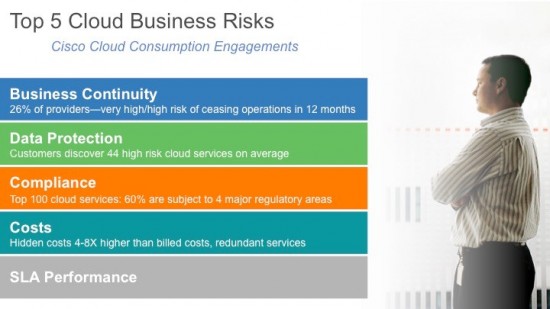
The uncoordinated use of public cloud can leave the business open to a wide range of risks. Our customer engagements helped us identify the top five business risks:
#1—Business Continuity
As cloud services are increasingly used to support business operations, service disruptions can have a significant impact. Service disruptions can result from planned and unplanned outages, disasters, or from inability of a cloud provider to meet acceptable recovery times.
There is also a potential for a cloud provider to cease operations due to financially-based shut-down, acquisition, or other operational failure. Based on financial viability scores provided by Dunn and Bradstreet, we have found that 26% of cloud providers used by Cloud Consumption customers are ranked very high or high risk of ceasing operations in 12 months. That is one out of every four vendors! If a vendor you were using ceased operations, could you replace them quickly or retrieve your data in a timely manner?
#2—Data Protection
With more critical data residing in the cloud, it is vital for organizations to ensure that business data (customer, employee, partner) is being protected from malicious acts. The first step is to ensure you are using vendors with a strong track-record of data protection and adequate policies. Could you identify vendors who might pose a risk to your data protection policies? The cloud can be extremely secure, but all cloud services aren’t created equal. You’d be surprised at how many high-risk vendors you might be using. Cloud Consumption customers discover they are using an average of 44 high-risk services.
#3—Regulatory Compliance
CIOs are responsible for ensuring that cloud services being used by their organization follow policies that would keep the organization compliant with regulations as well as understand what services they are using might be included in an audit. Of the top 100 cloud services used by Cloud Consumption customers, 60% are subject to major regulatory compliance issues and contain data that would be subject to an audit. (The four major regalatory complaince issues are financial reporting/SOX, Protected Health Information/HIPPA, Payment Card Industry, and FedRAMP) If you have an audit coming up, would you understand what services might be included?
#4—Costs
Increasingly, lines of business are making purchasing decisions often without oversight for IT. As every company becomes a technology company and budgets shifts to line of business, organizations are faced with runaway cloud spend. Why? They are spending money on redundant services and are facing hidden costs.
Do you know how much your organization is actually spending on cloud? Are you negotiating discounts on behalf of the entire business?
One of the quick wins our customer have found is around redundant cloud services. Organizations are often using multiple service providers that offer similar functionality. We have found that customers on average use:
92 hosting services to gain internet access
84 marketing and sales services
71 financial services such as banking and tax cloud applications and hosted insurance
61 compute services for running cloud-based systems
51 collaboration services like video & web conferencing, on-line training, education, and desktop sharing (not including social media)
46 cloud storage services to store unstructured data (not including backup and recovery)
37 office productivity services to produce documentation or manage projects
36 business intelligence services such as dashboards, reporting systems, scenario modelling, and data analysis
#5—Service Performance
Organizations have ineffective capabilities to monitor performance against service level agreements and are challenged to determine if they are receiving what they paid for. This problem is magnified when lines of business rather than IT are overseeing negotiations and might not be aware of contract pitfalls. Do you know if your providers are meeting their SLAs?
You Can’t Manage What You Can’t See
If you answered no to any of my questions above, you may need our help!
To help CIO’s manage their shadow IT issues,we last week. The new software-as-a-service product can help you to:
Discover and continually monitor public cloud use
Reduce your financial and security exposure by identifying cloud business risks and compliance issues.
Cut cloud costs by finding ways to consolidate or discontinue services.
Strategically manage cloud use by understanding needs of employees and internal groups and benchmarking cloud usage data against your peers.
Improve business agility by finding the right cloud services to meet your business, risk, and compliance requirements.
Sound interesting? I’m hosting a webinar on how to “Discover and Managing Your Shadow IT” on Wednesday January 20th at 9 am PDT. I encourage you to register HERE to learn more.
If you want to know more about your cloud please contact us for a demonstration of Cloud Consumption as a Service or learn more.
Like mentioned last week, there will be a number of new Cisco Small Business products coming out in the next few weeks and months. The theme we are using is “Connect More”.
But why, “Connect More”?
The new Cisco Small Business products, including new switching, wireless access points, and of course the routers, help you connect to more endpoints, devices, applications, workstation computers, laptops, servers, the cloud, the internet, heck, we can connect you (and of course, your small business) to just about anything. Except for maybe the Wimbledon Singles Trophy or the Stanley Cup.
But, it is why we are doing what we do. We want you to connect to more, easier and more effectively, and securely. We want more options for you and your small business. Coming soon, there are More 802.11ac wireless access points, indoor and outdoor, even a wall-plate AP , filling out the already strong wireless portfolio. New switches are coming. New routing includes new DSL/Ethernet combo WAN’s models, one the first with 802.11 AC in the portfolio, the other at about $150USD.
We will be sharing more details as the launch dates arrive.
Today I am here to tell you all about the new RV320 and RV325 with web filtering. But why web filtering for your small business?
There are a couple of reasons: a. Prevent Internet Abuse at your business. b. Keep your network users away from potentially bad websites loaded with malicious gunk; in general keep your network in good health. c. Keep your users producing. d. Manage your business website policy effectively, in a coupe of clicks.
In general, safeguarding your network and your users makes sense, business sense. It’s easy to set-up as you will see in the below video. you can categorize sites, set protection levels, enable website reputations, and even schedule when the service is on.
These new models will join the existing RV320 and RV325 models and will be on the shelf for you around mid-to-late February. Not all regions will get these, so please consult with your local Cisco Small Business Partner.
Due to the overabundance of choices, going to the mall can sometimes make your head spin.
One of France’s biggest property groups, Altarea Cogedim, recently built Qwartz in Villeneuve-la-Garenne. At this mall there are so many stores having so many sales, oftentimes just buying a pair of pants can be a harrowing experience for shoppers.
On the opposite side of the same coin, merchants are also drowning in a flood of choice too. Over a million unique visitors come through the mall every year, but shop owners don’t have the right data to know what items their customers are looking for.
#CiscoChampion Radio is a podcast series by Cisco Champions as technologists. Today we’re discussing Cisco Champions Crystal Ball: Your Predictions for 2016 with Cisco Subject Matter Experts Kim Austin.
This week, more than 2,500 leaders from business, government, academia, and civil society will convene at the 2016 World Economic Forum (WEF) Annual Meeting in Davos, Switzerland. As one of those attendees, Cisco will collaborate with other global problem solvers in strategic discussions about the political, economic, social, and technological transformations reshaping the world.
This year marks Cisco’s 14th as a WEF Strategic Partner, putting us in a group of 100 companies committed to changing the world. Our annual inclusion in WEF gives us the opportunity to build and strengthen the relationships that help us address some of the world’s biggest challenges. One of the key challenges being discussed as this year’s summit is “employment, skills and human capital,” with a focus on how to create 470 million new jobs in the connected economy by 2030.
More than 2,500 leaders from around the world will convene in Davos, Switzerland this week for the 2016 WEF Annual Meeting
There’s a lot that goes on behind the scenes in cloud. This makes it difficult to know how reliable a provider’s cloud is going to be. Many are best-effort implementations, meaning you only have the provider’s word for it that their cloud is reliable. These providers also often employ a white-box infrastructure so you don’t know what kind of equipment your data is running over or how well integrated that infrastructure is. You have no guarantees, not even an SLA. It’s your business on the line if the cloud goes down. That’s a lot for a cloud provider to ask when they promise, “Trust me.”
And therein lies the power behind Cisco Powered. The promise that a cloud provider who offers Cisco Powered services makes is not just words. It’s a promise with teeth. To use the Cisco Powered ingredient brand, providers must first go through a comprehensive certification process. Then, each and every one of their Cisco Powered services must pass a rigorous third-party audit.
This audit isn’t just a formality. Many of our partners have been surprised at how hard the audit is to pass. But it’s hard for a reason. There’s a lot that can go wrong in the cloud. A provider new to cloud may not be familiar with many of the pitfalls that await them. The audit is there to verify that the provider can and will deliver superior service, security, and support. And they only pass the audit when they are able to prove to a third-party that they can do this.
Many of these same vendors are the ones who praise the audit once it’s completed. They see the value of making sure that they can deliver. They understand that because the audit is so comprehensive and difficult, they are able to immediately offer a level of service unparalleled in the industry.
The final facet of the reliability of Cisco Powered services is the fact that they run on Cisco equipment. You trust Cisco in your data center and the network. Now you can trust Cisco in the cloud. In addition, because your data and applications are running on Cisco architectures, you’ll know your data is safe with end-to-end security.
The promise of Cisco Powered is that you can connect with confidence. It isn’t a promise our partners make lightly. They’ve worked hard and made a substantial investment in time and money to prove that they can deliver.
There’s a reason Cisco Powered is the industry standard for cloud and managed services. It’s a promise that stands up to its name.
Learn more about the promise of Cisco Powered and the Partners offering these services















![16CS0010-CiscoPoweredBlog-1.12.16-02[1]](https://blogs.cisco.com/gcs/ciscoblogs/1/16CS0010-CiscoPoweredBlog-1.12.16-021-1.jpg)