Avatar

Hi again!

Many of you are looking to refresh your current hardware, deploying your first or second cluster of hyperconverged infrastructure (HCI). You are likely starting with a VDI project, virtualized infrastructure in a branch office or perhaps a cluster of applications for a specific department in the organization. Hyperconvergence allows you to dramatically streamline deployment, eliminate storage complexity, simplify daily operations and increase scaling capabilities – sounds great! Right?

Hyperconvergence is awesome. But I invite you to think strategically, looking at what happens 1-3 years down the road. You probably plan to move more applications to HCI, but at the same time already have many applications in place. Things won’t happen over night, and you are unlikely to be comfortable migrating ALL of your applications to HCI.

New silos emerging?

Many solutions in the market put you in a tough spot. To enjoy the benefits of HCI one must create new silos. There’s traditional or converged infrastructure (CI) with one set of tools that you know how to use, and then there’s HCI with separate management tools and interface. Pretty ironic given that we were trying to eliminate datacenter silos!

Single platform for complete data center strategy

Here’s where HyperFlex fits in. Cisco always takes a broad and strategic architectural approach: The same platform you love from converged infrastructure with UCS is now used for both CI and HCI. This means you can use the same UCS Manager automation for UCS AND HyperFlex clusters, streamlining daily operations and increasing infrastructure reliability. Also, since both infrastructure types play well together you can add UCS Blades or Racks to a HyperFlex cluster, expanding compute-only resources, and thus optimizing your TCO for your specific needs. In fact, the same compute-only nodes can be shifted between HCI and CI clusters based on your changing application needs, enabling dynamic utilization of resources and cloud-like experience for your infrastructure.

Check out this video for information on Cisco HyperFlex and how it fits in your overall data center architecture:

https://www.youtube.com/watch?v=9fh62jIPvE0


Want to learn more?

Authors

Gil Haberman

Product Manager

HyperFlex Product Marketing

Avatar

MadiVastare

Having to cope with the loss of my Golden Retriever, Tiger was one of the hardest things I ever had to go through. He was a fluffy and happy eleven-year old pup that loved to grab the morning newspaper and sit right smack in the middle of all the excitement during the opening of presents every Christmas morning.

When my father called me to tell me that Tiger had passed away from cancer, I wasn’t sure what I was going to do. I was left sitting idle, staring at a blank wall through tears of uncontrollable grief.  To some, a dog is just a dog.  To others, they’re our family, and I felt Tiger’s loss deeply. I wasn’t sure who to turn to or even how I would cope with the grief I felt.

It was my manager, Sherry, who suggested that I not only acknowledge my grief, but give myself permission to express it as well. What a relief it was to have a manager who understood how much I was hurting! She thought that taking time to visit a nearby animal shelter would help me to channel my feelings, and immediately I fell in love with the idea of honoring Tiger’s memory by giving back to animals that are also seeking comfort.

Sherry’s compassion and care for me really helped me get through this moment in my life. So, it was a plan! I was going to head over to the Silicon Valley Humane Society and help animals in need, but…I knew I didn’t want to face this chapter alone. The solution here was easy – I sought out the help and aid of my Cisco FES-IT Team.

Cisconians are always up for supporting each other, and giving back – this was no different as everyone rallied around me and came together.

We were busy cleaning windows and completing loads of laundry – but we even made these chores fun, and got to make toys for the animals as well. We received a tour of the humane society’s facilities and were able to spend an hour with the many dogs seeking new homes, each little furry face had their own personality – and really tried to work their magic on becoming the next Cisco pup. When all was said and done, we left with big smiles and warm hearts, and I honestly feel like spending time with the animals was more therapeutic for our team than for the residents of the Silicon Valley Humane Society!

The past few months have been incredibly difficult for me, as losing my lifelong friend in Tiger made me feel a bit lost. However, it has helped me find solace and comfort in knowing that I have an incredibly supportive and giving team who not only came together for the animals of the Humane Society, but me as well.

I’m not sure if I would’ve had the courage to do this on my own, and I’m really happy to know that I have a family here at Cisco that not only advises me when things are tough but encourages and motivates me to empower myself.

Want to join a company that cares? We’re hiring!


Authors

Madi Vastare

Project Lead- Travel IT

Employee Financial Services

Avatar

Cisco is not only one of the first organizations to have discerned the trends leading to the need for “smart city” strategies, it is also uniquely prepared to provide the smart solutions to city challenges.

Cisco comes at smart cities, infrastructure up, building on its three decades of rock-solid networking expertise, a decade of focused research with city leaders worldwide, the continuing development of a strong ecosystem of technology, service provider, urban services management and finance partners—Cisco is announcing the availability of its Smart+Connected Digital Platform. We chose the Smart City Expo World Congress 2016 in Barcelona (Nov. 15 – 17) for the formal announcement.

What is the Smart+Connected Digital Platform?

The Smart+Connected Digital Platform is a unifying, cloud-based set of tools that, together, creates a centralized layer for addressing the infrastructural need to connect cameras, water meters, traffic meters, and so on in a reliable, secure, robust and seamless manner. And allows the city to capture, analyze and share data across city agencies and departments, across domains and with also with city residents, visitors and businesses—making the Internet of Things (IoT) a reality in cities.

And we aren’t working alone. We are working with systems integrators, application developers, technology vendors, urban services management providers. Cisco’s real value in this space is not in developing and selling city solutions, it is in deploying a powerful network platform that will enable other specific domain and process experts to continue to develop and deploy their city solutions.

Why is this important to cities and how do we know it?

Just as a city thinks in terms of highway networks, waterway networks, or electric/utilities network, the Cisco digital network helps integrate them.

The Smart+Connected Digital Platform will provide the type of open architecture that will help cities leverage the value of these new connections, devices and data. In fact, Cisco has been testing early versions of the Smart+Connected Digital Platform in pilots in a number of cities—including Adelaide, Copenhagen, Kansas City, Paris and Jaipur—and we have already heard promising results.

Their city leaders have told us that having a unifying layer to integrate smart solutions not only makes it easier to share and understand data, it also makes scaling smartness to more of the city and including more agency domains much more feasible. It represents a cost reduction approach versus trying to solve lighting, parking, traffic, safety and security, and other urban services challenges individually and duplicating equipment and effort. So, for instance, cameras for use on streets by the traffic department could be used by road maintenance, law enforcement and public transportation departments and the cost could be shared.

Let’s look at some cities we’re working with.

Adelaide

In Adelaide, Australia, for instance, city and state leaders have come together with Cisco to embrace and undertake digital transformation. Peter Auhl, CIO for the Adelaide City Council is dedicated to the benefits of the much needed transformation and disruption to bring the region stability and economic strength. He highlights the commitment Adelaide has to this effort and the impact this will have on citizens in this video: https://www.youtube.com/watch?v=ECGnp_VlXVM

Copenhagen

Copenhagen is another early adopter of smart technologies to help it meet its commitment to be carbon neutral by 2020. For the city that now has more bicycles than cars, sustainability goals are taken very seriously and the commitment has been significant. Greater Copenhagen has two living labs to test lighting solutions from 30+ vendors and its Smart Street lab tests to put other key smart city solutions to the test in a real-world environment. Cisco is partnering closely with Citelum and TDC to help strengthen Copenhagen’s unique position as a climate friendly lighthouse city by contributing to drive innovation and test new technology. The digital infrastructure is the most comprehensive in Denmark and the platform will help to ensure that Denmark continues to prepare its cities for the future. https://www.youtube.com/watch?v=MYH5wK8_54I

Jaipur

Cisco has a strong commitment to collaborate with the Indian government in its vision for a Digital India. Jaipur is a progressive city that is working hard and embracing new approaches to addressing the challenges typical of cities in the emerging world—such as bridging the digital divide, enabling citizen engagement, improving safety and other quality-of-life concerns. The Jaipur Development Authority (JDA) is collaborating with Cisco to develop smart city infrastructures that will improve the efficiency and quality of services delivered to residents.

We have implemented the Smart+Connected Digital Platform, which in turn has enabled city surveillance, lighting, and environmental monitoring solutions. In the famous “Pink City” connected transport, wireless broadband, security services, and traffic management showcase greater connectivity and information access for its citizens and tourist visitors (the city that attracts some 40 million tourists every year). Shikhar Agrawal, commissioner of the JDA, has noted that “working with Cisco has made [our] vision a reality, and our city is benefitting in every aspect – from safety and security, to easy access to information, to overall improvement of our image and our stepping into the ‘Smart City’ arena.” https://www.youtube.com/watch?v=zxXhhTWfNEU

Kansas City

Kansas City, Missouri, already a forward-looking city was interested in bringing together a select ecosystem partners that could help city leaders create a digital framework that would be reliable and grow as the city grows. It would allow them to deliver a new generation of urban services—including smart lighting and video, interactive digital kiosks and new water management initiative. We worked closely with the cities leaders and with a strong team of partners, including Sprint, Sensity, Mark One, and Black and Veatch, to gain early momentum on the implementation of the Smart+Connected Digital Platform into which the other solutions connect.  https://www.youtube.com/watch?v=mnyrUhPwd70

Our customers thus far are telling us that having a powerful, secure, open platform for digital connectivity and data sharing–that allows applications, sensors, cameras, and other connected devices from different vendors to connect seamlessly—will not only make it easier and more affordable for them to undertake a smart digital transformation, it already seems to be a true game-changer for why cities want to work with us and our ecosystem of partners.

If you’ll be at the Smart Cities Expo World Congress (SCEWC) in Barcelona, come say hello! Or follow us @CiscoGovt for all our #SCEWC16 coverage.

Cisco will be demoing the new Smart+Connected Digital Platform and our other portfolio of challenge-busting solutions in our booth (#C362) at the SCEWC in Barcelona from Nov. 15 – 17. I’ll be doing a Plenary Session (PL 05) on Wednesday, Nov. 16 and my colleagues will also be participating in sessions that day as well. Come by the booth and say hello. We’d be delighted to show you what we’re up to and answer your questions. And if you’d like to set up a meeting, please do let us know!


Authors

Anil Menon

President

Smart+Connected Communities and Cisco Deputy Chief Globalisation Officer

Avatar

There’s never been a better time to reimagine healthcare. Today, healthcare organizations are leveraging technology to connect people, processes, data and things while maintaining security and patient privacy. Read this quarter’s Connected Health newsletter to learn how you can extend the delivery of quality care whenever and wherever it is needed.

Point of View:  Digitization of Healthcare
Technology can improve the patient experience, drive analytics based on medical data, and secure the world’s most valuable data.

Case Study:  VRad
Live video radiology diagnostics reduce patient anxiety while assuring more effective care through face-to-face collaboration.

Case Study:  Union Hospital of Cecil County
Reliable, secure foundation protects patient information and delivers quick access to electronic health records.

Video:  Virtual Patient Observation
A video-enabled approach to patient sitting that improves workflows for caregivers, lowers costs, and helps improve patient safety.

Video:  Staying Connected During Illness
Cisco TelePresence allows Callie to stay connected while undergoing a bone marrow transplant and post-transplant isolation.

White Paper:  Healthcare Security
Protect your patients, your practice, your brand, and yourself by implementing a comprehensive threat-centric security model.

Video:  The Power of Connection
Young cancer patient uses Cisco video conferencing to create and maintain meaningful relationships while attending class remotely.

Be sure to subscribe now to get our quarterly newsletter delivered directly to your inbox!

Cisco Connected Health

Authors

Joyce Perrelli

Healthcare Program Manager

America’s Field Marketing

Avatar

“Location, location, location.” It’s no longer just the rallying cry of the real estate industry. Today, businesses of all stripes are tracking the location of smartphones—presumably attached to people roaming their stores, facilities and offices—to gain critical insights into how, when, and why they interact with these environments.

Location provides the context needed to bridge the gap between the digital and physical experiences your customers have with your brand (what retailers refer to as omnichannel). Insights gained can be used to enhance that experience—a supermarket adds a cashier when lines get too long—or to provide more relevant, personalized engagement—a mall offers free popcorn to the customer who hopped onto their free web portal, because he’s standing in their movie theater lobby.

You’re only limited by your imagination. And, of course, your ability to accurately locate mobile devices indoors.  Which, until recently, has had its challenges.

Learn all about indoor location accuracy, the innovations that are improving it, and the new products that are powering the indoor location revolution in this episode of TechWiseTV.

(Watch a short below here…or just go right the full episode)

https://youtu.be/ZatETNxloq8

Location 101: Granularity, Currency, Latency

In this episode, Darryl Sladden walks us through the three-legged stool that defines accuracy: granularity (location precision), currency (data freshness), and latency (time it all takes).

Then we’re off to the whiteboard to review the latest Wi-Fi and Bluetooth Low Energy (BLE) techniques used to enhance location accuracy:

  • RSSI triangulation – three or more wireless access points (APs), acting much like GPS
    satellites, use received signal strength from the mobile device to increase location accuracy (to
    within 5-7 meters).
  • Angle of Arrival (AoA) – by determining the angle at which the radio energy arrived, you can further
    increase location accuracy (within 1-3 meters). This requires a special antenna array, and knowing the
    x/y location, height, and orientation (the direction they’re facing) of all your APs.
  • Fingerprinting – compares signal strengths from multiple beacons with fixed locations to
    determine the location of a mobile device.

TWTV_203_CIS144312_V1.00_08_22_48.Still008

Darryl does a fantastic job of simplifying these concepts, so I won’t belabor them here. Instead, let’s move on to how these advancements have made their way into Cisco’s wireless mobility and indoor positioning solutions.

Cisco Connected Mobile Experiences (CMX) is a software solution that helps customers create relevant location-based user experiences (CMX Connect), and collect valuable location-based insights (CMX Analytics). It can run on the Cisco 3365 Mobility Services Engine, or as a virtual machine. And both have received a massive boost in capabilities thanks to two new hardware devices:

Hyperlocation

The Cisco Hyperlocation Solution uses all the advanced Wi-Fi location services we review in this episode to provide accuracy to within one to three meters, depending upon deployment. It includes an innovative snap-around antenna for determining AoA (actually, it’s forty miniaturized antennas. We crack one open in this episode). And, it’s sold as a field-upgradeable module for the Cisco Aironet 3600 and 3700 Series, so Cisco customers can leverage their existing wireless infrastructure.

Virtual Beacons

Ever since BLE became a default standard on most smart devices, beacons have become enormously popular for pushing location-based apps and content. They’re small, battery-operated, and cheap—at least to purchase. The expense comes with deployment. Comprehensive site surveys are often required, and need to be redone each time your space changes or you want to move beacons. They’re easily lost or stolen. And the more you beacon to get accurate and timely information, the faster you’ll be replacing batteries. All in all, studies estimate it costs large organizations $300 per beacon a year to manage.

Cisco’s new Virtual BLE Beacon solution solves these problems by combining the high-accuracy Cisco Beacon Point— a PoE-powered hardware device you attach to the ceiling—with CMX Cloud Beacon Center management that lets you drag and drop multiple virtual beacons anywhere in your coverage area.

TWTV_203_CIS144312_V1.00_20_05_57.Still014

Next Steps

As you can see in this episode, there’s a lot to indoor positioning technology. The key to success is to focus on your unique use cases so you can architect your network to meet the unique location data collection needs of your business.

If you haven’t yet, I highly recommend you watch this episode on Indoor Location Accuracy. And when you’re ready, work with a wireless partner with experience, not just in Wi-Fi and BLE deployments, but with location positioning.

Robb

@robbboyd

http://www.techwisetv.com

P.S. Learn even more about how indoor location can change the way you engage your customers. Register for our live, interactive workshop, taking place November 16th.  Use the same link even if you miss the live event…we will record it for you!


Authors

Robb Boyd

Producer, Writer, Host

Avatar

Infrastructure automation, continuous deployment and efficient operations require programmable infrastructure.

Developers want to treat physical infrastructure the way they treat other application services, using processes that automatically provision or change infrastructure resources. Your operations staff needs to provision, configure, and monitor physical and virtual resources. This allows them to automate routine activities and rapidly isolate and resolve problems. Programmable infrastructure naturally facilitates DevOps methodologies which makes development and operations teams more efficient and productive.

The Cisco UCS management framework is completely programmable – it manages infrastructure as code (IaC). Four innovations provide the foundation for IaC in Cisco UCS and Cisco HyperFlex by making the infrastructure programmable:

  • Software object model
  • Unified APIs
  • Virtual Interface Cards (VICs)
  • Service profiles and templates

The benefits of a unified API

Download a brief

 Unified APIs

The software object model and unified APIs in the Cisco UCS management framework work in conjunction with the Cisco® fabric interconnects and the VICs to facilitate IaC. Unified APIs provide a common control plane to manage IaC. They give you programmatic access to every system component. The APIs also facilitate custom development through Cisco UCS PowerTool Suite for Microsoft Windows PowerShell and a Python software development kit (SDK).

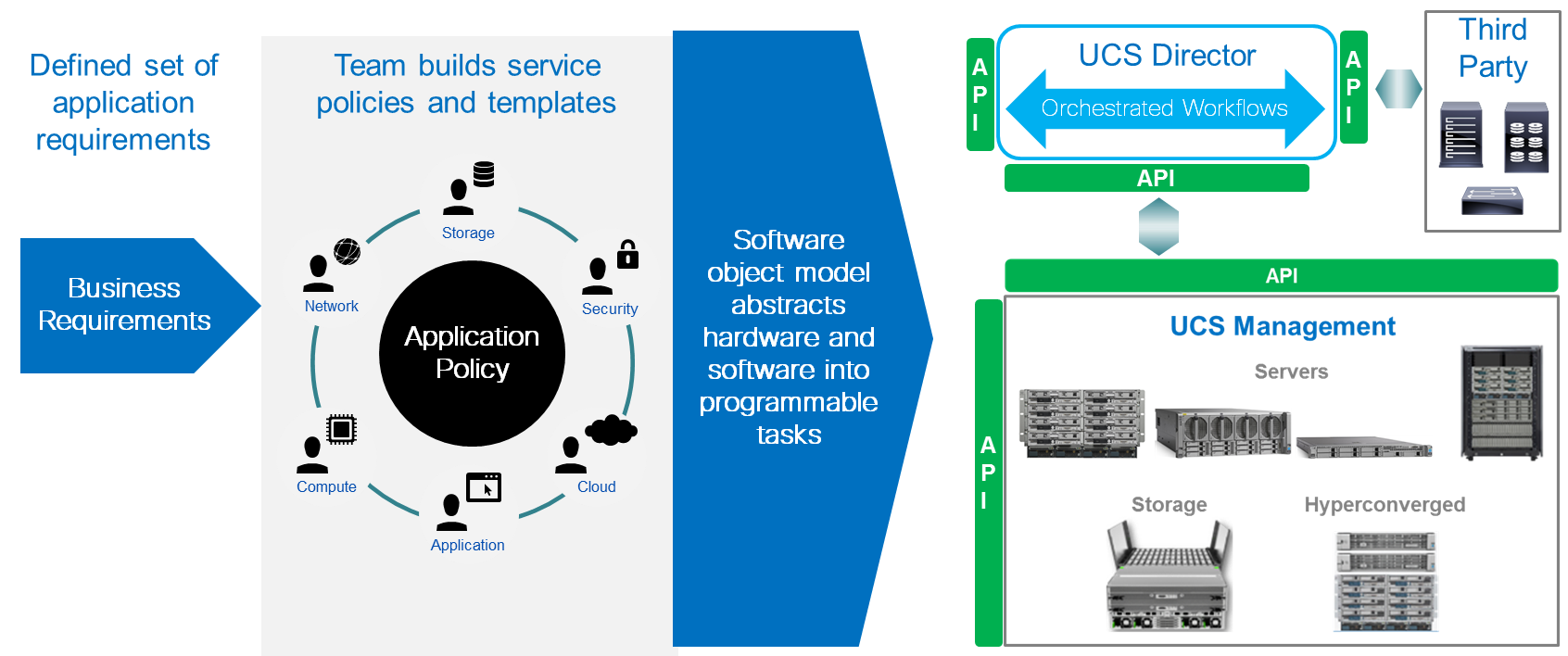
The UCS Director APIs provide access to tasks and workflows that can be used to automate and orchestrate Cisco and third party infrastructure resources. It supports a wide range of servers, storage, network, converged infrastructure and hyperconverged infrastructure. The API gives the application and DevOps developers the complete programmatic access they need.

Figure 1. Overview of Cisco UCS Management Programmability, Object Model and APIs

UCS Programmability Overview

The infrastructure service policies and templates are created by server, network, storage and other administrators, and they are stored in the Cisco UCS fabric interconnects. The software object model abstracts the hardware and software into programmable tasks. Service profiles allow you to define connectivity, computing, storage, chassis, and firmware settings once and then roll out the components with the same settings every time, with confidence that the settings will stay the same over time.

We’ve developed a new set of Learning Labs to give you experience with the UCS unified APIs and UCS Director APIs. Training modules feature UCS PowerTool Suite, the Python SDK and custom tasks and workflow creations. There’s a learning track for infrastructure developers and a separate track for application developers.

For more information on the Learning Labs

For UCS management, https://learninglabs.cisco.com/tracks/ucs-compute-prog

For UCS Director, https://learninglabs.cisco.com/tracks/ucsd-resource-automation

Authors

Ken Spear

Sr. Marketing Manager, Automation

UCS Solution Marketing

Avatar

Like a trusted partner, Cisco is there.

With the ISR 4000s, you’re in good hands.

Why all the cleverly-crafted references to insurance companies and security at the branch?

Continue reading “Your Branch Could Save You Millions or More from Security Attacks”

Authors

Jason Liu

Product Marketing Manager

Enterprise Networking and Mobility

Avatar

Smartphones may have become ubiquitous, but the demand for internet connections shows no sign of slowing down. In fact, the opposite is true: the growth of the Internet of Things (IoT) is rapidly boosting the number of devices that need a connection.

The growth of IoT presents a real opportunity for service providers. But they will need to cater for a huge variety of network requirements very different to, say, consumers who want to share videos with friends on messaging apps.

Configuring Bespoke Networks

The problem facing service providers is that there are so many different demands for connectivity, all wanting to use networks in different ways. How can they meet this challenge? Wouldn’t it be great if you could continuously configure and reconfigure your service to create bespoke virtual networks for each of your customers? Well, that’s exactly what programmable networks allow you to do.

A virtual network is enabled by software rather than hardware, making it more efficient and flexible – and many of its functions can be automated. The results for providers are reduced operational costs and the flexibility to adapt to new demands and conditions. So not only is it possible to create innovative new products for your customers – you can also implement them easily and bring them quickly onto the market.

Accelerating Into the Future

It’s increasingly easy to imagine a time when every device – from the street lamps on your road to the fridge in your kitchen – is connected to the internet of things. So it’s probable people will use IoT in ways we haven’t even begun to imagine.

The automotive industry is one area where IoT is already becoming a reality. Recent research by technology consultants Chetan Sharma found that in the first quarter of 2016, there were more cars added to networks than phones (32%, compared to 31%).

The owner of a connected car might want to subscribe to a connected vehicle care service, including options like virtual in-car assistance, sensor-based maintenance alerts, and on-board scheduling of appointments. They might also want to assess their driving safety, limit the speed a teenage driver can reach, or even monitor the health of an older family member at the wheel. And lots of organisations would be interested in the data provided by connected cars – insurance companies, emergency services, and parking providers, to name just a few.

In the US, AT&T already has over 8 million cars on its network. AT&T used Cisco’s virtualisation technology to create a network specifically for connecting cars. They required a fundamentally new mobile architecture that would enable machine-to-machine connections. Using Cisco technology, they were able to create a network that combined virtual and physical resources.

Of course, it isn’t just cars that can benefit from being connected. Philips has announced it sees itself as “the lighting company for the Internet of Things”, and has begun partnerships with Cisco and Vodafone. And in a further indication of IoT’s huge potential, service providers like Orange France – who last year created a low power network for machine-to-machine applications – are investing in the technology.

Flexibility is the Future

One of the key benefits of programmable networks is their flexibility: the technology that supports them can be adjusted to different situations. It’s clear why this agility is suited to IoT – it’s moving fast, but no one quite knows where it is going. And because programmable networks can be automated, these new products are simple to deliver.

At Cisco we pioneered many of the key technologies that make programmable networks possible, so we’re ideally positioned to make them work for you. And we invest billions in new research and development each year, to make sure we continue to come up with the products that will shape the future.

KEY TAKEAWAYS

  • The growth of IoT is rapidly boosting the number of devices that need a connection.
  • This growth presents a real opportunity for service providers. But they will need to cater for a huge variety of network requirements very different to those of standard consumers.
  • Programmable network technology enables providers to continuously configure and reconfigure their service to create bespoke virtual networks for each of their customers’ different needs.
  • Programmable networks can be automated, so these new services will be straightforward to deliver.

Learn more about innovation in Programmable Networks here or watch our expert interview about Programmable Network.


Authors

Yves Padrines

Vice President, EMEAR Sales

Global Service Provider

Avatar

As the days grow shorter and colder, I’m reminded that November is Critical Infrastructure Security and Resilience Month here in the US. According to the Department of Homeland Security, this observance “builds awareness and appreciation of the importance of critical infrastructure and reaffirms the nationwide commitment to keep our critical infrastructure and our communities safe and secure.”

Great songs tend to stick in our heads, so I thought I’d help to keep our critical infrastructure secure by putting it to music. Do you remember “The Dark Side of the Moon,” the epic album from Pink Floyd? Here are its wonderful tracks and a view on how each relates to cybersecurity:

  1. Speak to Me. Cybersecurity is a boardroom-level conversation now, and every critical infrastructure operator from power utilities to healthcare providers to water treatment plants should be talking about how cybersecurity risks can affect critical operations. Risk management conversations and coordination should include input from all levels in the organization: the executive level, the business/process level, and the implementation/operations level. These inclusive discussions help build consensus throughout the organization as well.
  2. Breathe. Once the cybersecurity conversation begins, the threat landscape and system vulnerabilities and what-if scenarios start sounding very ominous. Panic can set in. Protecting critical infrastructure can seem completely overwhelming! Here’s what to do: Breathe! Breathe in the air. Don’t be afraid to care. We at Cisco have some good news for you, and we can help too.
  3. On the Run. Keeping things on and running — availability — is the main mission of most critical infrastructure operators, sometimes at the expense of protecting data confidentiality and maintaining system integrity. Remember that cybersecurity must address all three tenets — confidentiality, integrity, and availability — so that cybersecurity problems don’t become operational problems. Recent ransomware outbreaks that completely shut down hospital systems are just the start. Cisco Ransomware Defense is one example of our many capabilities to help critical infrastructure operators address all three tenets of cybersecurity.
  4. Time. In cybersecurity, time is not our friend. Breaches and outages can happen in a matter of minutes. We must have the right capabilities to not only reduce the time to detection (discovering that you’re under attack) but also the time to remediation (taking effective action once you’re under attack). We at Cisco deliver the ultimate visibility and responsiveness to detect more threats and remediate them faster.
  5. The Great Gig in the Sky. There are a lot of compelling reasons to look up to the clouds. Cloud computing offers a wide range of IT capabilities with efficiency and scale that’s difficult or impossible to do in-house. However, you must have visibility and control over those great gigs in the sky. Consider CloudLock, a cloud cybersecurity platform that helps organizations securely leverage the cloud for apps they buy and build. CloudLock delivers security for cloud applications and platforms, including SaaS (Google G Suite, Box, Dropbox, Salesforce, ServiceNow, Slack) IaaS (Amazon Web Services), and PaaS (Force.com).
  6. Money. Just like Time, Money is not our friend in cybersecurity either. Critical infrastructure operators have very limited resources, so they must use them as effectively as possible. Every cybersecurity investment must help bring risks down to acceptable levels. Cisco Advisory Services is one example of how we can help. Our Strategy and Risk Management Services include assessments, planning and guidance that deliver a holistic view of IT risks from the impact of using cloud and mobile services as part of an IT strategy – one that helps ensure that cyber investments are as efficient and effective as possible.
  7. Us and Them. According to Gartner, about 30% of US organizations have already adopted the National Institute of Standards and Technology (NIST) Cybersecurity Framework (CSF) for Critical Infrastructure Protection. By 2020, it’s expected to be 50% of US companies. If your organization hasn’t considered adopting their framework, we think you ought to have a look. It’s a simple yet effective way to help manage cyber risks, covering the most critical people, process and technology controls. And we at Cisco have mapped our products and services to the CSF to make it easy for us to help.
  8. Any Colour You Like. Many organizations have already decided to follow a comprehensive risk management framework like ISACA COBIT 5, the ISO 27000-series, or maybe the Electricity Subsector Cybersecurity Risk Management Process (RMP). You can still use those with the NIST CSF; in fact, the NIST CSF is meant to help guide you to the key areas that will help manage cyber risks most effectively in your organization. Then it maps back to those frameworks so that you can get the detailed information you need. So follow any risk management framework you like. The NIST CSF is there to support and complement it — not complicate it.
  9. Brain Damage. Threat intelligence is vital. It must be built into the cybersecurity products you buy, updated constantly, and backed by a vigilant and experienced team of cyber experts and threat-hunters. Products that lack actionable threat intelligence could be diagnosed with… well, the song title says it best. Anyway, here at Cisco, Talos is our industry-leading threat intelligence organization. They detect and correlate threats in real time using the largest threat detection network in the world to protect against known and emerging cyber security threats to better protect your organization and keep your systems running. And we built it in.
  10. Eclipse. Whether the Earth blocks the Moon from view, or the Moon blocks the Sun, the eclipse reminds us that we still have to block as many attacks as we can. Sure, we must also be able to Detect, Respond, and Recover, but we cannot lose sight of the importance of blocking capabilities: Identify and Protect. That’s why we at Cisco have advanced solutions to provide deep visibility and advanced control over your network: To help you know what you have so that you can properly secure it and block threats from affecting operations. Of course, that’s in addition to our Detect, Respond, and Recover capabilities – but let’s focus on essential preventative controls too.

Okay, so there you have it. Cybersecurity to the tune of the Dark Side of the Moon. And now? Well… The time has come, the blog is over. Thought I’d something more to say.

Authors

Steve Caimi

Industry Solutions Specialist

US Public Sector Cybersecurity