Avatar

The SAN Also Rises: Cisco Delivers Storage Networking Innovations to Support High Data Growth, Scale and programmability.

New user demands and shifting application requirements impose higher demands on data center, cloud and storage infrastructure, requiring a transformative new approach that is simpler, more agile, high performance and cost-effective. To help customers grow, consolidate, converge and to adapt to changing business needs, Cisco is announcing new additions and innovations to its Cisco MDS, UCS and Nexus portfolios. The latest Cisco innovations include:

  1. Cisco MDS 9718 Director – The industry’s highest port density SAN Director (aka “The Beast”)scales up to 768 ports of 16G FC. Cisco MDS 9718 is also Industry’s first 32G-ready SAN Director and Industry’s first SAN Director to support native REST API calls directly to the switch.
  2. New 40G FCoE Module for MDS 9700 -Customers can now upgrade their SAN fabric between access and core to 40G speeds; Industry’s fastest interconnect speed for SAN Inter Switch Links (ISL). For FC customers 40G ISLs’ are very efficient providing 194% higher bandwidth compared to 16G FC and 47% higher bandwidth compared to 32G FC ISL.
  3. Nexus 5672UP-16G – Offering FC, FCoE and Ethernet convergence from a single platform, and the complementary Nexus 2348UPQ Fabric Extender, with support for Fibre Channel (FC) along with multiprotocol storage and LAN connectivity. Nexus 2348UPQ bring FEX capability to FC SANs.
  4. The Unified Computing System (UCS) Fabric Interconnect 6300 Series features two new 1RU 40G/16G FC switches and a new 40G/16G FC Fabric Extender. The new Fabric Interconnect enables 40G FCoE, and 16Gb FC to further bandwidth capacity and provide low latency and lossless fabric, with dramatic performance improvements
  5. Programmability: Latest REST API implementation of Cisco NX-OS allowing programmatic access to MDS, aiding simpler scripting and more effective programming.

To learn more, Please attend the webinar on Feb 23rd 8:00 PST – Register now.

A special thanks to all our partners for their support and participation to make the launch successful. Cisco’s MDS product line is supported and sold by authorized original storage manufacturers (OSM).  We are very pleased that all of our partners are looking forward for the arrival of the new high density MDS 9718 Director along with the other innovations. Cisco is also working closely with Flash Storage partners to bring customers better efficiency and flexibility and built a network that last for the next decade.  High performance SAN and Flash Storage Arrays are match made in heaven; Our Flash Storage partners are equally excited about the introduction of new MDS 9718, providing real value to our customers.

Global customers are also embracing Cisco’s new Storage Networking developments.  For example, China Guangfa Bank, which has 37 branches and more than 700 Business outlets across 76 cities in China, has used the high performing Cisco MDS 9513 Directors for the past 7 years.   With rapidly growing data requirements, and a current storage capacity exceeding 2.4 PB, the new MDS 9718 will help them meet growing customer demands.

Krones,  the market leader in the bottling and packaging industry, services customers worldwide through three data centers hosting over 1000 Virtual Machines that support more than 4.8 TB of data..   Krones currently uses the MDS 9700s to aggregate links and optimize bandwidth utilization as they scale, and is looking forward to implementing Cisco Data Center Network Manager for better visibility and scalability in their data centers

Continue reading “Cisco Storage Networking Innovations to support high data growth and scale”

Authors

Tony Antony

Marketing

Solutions

Avatar

Cisco Live Berlin 2016 is almost here and we would like to highlight a few key points that this event can bring your way. As you know networks are an essential part of business, education, government, and home communications. Every company in every vertical industry is facing unprecedented competitive pressure from new players making innovative usage of software and data analytics. It forces companies to embark on a digitization journey, which ends up having profound consequences on network infrastructure. You may also already know that the Cisco Visual Networking Index (VNI) forecast predicts significant traffic growth in such networks and Global Cloud Index (GCI) forecasts data center and cloud growth showing that total DC traffic will be 3X going from 2014 to 2019. So we worked out a Cisco service provider strategy to help you to stay ahead of the curve and we are delivering SP solutions to help you transform your business. Such strategy will not only increase the speeds and feeds, but will also provide comprehensive ways of growing your business through the virtualization and programmability of services based on Software Defined Networking (SDN) and Network Functions Virtualization (NFV) innovations. We want Cisco SP technologies and solutions to help increase your profitability and reduce your operational costs while reducing time to market. Cisco’s Open Network Strategy is our vision that fosters new solutions positioned to help you transform the way you handle your day-to-day operations and let you become an empowered provider.

rsz_cisco_live_berlin

Come visit the Service Provider booth to see how Cisco’s Service Provider Cloud Scale Networking Solutions for the Software Defined Operator are driving transformation through innovation at Cisco Live Berlin, February 15-19, 2016. We will feature demonstrations, product strategy overviews, and much more!

Continue reading “Cisco Service Provider is Bringing Cloud Scale Networking to Cisco Live Berlin”

Authors

Avatar

It has been said that data is the new oil. Given the price of crude today, the metaphor seems to fit in that there is just too much data in the world, to the point we have no idea what to do with all of it. The data glut is driven by the sheer number of data-producing devices in use today due to factors such as Internet of Things, distributed application architectures, and as-a-service consumption models of the cloud.VersaSTACK

The burden of managing all these devices and data is falling squarely in the heart of the data center, disruptively so. The urgency to modernize data center architectures and infrastructures has never been arguably stronger. Specifically, it requires data center to support higher VM densities, more powerful computational processing, a highly responsive and intelligent network, as well as a high-performance data storage foundation that form tightly integration solutions that can be rapidly deployed and provisioned at the speed of business.

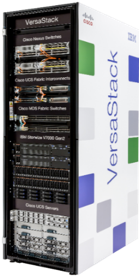
Cisco and IBM took on these challenges head-on when they collaborated to launch the VersaStack™, a next-generation, converged infrastructure that combines the innovation of the Cisco UCS Servers , Nexus Switches and the IBM Storwize 7000 Storage solutions. The initial VersaStack Cisco Validated Design (CVD) solution was designed to address the on-premise data center use cases wherein the UCS servers scaled dynamically up to 160 servers and the Storwize 7000 array scaling up to multiple petabytes of storage. It quickly became the blueprint for cloud-ready enterprise data centers that needed exponential scale for the next decade.

Cisco and IBM followed this success up by adding the next solution – VersaStack for private cloud build-outs to address the needs for the XaaS market. This solution combined Cisco UCS servers, Cisco UCS Director, Cisco Nexus® 9000, and IBM® Storwize V7000 Unified system into a single highly automated and scalable system.

Fast forward one year to today, VersaStack solutions now extend from the on-premise data centers and private cloud solutions to a scale out architecture to address the needs of the distributed data and application use-cases. This comes in the form of two additional VersaStack solutions that have been added to thereby enable VersaStack solutions to address the modern distributed workloads—within and across multiple data centers. This newest solution is based on Cisco UCS Servers and IBM FlashSystem V9000 running vSphere 5.5, and seamlessly handles mission-critical, I/O-bound workloads.

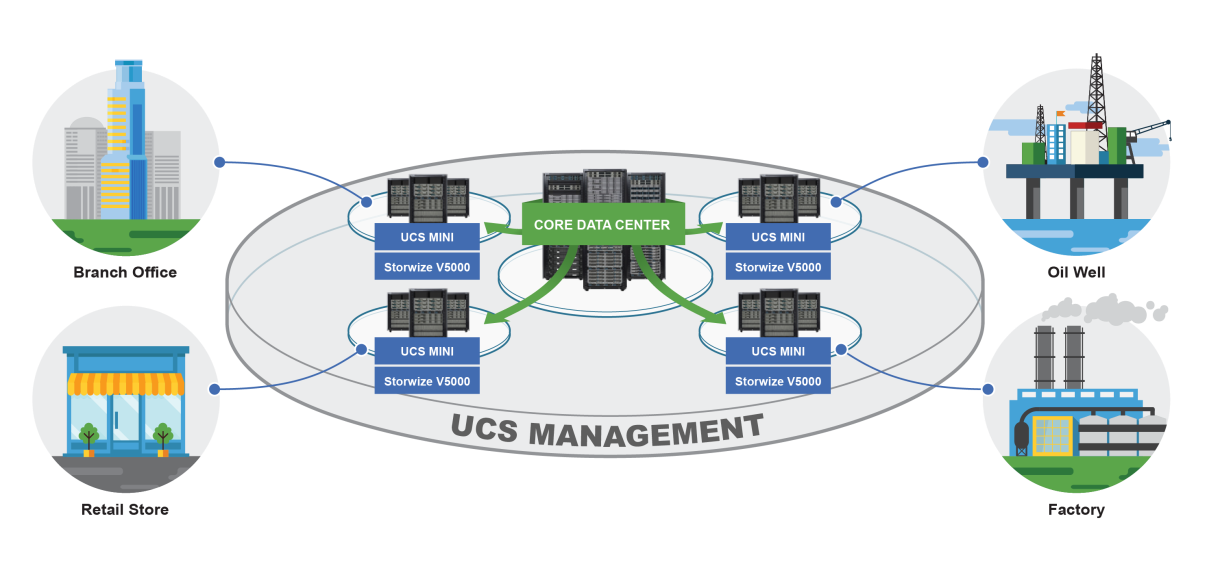
In addition, Cisco and IBM are addressing the requirements of smaller IT environments for medium-sized businesses, branch offices and retail stores. For these organization, we offered a VersaStack solution based on Cisco UCS Mini Servers and IBM Storwize V5000 array running vSphere 5.5, optimized for remote office/branch office that:

  1. Monitors and manages the infrastructure remotely from a single management point
  2. Requires a much smaller footprint
  3. Offers new levels of RAS (service profiles to move a server image quickly) to give new levels of geographic RAS to the ROBO use case. For example, a failed server can be replaced automatically within minutes, not days.

UCS MANAGEMENT


The advantages of having a single UCS management interface regardless of location include : being able to spin up new VMs 85% faster1 and reducing cabling complexity 75%2 than legacy data center management methods.

A quote from IT industry analyst firm Enterprise Strategy Group (ESG) validates the benefits of the single-pane-of-glass UCS solution:

VersaStack offers a vast improvement. It is a converged infrastructure solution that uses some of the most well-known and proven server, storage, and networking solutions in the industry. Pools of compute, network, and storage resources can be shared among many applications and reclaimed when not in use, driving utilization up and costs down. Pre-integrated and pretested, VersaStack saves IT from having to purchase the components individually, test them for interoperability, integrate them manually, and then test, refine, re-test, and finally deploy. Handling all this manually steals valuable time away from IT and application users, and will not provide the agility and flexibility that organizations demand. The same goes for ongoing management. VersaStack enables IT to manage all resources from a single pane of glass, and offers end-user self-service, saving organizations time and money.”1

In other words, enterprise data is more distributed than ever before and compounded with its exponential growth and ubiquity presents new demands on IT infrastructure. To manage this growth, enterprise IT teams have to operate far more efficiently, to do more with less and always faster. In this respect, perhaps the data is oil metaphor falls short. Unlike oil, the production of which can be manipulated downward, the data glut streams inexorably forward toward the Zettabyte Era and beyond. In the face of this daunting onslaught, Cisco and IBM teamed to produce the highly versatile and adaptable VersaStack that will serve as the converged infrastructure blueprint for the next decade. This is the kind of synergy that OPEC members can only dream about these days.

[1] ESG Lab Validation Report: VersaStack Converged Infrastructure from Cisco and IBM, December 2015
[2] VersaStack Customer Validation

Authors

DD Dasgupta

Vice President

Product Management

Avatar

Do you remember when cloud services first emerged? Driving operational efficiency was the name of the game – specifically reducing IT costs. Now, as organizations continue to innovate themselves, many are expecting their cloud services to be instrumental in digitization efforts that can improve business growth and drive innovation.

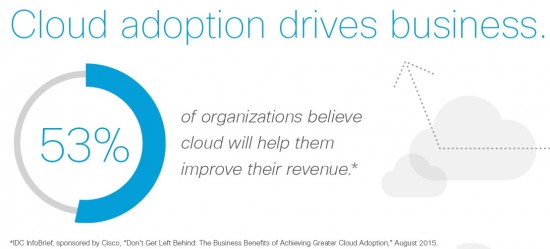
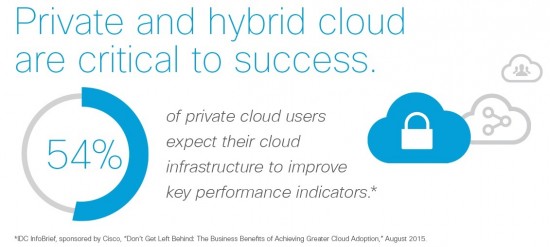
A Cisco-sponsored IDC survey revealed that a second wave of cloud adoption is emerging. Companies now have higher expectations and view cloud as a way to drive innovation and revenue growth. The first wave of cloud was primarily tied to operational efficiency and that is no longer the case. This next wave of Cloud adoption is driving more EFFICIENCY, it is increasing IT SPEED and it is enabling new and DISRUPTIVE applications.

First Image BCA Blog

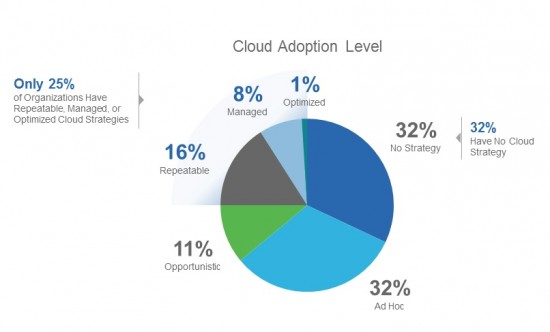
For those companies which have been able to optimize their cloud strategies the results are extremely positive across a number of key performance indicators (or KPIs.) But there is room for improvement since only 1% of organizations are getting the most out of their cloud strategies (or have in place optimized cloud strategies).

Third Image Cisco BCA Blog

As private and public cloud adoption continue to increase, the opportunities for Cisco to help our customers get the most out of their cloud deployments also will continue to grow. How can companies proceed in developing a cloud strategy that will help them take advantage of this second wave of cloud innovation? And what are the business benefits of doing so?

We worked with IDC to make all this research actionable for our customers and help organizations define their own cloud strategy. The Cisco Business Cloud Advisor (BCA) framework in addition (first and foremost) to our Cloud portfolio will allow us to help you derive more value from your cloud deployments. Cisco offers innovative private/hybrid cloud solutions (build your own or as a service) and with our partner ecosystem we can help organizations embrace the cloud with confidence while accelerating deployment times and business impact.


BCA Blog Second Image

In the quest for efficiency, IT organizations have already invested in consolidation and virtualization. They next area of focus to drive efficiencies now is automation, meaning the ability to simplify and bring consistency to provisioning, improve workflows, and accelerate IT services lifecycles.  And while automation’s sweet spot may start with efficiency, its function and impact needs to continually extend and evolve beyond the data center as we expand our playing field into cloud and to the edge of the network and IoT.

When it comes to speed, it’s a matter of delivering on the needs of stakeholders (such as LOB leaders and developers) in a timely fashion to help them stay ahead of market disruptions and capitalize on new opportunities faster. This requires support for flexible consumption models to deliver new IT and business services, whether sourced internally or externally via the cloud.

And when it comes to digital disruption, the next wave of market disruption is coming from IoT applications and goes well beyond big data and enabling M2M communication. It requires a radically different shift in what we consider the traditional boundaries of IT organizations. With the right IT capabilities, information from the IoT can be turned into actions quickly, creating new and disruptive capabilities, richer and innovative experiences, and unprecedented economic opportunities.

And finally, with the considerable complexity of today’s IT environment, especially when that environment includes public cloud resources, it’s critical to ensure security is pervasive across the extended network.

So at a minimum, you need automation, support for flexible consumption models, edge/IoT applications, and security to make this combination of efficiency, speed, and disruption a reality while extracting the most value out of your cloud services.

So the question now is … where are you in the journey? Take a quick assessment to preview the possibilities and engage with our Cisco Team and our Partners to begin a much deeper conversation during a BCA workshop.

Additional Resources:


Authors

Enrico Fuiano

Senior Solutions Marketing Manager

Cisco Cloud Marketing Team

Avatar


This is the first in a series of blogs that will showcase methodical approaches to digital business transformation.


If you think we’re headed for an all-digital nirvana, I suggest you think again. I believe paper will always be around and will continue to be essential in conducting business, in combination with digital approaches.  I was tempted to write a blog called “How paper is the solution to cyber-attacks,” but a more sober-minded me took control, at least for now.  But you get the idea; I don’t buy into the myth that paperless (aka all-digital) is the ideal we should be reaching for.

This disclaimer is important because it helps explain why I am wary of the notion that all we need to do is find the “paper” in every system or process and convert it to some digital equivalent. If this thinking were valid for information architectures, all we would need to do is convert analog/physical to digital formats, digitize all processes and build e-business environments that handle all transactions with no human interaction.

There is value to this thinking, but it’s not enough, not when you are tasked to build architectures that can be sustained beyond one week. When you hear a project leader say, “all we need to do is,” run for the hills.

Omnichannel-image-v2 (003)Consider an example from the retail industry. The era of e-business brought a new lexicon of terms such as e-commerce (aka online shopping) and brick-and-mortar (aka retail stores).  A whole generation of architects (the ones who had computer chips in their toys and laptops in pre-kindergarten) grew up with Java, HTML and the belief that shopping means digital.  Surely everyone will do all their shopping online using Paypal.  They figure that e-commerce systems don’t need to consider that other, outmoded form of shopping, with its point-of-sales systems and brick-and-mortar stores.  They cite companies such as Netflix and Amazon as proof that, if we’re not there yet, we will be soon.

Not so fast.

Continue reading “Blend the Physical and the Digital”

Authors

James Jamison

Director, Technical Marketing

Software Platforms Group

Avatar

#LoveWhereYouWork

Read just a few stories on this blog, and you’ll notice that people love to work here. Whether it’s the people, the innovation, the giving back, or a combination of all of those and more, love is in the air.

Since February is a month of recognizing love – and this year, there’s a whole extra day for it! – it’s the perfect timing for employees to take to social media to tell the world why they love where they work.

Just to make it interesting, we’re adding a bit of the competitive flair by creating an employee contest.

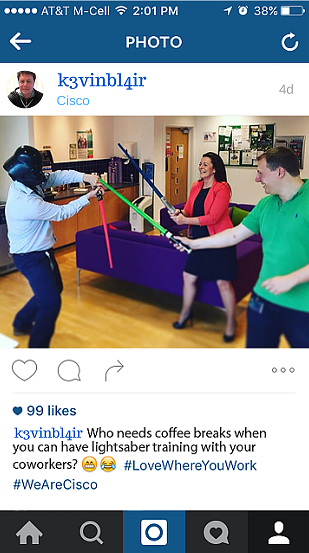
Employees – we’re asking you to take a photo that helps communicate why you love working at Cisco. Post it on Instagram or Twitter, tell us why working at Cisco is awesome, and tag it #WeAreCisco and #LoveWhereYouWork. (Or, upload your entry into the Our Big Picture Mosaic with the hashtags in the description.) A panel of judges will pick the best ones – here are some examples of what we’ll be looking for:

Best Use of Photography Techniques
Best Sense of Humor
Best “Tugs My Heartstrings” Photo
Most Creative Backdrop/Scenery
Most Creative Prop
Best Representation of Our People Deal
Most Humanitarian
Best Executive Representation
Most Inclusive/Diverse
Best Use of Technology
Best In Show

Employees can enter multiple times, but can only win once!

The first 200 entries will receive a Cisco selfie-stick, for more picture taking fun at work. The winners in the above categories will get a Cisco t-shirt to wear proudly!

Only full-time Cisco employees are eligible to enter (full rules here), though anyone can search on Twitter or Instagram for both #LoveWhereYouWork and #WeAreCisco you’ll be able to see the love story unfold! Like and share your favorites!

Stay tuned for the winners in March! Meanwhile, here are some early examples.

LoveWhereYouWork example


LoveWhereYouWork example

LoveWhereYouWork example


Authors

Carmen Shirkey Collins

Social Media Manager

Talent Brand and Enablement Team, HR

Avatar

With cyber threats escalating, security has emerged as a critical business driver and competitive differentiator. Organizations that successfully embed security throughout their network infrastructure, policies, processes, and culture are able to reduce risk while creating sustainable business advantage.

At CiscoLive Berlin this year, we will examine how Cisco is building foundational security into the underlying architecture of our solutions as well as throughout our business operations to enhance the security of our products, our customers, and our company.

Continue reading “Are you protecting your organization with comprehensive security and trust?”

Authors

Anthony Grieco

SVP & Chief Security & Trust Officer

Security and Trust Organization

Avatar

Throughout the year, our customers and partners provide feedback to us about their experience doing business with Cisco. We take that feedback very seriously, and are constantly making improvements to address the most common themes we hear and improve the overall experience. In the We’re Listening Blog series, we close the loop to tell you about these improvements and the changes that our customers and partners can expect to see.

One common theme in the feedback is the Services ordering process, so I’ve asked Lars Thorsen, Director, Partner Services, to describe some of the improvements that the Simplify and Optimize Annuity Revenue (SOAR) team has been making in this space over the past year – and what they have planned for this year.

lthorsen By Guest Author Lars Thorsen

We are constantly looking to simplify our quoting and ordering processes, starting with the improvements you’ve told us you most want to see. We’ve been listening to your feedback via surveys and live forums throughout the year, and we heard you say that the Services ordering process can be “complex and cumbersome” and the Services contract tool, CSCC, is a bit “difficult to use.” More specifically, you told us that it takes too many resources and cycles to interact with CSCC. We wanted to make immediate improvements that would decrease the time it takes to receive a quote for Services. Continue reading “The We’re Listening Blog Series: Big Data Analytics Drive Faster Time to Services Quotes”

Authors

Curt Hill

Senior Vice President

Customer Assurance

Avatar

In technology, things happen at the speed of change. “Evolve or get left behind” is a familiar phrase we’ve all heard. Technology is advancing at warp speed and companies are finding it difficult to manage their ever-growing and ever-changing support ecosystems. Now more than ever, companies are moving beyond maintenance and support services to Continue reading “Dimension Data & Cisco Systems: Partnering to Integrate the World”

Authors

Jim McDonnell

Director, General Manager

ServiceGrid, CMCP, UCSF Alliance