
Avatar

Cisco leads the industry with a Unified, Application-centric approach to computing. Building on the architectural foundations, partnerships, and rapid customer adoption of UCS,  today Cisco introduces innovations inspired by customer requirements in two key Data Center technology areas:

  • Cisco MDS, UCS and Nexus portfolio Innovations: To help customers grow, consolidate, converge and to adapt to changing business needs, Cisco is announcing new additions and innovations to the Cisco MDS, UCS and Nexus portfolio. Please check the blog post by Tony Anthony Cisco Storage Networking Innovations to support high data growth and scale for additional details about these innovations.
  • Cisco UCS Innovations: Inspired by customer needs for greater efficiency and lower TCO, Cisco delivers new UCS features and functionalities with 3rd generation Fabric Interconnect, next wave of unified computing management innovations, new acceleration options for Cisco UCS and scalability options for Cisco UCS solutions.

Let’s take a closer look at these latest Cisco UCS innovations and how they can assist to achieve better business outcomes.

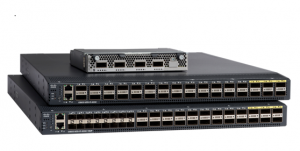
New Cisco UCS Fabric Interconnect 6300 Series and Fabric Extender 2304 
FI

The Cisco UCS Fabric Interconnect 6300 Series employs the UCS Fabric, VIC and UCS Manager to enable a high-performance, low latency and lossless fabric architecture for high capacity data centers. The Fabric Interconnect 6300 series adds to Cisco’s successful Fabric Interconnect 6200 series to deploy 40Gb, 40G FCoE, and 16Gb FC to further bandwidth capacity and provide for an adaptable data center fabric. The 6300 Series offers 2.6X increase in throughput, 3X lower latency and high-density 40GbE ports that enable an end-to-end 40 Gigabit solution. For additional details please check: http://www.cisco.com/c/en/us/products/servers-unified-computing/ucs-6300-series-fabric-interconnects/index.html

Cisco VIC 1387 dual port 40Gb QSFP mLOM adapter

Cisco also announced the 3rd generation UCS VIC 1387 dual port 40Gb QSFP mLOM adapter.The VIC 1387 is based on 3rd Generation Cisco ASIC technology and is ideally suited for next-generation networks requiring up to 40Gb bandwidth. It supports network overlay technologies such as VXLAN and carries forward support for advanced Cisco features such as VMFEX, Netflow, and usNIC. The VIC 1387 is supported with the C220 M4, C240 M4 and the C3160 Servers.

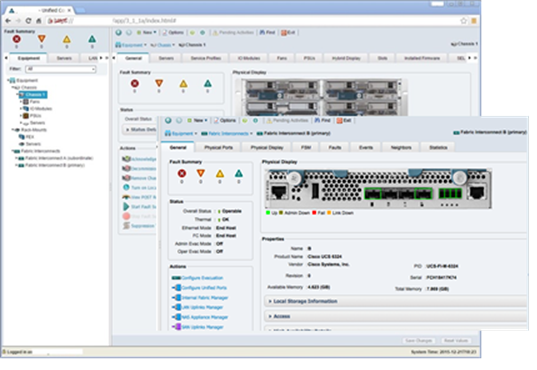
UCS Management Enhancements: UCS Central 1.4 (1a) Releases and UCS Manager 3.1(1e) Release:
UCSM 1

Enhancements to the UCS Management portfolio enable remote operation, automation and policy enforcement across massive multi-site footprints with the UCS Central Software 1.4(1a) Release. The UCS Manager 3.1(1e) Release provides Unified Management for ALL UCS Server Platforms – UCS B-Series, C-Series, M-Series and UCS Mini.

Some of the key UCS Management enhancements include:

  • New HTML5 as well as JAVA GUI options
  • Unified Release for ALL UCS server platforms – B-Series, C-Series, M-Series, and UCS Mini
  • Provisioning and usability Enhancements to UCS Central
  • Support mixed UCS domains with M-Series and B/C-Series with support for up to 10,000 servers

Please check Cisco UCS Manager and Cisco UCS Central Software for additional details.

New Acceleration options for Cisco UCS Servers

Cisco announced the availability of the new “Maxwell” generation M6 GPU for Blade Servers and M60 GPU for Rack Servers.  Both new GPU technologies enable new VDI use-cases with NVIDIA GRID 2.0 Integration. Cisco and NVIDIA have co-developed the M6 MXM GPU for both Tesla, general purpose Graphics Processing as well as GRID VDI GPU and integrated it with the Cisco B200 M4 Blade Server.  This fully-integrated GPU is supported with all CPU SKUs and provides performance on par with the NVIDIA K2 GPU, at less than ½ the power profile!

Here is a complete list of new acceleration options introduced for the Cisco UCS servers:

  • NVIDIA M6 GPU Support for B200-M4
  • NVIDIA M60 GPU support for C240 M4 and C460 M4
  • Support PCIe SSD on M4-Servers
  • Support Crypto Card on B200-M4
  • Support LSI 9286CV-8e RAID Controller

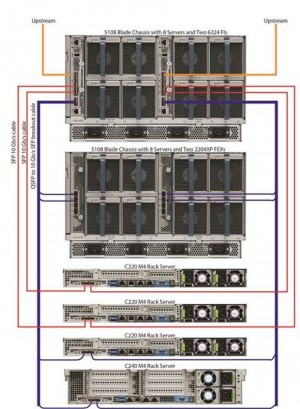
 Enhanced Solutions Scalability with Second UCS Mini Chassis Support
UCS Mini

If you need more than eight blades for your small / medium business, remote / branch office, or in your data center for physical isolation, wait no more! You can now have a total of 16 blades and up to six rack servers. Check out these UCS Mini Solutions for integrated infrastructure, business applications, and storage.

New Acceleration Options for UCS M-Series

Part of Cisco’s composable infrastructure, M-Series is designed for scale out applications and dense compute. Four new cartridges have been released. Two each for the M142 and M1414 models featuring the Intel® Xeon ® E3-1200 v4 series processors including Iris Pro graphics integrated GPU. The Iris Pro GPU can accelerate a variety of graphical applications like remote desktops. For additional details please check: http://www.cisco.com/c/en/us/products/servers-unified-computing/ucs-m-series-modular-servers/index.html

Building on the architectural foundations, partnerships, and rapid customer adoption of UCS, Cisco now delivers the next wave of Unified Computing innovations to enhance data center performance and scalability while maintaining operational efficiency. Leverage the latest Cisco UCS innovations to minimize data center complexity and disruption while deploying infrastructure and applications faster than ever before.

Don’t forget to register for the Interactive Webinar on February 11th, 2016 “Cisco UCS Innovations-Adopt the Power of Unification, Innovation and Scalability”  where Cisco Data center experts will review new Cisco UCS innovation in detail and you can  also hear fa customer testimonial about the latest UCS Innovations.

Authors

Girish Kulkarni

Senior Marketing Manager

Data Center & Virtualization Marketing

Avatar

Earlier today the International Trade Commission issued a preliminary ruling in the first of their ITC investigations related to Arista’s systemic copying of Cisco’s intellectual property. This decision represents the beginning of the end for Arista’s systemic copying of Cisco’s intellectual property. Please read Mark Chandler’s blog for additional information.

Authors

Darek Rensing

No Longer with Cisco

Avatar

Earlier today, the International Trade Commission (ITC) issued a ruling in the first of their investigations into Arista.

This follows a lengthy investigation, a review of thousands of pages of briefing materials and supporting evidence, and a two-week hearing involving testimony and cross-examination. We thank Judge Shaw and the ITC staff for their diligence.

Specifically the Judge’s ruling:

  1. Found violations of three patents: U.S. Patent 7,162,537 (“[E]xternally Managing Router Configuration Data … With A Centralized Database”) (Sysdb) and U.S. Patent Nos. 6,741,592 and 7,200,145 (Private VLANs)
  2. Foreshadows an exclusion order banning imports of all Arista switches (implemented after confirmation by the full Commission).
  3. Installs a challenging ITC review process for any new designs (the result of not bringing evidence of new designs to the ITC hearing).

The details of the Judge’s determination will be published within 30 days, but this notice marks the beginning of the end for Arista’s systemic copying of our intellectual property.

Arista can no longer support claims to customers, resellers, and the market that they created products from “a clean sheet of paper.” The patents in question go to the core of Arista’s products. One of those found to infringe covers Cisco’s proprietary “SysDB.” Arista’s CEO has previously referred to “SysDB” as Arista’s “secret sauce” and more recently, the architecture on which NetDB is built. None of the patents have been proposed for or adopted as industry standards. And all patents we asserted against Arista were invented either by Cisco employees who became Arista executives, or by Engineers who worked for Arista executives when employed at Cisco.

We seek fair competition, but will take action against those who misappropriate our technology and use it to compete against us. Based on our investigation, we believe that Arista’s use of our IP was intentional, pervasive, and driven by the most senior levels of their organization to unfairly compete. Copying and misappropriation are not a legitimate strategy, and today’s ruling is a vindication of our position.

We now see four options for Arista:

  1. Withdraw the products.
    This was the honorable path taken 12 years ago by the only other company that we caught intentionally using our intellectual property in their products.
  2. Modify the products so that they no longer infringe.
    Arista could have submitted new designs during the ITC investigation, but chose not to do so. We now call on them to disclose and submit any workarounds for the required ITC scrutiny.
  3. Face an exclusion order.
    Ignoring the order would result in further sanctions, including a potential permanent injunction against the sale of their products in the United States.
  4. Evade the ITC exclusion order.
    Instead of working around our intellectual property, Arista could try to work around the ITC. Any attempt to avoid an import ban by changing how they source and assemble products fails to acknowledge that ITC rulings cover components imported to make infringing products. This would be a cynical strategy that could expose their suppliers to liability for infringing Cisco’s patents, and validates customer and partner concerns about buying infringing products.

And this is just the beginning. In April we will see a ruling in the second ITC investigation, which may confirm more violations and import bans. Arista will also face two District Court juries with these rulings on their record. The judges and juries in those trials will note this day as the day that Arista no longer can pretend that its products aren’t tainted by misconduct. This will be important as they consider injunctions to remove infringing Arista product from the market.

Cisco’s goal has always been to protect our innovation, and stop Arista from using our patented technology. Their behavior has negative consequences for the industry, and is unfair to those who were sold infringing products and those competitors – beyond Cisco – who are working hard to play by the rules. We see today’s ruling is an important step towards accountability.


Authors

Mark Chandler

Retired | Executive Vice President

Chief Legal and Compliance Officer

Avatar

#CiscoChampion Radio is a podcast series by Cisco Champions as technologists. Today we’re discussing Insight Into New UCS Innovations with Cisco Subject Matter Expert Dan Hanson.

Cisco ChampionGet the Podcast

  • Listen to this episode
  • Download this episode (right-click on the episode’s download button)
  • View this episode in iTunes

Cisco Guest
Dan Hanson (@danhanso), Cisco UCS Product Group

Cisco Champion Hosts
John Kerns (@packetsar), Network & Systems Engineer
Colin Lynch, (@ucsguru), Principal Consultant

Moderator
Lauren Friedman (@lauren)

Continue reading “#CiscoChampion Radio, S3|Ep. 4. Insight Into New UCS Innovations”

Avatar

AS91675Cisco Innovation Centers are where start-ups, accelerators, developers, researchers, ecosystem partners and the venture community come together to create ground-breaking technology and innovative solutions for the future. We have nine of them around the world, and we wanted to share a little insight about what it’s like for a start-up to be part of one. In this guest blog, Jacoby Thwaites, founder of SPARKL, discusses the time he and his team spent at the Cisco-backed IDEALondon innovation hub, how it helped the firm grow, and his journey since leaving. The following copy comes directly from Jacoby:

A great emphasis has been placed by industry leaders and governmental bodies on supporting innovation at a grass roots level, to drive industry growth, explore new ideas and create jobs. As a result, hundreds of start-up accelerators have sprung up across Europe and the United States. But what happens when a start-up finishes its placement, and goes off to make it in the real world? Drawn from my own experiences at IDEALondon, here are some of the ways a Cisco Innovation Center can help a firm move to the next level:

Let’s connect

Innovation centers are naturally busy places, with people from all sectors and professional backgrounds passing through. As a result, you build up an amazing range of contacts which can really open doors for a start-up.

Often, it’s the introductions you don’t think will be particularly useful that turn out to be really valuable! For instance, a contact made at the beginning of our time at IDEALondon recently got back in touch to introduce us to an innovation lab at the Level 39 tech accelerator in Canary Wharf, London, which might be very useful for SPARKL in its next phase of growth.

Innovation labs such as IDEALondon, which are not industry-specific, also expose you to people from a wide range of sectors. This allowed us to connect with firms from manufacturing, aerospace, retail, finance and more. This is all incredibly valuable – not just in terms of future business leads, but also in obtaining feedback and insights that help you rethink the possibilities of your product. Continue reading “Life after an Innovation Center”

Authors

Tom Kneen

Business Development Manager, CTO Office, UKI

GEO - Sales UKI Mgmt

Avatar

Attackers are constantly innovating, employing more sophisticated techniques to compromise organizations and gain access to other parts of the network and sensitive data including proprietary information, trade secrets, and of course financial information. Threats have evolved to the point that it’s no longer feasible to simply defend the perimeter.

In the 2016 Cisco Annual Security Report, Cisco researchers analyzed threat intelligence and examine some of the most compelling trends in attack vectors, attack methods and vulnerabilities. The report called out that malicious browser add-ons, typically viewed as a low-severity threat, were seen affecting more than 85 percent of organizations monitored. Malicious browser extensions can steal information, and they can be a major source of data leakage.

Identifying and blocking adware, malware, and exfiltration of data requires a multi-tiered security approach. By investing in new detection methodologies that are constantly monitoring and analyzing web communications security teams are able to identify new actors and new techniques, reducing time to detection in their environments.

Cisco Cognitive Threat Analytics (CTA) is a cloud-based service that discovers breaches, malware operating inside protected networks, and other security threats by means of statistical analysis of network traffic data. It addresses gaps in perimeter-based defenses by identifying the symptoms of a malware infection or data breach using behavioral analysis and anomaly detection. CTA relies
on advanced statistical modeling and machine learning to independently identify new threats, learn from what it sees, and adapt over time.

Continue reading “Find Advanced Threats with Cisco Cognitive Threat Analytics”

Authors

Joe Malenfant

Director, IoT Marketing

Internet of Things (IoT)

Avatar
Icon_1_Data_StorytellersData Storytellers: Each month we’ll be highlighting experts and advocates to share their data stories, knowledge, and insights into the future of data and analytics. Subscribe to the RSS feed to get the latest updates.

Data is Everywhere

The Internet of Things (IoT) is fast approaching a critical mass of information that will demand a change in how companies process data. With the onslaught of data digital enterprises are now faced with, analyzing incoming data with historical data is becoming increasingly difficult.

The new world of information is widely distributed, streaming, and becoming too big to move. Experts predict that within two to three years, the bulk of analytic processing will take place on the “edge” of information architectures. A new era of information architectures is now unfolding, an infrastructure that is globally distributed and focused on paving the way for much more responsive and agile business models for both IT as well as business operations or operational technology (OT).

Continue reading “Immediate and Streaming: Analytics for Today’s Digital Enterprise”

Authors

Kim Macpherson

Director of Engineering, Analytics

Data and Analytics Group

Avatar

The threat landscape is ever-changing. Attackers continue to innovate and refine their tactics, and malware is more sophisticated than ever. New threats are surfacing every day, like the Angler exploit kit and the SSHPsychos DDoS attack. According to the 2016 Cisco Annual Security Report, ransomware is exploding, Adobe Flash vulnerabilities continue to be popular with cybercriminals, and malicious browser extensions continue to be a main source of data leakage for businesses.malware-security-challenge

But of all the threats out there today, malware still reigns supreme. In the 2016 Cisco Annual Security Report, IT decision-makers were asked to identify the top external challenges that they faced from an IT security perspective, and malware topped the list at 68%. And the target for that malware: your endpoints. Servers, laptops, desktop workstations, PCs, Macs, Linux systems, and mobile devices are all targets. In fact, 50% of respondents in the 2016 Cisco Annual Security Report study said that mobility represents one of the highest risks within their security infrastructure for a security breach. Cybercriminals want data, control of your system, or both. You need to protect your endpoints.

This is why Cisco AMP for Endpoints continues to evolve. Cisco AMP for Endpoints is now better than ever, with new features and capabilities that boost performance, improve usability, and enable IT security teams to better defend against today’s most advanced attacks.

Continue reading “Cisco AMP for Endpoints Adds New Features”

Authors

John Dominguez

Product Marketing

Cisco Security Business Group

Avatar

As Cisco’s Chief Digital Officer, my entire focus is on enabling Cisco and our customers to accelerate the digitization of our businesses, countries, and cities.

Digitization provides an enormous opportunity to enable, differentiate, and define new business models; yet at its core, the success of the transition is predicated on the capacity to reimagine and reinvent the actual work. This includes building on the Internet foundation to extend the mobility of work, the distribution of work, the immediacy of work, and how and where work will take place.

Being digital isn’t just about technology. It requires companies to reexamine their entire way of doing business — and how they offer it — to deliver new value to customers and partners through fast innovation and operational efficiency.

Winners will be those who equate digitization not with basic automation, but instead with the notion of reinventing systems and tools to create a continuous cycle of innovation in a company’s product portfolio and operating model.

As we begin 2016, companies are under more pressure to accelerate digitization than ever before.

In fact, according to a 2015 study by the Global Center for Digital Business Transformation (DBT Center), “digital disruption” will displace nearly 4 of the top 10 incumbents by industry over the next five years. The average time to disruption is a mere three years!

Continue reading “Reimagine Work to Maximize Digital Value”

Authors

Kevin Bandy

No Longer with Cisco