Avatar

lori-short-2012Bio: Lori MacVittie is responsible for education and evangelism of application services available across F5’s entire software suite with an emphasis on F5 Synthesis and LineRate. She currently focuses on cloud computing, infrastructure, devops, data center architecture, and security-related topics. Lori has extensive development and technical architecture experience in both high-tech and enterprise organizations, in addition to network and systems administration expertise. Lori authored this Blog.


One of the most frustrating experiences a developer can have is when a deployment into production goes wrong. It doesn’t matter how much you test yourself or in QA, invariably something goes wrong in production. That’s usually because while traditional DEV and TEST (QA) environments closely mirror the application infrastructure that will be used in production, it does not – and cannot – mirror the network infrastructure. The complex web of application and network services that exist in a production environment have been too expensive and difficult to replicate. So developers and admins have had to cross their fingers and hope nothing goes wrong. And when it does? It’s back to the queue until the next change window opens.

One might surmise that if you could only test deployments in a real environment that such situations would effectively go away. But asking to test against real, live production network infrastructure is akin to Oliver Twist asking for “More, please” in Dickens’ famous novel.

This nightmare is not reserved for developers and operators. Imagine, if you will, a network or application service professional crafting the appropriate policies designed to scale, secure, and optimize your application. This is not a trivial task. Oh, certainly assigning IP addresses and even VLANs seems simple, but there’s so much more to “the network” than just basic networking. There’s the load balancing with its associated (and very much required) monitoring. There’s application and network firewalling, anti-malware and anti-virus scanning for systems that exchange large data sets. There’s optimizations for mobile and things that must be configured, routes between services, isolation policies and more. This isn’t a “give me an IP address and let’s be done with it” kind of process. It’s a complex dance involving multiple parties that requires collaboration and careful orchestration.
Lori-report-cover-soad

In the past there’s been no way to “test” such a complex interaction of services outside of production. It’s do or die, deploy or roll back. It’s no wonder it takes so long to move that app into production.

But things are changing, for the better. Virtualization and programmability of network and application service infrastructure is making it possible to test policies and configurations before production, in increasingly complex configurations. Whether it’s the use of virtual labs or virtual appliances, the need to support testing of network and application service infrastructure is being heard and answered.

This is critical, especially as these systems become more integrated and orchestrated. Consider the role of Cisco’s APIC, for example, in not only provisioning but configuring a variety of application services such as those We (F5) provide through BIG-IP and BIG-IQ. It’s important that those responsible for deploying the policies that scale, secure, and optimize apps are able to test the orchestration that will ultimately deliver the application’s needed services into production.

That’s why it’s exciting to see Cisco’s efforts around DevNet and in particular its sandboxes. The ability to test against real infrastructure before moving into the production environment is of significant value in reducing the time it takes to move through production and improving time to market for all manner of applications. Like our own DevCentral, Cisco’s DevNet efforts are designed to provide a community in which documentation, testing, example code, and support are all available when its needed, whether that’s at 2pm or 2am.

This support and ability to test is paramount as DevOps continues to make its way into the network and bring with it the benefits developers and operators have begun to enjoy: stability of infrastructure, consistency of policy, and speed of deployment. “The network” needs not only the methodologies DevOps brings but similar frameworks for testing and the application of continuous integration for those networking components that rely on integration to provide for deployment and administration of network and application services, such as Cisco and F5.

Sandboxes, documentation, examples, and virtual appliances all lend themselves to enabling DevOps to extend its reach into the deployment pipeline. By including critical network and application services as part of an extended CI/CD pipeline, organizations can enjoy the benefits of a more agile deployment pipeline.

Greater agility in the pipeline through community, testing, and support is as much a goal of our partnership with Cisco as the deployment experience offered by the integration between Cisco APIC and F5 solutions.

Check out the 2nd release of F5’s State of Application Delivery Report. This survey of over 3,000 global customers helps us better understand how organizations from a diverse cross-section of industries, departments and regions deliver applications and keep their data and users secure, in light of such IT trends as cloud computing, SDN and DevOps.

Deploy on.

Related Links:

www.cisco.com/go/acif5

https://www.devcentral.f5.com

Authors

Ravi Balakrishnan

Senior Product Marketing Manager

Datacenter Solutions

Avatar
1442293746-bpfull
Ed Cho is a Strategic Partner Marketing Manager at Cisco where he is focusing on Cisco’s partnership with Microsoft around the cloud and data center. Prior to joining Cisco in 2013, Ed has accumulated a diversity of experiences by working in the healthcare, technology, and media /entertainment space.

This is a guest post by Ed Cho.

Since the inception of our strategic partnership in 2014, Cisco and Microsoft have worked diligiently to combine our respective strengths in the data center and cloud services into game changing solutions that empower our joint customers and partners. True to this objective, we are proud to announce the availability of Cisco’s Cloud Service Router (CSR) 1000V within Microsoft’s Azure Marketplace, thereby providing our joint customers and partners with access to a ready made virtual routing solution that brings enterprise-class networking features to users of public cloud platforms such as Microsoft Azure.

Connecting to the Cloud Can Be a Road Filled with Bumps

Businesses such as yours understand the strategic importance of leveraging the cloud as a means to lower costs and to respond to customer needs and business trends in a fast and agile manner. As the case with many cloud users, you are most likely using your Internet connections to connect to public and hybrid cloud providers. However, as you seek to host more of your business critical data and applications in the cloud you may find that this traffic will be competing with non-business critical Internet traffic, making security and performance of WAN connections a top priority.

Continue reading “Cisco CSR 1000V Now Available on Microsoft Azure Marketplace”

Authors

Allison Park

Product Marketing Manager

Enterprise Networks

Avatar

I do enjoy the (sometimes irreverent!) perspectives of some articles on data center in the UK publication “The Register“, and the story of how a data center change went wrong made me laugh, cringe and cry at the same time – the change being when an electrician cut the wrong wire and brought down a 25,000 square feet data center!!!

It Only Takes a Snip ... The Case for Change Support
It Only Takes a Snip … The Case for Change Support


Let’s have a look at what went wrong here, and then I’ll relate this to one of our more fundamental services, that of “change support”. Some may call this a “boring” service option, however “fundamental” is much more appropriate, as the following story will show.  Finally, I’ll point you to a free white paper to illustrate the cost benefits.

Continue reading “The Most Boring Service We offer … And how to bring down a data center in one easy snip!”

Authors

Stephen Speirs

No Longer at Cisco

Avatar

Today, Cisco announced its intent to acquire Jasper, a company that delivers a cloud-based IoT service platform for millions of connected devices. With Jasper, enterprises can simplify and automate the management of IoT services across a wide range of connected products such as cars, printers, vending machines and many others.

 
I’m incredibly excited about this news and believe it will help accelerate the digitization journey of our enterprise customers. Jasper understands that enterprises making connected products need a simple, scalable and interoperable IoT service platform that can support the billions of connected devices estimated to be connected to the network in the next five years. Together, Cisco and Jasper will deliver exactly that to our customers.

 
At Cisco, we use our build, buy, partner, invest and co-develop approach to innovation to identify and capture key market disruptions such as IoT. Today, Cisco Investments is one of the most active IoT investors globally, with over 50 companies in our portfolio; providing us a front row seat into the disruption and opportunity that IoT promises.

 
Cisco views Jasper as a unique IoT service platform that is disrupting a massive market with strong strategic alignment with Cisco. Jasper represents the largest platform of scale in IoT today with over 3500 enterprise customers and 27 service providers across 100 countries.

 
Jasper’s ability to build strong relationships with both enterprises and service providers makes them distinctive in the IoT industry. Jasper recognized early on that in order to support its enterprise customers, it needed to tightly integrate with service provider networks. This strategic decision was game changing – it helped them create an expansive recurring revenue-based business model that offers more breadth and reach than any other IoT player today.

 
When I first met the CEO, Jahangir Mohammad, I was immediately impressed with his visionary approach to the opportunities available in IoT and his foresight in building a unique business to capture those opportunities. 10 years ago, when everyone was focused on flip phones and the early adoption of smartphones, Jahangir and team focused their energies on connecting everything else, including GPS units, cars, security systems and point of sale devices. This early insight has proved fruitful, and now many millions of “things” are connected to the network and working on Jasper’s platform. More importantly, Jahangir and Cisco share a common vision of how to best serve the opportunities presented by IoT by connecting everything in a way that is simple, scalable, and interoperable. Jahangir will be leading a newly formed IoT Software Business Unit under our IoT and Collaboration SVP/GM Rowan Trollope.

 
By joining Jasper with Cisco we will help our customers move faster to truly realize the value of IoT.

Find more information about the announcement on cisco.com

Authors

Rob Salvagno

Vice President

Corporate Development and Cisco Investments

Avatar

Amsterdam 2016 FIRST Technical ColloquiumWe’d like to announce a “Save the Date” and “Call for Speakers” for the FIRST Amsterdam Technical Colloquium (TC) 2016. The event, hosted by Cisco Systems in Amsterdam, Netherlands will be a plenary style conference held on the 19th and 20th of April 2016.

Event registration is open now. This will be free event with no registration charges (although registration is required). This event will be open to all (not just FIRST members). Please register here.

A list of recommended hotels and travel information is available on our website.

Call for Speakers

FIRST is looking for speakers that would like to present at this Technical Colloquium. This is a GREAT opportunity to give something back to FIRST and the industry, while practicing your speaking skills and sharing your hard work.

Continue reading “Cisco Hosting Amsterdam 2016 FIRST Technical Colloquium”

Authors

Matt Valites

Information Security Investigator

Computer Security Incident Response Team (CSIRT)

Avatar

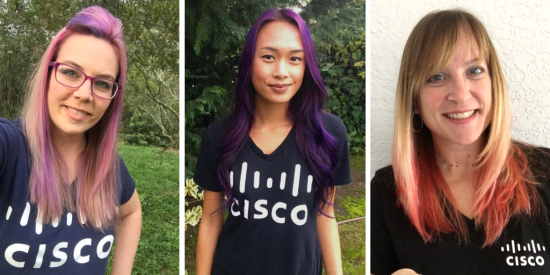
Cisco Hair Color

Can you be a professional, powerful person in the workplace while still setting trends?

May Le had always wanted to dye her hair purple, but having just started a job at Cisco, she wondered if it was the right time. Was there something in the “rule book” that would prevent it? Would it be accepted? Maybe it’s just too edgy, too much for a corporate tech company. “Purple hair might be off the table,” she thought.

But she wanted to be herself, so she thought she’d ask her manager, who surprised her with the ALL IN Cisco attitude. “If you’re going to do it – just rock it!” she said.

“Cisco has this reputation out there for being a boring, stodgy company,” May laughed. “That’s just not the case.”

May says the response has been overwhelmingly positive, and her hair has even been a great conversation starter. From the break room in San Jose to telepresence networking opportunities she’s experienced, and even amongst our Executive Leadership Team – which loves her boldness.

“Our Chief People Officer, Fran Katsoudas saw me on campus and recognized me from a photo I posted in social media, where I said #IChoseCisco because I can be myself! It really showed me how progressive of a company Cisco is, and knowing that I can be myself even at work and freely express my individuality was a defining moment in my career.”

It seems that May was a pioneer for fun hair at Cisco.

I started at Cisco a few months ago, myself. I was coming from the hospitality industry, where it was okay to have hair dyed “naturally blonde,” but not okay to add any touches that would be deemed “not normal,” because that would be disruptive.

For weeks I devoured any documentation that came my way to see what Cisco’s stance on purple hair was (as if they’d have a section called “PURPLE HAIR RULES”). Hindsight being 20/20 – I suppose simply asking the question would’ve been easier, but coming from a world where the answer was a hard “No.” – and, really, a question not to even be entertained – fear of getting rejected latched on to me.

That’s when I also saw May’s #IChoseCisco photo on Twitter, and in one swift moment I was excitedly texting my hair stylist, “I found a girl with a full head of awesomely purple hair…when can I come in?”

It may sound absolutely ridiculous, but as I sat there staring at the finished product – with vibrant purple in my hair – I couldn’t have been happier. I finally felt like “me” again. Cisco gave me that.

Purple hair was my “normal” – and at Cisco that kind of disruption was welcomed energy. In fact, it was almost a non-issue. Why would the color of one’s hair, or a tattoo, or any representation of self keep you from doing great work?

This colored-hair thing was something that my colleague, Carmen Collins, had wanted to try for a while as well.

“When I posted May’s photo on Twitter from the #IChoseCisco contest, I didn’t know her story. I just thought ‘cool hair! I want!’ My issue wasn’t whether Cisco would approve, it was whether everyone else would. (Silly me.)”

Carmen and I would talk about taking that step. We would talk about it here and there throughout our week, and while she would weigh the options – I would egg her on. “Just do it!” I’d say, “It’s just hair color!”

“As I learned May’s story, and saw Casie rocking the look, I decided to let my inner rocker show!”

A few days later, an ombre look with bright pink tips was Carmen’s new adventure. “I decided to go as far as to change my profile images and use the one with my pink hair – even on LinkedIn! I felt like if you’re going to interact with me – you should know who I am. And this is who I am.”

We recently ran a story on our blog about 3 Things to Look for When Choosing a Company. After the “hair revolution of 2015” at Cisco, the three of us thought it would be appropriate to add a fourth reason. Choose a Company that Encourages You to Be Yourself.

I think it’s safe to say that for May, Carmen, and myself – we’re glad we chose Cisco. Where being fun, powerful, and professional – while expressing your individuality – is not just encouraged, but expected too.


Interested in joining us? We’re hiring! Apply now!

Authors

Casie Shimansky

Content Strategist | Provider of Pixie Dust

Employee Storytelling

Avatar

Over the last decade, the Cisco Mobile Visual Networking Index (VNI), our rolling five year forecast of Internet trends has delivered some amazing and eye-popping predictions. Today’s VNI Mobile Forecast update, for example, shows that the deployment and adoption of 4G is accelerating even faster than we predicted just a year ago.

In the United States, just like the rest of the world, mobile data consumption continues to climb, driven by insatiable demand for video, video and more video, coupled with a surge in mobile users and devices, and an expansion of mobile networks to serve the Internet of Things – connected cars, homes, health care and more.

For policymakers, the flood of data traffic has created challenges with radio spectrum, forcing nations to find more efficient ways to allocate this scarce resource. And for the industry, it has created challenges forecasting what’s next. So far, we’ve done very well: in each of the last five years, initial projections have been within 10% of the reported 2015 data estimates.

Cisco is committed to being as accurate as possible on the VNI, as well as being transparent. That’s why we go back every year and compare our projections with subsequent mobile data estimates. Based on this year’s comparison, we reset the 2014 U.S. baseline for total mobile data consumption and traffic growth after incorporating data traffic estimates from CTIA, the Wireless Association. CTIA is the most comprehensive source for historic data in the U.S., since they collect data from wireless telecom operators through a voluntary annual survey.

The CTIA data shows fluctuating, positive, growth in U.S. mobile traffic from 2012 to 2014 with larger peaks and lesser peaks, including traffic growth of 26% in 2014. Based on CTIA’s survey data, as well as a close review of traffic samples and direct data sources that are part of our methodology, we reset the 2014 monthly baseline down — from 531 petabytes to 322 petabytes. This revised number may in fact understate the true traffic growth since some mobile operators suggested on their earnings calls that their traffic grew in excess of 50% between 2013 and 2014. But the CTIA survey number is one of the most comprehensive estimates of historical growth, and our 2014 baseline volume adjustment now aligns with CTIA’s figures.

Over the course of 10 years publishing the mobile VNI, we’ve reported out key trends about Internet traffic, connected devices, applications, and shifts in demand. These data are used by network operators and other industry players, including Cisco customers, partners and competitors, as well as government and industry decision-makers. That’s why it’s so important that Cisco be transparent about our methodology and validation efforts.

The adjustment reflected in today’s report does not change the forecast growth curve much at all. The 2015 growth (year-on-year) is forecast at 56%, and the 2015-2020 compound annual growth rate is forecast at 42%. The fundamental trend lines hold. There’s more devices and more video consumed over faster networks, which will continue to transform the world around us.

Authors

Robert Pepper

No Longer with Cisco

Avatar

Cowritten with Usha Andra, Senior Analyst, Visual Networking Index, Service Provider Marketing

2016 marks the 10th anniversary of the VNI Mobile Forecast. For a decade, we have analyzed, reviewed, and made projections about mobile networking and how consumers and business users’ behaviors and expectations have changed based on device innovations, network enhancements, and a seemingly never-ending variety of mobile applications and content options. Our work and focus on forecasting the growth of global mobile network traffic and wireless service trends has given us an opportunity to cover one of the fastest growing (in terms of user adoption) and constantly interesting global industries ever developed. Over the past 10 years, mobile data traffic has increased 6,000-fold, and over the past 15 years, it has increased an incredible 600-million-fold. The average smartphone owner today is carrying a computing device more powerful than 10 PCs from 2000. And mobile devices have evolved from devices for calling and texting to devices for calling, texting, tweeting, posting, watching, gaming, banking, navigating, shopping, and reading.

Here’s a very brief summary of some of the major mobile milestones that many of us have experienced over the last 15 years, in five-year increments. What did we miss or would you add to these timelines? We’ve also provided a quick snapshot of our projections for the next five years. Let us know what you think…

Pre-2000: The wireless wilderness shows early signs of development

In 1973, the first mobile phone call was placed with the words “guess where I’m calling from?”, the motto of the early days of cellular voice. Mobile phones became commercially available in 1979, but the early phones were expensive and heavy, with large nickel cadmium batteries weighing them down. In the 1990s, lithium ion batteries were introduced, reducing the weight and size of the phones by more than half, and the phones began to be offered at more affordable prices. Also in the early 1990s, 2G phones deploying GSM technology were introduced, marking the shift from analog to digital communications. With GSM, limited data services such as text messaging and paging began to be available. The GPRS standard was introduced in the late 1990s, delivering packet-switched data capabilities to existing GSM networks and allowing users to send graphics-rich data as packets.

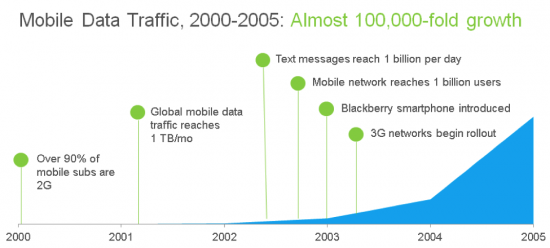
2000 – 2005: “Call me”

1

Mobile voice was still the dominant voice application in this era, but Continue reading “Major Mobile Milestones – The Last 15 Years, and the Next Five”

Authors

Arielle Sumits

Senior Analyst

Service Provider Marketing