Avatar

The Cisco team is preparing to ship out to Interop Las Vegas, a conference focused on IT infrastructure and networking. MandalayThis year Cisco is bringing a refreshing look and feel to the show. With a clean and open environment the Cisco booth should offer a never before seen presence to the show floor.
What’s different about Interop from years past? 

Many new booth items will be highlighted at Interop. These new activities will bring another level of excitement surrounding the Cisco booth and I’m excited to see what show-goers will think.

Demonstrations

There are several 1 to many demos being developed by Technology Marketing Managers Andy Phillips and Rich Zavala, and Technology Experiences Director Sean Curtis, the 1:many (one-to-many) demo’s are aimed at providing a larger audience a high level look at Cisco DNA technologies. Rather than focusing on one technology, 1:many demos will show how all of Cisco innovations can drive business success. This conversational approach to showing off our technology is a great way to engage the CIO and Network Buyers that will be attending Interop.

Guru Bar

Instead of the standard welcome desk that would show people to whatever demo happens to fall into the same technology umbrella, Interop will introduce a “Guru Bar” that will be staffed by Architecture TME’s that can answer specific IT/Network questions without having to sit through a demonstration that may not adequately get the job done.

TED Talk Speaking Sessions

There’s more than enough technical discussions at Interop that we wanted to provide a change of pace for attendees. These speaking sessions will be high level, solution based, inspiring presentations that will be a nice change of pace from the breakout sessions.

Keynote

Don’t miss the Cisco Keynote with Jeff Reed, VP Enterprise Infrastructure and Solutions Group on Thursday, May 5th, 9:28 to 9:50 am, PST.

Social Media Fun

To award our most social Interop attendees, Cisco will be giving away a special gift to top tweeters who tweet about Cisco booth activities, and talks by comprising a tweet using both #CiscoInterop and @CiscoEnterprise.

Winners will be notified via Twitter and will be asked to come to the booth to pick up your prize. Be sure to follow @CiscoEnterprise to join in the fun.

The Best of Interop 

Last, but definitely not least, three of Cisco DNA Technologies Reign in Three BOIFinalist Spots for Best of Interop:
• APIC-EM is available for free download to everybody with an account on developer.cisco.com.
Enterprise NFV
• Flexible Radio Assignments- Available on Cisco Aironet 2800 and 3800 Access Points

Awards will be announced at 12:30 pm on Wednesday. Post announcement please go to the Cisco booth for an awards celebration party.

With all that we have lined up, it’s going to be a jammed packed week of exciting activities. The team is ready to share the DNA story with Interop attendees and I’m excited to see what kind of buzz is created around the Cisco booth. Stay tuned for more from Las Vegas!

To find out more details about Cisco at Interop Las Vegas, please visit: www.cisco.com/go/interoplv

Authors

Andrew Caine

Marketing Specialist

Enterprise Networking and Mobility

Avatar

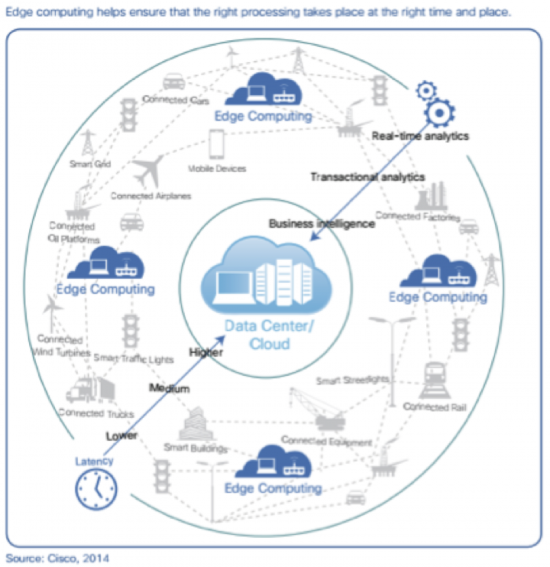
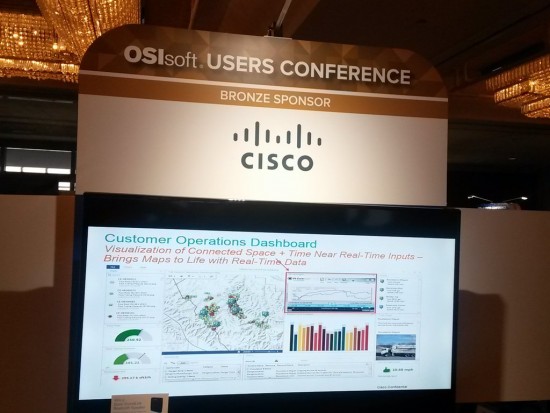
This year Cisco sponsored the OSIsoft User Conference in San Francisco. Customers across the manufacturing, energy, and utility industries came to learn about our new fog computing capabilities that let analytics run at the edge of the network.

The biggest challenge these customers have is that much of the data in their sensors, engines, machines, and tools goes to waste or isn’t captured in time to be useful. Now they see a solution by putting intelligence at the edge of the network through analytics and backhauling only the important data back to the control room and data center.

A lot of the data is a device saying, “I’m fine, nothing to worry about.” Yet customers need to know when there’s a problem, where it is, how serious it is, if anyone is in danger, and how quickly can it be fixed. Danger is reduced and things get fixed quickly when the network gets real-time data and sends the information to the right users at the right time.

It’s the Fog Computing platform that makes it all possible. And it comes with critical-infrastructure level security and IT-level management and authentication.

osisoft2

One manufacturer of large construction and earth-moving equipment said a common theme from the show:

“I think it’s great that Cisco has these newer products available that really save us cost and time. We would need several pieces of equipment to do what the Cisco Integrated Service Routers do, and they will even run 3rd party guest software on the IOx platform and that saves us another appliance.”

CfUW45oUIAAKjwR.jpg_large

At the event we had both a booth and a meeting room – both almost overwhelmed at times! My colleagues and I saw hundreds of visitors at our booth, and arranged many one-on-ones with several major household name customers and prospects. As a result, Cisco was asked to follow up with several Proof-of-Concepts so that customers can measure the benefits for themselves.

One customer already stated they:

“Would save thousands on rationalizing the network – i.e. less appliances and individual pieces of equipment needed – and save significant cost in terms of installation, provisioning, and support.”

I’ll follow up with you soon on the customer stories as they start coming through this summer!

And for the techies amongst you (you know who you are), here is some info on Cisco IOx, the IR809, and the IR829 that we had on display – the newest portfolio additions.

See how we can help you get control of your data by exploring our industry pages. More information on OSIsoft is available here if you are curious about our partnership.

Authors

Peter Granger

Senior Sales Transformation Manager

Avatar

Every April 22, Cisco joins the world in celebrating Earth Day, an annual event held in more than 193 countries each year. Historically, Cisco has used Earth Day to hold educational sessions for employees globally and virtual events around the clock, bringing speakers to discuss important issues and solutions that address environmental problems. In turn, employees are more aware than ever of Cisco’s efforts to improve environmental sustainability and make a positive impact on the planet.

This year, Cisco launched Earth Aware, a new month-long employee volunteerism and awareness campaign to support the environment and sustainability. From Monday April 4 through Earth Day on April 22, Cisco hosted global activities, events, and “green” volunteer opportunities to encourage employees to be more sustainable, both at work and at home.

Hundreds of employees around the world volunteered, and more than 425 volunteered from Cisco’s San Jose campus. They helped local charities and organizations harvest sustainable produce, maintained the San Jose Heritage Rose Garden, learned how to host a Bike to Work Day, recycled electronic waste, picked up litter around Cisco, and planted trees!

Continue reading ““Earth Aware” Cisco Employees Go Green on Earth Day”

Authors

Austin Belisle

No Longer with Cisco

Avatar

#CiscoChampion Radio is a podcast series by Cisco Champions as technologists. Today we’re discussing what DevNet can do for Network Engineers with Cisco expert Chris Oggerino.

Cisco Champion 2016Get the Podcast

  • Listen to this episode
  • Download this episode (right-click on the episode’s download button)
  • View this episode in iTunes

Cisco Guest
Chris Oggerino (@coggerin), Cisco DevNet

Cisco Champion Hosts
Bill Carter (@ccie5022), Senior Solutions Analyst
Sebastian Leuser (@sleuser), Systems Engineer

Moderator
Lauren Friedman (@Lauren)

Continue reading “#CiscoChampion Radio, S3|Ep. 12: What can DevNet do for Network Engineers?”

Avatar

We know innovation requires more than just a great idea – it requires the successful delivery of a solution, and that starts with working prototype. A few weeks ago, we held the first Warp Accelerated Rapid Prototyping (WARP) invitational event. WARP is a high speed innovation experience where participants bring ideas from paper to working prototype in a matter of days. The two-day event provided the environment, resources, and tools to build working Internet of Things (IoT) prototypes. The event — collaboratively hosted and designed by the Cisco Hyper-Innovation Learning Labs (CHILL) team and the Distinguished Services Engineers (DSEs) community— was a great demonstration of the value of prototyping and incubation to innovation.

https://vimeo.com/164197181

Over two days, 25 engineers from across Cisco gathered in Raleigh, NC, worked in teams, and built 7 working prototypes. Some started as customer requests, others were passion projects but each idea centered around IoT solutions. Each team had a simple focus: take an idea, get something working, and solicit real feedback.

Each team was given two days and a WARP Kit – a box of tools including sensors, code, actuators, and microprocessors. Teams worked on diverse ideas such as smart shelves for grocery produce quality, a health alert chair to keep sedentary workers on the move, and even connected pet bowls to track the rate of Fido’s or Fluffy’s water consumption. Some of the prototypes are slated to be incubated internally with development teams.warp_prototype

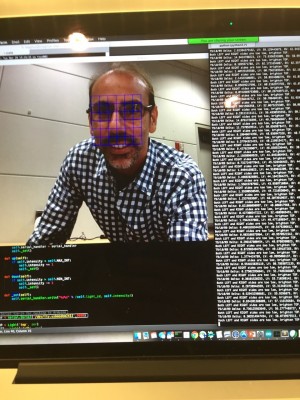
One of the prototypes, adaptive lighting for TelePresence (TP), is a great example of an idea that will enhance our everyday working experience here at Cisco. The team wanted to solve the problem of non-optimal lighting, resulting in faces that are dark or only half-lit over web cam, TP, and WebEx. A team of Cisco engineers locked themselves in a room and at the end of the day had a working prototype which used a laptop’s web cam and facial recognition software to identify faces, detect and eliminate shadows, and adjust color-hue LED lighting to enhance the face over TP – much the same way a professional lighting technician would for a TV broadcast.

Overall the event sparked ideas, new thinking, and new solutions for IoT. I’m really excited about our role in demonstrating the value of prototyping and incubation to innovation.

Authors

Kip Compton

No longer with Cisco

Avatar

If you’ve been curious about location services, but always assumed it was complicated to deploy, too technical for non-IT folks, too expensive, or all of the above, hear me out.

Perhaps you run a public-facing organization – maybe it’s a retail mall, hotel, an airport, or a café. In this new digital world, your customers walk through your doors and expect relevant and useful experiences. Great in-venue experiences ultimately translate to shoppers spending more time and money, or hospital patients and airport travelers feeling less stressed.

Behold Cisco Connected Mobile Experiences (CMX) Cloud, which my colleague Pushkar Sharma and I have talked about here and here. But to summarize, CMX Cloud is a SaaS solution that delivers presence analytics to optimize your operations and helps you create relevant engagement opportunities. Options for advanced capabilities coming soon. It’s simple to set up (no maps required!) and has an intuitive GUI that non-IT users can use.

Check out the video below to learn more.

https://youtu.be/DmhLUGkME5s

We’re currently offering a 60-day free trial, so take CMX Cloud for a spin with zero commitment. If you’re just getting started with location services, CMX Cloud is the perfect way to explore whether location services can help you engage your customers and make better business decisions: http://cmxcloud.cisco.com.

Authors

Jolene Tam

Product Marketing Manager

Security

Avatar

I talk to a lot of customers and partners in the Service Provider space, and among the many conversations, I notice a common set of concerns centered around a simple question: have we done all that we can to secure both our own infrastructure and that of our customers? Simple enough question, but the answer is much more complex.

Security is critical both for the Service Provider’s own networks and the services they provide their customers. It’s a key enabler for open and programmable networks that enhances business agility and profitability. The growth in video, mobility, Internet of Things (IoT), and cloud services drive new revenue opportunities and business outcomes. However, these new business opportunities bring new risks and create a larger attack surface that must be defended impacting both the service provider and their customers.

Until now, the only viable approach for service providers to protect their networks has been to deploy multiple point security solutions – in my last blog I wrote about the franken-structures that exist in many environments. Where many of the benefits of additional security capability are lost due to the massive complexity that is incurred as layer after layer of non-unified security technologies are layered onto one other. Massive and expensive over-provisioning of equipment is the norm, in order to handle burstable workloads and ‘absorb’ attacks. This can often provide a false sense comfort that the latest tools were deployed in defense of the business, but without a complete plan for operationalizing the combined system, the actual effectiveness of the new tools will be low and security risks and challenges will persist. The integration cost and time to tie these point solutions together is excessive. Worse, even when integrated, these franken-structures are often very brittle rendering them inflexible and unresponsive to the inevitable changes in the environment. This approach also leaves gaps between various security silos that attackers often exploit. Without a unifying and highly automated way to deploy and manage security services, organizations are unable to keep pace with nimble attackers and dynamic enterprise environments.

Without a unifying and highly automated way to deploy and manage security services, organizations are unable to keep pace with nimble attackers and dynamic enterprise environments.


Continuing our Multi-Service Security Approach with More Firepower

Cisco is focused on solving the integration, performance, and security effectiveness challenges that plague legacy security architectures and put service providers, their customers and data at risk. Threat-centric security is the foundation of Cisco’s Evolved Programmable Network (EPN) and Cisco Evolved Services Platform (ESP), with comprehensive threat protection across the attack continuum before, during and after an attack.

Our unique threat-focused approach is available with the Cisco Firepower™ 9300 Security Appliance and the Cisco Firepower 4100 Series high-performance carrier-class security platforms. Both platforms can deliver multiple Cisco security services, including the Cisco ASA firewall, Cisco Firepower next-generation firewall (NGFW) that includes URL filtering, application control (AVC), Cisco next-generation IPS (NGIPS), and Cisco Advanced Malware Protection (AMP). The platforms can also support 3rd party software such as the Radware DefensePro distributed denial-of-service (DDoS) mitigation capability.

The Firepower platforms are key components of Cisco’s vision for consistent security policies across physical, virtual, and cloud environments. With these security appliances, Cisco provides an optimized solutions for service provider security by utilizing containerization of its own and partner security services. Advanced threats are identified, contained and remediated without inhibiting service delivery or network flexibility, speed or scalability. With Cisco Firepower platform’s unique security and open network approach, service providers can realize enhanced agility, reduced expense, and increased revenue.

As ever, we don’t want you to only take our word for it. We take third-party validation very seriously, and Light Reading recently commissioned independent test lab European Advanced Networking Test Center AG (EANTC) to evaluate Cisco’s threat-centric security solutions. The result from EANTC is the industry’s first, third party validation of physical and virtual security solutions for securing SP cloud and NFV environments. The products tested include Firepower 9300, ASAv, NGIPSv, WSAv, ESAv, and Radware DefensePro. EANTC validated that Cisco’s threat centric approach to security. The comprehensive battery of tests demonstrated industry-leading performance and security effectiveness for service providers. You can read more about the test methods and results here.

One Size Does Not Fit All

It’s not just platforms and virtual appliances that Service Providers are looking for. They also want to leverage cloud-delivered security as a service to bolster the offerings they provide their end-user customers. EANTC testing underscored the need for end-to-end security solutions across physical and virtual form factors at the customer premise, service provider edge, and cloud data center.

Take the case of our customer: Exaprobe, Europe-based managed service provider and system integrator. Exaprobe leverages Cisco’s Hosted Security as a Service (HSS) Solution to deliver cloud-based security services or network function virtualization (NFV) to deliver comprehensive cloud-based web security, email security, and advanced malware protection to protect against the most advanced cyber attacks. The offering ensures that sophisticated threats are identified, contained and remediated — all without inhibiting service delivery, network agility, speed or scalability. HSS bundles virtual instances of Cisco’s industry-leading security solutions running on top of Cisco UCS server infrastructure. To learn more, read the Exaprobe blog here.

For Service Providers, security has never been more important, and answering the question “Are we secure and are our customers secure?” has never been higher on their agenda. When done properly, security can be a business enabler. But as SPs build out their security capabilities, the lack of integrated solutions yields lower threat effectiveness and inevitably leads to an explosion of complexity and cost. Hackers are increasingly targeting service providers and their enterprise customers with sophisticated assaults on the ever-broadening attack surface presented by new mobile services, expanded network connections, and device proliferation. Service providers seeking to adopt market leading security solutions turn to Cisco for appliances, integrated platforms and hosted services to increase security effectiveness without adding to the security sprawl that proliferates with point products. Security is an essential business enabler for service providers. Cisco’s threat-centric security solutions validated by EANTC help service providers to move confidently and adopt end-to-end security solutions to drive forward with NFV and cloud initiatives and more safely participate in the digital age. Service Providers trust Cisco to work with them to protect their business and their customers – before, during and after an attack.

Authors

Scott Harrell

Senior Vice President and General Manager

Enterprise Networking Business

Avatar

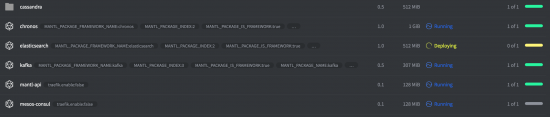
When developing applications, one to the first obstacles we encountered was around installing applications and frameworks. To address this complicated ecosystem, we developed a service framework and API. The Mantl API is a feature built in to Mantl that helps you find and install applications and Mesos frameworks. Think of the effort involved to build a multi-node Elasticsearch, HDFS, or Cassandra cluster using traditional configuration management tools. With Mantl, Mantl API, and the underlying Mesos platform, you can launch any of the above (and several others) with a single API call.mantlapi1

It can be complicated to install applications and frameworks on Mesos. Each framework has it’s own specific configuration options. And there is no conventions or standards for common options. The configuration mechanisms vary as well. Command line arguments, environment variables, and configuration files in varying formats are all common ways to configure frameworks. It often takes someone who has deep knowledge of the underlying application and the Mesos platform (and all of its dependencies) to figure out how to install and configure any given framework.

Mantl API and its packaging system allow you to install a number of frameworks and applications that are pre-configured to work with Marathon, Mesos, Zookeeper, Consul, Traefik, and other Mantl components. Most packages will work without any additional configuration but you do have the ability to customize the deployment to meet your needs. Things like how much CPU and memory to allocate, the number of instances to run (for multi-node applications), and other framework-specific options can be specified in a single JSON file when deploying.

At the time of this writing, the following packages are available:

  • Arangodb
  • Cassandra
  • Chronos
  • Elasticsearch
  • Elasticsearch-client
  • HDFS
  • Kafka
  • Kibana
  • Kibana-mesos
  • Memsql
  • Spark

Using Mantl API

Let’s take a look at how you can use Mantl API.

Mantl API is available at /api on your control nodes. By default, it is protected with SSL and basic authentication. I will be using curl and the invaluable jq utility in the following examples.

Listing Packages

The actual list of packages shown above can be obtained using the Mantl API /packages endpoint. This is the API request used:

curl -sku admin:password https://mantl-control-01/api/1/packages | jq -r ‘.[].name’

This issues an authenticated GET request to the /packages endpoint which returns a JSON representation of the all packages and associated metadata. I use the jq command to extract just the name from each package. The result is the list of available packages that you see above.

Of course, you will need to change the username, password, and host name to values appropriate for your Mantl cluster if you are following along.

Installing a Package

Installing packages is really easy. For example, let’s install Elasticsearch.

curl -sku admin:password -d “{\”name\”: \”elasticsearch\”}” https://mantl-control-01/api/1/packages

This sends a POST request to the /packages endpoint with a JSON object that contains the name of the package we want to install. It will return the JSON representation of the application running in Marathon. After a few minutes, you will have 3-node Elasticsearch cluster up and running.

Uninstalling a Package

Uninstalling a package is simple too — you simply issue a request using the DELETE method to the /packages endpoint with the same data you would use if you were installing the package:

curl -sku admin:password -XDELETE -d “{\”name\”: \”elasticsearch\”}” https://mantl-control-01/api/1/packages

Customizing a Package

Let’s look at a slightly more complicated example. We want to deploy a 5-node Cassandra ring. First, create a JSON file (called cassandra.json for example) with the desired configuration:

{
 “name”: “cassandra”,
 “config”: {
   “cassandra”: {
     “node-count”: 5,
     “seed-count”: 3
   }
 }
}

This indicates that we want to run a total of 5 Cassandra nodes with 3 being seed nodes. Now, we can install Cassandra with a familiar command:

curl -sku admin:password -d @cassandra.json https://mantl-control-01/api/1/packages

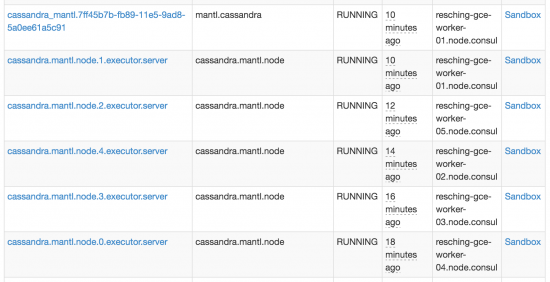
The only difference from the Elasticsearch install example is that we are telling curl to POST the JSON data from a file in the current directory. It will take several minutes for the Cassandra ring to bootstrap and become healthy.

mantlapi2

Note: you will need to have a Mantl cluster with sufficient nodes and resources to run the above example.

Custom Packages

Besides the packages that are available in the Mantl repository, it is possible to use Mantl API to install your own custom packages. Maybe you want to run a framework that is not currently packaged or maybe you want to package your custom application so that your QA team can easily deploy multiple versions on-demand for testing purposes. Mantl API supports multiple repositories which are stored in the Consul K/V store. Consult the documentation for more information on building Mantl-compatible packages.

Other Functionality and the Future

Besides letting you discover, deploy, and remove packages, Mantl API let’s you inspect the metadata of a specific package. And, it also provides an easy interface to view (and remove) Mesos frameworks. We plan to continue to add packages to the repository and welcome contributions (both the Spark and the ArangoDB packages were contributed by the community). We have a lot more ideas for Mantl API in the future. Let us know what you would like to see!

Thanks to Asteris and specifically Ryan Eschinger for contributing the details of the Mantl API for this blog post.

If you are at the OpenStack Summit event this week, come by the Cisco Booth C11 to talk to the Mantl team.

Authors

Kenneth Owens

Chief Technical Officer, Cloud Infrastructure Services

Avatar

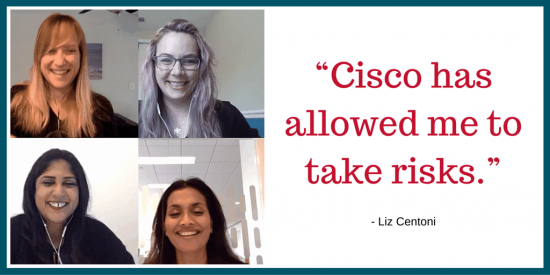
During a recent Blab, we talked to Cisco’s Liz Centoni who is the Vice President of Engineering Strategy and Portfolio Planning and the Chief of Staff to Cisco’s Chief Development Officer. We wanted to dive deeper into her blog post 3 Things to Look for When Choosing a Company from earlier this year, and get to know Liz even further.

_C_(1)

Did you know that Liz is a huge comic book fan and movie buff? And while Star Wars is her favorite, The Jungle Book, The Mummy, and The Princess Bride were all mentioned during our Blab too!

The Force is certainly strong with this one! 🙂

Liz is a fierce advocate for women in technology, and while our Blab (which also included Rehana Rehman) felt like a casual catch-up over coffee, we were all left inspired by Liz’s dynamic personality and infectious spirit for our future.

Here are a few of Liz’s key quotable moments from our Blab:

“I’ve never conformed to a norm, per say. I’ve worked in engineering for my entire 16 years and I still get comments today, ‘You don’t look like someone in engineering. You don’t sound like it, you don’t dress like it.’ So I didn’t know that there was a dress code — I’ve never felt the need to conform to anything here (at Cisco).”

“It’s lily pads – your ability to jump from one lily pad to another. And what you thought were your core competencies – have changed over time. You’ve added to that – it’s amazing when you’re in some of these roles that you discover skills you didn’t think you had! And you absolutely do!”

“There’s fear because you want to do well, there’s fear because you have your objectives in mind – what if everything goes wrong? Cracking a joke lowers my temperature, and makes everyone else feel less uncomfortable.”

Grace Hopper was “…an opportunity to show what Cisco is about and attract new talent as well. Innovation is about people innovating. Innovation on its own is not what creates the thing, it’s actually people that create it. And there is no innovation without women.”

Watch the full Blab replay below to really get inspired!


Authors

Casie Shimansky

Content Strategist | Provider of Pixie Dust

Employee Storytelling