Guest Blog Submitted by Filippo Galimberti, Sr. Marketing Manager SP
This is an exciting week at the OpenStack Summit in Austin. It’s been another great opportunity to meet, share experiences, and discuss the future of Cloud Computing. One of the most important takeaways is the maturity of the NFV transformation happening in the Service Provider space. It is no longer just talk with many of the world’s leading operators announcing their OpenStack powered NFV projects and deployments during keynotes and breakout sessions.
OpenStack has evolved now to be more mature, making Agility, Flexibility and Cost Reduction a reality, which is why it’s on top of every service providers’ agenda.
Cisco and RedHat presented the Cisco NFV Infrastructure, a joint solution enabling carriers to easily adopt the NFV paradigm shift.
Vijay Venugopal (Director, Product Management NFV, Cisco) and Chris Wright (VP, Chief Technologist, RedHat) discussed the benefits and explained the opportunities of network transformation in a very interesting interview with industry analysts.
Cisco NFV Infrastructure makes it easy for service providers to embrace the network transformation towards virtualization. Further simplifying and automating their NFV operations to deliver applications and services faster and providing them greater levels of business agility.
The threat landscape is ever changing and adversaries are always working to find more efficient ways to compromise users. One of the many ways that users are driven to malicious content is through malicious advertisements known as malvertising. Talos has been monitoring several large-scale malvertising campaigns, how the initial exploit occur, and the payloads that are downloaded as a result.
In a normal ad campaign, ad agencies buy ad space on publications and other trafficked websites, and the ad agency then tries to get those ads served to users that fit some criteria in the hopes that users click on the ads, which take the user to (for example) a product page. The aggregate of serving ads for a particular product is referred to as a ‘campaign.’ A malvertising campaign is similar. Ad space is purchased from an agency, users satisfying particular criteria are targeted. It may be that the content of the mal-ad itself can infect a user’s computer, or it may be that a user who clicks on the enticing mal-ad is taken somewhere which then infects the user’s computer. The initial infection will often download another payload.
Today we unveiled the new Cisco brand campaign. Don’t blink, because in an instant you might miss our bold, evolutionary change. For more than a decade we’ve shown that we’re more than a networking company. But now it’s time to show what that really means. Now is the time to share how we’re impacting our lives in big, bold, interesting ways. That technology is the driving force for change in the world. But we’re not doing it alone –it’s with you our partners, that we’ve made this a reality.
It gives me goose bumps just thinking about that! Through the technology and the relationships we’ve built– that our combined innovation is helping humanity. This campaign shows that when technology and people come together, that combination could solve some really big problems. If bringing water to impoverished nations to saving lives through Search and Rescue wasn’t astounding enough, partners like Dimension Data are changing the fate of endangered animals on the African safari. And this is just the beginning! More examples big and small of how Cisco, partners, and customers are coming together to make the world a better place.
So what does this mean to you? Well as a partner I’m asking for your help. First, I challenge you to think about what you’re doing with your customers to impact the world. Secondly, I’m asking that we come together and share this. Because we believe this is so huge, for thefirst time ever we’re giving you access to brand campaign assets and the know-how to make this happen.
We’re in this together! Beginning with the Engage Marketing Suite you’ll get the training, expert advice, and the best practices to use the campaign assets to reach your customers. In under 10 minutes of your time you can take three Marketing Velocity eLearning courses expanding your knowledge for Co-Branding, Improved Writing, and most importantly, how to maximize your unique Value Proposition. Then take an hour, to see what our own brand experts have to share about how to use your brand to your advantage, with the Enchant to Engage webcast.
You have the knowledge, now it’s time to apply that, and we’ve built the campaign assets for you. In Partner Marketing Centralwe’re giving you social media posts, digital assets and a playbook of how to use them. This is why we feel this is so important. It’s not about Cisco, it’s about us – Cisco and partners solving big problems to change the world. Getting the word out is going to spark conversations with your customers you would have never had before. These brand assets are giving you the fuel for that spark!
There’s never been a better time to change the world together
Tell Us What You’re Doing
We’re giving you access to the brand campaign and we hope you’ll use what we’ve created. But give me your feedback, tell me what you would like to see that would help you. Tell us what you’re doing to impact change and share your stories with us! We would love to feature them as more examples of how we are changing the world, together. These are the things that influence perception toward selecting your brand – use it to your advantage!
Or so thinks super-social Cisconian Rodney Heron. An Account Executive in Commercial Sales in Victoria (Australia), Rodney has been at Cisco for over 10 years.
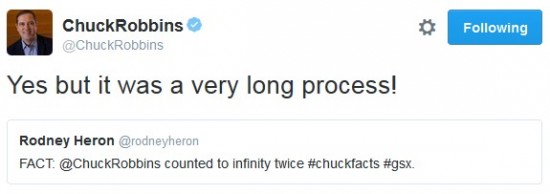
Rodney kind of likes the “Facts of Chuck Norris” books – he has all three. So when now-Cisco-CEO Chuck Robbins was named the keynote speaker for Cisco Live 2015, he thought he’d have a little fun and start Tweeting some #ChuckFacts – but these would be about Robbins, not Norris.
“I have a little bit of a reputation with the social team that comes out for Cisco Live,” Rodney says.
(In fact, another of his creative conversations, #fearthethumbs, was such a hit at Cisco Live 2014 that Cisco created thumb “workout” bands to hand out as gifts.)
“The #ChuckFacts have to be about Chuck Robbins, they have to be believable (okay, not really) but above all, it’s got to be funny.”
And funny they are. Here are a few of our favorites.
Apparently, Chuck Robbins has a favorite too. He responded on Twitter!
Why be an ambassador for Cisco on social media?
“It’s fun, love being creative and if I can make someone laugh or smile then every tweet is a winner,” Rodney said. “Sure I do post serious stuff from time to time, but really being social is about fun and engagement.”
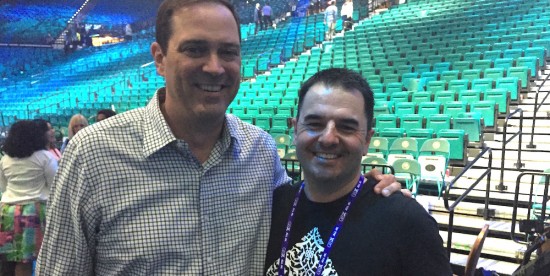
All the #ChuckFacts earned Rodney a follow from Chuck Robbins, and even a photo at GSX.
“He tells me that his kids really love the #ChuckFacts,” Rodney says. And maybe one day it’ll get me a free flight and ticket to a future Cisco Live!”
Employees love them too. Which one is your favorite? Tell us in comments, below. Better yet, give Rodney some ideas for his next Chuck Fact.
Billions of people and things are being connected globally. Digitization is forcing organizations and even countries to reimagine business models, products and services. Every industry, government, school system, university and hospital is grappling with how to navigate this digital transformation era to deliver the best experiences and value possible. Predictions say digital disruption will replace nearly four out of the top 10 industry leaders within five years. While this is a time of tremendous change, it is also a time of tremendous opportunity. Cisco truly believes that the technology behind the disruption plays a crucial role in solving some of the world’s greatest challenges.
For 30 years our goal has been to change the way people work, live, play and learn. Now it’s time for us to step forward with a new message of optimism and to share it in a bold and different way.
I’m thrilled to announce the launch of a new Cisco brand campaign centered on the theme, There’s Never Been a Better Time. In developing this campaign, we had deep conversations with our customers, partners, employees, and influencers. We discovered that despite the many challenges they face, they are excited about the present and the future. They are technology optimists, because like Cisco, they believe technology is a force for good in the world.
This campaign focuses on real stories from our customers and partners. These stories show how our technology is transforming entire industries and countries – bringing water to those who don’t have it, making jobs safer and cities smarter, and even saving the lives of people and animals.
We’ve taken an entirely new approach to the campaign that puts our customers first and is optimized to reach audiences digitally and socially. We’ve also invited our partners to get in on the action with joint marketing and the ability to share their own stories through the campaign. The stories we highlight tangibly connect to our solutions and services that are solving today’s problems.
Check out our new campaign, read stories from our customers and partners and find out how you can spread the #NeverBetter love on your social handles. Share with us why There’s Never Been a Better Time for technology to solve the world’s greatest challenges.
If you worked with just about any hospital or healthcare provider a mere ten years ago you may have come across the Information Security Manager, Director of Security and Compliance, or someone who filled this role under another title. Their role was to lead ‘IT Security’ and manage a small staff of security administrators or analysts, whose role in turn, was to provision users to systems, and troubleshoot access problems. The team would also occasionally check firewall and other security logs when time permitted, amongst a myriad of other tasks and responsibilities, including vulnerability testing and HIPAA and PCI self-assessments.
Cisco just wrapped-up OpenStack Summit 2016 in Austin, Texas as a headline sponsor and closed with the Design Summit on Friday, April 29. This year’s OpenStack Summit was my seventh summit, and it has been an incredible journey. It is amazing to see how the community has grown in only six years from 75 attendees at the first conference to 7,500 people at this year’s event!
Cisco – Scaling Containers and OpenStack
Ken Owens and I were fortunate to present to a standing-room only crowd on Monday to discuss scaling OpenStack and Containers. The OpenStack Foundation posted a recording of the session on the Foundation’s YouTube Channel. Watch the session recording for the entire presentation, but here are some highlights:
APIC networking plugin Contiv and Project Calico, including Contiv’s ability to integrate with APIC, and Calico’s ability to integrate with OpenStack Neutron, Docker Libnetwork, and Rkt/CoreOS CNI
OpenStack and the Power of Community-Developed Software
Lew Tucker, Cisco Cloud CTO and Vice Chairman of the OpenStack Foundation, gave an amazing keynote on Tuesday morning. Lew’s keynote featured Cisco’s involvement in open source projects and discussed how traditional manual processes like cabling and configuration are now automated and converted to code. Lew also talked about how collaboration and community-developed software is changing technology. Lew’s keynote is also posted at the OpenStack Foundation’s YouTube channel.
Thanks to everyone who attended or viewed the OpenStack sessions from Austin! We are also planning more Container and OpenStack sessions at Cisco Live in Las Vegas in July 10-14. Rohit Agarwalla and my Introduction to Containers and Container Networking session (BRKSDN-2115) will be on Monday July 11 at Cisco Live. Maroon 5 will be at the Customer Appreciation Event, and we are looking forward to seeing everyone at Cisco Live!
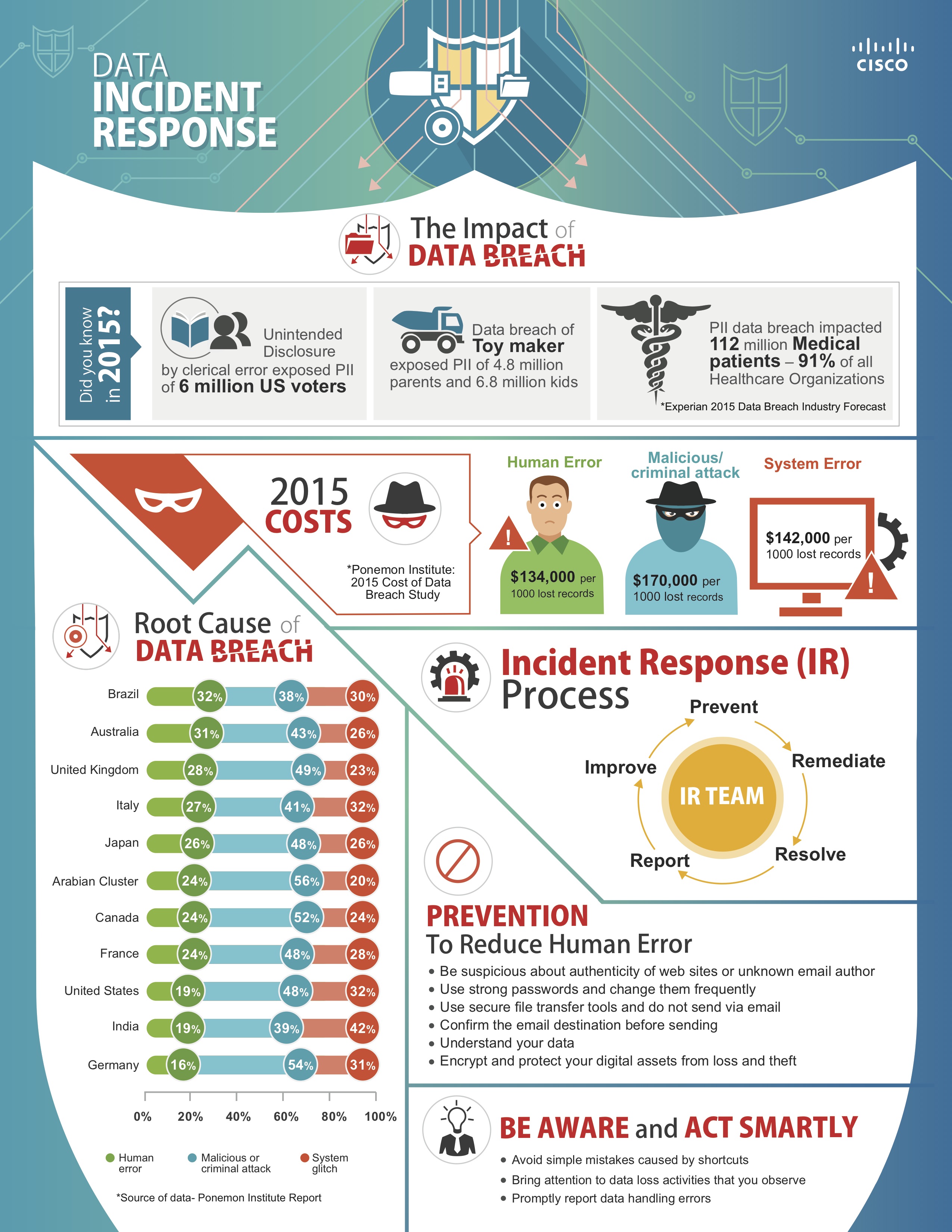
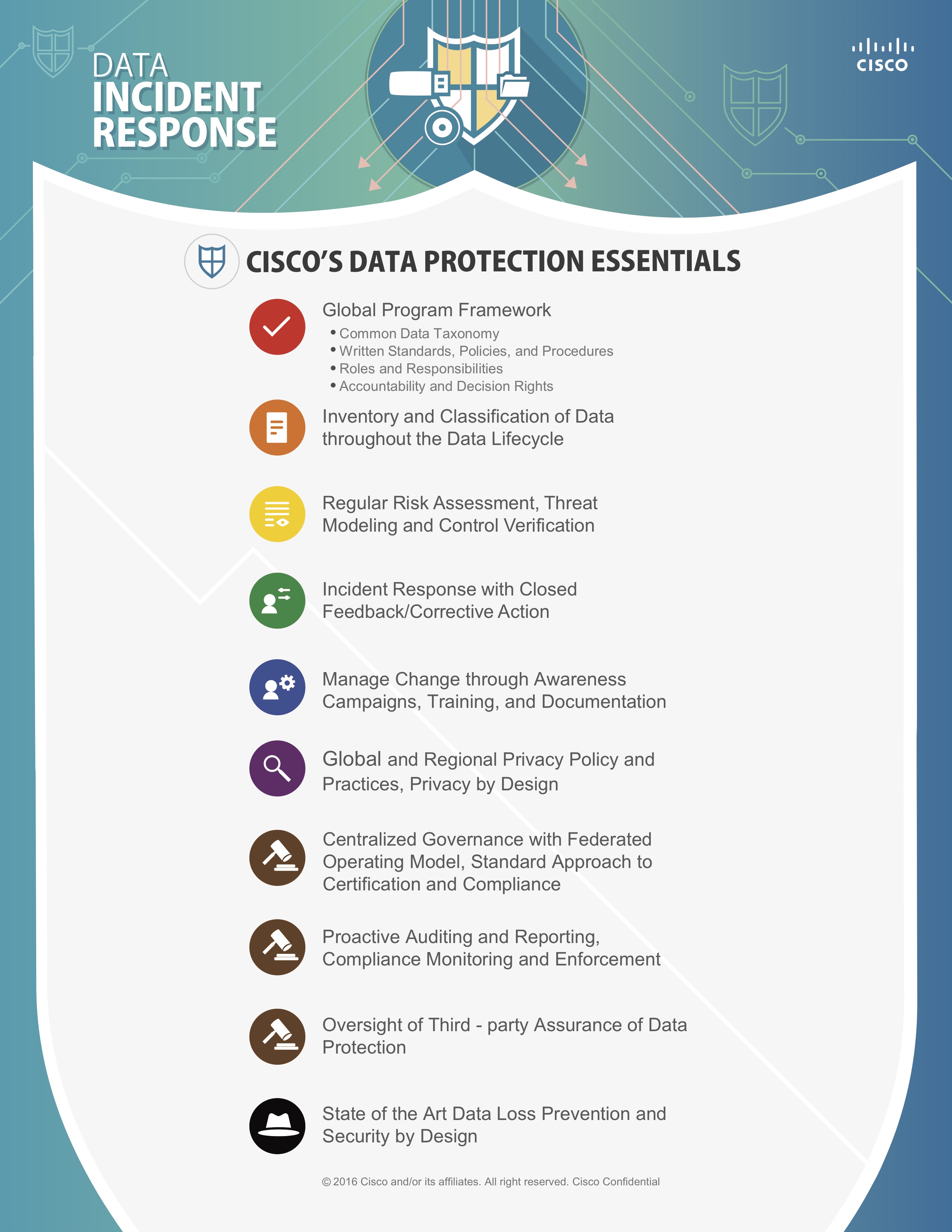
All organizations depend, at least in part, on their data to carry out day-to-day operations. Yet new, high-profile data breaches are reported every week, and the costs of those breaches continue to rise
The core elements of an incident response program are straightforward and quick to establish. Let’s take a look at the critical processes within an incident response program that may be easily implemented in your organization.
Critical Processes of an Incident Response Program
A structured response assures consistent incident research and action. Responses to security incidents that may involve data loss typically follow a workflow such as this:
Research the background details of the incident
Consult with incident response advisory resources
Develop, communicate and implement a resolution plan
Follow-up to identify improvements
Of course an Incident Response Program needs to be established before an incident is detected and a response is needed. Let’s start there.
Setting Up an Incident Response Program
Here’s how to quickly establish an incident response program:
Identify an incident response leader who has good knowledge of your business and who is an effective and responsible problem solver.
Assemble and empower a team of critical stakeholders, with clearly defined roles and responsibilities.
Draft your incident response process and establish documentation standards. The key is consistency in how you respond to incidents. There’s no need for a complicated plan. Just make sure it works for your organization’s culture.
Connect people and tools with the needed capabilities from around your organization. Chances are, much of what you need is already in place.
Understand the most significant capability gaps relative to your draft incident response process and build a plan to address those gaps. Start with a minimum viable process, and then enhance it over time.
Detection of Events
New incident discovery comes from many different sources:
Internal users
Internal monitoring tools
Internal risk-assessment tools
External customer
External entities
Social media
The best place to start? Employee awareness. Make sure your workforce understands the security risks to the business and what to look for. It’s easy to overlook an anomaly when you believe everything is safe.
Second line of defense – automation. Monitoring tools, including analytics of anomalous traffic or user behavior, are invaluable.
Finally, keep an eye out on social media. Bad news travels fast. You don’t want to be the last to know.
Triage and Containment
The triage process begins as soon as a data incident is detected and it involves research to understand the situation and to determine which actions need to be taken and when. Ask the following questions:
What is the nature of the event?
Is the event ongoing?
Is the event known or likely to be known outside the organization?
Which systems, applications, products, or services have been affected?
Is customer, personal, or other sensitive data actually or potentially exposed or compromised?
“Containment” refers to all efforts to stop, contain, and control the incident and data loss. These actions need to be taken as soon as practically possible to prevent further data compromise.
Response Plans
As soon as the necessary steps have been taken to contain and control an incident, document all the actions taken and produce a response plan. Your plan may include:
Actions to remediate
Notifications
Communications, both internal and external
It is important to understand the root cause, nature, and scope of the incident before creating the response plan.
Remediation
After completing the activities in the response plan, review the status of the incident and summarize the lessons learned. Post-incident actions can improve future data security practices.
It makes sense to select a risk posture when it comes to post-incident action. In some cases, many actions will need to be undertaken, not all of which will provide the same levels of improvement, equivalent increases in security, or relative returns on investment.
Conclusion
The operation of your organization depends on its data.
Build an effective detection and response plan so that you can avoid fines and remediation costs, protect your organization’s reputation and employee morale, and maintain business.
The simplicity of the incident response process can be misleading. We also recommend tabletop exercises as an important step in pressure-testing your program.
Facebook users post 350 million photos per day, and 4,501 per second, while Snapchat has 200 million users who share 8,796 photos per second. It took 10 years to decode the human genome, but it now can be done in less than a week.
As these examples demonstrate, data is multiplying at an alarming rate and changing dramatically in nature. Trends like the Internet of Things, Cloud, Big Data Analytics, SDN and hyper-convergence are imposing new requirements on how to design and built storage infrastructure. As these trends continue, budgets are shrinking and IT departments are asked to do more with less. An agile data center infrastructure that is easy to manage, affordable and flexible is required to meet the needs of resource-constrained IT professionals in large or small companies. Global technology leaders Cisco and EMC are collaborating to offer customers a choice of industry-leading architectures that can simplify, automate, and transform information technology, while helping them accelerate the journey to a software defined infrastructure.
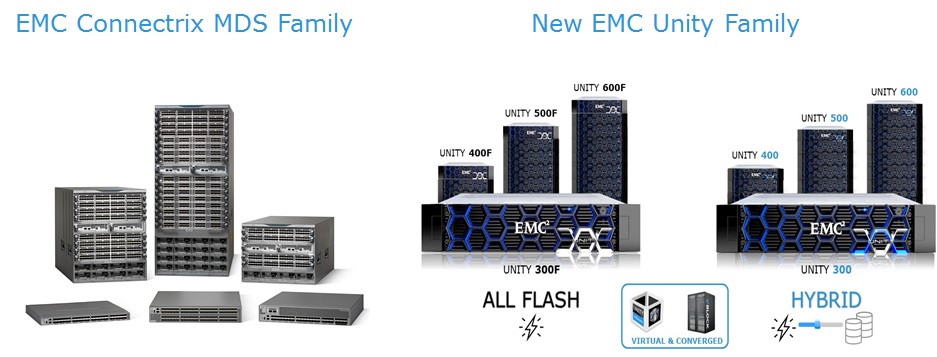
EMC today announced the EMC Unity system, an affordable midrange storage solution, along with the EMC UnityVSA system (virtual) which allows customers to easily deploy the advanced unified storage and data management features of the Unity family on a VMware ESXi server, for a software defined approach.
The Cisco MDS is an open, flexible and standards based platform for storage networking. It integrates well with a wide variety of storage systems including the new Unity. Cisco MDS, the Industry leadingStorage Networking platform along with EMC’s new Unity product line for storage enable customers to realize the full value of IT investments faster by providing compelling simplicity, a modern design, affordable prices, and flexible deployment options. EMC resells and services Cisco MDS under the EMC Connectrix brand.