Avatar

A whopping 59 percent of manufacturers expect their company’s strategy to change as a result of real-time information in the next three years. That’s in just three years. But what about the years after that?

Our team developed The Business World in 2025 report with the Global Center for Digital Business Transformation, an IMD and Cisco initiative, to help executives begin to think about how to create a business strategy to thrive as everything comes online.

In my previous blog in this series, I presented an overview of the four scenarios we constructed for report. Today, I’ll share the scenario we call the Global Bazaar.

St Blog 1Since 2015, manufacturers, and other industries, began to ride the wave of the fourth industrial revolution powered by IoT. This revolution is changing the face of competition. As time marches on, it will become almost impossible to define who your competitors will be. In fact, it’s already happening.

We’ve all heard the stories. Uber. Airbnb. Amazon. This is just the start of a major transformation.

Gone are the days of facing a few new entrants in a market and deciding whether to take a defensive or an offensive strategy. Today, organizations have to walk a tight rope between the opportunities and threats presented by digital technologies and the value that customers demand. And it has to be done while preserving incredible trust to ensure customers that their data is safe.

The Global Bazaar contributes to these challenges. It’s a scenario of fundamental business transformation, based on the following three forces:

  • Global markets – international trade flourishes and companies can scale globally
  • Blurring industry boundaries – regulation supports business to compete across different verticals (e.g. by using technology to expand services)
  • Internet ubiquity – Internet access is ubiquitous and business and consumers are enabled by an open internet without boundaries

If approached with the right strategy, Global Bazaar is an opportunity to tap into entirely new revenue streams. At the same time, this scenario is wrought with corporate volatility because of its fluid markets and hyper-competition. In 2025, your organization isn’t guaranteed to have a stable business environment. So planning ahead now is critical.

St Blog 2

Global Bazaar: How Did We Get Here and Where Are We Headed?

Decades of globalization have created a more interconnected, interdependent, and complex world. The only constant has become change. Globalization comes with pros and cons that should be addressed at the highest level of the organization.

On the plus side, global markets mean organizations can expand globally and access new markets easily. Using technology as a key driving force, they can innovate not only in their own vertical, but across different verticals to compete in industries where they’ve never had a foothold.

Multinational corporations can globalize manufacturing, rely on just-in-time production, and integrate their supply chains. The result is the creation of a highly intelligent, central nervous system for a sophisticated global economy.

These globally integrated, digitally enabled companies become “digital disruptors.” They’ll be the organizations that will define what the future of the business world will look like in the Global Bazaar.

On the down side, the acceleration of global integration puts companies at risk of global economic shocks. Remember the 2008 global financial crisis? The Eurozone’s migrant and debt crises? What about China’s slowdown in 2015? The effects of these events are felt much more broadly and with a multiplier effect because of the tight integration of the global economy.

In the Global Bazaar scenario, global institutions, businesses, and executives need to innovate to stay alive. For multinationals the question becomes how to operate in a world where competition can come from anywhere? How do you protect your business in a global market? How will governments, in an open and integrated world, protect their economics from global shocks?

Global Bazaar: The implications for your organization

 Is your company agile enough to capture these opportunities looking forward? Would your company’s current value proposition still hold in Global Bazaar? Will talents be attracted to join your company in such a future dynamic environment? With competition coming from any industry or region, what will be the source of your unique competitive advantage?

The time to discuss these topics in your boardroom is now. Before competitors leapfrog ahead of you, before digital disruption makes your organization a dinosaur, and before you make, quite possibly, the most important strategic decisions of your career.

Join me next time as we look at Cautious Capitalism, a scenario that has only a slightly different point of departure, but dramatically different implications. Meanwhile, you can find the entire report here.

Authors

Stephan Monterde

Director, Corporate Strategic Innovation

Chief Strategy Office

Avatar

No matter how many security tools you deploy to defend your organization, malware is going to get in. You need to see it if you want any chance of stopping it. Cisco AMP for Endpoints provides deep visibility into the activity of files on your system so that you can spot malicious behavior quickly and then contain and eliminate threats before damage can be done. But malware is constantly evolving, becoming more sophisticated and stealthy every day. Your security tools need to evolve as well.

This is why we have added new capabilities to AMP for Endpoints. We recently integrated our Cognitive Threat Analytics (CTA) platform with AMP for Endpoints.

What is CTA? It’s a cloud-based software as a service (Saas) that turns an existing web proxy—like Cisco Cloud Web Security (CWS), Cisco Web Security Appliance (WSA), and Blue Coat ProxySG—into a security sensor that analyzes traffic for command and control communications. Analyzing over 3 billion web requests daily, CTA finds malicious activity that has bypassed security controls, and is now operating inside an organization’s environment. CTA does this by:

  1. Establishing a baseline of normal network activity using trust modeling and event classification
  2. Parsing out abnormal activity to find compromised devices in your environment
  3. Using machine learning, CTA continuously updates, improves, and evolves with threats over time

We integrated CTA with AMP for Endpoints. This is how the integration works:

If you have AMP for Endpoints deployed alongside Cisco CWS, WSA, or a Blue Coat web proxy, CTA capabilities can be turned on with a few clicks inside the AMP for Endpoints console. Then follow a few easy steps to configure CTA with your web proxy, and you’re ready to go.

CTA inspects web logs, traffic and telemetry from the web proxy, and then CTA detection events are pushed to AMP for Endpoints for further investigation, giving you an added level of visibility.

This integration allows AMP for Endpoints users to:

  1. See more malware than before. With added visibility from the CTA integration, you can find additional types of malware, like additional polymorphic malware; file-less or memory-only malware; powershell script attacks; and infections that live in a web browser only.
  1. You can reduce endpoint exposure to threats because with the CTA integration, you can catch more malware before it compromises the operating system level. By catching it early, you can prevent those infections from reaching a terminal stage. For instance, if you can catch ransomware before it hits the OS-level, you can stop it in time before it starts encrypting files, and it makes remediation a lot easier.
  1. You can also get visibility into devices where you can’t install an AMP for Endpoints connector. AMP for Endpoints can be deployed on Windows, Macs, Linux, and mobile devices, and gives you deep visibility into activities on those devices. But since CTA analyzes web traffic across all devices on the network, the security team can get an expanded view into other devices like connected TVs or printers, and BYOD devices where a user might not want a connector on their personal device.
  1. And finally, this integration makes investigations easier and faster because now that CTA is pushing information to AMP for Endpoints, you can see results from both systems in one place (and act on them) all from the AMP for Endpoints console.

As a result of this integration with CTA, our engineers have reported that AMP for Endpoints is seeing about 30% more infections on average.

To learn more and watch a demo, visit cisco.com/go/ampendpoint-cta.


Authors

John Dominguez

Product Marketing

Cisco Security Business Group

Avatar

To me, there is nothing more satisfying than when a customer gives glowing testimonials publicly to our products and solutions. In the last two weeks, Cisco Application Centric Infrastructure (ACI) has been in the news with a spate of customer success stories. First, we saw the news report on how service providers worldwide are benefiting with Cisco ACI’s advanced SDN services. Cisco’s famous blogger, Craig Huitema, illustrated last week via his blog how UK based service provider, Hutchinson, leveraged efficiency and cost savings with Cisco ACI. Now it is my turn to present you two, hot out of the oven, customer success stories featuring Cisco ACI, and its premier ADC eco-system partner, F5.

Let us pick up the action here at home in US with West Corp, who provide the core of US 911 infrastructure.

Challenges: Multiple data centers, Heterogeneous IT, Incompatible systems

West Corp handles some 65 billion telephony minutes and 290 million calls per year on average. With a mish-mash of multi-vendor infrastructure through acquisitions, this has proved difficult to manage and maintain. West calls it high-wire networking without a net.

Solution: West Corp decided to move from a collection of acquired companies’ technologies to a model based on a standardized IT infrastructure managed as a single entity. To streamline its IT environment, West decided to use F5 technologies integrated with the Cisco ACI.  Jeremy Brown, Enterprise Network Architect for West, cited Cisco ACI as a foundation of high-capacity, speed and reliable switching infrastructure.

According to Jeremy, “We understand well its capabilities and reliability. We never know what demands customers will put on our applications, but ACI helps keep us ready.” He agrees with one of the core tenants of Cisco ACI – it optimizes the application lifecycle for scale and performance, and supports application provisioning across physical and virtual resources. West Corp augmented their ACI architecture with F5 Software-Defined Application Services.  They also opted for the open, programmable, and intelligent F5 BIG-IQ platform to provide management, orchestration and control of West’s F5 BIG-IP devices and application services.

Why West Corp chose the integrated F5/ACI solution?

“We split our network in such a way that we can spin up applications and services, test them, and spin them down. That means we need software-defined networking, an application-centric infrastructure, and the ability to intelligently manage the traffic of these services essentially at a moment’s notice,” explains Brown. “Combining F5 and ACI meets those needs, and we’re using the BIG-IQ platform to make the integration work best,” he continues. “We know what we’re getting with the F5/ACI fabric combination—it’s tangible and reliable, not guesswork.”

Benefits from Cisco ACI-F5 integrated solution deployment for West Corp: By consolidating data centers and standardizing on an integrated Cisco ACI and F5 application delivery infrastructure, West saves on IT costs, frees up IT resources to work on value-added projects, and gains more reliable systems and applications.

Next hop in our story is INSEE, a subsidiary of Siam City Cements, Thailand.

Challenges: Digitalization of Siam City Cements, short-timeframe to build a new data center to address digitalization needs, and leverage technology to meet strategic business needs.

The IT infrastructure at INSEE is designed to be reliable, flexible and secure to meet SCCC’s strategic business needs. To ensure its needs continue to be met in the future, INSEE embarked on an ambitious nine month project to build a new data center that consisted of an application-centric infrastructure (ACI) at its core, running ERP solutions from SAP and business applications such as Cisco Unified Communications. This application-centric approach would allow INSEE to continue being reliable, flexible and secure, even as the needs of SCCC changes and technologies evolve.

Solution:

The growing partnership between Cisco and F5 provides additional opportunities to enhance its infrastructure, particularly around Cisco ACI. The F5 Device Package for Cisco Application Policy Infrastructure Controller™ (APIC) lets INSEE configure application policies and requirements for F5 appliances across L2–7 fabrics. This ensures that applications receive the services and resources they require throughout the network, while also enabling organizations to automate systems for further efficiency and cost savings.

Benefits: INSEE’s Infrastructure team was able to set up the data center within 4 months of project inception. This was one month ahead of the project milestone, and before the applications team did its integration testing. With an Application Centric Infrastructure (Cisco ACI), INSEE can easily meet their application needs for the next ten years, all they have to do is simply stack the applications on top of the infrastructure.


Related Links:

www.cisco.com/go/acif5

https://f5.com/solutions/customer-stories/communications-services-firm-gains-huge-data-throughput-with-f5-and-cisco-aci-19985

https://f5.com/solutions/customer-stories/insee-digital-supports-siam-city-cement-companys-future-needs-with-app-centric-hybrid-infrastructure-19859

Authors

Ravi Balakrishnan

Senior Product Marketing Manager

Datacenter Solutions

Avatar

The impact of Distributed Energy Resources (such as solar photovoltaics, Electric Vehicles, Energy Management Systems) is still generally discussed in the future tense but for many utilities, especially those with substantial amounts of distributed solar, the impact is happening today. They are changing the way electricity is generated, transmitted, and distributed. They are changing the relationship between utilities and their customers, and they will bring about new opportunities for energy management and aggregation of Demand Management and Distributed Generation Management.

There are many discussions happening in the domain of regulations and public policy, but those discussions need to reflect a solid grounding in the physics of electricity and the control systems that are required to bring about the reliability and availability required by our modern society.

der

The Department of Energy, through its Office of Electricity, and the National Labs are actively working on the control systems and communication architectures that are required.

It was my privilege to host the webinar Transactive Grid Codes for DER Integration in partnership with:
• Jeffrey Taft, Chief Architect for Electric Grid Transformation at Pacific Northwest National Labs (PNNL)
• Lorenzo Kristov, Principal, Market & Infrastructure Policy at CAISO
• Paul De Martini, Principal, Newport Consulting Group

In the webinar Jeff explains the nature of Grid Codes as the interconnection agreements between DER owners, Aggregators or Energy Service companies, and utilities. Grid Codes address physical and electrical connection, protection and control, and business terms.

Jeff also proposes an architectural approach for Transactional Energy Systems for which Grid Codes can define a plug and play interface for DER.

Although at times a bit technical, I highly recommend you listen in since the topics covered in this webinar are attracting international interest as they provide a sound technical basis for future policy and regulatory decisions.

Listen to the recording (53min) or download it to learn more.
Recording password: TwiNDug5

To get our blogs delivered straight to your inbox:

subscribe

Authors

Rick Geiger

Executive Director

Utilities and Smart Grid

Avatar

AR38572

Generally, museums are pretty large places with dozens of exhibits and thousands of pieces of artwork to view. The National History Museum (NHM) in London is no exception. When museum brass discovered that there was a way for their visitors to be connected and not miss the things that they most wanted to see, you better believe that they spoke to Cisco about this solution.

With over 5.4 million people visiting the NHM, the museum understands crowds. And they also understand people and how they’ve grown accustomed to getting their information through their phones via public Wi-Fi. For the amount of people going through the museum every day, this type of wireless network needed to be big and Cisco had just the answer.

Using Cisco Aironet 3600 and 3700 Series Access Points along with Cisco Catalyst 5508 switches, a top-of-the-line wireless network infrastructure was created. Now people were able to connect to a robust, fast public Wi-Fi system the moment they walked in the door.

In addition to the network, Cisco Connected Mobile Experiences (CMX) was deployed. CMX run in conjunction with the wireless infrastructure are able to work together to detect and locate any and all mobile devices. The museum is provided this data, which it uses to understand visitor flow and what exhibits are most popular. NHM also uses this information to adjust, in real time, its plans to keep foot traffic flowing around the building.

Traffic flow isn’t the only information CMX provides, using the NHM mobile app, visitors are able to get interactive maps and event listings. It can also send alerts and push messages about areas that are busy, so that visitors can check out less-crowded exhibits before checking out the popular things. In the future, repeat visitors will be recognized when they walk in the door with a personalized message on their mobile devices.

This particular solution isn’t solely for museums. There are a lot of businesses out there competing for the same customers that you are. How do you reach those customers properly so that they aren’t missing out on your products? By applying the NHM’s mobility solutions—a robust wireless network coupled with Cisco CMX—to your organization.

To read more about this Case Study, click here.

Authors

Byron Magrane

Product Manager, Marketing

Avatar

Delivering Managed network services now costs less than ever. Whole new markets are ready and waiting for the benefits they bring.

It took years for alternative energy sources, such as wind and solar power, to become affordable to consumers and profitable for providers. The same is true of managed network services. For years, network service providers struggled to serve small to medium-sized companies or the small branches of large companies. The high cost of acquiring and supporting them and the price sensitivity did not make economic sense.

Now times have changed. Providers can deliver cost-effective managed services faster and more easily to businesses of all types and sizes. They can do this via a cloud model enabled by Software Defined Networking (SDN) and Network Functions Virtualization (NFV). These are not only more cost-effective, they give business customers what they want. That is easy self-service, service on demand, and capacity on demand.

User benefits in high demand

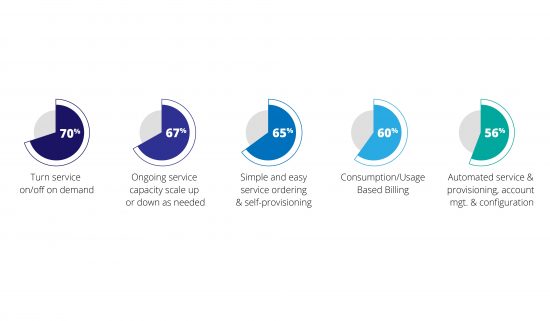
In a 2015 AMI-Partners study, more than 70 per cent of businesses surveyed had a strong desire for the efficiencies available with SDN- and NFV-enabled IT-as-a-Service (ITaaS) in the cloud. The main benefit cited was the ability to easily turn cloud services on or off through a web portal. Others mentioned included the ability to scale the capacity up or down as needed; to order services as desired; to enjoy more precise billing based on consumption; and to benefit from zero-touch automated service and network provisioning.

wednesday blog

Source: AMI-Partners study, March 2015.

Reduced costs for service providers

SDN and NFV technologies can also reduce the cost of deploying these services. An ACG Research study estimated that building a software-defined infrastructure behind cloud services lowers a provider’s costs by a whopping 78 per cent. That transforms the business model, making a broader range of business customers more attractive prospects.

The opportunity is clear. Network service providers are now better positioned to deliver higher quality managed services (or ITaaS) in the cloud. Targeting businesses through channel partners helps them to reach this new business market. They can differentiate further by creating a range of service bundles based on the operational efficiencies offered by the cloud infrastructure.

Find out more

By giving you the right tools, Cisco allows you to build a highly evolved cloud platform and broaden your market for managed services. Whatever their sector, businesses are ready for a new era of affordable IT services delivered from the cloud. They want the self-service simplicity and ability to tweak features in real time. It’s a game changer for businesses. And it’s a bright new revenue opportunity for network service providers.

For more information on the opportunity, visit us here: cisco.com/go/moi

For information on our virtual managed services solution, check this out: cisco.com/go/vms

Authors

Wayne Cullen

Senior Manager, Service Provider Architectures

Avatar

We all know the story of Goldilocks and her ill-fated visit to the house of the three bears. What lesson, if any, one might take away from this story is that too much of a good thing doesn’t necessarily make it the right thing. Porridge is best hot, but too hot and that’s not good. Big chairs are big, but if they’re too big, they’re not comfortable.

What is true for Goldilocks – and bear with me on this analogy here – is also true when considering security technologies for business. These days, the industry is abuzz with consumer players that have decided to implement end-to-end (E2E) security in their messaging products. It started with Apple and its battle with the U.S. government on access to iPhone data. Then, WhatsApp switched its messaging technology in such a way that no one could have access to messages except for the end-user client. Recently, rumors have circulated that Facebook plans to make a similar change for Facebook Messenger.

When evaluating messaging technologies for the workplace, these kinds of solutions seem like they would be a good thing. But if you dig a little deeper, they’re not. The reason is that the workplace environment requires that certain parties can access message content. The legal department will need access in case of a lawsuit. The infosec department will need access when tracking a possible data leak. They may also want real-time access in order to audit shared content to make sure users are complying with company policy (e.g., no sharing of restricted information with outside parties).

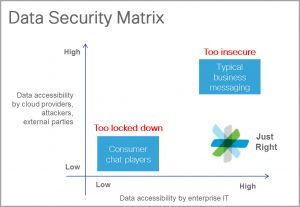
As such, when evaluating messaging technologies, the question to think about is: What parties should have access to content, and which should not? When you do that, you quickly draw a simple 2×2 matrix that looks like this:

spark_security
Consider which parties should have access to content, and which should not.

One dimension is the level of data access that is available to Enterprise IT (including Infosec, Legal, and other authorized parties). This is desirable access. The second dimension is data access by the cloud provider of the messaging service, as well as data access available to attackers and external parties. This is undesirable access.

E2E secure consumer tools – like WhatsApp – provide low data access for attackers and the cloud provider (WhatsApp itself), but also provide low data access for anyone else – including IT. For any business seriously considering “just use WhatsApp at work,” this should give you great pause. In essence, these providers are “too locked down.”

On the other end of the spectrum, we have enterprise messaging providers – Slack and Hipchat are examples in the industry. They typically use transport security combined with encrypted databases. These provide some security but ultimately enable the provider, attackers, and perhaps enterprise IT (assuming such features are developed and made available) to have access.  This is also not a great solution since it means critical business data is potentially in the hands of many parties. Worse still, the more successful and more popular the provider is, the more data it has, and the more attractive of a target it becomes for attackers and other parties who seek access to data. These solutions are “too insecure.”

With Cisco Spark, we’ve built a solution that is “just right.” Our unique security solution locks out Cisco – as the cloud provider – from having access to the content. At the same time, it enables enterprise IT to have the access it needs. And, of course, since Cisco as the cloud provider doesn’t have access, any attackers to our cloud won’t have it either.

How, perchance, is this possible? Well, the great news is that we’ve decided to open up the kimono, so to speak, and reveal all of the details on how Cisco Spark security works. We’ve just published a white paper that reveals information on our architecture. It covers:

  • Our split-security model–a core layer and a security layer–and describes how clients build and maintain trusted relationships with the security layer with the core in the middle.
  • How we enable search of content–a critical user feature–using this split architecture.
  • How the architecture works in the face of multiple security domains (which we call KMS federation) and provides details on key authorization and access controls.

We’re proud of this amazing architecture, and pleased we’re finally able to open up and reveal to the world how it works.

Once you’ve read through the white paper, you’ll see how our solution meets the seemingly impossible goal of providing “just right” security for the workplace – access to those who need it, and not for those who don’t.

Read the full “Cisco Spark Security and Privacy” white paper.

Authors

Jonathan Rosenberg

Cisco Fellow and Vice President

CTO for Cisco's Collaboration Business

Avatar

Do you dream of keeping your data under a lock and key that only you control? Or are you trying to appease regulations, whether corporate or government mandated? Organizations should not fear the auditor more than the attacker.

While many have come to adopt the cloud, there are cases where it might not be for you. That’s why on May 18th we released the latest version of Cisco AMP Private Cloud that features integration with AMP Threat Grid.

AMP Private Cloud lets you have the best of both worlds: cisco amp private cloudprivacy and security without compromising on the latest technologies that allow you to detect breaches.

Integrated malware analysis

The integration of AMP Threat Grid is a critical milestone for the private cloud virtual appliance as it now allows users to take advantage of Threat Grid’s innovative static and dynamic malware analysis technology in a completely on premises solution.

What is AMP Virtual Private Cloud?

The AMP Private Cloud is an on-premises private cloud deployment of Cisco AMP for Networks and/or Cisco AMP for Endpoints technology. Like our other AMP technologies, it continuously monitors file activity throughout your extended network and will provide retrospective security alerts if something benign suddenly begins to act malicious. The virtual appliance not only satisfies stringent privacy mandates (like those in Germany or at a defense contractor), but also provides network and endpoint protection across the enterprise, comprehensive advanced malware protection without compromising your capabilities, and scalability for even the largest global organizations. The best part? You can install it all on your own hardware.

What is the difference between the Private Cloud and Public Cloud?

There are a couple minor differences between the Private and Public cloud instance of AMP.

  • Advanced custom detections: the private cloud only supports Windows, whereas the Public cloud supports Linux, Mac, and other popular operating systems.
  • ETHOS: This is one of the many detection engines AMP uses to continuously protect you from malware. ETHOS catches families of malware through use of “fuzzy hashes” as a way to counter malware evasion aided by “bit-twiddling”. It is only available in the public cloud.

How do I get the latest threat intelligence?

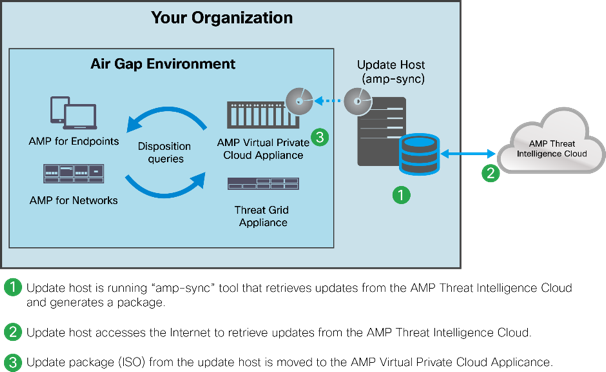
Since AMP is not directly connected to the internet, we provide a tool to download and synchronize updates between the private cloud and public cloud, ensuring you have the most current file dispositions and related threat intelligence.

Visibility and control with simplified management

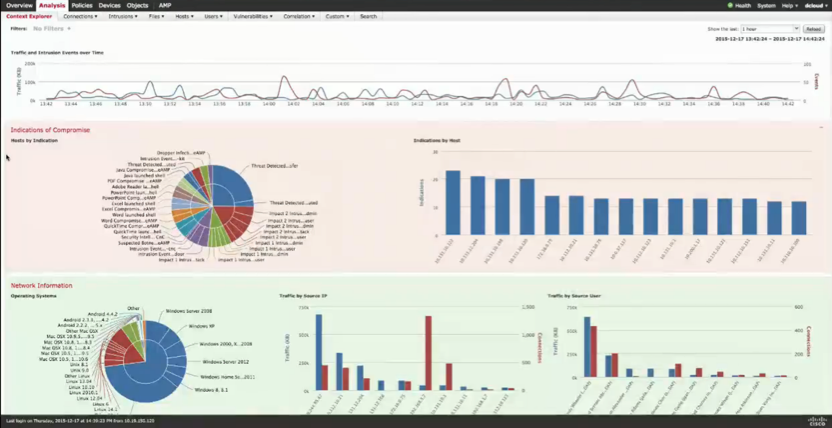
AMP Private Cloud uses the latest Firepower Management Center, the critical nerve center that provides a consolidated view into events across both network and endpoints. In addition to being able to manage AMP, it provides unified management over firewalls, application control, intrusion prevention, and URL filtering, reducing the time needed to investigate and remediate malware outbreaks.

amp-pc-2

Here are a few additional resources if you want to dive deeper into any of the solutions that work with AMP Private Cloud:

Authors

Joe Malenfant

Director, IoT Marketing

Internet of Things (IoT)

Avatar

A day in the life of a Cisco pet consists of making cameo appearances on Webex calls with your human’s coworkers, either by vocalizing your opinions in the background or showing your furry face on camera. Getting extra belly rubs during official office “dog days” if you’re a dog, or if you’re a cat, laying on the keyboard while your human works at home to remind them that it’s important to take a break.

My cat ZuccaMeet my cat, Zucca. (It’s pronounced Zoo-ka, and it’s Italian for pumpkin, since he’s orange.) He’s a proud Cisco cat, and since I’m the social media lead for the Talent Brand Team at Cisco, (I manage the strategy for this blog and the WeAreCisco social media channels) he often makes appearances is my social feeds, and is a bigger social star than I’ll ever be.



Social media is a 24/7 gig, and Cisco allows me a flexible working schedule from home to accommodate that (and the global employees I connect with.)

He keeps me grounded, he reminds me that even when I have a challenge, there’s nothing a “cat nap” can’t cure, and always has an answer when I ask him a question. (The answer is always “meow,” but I know he’s supportive anyway.)

I’m not alone. You’ll find a lot of Cisco employees working alongside their animals.

Kati and her dog
Kati and Simba in the office.

Cisco PR Specialist Kati Dahm gets to bring her dog Simba to the office a few times a week as part of a pilot program at Cisco.

“Having my dog at work helps remind me to take breaks to walk around and refresh, which in turn helps me focus better and stay energized,” Kati said. “It’s also provided an opportunity to meet more people, as everyone likes to come up and say hi!”

Another example is Silvia Spiva, a technical writer at Cisco – she recently wrote a blog about the work/life balance that Cisco allows her helps her appreciate Cisco technology on the days that she can work remotely to take care of her human kids, AND her dog baby girl, Wolfi.

Silvia's dog Wolfi
Silvia’s “kids” include her dog Wolfi.

“Wolfi helped me focus on what was really important for me professionally,” Silvia explains. “Being a full-time remote professional would have been lonely, had I not had Wolfi’s company, because I work globabl hours, not just 8-5. My dog has been the chief digital disruptor in my life. Home is a workplace thanks to Cisco tech, but I’m glad our best collaborators are now welcome at offices, too.”

Recently, a WeAreCisco Twitter and Instagram social media contest asked employees to share why they #LoveWhereYouWork., and Molly Chamblee’s photo of her labs was one of the winners.

“At Cisco I am known on the team for having puppies and now just lazy labs,” Molly, a Cisco engagement manager says. “When I had a litter, I was often asked to show one puppy on video or all of them. In some cases, a stressful call would be interrupted by the puppy request to improve the mood and decrease stress. Having a pet bark in the background or show up on video, makes it hard for people on a call to be rude…. But a puppy makes everyone smile!”

Labs love where they work
Molly’s winning #LoveWhereYouWork #WeAreCisco photo of her labs.

Cisco humans love every extra minute with their furry friends, and not only their own. From volunteering with the Cisco Cat Club to giving back at shelters, most will tell you that “fur kids” are an important part of Cisco life.


Want to work at Cisco now? Apply here.

Authors

Carmen Shirkey Collins

Social Media Manager

Talent Brand and Enablement Team, HR