Avatar

In 2016, the Customer Success Talk webinar series brought together a wide array of influencers and decision makers from Cisco partners, both large and small. Our subject matter experts focused on the business case for customer success management (CSM) and the people, process, automation and analytics that must come together to form a post-sale lifecycle management practice that creates customers for life.

Customer Success Talk Rewind: Get caught up on what you’ve missed. Watch highlights of all 2016 sessions.

While the webinar series was created to share strategy and tools, it has also served as a venue to engage in a dialogue with our partners to better understand how they are progressing on their own CSM journey. Across 15 webinars, and interactions with 4,000-plus attendees, we gained valuable insights into the challenges partners are facing in maintaining customer health in today’s subscription economy. Nearly all are establishing their own customer success practices to improve the customer experience, drive loyalty, and find new opportunities for growth.

12:1 blog infographic


So how are your peers coping with customer success management? Here are some key insights from the webinar series:

  • Partners know what customers want: faster ROI and outcomes. But most partners—as many as 68%—are not actively tracking if their solutions are delivering the outcomes the customer signed up for.
  • Most partners consider themselves on the lower half of the CSM maturity matrix. As many as 81% are still not making strategic decisions based on real-time, customer health data.
  • Most partners have a dedicated renewals team (82%) but fall short elsewhere in the customer journey, such as in adoption and expand selling.
  • The number one challenge for partners in building a CSM practice is accessing the data they need.

While many partners still have a long way to go with CSM, the good news is that Cisco is actively sharing the methodology and tools to fill the gaps and help partners build a best-in-class customer success practice focused on creating customers for life. The Customer Success Talk webinar series is a great place to start if you want to get your CSM practice up and running. To get caught up on what you’ve missed, click here to watch the highlights of all 2016 sessions. And stay tuned for more webinars that are in the works.

Subscribe here to receive notifications about the next series of Customer Success Talk webinars starting in January 2017.

Authors

Nichole Lemieux

Partner Experience Architect

Global Virtual Sales & Customer Success

Avatar

Much to the dismay of countless business leaders everywhere, innovation doesn’t just happen by magic. Creating a pervasive innovation culture within any organization takes time, effort, and strong leadership. But if the importance of innovation is so universally acknowledged, why do so many struggle with it?

It’s no secret that well-established businesses find it much harder to innovate effectively than lean start-ups. This is because they tend to be overly fixated on optimizing existing business activity (i.e. the source of their current success), rather than taking the time to think about where the future of the business lies. Whilst perhaps understandable, it’s a foolish mentality.

The truth is that today, even well-established businesses are just one disruption away from oblivion. Just ask Blockbuster, Borders, or Blackberry. It’s not just the obvious ones either. One hundred years ago the average lifespan of a company was around 67 years. Today, that has dropped to just 15 years. So as a leader, what can you do if you’re being kept awake at night by innovation woes?

In most cases, the first and most important thing you can do is take a good look in the mirror. What are you personally doing (or not doing) to encourage an innovative mindset amongst your employees and colleagues? In fact, are you the main problem? In larger companies there’s a dangerous tendency amongst senior management to view innovation as a poisoned chalice. Everyone gets how important it is, but no one wants to be in the firing line if it all goes wrong.

Moving as far away from this mentality as possible is one of the most important things you can do. Yes, innovation is risky, and no, projects may not turn out the way you had hoped. But this doesn’t ever mean you should shy away from doing them. Remember, failure is only truly a failure if nothing is learned from it.

The most innovative business leaders today are like conductors. They don’t need to be the best musicians themselves but that’s not their role. They know they can hire other people to play the instruments far better than they ever could. Their sole focus is on being the best at directing the musicians as a whole to create the overall symphony. They know they don’t and won’t have all of the answers themselves and don’t let their ego get in the way. Equally importantly, they trust others and encourage them, never stifling thinking that’s different from their own. After all, the most innovative ideas can come from the unlikeliest of places!

In the next two blogs of this four blog series, we’ll look at some of the specific tactics that business leaders can employ to cultivate and nurture an innovative culture from within. But for now, remember that culture is bred from the top and as a leader, your actions speak louder than words. Innovation is all about getting people asking questions to ensure your business has a future, so if nobody is asking any questions, take a look at yourself before pointing the finger at others.

Authors

Harvey Wade

Innovation Program Manager

Cisco Services Innovation Excellence Center (SIEC)

Avatar

Technology has the ability to expand opportunities for students in both K-12 and higher education. It can extend the classroom beyond its physical footprint, offer alternative ways for students to learn, and provide increased access to education worldwide. It also helps schools operate more efficiently and can keep students and faculty safe. So why wouldn’t everyone want to digitize education?

Well, for many educators and administration, the issue isn’t desire – the deal-breaker is cost. Many schools would love to bring digital tools and solutions to their institutions, but rely on local, state and even federal funds to operate, and often have a limited budget as it is. If you need to use every bit of money you get to pay your teachers, keep the lights on, and provide basic resources for your students, it’s difficult to make an investment in technology, even if it will improve learning in the long run.

While technology can reduce costs in the long-term, the up-front expenditure is often too much of a burden for schools to undertake. But we strongly believe that every students should be able to reap the rewards that digital learning can bring. That’s why we work so closely with our customers to discuss alternative funding methods, which can allow schools to undergo digital transformations in a more financially feasible way.

For example, many K-12 schools are eligible for E-rate funding, which is a government program administered by the Universal Service Administrative Company to help close the Wi-Fi gap and open access to high-speed broadband. We have multiple resources available to schools applying for E-rate funding, and have experts that can help walk you through the process. You can learn more about it on our new E-rate website.

Another option is to utilize Cisco Capital Financing. From fair market value leases to full pay-out leases to loans to lifecycle financing, Cisco Capital has a variety of options that can help your school. Read more about how Cisco Capital Financing works and if it’s a good option for your school’s needs here.

A third option to help your school digitize is to apply for a grant. Today, grants are proliferating, and it can be a difficult process to navigate. Our Grants Strategy Team for Education was created to help walk schools through this process. Every grant and every school is different, which is why our team adopts a tailored approach.

AM63062 (1)

I would like to showcase Central Georgia Technical College (CGTC), a rural college located in Macon, Georgia. CGTC created “BlendFlex,” a blended learning program that provides multiple avenues of learning for its students and enables professional learners to meet business and educational needs. When the college decided to increase classrooms, teaching resources, managing personnel and learning opportunities, it engaged the Cisco grants team to explore its options.

Together, CGTC and the Cisco Public Funding Team identified the Trade Adjustment Assistance Community College and Career Training (TAACCCT) grant as the right fit for CGTC’s needs. Cisco guided CGTC through the application process, and the college was awarded $2.6 million in 2014 to help implement BlendFlex. This new suite of collaboration tools deployed across CGTC’s satellite and rural campuses gives students more options to continue their education.

In fact, CGTC experienced such strong results from the TAACCCT grant that they’ve continued to work with the Cisco Public Funding Team to identify more grant opportunities. You can learn more about CGTC’s story here. If you think that a grant might be a good funding option for your school, you can learn how to partner with Cisco here.

No student should be held back from digital learning opportunities just because their school can’t afford the technology. We strongly believe in the transformative power education technology, and we’re here to help you find an alternative funding option that can help your school undergo its own digital transformation.

Authors

Mary Schlegelmilch

Business Development Manager

Education

Avatar

One is a sport apparel retailer while the other is a software company. “What can they possibly have in common?” you may ask. Both have a common IT goal, and that is to extend their enterprise network to AWS cloud, but for very different business outcomes. And both accomplished their goal using the same solution: Cisco Cloud Services Router 1000V.

Did you know? Up to 70% of CIOs stated they need cloud solutions to better respond to business needs (Source: 2015, CIO Insight). For that reason, cloud adoption between 2015 and 2016 grows exponentially with as much as 71% of organizations choosing the hybrid cloud approach. See Chart I below.

Chart I: Respondents Adopting cloud – 2016 vs. 2015
Chart I: Respondents Adopting Cloud

What are top 3 cloud adoption challenges?
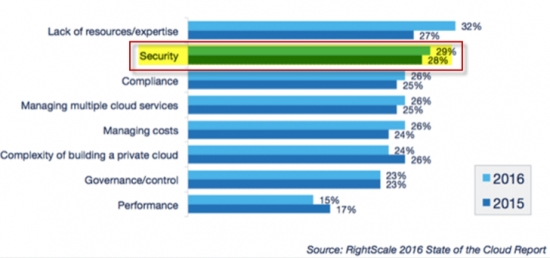
When it comes to extending the enterprise network to the cloud, there are many factors to consider – see Chart II below.

Chart II: Cloud Challenges 2016 vs. 2015
Chart II: Cloud Challenges 2016 vs 2015

Security, no doubt, is among the top. One out of every three organizations shared ensuring a secure connection between the on-prem enterprise network and public and private cloud environments as a top challenge. There are several reasons why.

  1. Inconsistent VPN and firewall policies between on-prem enterprise network and different cloud environment;
  2. Limited connection reliability, e.g. not all cloud solution can support high scale; and
  3. Non-unified network topologies make management and operations error-prone.

Next on the list is integration. With the LAN, WAN and data center network, each having its own set of internal and external network/IP address, management interface/tools and different quantity and set of network services, operations quickly become onerous due to lack of centralization and standardization. The complexity increases multifold when multiple types of on-prem and cloud infrastructure come into the picture. For example, do I have VMWare ESXi, RHEL KVM, Ubuntu KVM, Citrix Xen, and/or Microsoft Hyper-V? And how do they work with Amazon AWS, Microsoft Azure, or any cloud? Quick answer: it should not matter.

Last but not least is the user experience. When the network is confined within an enterprise WAN perimeter, policy enforcement can be automated based on business priorities. Once connected to the cloud, how would network services that were once innate on-prem such as QoS, WAN and application optimization, and firewall be deployed, managed and scaled?

Learn from Under Armour and Adobe
This December, two enterprise customers, Under Armour and Adobe, will share with us their cloud strategy successes in a webinar. Each will highlight its goal, network environments, desired business outcomes, and the chosen solution. Here’s an overview.

UA logoUnder Armour, Inc. – a multi-billion American sports clothing and accessories company

Its goal: New IT model – a service broker for Line of Business

  • Enable the Application/Marketing/Financial team’s growth
  • Curve the organic growth of ungoverned Shadow IT resources
  • Provide an agnostic platform that facilitates Standard Operating Procedure
  • Augment application owner’s security controls
  • Have visibility to address issues proactively

Adobe logoAdobe Systems, Inc. – a multinational computer software company

Its goal: Adobe Digital Marketing Cloud

  • Provide a comprehensive marketing solution
  • Enable marketers to measure, personalize and optimize digital experiences
  • Attain agility and workload mobility

WATCH ON-DEMAND
Join us and learn

  • How Cisco helped simplify Under Armour’s and Adobe’s security management while keeping connectivity costs under control
  • Best practices for monitoring and analyzing application security and performance in the cloud
  • How to implement consistent network policies across hybrid environments

Speakers:
Nick Matthews, Partner Solutions Architect, Amazon Web Services
Fan Yang, Technical Marketing Engineer, Cisco
Carl Coles, Network Architect, Adobe Systems
Patrick Duroseau, Sr. Director Global Infrastructure, Under Armour

Try It FREE

Test drive the solution yourself in your own environment with a free trial for 30 days on AWS. Cisco CSR 1000V is a complete multiservice cloud networking platform for all deployment types: physical, virtual, and cloud.

Key Benefits:

  1. Consistent operations across on-prem network and multi-cloud environments with familiar Cisco IOS-XE software;
  2. Support VMware ESXi, RHEL KVM, Ubuntu KVM, Citrix Xen, Microsoft Hyper-V;
  3. Infrastructure agnostic operations means freedom of choice, no dependency on any specific server or virtual switch;
  4. Elastic scalability with licensing flexibility: throughput up to 10gbps, up to 1000+ connections, and up to 8 virtual CPUs, pay only for what you need; and
  5. Programmable with NetConf/Yang, RESTConf and SSH/Telnet for automated provisioning, management and monitoring.

Authors

Anna Duong

Products & Solutions Marketing

Enterprise Network and Cloud

Avatar

The Wi-Fi market has been moving to controller-less solutions, and Cisco appears to be walking the controller-less management walk.” This statement by Zeus Kerravala, who wrote this statement for an article he penned for Network World has raised some thoughts in the industry. Let’s examine this and start by looking at this from a historical perspective.

Around a decade ago, wireless started transitioning from the nomadic Wi-Fi deployments to pervasive Access Point deployments. The market evolved from Autonomous Access Point Architecture to Controller-based to avail of the benefits of Centralization. This allowed users to manage the firmware and real-time configuration of hundreds and thousands of Access Points. Over time, the wireless controller evolved from simply managing the Firmware and Configuration to enabling customers to deploy policy-rich services across the whole network.

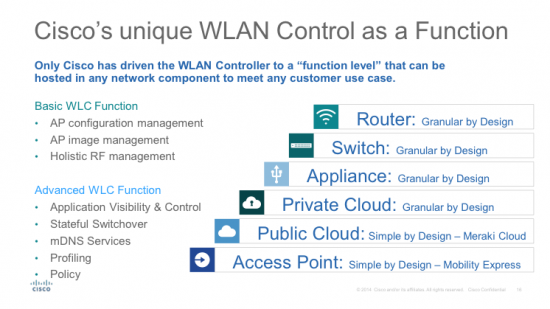
For the last five or so years Cisco has introduced multiple offerings whereby wireless control is a network function integrated into the network. This control can live essentially anywhere in the network example. It is deployed within our Catalyst 3850, 3650 and 4500 Switches that support the converged access network deployment mode. It can be deployed within our Cisco Integrated Services Routers (ISRs) to bring wireless control functionality to the branch. It can be deployed as a virtual machine in your virtual environment. We have deployed wireless control on our access points for our Mobility Express Solution and of course we have dedicated wireless controller appliances that serve this function. If you take a look at our Cisco Meraki solution, we also provide wireless control from the cloud.

Wireless control is still a critical function of any wireless network solution delivering both basic and advanced functionality to meet any customer use case:

WLAN Control_GD blog

You may ask, “Why does Cisco have so many ways of providing this function?” The answer is simple. We do not live in a one size fits all world and Cisco has been dedicated to meet the needs of today’s smaller to world’s largest organizations without asking them to compromise.

Together, Cisco and our customers are moving to a new digital reality and this is only one example of how Cisco has been leading this change.

Because these functions are as vital today as ever, the need for wireless control anywhere and everywhere is necessary. The control function will always be there as it is required for ease of automation and assurance. In the future, it may not be a physical appliance but instead reside anywhere in the network.  It can be tailored to different users from allowing advanced users the ability to reconfigure through Command Line Interface, WebUI to open API or be a plug and play function that has the best practices installed by default. Additionally Controllers may evolve to supporting IoT technologies and newer protocols.

It is our goal to do what is right for our customers and the industry as a whole and that means the way we deliver technology has to evolve as new opportunities and changes industry show themselves.

Authors

Greg Dorai

Senior Vice President & General Manager

Cisco Switching

Avatar
London Financial Centre

Over the past few years, I’ve attended Gartner’s Data Center Conference in London (see 2013, 2014, and 2015 !). As always, it was a very informative couple of days with some surprises, and one or two “I knew that would happen” moments – we’ll I like to think that anyway.  Here are my top 5 observations – it’s not an exhaustive list, just what I found particularly interesting. Continue reading “Top 5 Takeaways from the London Gartner Data Center Conference 2016”

Authors

Stephen Speirs

No Longer at Cisco

Avatar

Paella, Tapas, Spanish reds, thin slices of Iberian Ham, Antoni Gaudi, and a twisty walk through the Gothic Quarter. Yes, I’m talking about Barcelona! And it was there, in the “Head and Hearth of Catalonia” where the 2016 European Utility Week was held November 15 – 17.

barcelona hero

Walking the floor reminded me keenly of how far we have come in this previously antiquated business sector. This was one of the highest-tech utility trade shows I’ve attended, where network connectivity was the core around which all else revolved.

Hub theaters included Energy Revolution, Intelligent Buildings, Smart Gas & Smart Water, Intelligent Grid, and Big Data & Analytics. This is a far cry from the analog/serial-heavy shows of only a few years before. We saw a large presence by some of the big data and computing players like IBM, Accenture, Oracle, SAP, Intel, and others, demonstrating that data management and cloud-based systems are taking the lead as a critical component of the digitized grid.

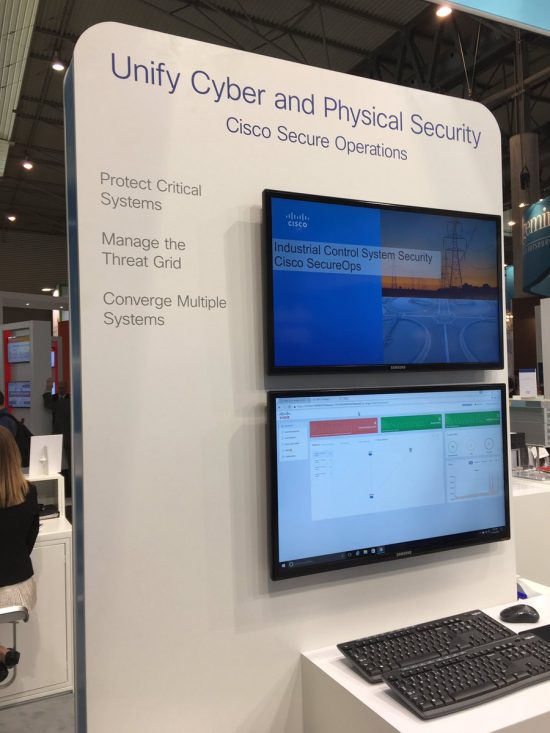
As expected, Security was a prime topic of most booth visitors. Our ISA-3000 generated a lot of interest, and its access control, advanced threat detection, and defense-in-depth capabilities drew heavy attention as utilities struggle to lock down their systems from prying, malicious acts.

CxY4R5oW8AMBZ0S

A surprising area of interest for many attendees was our connected fleet and field workers display, where we demonstrated our IR829 Industrial Integrated Services Router. With asset tracking so important to our customers, the IR829 allows field trucks to become fully integrated into the utility network, pulling data over long distances through 3G and 4G connections, and enabling the truck to become a big wireless hotspot.

With a built-in GPS and GEO Fencing capabilities, the network will recognize when a vehicle arrives at its location, and the system can promptly download data and repair manuals. With the new augmented reality headsets in the works, the future looks very bright for this segment. I’ll talk more about augmented reality in a future blog post.

With ongoing migrations from TDM to MPLS, and Substation SCADA and Telemetry equipment moving to a packetized infrastructure, Cisco’s ASR 900 family of routers attracted a steady stream of visitors. Our Unified Operations Network station demonstrated the powerful capabilities of our serial interfacing CGR-2010, and also on display were our IE-2000U, IE-4000, and the IE-5000, bringing substation protocols like 61850, Goose, or DNP3/IP to our customer’s networks.

CxdO0YuWIAA-h-m.jpg_large

There was so much to see, like our LoRaWAN station, the Field Area Network Director Meter Interoperability station, Asset Monitoring station, and our Distribution Automation Optimization with Eximprod station. A steady flow of a truly international audience kept our staff busy and engaged with exciting and interesting opportunities! This was the first trade show I’ve seen where security had to ask visitors to leave after the floor hours had expired.

With Cisco’s Digital Utilities Validated Network Designs, our customers can pull their legacy systems into the future, offering them security, reliability, and a unified plan to digitize their grid infrastructure. There’s really never been a better time to Connect the Grid!

You can find out more here:

page-cta-2


Authors

Jon Judson

Marketing Manager

Industry Marketing

Avatar

There is a great deal of focus in the world today on gender equality.  Women are being given an equal chance to prove themselves, to work their way up the corporate ladder and hold executive leadership positions. If they so choose. Doors that were once shut tight, have now been gracefully and respectfully opened.

But with these new opportunities, comes tremendous pressure. There is a huge stress on women today to lean in and sit at the table. Women can have it all. Women can do it all. But what if you don’t want that? What if, that managerial position or executive position is really not what you want, not what you are striving for, not your life’s dream? What does that make you?  What does that say about you?

I have never been in the Operating Room of a hospital after a critical lifesaving surgery, but I would imagine it is not such a pretty sight. And while the real life saving is done by the very (hopefully) experienced and skilled surgeon, it takes a team of doctors, nurses and staff who perform their individual roles and work together to ensure the most successful outcome. It’s the anesthesiologist who carefully monitors the breathing and vital signs of the patient ensuring they don’t wake up in the middle of surgery, the scrub tech who handles all the sterile equipment, the support technician, the OR nurses, and probably a team of students who are there to observe and learn, but may also assist the team with various tasks. Each person plays a critical role. Each person on the team is valuable. Each person is necessary.

But let’s take one step back even further…

The person who comes in to clean the OR. The person who sterilizes the equipment. The nurse (or volunteer or maybe a person doing community service) that packs and prepares the surgical equipment.  The technician who checks the equipment to ensure it is working perfectly. The cleaner who comes in and cleans up the mess from the previous surgery. Each and every player is vital to the smooth running of the OR, and the saving of lives.

So, if your ambition is to be a top executive or some high power/high profile role, then go for it. Give it everything you have. Attitudes and perceptions have changed, the world is your oyster. But if you are happy where you are and you have no desire to climb the corporate ladder — if your position or role brings you satisfaction, then hold your head up high. Continue to love what you do and do it well. Keep on celebrating who you are and what you bring. It takes a village to raise a child, and a team to make a company successful.

It’s not always about being in a position of power, but rather being powerful in your position.

Authors

Martine Alperstein

Project Manager

GSS Americas

Avatar

Mody University’s focus is delivering quality STEM education to women from all around the world. Their vision goes beyond transforming the educational experience to also ensuring a connected student experience.

Embarking on a bold digital journey, Mody University saw the wireless environment as the foundation of their connected learning vision. However, the university had outgrown its initially leading Wi-Fi environment. The advent of BYOD (bring your own device) placed added burden on the existing network. Additionally, faculty were looking to leverage video and other global resources within the classroom and students required connectivity to educational resources from any location; gone were the days of trekking to the Computer Center for access.

Screen Shot 2016-11-21 at 11.22.02 AM

To bring their connected learning vision to life, Mody enabled high-speed digital learning with a Cisco Catalyst Switching network foundation, advanced bring-your-own-device capabilities using Cisco Aironet access points, campus protection using Next-Generation Firewalls and simplified IT management with Cisco Prime Infrastructure and Smart Net Total Care Service.

Since the deployment, Mody University has increased their recruitment and retention rates by transforming global access to resources for students and teachers while also ensuring students can connect with confidence to remote family and friends.

To learn more about Mody University and their partnership with Cisco, read the full case study here.

Authors

Sangita Patel

Cisco SD-WAN, Routing, Cloud Networking Marketing Lead