Avatar

As a software engineer, I like it when things work together in new and surprising ways. And especially when they work together to be even better. Like when my Amazon Echo talks to my Nest, my WeMo light switch, or my garage-door opener. Which makes me wonder: When I’m working, why don’t all my tools talk to each other the same way?

Don’t get me wrong – I’m really proud of our Cisco Collaboration tools and how they work with each other: Cisco Spark with integrated video calling, Jabber integrated with Unified Communications Manager, virtual meeting rooms integrated within WebEx.

Why can’t everything else be as simple to use? Why can’t these same tools talk to my email client or other productivity tools? And why, if I’m repeating the same task, do I have to keep doing it? Why can’t my machine figure out that repetitive, mundane task and just take care of it for me? With the advent of cognitive intelligence, there must be a way to make collaboration even better.

I asked these questions over and over, and my team decided to do something about it. So they went and found the best technology gurus to help make things work together. The result? Cisco and IBM coming together in a global alliance to enhance collaboration. This is really interesting. And very exciting, because we are putting our collective expertise toward integrating your business conversations across all channels.

Not only are we working together to have our collaboration technology connect to IBM’s productivity tools, we’re going to leverage the power of Watson. Yes, that Watson. Imagine that kind of cognitive intelligence coupled with our collaboration tools!

It starts with collaboration services that talk to each other, so you can talk to anyone. IBM Connections Cloud Social and IBM Verse will both be “Cisco aware,” giving them a wide range of collaborative enhancements, including better integration with Cisco Spark and WebEx. Cisco Spark and WebEx will be similarly “IBM aware.” This means that you can host a meeting or call a coworker almost instantaneously from a variety of enterprise applications. Likewise, collaboration tools will have integrated enterprise cloud features.

Together, IBM and Cisco are building an open, integrated platform that will foster inspiration and innovation. We’re using the power of the open cloud to bring together key applications that we need to be our most productive. This platform will capture and understand not only our documents, but also the way we work together.

This integrated platform will leverage the power of Watson to analyze the unstructured data in our conversations, content, and workflows, providing insights and expertise to continuously improve the way we work.

Together, we’re creating an intelligent fabric that connects all collaboration workloads. I like to call it “Intelligent Collaboration.”

This is just the beginning of our new alliance. Over the next few months, we’ll share more details about new integrations and capabilities that combine our collective strengths.

It all comes down to simplifying communication, making it more intelligent, making it incredibly intuitive and easy. In short, making it work together to be better. That’s the future of enterprise collaboration – Intelligent Collaboration.

For more information, read the joint press release, check out our Partner page, IBM’s blog post, or see what’s happening at Cisco Live in Las Vegas.

Authors

Jens Meggers

No Longer with Cisco

Avatar

One of your customers’ top priorities IS securing their network.

By now you’re more than versed with the pitfalls of security vulnerabilities and you’re using that knowledge every day to educate your customers. Have you seen how focused we are on security? You could say we’ve become passionate about it. We’ve changed our philosophy beyond just point products by baking that security intelligence throughout the entire network.


As Wendy Bahr mentioned in her blog, we live in a hyper-connected digital environment that requires different thinking for protection throughout the network and all phases of the attack. The threat landscape is real, hackers are smart and they will do everything in their power to exploit vulnerabilities. It’s both terrifying and amazing this has become our new reality. The positive is that Cisco’s threat centric architecture approach has proven so effective that we are winning customer praise, industry awards and analyst recognition!

Security Image for MC Blog

Now is the time to act.

These awards are giving us momentum that we need to capitalize on, and it’s presenting partners and Cisco alike, with an opportunity. An opportunity to educate customers and ultimately increase relationships with them through trust. Data is a precious commodity not only as your customers’ lifeblood, but as currency for hackers. Now is the time to expand your security practices, and we want to help! Use the Engage suite to reach your customers through campaigns and spark conversations with your customers to protect their networks.


Not sure where to start?

Start with the campaigns, programs and promotions in Partner Marketing Central. If you have marketing funds available use them to create demand with new or expanded campaigns. Enlist the guidance of our marketing experts and visit Marketing Velocity to brush up on your marketing skills through training courses and the wide breadth of best practices to pull from.

sec

Wendy also cited that famous line from Jerry Maguire, “Help me, help you.” I think another phrase from that movie also applies, “Show me the money!” (Probably not to your customers!). In the coming months, Cisco security will continue to gain momentum. Through multiple industry events and our continued focus on security. Now is the time to engage your customers. I would also ask that you help us, help you by sharing the positive news and awareness garnered with your customers. Use this to your advantage, and win with Cisco.

jerry

As a parting thought, remember that your security practice is so much more than a transaction. You’re creating a trust network based on a foundation of confidence in you and Cisco. Thank you for the partnership!

I welcome your feedback and questions.

Avatar

A really fun day was held by all at the Ersi International User Conference in San Diego. Over one hundred and fifty delegates lined up to use a Cisco selfie-stick to take a ‘selfie’ against a Cisco San Diego photo back drop. Then they had to Tweet it to their followers with the hashtag ‘#NeverBetter’. Today they will be asked to Tweet with the hashtag “#ESRIUC” denoting the Esri User Conference.

HUGE lines at #EsriUC

This has started conversations on ‘Why is Cisco here’ – conversations we often set off when Cisco grows into new markets. At this event we’re discussing Cisco and Esri working together to address customer demand for fast and secure GIS (Geographic Information Systems) solutions. My previous blog “Esri and Cisco Help You Visualize Data More Easily – See Us at the Esri User Conference!” gives you more details of the event and the Cisco presence.

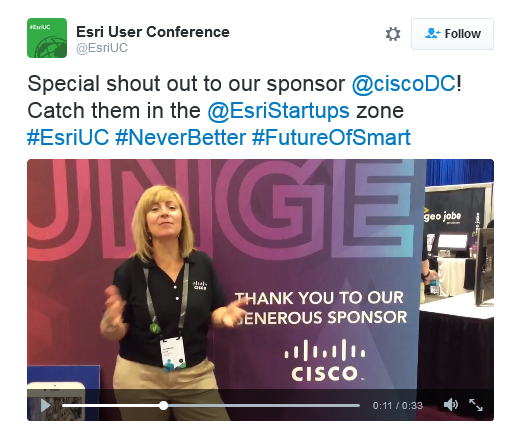
Here’s Annemarie Link from Cisco explaining what to do to get a selfie. Remember today the hashtag has changed to #ESRIUC.

Use hashtag #ESRIUC today!
Use hashtag #ESRIUC today! Click on the picture to play (adjust sound up!)

…and since the video was taken yesterday (Tuesday) Annemarie is really saying come by Wednesday (and Thursday!).

At the Esri User Conference there will be ample time to discuss with Cisco Subject Matter Experts (SMEs) these topics:

  • How Esri and Cisco are working together to improve the user experience. Esri, OSIsoft, and Cisco are exploring ways that will provide this new virtualized environment easily to users – an Internet of things (IoT) solution for asset-insensitive utilities and manufacturer customers.
  • How Industries such as power utilities and manufacturing are benefiting from a secure scaleable environment that can be provisioned in minutes, not hours or days. With our partners Esri and OSIsoft we’re providing a more efficient, safe, and cost-effective operation capability.
  • How we enable Smart City solutions that empower both government and the private sector to work together to provide improved services and greater responsiveness to citizens.

I’m looking forward to our conversations in San Diego at the Esri User Conference. Find us in the lounge area of the Startup Zone – that’s Booth UNB2.

To receive future blogs straight to your inbox:

subscribe

Authors

Peter Granger

Senior Sales Transformation Manager

Avatar

Traditional IT jobs are morphing, requiring new abilities. Not only that, but technologies are moving faster than the expertise needed to grapple with them. Without a rich talent pool armed with the latest IT skills, organizations cannot fully realize the business outcomes, productivity gains and efficiencies they need to thrive. That’s why we are continually working to ensure there is a robust collection of resources available to help individuals – and organizations – gain the skills they need to be competitive.

Although every individual has different needs when it comes to training, there is one commonality – everyone needs the right resources for their specific learning style. That’s why Cisco offers an array of learning and skills development materials ranging from instructor led training from authorized Cisco Learning Partners to self-study tools. Cisco has been developing and publishing the leading Cisco certification and network technology exam preparations and study guides through Cisco Press for the past 20 years.

(GaudiLab)Shutterstock
Photo via Gaudi Lab on Shutterstock

It’s been our goal as an organization to create an industry benchmark by aligning with industry job roles and to provide the talent needed for organizations to thrive in today’s fast paced digital world. We continue to evolve our certification program to help professionals obtain the skills they need to align with emerging technologies, including the recent re-vamping of our Cisco Certified Network Associate (CCNA) Route and Switch curriculum, one of the most widely held IT certifications. Through our certification and training program, we offer a non-traditional environment to learn and obtain the necessary skills needed to fill the technical job roles of today through public-private partnerships, apprenticeships, self-study courses and other innovative forms of learning helping to build the workforce of the future.

To truly succeed in this, learners must be empowered with the resources they need to help themselves. Cisco and Pearson Education established Cisco Press in 1996 to further our commitment to provide current and future technology professionals with the training and information they need to succeed.

As the needs of the industry and customers grow and change, so has Cisco Press evolved. Today the program delivers an assortment of certification preparation tools — including books, flashcards, videos and more — across all Cisco technology tracks. Learners can choose what methods work best for them, enabling their chances of success. Combined with hands-on instruction and e-learning, Cisco Press’ self-study materials complement our recommended learning path.

AR75984

As we move into the publishing program’s third decade, Cisco Press continues to provide publications on Cisco’s innovative technologies, successful certification tracks and Networking Academy program courses. These materials incorporate new and emerging technologies, such as cybersecurity, the Internet of Things, Software Defined Networking (SDN)/network programmability, and data analytics. We’re looking forward to continuing our work with Cisco Press and preparing the workforce of today for the challenges of tomorrow.

Interested in learning more about the self-study resources available through Cisco Press? Visit the Cisco Press Lounge now.


Authors

Tejas R Vashi

Senior Director, Product Strategy & Marketing

Learning@Cisco, Cisco Services

Avatar

Well, we do not stand still for long…at least our R&D teams don’t!

The breadth of our solutions for Big Data and Analytics continues to grow, as we are pleased to introduce Cisco’s UCS Integrated Infrastructure for Big Data and Analytics with Cloudera and Apache Spark.  Working with one of our key Big Data ISV Partners – Cloudera – our Engineering teams have created this new Cisco Validated Design, downloadable for free here.

Apache Spark is a fast, general-purpose engine for large-scale data processing. With Spark, more enterprises are adopting Hadoop and gaining the capability to process a much wider set of workloads, including streaming and machine learning.

Two common reference architectures for Spark on Cisco UCS are available on Cisco UCS C-Series Rack Servers: one adds Spark processing on Hadoop infrastructure, and the other enables stream processing with Kafka or similar technologies. Continue reading “New! Cisco UCS Integrated Infrastructure for Big Data and Analytics with Cloudera and Apache Spark”

Authors

Rex Backman

Senior Marketing Manager, Big Data Solutions

Data Center and Cloud

Avatar

Hundreds of government officials, leaders of both business and academia, and young entrepreneurs joined the New Cities Foundation 2016 Summit in Montreal last week. Montreal, proven to be an ideal host for the summit, as only one week earlier it earned the “Intelligent Community of the Year” designation, awarded by the Intelligent Communities Forum to the city that best demonstrates a culture of urban innovation that advances the community to benefit its residents and local businesses.

This culture of innovation was the backdrop and set the tone of the two-day New Cities Summit—an event proudly sponsored by Cisco and its Smart+Connected Communities team. The summit explored the intersection of people and technologies, where we take opportunities to create better places to live, work, learn and play, ultimately reshaping the urban landscape. Although the tech industry is a driving force of so-called smart cities, the wonderful discussions throughout the week unequivocally centered on the notion that it cannot just be the introduction or evolution of technology that makes a city smart.

This seems obvious—although surely we in the tech world still are often caught pushing others and ourselves toward a technology-focused definition of what a smart city means. But as discussed at length during the show and beyond, we must give up on positioning technology for the sake of technology. Like myself, Anil Menon also freely admits that technology is an enabler that leads to innovative and unprecedented outcomes. Giving city leaders more tools to run productive operations and reduce capital cost, to offer higher quality services and experiences to its constituents and local business, and allow municipalities to differentiate themselves to compete for the best workforce talent and key investment opportunities.

In the face of growing political, environmental, and economic challenges, cities cling to what inspires their unique identities. Yet in our increasingly complex world of endless digital connections, cities also seek to redefine themselves. Those defined as a smart city understand that we’re at a key phase of urban evolution that requiring that city leaders take advantage of digital capabilities and innovative culture shifts to address rising challenges and opportunities alike. Still, we cannot forget the human element. The discourse at New Cities Summit referred to this as cities that thrive with Urban Tech. People first, technology later; yet, an unyielding and relentless focus on creating efficiency, opportunity, value, and new experiences.

During the summit, I had the pleasure to participate in a panel discussion with some amazing thought leaders and visionaries: the CTO of the City of Washington DC and the Chief Innovation Officer for San Francisco Transit Authority. The topic of our debate was the role of open data in the public domain. We touched on the technical requirements and challenges of sharing and securing data sets—agreeing that where there is a will, there is a way, and technology hurdles can be overcome.

IMG_4765[2]

The barrier I’d like to address is a question of culture. Open data requires open government, a willingness to expose data sets and invite the public to actively participate in conversation for how to put this data to good use. Governments and city leaders cannot be afraid of over-exposure, it’s ultimately inevitable for processes to be inefficient and become obsolete. It takes courage to invite the public into the conversation and collectively look for ways to create new value and opportunities for your community. The question for public leaders, however, remains. How much data do I expose and what is it that I want to achieve? One must then justify the cost of cleaning (not necessarily surprising, but not all data is valuable data), preparing, curating, and presenting data. And address where the data might securely reside. I do submit that it’s more common to not know the real value of open data until collaborative exchanges take place (like organized hackathons and partnership opportunities with universities) and out-of-the-box thinking becomes the new norm. And as we on the panel agreed, the answers to these poignant questions will remain open-ended for the foreseeable future.

The New Cities Foundation put forth an inspiring message during last week’s summit—If you want to go fast, go alone. If you want to go far, go together. It cannot be denied that the application of innovative technologies is propelling our communities towards productivity, environmental sustainability, and economic prosperity. But when cities work together with the private sector, entrepreneurs, academia, and the public at large, amazing things can happen and true innovation will take place.

Authors

Rick Huijbregts

Vice President

Smart Connected Communities

Avatar

Last week was quite eventful, certainly unpredictable and some would probably say chaotic.

I am a big soccer fan, so with the Copa America and the Euro 2016 tournaments happening, I certainly could scratch that itch. And as always, it is more art than science to predict the results (Iceland winning over England anyone?) and we are treated to memorable outcomes.  Now the world knows there is more to Iceland than being a great place, or even paradise, to build and operate datacenters.

One of the other memorable aspects for me came at last week’s Velocity Conference during the Ignite Sessions when attendees learned that “AWS is Chaos Monkey as a Service”.  As far as predictions go for moving and running applications and workloads in the cloud – it’s happening. See the Cisco Global Cloud Index for some concrete data points and forecasts. Yet with applications based on microservices architectures running on containers, the consumption can be potentially chaotic. This is where DevOps enters the picture helping to bring order to chaos.

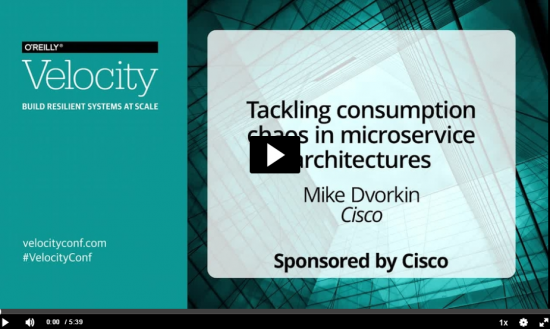
Cisco’s Mike Dvorkin gave a keynote talk that I think you will find interesting to watch in case you missed out at last week’s event. Stating that DevOps exists to run applications, but in many cases, the focus is on the micromanagement of every elemental detail – no focus, or understanding, of the application. This breaks down in two fundamental ways. First, there is an explosion in the number of application service definitions.  All of them hardwired for specific use cases, environments, and circumstances related to various stages in the application life cycle. Second is the dependency chaos resulting from a lack of mechanisms to control the consumption of application services. These problems are closely related. The missing piece is how service resources are allocated to their consumers, and how such allocations can be controlled in a consistent, abstracted way – devoid of understanding of instance, architecture, and environmental detail.

Mike discusses the principles and benefits of a controlled consumption model, and its implications to DevOps processes and security in his keynote talk at Velocity Conference. You can watch the recording of his talk here.

Velocity Keynote
Mike Dvorkin Keynote: “Tackling consumption chaos in microservice architectures”

Other memorable moments last week included talking to developers, DevOps Engineers and Ops Managers, and listening to how we could help them in their day to day work. We demonstrated that Cisco sponsors several open source projects.  This included a demo of Policy based Infrastructure for Containers with Project Contiv,  Cisco UCS Manager integration with Puppet and a DevOps Model with Cisco and Ansible. Of course, handing out Cisco DevNet T-shirts and having a raffle always proves to be a fairly predictable way to help draw a crowd.

Speaking of crowds, we certainly expect a large one at the upcoming Cisco live! in Las Vegas, July 10-14. Next to visiting the DevNet Zone, I encourage you to plan and schedule your DevOps Sessions.

In case you care about who will win Euro 2016, the final is on July 10.  Since you will be in Vegas, maybe place a bet. Good luck with your prediction on the outcome. I am pretty certain it’s a safe bet Cisco live! will be yet another great opportunity to learn, engage, and make more memorable moments. It may just be organized chaos. See you there!


Image Source: Pixabay

Authors

Klaus Schwegler

No Longer with Cisco

Avatar

HAK28840

One of the best things about the Cisco initiative of “There’s Never Been a Better Time” is the way that businesses—and our world as a whole—are transforming for the better. With digitization, simple tasks that used to take a half hour are cut to just minutes. Allowing employees to work from home—and establish a better work-life balance—is also a part of that digitization transformation.

No company has shown that spirit of digitization more than the world’s largest appliance manufacturer, Whirlpool.

The company recently realized that the reason why their network struggled was because it was a hodge-podge of old and slow devices that was constantly breaking down. Whirlpool knew that they had to act quickly as the old network configuration was difficult to troubleshoot and became expensive to fix.

When they needed a modern upgrade, Whirlpool chose Cisco. With products such as Cisco Aironet 3600 Series Access Points, Cisco Catalyst 3750-X switches and Cisco Catalyst 2960 switches with 10 Gigabit Ethernet, Whirlpool was able to deploy a top-notch infrastructure that is centrally managed by Cisco Prime. The hardware and software work hand-in-hand to create a culture of digitization that has shrunk Whirlpool’s world, allowing for better collaboration and better communication company-wide.

After the network improvement, digitized endeavors began to roll out. One was empowering a mobile workforce. “People can go to any location, plug in a laptop and work like they’re in the office,” said Greg Fisbeck, Program Manager, Whirlpool Corporation. “And with a global IT standard, it’s much easier to run a transglobal business process.”

And Whirlpool’s new network truly spans the globe: the company has started a program to upgrade up to 20 locations per year from the United States, Europe, China, India and Brazil. There are 85 global sites to complete and Whirlpool’s key target is 99.99 percent availability. Fisbeck is confident that Cisco equipment will keep Whirlpool digitized for a long time.

“We didn’t want to have to come back in a few years and do another refresh,” Fisbeck said. “So we chose Cisco as our global standard.”

To read this full case study, click here.

Authors

Byron Magrane

Product Manager, Marketing

Avatar

Cisco Live is coming up on July 10-14, 2016 in Las Vegas. Will you be there? The event is geared to help IT, networking, and communications professionals capture the value of the Internet of Things (IoT). At the event Industrial IP Advantage will show its new eLearning courses focused on designing IoT-enabled industrial network architectures. Perhaps this eLearning is just what you need to bolster your training.

Are you ready to address the skills gap?

Cisco Live As we all know, operation technology (OT) and information technology (IT) professionals have historically had distinct roles and responsibilities. With the emergence of the Internet of Things, the responsibilities of IT and OT experts have blurred.

To maintain plant productivity and take advantage of the full benefits IoT has to offer, IT and OT professionals are required to learn new skills to help them collaborate. IT professionals must now maintain networks and devices in industrial settings while OT needs to gain insight into helping manage the deployment, management, and troubleshooting of Ethernet devices.

To help bring these two teams together to develop and deploy future-ready networks, Industrial IP Advantage has developed eLearning courses that teach critical network design skills in an interactive, self-paced environment. These courses – including the latest course on the industrial zone – will be available to demo at Cisco Live. You can stop by booth #937 to test your knowledge on managed and unmanaged switches, network topographies and EtherNet/IP. Subject matter experts from Cisco, Panduit, and Rockwell Automation will also be on hand to discuss your specific requirements, challenges and business opportunities.

Social media caption contest

In addition to grabbing a promotional code for free training, there’s another incentive to make sure #937 is on your itinerary. Industrial IP Advantage is hosting a social media photo caption contest. Do you have a Twitter or Facebook account? If so, you’re already on your way to win a prize from Industrial IP Advantage.

At Cisco Live, stop by and snap a photo with the booth props. Share the photo on Facebook or Twitter using the hashtags ‘#TrainYourIPBrain’ and ‘#CiscoLive,’ to be entered to win a free FitBit!

For more information on eLearning opportunities offered by Industrial IP Advantage, please visit: http://www.industrial-ip.org/en/training

To receive future Manufacturing blogs straight to your inbox:

subscribe

Authors

Peter Granger

Senior Sales Transformation Manager