This week, the Cisco Education team attended the annual ISTE (International Society for Technology in Education) conference, an event for educators and technology supporters.
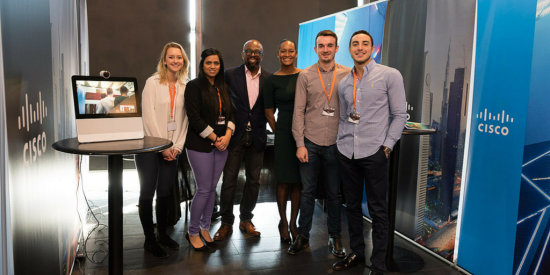
Throughout the three-day conference, our team learned from educators, thought leaders and experts from around the world. In addition to attending breakout sessions, keynotes and panels, we also teamed up with Cisco Meraki to introduce educators to our technologies through a booth on the expo floor.
To highlight the impactful conversations, discussions and key insights learned, here are seven quotes from ISTE that sum up the meaningful change that these education leaders hope to achieve through technology.
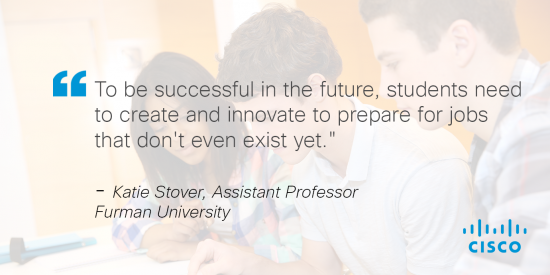
This assistant professor of literacy and education urged educators to consider what the future job force will look like. To prepare students, we need to alter the curriculum and learning methods to better equip students.
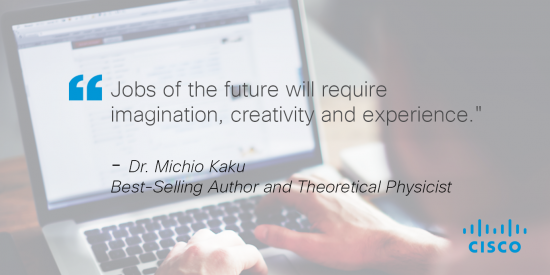
World renowned physicist Dr. Michio Kaku spoke to the future of education, proclaiming that transportation, medicine and education were the next industries to be digitized.
This quote, from a panel on project-based learning, encourages teachers to provide meaningful instruction and projects to allow students to drive their own education.
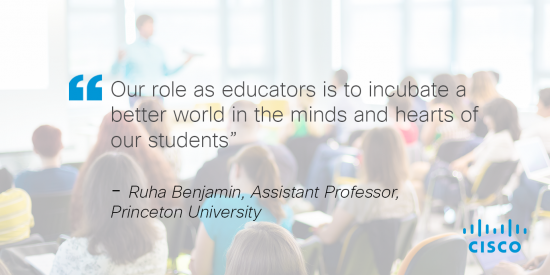
This Princeton University professor urges educators to invest in the next generation and encourage and prepare students for the future.
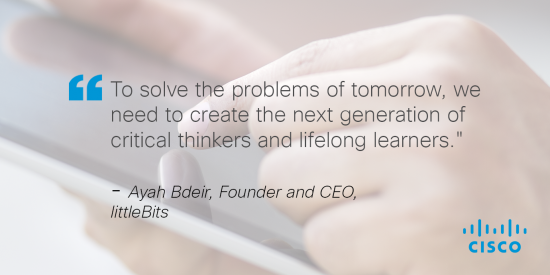
Ayah Bdeir, Founder and CEO of littleBits, shares the value of curiosity and problem-solving in education.
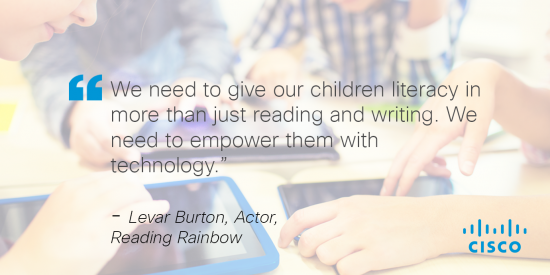
Levar Burton, best known for his role in Reading Rainbow, says that literacy goes beyond reading and writing and now extends into new modes of literacy, like coding.
All photos via Shutterstock
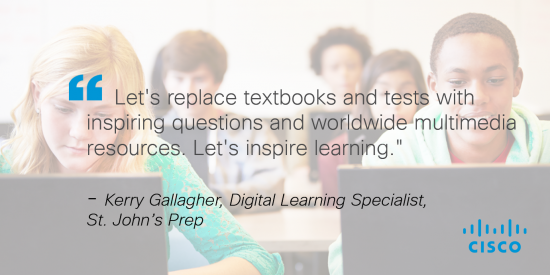
Kerry Gallagher tells educators to inspire students through multimedia resources, not just traditional learning tools.
Want to learn more about our presence at ISTE? Read this blog to learn more about our booth and demos.
So we continue with our series on Mobile Video, today we are taking a look at Verizon’s go90 service.
go90, is the Verizon all-in-one mobile entertainment app that brings together live music, live sports, original shows and TV favorites giving users access to more than 21,000 titles and more than 50 exclusive original series anytime, anywhere in the U.S. – all from a smartphone or tablet. Verizon has reached agreements with broadcasters including Comedy Central, Discovery Channel, ESPN, The Food Network, as well as web video producers including AwesomenessTV, Machinima and Vice Media. Users can get a front-row seat to some of the biggest musical performances with the go90 Live Concert Series and streaming of the most-buzzed about exclusive originals from some of today’s hottest creators and stars.
Since early February 2016, all go90-registered Verizon Wireless post-paid customers can watch all of their favorite go90 video content anytime, on Verizon’s LTE network as part of go90’s participation in FreeBee Data 360’s sponsored data service.
Target Customers
Verizon is targeting their mobile customer base, specifically young users by developing go90 on smartphones using a free, ad-supported model. The service is courting under-25s who circumvent traditional pay TV. Surveys conducted by Animoto discovered about millennials:
Nearly half (48%) of millennials only watch videos on their mobile device.
80 percent of millennials consider video content when researching a purchase decision
7 out of 10 millennials are likely to watch a company video when shopping online
76 percent of millennials follow brands on YouTube
60 percent of millennials prefer to watch a company video over reading a company newsletter
Verizon’s move follows similar moves by competitors. For example, Dish Network launched its OTT live television service Sling TV in February 2015, and cable companies have started offering ‘slim bundles’, which feature a smaller selection of channels at a lower price. However, with Go90, Verizon is going further, specifically by trying to establish a footprint within the segment that considers the smartphone to be the primary screen for consumption: 18-24 year-old users spend 4 hours per day on their phones (60% more than the national average – eMarketeer). Go90 also features certain social media capabilities to capture some of the 20 minutes per day that smartphone users spend on average using social media on their phones.
The go90 Difference
A big differential factor for Verizon is not restricting access to Go90 to its own customers, which means that the service presents a wider disruption to the video market and potentially promotes the Verizon brand to a wider youth audience. Intrinsic to this aspiration to disrupt is go90’s integrated social media environment: the service promises to let users easily slice and share short clips of its content, which it hopes will gather some viral momentum.
The goal for go90 was to enable Verizon to capitalize on data from its wireless customer base in a targeted and scaled way to connect consumers with advertisers. Within the company’s broader video strategy, go90 captures and aggregates the audience, provides mobile-first content, and creates incremental ad-generated revenue.
Unlike many other OTT services, Verizon’s go90 offers some unique social media aspects including the in-app ability to comment, chat with friends, follow shows and celebrities and even cut a segment of live video and share it with friends on Facebook and Twitter.
go90 Today
“I think we had always internally viewed go90 as what we call patient money inside the business that we knew, because it wasn’t our core competency, we knew we were going to have to build slowly in this area. And the way I would characterize it, we have seen enough success to make us excited about continuing to work it. But we didn’t believe, and I think it did get a little bit overhyped.” – Lowell McAdam – Verizon Communications Inc. – Chairman & CEO
go90 illustrates Verizon’s broader strategy on the programmatic platform.
“The main goal for go90 is to gain viewership”, said Verizon Wireless Executive Vice President and CFO Fran Shammo during the company’s fourth-quarter 2015 earnings call.
In my previous blog, I shared an overview of fog-based security services. At the center of these services—and critical for moving the needle on the Internet of Things—is a requirement for ubiquitous malware defense for a large number of devices with vastly diverse capabilities.
Through fog, this is possible. Malware-defense tasks, which require heavy resources, large storage space, timely processing, and global intelligence, can be moved to fog nodes near the protected devices and systems. We can distribute malware defense capabilities across a cluster of fog nodes. As a result, each fog node can have the same, or complementary, threat defense capabilities. This approach makes efficient use of shared resources. It also improves overall security by making it harder for attackers to disrupt security operations.
To be successful, however, the large population of often resource-constrained devices to be protected, such as user endpoints, should only be required to implement lightweight security functions, such as detecting suspicious files rather than high-fidelity determination of whether the files actually contain malware or not. This will greatly reduce the complexity and processing load of the vast majority of the devices to be protected, and also lowering their cost.
What’s really exciting is that the fog nodes can work together to collectively detect whether a file is infected by malware. This technology can even go a step further. The fog nodes can collaboratively help the protected devices and systems respond to compromises—from monitoring the real-time progress of the compromises to assessing their potential impacts to cleaning up infected files to containing suspicious traffic.
Following are a few ways to illustrate how fog-based, distributed malware defense can boost IoT security by providing services to help protect resource-constrained devices, creating a new pathway for innovation:
• Some fog nodes can support one type of malware detection mechanisms (such as signature-based malware scanning), while other fog nodes support additional malware detection techniques (such as heuristic-based malware detection mechanisms). Mission-critical files can be examined by both types of fog nodes.
• Some fog nodes can be responsible for detecting malware targeted at Windows Operating Systems (OS) and can be used to support devices that run Windows OS, while other fog nodes handle malware targeted at Linus or other OSs.
• Some fog nodes can maintain more comprehensive malware signature databases (because of their higher processing and storage capacities and abilities to communicate with the centralized cloud services more frequently and reliably), while other fog nodes may maintain only subsets of the signature database pertaining, for example, to the threats most critical to them. The resource-constrained fog nodes, which maintain only partial malware information, can collaborate with the more capable fog nodes and the cloud to achieve a satisfactory levels of protections.
• Multiple fog nodes can offer the same protection capability for load balancing or backup.
In the scenarios above, each protected device detects suspicious files only.
For example, let’s say an endpoint starts with a known set of authorized files or a “golden image.” Then, any file that deviates from the authorized files can be considered suspicious. This could be anything from files that have changed in size to new files that haven’t been digitally signed by authorized parties.
To detect these suspicious files, a thin software client is all that’s needed. It will reside within the client device itself. And if the client detects something amiss, it will send either the metadata or copies of the files to a fog node cluster for further analysis and assessment for malware.
As a result, we can securely interconnect a significantly larger number and broader range of “things” than possible in today’s Internet. These things range from simple sensors to wearable devices on humans and animals to complex endpoints such as cars, trains, drones, appliances, and robots. Other possibilities are industrial control systems, connected transportation systems, smart buildings and cities, oil and gas systems, and smart energy grids.
In the new world of fog computing, the possibilities will only be limited by our imagination.
In my next blog, I’ll introduce “crowd attestation”—a new way for systems to attest their trustworthiness. I’ll also share methods of assessing trustworthiness of monitored devices.
Though a long time IT guy and Cisco veteran, when it comes to Open Source, containers, really the future of data centers – I’m a newbie! However, this has got to be one of the coolest times to enter this field.
In the Red Hat Summit keynote session, Open Source: The Forefront of Innovation, I am just floored by the pace of innovation happening across the industry and inspired by how the open source philosophy (dare I say theology for some) is enabling change.
David Ward, Cisco’s Chief Technical Architect/standards & academia ambassador/guru of cool tech presented a fascinating talk about how this new approach to data center is breaking down the old IT stacks and ushering in agile service brokered networking, workflow analytics and the open source cloud. You can watch the replay here.
The implications it has for simplifying the management and provisioning of data centers are really compelling. It enables truly application-led provisioning of resources, security, networking all in real-time and based on what’s needed right now. As a noob, I can only imagine the developments we’ll pursue once that agility is harnessed.
Then join Cisco, Red Hat and John Wilbanks (Ted Talks) today for a live video discussion on BLAB at 1:30 pm PT / 4:30 pm ET. We will discuss the need for open source and change in healthcare. You can also watch the replay after the live session.
Note: This blog features content from a Connected Futures podcast which has been edited due to space limitations
For today’s manufacturers, data is every bit as important as supply chains, trucks, and industrial machines. Data is useless if you don’t turn it into insights — and then leverage that real-time information for new efficiencies, services, and business models. Digital transformation — technology change and organizational change — enables the agility that manufacturers will need to compete effectively.
Recently, I had the privilege of exploring how manufacturers are approaching digital transformation on a podcast with Scott Lapcewich, Vice President and General Manager of Customer Support and Maintenance for Rockwell Automation.
Here are some highlights from our conversation:
How do successful manufacturers start going digital?
Scott and I agreed quickly that it’s important to get back to the basics when thinking about going digital – you need an actual plan! Many of the customers that we engage with are excited about the possibilities of digitization and we encourage them think about how their manufacturing operations fit into their overall business goals.
Scott brought up a few additional considerations following the development of your plan:
An outcome of that plan should include what investments are required from both an infrastructure and a modernization standpoint
Once you get connected and your plants are integrated, your data can be captured through an enterprise software application. At Rockwell Automation, we did this with our own plants and use our data to improve output and improve quality.
Finally we suggest integrating your manufacturing operations with both the front end of your business and the back end. Align your customers as well as your suppliers, so you can begin to optimize your responsiveness, inventory and production.
So Scott mentioned data. From my experience working with customers and even internally, data scares people. That includes the volume of data and what it’s trying to tell them. Data for data’s sake doesn’t make sense. The sensor and the data together are powerful.
What advice are you giving manufacturers to optimize performance?
As I said previously, first you need to unlock the data that exists so you can actually start reacting to what’s going on. Looking at what’s there can be scary because if it’s not there and you can’t see it, it’s a great way to hide problems.
When I look at the numbers of sensors coming out and talking, some surveys are 20 billion sensors in the next five years, some are 40, some are 50, but the number doesn’t matter. It’s a huge amount of data from those sensors. What we need to talk about is where did the data come from, what we do with it, how do we do it, and where are you looking at it from. We also need to help our customers understand that data, how they’re either using or not using the data, and how to prioritize that information.
Scott gave some examples of what Rockwell Automation is doing to indicate the health of different assets and generate automated diagnostic information on what’s happening on the plant floor. By building automated analytics into Rockwell Automation programmable controllers and enterprise software, customers can get intelligence coming back from the machines.
We also talked about the significant opportunity to analyze data trends and monitor performance benchmarks to help customers determine specific actions they can take within their operations. As an example, to improve quality they can view long-term trended data to pinpoint what factors may lead to declining quality over time.
How can they master (or get control of) their data?
One thing we always hear from manufacturers is they are getting data and dashboards, but the problem is they have too much data and not enough expertise around the alerts being received. If an alert goes off, they want built-in workflows to call the expert – whether in-house or out.
I asked Scott if Rockwell Automation is building any capability that routes the alerts on devices to a trained operations professional so that customers can start handing it off to automation suppliers.
Turns out it’s not as easy as it may sound. He explained that the challenge is there’s a lot of alarms that occur in a process line in any given day. Some of them are meaningful, some are not. So in terms of being able to set up a managed service agreement with customers, there needs to be collaboration up front as to what the process line is doing, what the key variables and trends are, and how to monitor them to indicate potential issues. Then you can set up the sensors and monitoring capability to identify which combinations of events or alarms indicate a potential pending failure, pending issue, or an issue that’s already occurred.
Rockwell Automation does in fact provide the service of routing alarms to their support center where someone is available to respond 24 hours a day. They can also route alarms directly to a specific domain expert’s desktop – wherever they are in the world – to troubleshoot remotely.
Those are a few of the key takeaways from our discussion. Listen to the full podcast on Itunes and check out our slideshare for more high-level takeaways:
Cisco Live Las Vegas is right around the corner on July 10-14! This year’s theme is “Your Time is Now” to take advantage of what Cisco and our partners can offer to transform your business with digital. Digital puts customers in control, and retailers have a unique chance to leverage today’s new technologies to provide engaging (and profitable) guest experiences. We can help you unlock new opportunities, create differentiation, and grow your business.
Be sure to stop by our Cisco Booth #190e to learn how to digitize your store and create a connected, personalized, and interactive experience for your customers. Please also visit “The Digital Campus” and the World of Solutions.
At the booth, you’ll have a chance to view and discuss Cisco’s digital retail roadmap with our retail experts and experience firsthand demos of some of our leading solutions. In addition, be one of the first to obtain a personal copy of a newly released joint white paper with research partner PSFK highlighting opportunities for the Retailer of the Future.
Top Three Don’t Miss Retail Demos
Transforming Shopper Experiences with a Digital Foundation
The Unified Retail Platform (URP) consolidates your critical store system into a single, flexible platform and delivers a foundation for innovative shopping experiences and business growth, from Wi-Fi to security to mobility to compute. URP is a great fit for branch stores, setups, and popups, reducing truck roll and add-on infrastructure expenses.
Mobile is key to the differentiated customer shopping experience. Learn how you can easily capture customer information and effectively offer context-aware, real-time experiences. We’ll also highlight opportunities for Dynamic Digital Signage that will help contribute to a more interactive digital shopping journey.
See how you can create and deliver the digital experiences your customers desire:
With knowledge of your customers’ preferences and improved store operations, you can provide a better shopping experience. Cisco technologies can help you gather real-time, actionable insights from multiple touch-points to create a 360-degree view of shopper behavior and improve operational efficiencies.
Attend Our Speaker Sessions:
Retail Security – Before/During/After a High-Profile Data Breach
Speaker: Kevin Wood, Retail Practice Architect, Cisco
Monday, July 11, 5:30 p.m. PT
Solutions Theater West
Reimagine Retail with Cisco Unified Retail Platform
Speaker: Kevin Wood, Retail Practice Architect, Cisco
Tuesday, July 12, 1:00 p.m. PT
Solutions Theater East
Deliver Superior Shopping Experiences with Cisco Customer Mobile Experience
Speaker: Jeremy Witikko, Retail Practice Advisor, Cisco
Tuesday, July 12, 1:45 p.m. PT
Solutions Theater East
Wrapping It Up at MGM’s T-Mobile Arena
After all this, you’ll also have a chance to experience Cisco’s solutions and much more at the final Customer Appreciation Event, being held on July 14 at the recently opened T-Mobile Arena! See how Cisco enables MGM to transform the guest experience: Click here to view video.
Register Today!
If you haven’t registered for Cisco Live already, you can do so here. Other contact information:
Orphaned and homeless at the age of 11, I was fortunate to benefit from school teachers, career professionals, and mentors who helped guide me into my future. They saw potential in me, and they became my village because of how dedicated they were in ensuring I had the right tools to succeed. Without them, where would I be?
Those early interventions defined the person I am today, and in providing those inspiring opportunities to me as I was just getting started, they also inspired me to pass this education on to others. I now dedicate much of my time to ensuring those from diverse backgrounds are able to fulfill the span of their potential through mentoring and exposure to the exciting opportunities in Science & Technology (STEM).
In 2012, I founded a social enterprise called “Your Future, Your Ambition” (YFYA) with the help and support of Cisco. YFYA aims to inspire, excite, and engage diverse talent in pursuing careers in STEM through education, experiences, and exposure.
A huge part of Cisco’s culture is teamwork and collaboration, thus I quickly sought the support of like-minded colleagues and more importantly other companies through Cisco’s Diversity & Inclusion networks (another one of my many passions!) Through these impressive networks, I was able to quickly assemble a group esteemed organizations to host an event at Cisco House during the London 2012 Olympics.
The event was a resounding success and a legacy was created.
Fast forward – four years later. In March 2016, YFYA hosted its 5th annual event with over 30 organisations taking part. 1,000 students also attended a wealth of STEM related activities and workshops throughout the day at the Emirates Stadium in London – which is home to Arsenal Football Club.
This 5th event marked the fact that over 3,000 young people had attended YFYA, 700 have received STEM mentoring, and over 100 have received STEM work placements, scholarships, internships, apprenticeship and jobs from the companies taking part.
It is now one of the top STEM events in the UK and has won many awards over the last few years. In addition, I have also received a few pieces of recognition and awards including GQ Magazine’s 100 Most Connected Men in Britain and a National Diversity Award for being a role model.
All of the recognition pertains to my work in Diversity, STEM, and Mentoring through our culture of empowerment, collaboration, and giving back. It makes me always proud to work for Cisco.
Quick Fire Round: Who is Tunji?
Where were you born? London
What did you study? Degree in Microelectronics and Master Degree in Information Systems
What was the last book you read? “Originals” by Adam Grant (my professor at Wharton)
Favorite city? San Francisco
Football team? Arsenal
Charities you support? Teach First & Amos Bursary (I am a mentor for both)
What other jobs have you had? Record producer and running a modelling agency
Favoritism saying? “Time Teller or Clock Builder?”
Next big thing for you? It has something to do with Rio and 2016. I can’t wait to write another blog post about it soon. Stay tuned!
I think the village has raised this child well.
How are you inspiring or mentoring the future?
Interested in working for a company that benefits everyone? Join us!
As many of you know, over the past six months or so we’ve been working closely with our colleagues at Ericsson to help our customers around the world transform their networks, and their businesses.
Since our partnership was announced, customers have been excited to be working with us as one business partner, helping them design, develop and deploy new services and new business models.
By working together, we can simplify customers’ testing, integration, purchasing, and deployment processes, greatly accelerating their time to market.
And not only are we faster together in bringing new solutions to market, but with our combined global footprint, we’re able to serve more customers in more geographies with more whole offers.
In this video you’ll hear from my counterpart, Eva Sparr, and me about the solutions we’re developing and the value we’re bringing to our customers’ businesses.
As Las Vegas glows in the intense June summer sun, another glow is appearing on the horizon. The heat is hot and the ground dry, but the air is filled with sound – I am reminded of a famous America song. Are you wondering what the song could be?
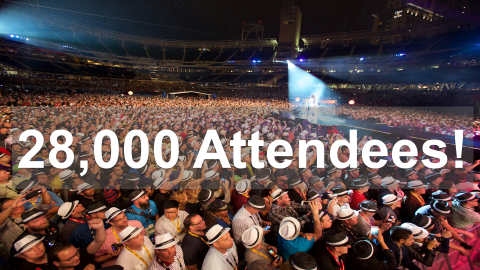
Cisco Live 2016 is arriving in town a week from now, and the city is already getting prepared. Cisco Live US 2016, Cisco’s premier education and training destination for IT professionals worldwide, kicks off next week in Vegas. More than 28,000 customers and partners converge to network and share their experiences, and potentially meet new peers onsite.
Like you, I am eagerly awaiting the keynote set for Monday, July 11, 10.30 AM local time. Chuck will discuss how IT and Network play a key role in the emerging Digital world, and how Cisco’s vision and strategy will help organizations succeed and lead digital transformation.
There are several other additional keynotes , including a Guest keynote by actor Kevin Spacey, a luminary keynote by Jason Silva, and an industry keynote by Cisco CTO and SVP, Zorowar Biri Singh. So prepare your agenda in advance to get a broad exposure.
For the remainder of this blog I will focus on Tetration Analytics and Application Centric Infrastructure (ACI) highlights. The logical place to start is with Tom Edsall and Ishmael Limkakeng’s Innovation Talk on the topic “Next Gen Data Center Part 1: Automation, Analytics and Orchestration” which is scheduled for July 11, 2.30 PM.
Tom and Ish will also be joined by Cisco Exec, Joseph Pinto, as the three of them discuss how customers can achieve pervasive visibility across the data center with Cisco Tetration Analytics. This action packed session includes a demo, ACI and CliQr customers sharing their digital journeys, and highlights from our newest eco-system partners. You’ll also learn how ACI’s jumpstart solutions can pro-actively help ensure your success.
Let us now segue into ACI and the Tetration Analytics Breakout sessions. More than a 100 sessions are dedicated to Tetration Analytics this year at the show. I’d recommend Senior Director Yogesh Kaushik’s session titled “Real-time application visibility and policy management using advanced analytics” as a must-attend. I also recommend Cisco fellow Navindra Yadav’s session BRKDCN-2040, for a close peek at machine learning and Network analytics and how they enhance Data Center security and operations. Plus there are many more, and you can pick and choose from the session catalog?
More than 75 ACI breakouts feature prominently among a large collection of 1,000 plus breakout sessions this year with several experts addressing hot topics in operations, deployment, and eco-system. I recommend a few breakouts I consider relevant to current data center trends and ACI deployments. Dhritiman Dasgupta (DD), Vice President, Data Center Marketing, is presenting a business session and explores the top strategies companies can factor into their planning cycles in building their next-generation data centers over the next 3 to 5 years. DD is an amazing story-teller, and in this session he’ll discuss how SDN, Hybrid Cloud, Analytics, Big Data etc are coming together to create a compelling architectural play.
Many customers have expressed their interest in hearing how ACI helps simplify DevOps operationally in application centric data centers. Harry Petty, Director of Marketing with Cisco systems, brings you exactly that perspective in his breakout session. My own personal favorite, Carlos Pereira, will treat you via both a short (2 hour) and long (9 hr) session. Please check the session catalog for date and time. Rami Rammaha from Cisco Data Center Marketing team is doing a session on topic “Speeding Up Business By Simplifying The Data Centre With ACI & Nexus”, Monday, Jul 11, 5:00 p.m. This session will discuss the Nexus portfolio and clarify how ACI simplifies these elements resulting in a faster, more flexible and responsive IT that better aligns with the business needs of todays rapidly shifting environment.
Most of you by now will be raring to make a beeline to the world of solutions as it is where exhibitors and subject matter experts from various partners and customers of cisco throng to gather insights on what’s new and exciting.
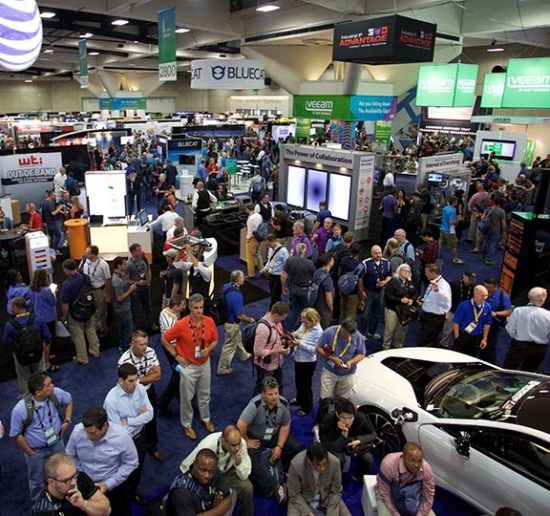
This year, we are showcasing a big collection of solution demos spanning multiple architectures including Data Center, IOE, Security etc. It will take me several blogs to cover them all, so I will stick to Tetration Analytics and my focus area, ACI. Solutions from hundreds of cisco partners are on display in the world of solutions. This is your opportunity to explore the broader Cisco Partner eco-system, find answers for your specific networking challenges, and hear unique perspectives from Cisco engineers and partners, Monday-Wednesday 11.30 – 7.30 PM.
Our ACI and Tetration Analytics solutions and demo showcase focuses on typical customer care-abouts. The demos include Multi-Pod ACI, ACI Security, Cloud Orchestration with ACI, Tetration Analytics, and Cisco CloudCenter. There’s more, so please stop by our Cisco booth for a detailed engagement with one of our subject matter experts.
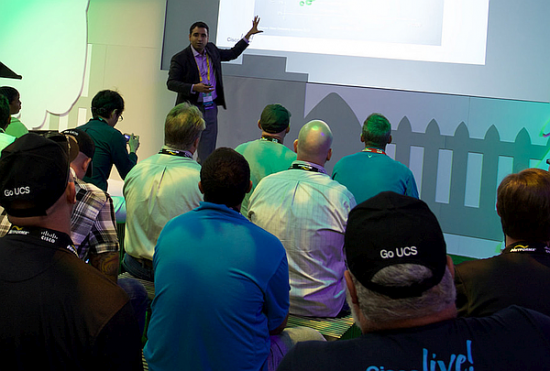
If you have some time, please plan to take in the Theater presentations – it runs every 15 minutes.
These short duration presentations give you an overview on key topics such as how ACI’s open API has enabled a broad L4-L7 eco-system with Citrix, F5, A10, Radware, et al. The session titled “Secure and Accelerate your applications with Cisco ACI” runs on Monday 1.20 pm. I recommend you attend the session titled “CliQr – A path to digitization in a hybrid cloud world” on Tuesday 11.30 AM. These are very highly sought after topics in most of our customer engagements. There are several others you can choose from in the agenda planner.
One of the key pillars that made Cisco ACI phenomenally successful is the Open and Secure eco-system of 50 plus leading partners that have built joint, integrated solutions with ACI. F5, a leading ACI partner on the L4-L7 integration front, have a big booth presence (booth #617) this year as an Emerald sponsor.
F5 has exciting demos and videos featuring Cisco ACI- BIG IP & iWorkflow, OpenStack, SAP with F5 BIG-IP, NFV etc. Please check them out. There are multiple speaking sessions Monday through Wednesday at the F5 booth on “Deploy your Application using F5 iApps in Cisco ACI using iWorkflow.” Several F5 execs will be present in the F5 booth, so you can understand the big picture and strategy behind how the two companies are evolving the SDN landscape. F5 will also be speaking in the DevNet Zone on how programmability helps in easy deployment of applications with F5 iApps and Cisco ACI.
Citrix is another of Cisco’s key ACI eco-system partner. They are lighting up the Partner section with booth demonstrations, speaking opportunities and social media outreach.
Join Citrix at Cisco Live Las Vegas – the destination for the education and inspiration you need to thrive in the world of digital business. Visit Citrix booth 609 to learn about our technology-driven solutions to enable digital business transformation. Meet our technology experts on delivering business agility through datacenter automation and application and desktop virtualization from the leader in secure delivery of apps and data. Stop by our sessions on July 11 at 1:15pm in the Cisco Solution Theater and July 11 at 3pm in the Think Tank Hub: Citrix and Cisco Alliance – Delivering the best load balancing, virtual desktops and application delivery with Cisco ACI. Citrix booth 609 will also hold hourly theater presentations on our solutions with a grand prize raffle of 3-D Printers at the end of each day. Cisco is presenting at the Citrix theater Tuesday and Wednesday 5 PM on topic “ACI and NetScaler joint solution.” We will cover key integration features, benefits and customer adoption. Do not miss this presentation if you are looking to integrate NetScaler with ACI.
There are also new members to the ACI eco-system. Tufin is the latest one. Tufin Orchestration Suite™ integrates with firewalls, routers, SDN platforms such as Cisco ACI, and public cloud platforms to provide Cisco customers with visibility and control of security policies across heterogeneous networks to ensure security and compliance and boost agility of network security teams. With Cisco Tetration and Tufin, customers have the ability to discover, monitor, modify, and validate application connectivity across a multi-vendor infrastructure, in the data center and the cloud, all in compliance with their security policy. Stop by Tufin booth #3045 at Cisco Live to learn more!
AlgoSec is the newest kid on the ACI eco-system block. AlgoSec extends ACI’s policy-based automation across customers’ heterogeneous enterprise network infrastructure, to deliver unified, automated security policy management. This integration provides users with visibility and control, risk and compliance insights, as well as extends the range of 3rd party devices that Cisco can manage. AlgoSec will be showcasing the joint solution at Cisco Live, booth #2944 – stop by!
We also want you to have lots of fun amidst your busy schedule. Excited to see Elle King and Maroon 5 at Cisco Live? Cisco customers will be in for a treat at the Customer Appreciation Event this year, and T-Mobile arena will be the setting for this spectacular celebration on Wednesday, July 13, 7:30 p.m.
There are several other ACI and Tetration partners of cisco showcasing their ACI centric solutions, and I will exceed the guidelines for a blog if I were to describe each one of them.
I hope you enjoy the event, and paint the town red. And for those who are new, don’t feel overwhelmed. I have been there. Our Cisco ambassadors will meet and greet you, and make you feel at home. Do not hesitate to ask Cisco staff what you are looking for, and enjoy the show!





 The goal for go90 was to enable Verizon to capitalize on data from its wireless customer base in a targeted and scaled way to connect consumers with advertisers. Within the company’s broader video strategy, go90 captures and aggregates the audience, provides mobile-first content, and creates incremental ad-generated revenue.


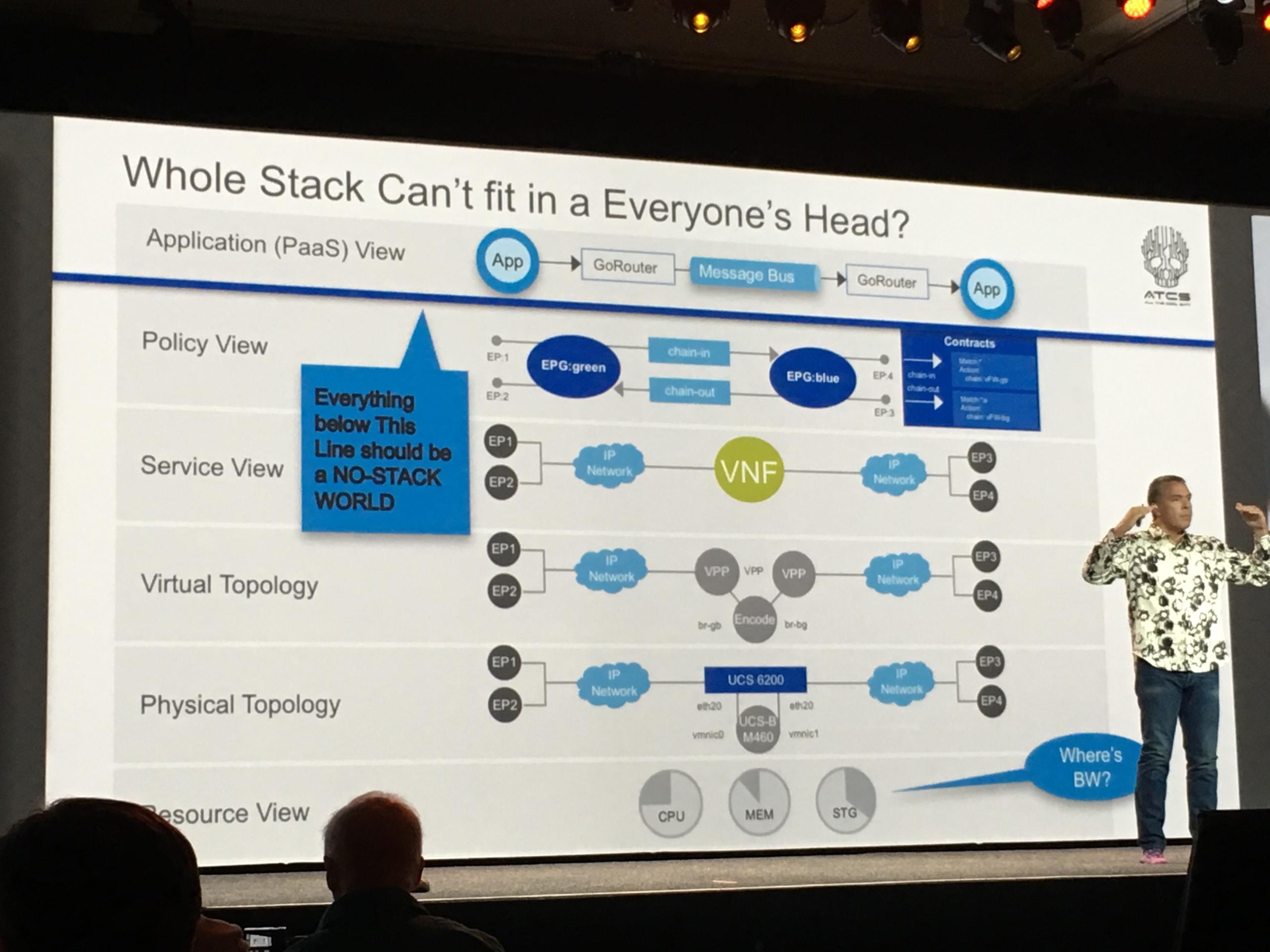 about how this new approach to data center is breaking down the