Access to reliable and secure Wi-Fi is no longer a luxury in the retail world; it’s a necessity. Whether you’re looking to add a network or simply upgrade an older one, Cisco’s Mobility Express Solution makes it easy to provide customers with Wi-Fi, add security cameras and even introduce wireless POS terminals to expedite checkouts. And when you add Cisco Connected Mobile Experiences to your deployment, you can capture presence analytics and engage with your customer through the wi-fi network.
Overloaded networks stop shopping, security and inventory checks in their tracks.
As we explored in my previous blog, today’s rampant pace of innovation can be likened to a Digital Vortex, where ideas, technologies, and even entire industries are swept to the center of the Vortex — recombining and merging into disruptive new business models.
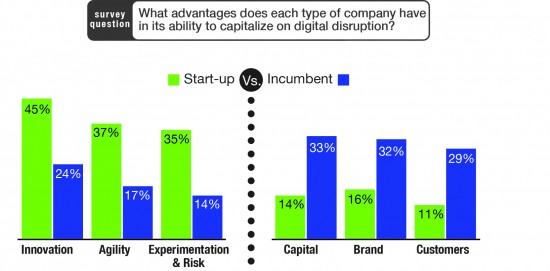
In such an environment, digital business transformation is critical — and demands decisive top-down leadership. Nevertheless, as our Digital Vortex research revealed, 45 percent of companies don’t consider digital disruption a board-level concern.
That represents a dangerous level of complacency, especially for market incumbents. We all know the names of seemingly immune incumbents that rested easy as innovative disruptors combined technologies into new business models — challenging and disrupting them from seemingly out of nowhere. Those disruptors were innovative, agile, and, of course, digital (see chart below from our Digital Vortex research).
Source: Global Center for Digital Business Transformation, 2015
While I was thinking about the topic of my second post in the court series leading up to the CTC conference in September, I came across an interesting news article. The state of California just announced that it will now provide court interpreters for free in all court cases. In the past, the state – along with many others – has only provided interpretation services in criminal cases. However, ensuring that everyone understands what is going on in the courtroom, no matter the case, is critical to making sure justice is dispensed fairly, efficiently and accurately. This means that court interpretation services are a crucial part of the justice system.
While this move by California is great, it is a bit behind the times. Back in 2010, the Department of Justice issued guidance on the issue of interpreters within the judicial system, noting that a particular concern was, “limiting the types of proceedings for which qualified interpreter services are provided by the court.” The letter went on to state: “Some courts only provide competent interpreter assistance in limited categories of cases, such as in criminal, termination of parental rights, or domestic violence proceedings. DOJ, however, views access to all court proceedings as critical.” This means that all states have had five years to expand their court translation services to cover all types of cases, in accordance with the Department of Justice’s standards.
However, states have been slow to take on this expansion, largely due to the high costs. California, for example, has the nation’s largest court system, spread out across a huge state. They also have about seven million residents with limited English proficiency, who speak over 200 different languages. The cost to provide translators in those locations for these residents is huge; in 2010, California spent nearly $93 million on court interpretation services. So in order to reconcile the challenge of fixed budgets with the increased demand for interpreters, state and local governments need to rethink their manual processes for deploying these services and look toward technology instead.
One major way to reduce the cost of providing interpreters and ensure that all citizens participate in a fair and balanced judicial process is using video services. To address the rising demand for interpreters and to help streamline court procedures, Cisco has developed a Connected Justice™ Video Interpretation solution (CJVI). CJVI allows interpreters to virtually join court proceedings using the high-quality video and audio features of Cisco® Unified Communications Manager and Cisco TelePresence® end-points. Continue reading “Video Interpretation Solutions Help Ensure Equality in the Justice System”
You need to purchase new software on behalf of your company – how do you decide which product/company to choose? You probably go and check out some vendor websites and ask the opinion of people you know and trust, but would you ask a vendor’s employees what they think about their company?
Fact is that employees’ social posts generate 8X more engagement than posts from their employer. Wow! This has the potential to radically alter the marketing landscape by changing the way we discover and buy goods and services.
What is employee advocacy?
As traditional marketing practises like advertising lose effect in this noisy, ‘always-on’ world, new methods – like employee advocacy – are stepping in to take to take their place (for more on this topic see my blog, “Inbound Marketing: What Comes After the Tipping Point?”).
Employee advocacy is empowering a company’s employees to support the goals of the brand using company content cascaded via employee-owned social channels. Said another way: it’s word-of-mouth marketing for the digital age. Through employee advocacy we can increase share of voice by encouraging employees across the company to be more active on social media.
Why is it good for marketing?
Giving employees a voice on social media accomplishes two key goals for marketers:
1. Brand awareness/reach
According to Dynamic Signal, with employee advocacy, “You can increase brand awareness by 14x. Your employees are already on social all the time. The average social employee has 10x more followers than your corporate network and 90% of their social audience is new to the brand.”
This is significant because increased brand awareness drives customer loyalty, which drives revenue.
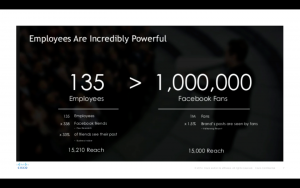
In fact, having 135 employee advocates is more powerful than having 1,000,000 Facebook fans. Why? As the graphic below demonstrates, employees’ social networks amplify reach in a big way.
2. Trust
Now more than ever, people want to buy from people, not faceless companies. In fact, according to WeRSM, only 15% of people trust recommendations from brands, while a whopping 84% of people trust recommendations from people they know.
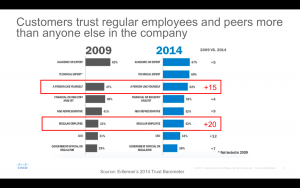
This stat is backed by compelling research from the 2014 Edleman’s Trust Barometer. As the chart below indicates, not only do customers trust their peers and regular company employees, their trust in these sources is on a dramatic rise.
Why is it good for business?
Employee advocacy programs have the power to deliver results beyond marketing value and can have a huge impact on the business.
Social selling: According to a recent Social Media and Sales Quota Survey, more than 40% of salespeople say they have closed between two and five deals as a result of social media.
Customer insight: In the Globe and Mail, Peter Aceto, the CEO of Tangerine Bank, says, “I would rather engage in a Twitter conversation with a single customer than see our company attempt to attract the attention of millions in a coveted Superbowl commercial.”
His sentiments are echoed in a Harvard Business article, “The 7 attributes of CEOs who get social media,” which explains that savvy CEOs “don’t want to hear input from customers filtered through 13 layers of management. They want their input raw and without any manipulation.”
Attracting talent: Enabling your employees to post about job openings and talk about why they like their job is an incredible competitive advantage. A Fast Company article, “How to Make Your ‘Employer Brand’ Shine and Attract The Best Tech Talent,” mentions this success story from Apple: “Apple, coming in at number three on the employer brand index, features photos and quotes from current employees on its job website. In other words, the company has effectively turned its employees into brand advocates.”
Marketing Engine of the Future?
Employee advocacy is a new source of trust for today’s consumer. It has the power to fuel brand awareness, increase customer loyalty, and drive new revenue. So is it a Marketing Engine of the future? As “word of mouth” marketing for the digital age, I think the answer is YES! Do you agree?
Ecosystem partners are an important adjunct to Cisco Connected Mobile Experience (CMX). They augment the analytic and customer engagement capabilities of the solution with innovative business outcomes. This blog is one in a series that will highlight several of our CMX Ecosystem Partners. Today—Intelligent InSites.
Intelligent InSites provides products and services that enhance the interoperability of healthcare IT systems, empowering staff with the right information at the right moment. By applying logic and location to clinical equipment, patients, and staff, the healthcare system can improve workflow and maximize patient satisfaction by optimizing equipment usage and staffing. Intelligent InSites drives value to healthcare systems by offering three primary products:
Locate: By providing real-time visibility into the current location of mobile medical equipment and staff, Locate enables caregivers to spend less time searching and more time delivering care.
Asset Optimization: By delivering insights into the utilization of assets, Asset Optimization enables healthcare organization to better use what they have and avoid unnecessary purchases or rentals.
Guest blog By Christelle Gental, SP Video Marketing Solutions Manager
So here we are, back in Amsterdam for IBC 2015. The first busy day was concluded with the prestigious CSI awards, a ceremony which was launched by the Cable and Satellite International team back in 2003. The idea behind it is to recognise and reward industry top technologies in cable, satellite, IPTV, telco , OTT and mobile TV. The program has now grown to 19 categories and this year, Cisco was proud to be short listed for 4 of these: Continue reading “Two are Better than One – cBR-8 and Connected Life Won CSI Awards”
I am a snowboard guy. The adrenaline rush of fast, frozen snow is my idea of a good time. So, why am I headed to blistering hot #SpiceWorld2015 in Austin at the tail end of summer? It’s simple. I want to demo our fast and furious Mobility Express solution to more than 1000 SpiceHeads from the IT networking #Spiceworks community. As Product Manager, I am extremely proud to work on improving the way small organizations install and use their wireless networks and I look forward to talking with IT managers in the trenches. That’s another one of my interests, World World II documentaries.
When it comes to encouraging more students to enter the fields that make up STEM –Science, Technology, Engineering and Math – American faces twin crises. First, how do we meet the looming 1.8 million shortfall in the number of workers who have the technical skills necessary for the jobs of tomorrow? And second, how do we ensure that more women and girls go into these fields?
The good news is that there are some true leaders committed to solving this problem. Among them, Cisco’s own Liz Centoni, Vice President, Engineering Strategy & Portfolio Planning and Chief of Staff for Chief Development Officer. Liz sits in the part of Cisco that innovates and develops our new technologies, products and solutions, the core of Cisco’s engineering team. Liz is an active mentor and supports under-represented minorities. At Cisco, she launched a “Women in Engineering Leadership” forum, and is the Global Executive Sponsor for Cisco’s Women in Science and Engineering (WISE), a recipient of the YWCA (Silicon Valley) 2015 TWIN Award, and CloudNOW’s “Top 10 Women in Cloud-2015.”
That’s why this week Liz will be honored by one of our nation’s most notable organizations that is trying to make mentoring a national priority – Million Women Mentors.
The Million Women Mentors organization is dedicated to advancing the education of girls and women in STEM. Today, Million Women Mentors is meeting at the National Press Club for an annual summit and gala. Cisco is proud to be both a sponsor and participant. www.millionwomenmentors.org
Cisco believes passionately in STEM mentoring as a tool that can help advance diversity in the STEM fields, a cause we wholeheartedly support. We are especially honored to be among the group – public and private – scheduled to receive awards tonight. We have committed to the US2020 pledge – that 20 percent of our workforce will mentor students in STEM annually by 2020. We have also significant programs in place to train students to meet the needs of the 21st century economy, as well as to increase the number of students of all backgrounds to go into STEM.
We’re proud to share the stage with other corporate leaders and elected officials, including Senators Debbie Stabenow (D-MI), Jeanne Shaheen (D-NH), and Kirsten Gillibrand (D-NY).
As Patrice D’Eramo, Cisco’s vice president of America’s Field Marketing and a one of the Vice Chairs of the MWM told me: “Each of us has an obligation to extend a hand mentoring the next generation of leaders,” she said. “We want to open the door of opportunity to all students – and especially girls and young women– to be aware of STEM careers and to be excited by the possibilities that are out there. My career in tech is living proof what happens when you are mentored, in STEM, at a young age.”
I could not agree more.
Congratulations to Liz, other awardees, and the Million Women Mentor’s organization on this day of celebration. The work they do truly makes a difference.
New CEO Chuck Robbins issued a challenge (one of many) when he stepped into his new role this past summer.
“I want Cisco to be viewed as having the most innovative employee experience in technology or in corporate America,” says Robbins.
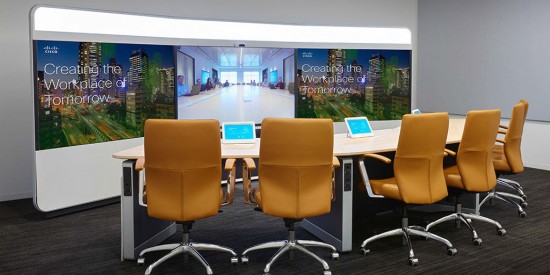
Cisco is just getting started, but we’re excited to have some of the most innovative employee experiences around the globe. The new Building 10 headquarters in San Jose, CA joins other offices such as those in Japan and India as case studies for the future of work and workspaces. Read all about the building’s futuristic makeover on Cisco’s Newsroom site.
It’s got the Cisco employees that work in that building (and the ones who visit regularly) excited about what’s next.
“Cisco’s investment in our work space is incredible!” says Rachael Thomas, an executive communications manager. “It provides space for us to work as a team, quiet rooms for focus time and meeting rooms with ceiling to floor writing spaces — great for brainstorming new ideas and mapping out the future of Cisco. The open feel of the office makes it easy to connect across levels and business areas; interacting with executives, customers and partners throughout the course of the day helps us stay aligned to what’s really important.”
“Building 10 is bustling with energy,” adds Justin Riray, an executive communications specialist. “Work is very fast-paced up here so people are constantly moving from their desk to a room to another room to another floor – it’s never boring. We have a lot of mini-celebrations for birthdays, promotions, baby showers and other things. Plus, I get to drive the iRobot Ava500 so there’s an extra bonus.”
Communications Manager Jung Kim can’t agree more.
“I love my new workspace and actually look forward to coming into the office everyday! It’s way more open and gives us the space to collaborate, be creative, and innovate in new ways.”
As Cisco tries out new ways to use collaboration technologies to enhance employee experiences, there could be much more of this kind of workplace innovation in the future.











 Guest blog By Christelle Gental, SP Video Marketing Solutions Manager
 I am a snowboard guy. The adrenaline rush of fast, frozen snow is my idea of a good time. So, why am I headed to blistering hot #SpiceWorld2015 in Austin at the tail end of summer? It’s simple. I want to demo our fast and furious Mobility Express solution to more than 1000 SpiceHeads from the IT networking #Spiceworks community. As Product Manager, I am extremely proud to work on improving the way small organizations install and use their wireless networks and I look forward to talking with IT managers in the trenches. That’s another one of my interests, World World II documentaries.